28
ISSN: 1646-0499
Revista da Faculdade de Ciências da Saúde, nº 7, p. 28-41 (2010) Submetido: 31 Mai. 2010/Aceite: 26 Jul. 2010
DEVELOPMENT AND ANALYTICAL
CHARACTERIZATION OF OFLOXACIN
ION-SELECTIVE ELECTRODES
Renata Souto
AAssociate ProfessorCEBIMED, Faculty of Health Sciences University Fernando Pessoa, Porto, Portugal Researcher
Center for Biotechnology and Fine Chemistry Portuguese Catholic University
Adriana Pimenta
Assistant ProfessorCEBIMED, Faculty of Health Sciences University Fernando Pessoa, Porto, Portugal Researcher
REQUIMTE, Faculty of Pharmacy University of Porto, Porto, Portugal
Fernanda Leal
Assistant ProfessorCEBIMED, Faculty of Health Sciences University Fernando Pessoa, Porto, Portugal Researcher
REQUIMTE, Faculty of Pharmacy University of Porto, Porto, Portugal
29
Rita Catarino
Assistant ProfessorCEBIMED, Faculty of Health Sciences University Fernando Pessoa, Porto, Portugal Researcher
REQUIMTE, Faculty of Pharmacy University of Porto, Porto, Portugal
Gory Santos
Master Student in Pharmacy Faculty of Health Sciences
University Fernando Pessoa, Porto, Portugal
Tânia Tavares
Master Student in Pharmacy Faculty of Health Sciences
University Fernando Pessoa, Porto, Portugal
ABSTRACT
An ofloxacin-selective electrode based on incorporation of a ofloxacin-tetrakis[3,5-bis(trifluoromethyl)phenyl]borate ion-pair complex in a poly(vinyl chloride) membrane was developed. The sensor displayed a Nernstian response over a wide concentration range (7×10⁻⁶–1×10⁻² mol L-1) with a slope of 54.9 ± 1.3 mV per decade of concentration, a detec-tion limit of 4×10⁻⁶ mol L-1 and adequateselectivity toward some inorganic and organic spe-cies. The sensor can be used for a period of more than 8 months without significant change in its characteristics.
KEYWORDS
Fluoroquinolones, ofloxacin, ion-selective electrodes, potentiometry, ion-pair sensor, PVC membrane.
RESUMO
concen-30
trações (7×10⁻⁶–1×10⁻² mol L-1), com um declive de 54,9±1,3 mV por década de concen-tração, um limite de detecção de 4×10⁻⁶ mol L-1 e adequada selectividade relativamente a algumas espécies orgânicas e inorgânicas. O seu tempo de vida é superior a oito meses, não havendo alteração das suas características durante este período.PALAVRAS-CHAVE
Fluoroquinolonas, ofloxacina, eléctrodos selectivos de ião, potenciometria, sensor par-ióni-co, membrana de PVC.
1.
INTRODUCTION
Ofloxacin (OFLX) [(±)-9-fluoro-2,3-dihydro-3-methyl-10-(4-methyl-1-piperazinyl)-7-oxo-7H--pyrido[1,2,3-de]-1,4-benzoxacine-6-carboxylic acid] (Fig.1) is a synthetic antimicrobial agent belonging to the class of fluoroquinolones. It exhibits broad-spectrum activity against Gram-positive and Gram-negative organisms and presents few adverse effects. The bacteri-cidal action of OFLX results from its interference with enzyme DNA gyrase and topoisomera-se IV, needed for the synthesis of bacterial DNA. OFLX is utopoisomera-sed in both human and veterinary medicine for the treatment of a wide variety of diseases, namely urinary, respiratory and gastrointestinal tract infection (Goodman et al.; Andreu et al.). It has two optical isomers: levofloxacin (LVFX), the (-)-(S)-enantiomer (which is the more active isomer), and dextro-floxacin, the (+)-(R)-OFLX (Fujimoto and Mitsuhashi). Currently, the drug is marketed by a variety of brand names as well as generic drug equivalents as a racemic mixture (consisting of equal amounts of the enantiomers) or only as S-isomer.
FIGURE 1 - Chemical structure of ofloxacin enantiomers. (a) R-enantiomer; (b) S-enantiomer or levofloxacin.
per-31
formance liquid chromatography (HPLC) (Espinosa-Mansilla et al. “Determination of fluoro-quinolones in urine”; Ballesteros et al. “Determination of Fluorofluoro-quinolones”; Tuerk et al.) and capilary electrophoresis (CE) (Sun et al.; Takashi et al.) for this purpose. However, in spite of their high selectivity and sensitivities, these methodologies have several drawbacks namely the fact of being expensive, complex, time-consuming, often requiring preliminary treat-ment of samples and involving the use of large amounts of reagents and organic solvents. Alternative procedures using spectrophotometric (Ashour et al; Espinosa-Mansilla et al. “De-terminations of fluoroquinolones and nonsteroidal”), fluorimetric (Muñoz de la Peña et al.; Ballesteros et al. “Determination of the antibacterial”), chemiluminesce (Francis and Adcock; B. Li et al.; Aly et al.) and voltammetric methodologies (Ni et al.; Zhou and Pan; Tamer) have also been reported. Yet these procedures use expensive equipment, often have inadequate selectivity, and require extensive sample pretreatment, or even complex treatment of the analytical results, making them inadequate for routine sample analysis.
In recent decades potentiometric membrane ion-selective electrode (ISEs) have been widely used in several fields of modern analytical chemistry (Frant). The simple design, low cost, rela-tively short response times, wide linear dynamic range (making sample concentration adjust-ments, to fit analyte concentration to the linear working range usually unnecessary), adequate selectivity, feasibility to analyse turbid and coloured samples and the low sample treatment (usually only an ionic strength adjustment step is required) are some of intrinsic advantages of potentiometric measurements that justify why these units have been the aim of several resear-ches (García et al.). These sensors systems enable the development of an electrical potential at the surface of an electrode membrane when placed in contact with a solution containing the analyte. The extent of this potential change is related with the activity of the target species. Des-pite the progresses in the design of highly selective electrodes for many ions - over 60 synthetic receptors (ionophores) that selectively bind to the target analytes have been reported (Bakker et al.) - no record of the development of selective and sensitive sensor to OFLX was found.
The aim of this work was to develop a new simple potentiometric PVC-membrane sensor without inner reference solution for the simple, sensitive, rapid and reliable determination of OFLX in seve-ral matrices. The membrane used consisted of liquid–plasticizer PVC and was based on lipophilic ofloxacin-tetrakis[3,5-bis(trifluoromethyl)phenyl] borate ion pair complex as ion exchanger.
2.
EXPERIMENTAL
2.1.
REAGENTS AND SOLUTIONS
All solutions were prepared with analytical reagent grade chemicals (without any additional purification) and deionised water with a specific conductance lower than 0.1 µS cm-1.
32
A 0.1 mol L-1 NaH2PO4/H3PO4 buffer solution (pH = 2.5; 0.1 mol L
-1) was used to enable
simul-taneous pH and ionic strength adjustments.
Standard 1×10⁻² mol L-1 OFLX (Sigma O8757) or LVFX (Fluka 28266) stock solutions were prepared daily by precise weighing of the solid and dilution in the buffer solution. To prepare the working standards, obtained by rigorous dilution of the stock solutions, glass pipettes of different volumes and Gilson micropipettes (models P100, P200, P1000 and P5000, with maximum capacities of 100, 200, 1000 and 5000 µL, respectively) were used.
All ion inorganic interferent standard solutions were prepared of the analytical grade chlo-ride salts.
2.2.
MEMBRANE PREPARATION AND SENSOR CONSTRUCTION
Polymeric membranes were prepared by dissolution of 0.06-0.12 g of the sensor (ionophore and the additive) in 0.36 g of the appropriate solvent. When necessary, an ultrasonic bath was used to promote complete dissolution of the sensor. Powdered PVC (0.16 g) and 6 mL of tetrahydrofuran were subsequently added. The mixture was shaken until full dissolution and then used for the preparation of the electrodes. The membrane solutions were then added dropwise on the conductor support, made up of a mixture of epoxi resin (Araldite) with graphite powder constructed following the methodology previously described (Lima et al.). After tetrahydrofuran evaporation, the operation was repeated several times to guar-antee the formation of a 1 mm thick membrane coating as uniform as possible. Once the application of the sensor membrane was completed the electrode was left to dry at room temperature (at least 10 h). Prior to use, the electrodes were conditioned in a 1×10⁻³ mol L-1 OFLX solution until a potential drift lower than 0.1 mV min-1 was achieved (approximately 30 minutes). When not in use, the electrodes were stored dry in contact with air.
2.3.
APPARATUS AND MEASUREMENTS
A Crison micropH, model 2002 voltmeter (±0.1 mV sensitivity), was used to measure the potential differences between an Orion (model 900200) double-junction Ag/AgCl reference electrode and the proposed indicator electrodes. The outer compartment of the referen-ce electrode was filled with the buffer solution. pH measurements were performed with a WTW model SenTix 41 glass electrode.
To establish general analytical performance characteristics of the sensor systems, OFLX-se-lective and reference electrodes were immersed in phosphate buffer solution and adequate small volumes of a standard OFLX solution were added, while stirring, to cover the concen-tration range from 10−7 to 10-2 mol L-1.
3.
RESULTS AND DISCUSSION
3.1.
DEVELOPMENT AND OPTIMIZATION OF THE SENSING MEMBRANES
33
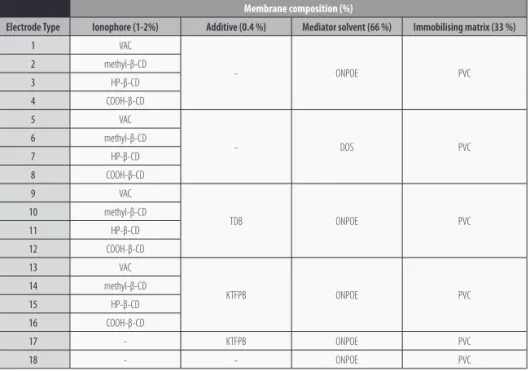
Cyclodextrins (CDs) are a family of cyclical oligosaccharides, with torus-like form, that allows the inclusion of several organic compounds of adequate size and polarity in a “host-guest” type of structure. This property makes these receptors an interesting class of species to be studied as electrochemical sensors for wide range of alkyl and arylammonium ions (Pires et al.). Additionally, some authors have reported the use of CDs and vancomycin (VAC) as chiral selectors in chromatographic systems for HPLC and CE enantioselective determination of OFLX (Elbashir et al.; Sun et al.; Takashi et al.). Taking these into account, the first trial was to develop selective electrodes to OFLX using three functionalized lipophilic CDs (methyl-β-CD, HP-β-CD and COOH-β-CD) and VAC as sensor ionophores. Two different plasticizers (with very different dielectric constants) as mediator solvents (ONPOE and DOS) were also tested. PVC was used as a support matrix. Membrane composition (% w/w) of the several types of OFLX-selective electrodes tested is presented in Table 1.
Membrane composition (%)
Electrode Type Ionophore (1-2%) Additive (0.4 %) Mediator solvent (66 %) Immobilising matrix (33 %)
1 VAC
- ONPOE PVC
2 methyl-β-CD 3 HP-β-CD 4 COOH-β-CD
5 VAC
- DOS PVC
6 methyl-β-CD 7 HP-β-CD 8 COOH-β-CD
9 VAC
TDB ONPOE PVC
10 methyl-β-CD 11 HP-β-CD 12 COOH-β-CD
13 VAC
KTFPB ONPOE PVC
14 methyl-β-CD 15 HP-β-CD 16 COOH-β-CD
17 - KTFPB ONPOE PVC
18 - - ONPOE PVC
TABLE 1 - Membrane composition (% w/w) of the several types of ion-selective electrodes.
34
FIGURE 2 - Analytical data for electrodes Types 1-8.
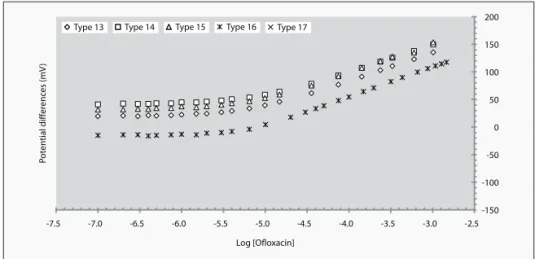
Several authors reported that the addition of low percentage of lipophilic species as an additive can contribute to a decrease of the membrane resistance and a subsequent impro-vement in the slope and selectivity of the ISEs (Bates et al.). The inclusion of a small amount of KTFPB or TDB, as fixed ionic site additives, was then tested. No reaction to OFLX was sho-wn by the units with TDB (type 9-12). However, regardless of the ionophore used, all elec-trodes containing KTFPB (types 13-16) exhibited regular potentiometric behaviour to OFLX (Figure 3) with well defined zones in the analytical curve and similar analytical performance characteristics (with near Nernstian slopes, comparable detection limits and analogous pH operational range).
FIGURE 3 - Analytical features for electrodes Types 13-17.
35
Ofloxacin is an organic amine positively charged under a relatively wide pH range. It can react with the anionic tetraphenylborate group present in the additive to form lipophilic water-insoluble ion-pair complexes (Bakker and Pretsch). The potentiometric activity of electrodes with KTFPB could therefore be attributed to an ion exchange mechanism. This ion-pair would be obtained in situ, after soaking the PVC membranes containing KTFPB in 1×10⁻³ mol L-1 OFLX solution for electrode conditioning prior to its use.
The response of blank membranes, containing only mediator solvent ONPOE and PVC (elec-trodes 18) was also studied. No answer was obtained with blank PVC elec(elec-trodes.
As there was no improvement in the analytical characteristics of the electrochemical devices including either CDs or VAC, KTFPB electrodes (units 17) were selected to carry on the study.
3.2. GENERAL WORKING CHARACTEISTICS EVALUATION
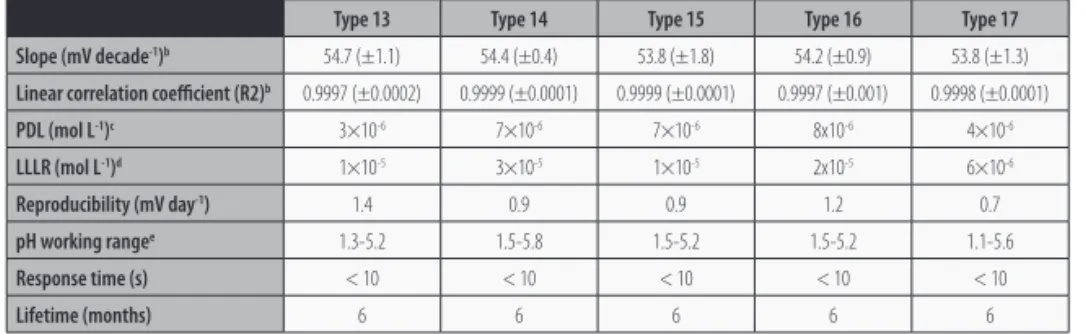
The general analytical features of the electrodes, namely the lower limit of linear response (LLLR) and practical detection limit (PDL), were established from calibration curves in the concentration interval from 1×10⁻⁷ to 1×10⁻² mol L−1 in solutions with adjusted pH and ionic strength (0.1 mol L−1 NaH
2PO4/H3PO4 buffer solution pH = 2.5), according to the recommend procedures (Buck and Lindner, 1994). Data obtained, from the evaluation of at least three units of each type (series 13 to 17), are presented in Table 2.
Type 13 Type 14 Type 15 Type 16 Type 17
Slope (mV decade-1)b 54.7 (±1.1) 54.4 (±0.4) 53.8 (±1.8) 54.2 (±0.9) 53.8 (±1.3) Linear correlation coefficient (R2)b 0.9997 (±0.0002) 0.9999 (±0.0001) 0.9999 (±0.0001) 0.9997 (±0.001) 0.9998 (±0.0001)
PDL (mol L-1)c 3×10⁻⁶ 7×10⁻⁶ 7×10⁻⁶ 8x10⁻⁶ 4×10⁻⁶
LLLR (mol L-1)d 1×10⁻⁵ 3×10⁻⁵ 1×10⁻⁵ 2x10⁻⁵ 6×10⁻⁶
Reproducibility (mV day-1) 1.4 0.9 0.9 1.2 0.7
pH working rangee 1.3-5.2 1.5-5.8 1.5-5.2 1.5-5.2 1.1-5.6
Response time (s) < 10 < 10 < 10 < 10 < 10
Lifetime (months) 6 6 6 6 6
TABLE 2 - Average values obtained for some analytical features of the OFLX-sensorsa.
[a] Data obtained with at least three units of each type of electrodes; pH and ionic strength adjusted with 0.1 mol L-1 NaH2PO4/H3PO4 buffer solution (pH = 2.5)
[b] Average value ± standard deviations of 20 determinations over a period of 6 months
[c] PLD – practical detection limit
[d] LLLR – lower limit of linear response
[e] Results corresponding to 5×10⁻³ and 5×10⁻⁴ mol L-1 and of OFLX solutions
36
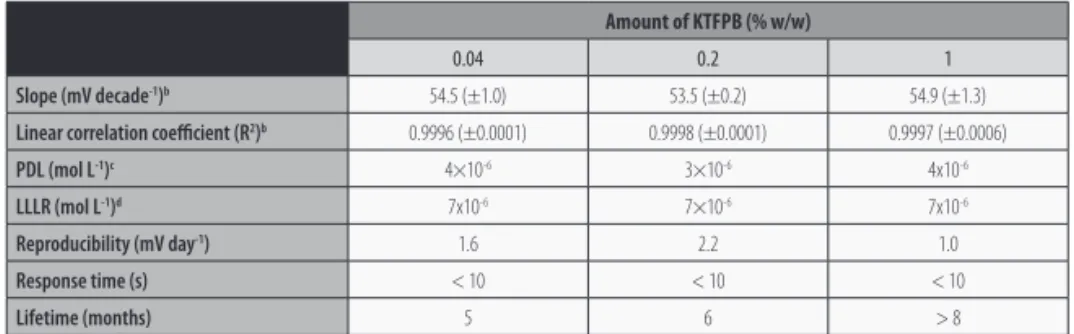
were the same. Yet, sensor systems having higher anionic additive concentration (1%)ex-hibited longer life time which could be attributed to the higher amount of ion-pair in its composition. These units were used throughout a period of more than 8 months without significant changes in their general working characteristics. KTFPB 1% electrodes displayed a wide range of linear response (7.1x10⁻⁶ to 1.0x10⁻² mol L−1), with a near Nernstian slope of 54.9 ± 1.3 mV per concentration decade and a limit of detection of 3.2×10⁻⁶ mol L−1.
Amount of KTFPB (% w/w)
0.04 0.2 1
Slope (mV decade-1)b 54.5 (±1.0) 53.5 (±0.2) 54.9 (±1.3)
Linear correlation coefficient (R2)b 0.9996 (±0.0001) 0.9998 (±0.0001) 0.9997 (±0.0006)
PDL (mol L-1)c 4×10⁻⁶ 3×10⁻⁶ 4x10⁻⁶
LLLR (mol L-1)d 7x10⁻⁶ 7×10⁻⁶ 7x10⁻⁶
Reproducibility (mV day-1) 1.6 2.2 1.0
Response time (s) < 10 < 10 < 10
Lifetime (months) 5 6 > 8
TABLE 3 - Some analytical features of the OFLX-KTFPB sensors with different KTFPB concentrationsa.
[a] Data obtained with at least three units of each type of electrodes; pH and ionic strength adjusted with 0.1 mol L-1 NaH2PO4/H3PO4 buffer solution (pH = 2.5)
[b] Average value ± standard deviations of 20 determinations over a electrode lifetime
[c] PLD – practical detection limit
[d] LLLR – lower limit of linear response
3.3.
RESPONSE TIME
The response time of the electrodes was assessed as the time elapsed from the beginning of the change in the electrode potential until it reached the steady-state value, when sub-jected to a sudden increase in OFLX concentration (at least twice of initial concentration) in the interval of linear response. A stable analytical signal was obtained in all units in less than 10 seconds (Tables 2 and 3). This fast response to OFLX concentration changes points to the possible use of these units in automatic flow systems.
3.4.
PRECISION
The precision of the analytical signals was determined throughout a working day, by repe-ated calibrations with standard solutions (concentrations lying within the linear response range of the electrode). A potential drift of up to 2 mV per day (RSDs of potentials lower than 5%) was found (Tables 2 and 3).
3.5.
INFLUENCE OF PH
The effect of pH in the electrode response was determined by adding small volumes of concentrated sulphuric acid or 50% (w/v) NaOH solutions to the test solution.
(Reil-37
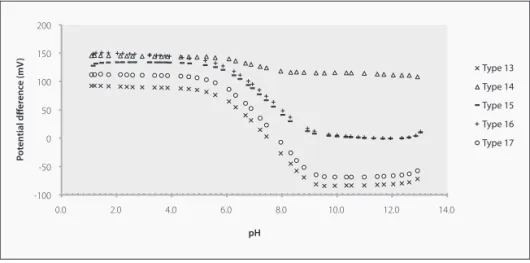
ley diagrams) showed a pH range between 1.2 to 5.6 where the potential remains nearly constant (potential differences lower than 5 mV). This interval was taken as the working pH range of the electrode. Results of typical profiles for a 5×10⁻⁴ OFLX solution, using electrodes with different sensor composition are shown in Figure 4. The same pattern of pH depen-dence was found, at both analyte concentrations, for other electrodes types (Table 2).
FIGURE 4 - pH operational range.
OFLX has zwitterionic properties by virtue of carboxyl group being deprotonated at basic pH values (pKa1=6.00) and its amino function in position 4 of the piperazine ring being posi-tively charged under acidic conditions (pKa2=8.00). So, at the pH interval mentioned above, the OFLX molecules are positively charged and can be sensed by anion-exchanger KTFPB present in the electrodes. For pH values higher than 6, deprotonation of the carboxyl group occurs. A severe decrease of the cationic form of OFLX occurs since the analyte molecules are mainly at the zwitterionic form. Having no net charge, OFLX has no ability to form ion--pair complex and therefore is no longer detected, that is, a marked decrease in the elec-trode response is observed. Considering this behaviour a 0.1 mol L-1 NaH
2PO4/H3PO4 buffer solution (pH = 2.5 and I = 0.1 mol L-1) was used throughout the rest of the work. This solution acted both as an ionic strength and pH adjuster.
3.6.
POTENTIOMETRIC SELECTIVITY COEFFICIENTS
A detailed study of the potentiometric selectivity coefficients ( ) toward some
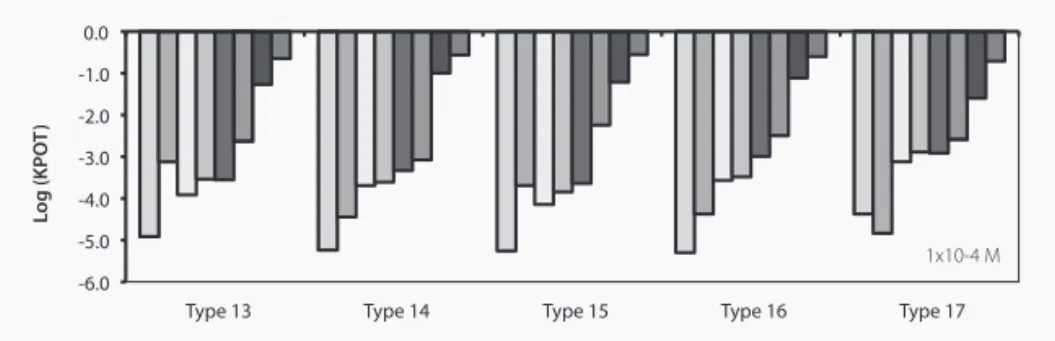
inorganic and organic species was carried out using the separate solutions method (SSM) at two levels of similar concentrations of primary and interfering ion (1.0×10⁻⁴ and 1×10⁻³ mol L−1), according to IUPAC guidelines (Umezawa et al.). Figure 5 presents selectivity coef-ficients obtained for main inorganic cations present in most matrices (Group I and II cations and ammonium ion) and two organic cations (phenylethylamine and epinephrine) having a chemical structure similar to that of the target specie tested. Data point out that all elec-trodes with KTFPB in their composition (types 13-17) present only a slight and similar
re-sponse to inorganic species assayed ( < 10-2). The selectivity pattern for these
units follows the same sequence: Mg2+ < Ca2+ < Li+ < Na+ < NH 4
+ < K+ < phenylethylamine <
38
the membranes. The high selectivity toward inorganic ions was attributed to differences inionic size with consequences in terms of mobility and permeability. Regarding organic mol-ecules the lower selectivity is mainly due to the similarity in polarity and to the moderately hydrophobic nature of these molecules relative to OFLX cation.
FIGURE 5 - Selectivity coefficients for the OFLX ion selective membrane electrodes.
4.
CONCLUSIONS
The developed OFLX ion-selective electrode, based on ofloxacin-tetrakis [3,5-bis (trifluoro-methyl) phenyl] borate ion-pair immobilized in a PVC-matrix membrane, allows determina-tions over a wide linear response range with the same sensitivity and without the need for complex sample manipulations. The electrode can be used over a broad pH interval and exhibits long lifetime and good selectivity. Additionally, it should be stated that these easily built PVC matrix membrane electrodes allow simple replacement of an exhausted membra-ne or change of function with a membra-new sensor system.
As mentioned, the procedure avoids the usual pretreatment steps necessary for OFLX assays and presents some general advantages over common chromatographic and spectrophoto-metric procedures: it makes use of less sophisticated equipment (therefore being easier to operate and providing lower cost of analysis) and surpasses colour and turbidity problems associated with the suspensions and colloids. Additionally, unlike the potentiometric titra-tion proposed by the Official Pharmacopeia, the procedure exhibits adequate selectivity and sensivity, is much easier to perform and less time-consuming.
39
REFERENCES
Aly, Fatma A., Salma A. Al-Tamimi, and Abdulrahman A. Alwarthan. “Chemiluminescence Determination of some Fluoroquinolone Derivatives in Pharmaceutical Formulations and Biological Fluids Using [Ru(bipy)32+]-Ce(IV) System.” Talanta 53.4 (2001): 885-93.
Andreu, Vicente, Cristina Blasco, and Yolanda Picó. “Analytical Strategies to Determine Quino-“Analytical Strategies to Determine Quino-lone Residues in Food and the Environment.” Trends in Analytical Chemistry 26.6 (2007): 534-56.
Ashour, Safwan, and Raghad Al-Khalil. “Simple Extractive Colorimetric Determination of
Le-vofloxacin by acid-Dye Complexation Methods in Pharmaceutical Preparations.” Il Farmaco
60.9 (2005): 771-75.
Bakker, Eric, Philippe Buhlmann, and Erno Pretsch. “Carrier-Based Ion-Selective Electrodes and Bulk Optodes. 1. General Characteristics.” Chemical Reviews 97.8 (1997): 3083-132.
Bakker, Eric, and Ernö Pretsch. “Lipophilicity of Tetraphenylborate Derivatives as Anionic Sites in Neutral Carrier-Based Solvent Polymeric Membranes and lifetime Of Corresponding Ion-Selective Electrochemical and optical Sensors.” Analytica Chimica Acta 309.1-3 (1995): 7-17.
Ballesteros, Oscar, et al. “Determination of Fluoroquinolones in Human Urine by Liquid Chro-matography Coupled to Pneumatically Assisted Electrospray Ionization Mass Spectrometry.”
Journal of Chromatography B 798.1 (2003): 137-44.
Ballesteros, Oscar, José L. Vílchez, and Alberto Navalón. “Determination of the Antibacterial Ofloxacin in Human Urine and Serum Samples by Solid-Phase Spectrofluorimetry.” Journal of
Pharmaceutical and Biomedical Analysis 30.4 (2002): 1103-10.
Bates, Paul S., Ritu Kataky, and David Parker. “Functionalized Cyclodextrins as Potentiometric Sensors for Onium Ions.” The Analyst 119.2 (1994): 181-86.
Buck, R. P., and E. Lindner. “Recommendations For Nomenclature of Ionselective Electrodes (IUPAC Recommendations 1994).” Pure and Applied Chemistry 66.12 (1994): 2527-36.
Elbashir, Abdalla A., et al. “Determination of Ofl oxacin Enantiomers in Pharmaceutical For-“Determination of Ofloxacin Enantiomers in Pharmaceutical For-mulations by Capillary Electrophoresis.” Journal of Liquid Chromatography & Related Technolo-gies 31.3 (2008): 348-60.
Espinosa-Mansilla, A., et al. “Determination of Fluoroquinolones in Urine and Serum by Using High Performance Liquid Chromatography and Multiemission Scan Fluorimetric Detection.”
Talanta 68.4 (2006): 1215-21.
Espinosa-Mansilla, A., et al. “Determinations of Fluoroquinolones and Nonsteroidal Anti-Inflammatory Drugs in Urine by Extractive Spectrophotometry and Photoinduced Spectro-fluorimetry Using Multivariate Calibration.” Analytical Biochemistry 347.2 (2005): 275-86.
40
Frant, Martin S. “Historical Perspective. History of the Early Commercialization ofIon-Selec-tive Electrodes.” The Analyst 119.11 (1994): 2293-301.
Fujimoto, T., and S. Mitsuhashi. “In Vitro Antibacterial Activity of DR-3355, the S-(-)-isomer of Ofloxacin.” Chemotherapy 36.4 (1990): 268-76.
García, M. S., et al. “Application of a Trazodone-Selective Electrode to Pharmaceutical Qual-“Application of a Trazodone-Selective Electrode to Pharmaceutical Qual-ity Control and Urine Analyses.” Analytical and Bioanalytical Chemistry 394.6 (2009): 1563-67.
Goodman, Louis S., et al. Goodman and Gilman’s the Pharmacological Basis of Therapeutics. s.l.: McGraw-Hill, 2006.
Li, Baoxin, et al. “Chemiluminescence Flow-Through Sensor for Ofloxacin Using Solid-Phase PbO2 as an Oxidant.” Talanta 57.4 (2002): 765-71.
Lima, José L., M. Conceição B. Montenegro, and A. M. Roque da Silva. “A Phenobarbital Ion-Selective Electrode without an Inner Reference Solution, and Its Application to Pharmaceuti-cal Analysis.” Journal of Pharmaceutical and Biomedical Analysis 8.8-12 (1990): 701-04.
Muñoz de la Peña, Arsenio, et al. “Interference-Free Analysis Using Three-Way Fluorescence Data and the Parallel Factor Model. Determination of Fluoroquinolone Antibiotics in Human Serum.” Analytical Chemistry 75.11 (2003): 2640-46.
Ni, Yongnian, Yuerong Wang, and Serge Kokot. “Simultaneous Determination of Three
Fluo-roquinolones by Linear Sweep Stripping Voltammetry with the Aid of Chemometrics.”
Ta-lanta 69.1 (2006): 216-25.
Pires, Ana Rita, et al. “New Ionophores for Vitamin B1 and Vitamin B6 Potentiometric Sensors for Multivitaminic Control.” Journal of Pharmaceutical and Biomedical Analysis 46.4 (2008): 683-91.
Sun, Hongyuan, et al. “New Cyclodextrin Derivative 6-O-(2-hydroxyl-3-betainylpropyl)-β-cyclodextrin: Preparation and its Application for Enantiomer Separation of Drugs by Capillary Electrophoresis.” Journal of Inclusion Phenomena and Macrocyclic Chemistry 65.3-4 (2009): 427-30.
Takashi Arai, Noriyuki Nimura, and Toshio Kinoshita. “Investigation of Enantioselective Sepa-ration of quinolonecarboxylic Acids by Capillary Zone Electrophoresis Using Vancomycin as a Chiral Selector.” Journal of Chromatography A 736.1-2 (1996): 303-11.
Tamer, Ayla. “Adsorptive Stripping Voltammetric Determination of Ofloxacin.” Analytica
Chi-mica Acta 231 (1990): 129-31.
Tuerk, Jochen, et al. “Analysis of Antibiotics in Urine and Wipe Samples from Environmental and Biological Monitoring--Comparison of HPLC with UV-, Single MS- and Tandem MS-de-tection.” Journal of Chromatography B 831.1-2 (2006): 72-80.