PRODUCTION OF FUNGAL PROTEIN BY SOLID SUBSTRATE FERMENTATION OF CACTUS CEREUS PERUVIANUS AND OPUNTIA FICUS INDICA
Moises A. Oliveira
Departamento de Química, Universidade Estadual de Londrina, 86051-990, Campus Universitário Londrina - PR Claudenice Rodrigues, Edson Marques dos Reis and Jorge Nozaki*
Departamento de Química, Universidade Estadual de Maringá, 87020-900 Maringá - PR
Recebido em 4/1/00; aceito em 11/10/00
Agricultural wastes from cactus Cereus peruvianus and Opuntia ficus indica were investigated for protein production by solid substrate fermentation. Firstly, the polyelectrolytes were extracted and used in water cleaning as auxiliary of flocculation and coagulation. The remaining fibrous material and peels were used as substrate for fermentation with Aspergillus niger. Glucoamylase and cellulase were the main enzymes produced. Amino acids were determined by HPLC and protein by Lowry’s method. After 120 hours of fermentation the protein increased by 12.8%. Aspartic acid (1.27%), threonine (0.97%), glutamic acid (0.88%), valine (0.70%), serine (0.68%), arginine (0.82%), and phenylalanine (0.51%) were the principal amino acids produced.
Keywords: solid substrate fermentation; cactus; Aspergillus niger.
Artigo Quim. Nova, Vol. 24, No. 3, 307-310, 2001.
INTRODUCTION
In the northeast region of Brazil, where drought, hungry, and thirsty are the drawback for local development, plants that can grow under adverse climatic conditions are of fundamental importance1. Cereus peruvianus, a cactus native in Central and South America, although its low content of protein and vitamin, is used as animal and human food in the drought period2. Regardless of its shape, degree of elongation, or branching, the cactus stem is succulent and the cortex and often the pith, or both, are greatly enlarged as storage tissue. Some kinds of cactus as Cereus peruvianus reach the flowering stage in two or three years, and they may develop both flowers and fruits even on the stems still retaining juvenile characters. The survival of cactus in dry regions usually is associated with their ability to store water in the thick, succulent stems and to obtain this water through widely spreading, shallow root systems. Even when the soil is dry, the roots retain their capacity to absorb water the instant it becomes available2.
Protein production by solid substrate fermentation (SSF)3 using renewable sources received worldwide attention. This is an important way, in developed countries, of dietary changes for the partial substitution of animal protein with plant protein. Fermentation with Aspergillus niger, a filamentous fungi, have been studied for citric acid4, xylanolytic enzyme5,6, pectolytic enzyme7,8, β-glucosidase9,10, alpha and gluco-amylase11,12,13, and nucleic acid related substances productions14. The study of fungal growth in SSF shows advantages over submerged cultures, because this is a natural environment for filamentous fungi15.
Natural polyelectrolytes were used since 2000 B.C. where Strychno potatorium Linn extracted from seeds was used as water clarifier16. After the petroleum crisis in 1970-1980, the substitution of synthetic polyelectrolytes by natural products has increased tremendously, and several sources has been investigated. Floccotan, extracted from quebracho (Schinopsis lorentziu) and chemically modified is largely used as water clarifier in South America2. Opuntia ficus indica a cactus that grows naturally in South America, is also a source of
viscous natural polyelectrolytes bearing negative surface charges17. The flocculation process induced by anionic polyelectrolytes such as the natural polyelectrolytes extracted from Opuntia ficus indica is greatly facilitated by the presence of low concentration of a metal ion (Al3+) capable of binding with the functional groups on the polyelectrolytes. The positive metal ion serves to form a bridge among the anionic polyelectrolytes and negatively charged functional groups on the colloidal particle surface. Due to its hydrophilic character, several hydrogen bonds are formed among polyelectrolytes and water molecules. This association tends to occupy larger surface area causing its very high viscosity18. Natural polyelectrolytes have been used as auxiliary of flocculation and coagulation in wastewater treatment and water cleaning process19. Water, starch, cellulose, hemicellulose, pectins, lignins, and chlorophyll are the main constituents of cactus. After extraction of polyelectrolytes, the remaining solids residues of cactus are, peels, cellulose, hemicellulose, and starch that could be used as substrate for fermentation with filamentous fungi.
The main purpose of this paper was to make it feasible to use of cactus, after extraction of natural polyelectrolytes, for enzyme production. Wild strains of Aspergillus niger were used throughout this work, because of its high amylolytic and cellulolytic activities20,21, for converting cactus pulps directly to feedable microbial protein by semi-solid fermentation.
EXPERIMENTAL
Flocculation and coagulation studies
The preparation of natural polyelectrolytes was performed in the following way: the cactus Opuntia ficus indica or Cereus peruvianus was cut in small pieces (10 x 30 mm), and approximately 132 g of cactus pieces and 750 mL of tap water were transferred to a 2 L flask with stirring for 30 min. The extraction of viscous natural polyelectrolytes (soluble sugars) was performed by maceration. The natural polyelectrolytes was kept at 40C until use in wastewater treatment and water purification. A Jar Test (Milan-JT 101) with 6 x 1000 mL flasks was employed for floculation and coagulation studies19.
308 Oliveira et al. Quim. Nova
Substrate preparation after polyelectrolytes removal The solid residue left after removal of natural polyelectrolytes, constituted by external chlorophyll, starch, cellulose, and hemicellulose, was dried, exposing directly to the sun for 6 h., before using as substrate for solid substrate fermentation (SSF).
Filamentous fungi
Wild strains of Aspergillus niger were isolated from decomposed wood pulps at different locations, and screened on agar plates containing 100 g of dried cactus pulp,10 g (NH4)SO4, 5 g K2HPO4, 1.5 g MgSO4.7 H2O, pH 3.6, for 5 days. Cactus pulp was used as the only carbon source, and those black colonies that grew well under such environment, were isolated and retained for second screening. Those isolated organisms from the previous screening were cultured in flasks at 35oC, after autoclaving (110oC for 20 min.), at pH 3.0, containing 10 g of D-glucose and the same medium as the first screening.
Solid-state fermentation
Five grams of KH2PO4 (Merck), (NH4)2SO4 (Merck) (11.5 g), and urea (33.7 g) were added to a (30 x 30 cm) tray containing 100 g of dried cactus. After adjusting the moisture to 60-65% with tap water and pH 3.0 with diluted solution of sulfuric acid, 0.5 g of inoculum were transferred to its surface. Three more trays were prepared in the same way and put inside of a greenhouse at 350C. The first tray was on the botton surface, and the vertical distance among the first, second, third, and fourth trays were 15 cm respectively. The aeration was performed with an air compressor using a silicone tube (60 cm lenght and 5 mm i.d.) from the top of the greenhouse (Figure 1).
void volume V0 was determined from the elution of 0.4 % solution of Blue Dextran, reading the absorbance at 620 nm. The total volume Vt was determined with a 30 µLmL-1 acetone, reading the absorbance at 264 nm. Partition coefficient, designated kav, was calculated using a kit of standard proteins (Sigma-USA) (12300 – 78000 Da) with the following equation: kav = (Ve – V0)/(Vt – V0), where Ve was ellution volume and Vt the total volume. Plot of kav x logarithm of average molar mass was linear for an average molar mass (Daltons) of 16949 (myoglobin), 30000 (carbonic anhydrase), 42700 (ovalbumin), 66250 (albumin), and 78000 (ovotransferrin)22.
Protein and sugar determinations
Approximately 5 g of fermented moldy was soaked with 50 mL of phosphate buffer, pH 6.9, and stirred for 30 min. at 600C. The extract was collected by filtration23. The extraction process was repeated five times, all the extractants were transferred to a flask, and the final volume was made up to 100 mL with distilled water. The method of Lowry was employed for protein determination using bovine serum albumin as standard24. Reducing sugars were determined using dinitrosalicylic acid (DNS) method25, and starch was measured by polarimetric method26.
Sample preparation and starch determination by polarimetric method
Crushed sample (2.5 g) and 50 mL of 0.14 molL-1 HCl (Merck) were transferred to a 100 mL volumetric flask in a thermostatic bath at 50oC with shaking for 15 min. After cooling, clarifier solutions constituted by 10 mL of 1 molL-1 zinc acetate dihydrate (Aldrich) and 10 mL of 0.25 molL-1 potassium ferrocyanide trihydrate (Aldrich) were transferred to the flask, and the final volume was made up to 100 mL with distilled water. After one or two filtrations this solution was clear enough for polarimetric measurements. The sample solution was transferred to a 20 cm length polarimetric cell and the concentration of starch was determined using the following relationship:
[α]D(20) = observed rotation degree x 100
optical path lenght (dm) x concentration (g/100 mL)
and C = 100 x α/L x αD(20) D = sodium line (λ = 589.3 nm) L = optical path lenght (dm) C = starch concentration (g/100 mL) α = observed rotation (degree). The specific factor used for starch [α]D(20) was 84.8 (20oC)
Sample preparation and amino acids analysis by liquid chromatography (HPLC)
The hydrolysis of soluble protein was performed using a Teflon tube, with an internal volume of 75 mL, heating at 110oC for 36 h with 6 molL-1 HCl solution. The volume was reduced by evaporation and the pH adjusted to 5.0-5.5. Amino acids separations were performed by high performance liquid chromatography using HPLC-LDC-Analytical (Pickering Laboratories, Inc.) with a pump Consta Metric 3200, a UV-VIS detector Spectro Monitor 3200 (Altech) was used for HPLC analysis of amino acids. The separations were carried out using sodium cation exchange columns, temperature of 55oC, flow rate of 0.3 mLmin-1, and Ninhydrin solution for derivative reactions with amino acids. The eluents used were: Mobile phase A: buffer solution of 0.2 molL-1 sodium citrate, pH 3.25. Mobile phase B: buffer solution of 0.01 molL-1 sodium phosphate, pH 7.40. Post-column temperature of 1300C with absorbance reading at 570 nm.
Figure 1. Solid substrate fermentation of cactus in trays inside of thermostatic chamber at 35oC. The initial pH was adjusted to 3.0 and 60% of initial moisture. A nitrogen source was made of 11% ammonium and 2% urea (on a nitrogen basis), 5% potassium phosphate, and 3.2 g spore/100 g substrate.
Analytical methods
Vol. 24, No. 3 Production of Fungal Protein by Solid Substrate Fermentation 309
RESULTS AND DISCUSSION
Optimum pH range for better flocculation and settlement observed was 6.0-7.0 for wastewater of paper and pulp27 and tannery effluents19. According to the experiments, optimum conditions for flocculations and coagulations were: 30 sec. of strong shaking after addition of aluminun sulfate and natural polyelectrolytes, followed by 15 min. of sllow shaking, and then 30 min. for complete settlement. Optimum concentration range were: 250-300 mgL-1 of Al
2(SO4)3 and 0.6-0.8 mgL-1 of natural polyelectrolytes. BOD (85-90%), COD (70-75%), and colour (80-85%) were removed by flocculation and coagulation27.
Table 1 shows the average protein composition before and after 120 h of solid substrate fermentation of cactus. As shown in Table 1, the protein content of cactus pulps was very low before fermentation. Figure 2 shows the average composition of cactus Cereus peruvianus. The composition of cellulose, hemicellulose, chlorophyll, and lignin was variable and depended on cactus age, soil, time of collecting, etc..The average protein composition of cactus (powder) was about 0.85%. Without the chlorophyll extraction the average protein observed was 1.58% due to the presence of nitrogen in the chlorophyll moiety as determined by Kjeldhal method. The average soluble protein determination by Lowry’s method was 0.80%.
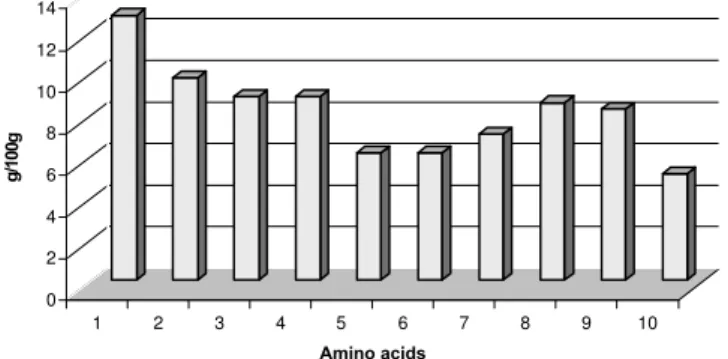
As shown in Figure 3, water is the main constituent of cactus and its depend on the cactus age, time of harvesting, and soil conditions.Very low protein concentrations were found in both cactus Cereus peruvianus and Opuntia ficus indica. Figure 4 shows the average (six determinations) amino acids production after solid substrate fermentation of cactus. The average (six determinations) of total protein production after 120 h of fermentation was 12.8%. Aspartic acid (1.27%), serine (0.88%), glutamic acid (0.88%), threonine (0.88%), glycine (0.61%), and phenylalanine (0.51%) were the principal amino acids produced. Figure 5 shows that the glucose consumption is closely proportional to protein production during solid substrate fermentation.
Table 1. Average soluble protein content of cactus pulp (powder) after extraction of natural polyelectrolytes (*).
Sample composition
g/100 (dry weight)
Cactus pulp (powder) after
extraction of chlorophyll (**) 0.85 ± 0.10
Without extraction of chlorophyll (α) 1.58 ± 0.15
Without extraction of chlorophyll (β) 0.80 ± 0.10
After solid substrate fermentation (γ) 12.80 ± 0.80
(*) Average of six determinations and standard deviations; (**) Chlorophyll extracted using acetone, and protein determination by Kjeldhal’s method (Cereus peruvianus), before fermentation; (α) Without chlorophyll extraction, and protein determination by Kjeldhal’s method (Cereus peruvianus), before fermentation; (β) Cactus without chlorophyll extraction, and soluble protein determination by Lowry’s method (Opuntia ficus indica), before fermentation; (γ) Soluble protein production (Lowry’s method) after 120 h of solid substrate fermentation.
0 20 40 60 80 100 120 140 160
%
x
1
0
0
1 2 3
Protein
Figure 2. Protein content (% x 100) of cactus after extraction of natural polyelectrolytes and before SSF.(1) Soluble protein content of Cereus peruvianus determined by Lowry’s method, after chlorophyll extraction, and before fermentation. (2) Total nitrogen (including protein) of C. peruvianus determined by Kjeldhal’s method, before fermentation.(3) Soluble protein content (Lowry’s method) of Opuntia ficus indica with chlorophyll extraction before fermentation.
1
2
3
4 0
10 20 30 40 50 60 70 80
C
o
m
p
o
s
iti
o
n
(%
)
Average composition
Figure 3. Average composition of cactus Cereus peruvianus and
Opuntia ficus indica, after extraction of natural polyelectrolytes. (1) Water content ~70%. (2) Starch ~8%. (3) Chlorophyll ~1%. (4) Protein < 1%. The initial average concentration of starch plus sugar were about 20% after extraction of natural polyelectrolytes.
0 2 4 6 8 10 12 14
g
/1
0
0
g
1 2 3 4 5 6 7 8 9 10
Amino acids
0 20
40 60
80 100 120 140
0 5 10 15 20
g
p
ro
te
in
/1
0
0
g
s
u
b
s
tr
a
te
Time of fermentation (hours)
Figure 4.Amino acids (% x 10) produced by SSF, and determined by HPLC, (n = 6, SD = ± 0.05%). (1) aspartic acid. (2) threonine. (3) serine. (4) glutamic acid. (5) glycine. (6) alanine. (7) leucine. (8) arginine. (9) valine. (10) phenylalanine. The other amino acids (methionine, tyrosine, histidine, cystine, etc.,) were found in the range of 0.20 – 0.40% each.
310 Oliveira et al. Quim. Nova
CONCLUSION
High efficiency of glucoamylase production, reduced energy requirement, low wastewater output, and low capital investment were the advantages of SSF with wild strain of Aspergillus niger using cactus as substrate. The extraction and application of natural polyelectrolytes in water purification was the princi-pal advantage of using the cactus Cereus peruvianus and Opuntia ficus indica. The remained solid wastes may be easily used for protein production after solid substrate fermentation.
ACKNOWLEDGEMENTS
The authors would like to thank FNMA (Brazilian National Foundation of the Environment) and CNPq (Brazilian National Council of Scientific and Technological Development) for fellowships and financial support.
REFERENCES
1. Alvarez, M.; Costa, S. C.; Huber, A.; Baron, M.; Fontana, J. D.; Appl. Biochem.Biotechnol. 1995, 51/52, 367. 2. Rodrigues, D. G.; Dissertação de
Mestrado-Departamen-to de Engenharia Sanitária-UFMG, 1984.
3. Jwanny, E. W.; Rashad, M. M.; Abdu, H. M.; Appl. Biochem. Biotechnol. 1995, 50, 71.
4. Papagianni, M.; Mattey, M.; Kristiansen, B.; Enzyme Microb. Technol. 1999, 25, 710.
5. Cai, J. M.; Wu, K.; Zhang, J.; Pan, R. R.; Enzyme Eng. 1998, 864, 214.
6. Ferreira, M. C.; Dias, A.; Máximo, C.; Morgado, M. J.; Martins, G. S.; Duarte, J. C.; Appl. Biochem. Biotechnol. 1994, 44, 231.
7. Antier, P.; Minjares, A.; Roussos, S.; Raimbault, M.; Gonzalez, G. V.; Enzyme Microb. Technol. 1993, 15, 254. 8. Castilho, L. R.; Medronho, R. A.; Alves, T. L. M.;
Bioresources Technol. 2000, 71, 45.
9. Fadda, M. B.; Curreli, N.; Pompei, R.; Rescigno, A.; Rinaldi, A.; Sanjust, E.; Appl. Biochem. Biotechnol. 1994, 44, 263.
10. Kang, S. W.; Ko, E. H.; Lee, J. S.; Kim, S. W.; Biotechnol. Lett. 1999, 21, 647.
11. Cadmus, M. C.; Jayko, L. G.; Hensley, D. F.; Gasdorf, H.; Smiley, K. L.; Cereal Chem. 1996, 43, 658. 12. Soriano, R.; Bautista, L. F.; Martinet, M.; Aracil, J.;
J. Chem. Technol. Biotechnol. 1999, 74, 199. 13. Pandey, A.; Starch-Starke 1992, 44,75.
14. Carvalho, A.; Faria, C. R.; Molinari, R.; Eclética Quími-ca 1978, 3, 55.
15. Raimbault, M. Alazard, D.; Eur. J. Appl. Microbiol. Biotechnol. 1980, 9, 199.
16. Collem, J. M.; Rourke, G. A.; Woodward, R. L.; J. AWWA 1958, 463.
17. Forni, E.; Penci, M.; Polesello, A.; Carbohydr. Polym. 1994, 23, 231.
18. La Mer, Y.; Healy, T.; Rev. Pure Appl. Chem. 1963, 13, 112.
19. Nozaki, J.; Messerschimidt, I.; Rodrigues, D.G.; Arq.Biol. Tecnol. 1993, 36, 761.
20. Pandey, A.; Selvakumar, P.; Soccol, C. R.; Nigam, P.; Curr. Sci. 1999, 77, 149.
21. Jecu, L.; Ind. Crops Prod. 2000, 11, 1.
22. Garcia, E. E.; Kimura, C. C. M.; Martins, A. C.; Rocha, G. O; Nozaki, J.; Braz. Arch. Biol. Technol. 1999, 42, 281. 23. Bollag, D.M; Edelstein, S.J.; Protein Methods.Wiley-Liss,
John Wiley & Sons, Inc., New York, 1993, p. 230. 24. Lowry, OH.; Rosebrough, N. J.; Farr, A.L.; Randall, R.J.;
J. Biol. Chem. 1951, 193,112.
25. Wood, T. M. Bhat, K. M.; Methods Enzymol. 1988, 160, 87. 26. Landgrebe, J. A.; Theory and Practice in the Organic Laboratory. Second Edition. D.C. Heath and Company. Massachusetts, 1977, p.551.