Vol.2 No.3. Aug. 2005 CHINA FOUNDRY
Directional solidification of metal-gas eutectic
and fabrication of regular porous metals
*Yuan LIU, Huawei ZHANG, Xiang CHEN, Yanxiang LI
(Key Laboratory for Advanced Manufacturing by Materials Processing Technology, Dept. of Mechanical Engineering, Tsinghua University, Beijing 100084, P. R. China)
Abstract: Directional solidification of metal-gas eutectic (Gasar) is a novel process for making regular porous metals. This process is based on a solid-gas eutectic reaction involving a gaseous medium and a metal or a ceramic phase, and allows an easy control of the porosity, such as its pore size, pore orientation and morphology in a wide range by properly adjusting its melting and solidification conditions. The latest progress and our research work in this field are reviewed in this paper.
Keywords: metal-gas eutectic; unidirectional solidification; Gasar process; porous metals
CLC number: TG249.9 Document: A Article ID: 1672-6421(2005)03-0184-04
1. Introduction
Porous and foamed metallic materials have become an attractive research field from either the scientific viewpoint or the industrial application prospect, because they exhibit many special combinations of physical and mechanical properties, such as impact energy absorption capacity, air and water permeability, unusual acoustic energy absorption ability, lower thermal conductivity etc [1]. Various fabrication methods for porous materials have been developed. They include the foaming method with gas bubbling, the vapor deposition or electro-deposition of metal onto a polyurethane foam precursor, the powder sintering method and so on. The spatial distribution of pores in the porous materials fabricated by these methods is usually random. Just in 1993, a Ukraine scientist Shapovalov presented a new method in his patent applied in America for producing a new type of porous metals whose long cylindrical pores are in an ordered structure [2]. This method was called 'Gasar' process in which an invariant reaction of the so-called 'metal-gas eutectic reaction' was utilized to fabricate regular porous structure. Gasar metals with different porosity and structure may be synthesized for filters, metal-matrix composites, bearings, brakes, damping elements etc [3]. Compared with traditional fabrication techniques, this process allows an effective control of porosity, pore morphology and pore orientation, so it was thought as the revolutionary method and should be distinguished as a new direction in porous
materials manufacturing technologies. This method got its fame in 1993, after that it was successfully tested and studied in Ukraine, USA, Japan, and China [3-17]. This paper is to introduce our research work in this field.
2. Gasar principle
This processing technique utilizes an invariant reaction of the so-called 'metal-gas eutectic transformation' in which the melt is solidified into a solid solution and a gas phase [18], as shown in Fig.1, which is similar to the traditional eutectic transformation (two solid phases formed from one liquid phase). Numerous Metal-Hydrogen binary systems, including Al-H, Cu-H, Fe-H, Mg-H, Mn-H, Ti-H, Co-H, Be-H, Cr-H, and Ni-H, etc, exhibit this kind of gas-eutectic transformation. Some Metal-Oxyg-en (Ag-O; Fe-C-O; Cu-O), Metal-NitrogMetal-Oxyg-en systems (Fe-N; Ni-N; Mn-N) and some kind of ceramic saturated with hydrogen, nitrogen or oxygen are also perspective for the application of the Gasar process.
*Yuan LIU: Ph.D., being mainly engaged in fabrication of porous materials, alloy materials and solidification technology.
E-mail: [email protected]
Vol.2 No.3 Directional solidification of metal-gas eutectic and fabrication of regular porous metals
Like the traditional eutectic transformation, during the directional solidification process, the gas-eutectic transfo-rmation may result in the formation of ordered structure with two phases one of which is gaseous. This method demands a specific apparatus.
Figure 2 shows a typical apparatus developed by the authors in the study for making Gasar porous metals. The main part of the apparatus contains a crucible, a heating coil and a cylindrical mould with a water cooled copper plate at the base which are all housed in a high-pressure vessel.
1.Graphite stopper; 2. High pressure chamber; 3. Heating coil; 4. Molten metal; 5. Graphite crucible; 6. Ceramic mould; 7. Copper chiller; 8. Cooling water
Fig.2 A schematic of the fabrication principle and apparatus for Gasar metals
The apparatus makes it possible to melt metals in a crucible and to solidify them in a casting mould under controllable gas pressure (typically 1-50 atmospheres). By changing the partial pressure of H2, variable concentrations of hydrogen in the melt are obtained.
During the following directional solidification process, as the metal solidifies, the solubility of the hydrogen dissolved in solid goes through a sharp decrease, compared with that in liquid, and then the gas bubbles form as a result of the supersaturated hydrogen isolated from the solid metal. If the process parameters get controlled properly, the growth of the bubbles advances concurrently with the solid and does not leave from the solidification front, thus the porous structure gets formed.
3. Gasar structure
Depending on variable heat releasing direction, it is possible to form Gasar structure with axial or radial pore orientation. As shown in Fig.2, if the bottom plate of the mould is cooled, the melt poured into the mould is solidified upward from the bottom and simultaneously the gas pores grow along the axial direction, too. This kind of
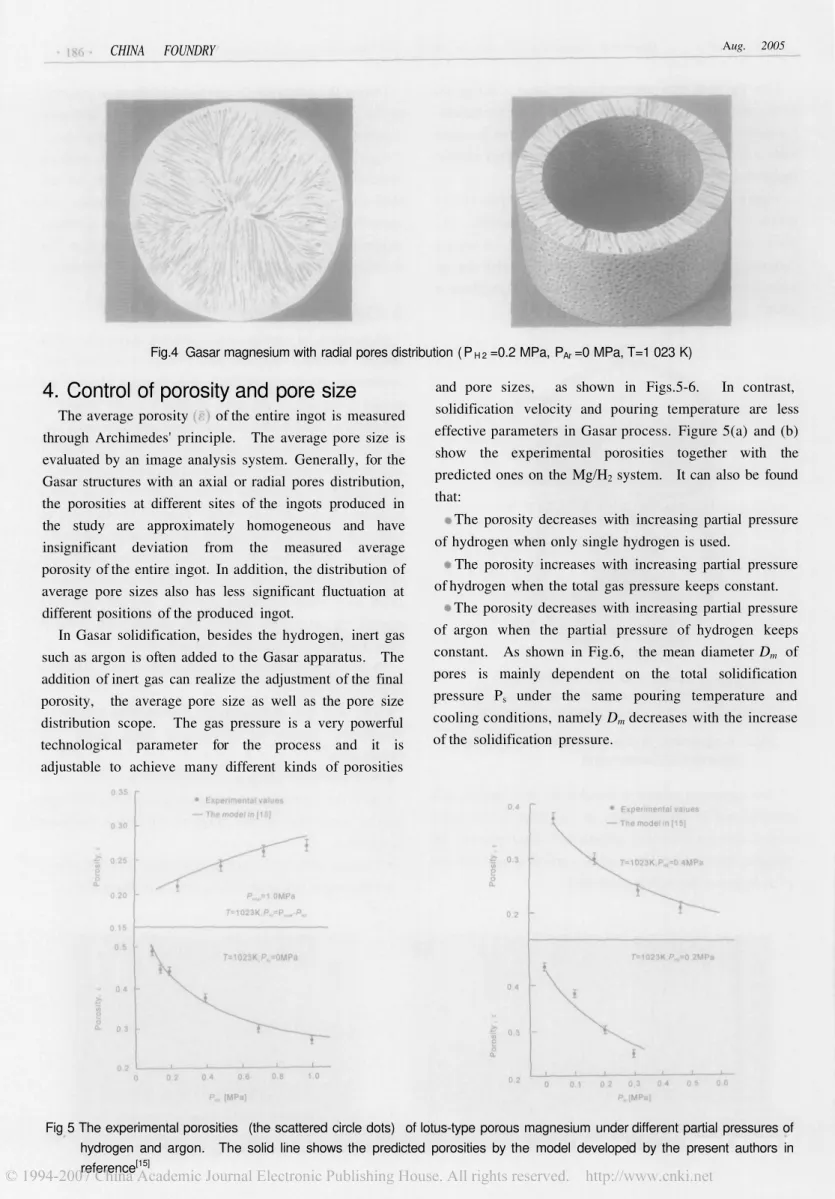
regular porous structure with an axial pore distribution is also called as lotus-type porous metal or lotus metal because it looks like lotus roots. Figure 3 shows a typical lotus-type of porous magnesium sample produced by the authors. If the lateral surroundings of the mould are applied by cooling, the melt is solidified inwards and the pores grow along the radial direction. Figure 4 shows a typical regular porous magnesium sample with a radial pore distribution produced by the authors, too.
A few general observations from the Gasar structure under the study are:
The pore size distribution is non-uniform because of concurrent growth of small and large pores and coalescence.
No branching of pores is ever observed to occur. No pores are nucleated on the mould surface and a non-porous metal skin in the range of 0.05-5mm thickness forms first.
Porosity 10%-55% and pore diameters 10-1 500 µm. Pore shape: cylindrical, spherical, and ellipsoidal.
CHINA FOUNDRY Aug. 2005
Fig.4 Gasar magnesium with radial pores distribution ( PH 2 =0.2 MPa, PAr =0 MPa, T=1 023 K)
4. Control of porosity and pore size
The average porosity of the entire ingot is measured through Archimedes' principle. The average pore size is evaluated by an image analysis system. Generally, for the Gasar structures with an axial or radial pores distribution, the porosities at different sites of the ingots produced in the study are approximately homogeneous and have insignificant deviation from the measured average porosity of the entire ingot. In addition, the distribution of average pore sizes also has less significant fluctuation at different positions of the produced ingot.In Gasar solidification, besides the hydrogen, inert gas such as argon is often added to the Gasar apparatus. The addition of inert gas can realize the adjustment of the final porosity, the average pore size as well as the pore size distribution scope. The gas pressure is a very powerful technological parameter for the process and it is adjustable to achieve many different kinds of porosities
and pore sizes, as shown in Figs.5-6. In contrast, solidification velocity and pouring temperature are less effective parameters in Gasar process. Figure 5(a) and (b) show the experimental porosities together with the predicted ones on the Mg/H2 system. It can also be found
that:
The porosity decreases with increasing partial pressure of hydrogen when only single hydrogen is used.
The porosity increases with increasing partial pressure of hydrogen when the total gas pressure keeps constant.
The porosity decreases with increasing partial pressure of argon when the partial pressure of hydrogen keeps constant. As shown in Fig.6, the mean diameter Dm of
pores is mainly dependent on the total solidification pressure Ps under the same pouring temperature and
cooling conditions, namely Dm decreases with the increase
of the solidification pressure.
Vol. 2 No. 3 Directional solidification of metal-gas eutectic and fabrication of regular porous metals
Fig.6 The evolution trend of the mean diameter of pores in lotus-type magnesium with the solidification pressure Ps (Ps=PH2+PAr), T=1 023 K
5. Summary
Gasar technology is based on a new scientific knowledge about gas-eutectic reaction in metal-gas system. Although the researches in this field have been carried out for 12 years in several countries, unfortunately, a well understanding on Gasar's manufacturing parameters as well as its processing control system has not been established, yet. The current research on the Gasar process has just been carried out for 3 years by our group. The Gasar structures with axial and radial pore distribution have been fabricated successfully with an apparatus developed by the authors in the study. The experimental results indicate that the gas pressure is a very powerful technical parameter that can be applied to achieve various kinds of porosities and pore sizes. In contrast, the parameters such as solidification velocity and pouring temperature are less important and relatively ineffective for the Gasar process.
Acknowledgments
The present research was supported by the Natural Science Foundation of China (No.50404002) and National Program on Key Basic Research Projects (No. 2004CCA05100).
References
[1] J. Banhart. Manufacture, characterization and application of cellular metals and metal foams [J]. Progress in Materials Science, 2001, 46: 559-632
[2] V. I. Shapovalov. Method for manufacturing porous articles [P]. U.S. Patent, No. 5,181,549 (January 26, 1993)
[3] V. I. Shapovalov and L.V. Boyko. Gasar- A new class of porous materials [J]. Advanced Engineering Materials, 2004, 6 (6): 407-410
[4] V. I. Shapovalov. Structure formation behavior of alloys during gas-eutectic transformation and prospects of the use of hydrogen in alloying. Microstructural Design by Solidification Processing (Edited by Enrique J. Lavernia and Mehmet N. Gungor) [M]. The Minerals, Metals & Materials Society, 1992. pp 207-216
[5] D. Ludmil, S. Jerzy and A. Rajiv. Mathematical modelling and numerical simulation of ordered porosity metal materials formation [J]. Journal of Computer-Aided Materials Design, 2003, 10: 35-54
[6] J. M. Apprill, D. R. Poirier and M. C. Maguire. Gasar porous metals process control [A], Mat. Res. Soc. Symp. Proc. [C]. 1998,521:291-296
[7] C. J. Paradies and A. Tobin. The effect of Gasar processing parameters on porosity and properties in aluminum alloys [A]. Mat. Res. Soc. Symp. Proc. [C]. 1998, 521: 297-302
[8] P. Chanman and R. N. Steven. Metallographic study of Gasar porous magnesium [A], Mat. Res. Soc. Symp. Proc. [C]. 1998, 521:315-320
[9] A. Patanaik, S. C. Sanday and C. L. Vold. Microstructure of Gasar porous copper ingots [A]. Mat. Res. Soc. Symp. Proc. [C]. 1995,371:371-376
[10] H. Nakajima, S. K. Hyun and K. Ohashi. Fabrication of porous copper by unidirectional solidification under hydrogen and its properties [J]. Colloids and Surfaces A: Physicochemical and Engineering Aspects, 2001, 179: 209-214
[11] S. K. Hyun and H. Nakajima. Fabrication of porous iron by unidirectional solidification in nitrogen atmosphere [J]. Mater. Trans., 2002, 43: 526-531
[12] S. Yamamura, H. Shiota, K. Murakami and H. Nakajima. Evaluation of porosity in porous copper fabricated by unidirectional solidification under pressured hydrogen [J]. Mater. Sci. Eng., 2003, A318: 137-143
[13] Yuan LIU and Yanxiang LI. A theoretical study of Gasarite eutectic growth [J]. Scripta. Metall., 2003, 49 (5): 379-386 [14] Yuan LIU and Yanxiang LI. Theoretical analysis of bubble
nucleation in GASAR materials [J]. Trans. Nonferrous Met. Soc. China, 2003,13 (4): 830-834
[15] Yuan LIU, Yangxiang LI and Huawei ZHANG. Effect of Gasar processing parameters on structure of botus-type porous metal [J]. Rare Metal Materials & Engineering, 2005, 34(7): 1128-1130 (in Chinese)
[16] Yuan LIU, Yanxiang LI and Huawei ZHANG. Fabrication of lotus-structured porous magnesium with Gasar process [J]. Acta. Metallurgica. Sinica., 2004, 40 (11): 1121-1126
[17] Yuan LIU, Yanxiang LI and Huawei ZHANG. Experimental study on fabrication of lotus-type porous metals with metal-gas eutectic directional solidification process [J]. Special Casting & Nonferrous, 2005, (1): 1-4 (in Chinese )