GMDD
6, 4207–4242, 2013Reallocation in modal aerosol models
T. Korhola et al.
Title Page
Abstract Introduction
Conclusions References
Tables Figures
◭ ◮
◭ ◮
Back Close
Full Screen / Esc
Printer-friendly Version Interactive Discussion
Discussion
P
a
per
|
D
iscussion
P
a
per
|
Discussion
P
a
per
|
Discuss
ion
P
a
per
|
Geosci. Model Dev. Discuss., 6, 4207–4242, 2013 www.geosci-model-dev-discuss.net/6/4207/2013/ doi:10.5194/gmdd-6-4207-2013
© Author(s) 2013. CC Attribution 3.0 License.
Geoscientiic Geoscientiic
Geoscientiic
Open Access
Geoscientiic
Model Development
Discussions
This discussion paper is/has been under review for the journal Geoscientific Model Development (GMD). Please refer to the corresponding final paper in GMD if available.
Reallocation in modal aerosol models:
impacts on predicting aerosol radiative
e
ff
ects
T. Korhola1, H. Kokkola2, H. Korhonen2, A.-I. Partanen2, A. Laaksonen1,3, K. E. J. Lehtinen1,2, and S. Romakkaniemi1
1
Department of Applied Physics, University of Eastern Finland, P.O. Box 1627, 70211 Kuopio, Finland
2
Finnish Meteorological Institute, Kuopio Unit, P.O. Box 1627, 70211 Kuopio, Finland
3
Finnish Meteorological Institute, P.O. Box 503, 00101 Helsinki, Finland
Received: 14 June 2013 – Accepted: 24 June 2013 – Published: 6 August 2013
Correspondence to: T. Korhola ([email protected])
GMDD
6, 4207–4242, 2013Reallocation in modal aerosol models
T. Korhola et al.
Title Page
Abstract Introduction
Conclusions References
Tables Figures
◭ ◮
◭ ◮
Back Close
Full Screen / Esc
Printer-friendly Version Interactive Discussion
Discussion
P
a
per
|
D
iscussion
P
a
per
|
Discussion
P
a
per
|
Discuss
ion
P
a
per
|
Abstract
In atmospheric modelling applications the aerosol particle size distribution is com-monly represented by modal approach, in which particles in different size ranges are described with log-normal modes within predetermined size ranges. Such method in-cludes numerical reallocation of particles from a mode to another for example during 5
particle growth, leading to potentially artificial changes in the aerosol size distribution. In this study we analysed how this reallocation affects climatologically relevant parame-ters: cloud droplet number concentration, aerosol-cloud interaction coefficient and light extinction coefficient. We compared these parameters between a modal model with and without reallocation routines, and a high resolution sectional model that was con-10
sidered as a reference model. We analysed the relative differences of the parameters in different experiments that were designed to cover a wide range of dynamic aerosol processes occurring in the atmosphere. According to our results, limiting the allowed size ranges of the modes and the following numerical remapping of the distribution by reallocation, leads on average to underestimation of cloud droplet number concentra-15
tion (up to 100 %) and overestimation of light extinction (up to 20 %). The analysis of aerosol first indirect effect is more complicated as the ACI parameter can be either over- or underestimated by the reallocating model, depending on the conditions. How-ever, for example in the case of atmospheric new particle formation events followed by rapid particle growth, the reallocation can cause around average 10 % overestima-20
tion of the ACI parameter. Thus it is shown that the reallocation affects the ability of a model to estimate aerosol climate effects accurately, and this should be taken into account when using and developing aerosol models.
1 Introduction
Atmospheric aerosol particles are one of the most important climate forcing agents 25
GMDD
6, 4207–4242, 2013Reallocation in modal aerosol models
T. Korhola et al.
Title Page
Abstract Introduction
Conclusions References
Tables Figures
◭ ◮
◭ ◮
Back Close
Full Screen / Esc
Printer-friendly Version Interactive Discussion
Discussion
P
a
per
|
D
iscussion
P
a
per
|
Discussion
P
a
per
|
Discuss
ion
P
a
per
|
indirectly by acting as condensation nucleus for cloud droplets (IPCC, 2007). In order to estimate these effects, it has become a necessity to implement aerosol microphysics also into global climate models. The difficulty with aerosols is that, compared to green-house gases, they have highly variable size and composition on which the radiative forcing is strongly dependent. Thus capturing the climate effects of atmospheric parti-5
cles requires detailed modeling, which is limited by the high computational costs. There are several ways to represent the aerosol size distribution in global climate models. Computationally, the most efficient methods are the so called bulk methods, in which only the mass of different aerosol compounds is tracked and all relevant param-eters are calculated assuming a prescribed size distribution (Salill et al., 2012). How-10
ever, this approach has severely limited accuracy. One of the most accurate, but also computationally most expensive approach is the sectional method, which divides the size range of aerosol particles into discrete size sections. With the sectional method, the accuracy increases by increasing the number of sections, but this also leads to increased number of variables and thus to a higher computational burden, which can 15
become infeasible to use in large-scale models. The so called modal method offers an intermediate level of sophistication for describing aerosol size distribution. It has been noticed through empirical studies that a sum of log-normal distribution functions often match well to ambient aerosol size distributions (Seinfeld and Pandis, 2006). Therefore the log-normal mode assumption is frequently used in atmospheric applications. When 20
the number of modes is kept low, a modal model is computationally efficient but the model accuracy may become compromised (Liu et al., 2012). In a modal model the aerosol distribution can be represented for example by a sum of four modes covering the size range from nucleation to coarse mode (containing several compositions for internal mixing) with three parallel modes to take into account external mixing (Vignati 25
GMDD
6, 4207–4242, 2013Reallocation in modal aerosol models
T. Korhola et al.
Title Page
Abstract Introduction
Conclusions References
Tables Figures
◭ ◮
◭ ◮
Back Close
Full Screen / Esc
Printer-friendly Version Interactive Discussion
Discussion
P
a
per
|
D
iscussion
P
a
per
|
Discussion
P
a
per
|
Discuss
ion
P
a
per
|
most commonly used method in aerosol-climate models which explicitly describe the aerosol size distribution (Bauer et al., 2008; Liu et al., 2012; Mann et al., 2010; Pringle et al., 2010; Vignati et al., 2010; Zhang, et al., 2012).
Different methods have been compared earlier in several publications (Seigneur et al., 1986; Zhang et al., 1999, 2002; Harrington et al., 1998; Kokkola et al., 2009). This 5
study focuses on the numerical phenomena often connected to the application of modal representation of aerosol distribution in global atmospheric models. More specifically we investigate the effects of particle reallocation between modes on cloud droplet num-ber concentration, aerosol-cloud interaction parameter and light extinction coefficient, in atmospherically relevant scenarios. Particle reallocation effectively means transfer-10
ring particles between the log-normal modes, with specific conditions and purposes. In the following, we introduce some common cases which require the use of this tech-nique and discuss some of its limitations.
In modal models the aerosol processes are usually described using a finite difference method so that the atmosphere is represented by e.g. a Gaussian grid. A need for re-15
allocation arises from e.g. a scenario in which aerosol size distributions are merged between two of these grids. For example, in case of air mass mixing between two of model grids, the pre-existing and transported (from the adjacent grid) fractions of mass and number of the corresponding (same size range, for example Aitken) log-normal modes are summed. The average diameter of the combined mode is then calculated 20
from the new mass and number concentrations. When the modes’ average diameters are of similar size, the resulting combined mode represents the actual physical situa-tion adequately. But if the transported mode has grown significantly compared to the corresponding pre-existing mode in the grid (or vice versa), the averaged mode rep-resents “non-existent” particles and not the two distinct modes that actually should be 25
GMDD
6, 4207–4242, 2013Reallocation in modal aerosol models
T. Korhola et al.
Title Page
Abstract Introduction
Conclusions References
Tables Figures
◭ ◮
◭ ◮
Back Close
Full Screen / Esc
Printer-friendly Version Interactive Discussion
Discussion
P
a
per
|
D
iscussion
P
a
per
|
Discussion
P
a
per
|
Discuss
ion
P
a
per
|
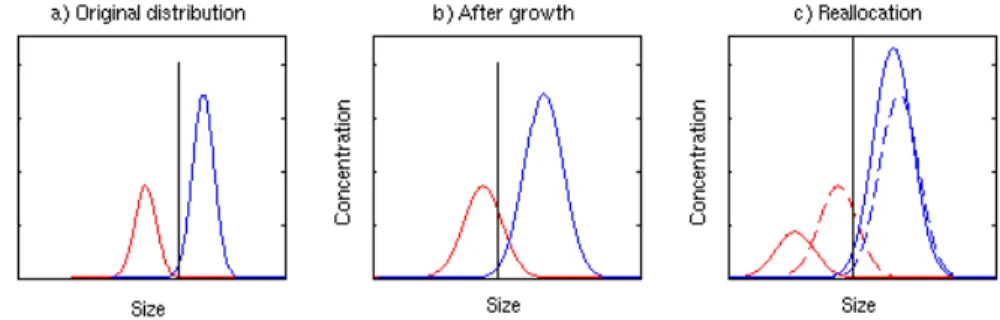
This misrepresentation is reduced when the diameters of corresponding modes are not allowed to deviate too much by restricting their allowed range: when the leading edge of the mode grows past the threshold diameter, the mass and number corre-sponding to the fraction exceeding the threshold diameter are transferred to the adja-cent larger mode (Binkowski and Roselle, 2003). This efficiently decreases the average 5
radius of the smaller mode, since the mass to number ratio of the transferred particles is higher than of the average particle in the mode. The larger mode also decreases due to same reasons, but only slightly. However, this aerosol particle reallocation, keeps the modes within the desired size ranges.
While the use of a reallocation routine prevents unrepresentative distributions when 10
combining modes, it still artificially changes the aerosol size distribution, and creates artificial minima in the distribution. This is illustrated in Fig. 1. From left to middle panel the smaller mode (red curve) grows, and reaches its threshold diameter at the verti-cal line. Then, mass and number corresponding to the largest particles in the smaller mode are moved, i.e. reallocated, to the blue mode. In the last panel the dashed line 15
shows the distribution after the growth and the solid line is the result of a reallocated distribution. In reallocation the total aerosol number and mass concentrations remain the same, and these are the two parameters that are often studied when model accu-racy is evaluated. However, the shapes of the distributions are distinctly different which can have strong effect in physically important parameters which rely on the number 20
and size of the aerosol particles, for example the cloud droplet number concentration (CDNC), aerosol-cloud interaction (ACI) parameter describing the aerosol indirect ef-fect, and extinction coefficient (bext) contributing to the aerosol direct effect.
For example, consider the situation presented in Fig. 1 in a case where the size for smallest particles activating to cloud droplets is close to the threshold diameter 25
GMDD
6, 4207–4242, 2013Reallocation in modal aerosol models
T. Korhola et al.
Title Page
Abstract Introduction
Conclusions References
Tables Figures
◭ ◮
◭ ◮
Back Close
Full Screen / Esc
Printer-friendly Version Interactive Discussion
Discussion
P
a
per
|
D
iscussion
P
a
per
|
Discussion
P
a
per
|
Discuss
ion
P
a
per
|
underestimation of the cloud droplet concentration formed. Thus the effect of realloca-tion on CDNC (and ACI parameter) affects the models ability to reliably describe the indirect effect on global radiative forcing, whereas the changes in the EC count towards the uncertainty in direct forcing.
2 Methods
5
While the problems described above arise predominantly in global models, we studied them in a box model framework, which allows better control over the physical, numerical and statistical phenomena compared to a global modeling framework. Most importantly, the box model allows the use of unrestricted mode structure with minimal errors in con-trast to a three dimensional framework where e.g. aerosol transport between different 10
model grids would be problematic for an unrestricted structure (Jacobson, 2005). The main tool of this study was a modal model which describes the aerosol size distribution with 4 modes, and accounts for nucleation, condensation, coagulation and water uptake. The modal model was run using two approaches. In the first approach, we let the model run with unrestricted modes, i.e. there was no reallocation between 15
the modes (hereafter: unrestricted model). In the second approach, we reallocated the modes so that none of them exceeded their set threshold values (hereafter: reallocating model). The threshold diameters used for reallocation were 10, 100, and 1000 nm for nucleation, Aitken and accumulation modes, respectively. These values fall in the range of values typically used in large scale atmospheric models. Note that these are not the 20
limits for the average diameter but instead to the leading edge of the mode.
In addition to the modal model, we also used the sectional model SALSA (Kokkola et al., 2008). This sectional model was run with high size resolution using 100 size sections, and thus it served as reference model when analyzing the effects of reallo-cation to physical parameters (CDNC, ACI,bext). SALSA modeled the same physical 25
GMDD
6, 4207–4242, 2013Reallocation in modal aerosol models
T. Korhola et al.
Title Page
Abstract Introduction
Conclusions References
Tables Figures
◭ ◮
◭ ◮
Back Close
Full Screen / Esc
Printer-friendly Version Interactive Discussion
Discussion
P
a
per
|
D
iscussion
P
a
per
|
Discussion
P
a
per
|
Discuss
ion
P
a
per
|
Although the modal model is not used with unrestricted modes in global applica-tions, results from it were also compared against the sectional model in order to see how much of the difference between reallocating and sectional models is caused by assumption of predetermined width of different modes. To improve the comparability between the modal and sectionals models, all CDNC, ACI andbext calculations were 5
done with the sectional version of the parameterization and library functions by trans-forming the log-normal modes to a sectional representation of 100 sections before calculations. With this high resolution the errors from the transformation were negligi-ble. The number of activated aerosol particles during cloud formation was calculated with a sectional version of the parameterization by Nenes and Seinfeld (Nenes and Se-10
infeld, 2005). The extinction coefficient was calculated using libRadtran library for ra-diative transfer calculations (Mayer and Kylling, 2005). ACI parameter was determined by
ACI=d log (CDNC)
d log (N) (1)
whereNis the total aerosol number concentration. From the simulations, the ACI is cal-15
culated for each time step by increasingN by a constant factor and then recalculating the CDNC.
In experiments that simulated new particle formation, nucleation was calculated us-ing activation type nucleation (Sihto et al., 2006),
J=A[H2SO4] (2)
20
where J is the rate of 1.5 nm particles formed, A is the nucleation coefficient and [H2SO4] is the sulphuric acid concentration. The coefficientAis determined from mea-surements, and in our simulations the used value of 10−6s−1 corresponds to boreal forest nucleation event. The gas phase sulphuric acid concentration is affected by the removal due to new particle formation and condensation as in Vignati et al. (2004). 25
GMDD
6, 4207–4242, 2013Reallocation in modal aerosol models
T. Korhola et al.
Title Page
Abstract Introduction
Conclusions References
Tables Figures
◭ ◮
◭ ◮
Back Close
Full Screen / Esc
Printer-friendly Version Interactive Discussion
Discussion
P
a
per
|
D
iscussion
P
a
per
|
Discussion
P
a
per
|
Discuss
ion
P
a
per
|
be found in Kokkola et al., 2008. All simulations included only sulphate particles, gas phase sulphuric acid and water.
Since this is a comparison between different models with known limitations, we chose Eq. (3) for relative difference since it does not assume either of the values as an abso-lute reference.
5
Relative difference (a,b)= a−b
(a+b)/2 (3)
In this study, we did four different experiments to address typical situations arising in global models, in which size distribution dependent parameters can be affected by the particle reallocation. In the first three experiments the same background aerosol consisting of three modes was used: the mean diameters of the modes were 30, 200 10
and 2400 nm with number concentrations of 500, 200 and 0.1 cm−3, respectively. The geometric standard deviation was assumed 1.59 for all modes. This size distribution of the background aerosol was considered to be representative for boundary layer conditions according to Asmi et al. (2011).
3 Results
15
3.1 Emission reallocation
The motivation for the first experiment was to study how the reallocation can affect the aerosol size distribution when primary aerosols are emitted. Emission databases for anthropogenic primary aerosol typically provide only particle mass fluxes; however, models explicitly tracking the aerosol size distribution need to assume also a size for 20
GMDD
6, 4207–4242, 2013Reallocation in modal aerosol models
T. Korhola et al.
Title Page
Abstract Introduction
Conclusions References
Tables Figures
◭ ◮
◭ ◮
Back Close
Full Screen / Esc
Printer-friendly Version Interactive Discussion
Discussion
P
a
per
|
D
iscussion
P
a
per
|
Discussion
P
a
per
|
Discuss
ion
P
a
per
|
emitted particles is fairly close to the commonly assumed threshold diameter for real-location and thus the artificial minimum produced by the realreal-location procedure. The emission mode mean diameter is also∼50 nm larger than the largest allowed average
diameter for the Aitken mode, which causes strong reallocation of the emitted particle mode between Aitken and accumulation modes.
5
During the experiment, the CDNC and ACI parameter were calculated for a variety of emission mode number concentrations (50–800 cm−3) and updraft velocities (0.1– 3.0 m s−1). Since theb
extis independent from the updraft velocity, the relative difference for it was calculated only as a function of emission number concentration. The emis-sion mode mean diameter was kept constant (at the inventory value) and the same 10
calculations were done with and without background aerosol. This experiment did not include any aerosol processes, only reallocation of the distribution and following calcu-lations for CDNC, ACI andbext. We present only a comparison between the reallocating modal model and the sectional reference model, since the unrestricted modal model gives almost identical results to the reference model now that no aerosol microphysics 15
is simulated.
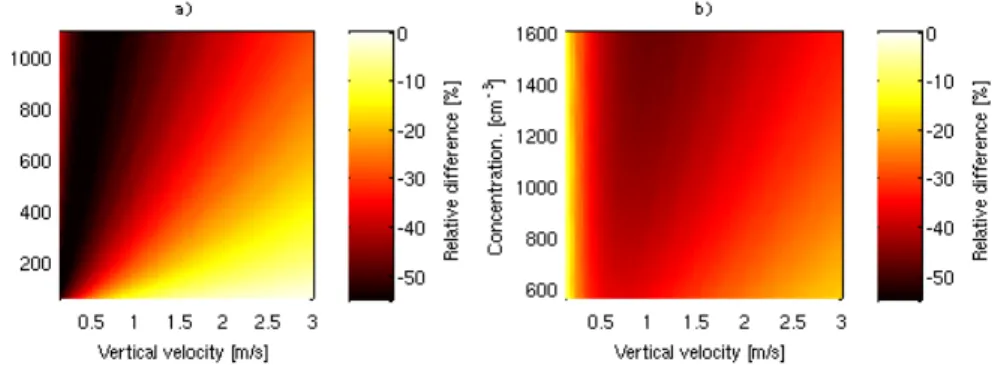
Figure 2 shows the relative difference in CDNC as a function of the emission concen-tration and updraft velocity for both the reallocating and unrestricted models. Looking at the relative differences it is clear that the reallocation of the emission mode causes underestimation of the CDNC, especially for high updrafts. The maximum underestima-20
tion without the background aerosol is more than 50 %, and with background aerosol almost 40 %. The activated fractions varied from 48 to 98 %. The underestimation of the CDNC due to reallocation occurs for two reasons. First, the reallocating model di-vides the emission mode to two modes by reallocating a large part of the particles to the accumulation mode while keeping the Aitken mode below its threshold diameter. 25
GMDD
6, 4207–4242, 2013Reallocation in modal aerosol models
T. Korhola et al.
Title Page
Abstract Introduction
Conclusions References
Tables Figures
◭ ◮
◭ ◮
Back Close
Full Screen / Esc
Printer-friendly Version Interactive Discussion
Discussion
P
a
per
|
D
iscussion
P
a
per
|
Discussion
P
a
per
|
Discuss
ion
P
a
per
|
diameter. This means that reallocation reduces the number of particles larger than the critical diameter in this case.
When background aerosol is included in the simulation, the underestimation de-creases (Fig. 2b). This is because background accumulation mode particles decrease the relative contribution of the emitted particles to the CDNC concentration. It is worth 5
noting that especially when the mean diameter of the background accumulation mode and the critical diameter are clearly larger than the emission mode, the reallocation can cause an overestimation of CDNC. This happens because some of the emitted particles are reallocated to the accumulation mode which is (partly) activated as it is larger than the critical diameter, whereas the original accumulation in the unrestricted 10
has too small diameter to contribute to the CDNC. This effect is stronger when the background aerosol is included in the simulation because the accumulation mode now has a larger diameter compared to the no background case. Also when calculating the accumulation mode mean diameter after reallocation, the large background mode par-ticles dominate over the clearly smaller reallocated parpar-ticles, and the addition of those 15
reallocated particles decrease the accumulation mode diameter only slightly.
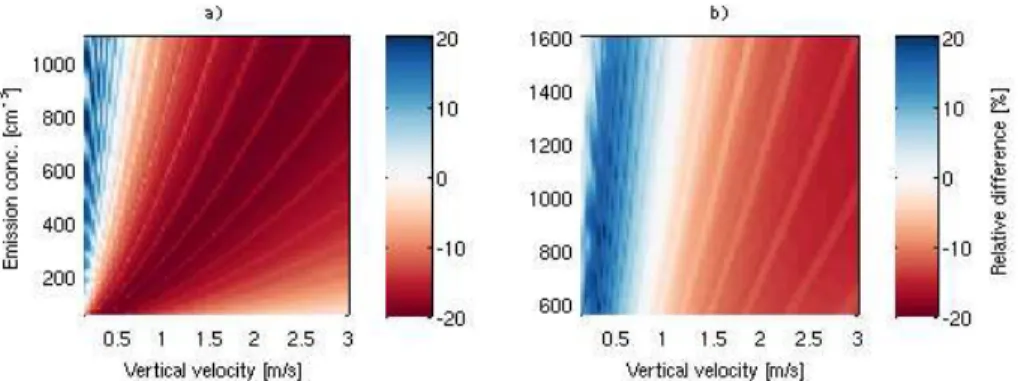
In Fig. 4 the relative difference of the ACI parameter shows both over- and under-estimation by the model with reallocation compared to the freely moving model, de-pending on the concentration of emitted particles and the updraft velocity. For updraft velocities below 0.4 m s−1 and without background aerosol, reallocation causes over-20
estimation in ACI parameter while underestimating it for higher updraft velocities. With background aerosol, the switch between over- and underestimation occurs approxi-mately at 0.8 m s−1. The maximum relative di
fferences were+25 % and−20 % without
background, and with background+19 % and−16 %. The absolute values for the ACI
parameter varied between 0.58 and 0.98 (latter for the unrestricted model at maximum 25
updraft velocity with a low number of particles).
GMDD
6, 4207–4242, 2013Reallocation in modal aerosol models
T. Korhola et al.
Title Page
Abstract Introduction
Conclusions References
Tables Figures
◭ ◮
◭ ◮
Back Close
Full Screen / Esc
Printer-friendly Version Interactive Discussion
Discussion
P
a
per
|
D
iscussion
P
a
per
|
Discussion
P
a
per
|
Discuss
ion
P
a
per
|
moves a portion of the particles below the critical diameter. Because of this, the emis-sion mode in the reallocating model is unable to contribute as directly to the CDNC as in the unrestricted model. This means that the ACI parameter (Eq. 1) is higher in the unrestricted structure compared to the model with reallocation.
The background aerosol decreases the ACI parameter more effectively in the unre-5
stricted than in the reallocating model. This is because the presence of a non-activating background Aitken mode clearly decreases the activated fraction in the unrestricted model whereas in the reallocating model a smaller non-activating Aitken mode already exists due to reallocation of the emission mode, and the change in the activation frac-tion is not so large. Thus the background aerosol decreases the relative difference 10
between the two models in terms of the ACI parameter.
In this emission experiment, the size of emitted particles is too small to affect the light extinction efficiently directly. The maximum value for the extinction coefficient was be-low 2 Mm−1 without background aerosol. The relative di
fference between reallocating and unrestricted models of the bext was approximately a constant 38 %, but low ab-15
solute values decrease its relevance. With background aerosol absolute values were between 10 and 13 Mm−1but the relative di
fference was just above 5 %.
3.2 Constant emission into an aging aerosol distribution
In the second experiment, we studied how the reallocation of particles affects model results in a case with constant aerosol emission and the aerosol size distribution evolv-20
ing due to microphysical processes. The microphysical processes affecting the size distribution were coagulation, growth by water uptake and sulphuric acid condensa-tion; however, nucleation was excluded from this experiment. These processes acted upon the background size distribution detailed in Sect. 2.1. The second experiment was ran over 18 h for updraft velocities from 0.1 to 3.0 m s−1assuming a constant emission 25
GMDD
6, 4207–4242, 2013Reallocation in modal aerosol models
T. Korhola et al.
Title Page
Abstract Introduction
Conclusions References
Tables Figures
◭ ◮
◭ ◮
Back Close
Full Screen / Esc
Printer-friendly Version Interactive Discussion
Discussion
P
a
per
|
D
iscussion
P
a
per
|
Discussion
P
a
per
|
Discuss
ion
P
a
per
|
injection rateCSA at each time step was
CSA=C0T−t
T (4)
where C0(2.6×10 8
) was a constant concentration,T (18 h) andtwere the total simula-tion time and the current time at a given time step. The decreasing injecsimula-tion concentra-tion in the presence of a condensaconcentra-tion sink leads in to quickly decreasing H2SO4 con-5
centration with peak value of 2.6×10⁸molecules cm−3at the beginning of the injection.
We calculated the relative difference in bextbetween the unrestricted and reallocating modal approaches as a function of simulation time. In addition, we calculated the rela-tive differences in CDNC and the ACI parameter for a range of updraft velocities. These results were also compared with the sectional model.
10
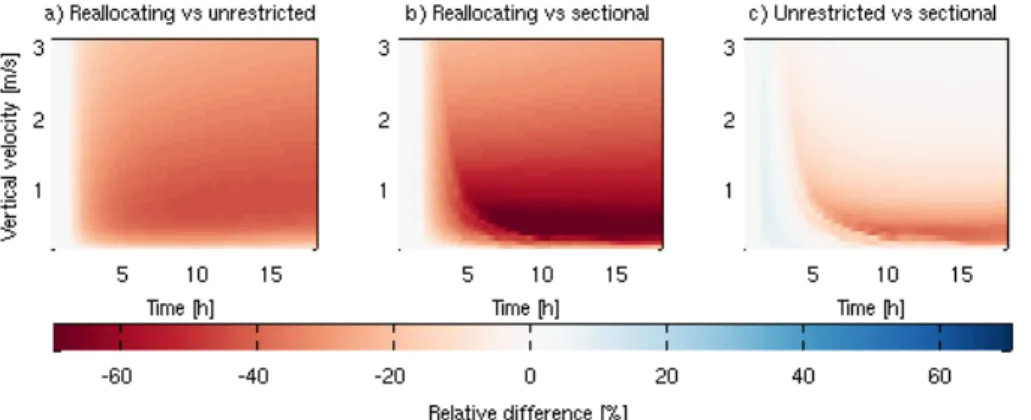
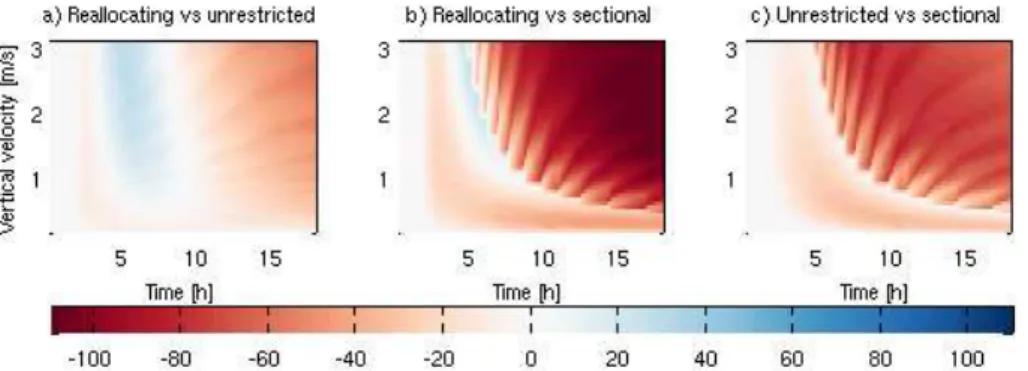
Figure 5 shows the relative difference of the CDNC between different models. With a constant emission rate of 0.01 particles per second (average diameter 80 nm), the re-allocating model underestimates the CDNC for the most part compared to unrestricted modal and sectional model. The largest difference of−77 % is between the
reallocat-ing and sectional models, whereas the unrestricted model underestimates at maximum 15
by−41 % compared to the sectional model. At low updraft velocities and in the
begin-ning of the simulation the unrestricted and reallocating modal models overestimate the CDNC compared to the sectional model by up to 9 and 5 %, respectively.
Figure 5 also demonstrates nicely a noticeable difference between a modal model with fixed mode width and a sectional model. As the shape of a “mode” is allowed 20
change freely in the sectional model, the condensational growth will narrow it quickly due to small particles growing faster compared to larger ones. This also shows up in cloud activation as a sharp increase in the CDNC when the narrow peaked “mode” reaches the critical diameter. This increase can be seen in Fig. 5 as a sharp gradient in b and c. Note also that the average diameter of the Aitken mode in the modal models 25
GMDD
6, 4207–4242, 2013Reallocation in modal aerosol models
T. Korhola et al.
Title Page
Abstract Introduction
Conclusions References
Tables Figures
◭ ◮
◭ ◮
Back Close
Full Screen / Esc
Printer-friendly Version Interactive Discussion
Discussion
P
a
per
|
D
iscussion
P
a
per
|
Discussion
P
a
per
|
Discuss
ion
P
a
per
|
mode to grow by 45 nm). However, after the Aitken mode diameter has reached the size of the emission mode condensation is not strong enough to increase the mode di-ameter further since the injection of 80 nm particles will dominate the average didi-ameter compared to already slowed down condensational growth.
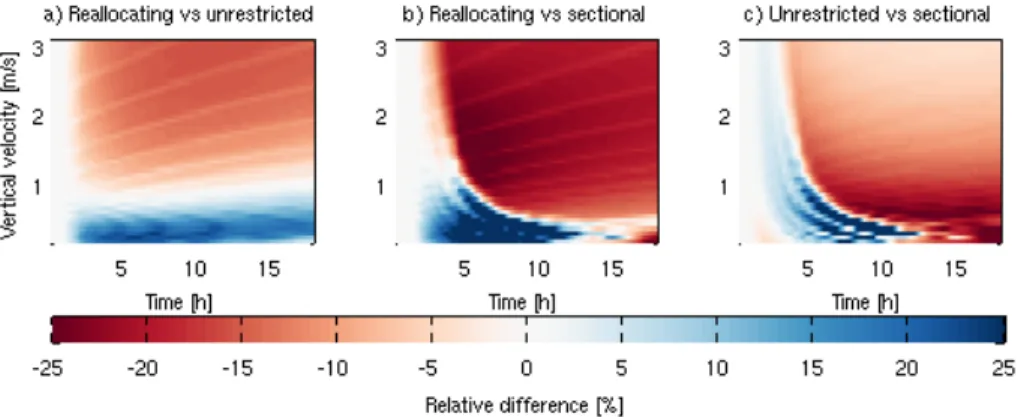
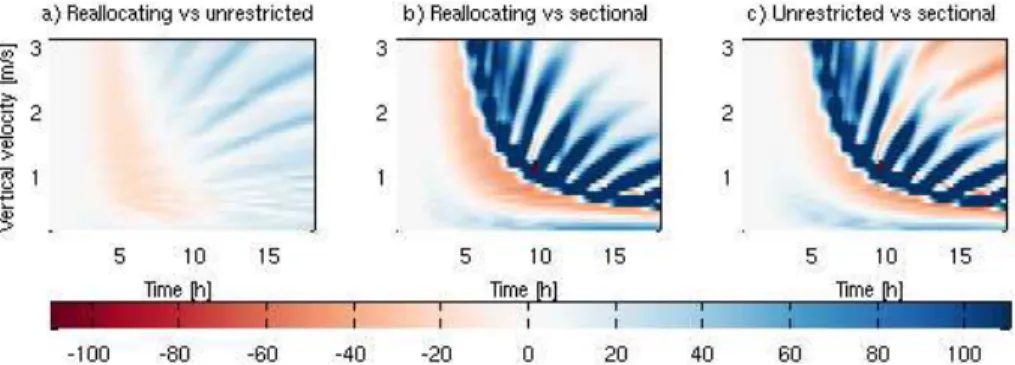
The relative difference of the ACI parameter is shown in Fig. 6. The relative difference 5
between the modal models goes from maximum of 23 % (updraft velocity∼0.4 m s−1)
to minimum of −16 % (updraft velocity above 1.5 m s−1). Compared to the sectional
model, the modal models overestimate the ACI by close to 100 % before the narrow (and high) Aitken mode in the sectional model reaches the activation diameter. How-ever, once this narrow Aitken mode has grown to the activation size, the modal models 10
start to underestimate the ACI. The underestimation is up to 25 % by the reallocating and−10 to−20 % by the unrestricted model. The relative differences of the CDNC and
ACI parameter are for the large part governed by the same phenomena as explained and illustrated in Sect. 3.1 and Fig. 3.
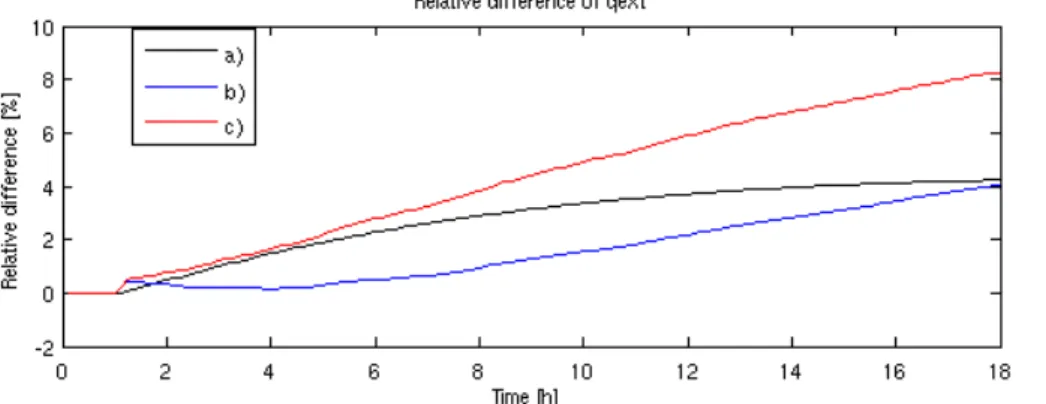
Figure 7 shows the relative difference in the light extinction coefficient between the 15
models. At the end of the simulation the relative difference is 4 % between the unre-stricted and the sectional model and 8 % between the reallocating and the sectional model. The extinction coefficient is sensitive to particles clearly larger than the critical activation diameter. In the reallocating model the reallocation increases the number of those large particles. The sectional model does have more particles above the criti-20
cal diameter (∼100 nm) for example but not above the sizes (∼500 nm) sensitive to
light scattering and absorption. The absolute values for the extinction coefficients were 150–250 Mm−1.
3.3 Nucleation event
The third experiment simulated all microphysical processes, nucleation being the only 25
GMDD
6, 4207–4242, 2013Reallocation in modal aerosol models
T. Korhola et al.
Title Page
Abstract Introduction
Conclusions References
Tables Figures
◭ ◮
◭ ◮
Back Close
Full Screen / Esc
Printer-friendly Version Interactive Discussion
Discussion
P
a
per
|
D
iscussion
P
a
per
|
Discussion
P
a
per
|
Discuss
ion
P
a
per
|
the simulation until the end of the simulation (18 h). The CDNC, ACI parameter and bextwere compared between the unrestricted and reallocating modal models and the sectional model for updraft velocity range of 0.1–3.0 m s−1. In all of the simulations, the average diameters of the background modes did not exceed their reallocation threshold values, making sure that there was no need for reallocation of background distribution 5
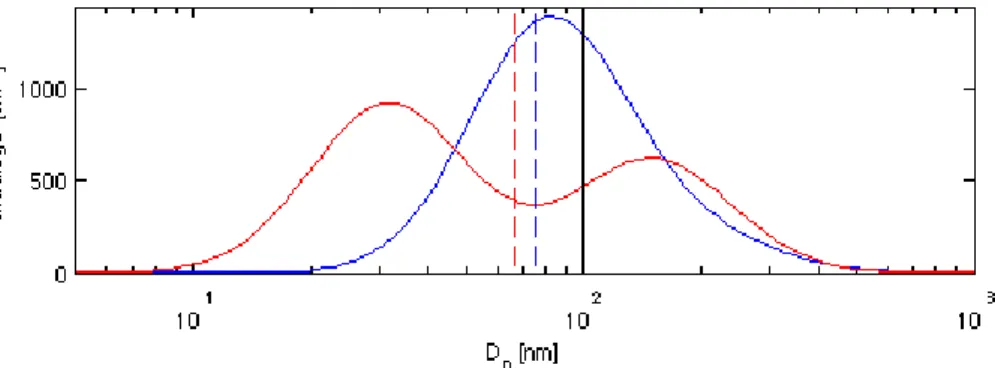
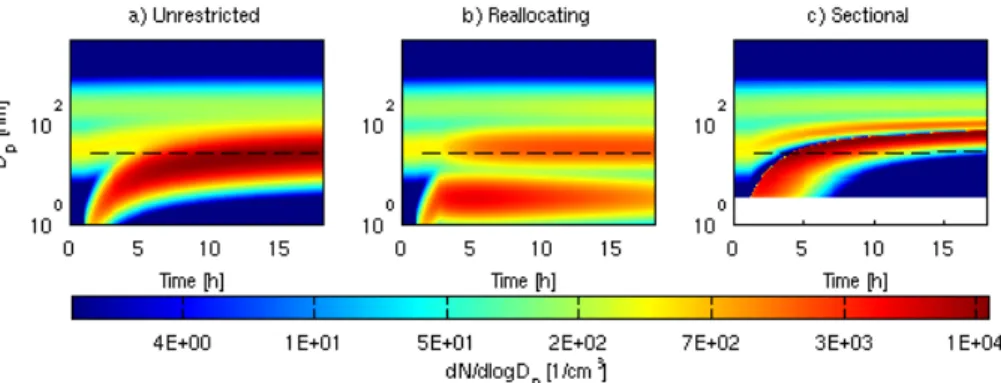
at the beginning of the simulations. Figure 8 shows a significant difference in the num-ber size distribution between the unrestricted and reallocating modal representations and the sectional aerosol representation. Note the persistent minima in the reallocating modal model’s distribution due to reallocation (Fig. 8b).
Both the unrestricted and the sectional model have a large number of particles in the 10
growing nucleation mode throughout the simulation, whereas in the reallocating model the particles are being divided between two or three modes. As seen in Fig. 8, the location of the minima and maxima in the size distribution in relation to the critical size (a typical value illustrated in the figure with a horizontal dashed line) is crucial in terms of particle activation. Also in a modal model, a fixed mode width causes the largest par-15
ticles in a mode with a small average diameter to artificially grow faster than particles of the same size in a sectional distribution. This is because the small particles within the mode have a higher growth rate compared to larger particles and the contribution of these quickly growing particles to the mass of the mode also increases the size of the larger particles by increasing the average diameter. In the sectional distribution, 20
the simulated particle mode tends to narrow significantly due to the faster growth rate and coagulation loss of the smallest particles. When the narrow peak in the sectional model reaches the activation size it produces significantly more cloud droplets when compared to both modal representations.
Due to these reasons, the differences in CDNC and ACI parameter may shift con-25
GMDD
6, 4207–4242, 2013Reallocation in modal aerosol models
T. Korhola et al.
Title Page
Abstract Introduction
Conclusions References
Tables Figures
◭ ◮
◭ ◮
Back Close
Full Screen / Esc
Printer-friendly Version Interactive Discussion
Discussion
P
a
per
|
D
iscussion
P
a
per
|
Discussion
P
a
per
|
Discuss
ion
P
a
per
|
restricted and thus the increase of CDNC by Aitken mode stops; this causes increasing underestimation until 4 h. When the particles are being reallocated after 4 h from nucle-ation mode to partially activating Aitken mode the difference between the distributions even out and momentarily the reallocated model produces 20 % more cloud droplets. Eventually the freely growing nucleation mode in the unrestricted model grows enough 5
to contribute to CDNC, whereas a large portion of the nucleated particles in the re-allocating model are held back in the nucleation and Aitken modes, which eventually leads into underestimation (−40 %) by reallocating model compared to the unrestricted
model. In the Fig. 9b and c after the narrow nucleation mode in the sectional model has reached activation size it will produce 118 and 87 % more droplets compared to 10
the reallocating and unrestricted modal models. Thus, in the case of nucleation event followed by rapid growth of particles, the limitation of predetermined mode width is causing relatively larger error than the reallocation when the nucleated particles are big enough to form cloud droplets in the sectional model.
It is also worth pointing out that the differences in the number size distributions also 15
affect the coagulation loss of the particles. In the reallocating model version, more particles remain in the nucleation mode which leads to higher average coagulation coefficients and thus higher particle loss by coagulation. In this experiment the largest relative difference between the unrestricted and reallocating model versions’ total num-ber concentration was 40 % which also amplifies the underestimation of the CDNC by 20
the reallocating model.
The relative differences of the ACI parameter (Fig. 10) show the same patterns as was seen for the relative differences of the CDNC but mostly of the opposite sign. This is due to the fact that new particle formation creates a distinct peak in the size distri-bution in the sectional model making CDNC and the ACI parameter sensitive to small 25
GMDD
6, 4207–4242, 2013Reallocation in modal aerosol models
T. Korhola et al.
Title Page
Abstract Introduction
Conclusions References
Tables Figures
◭ ◮
◭ ◮
Back Close
Full Screen / Esc
Printer-friendly Version Interactive Discussion
Discussion
P
a
per
|
D
iscussion
P
a
per
|
Discussion
P
a
per
|
Discuss
ion
P
a
per
|
The difference in particle number concentrations for particles with the size of the order of few hundred nanometres (to which thebextis sensitive to) was not significant in this experiment between the different models. This results in small relative differences ranging from 7 to−6 % in the extinction coefficient between the models as can be seen
in Fig. 11. 5
3.4 Ensemble nucleation event
To analyze the effect of the simulation conditions on the full microphysics run, we made simulations for conditions where the model produced nucleation events with large num-ber of different conditions. The number concentrations for the initial size distribution for Aitken mode were varied between 100 to 6400 cm−3. For the accumulation mode the 10
number concentrations were varied between 50 to 3200 cm−3. The updraft velocity was varied between 0.1–3.0 m s−1. Although the setup for these simulations was tailored for simulating nucleation events, some of the background distributions acted as such a strong condensation sink for sulphuric acid that there was no noticeable new particle formation (NPF).
15
Figure 12 shows the relative differences between all three models for updraft veloc-ity of 1.0 m s−1(only one case presented as an example for clarity). For accumulation mode number concentrations higher than 1000 cm−3(red lines), the relative di
fference in the CDNC between the models is close to zero. This is because condensation to the accumulation mode depletes most of the H2SO4, and thus growth of the Aitken mode 20
is weak; therefore very little or no reallocation occurs between the Aitken and accumu-lation modes. The growth and reallocation of the accumuaccumu-lation mode to coarse mode do not cause a difference in CDNC since both modes are usually larger than the crit-ical diameter. In addition, in these cases, with high accumulation mode concentration there is no new particle formation due to lack of available sulphuric acid. Increase in 25
GMDD
6, 4207–4242, 2013Reallocation in modal aerosol models
T. Korhola et al.
Title Page
Abstract Introduction
Conclusions References
Tables Figures
◭ ◮
◭ ◮
Back Close
Full Screen / Esc
Printer-friendly Version Interactive Discussion
Discussion
P
a
per
|
D
iscussion
P
a
per
|
Discussion
P
a
per
|
Discuss
ion
P
a
per
|
When there are fewer particles in the accumulation mode (blue and green lines), the underestimation of CDNC by the reallocating model starts to be more pronounced. With few hundred particles per cm−3 in the accumulation mode, the underestimation between the reallocating and unrestricted model is around 60 % at the end of the simu-lation. Relative differences are similar between the unrestricted and sectional models. 5
The largest relative difference is between the reallocating and sectional models with values of approximately−110 % (in the case of 1.0 m s−1updraft velocity). The
overes-timation for the reallocating model compared to the unrestricted and sectional ones at the beginning of the simulation is due to the same reasons as in the previous nucle-ation experiments (still small nuclenucle-ation mode in the unrestricted and sectional models 10
plus first reallocated particles into Aitken mode in reallocating model).
As seen in the previous experiment in Sect. 3.3, the ACI parameter can be very sen-sitive to small changes in updraft velocities when there are steep gradients in the size distribution. To show the trend in the ACI parameter, the average relative difference over the 49 size distributions is presented in Fig. 13. The reasons behind the higher values 15
given by modal models compared to sectional model are the same as in Sect. 3.3. On the average, the modal models agree well with each other and the relative difference between the sectional and both of the modal models is around 10 %.
Figure 14 shows the relative differences of the extinction coefficient between the different models. The difference between the unrestricted and the sectional model re-20
mains relatively small, between 3 and −5 % because the condensation of sulphuric
acid is not fast enough to narrow the accumulation mode and thus the assumption of constant mode width is causing only small error. The overestimation of bextfor the reallocating model reaches 20 % when the accumulation mode concentration is at its lowest values. Since the accumulation and coarse mode particles dominate the ex-25
GMDD
6, 4207–4242, 2013Reallocation in modal aerosol models
T. Korhola et al.
Title Page
Abstract Introduction
Conclusions References
Tables Figures
◭ ◮
◭ ◮
Back Close
Full Screen / Esc
Printer-friendly Version Interactive Discussion
Discussion
P
a
per
|
D
iscussion
P
a
per
|
Discussion
P
a
per
|
Discuss
ion
P
a
per
|
4 Conclusions
In this study we concentrated on the effects of reallocating the aerosol mass and num-ber between modes on size dependent physical parameters. The reallocation is a nu-merical routine required in global modal aerosol models to keep the aerosol distribution representative. More specifically we focused on three atmospherically relevant physical 5
parameters: cloud droplet number concentration (CDNC), aerosol-cloud interaction pa-rameter (ACI) and light extinction coefficient (bext). We did four experiments to address the typical aerosol related phenomena in the atmosphere. We compared the results between sectional model and both reallocating and unrestricted modal models.
In the first experiment we studied the effect of the reallocation routine on the phys-10
ical parameters when a AeroCom inventory based aerosol emissions with given rec-ommendations for size distribution were reallocated according to the model setup. We evaluated the relative differences of the physical parameters as a function of the emis-sion concentration and the updraft velocity of the rising air parcel. The results show clear underestimation of the CDNC and ACI by the reallocating model compared to un-15
restricted modal model/sectional model. Changes in the size distribution were confined to small particle sizes which did not have a noticeable effect on the extinction coeffi -cient. In the second experiment a constant aerosol emission of the same size as in the first experiment was allowed to be modified by microphysical processes, and a simi-lar underestimation of the CDNC was observed between the two distributions in the 20
modal model as in the first experiment. Both of the modal models also underestimated the CDNC compared to the sectional model, although less in the case of unrestricted model. In the second experiment, particles also grew large enough to be able to affect the light extinction as well. The reallocating modal model gave the largest extinction coefficient values followed by unrestricted model and sectional model.
25
GMDD
6, 4207–4242, 2013Reallocation in modal aerosol models
T. Korhola et al.
Title Page
Abstract Introduction
Conclusions References
Tables Figures
◭ ◮
◭ ◮
Back Close
Full Screen / Esc
Printer-friendly Version Interactive Discussion
Discussion
P
a
per
|
D
iscussion
P
a
per
|
Discussion
P
a
per
|
Discuss
ion
P
a
per
|
underestimates the CDNC compared to unrestricted distribution, which in turn under-estimates the CDNC when compared to the sectional model. In this experiment there were no significant differences in the extinction coefficient between the models.
To assess the effect of the initial background distribution to the possible under- or overestimation we used 49 different initial combinations of Aitken and accumulation 5
mode number concentrations for a 50 different updraft velocities in the last experiment. For the most part the results agree with the previous experiments. In the minority of cases where accumulation mode dominates the models agree well with respect to CDNC and ACI values, but in the more balanced cases the underestimation in CDNC by reallocation is again clearly noticeable. Now also in the case of low accumulation 10
mode concentration thebextwas overestimated by reallocating model compared to both the freely moving and sectional models, which in turn agreed reasonably well with each other.
According to our results limiting the mode average diameters within given size ranges and the following remapping of the modes by reallocation in modal models mainly 15
underestimates the cloud droplet number concentration while overestimating the light extinction. The aerosol-cloud interaction parameter can be either over- or underesti-mated by the reallocating model, depending on the conditions. This affects the ability of a model to estimate aerosol climate effect accurately, mainly the first indirect and the direct effect. The underestimation of the CDNC after the nucleated particles grow 20
big enough to form cloud droplets causes underestimation of the first aerosol indirect, where as the overestimation of the EC causes too strong aerosol direct effect. These phenomena should be taken into account when using and developing aerosol models.
Acknowledgements. The research has been supported by the strategic funding of the Univer-sity of Eastern Finland, and by the Academy of Finland Centre of Excellence Program (project
25
GMDD
6, 4207–4242, 2013Reallocation in modal aerosol models
T. Korhola et al.
Title Page
Abstract Introduction
Conclusions References
Tables Figures
◭ ◮
◭ ◮
Back Close
Full Screen / Esc
Printer-friendly Version Interactive Discussion
Discussion
P
a
per
|
D
iscussion
P
a
per
|
Discussion
P
a
per
|
Discuss
ion
P
a
per
|
References
Bauer, S. E., Wright, D. L., Koch, D., Lewis, E. R., McGraw, R., Chang, L.-S., Schwartz, S. E., and Ruedy, R.: MATRIX (Multiconfiguration Aerosol TRacker of mIXing state): an aerosol microphysical module for global atmospheric models, Atmos. Chem. Phys., 8, 6003–6035, doi:10.5194/acp-8-6003-2008, 2008.
5
Binkowski, F. S. and Roselle, S. J.: Models-3 Community Multiscale Air Quality (CMAQ) model aerosol component, 1, model description, J. Geophys. Res., 108, 4183, doi:10.1029/2001JD001409, 2003.
Dentener, F., Kinne, S., Bond, T., Boucher, O., Cofala, J., Generoso, S., Ginoux, P., Gong, S., Hoelzemann, J. J., Ito, A., Marelli, L., Penner, J. E., Putaud, J.-P., Textor, C., Schulz, M.,
10
van der Werf, G. R., and Wilson, J.: Emissions of primary aerosol and precursor gases in the years 2000 and 1750 prescribed data-sets for AeroCom, Atmos. Chem. Phys., 6, 4321– 4344, doi:10.5194/acp-6-4321-2006, 2006.
Harrington, D. Y. and Kreidenweis, S. M.: Simulations of sulphate aerosol dynamics-II. Model intercomparison, Atmos. Environ., 32, 1701–1709, 1998
15
Intergovernmental Panel on Climate Change: Climate Change 2007 – The Physical Science Basis: Contribution of Working Group I to the Fourth Assessment Report of the IPCC, Cam-bridge University Press, CamCam-bridge, 2007a.
Jacobson, M. Z.: Fundamentals of Atmospheric Modeling, Second Edition, Cambridge Univer-sity Press, New York, 2005.
20
Kokkola, H., Korhonen, H., Lehtinen, K. E. J., Makkonen, R., Asmi, A., Järvenoja, S., Anttila, T., Partanen, A.-I., Kulmala, M., Järvinen, H., Laaksonen, A., and Kerminen, V.-M.: SALSA – a Sectional Aerosol module for Large Scale Applications, Atmos. Chem. Phys., 8, 2469–2483, doi:10.5194/acp-8-2469-2008, 2008.
Kokkola, H., Hommel, R., Kazil, J., Niemeier, U., Partanen, A.-I., Feichter, J., and Timmreck, C.:
25
Aerosol microphysics modules in the framework of the ECHAM5 climate model – intercom-parison under stratospheric conditions, Geosci. Model Dev., 2, 97–112, doi:10.5194/gmd-2-97-2009, 2009.
Liu, X., Easter, R. C., Ghan, S. J., Zaveri, R., Rasch, P., Shi, X., Lamarque, J.-F., Gettel-man, A., Morrison, H., Vitt, F., Conley, A., Park, S., Neale, R., Hannay, C., EkGettel-man, A. M. L.,
30
GMDD
6, 4207–4242, 2013Reallocation in modal aerosol models
T. Korhola et al.
Title Page
Abstract Introduction
Conclusions References
Tables Figures
◭ ◮
◭ ◮
Back Close
Full Screen / Esc
Printer-friendly Version Interactive Discussion
Discussion
P
a
per
|
D
iscussion
P
a
per
|
Discussion
P
a
per
|
Discuss
ion
P
a
per
|
evaluation in the Community Atmosphere Model CAM5, Geosci. Model Dev., 5, 709–739, doi:10.5194/gmd-5-709-2012, 2012.
Mann, G. W., Carslaw, K. S., Spracklen, D. V., Ridley, D. A., Manktelow, P. T., Chipperfield, M. P., Pickering, S. J., and Johnson, C. E.: Description and evaluation of GLOMAP-mode: a modal global aerosol microphysics model for the UKCA composition-climate model, Geosci. Model
5
Dev., 3, 519–551, doi:10.5194/gmd-3-519-2010, 2010.
Mayer, B. and Kylling, A.: Technical note: The libRadtran software package for radiative trans-fer calculations – description and examples of use, Atmos. Chem. Phys., 5, 1855–1877, doi:10.5194/acp-5-1855-2005, 2005.
Nenes, A. and Seinfeld, J. H.: Parameterization of cloud droplet formation in global climate
10
models, J. Geophys. Res., 108, 4415, doi:10.1029/2002JD002911, 2003.
Pringle, K. J., Tost, H., Message, S., Steil, B., Giannadaki, D., Nenes, A., Fountoukis, C., Stier, P., Vignati, E., and Lelieveld, J.: Description and evaluation of GMXe: a new aerosol submodel for global simulations (v1), Geosci. Model Dev., 3, 391–412, doi:10.5194/gmd-3-391-2010, 2010.
15
Salil, M., Evans, K. J., Truesdale, J. E., Hack, J. J., Lamarque, J.-F.: Interannual tropospheric aerosol variability in the late twentieth century and its impact on tropical Atlantic and West African climate by direct and semidirect effects, J. Climate, 25, 8031–8056, doi:10.1175/JCLI-D-12-00029.1, 2012
Seigneur, C., Hudischewskyj, A. B., Seinfeld, J. H., Whitby, K. T., Whitby, E. R., Brock, J. R.,
20
ann Barnes, H. M.: Simulation of aerosol dynamics: a comparative review of mathematical models, Aerosol Sci. Tech., 5, 205–222, 1986.
Seinfeld, J. H. and Pandis, S. N.: Atmospheric Chemistry and Physics: From Air Pollution to Climate Change, 2nd edition, J. Wiley, New York, 2006.
Sihto, S.-L., Kulmala, M., Kerminen, V.-M., Dal Maso, M., Petäjä, T., Riipinen, I., Korhonen, H.,
25
Arnold, F., Janson, R., Boy, M., Laaksonen, A., and Lehtinen, K. E. J.: Atmospheric sul-phuric acid and aerosol formation: implications from atmospheric measurements for nucle-ation and early growth mechanisms, Atmos. Chem. Phys., 6, 4079–4091, doi:10.5194/acp-6-4079-2006, 2006.
Vignati, E., Wilson, J., and Stier, P.: M7: an efficient size-resolved aerosol microphysics
30
GMDD
6, 4207–4242, 2013Reallocation in modal aerosol models
T. Korhola et al.
Title Page
Abstract Introduction
Conclusions References
Tables Figures
◭ ◮
◭ ◮
Back Close
Full Screen / Esc
Printer-friendly Version Interactive Discussion
Discussion
P
a
per
|
D
iscussion
P
a
per
|
Discussion
P
a
per
|
Discuss
ion
P
a
per
|
Vignati, E., Karl, M., Krol, M., Wilson, J., Stier, P., and Cavalli, F.: Sources of uncertain-ties in modelling black carbon at the global scale, Atmos. Chem. Phys., 10, 2595–2611, doi:10.5194/acp-10-2595-2010, 2010.
Whitby, E. R. and McMurry, P. H.: Modal aerosol dynamics modeling, Aerosol Sci. Tech., 27, 673–688, 1997.
5
Zhang, K., O’Donnell, D., Kazil, J., Stier, P., Kinne, S., Lohmann, U., Ferrachat, S., Croft, B., Quaas, J., Wan, H., Rast, S., and Feichter, J.: The global aerosol-climate model ECHAM-HAM, version 2: sensitivity to improvements in process representations, Atmos. Chem. Phys., 12, 8911–8949, doi:10.5194/acp-12-8911-2012, 2012.
Zhang, Y., Seigneur, C., Seinfeld, J. H., Jacobson, M. Z., and Binkowski, F. S.: Simulation of
10
aerosol dynamics: a comparative review of algorithms used in air quality models, Aerosol Sci. Tech. 31, 487– 514, doi:10.1080/027868299304039, 1999.
Zhang, Y., Easter, R. C., Ghan, S. J., and Abdul-Razzak, H.: Impact of aerosol size represen-tation on modeling aerosol-cloud interactions, J. Geophys. Res., 107, AAC 4-1–AAC 4-17, doi:10.1029/2001JD001549, 2002.
GMDD
6, 4207–4242, 2013Reallocation in modal aerosol models
T. Korhola et al.
Title Page
Abstract Introduction
Conclusions References
Tables Figures
◭ ◮
◭ ◮
Back Close
Full Screen / Esc
Printer-friendly Version Interactive Discussion
Discussion
P
a
per
|
D
iscussion
P
a
per
|
Discussion
P
a
per
|
Discuss
ion
P
a
per
|
GMDD
6, 4207–4242, 2013Reallocation in modal aerosol models
T. Korhola et al.
Title Page
Abstract Introduction
Conclusions References
Tables Figures
◭ ◮
◭ ◮
Back Close
Full Screen / Esc
Printer-friendly Version Interactive Discussion
Discussion
P
a
per
|
D
iscussion
P
a
per
|
Discussion
P
a
per
|
Discuss
ion
P
a
per
|
GMDD
6, 4207–4242, 2013Reallocation in modal aerosol models
T. Korhola et al.
Title Page
Abstract Introduction
Conclusions References
Tables Figures
◭ ◮
◭ ◮
Back Close
Full Screen / Esc
Printer-friendly Version Interactive Discussion
Discussion
P
a
per
|
D
iscussion
P
a
per
|
Discussion
P
a
per
|
Discuss
ion
P
a
per
|
GMDD
6, 4207–4242, 2013Reallocation in modal aerosol models
T. Korhola et al.
Title Page
Abstract Introduction
Conclusions References
Tables Figures
◭ ◮
◭ ◮
Back Close
Full Screen / Esc
Printer-friendly Version Interactive Discussion
Discussion
P
a
per
|
D
iscussion
P
a
per
|
Discussion
P
a
per
|
Discuss
ion
P
a
per
|
GMDD
6, 4207–4242, 2013Reallocation in modal aerosol models
T. Korhola et al.
Title Page
Abstract Introduction
Conclusions References
Tables Figures
◭ ◮
◭ ◮
Back Close
Full Screen / Esc
Printer-friendly Version Interactive Discussion
Discussion
P
a
per
|
D
iscussion
P
a
per
|
Discussion
P
a
per
|
Discuss
ion
P
a
per
|
GMDD
6, 4207–4242, 2013Reallocation in modal aerosol models
T. Korhola et al.
Title Page
Abstract Introduction
Conclusions References
Tables Figures
◭ ◮
◭ ◮
Back Close
Full Screen / Esc
Printer-friendly Version Interactive Discussion
Discussion
P
a
per
|
D
iscussion
P
a
per
|
Discussion
P
a
per
|
Discuss
ion
P
a
per
|
GMDD
6, 4207–4242, 2013Reallocation in modal aerosol models
T. Korhola et al.
Title Page
Abstract Introduction
Conclusions References
Tables Figures
◭ ◮
◭ ◮
Back Close
Full Screen / Esc
Printer-friendly Version Interactive Discussion
Discussion
P
a
per
|
D
iscussion
P
a
per
|
Discussion
P
a
per
|
Discuss
ion
P
a
per
|
Fig. 7.The relative difference of the light extinction coefficient in experiment 2. In the legend
GMDD
6, 4207–4242, 2013Reallocation in modal aerosol models
T. Korhola et al.
Title Page
Abstract Introduction
Conclusions References
Tables Figures
◭ ◮
◭ ◮
Back Close
Full Screen / Esc
Printer-friendly Version Interactive Discussion
Discussion
P
a
per
|
D
iscussion
P
a
per
|
Discussion
P
a
per
|
Discuss
ion
P
a
per
|
GMDD
6, 4207–4242, 2013Reallocation in modal aerosol models
T. Korhola et al.
Title Page
Abstract Introduction
Conclusions References
Tables Figures
◭ ◮
◭ ◮
Back Close
Full Screen / Esc
Printer-friendly Version Interactive Discussion
Discussion
P
a
per
|
D
iscussion
P
a
per
|
Discussion
P
a
per
|
Discuss
ion
P
a
per
|
GMDD
6, 4207–4242, 2013Reallocation in modal aerosol models
T. Korhola et al.
Title Page
Abstract Introduction
Conclusions References
Tables Figures
◭ ◮
◭ ◮
Back Close
Full Screen / Esc
Printer-friendly Version Interactive Discussion
Discussion
P
a
per
|
D
iscussion
P
a
per
|
Discussion
P
a
per
|
Discuss
ion
P
a
per
|
GMDD
6, 4207–4242, 2013Reallocation in modal aerosol models
T. Korhola et al.
Title Page
Abstract Introduction
Conclusions References
Tables Figures
◭ ◮
◭ ◮
Back Close
Full Screen / Esc
Printer-friendly Version Interactive Discussion
Discussion
P
a
per
|
D
iscussion
P
a
per
|
Discussion
P
a
per
|
Discuss
ion
P
a
per
|
Fig. 11.The relative difference of the light extinction coefficient in experiment 3. In the legend
GMDD
6, 4207–4242, 2013Reallocation in modal aerosol models
T. Korhola et al.
Title Page
Abstract Introduction
Conclusions References
Tables Figures
◭ ◮
◭ ◮
Back Close
Full Screen / Esc
Printer-friendly Version Interactive Discussion
Discussion
P
a
per
|
D
iscussion
P
a
per
|
Discussion
P
a
per
|
Discuss
ion
P
a
per
|
GMDD
6, 4207–4242, 2013Reallocation in modal aerosol models
T. Korhola et al.
Title Page
Abstract Introduction
Conclusions References
Tables Figures
◭ ◮
◭ ◮
Back Close
Full Screen / Esc
Printer-friendly Version Interactive Discussion
Discussion
P
a
per
|
D
iscussion
P
a
per
|
Discussion
P
a
per
|
Discuss
ion
P
a
per
|
GMDD
6, 4207–4242, 2013Reallocation in modal aerosol models
T. Korhola et al.
Title Page
Abstract Introduction
Conclusions References
Tables Figures
◭ ◮
◭ ◮
Back Close
Full Screen / Esc
Printer-friendly Version Interactive Discussion
Discussion
P
a
per
|
D
iscussion
P
a
per
|
Discussion
P
a
per
|
Discuss
ion
P
a
per
|