Copyright © 2015 Revista Latino-Americana de Enfermagem This is an Open Access article distributed under the terms of the Creative Commons Attribution Non-Commercial License (CC BY-NC).
This license lets others distribute, remix, tweak, and build upon your work non-commercially, and although their new works must also acknowledge you and be non-commercial, they don’t have to license their derivative works on the same terms.
Corresponding Author: Marilia Aparecida Carvalho Leite Universidade Federal de Alfenas Rua Gabriel Monteiro da Silva, 700 Centro
CEP: 37130-000, Alfenas, MG, Brasil E-mail: [email protected]
1 Paper extracted from master’s thesis “Avaliação da autoestima em pacientes oncológicos submetidos ao tratamento quimioterápico”, presented to Universidade Federal de Alfenas, Alfenas, MG, Brazil.
2 MSc, RN, Hospital Universitário Alzira Velano, Alfenas, MG, Brazil.
3 PhD, Adjunct Professor, Instituto de Ciências Exatas, Universidade Federal de Alfenas, Alfenas, MG, Brazil. 4 PhD, Adjunct Professor, Escola de Enfermagem, Universidade Federal de Alfenas, Alfenas, MG, Brazil.
Evaluation of self-esteem in cancer patients undergoing chemotherapy
treatment
1Marilia Aparecida Carvalho Leite
2Denismar Alves Nogueira
3Fábio de Souza Terra
4Objective: to evaluate the self-esteem of cancer patients undergoing chemotherapy. Method:
descriptive analytical cross-sectional study with a quantitative approach. Around 156 patients
that attended an oncology unit of a mid-sized hospital participated in the study. Results: we found
a higher frequency of patients with high self-esteem, but some of them showed average or low
self-esteem. The scale showed a Cronbach’s alpha value of 0.746, by considering its acceptable
internal consistency for the evaluated items. No independent variables showed significant
associations with self-esteem. Conclusion: the cancer patients evaluated have presented high
self-esteem; thus, it becomes crucial for nursing to plan the assistance of patients undergoing
chemotherapy treatments, which enables actions and strategies that meet their physical and
psychosocial conditions, aiming to maintain and rehabilitate these people’s emotional aspects.
Descriptors: Self Concept; Neoplasms; Drug Therapy; Oncology Nursing.
Rev. Latino-Am. Enfermagem
2015 Nov.-Dec.;23(6):1082-9
DOI: 10.1590/0104-1169.0575.2652 www.eerp.usp.br/rlae
Introduction
Cancer is a serious public health problem not
only in Brazil but also worldwide, worsening in recent
years because of population aging in developing
countries such as Brazil. This disease is different from
other chronic diseases since its pathology can lead to
deformities, pain and mutilation, also causing great
psychological impact and negative feelings from the
time of diagnosis(1-2).
The last two decades witnessed a considerable
progress in the diagnosis and treatment of cancer.
The main forms of treating cancer are: surgery,
radiation therapy, chemotherapy, hormone therapy,
immunotherapy, and combined therapy that may be
gather all forms of treating cancer(3).
The use of antineoplasic chemotherapy has become one of the most promising ways to ight cancer. However, several factors must be taken into
account during its planning, such as the patient’s
age, nutritional status, renal, hepatic and pulmonary
functions, presence or absence of infection, tumor
type, presence of metastases, and patient’s life
condition(4-5).
It is worth highlighting that patients may have
their psychological balance threatened by necessary
changes in the course of the disease and of treatments,
which includes changes in self-esteem. The adaptation
or the psychosocial adjustment to cancer is a process
in which people try to deal with their suffering, solve speciic problems, and take control over events triggered by the disease(6).
Low self-esteem can be deined as the absence of positive feelings individuals have for themselves,
being of great relevance in their relationships with
others, also encouraging their performance in relation
to their goals(7).
Regarding cancer treatment, patients may face
changes in physical appearance, barriers to routine
activities that sometimes are added to chemotherapy, the stigma of the disease, the dificulty of addressing the treatment and side effects, and readaptation after
treatment. These patients may have psychological
problems such as changes in their self-esteem once
their perception on body image is related to this new
life condition(8).
Given the high incidence of people with cancer,
we not only must be aware of early diagnosis and
appropriate treatment, but also of the individuals’
perception on life to ensure a good quality of life
index. It is also necessary to maintain their emotional
state healthy despite all shock(8).
Thus, self-esteem, responsible for instigating
approval attitudes regarding the ability and the value
that individuals have of themselves, depends on their emotional states, being also related to conidence level(7). We justify the performance of this study by
considering all that was previously pointed out and
also the small number of studies on the self-esteem
of cancer patients undergoing chemotherapy, since we
want to sensitize health workers in relation to issues
involving the assistance of patients with cancer. This
way, it will be possible to improve the quality of the
relationship professional/patient/family/institution, to
ensure greater adhesion of these patients to treatment,
to contribute to the development of strategies that
guarantee humanization and assistance completeness,
and to improve the self-esteem of patients with cancer
undergoing chemotherapy treatment, as well as the
interaction between patients/nursing staff.
We decided to conduct this study aiming to
evaluate the self-esteem of patients with cancer
undergoing chemotherapy in a city in the southern
region of the state of Minas Gerais, Brazil.
Method
This is a descriptive analytical cross-sectional
study with a quantitative approach developed in an
oncology unit of a mid-sized general hospital located
in a city in the southern region of the state of Minas
Gerais, Brazil. There were approximately 225 patients
in chemotherapy treatment, while others were only
being monitored.
Through random sampling, sample calculation
has determined a sample of 142 patients. Data was
collected from 156 patients who attended the oncology
service of the hospital in chemotherapy treatment, composing the inal sample of this study.
Data collection occurred from January to May
of 2013. For this step, we used a semi-structured
questionnaire with sociodemographic variables
concerning the treatment and patients’ way of life. This instrument has undergone a reining process through the evaluation of ive judges: three experts in oncology, one in self-esteem, and one in the construction and
validation of research instruments. Later, it underwent
a pilot test to check the understanding of the issues
by the subjects and the need for adequate vocabulary,
highlight that the individuals who participated in this process were not discarded from the inal sample, since individuals apparently had no dificulties while answering it, not being necessary any modiications in the instrument during this step.
For the evaluation of self-esteem, we used the
Rosenberg Self-Esteem Scale. The original instrument,
in English, was developed by Rosenberg, in 1965, being
translated and validated for Portuguese in 2001(9).
This is a Likert-type scale of 4 points, containing
10 objective items to evaluate self-esteem through a
single dimension, considering that 5 of these evaluate
the individuals’ positive feelings about themselves and
5 evaluate negative feelings. By adding the scoring
obtained through the evaluation of 10 sentences, we
calculated the score to total a single value for the
scale. The possible range for this scale is from 10
(10 items multiplied by the value 1) to 40 (10 items
multiplied by the value 4)(9).
The classiication of self-esteem is deined by the following scale: high self-esteem (satisfactory),
scores over 30 points; average, scores between 20
and 30 points; and low (unsatisfactory) score less
than 20 points(9).
This study was approved by the Committee of
Ethics in Research in Humans of the Federal University
of Alfenas (UNIFAL-MG), protocol 91928/2012. First,
we asked authorization to the administration of the
institution where the study was carried out, as well as
the signature of the free and informed consent form
by the participants of the survey. Anonymity and the
right of withdrawal at any stage of the study were
guaranteed according to Resolution 466/2012 that
deals with Research Involving humans(10).
We used the MS-Excel spreadsheet, version
2010, to prepare a twice typed database. Then, for
the statistical, descriptive, and inferential analysis
of data, we used the software Statistical Package for
Social Science (SPSS), version 17.0.
We used the Cronbach’s alpha coeficient to evaluate the reliability of the Rosenberg Self-Esteem
Scale and its internal consistency. For the bivariate
analysis of independent variables with self-esteem
measures, we used the Chi-square test or the Fisher’s
exact test.
In this study, we adopted a signiicance level of 5%, that is, the data were statistically signiicant for p<0.05 and, by the end of the analyses, we presented
the data in tables with absolute and percentage values
and numerical variables with descriptive statistics.
Results
The total sample presented a higher frequency of
male patients with age between 51 and 60 years old
(51.9%, average of 61), married or living with a partner
(64.1%), with 1 to 5 children (71.8%, average of 2),
catholics (80.8%), retired or pensioners (57.0%),
lived in a house they owned (85.9%), with monthly
household income between 651 to 1,200 reais (58.3%,
average of 800), having completed elementary school
(61.6%), residents of municipalities close to Alfenas,
state of Minas Gerais (74.4%), sedentary (75.6%),
non-smokers (80.1%) – however, non-smokers claimed to have
smoked up to 10 cigarettes per day (77.4%, average of
4). Ex-smokers (57.6%) have smoked for a period of 10
to 20 years (55.6%, average of 19.50) and quit smoking
10 years ago (45.8%, median 13), not consumers of
alcoholic beverages (60.9%), and those who reported consuming alcohol were classiied as light users (used alcohol in the past month but the consumption was less
than once a week), and all of them (100.0%) reported to have been attended by the Brazilian Uniied Health System (SUS).
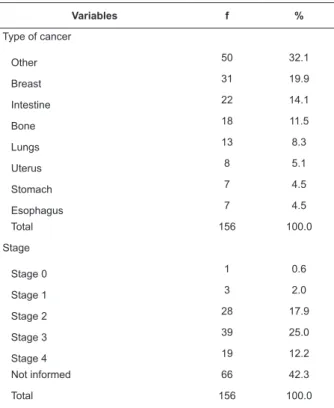
Belonging to variable of type cancer, the category
“other” (peritoneum, parotid gland, mouth, prostate,
larynx, skin, leukemia, testicles, lymphatic, ovary, Hodking
and non Hodking lymphoma, liver, pancreas, brain, bladder,
and urethra) obtained, among all surveyed individuals, a
percentage of 32.1. As for the stage of the disease, the
category non-informed had the higher frequency among
participants (42.3%). We highlight that the stages 3 and 4
represent 37.2% of the total sample (Table 1).
Concerning the time of the current cancer
diagnosis, the surveyed people reported having received
the diagnosis for up to 6 months (53.2%, average of
6). Regarding the duration of chemotherapy, the
category “up to 6 months” was also prominent among
the participants (61.5%, average of 5). The category
“up to 6 sessions of chemotherapy”, belonging to the
chemotherapy sessions variable, was cited by most of
the interviewed people (54.5%, average of 5) (Table 2).
Regarding the variable “other treatment besides
chemotherapy”, 51.3% of patients claimed not having
done any other therapy. However, for those who had had
other therapies, surgery presented greater prominence
(52.6%). As for cancer in other organs, the sample
showed “no” for 75.0% of cases. However, we noted that
for those patients who have already had cancer in other
organs, there was a higher frequency in the prostate
Table 1 - Distribution of cancer patients in chemotherapy
treatment consistent to variables of cancer type and
stage. Alfenas, state of Minas Gerais, Brazil, 2013
Variables f %
Type of cancer
Other 50 32.1
Breast 31 19.9
Intestine 22 14.1
Bone 18 11.5
Lungs 13 8.3
Uterus 8 5.1
Stomach 7 4.5
Esophagus 7 4.5
Total 156 100.0
Stage
Stage 0 1 0.6
Stage 1 3 2.0
Stage 2 28 17.9
Stage 3 39 25.0
Stage 4 19 12.2
Not informed 66 42.3
Total 156 100.0
Table 2 - Distribution of cancer patients in chemotherapy
treatment according to the variables time of current
cancer diagnosis, duration of chemotherapy, and
number of chemotherapy sessions. Alfenas, state of
Minas Gerais, Brazil, 2013
Variables f %
Time of current cancer diagnosis
Up to 6 months 83 53.2
7 to 12 months 49 31.4
13 to 18 months 10 6.5
19 to 24 months 13 8.3
Over than 24 months 1 0.6
Total 156 100.0
Duration of chemotherapy
Up to 6 months 96 61.5
7 to 12 months 45 28.8
13 to 18 months 10 6.4
19 to 24 months 5 3.3
Total 156 100.0
Sessions of chemotherapy
Up to 6 sessions 85 54.5
7 to 12 sessions 56 35.9
13 to 18 sessions 9 5.8
19 to 24 sessions 6 3.8
Total 156 100.0
Table 3 - Distribution of cancer patients in chemotherapy
treatment equivalent to the variables that follow other
treatments besides chemotherapy (treatment, other
types of cancer, and location). Alfenas, state of Minas
Gerais, Brazil, 2013
Variables f %
Other treatments besides chemotherapy
Yes 76 48.7
No 80 51.3
Total 156 100.0
Type of treatment*
Surgery 40 52.6
Radiotherapy 23 30.3
Surgery/radiotherapy 13 17.1
Total 76 100.0
Cancer in other organs
Yes 38 25.0
No 117 75.0
Total 156 100.0
Location of cancer†
Prostate 13 34.2
Breast 10 26.3
Other 9 21.1
Intestine 4 10.5
Lungs 2 5.3
Total 38 100.0
* Only those patients who did other treatment besides chemotherapy † Only those patients who have had cancer in other locations
There was no presence of chronic diseases for
51.9% of patients. However, most of those who declared
to hold some chronic disease (48.1%) featured it in an
unique way (85.3%). The most frequent disease among
participants was high blood pressure with 100%; but
it is worth highlighting the other diseases mentioned
by participants, such as diabetes mellitus, chronic
obstructive pulmonary disease, hyperthyroidism,
hypothyroidism, cysticercosis, and the Barrett’s
esophagus.
Of the total sample, 51.9% of the individuals
interviewed claimed not to take medicines of continuous
use. However, most of those who have undertaken the
use of drugs on a daily basis (48.1%), have used it in
an unique way (85.3%). The most used pharmacological
group was antihypertensives (100.0%), followed
by hypoglycemic medications, thyroid hormones,
bronchodilators, anticonvulsants, antacid and antiulcer
medications.
In the variable “milestone event in life”, 57.7
percent of participants denied the occurrence of
undergone a milestone event in the last year (42.3%),
the most cited was loss or death of loved ones (with
39% of answers), followed by the birth of children or
grandchildren (27.2%). Other landmark events also
cited by the population under study and that deserve to
be mentioned were: celebrations (21.2%), diagnosis of
disease in loved ones (4.5%), separation from partner
or family members (3%), and the arrest of family
members (3%).
To the internal consistency of the assessment
instrument used, the Rosenberg self-esteem scale, the internal Alpha Cronbach’s coeficient was applied with a value of 0.746. Thus, internal consistency
ended up being good and acceptable for the items
assessed and correlated with each other, indicating
homogeneity.
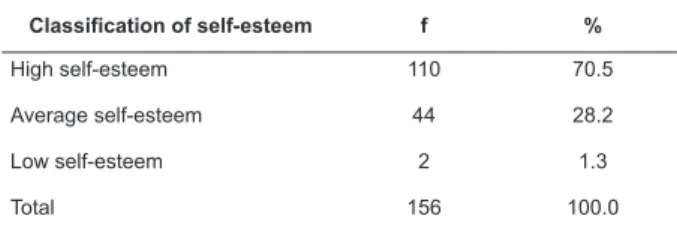
Concerning the classiication of self-esteem, we saw that most of the sample comprises patients
with high self-esteem (70.5%), followed by patients
with average self-esteem (28.2%), and by the ones
considered of low self-esteem (1.3%) (Table 4).
Table 4 - Distribution of cancer patients in chemotherapy treatment according to the classiication of self-esteem based on cut-off points. Alfenas, state of Minas Gerais,
Brazil, 2013
Classification of self-esteem f %
High self-esteem 110 70.5
Average self-esteem 44 28.2
Low self-esteem 2 1.3
Total 156 100.0
We identiied in this study that none of the following variables showed signiicant associations with the measure of self-esteem: gender (p = 0.172), age
group (p = 0.549), marital status (p = 0.363), number
of children (p = 0.344), monthly household income
(p = 0.430), education (p = 0.777), occupation (p =
0.067), religious belief (p = 0.160), exercise practice
(p = 0.994), smoking (p = 0.777), alcoholic beverages
consumption (p = 0.413), cancer type (p = 0.432),
disease stage (p = 0.956), time for cancer diagnosis
(p = 0.853), duration of chemotherapy treatment (p =
0.803), number of chemotherapy sessions (p = 0.708),
other types of cancer treatment besides chemotherapy
(p = 0.836), the presence of cancer in other organs (p
= 0.839), the presence of chronic diseases (p = 0.457),
continuous use of medicines (p = 0.457), and milestone
events in life (p = 0.585).
Discussion
Self-esteem is related to the way people see
themselves. It may present stable characteristics as
well as others considered lexible and adaptive. Thus, people’s self-concept may experience momentary
changes as, for example, when individuals compare
themselves to extremely successful people. With that, it
will be possible to feel certain contrast that will inevitably
be translated to the reduction or the increase of
self-esteem(11).
In a research carried out with 48 women who went
through breast cancer surgeries to analyze self-esteem,
the authors found that most women (54.1%) showed
high self-esteem(12), accordingly with the indings of this
study, which presented higher frequency of patients with
high self-esteem.
It is worth mentioning that people with high self-esteem feel conident and appreciated, present positive feelings towards themselves, believe in their
own competence, and feel capable of dealing with
the imposed challenges and to adapt themselves
to different situations. In this way, when people
undergoing chemotherapy treatment present high
self-esteem, it will be possible for them to see life in
another way and, consequently, to face the disease
and the treatment differently from patients with low
self-esteem(12).
It is relevant to point out that the professional
occupation is closely related to the overall assessment
individuals make of themselves, which may contribute to
increases in self-esteem, i.e., professional dissatisfaction
as well as the feeling of incompetence and dependency
can affect self-esteem. In this condition, most of the
assessed patients were retired or pensioners(13).
Regarding religious belief, another research with the
same population characteristics of this study presented
101 catholic participants (86%) among cancer patients
undergoing chemotherapy treatment, meeting the
results of this study, in which there was a predominance
of Catholicism.
When self-esteem is threatened by a negative
event, such as presence of chronic diseases like cancer,
individuals may develop increases in the levels of
the situation. In many cases, these ways are inadequate
or harmful to health, such as the consumption of alcohol.
The adoption of health-related behaviors has been
linked to subjects’ dissatisfaction about themselves,
with tendencies of adherence to smoking. Thus, it is
important to assess the consumption of cigarettes and
alcohol by cancer patients undergoing chemotherapy to
work together with them and prevent the worsening of
their health state(15-16).
There is no doubt that the diagnosis of cancer and its
treatments affect negatively the image that patients have
of their own bodies, resulting in affective disorders and
changes in self-esteem. A type of neoplasm that can cause
changes in women’s body image is breast cancer. A study
with 72 women showed that there are several factors
between the impact of breast cancer and its treatment on
the self-esteem of patients. Most of these are based on
patients’ age, on the disease’s stage of evolution as well
as on treatment types adopted against cancer. However,
neither the education level, nor the marital status or the
type of breast surgery were associated with the
self-esteem expressed by patients, being only a positive
relationship between the level of self-esteem and the
general perception about the quality of life(17).
The experience of diagnosis is singular to each
individual. However, the feelings of anguish, fear, worry,
and anxiety follow cancer patients from diagnosis until
the end of the treatment(6).
According to the data of this study, regarding
low or average self-esteem and the frequency of
individuals who had had other treatments in addition to
chemotherapy, it is important to highlight surgery, which
is required in almost all cases, causing changes in the
self-concept and body image of patients that face it, once
surgery is seen as an aggressive and disturbing method,
triggering emotional changes such as anxiety, irritation, uncertainty, and other conlicts. The lack of information on pain and physical limitations in the postoperative
period are factors that can aggravate the emotional and social conlicts experienced by patients(12).
Through these surveys, it is important to highlight the relevance of nursing in the identiication of the needs presented by patients who have gone or will go
through surgery, as well as other treatments besides
chemotherapy. A viable proposal would be the formation
of groups focused on supporting, maintaining and/or
restoring the self-esteem of these patients, once the
physical and psychosocial rehabilitation continues by the
end of the treatment(12).
We also noted that the low level of social
confrontation, as well as the ability to solve problems in patients with cancer, inluences the way they see themselves, interfering directly in their expectations
and, therefore, leading to low self-esteem. When it
comes to the frequency of participants of this study that
went through a milestone event in life and self-esteem,
it is said that when that event is the death of a loved
one (the most cited milestone event), sometimes family
members make use of religious help to understand the
situation, and to obtain an explanation for the inevitable
while searching for support(7-18).
In this way, the death of a loved one can come tied
up to a rupture of well-being, a condition that affects
work routine, social and familiar life, leading to changes
in the psychological state such as in self-esteem. With
that, professionals, including the ones from nursing,
need to carry out a careful and extensive assessment,
not only focused on clinical conditions, i.e., symptoms
and complaints, but in the whole biopsychosocial aspect
of individuals(19).
Conclusion
We concluded that the cancer patients assessed
in this study presented high self-esteem, considering
some of them also presented average self-esteem or
low self-esteem. In this way, addressing self-esteem in
cancer patients undergoing chemotherapy treatment is
complex, since it involves particular characteristics of
each individual, which affects the way of dealing with
the disease and the treatment. What becomes a great
challenge once the knowledge produced on this subject,
and attached to this population, is restricted to the
promotion of more insightful understanding.
This study presented limitations regarding the
research design that did not allow better establishment of the indings cause/effect relationship. However, we assumed the importance of this research to describe the
populations’ characteristics and the possible association
between independent and dependent variables, even
Another factor considered limiting was the size of
the sample that did not allow severe statistical analysis of
variables that may be associated with the subjects’ level
of self-esteem. Finally, the third limitation is related to the dificulty in collecting data for the variable “disease stage”, since many patients did not know the stage they
were, and also considering that such information was
often ignored in most medical records.
Through these results, we infer the necessity of
developing longitudinal studies that aim to evaluate
these patients’ self-esteem in different stages of
chemotherapy (by the beginning, the middle, and by
the end of it).
Therefore, nursing should promote the involvement
of strategies and actions that may assist its work in the
maintenance of self-esteem of patients undergoing
chemotherapy, and support those who need to be
assisted, since the psychosocial rehabilitation continues
after the period of diagnosis, as well as by the end of
the treatment.
References
1. Nakashima JP, Koifman RJ, Koifman S. Incidência
de câncer na Amazônia ocidental: estimativa de base
populacional de Rio Branco, Acre, Brasil, 2007-2009.
Cad Saúde Pública. 2012;28(11):2125-32.
2. Salci MA, Marcon SS. Itinerário percorrido pelas
mulheres na descoberta do câncer. Esc Anna Nery.
2009;13(3):558-66.
3. Soares EM, Silva SR. Perfil de pacientes com câncer
ginecológico em tratamento quimioterápico. Rev Bras
Enferm. 2010;63(4):517-22.
4. Nicolussi AC, Sawada NO. Qualidade de vida de
pacientes com câncer colorretal em terapia adjuvante.
Acta Paul Enferm. 2009;22(2):151-61.
5. Jorge LLR, Silva SR. Evaluation of the Quality
of Life of Gynecological Cancer Patients Submitted
to Antineoplastic Chemotherapy. Rev. Latino-Am.
Enfermagem. 2010;18(5):849-55.
6. Souza JR, Araújo TCCF. Eficácia terapêutica de intervenção
em grupo psicoeducacional: um estudo exploratório em
oncologia. Estud Psicol. 2010;27(2):187-96.
7. Garzon OE, Salazar, LPM, Barrero JAC, Chavarro AS,
Toro GIC, Vernaza MBG. Relación entre las estrategias
de afrontamiento, ansiedad, depresión y autoestima, en
un grupo de adultos con diagnóstico de cáncer. Psychol
Av Discip. 2014;8(1):77-83.
8. Bertan FC, Castro EK. Quality of Life, Anxiety and
Depressions Indicators and Sexual Satisfaction in Adult
Patients with Cancer. Rev Salud Soc. 2010;1(2):76-88.
9. Dini GM, Quaresma MR, Ferreira LM. Adaptação
cultural e validação da versão brasileira da Escala de
Autoestima de Rosenberg. Rev Soc Bras Cir Plást.
2004;19(1):41-2.
10. Ministério da Saúde (BR). Conselho Nacional de
Saúde. Comissão Nacional de Ética em Pesquisa.
Resolução No 466 de 12 de dezembro de 2012: aprova
as diretrizes e normas regulamentadoras de pesquisas
envolvendo seres humanos. Brasília: Ministério da
Saúde; 2012.
11. Ramos M. Adaptação para uma população de
estudantes universitários portugueses da escala de
autoestima de estado de Heatherton e Policy. Psicologia.
2014;28(1):32-8.
12. Gomes NS, Silva SR. Avaliação da autoestima de
mulheres submetidas à cirurgia oncológica mamária.
Texto Contexto Enferm. 2013;22(3):509-16.
13. Peixoto F, Almeida LS. Self-concept, Self-esteem and
Academic Achievement: Strategies for Maintaining
Self-esteem in Students Experiencing Academic Failure. Eur
J Psychol Educ. 2010;25(2):157-75.
14. Mesquita AC, Chaves ECL, Avelino CCV, Nogueira
DA, Panzini RG, Carvalho EC. The use of Religious/
Spiritual Coping among Patients with Cancer Undergoing
Chemotherapy Treatment. Rev. Latino-Am. Enfermagem.
2013;21(2):539-45.
15. Aguirre AA, Castillo MMA, Zanetti ACG. Adolescent
Self-Steem and its Relationship to the Alcohol
Risk Consumption. Rev. Latino-Am. Enfermagem.
2010;18(esp.):634-40.
16. Martins CR, Gordia AP, Silva DAS, Quadros TMB,
Ferrari EP, Teixeira DM, et al. Insatisfação com a imagem
corporal e fatores associados em universitários. Estud
Psicol. 2012;17(2):241-6.
17. Rincón M.E, Pérez MA, Borda M, Martín A. Impacto
de la reconstrucción mamaria sobre la autoestima y la
imagen corporal en pacientes con cáncer de mama. Univ
Psychol. 2012;11(1):25-41.
18. Mendes JA, Lustosa MA, Andrade MCM. Paciente
terminal, família e equipe de saúde. Rev SBPH.
19. Campos MTFS. Uma influência do luto no
comportamento alimentar e suas implicações
nas condutas nutricionais. Ciênc Saúde Coletiva.
2013;18(9):2769-79.
Received: Nov. 16th 2014