Effect of isopregnanolone on rapid tolerance to the
anxiolytic effect of ethanol
Influência da isopregnenolona na tolerância rápida
ao efeito ansiolítico do etanol
A b s t r a c t
Objective: It has been shown that neurosteroids can either block or stimulate the development of chronic and rapid tolerance to the incoordination and hypothermia caused by ethanol consumption. The aim of the present study was to investigate the influence of isopregnanolone on the development of rapid tolerance to the anxiolytic effect of ethanol in mice. Method: Male Swiss mice were pretreated with isopregnanolone (0.05, 0.10 or 0.20 mg/kg) 30 min before administration of ethanol (1.5 g/kg). Twenty-four hours later, all animals we tested using the plus-maze apparatus. The first experiment defined the doses of ethanol that did or did not induce rapid tolerance to the anxiolytic effect of ethanol. In the second, the influence of pretreatment of mice with isopregnanolone (0.05, 0.10 or 0.20 mg/kg) on rapid tolerance to ethanol (1.5 g/kg) was studied. Conclusions: The results show that pretreatment with isopregnanolone interfered with the development of rapid tolerance to the anxiolytic effect of ethanol.
Keywords: Ethanol; Drug tolerance; Anti-anxiety agents; Mice; Alcoholism
R e s u m o
Objetivo: Estudos prévios têm mostrado que os neuroesteróides podem bloquear ou estimular o desenvolvimento da tolerância rápida e crônica aos efeitos de incoordenação e hipotermia produzidos pelo etanol. O objetivo do presente estudo foi investigar a influência da isopregnenolona sobre o desenvolvimento da tolerância rápida ao efeito ansiolítico do etanol em camundongos. Método: Camundongos suíços, machos, foram pré-tratados com isopregnenolona (0,05, 0,10 ou 0,20 mg/kg) 30 minutos antes da administração de etanol (1,5 g/kg). Após 24 horas, todos os animais foram testados no labirinto em cruz elevado. O primeiro experimento foi realizado com o intuito de selecionar uma dose de etanol que produzisse tolerância rápida ao efeito ansiolítico do etanol. No segundo experimento, o objetivo foi investigar o efeito da isopregnenolona (ISO; 0,05, 0,10 ou 0,20 mg/kg) sobre a tolerância rápida ao etanol (1,5 g/kg). Conclusões: Os resultados mostram que o tratamento prévio com isopregnenolona interferiu no desenvolvimento da tolerância rápida ao efeito ansiolítico etanol.
Descritores: Etanol; Tolerância a drogas; Ansiolíticos; Camundongos; Alcoolismo
1 Department of Natural Sciences, Universidade Regional de Blumenau, Blumenau (SC), Brazil 2 Medicine Committee, Universidade do Vale do Itajaí (Univali), Itajaí (SC), Brazil
Thaize Debatin,
1Adriana Dias Elpo Barbosa
2Department of Natural Sciences, Universidade Regional de Blumenau, Blumenau (SC), Brazil
Financing: None
Conflicts of interest: None
Submitted: 29 November 2004 Accepted: 25 May 2005
Correspondence
Adriana Dias Elpo Barbosa
Coordenadoria de Medicina, Centro de Ciências da Saúde, Universidade do Vale do Itajaí
Rua Uruguai, 458
89302-202 Itajaí, SC, Brazil
Phone: (55 47) 34 1-7678 Fax: (55 47) 34 1-7865 E-mail: [email protected]
I n t r o d u c t i o n
Although alcoholism is one of the principal medical problems worldwide, the mechanisms responsible for the various clinical manifestations of this disease remain unclear. Therefore, various studies have been carried out in attempts to gain a better understanding of the mechanisms of action that result in the development of alcohol tolerance and alcohol dependence. It has been suggested that the phenomenon of tolerance to alcohol is one of the factors associated with dependence, and alcohol tolerance has therefore been widely studied. Knowledge of the phenomenon of tolerance to the effects of ethanol has furthered understanding of the implicit nature of the habit of consuming alcoholic beverages, thereby leading to the development of new treatment regimens for this disease.
Tolerance is one of the various criteria that characterize ethanol dependence. It is defined as the need for progressively greater amounts of the substance to reach the state of intoxication or an accentuated reduction of its effect with the constant use of the same quantity of the substance.1-2
A temporal approach to the study of tolerance allows us to classify it as acute, rapid or chronic. Acute tolerance is observed during a single episode of ethanol administration, whereas chronic tolerance is generally detected after various days, weeks or months of repeated ethanol administration.3-4 Rapid
tolerance, which is usually detected between 8 and 24 hours after the first ethanol injection,5-8 has been considered a
predictive model of chronic tolerance due to the similarity observed between rats in the two types of tolerance.9-10
It has been demonstrated that ethanol affects a variety of neurotransmitter systems, such as those of acetylcholine, monoamine, amino acids and neuroactive steroids.11-12 Ethanol
also exerts significant effects on membranes, ionic channels, second messenger systems and nitric oxide.13-16 However, some
studies suggest that ethanol can stimulate GABAergic n e u r o t r a n s m i s s i o n a n d b l o c k g l u t a m a t e r g i c neurotransmission.2,17 The effect of ethanol on the GABA-A
receptor can contribute to its anxiolytic and sedative effects,18
resulting in learning impairment and memory loss.19-20 It has
been reported that the development of alcohol tolerance and alcohol dependence seems to be associated with reduced effectiveness of GABA or of the benzodiazepines in some regions of the brain, due in part to the desensitization or down-regulation of the GABA-A receptor.21-22
The term “neurosteroid” was proposed by Baulieu in 1981 and has been applied to various steroids that accumulate in t h e n e r v o u s s y s t e m , i n d e p e n d e n t l y o f t h e e n d o c r i n e steroidogenic glands, and can be resynthesized from cholesterol, in both the central and peripheral nervous systems.23-24 It has
been demonstrated that neurosteroids, in addition to their classical genomic action, have nongenomic effects.25 For
example, allopregnanolone, allotetrahydrodeoxycorticosterone, progesterone, epipregnanolone and isopregnanolone (a neuroactive metabolite of progesterone) act as positive m o d u l a t o r s ,26-27 w h e r e a s p r e g n e n o l o n e s u l f a t e a n d
dehydroepiandrosterone sulfate act as negative modulators of the GABA-A receptor.28-29 Melchior & Ritzmann demonstrated
that the neurosteroids dehydroepiandrosterone sulfate, pregnenolone sulfate and pregnenolone blocked the anxiolytic effect of ethanol in mice.30-31 In addition, it has been
demonstrated that chronic treatment with neurosteroids in mice interferes with tolerance to the antinociceptive effect of m o r p h i n e a n d t o t h e e f f e c t o f b e n z o d i a z e p i n e s o n locomotion.32-33
Studies carried out by Barbosa & Morato6,34-35 revealed that
the pretreatment of mice with pregnenolone sulfate or dehydroepiandrosterone sulfate facilitated tolerance to ethanol, whereas epipregnanolone blocked such tolerance. Since the anxiolytic effect of ethanol has been used for several years in the study of the various aspects of ethanol, and since this effect is one of the factors generally recognized as being subjacent to dependence on this drug, the present study investigated the influence of isopregnanolone on the development of rapid tolerance to the anxiolytic effect of ethanol in mice.
M e t h o d 1. Animals
This study involved male Swiss mice, aged 3 to 3.5 months, weighing 35-40 g and housed in the animal facility of the Laboratory of Physiology of the Regional University of Blumenau. The mice were maintained in a temperature-controlled environment (23 ± 1°C) on a 12-h light/dark cycle (lights on at 6 am) and were given free access to food and water. The present study was conducted in accordance with the recommendations of the Guide for the Care and Use of Laboratory Animals of the National Institutes of Health of the United States. The experimental protocol was approved by the Ethics Committee for the Use of Animals of the Regional University of Blumenau (process no. CEUA-004/2003).
2. Drugs
The following drugs were used: analytical-grade ethanol (degree of purity = 99.8%; Merck, Darmstadt, Germany) diluted in saline solution (0.9% NaCl) at 14% (p/v) in all experiments; isopregnanolone (3 beta-hydroxy-5 alpha-pregnan-20-one; Research Biochemicals International, Natick, MA, USA), prepared in the proper concentrations in saline solution; the saline solution was prepared with NaCl (Merck) in distilled water at a concentration of 0.9%. All of the solutions were administrated intraperitoneally, and all were injected in volu-mes of 1 ml/kg of body weight, except for the ethanol, the proportion of which was adjusted according to the dose utilized.
3. Elevated plus-maze test
The elevated plus-maze (EPM) is a T-shaped wooden maze positioned at 56 cm above the floor and consists of two open arms (30 x 5 cm) and two closed arms (30 x 5 x 30 cm), directly opposite each other, with a 0.5-cm high acrylic protector surrounding the open arms in order to prevent the animals from falling. The apparatus was maintained in a partially dark room, illuminated by red light (44 lux). Prior to the EPM test, the animals were placed in a wooden arena (40 x 40 cm) for five minutes to become accustomed to the test environment. The animals were placed in the EPM for five minutes in order to record the behavioral measurements, which consist of determining the frequency of entry into the open arms (FEO) and into the closed arms (FEC), as well as the elapsed time spent in the open arms (TSO) and in the closed arms (TSC). The percentage of FEO (%FEO) and of TSO (%TSO) were calculated according to the formulas: %FEO = FEO × 100 %TSO = TSO × 100 FEO + FEC TSO + TSC
closed arms. The proportion of the total exploration of the open arms is a measure of anxiety. Therefore, an increase in the percentage of entries and in the time spent in these arms is considered indicative of the anxiolytic action of drugs.
4. Experimental procedure
Experiment 1 – Effect of different doses of ethanol on the development of rapid tolerance to the anxiolytic effect. This experiment was carried out with the objective of selecting a dose of ethanol that would result in rapid tolerance to the anxiolytic effect of this drug. On day 1, 30 mice (three groups of 10) received ethanol (1.5 g/kg), and 30 others (also in three groups of 10) received saline. The animals were then returned to their home cages. On day 2, all of the animals received ethanol (0.75, 1.0 or 1.5 g/kg), and the anxiolytic response was measured after 10 minutes to evaluate the degree of rapid tolerance.
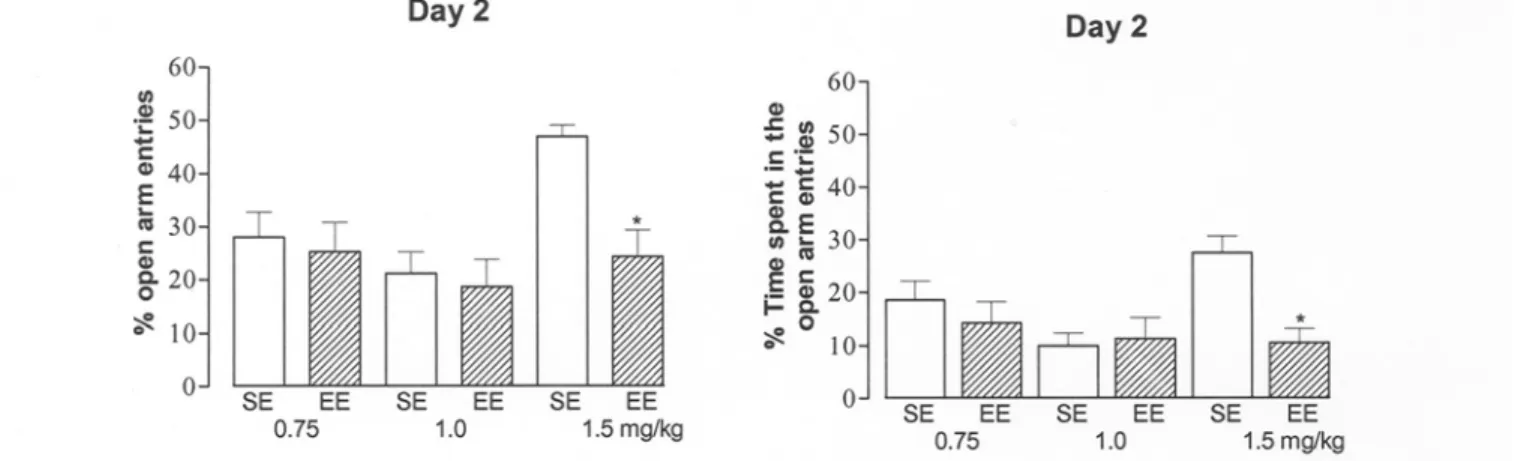
Experiment 2 – Effect of isopregnanolone on the rapid tolerance to the anxiolytic effect of ethanol. On day 1 of the experiment, 60 mice (three groups of 20) were pretreated with saline, and another 60 (also in three groups of 20) were pretreated with isopregnanolone (0.05, 0.10 or 0.20 mg/kg, respectively). After 30 minutes, each group was divided into two subgroups of 10 mice each, and the mice in one of each pair of subgroups received 1.5 g/kg of ethanol, whereas those in the corresponding subgroups received 1.5 g/kg of saline. The animals were then returned to their home cages. On day 2, all of the animals were treated with a dose of 1.5 g/kg of ethanol and the anxiolytic response was evaluated. The 1.5 g/kg dose of ethanol was chosen because it produced more evident tolerance (Figure 1).
5. Statistical analysis
The results were evaluated using Student’s t-test or one-way ANOVA. The post hoc test applied was the Tukey test. Values of p = 0.05 were considered statistically significant, and the results are presented as mean ± SEM.
R e s u l t s
Figure 1 illustrates the effect of different doses of ethanol on the development of rapid tolerance to the anxiolytic effect of ethanol. Administration of a 1.5 g/kg dose of ethanol on day 2 resulted in a reduction in the anxiolytic effect. Ethanol administration decreased the %FEO [t(1.18) = 3.825; p < 0.0024] and the %TSO [t(1.18) = 3.692; p < 0.0027].
The results of experiment 2 are presented in Figure 2. On
day 2, pretreatment with a 0.20 mg/kg dose of isopregnanolone blocked the development of rapid tolerance to the anxiolytic effect of ethanol. However, there was a significant decrease in the anxiolytic effect in the control groups that received ethanol on both days (EE), suggesting that the 1.5 g/kg dose of ethanol results in rapid tolerance. In the ANOVA, the factors that were found to have a significant effect were as follows: ethanol treatment (%FEO [F(1.36) = 27.75; p < 0.0001] and %TSO [F(1.36) = 16.43; p < 0.0003] – %FEO [F(1.36) = 22.65; p < 0.0001] and %TSO [F(1.36) = 12.76; p < 0.0010] – %TSO [F(1.36) = 6.56; p < 0.014] (Figures 2A, 2B and 2C); and pretreatment with isopregnanolone (%FEO [F(1.36) = 12.99; p < 0.0009] and %TSO [F(1.36) = 15.09; p < 0.0004]) (Figu-re 2C). The post hoc analysis (Tukey test) confirmed that the 0.20 mg/kg pretreatment with isopregnanolone blocked the rapid tolerance compared to the control groups, although the 0.10 mg/kg dose only partially blocked the development of such tolerance (Figure 2B). However, the 0.05 mg/kg dose had no effect on the development of rapid tolerance to ethanol (Figure 2A).
D i s c u s s i o n
The results of the present study clearly demonstrate the development of rapid tolerance to the anxiolytic effect of ethanol in mice receiving a 1.5 g/kg dose on two consecutive days. T h e s e d a t a c o r r o b o r a t e t h e r e s u l t s o b t a i n e d i n o t h e r experiments, in which rapid tolerance to the incoordination and hypothermia caused by ethanol consumption was achieved at certain dose levels.6-7,35-38 In addition, studies carried out by
Khanna et al. revealed that rapid tolerance occurs when ethanol is administered on both test days (intoxicated practice) and also in the dummy test (measurements were not actually recorded until the second day of the protocol), suggesting that the behavioral experience on an inclined plane or on the hypothermia test is not crucial for the development of rapid tolerance to ethanol.36 Our results are also in accordance with
those of that study since our animals were tested in the elevated plus-maze only on the second day. Moreover, the results of studies carried out by Bertoglio & Carobrez suggest that previous experience in the elevated plus-maze affects the anxiolytic effect of ethanol and of phenobarbital, a phenomenon known as “one-trial tolerance”.39
receptor,27 prior to the administration of ethanol significantly
blocked the development of rapid tolerance to the anxiolytic effect of the ethanol. These results are consistent with those of previous studies on the influence of neurosteroids on rapid and chronic tolerance to the incoordination and hypothermia induced by ethanol consumption in mice.6,34-35
The doses of isopregnanolone used in the present study did not have any residual effect on the performance of the animals on the second day. In addition, the effect of this neurosteroid seems to be pharmacodynamic rather than pharmacokinetic since our results and those of previous studies have shown that the acute administration of neurosteroids does not inter-fere with the pharmacokinetics of ethanol in mice or rats.6,35,40
However, Barbaccia et al. reported that a low dose of ethanol ( 1 g / k g ) i n c r e a s e d l e v e l s o f a l l o p r e g n a n o l o n e a n d allotetrahydrodeoxycorticosterone in the cerebral cortices and hippocampi in a lineage of rats that prefer alcohol, when compared to those presented by a lineage of rats that do not p r e f e r a l c o h o l .41 O ’ D e l l e t a l . a l s o s h o w e d t h a t t h e
administration of ethanol (2 g/kg) increased the levels of these neurosteroids in the frontal cortices of rats.42 Furthermore,
the findings of other studies have suggested that acute a d m i n i s t r a t i o n o f e t h a n o l d e c r e a s e s t h e l e v e l s o f dehydroepiandrosterone sulfate in the brains of rats.43
R e f e r e n c e s
1 . American Psychiatric Association [DSM-IV]. Manual diagnóstico e
estatística de transtornos mentais. 4a Ed. (D. Batista, trad.) Porto Alegre, RS: Artes Médicas; 1995.
2 . Tabakoff B, Hoffman PL. Alcohol addiction: an enigma among us.
Neuron. 1996;16(5):909-12.
3. Kalant H. Research on tolerance: what can we learn from history?
Alcohol Clin Exp Res. 1998;22(1):67-76.
4. Chandler JL, Harris RA, Crews TF. Ethanol tolerance and synaptic
plasticity. Trends Pharmacol Sci. 1998;19(12):491-5.
5. Crabbe JC, Rigter H, Uijlen J, Strijbos C. Rapid development of
tolerance to the hypothermic effect of ethanol in mice. J Pharmacol Exper Ther. 1979;208(1):128-33.
6. Barbosa AD, Morato GS. Influence of neurosteroids on the
development of rapid tolerance to ethanol in mice. Eur J Pharmacol. 2001;431(2):179-88.
7 . Barreto PS, Lemos T, Morato GS. NMDA-receptor antagonists block
the development of rapid tolerance to ethanol in mice. Addict Biol. 1998 3:55-64.
8 . Rustay NR, Crabbe JC. Genetic analysis of rapid tolerance to ethanol’s
incoordinating effects in mice: inbred strains and artificial selection. Behav Genet. 2004;34(4):441-51.
9. Chan AW, Schanley DL, Aleo MD, Leong FW. Cross-tolerance between
ethanol and chlordiazepoxide. Alcohol. 1985;2(2):209-13.
10. Khanna JM, Kalant H, Weiner J, Shah G. Rapid tolerance and
cross-tolerance as predictors of chronic tolerance and cross-tolerance. Pharmacol Biochem Behav. 1992;41(2):355-60.
11. Bowen CA, Purdy RH, Grant KA. Ethanol-like discriminative stimulus
effects of endogenous neuroactive steroids: effect of ethanol training dose and dosing procedure. J Pharmacol Exp Ther. 1999;289(1):405-11.
12. Vanover KE, Suruki M, Robledo S, Huber H, Wieland S, Lan NC,
Gee KW, Wood PL, Carter RB. Positive allosteric modulators of the
GABAA receptor: differential interaction of benzodiazepines and
neuroactive steroids with ethanol. Psychopharmacology (Berl). 1999;141(1):77-82.
13. Mihic SJ. Acute effects of ethanol on GABA-A and glycine receptor
function. Neurochem Int. 1999;35(2):115-23.
14. Pandey SC. Neuronal signaling systems and ethanol dependence.
Mol Neurobiol. 1998;17(1-3):1-15.
15. Snell LD, Claffey DJ, Ruth JA, Valenzuela CF, Cardoso R, Wang Z,
Levinson SR, Sather WA, Williamson AV, Ingersoll NC, Ovchinnikova L, Bhave SV, Hoffman PL, Tabakoff B. Novel structure having antagonist actions at both the glycine site of the N-methyl-D-aspartate receptor and neuronal voltage-sensitive sodium channels: biochemical, electrophysiological, and behavioral characterization. J Pharmacol Exp Ther. 2000;292(1):215-27.
16. Venkov CD, Myers PR, Tanner MA, Su M, Vaughan DE. Ethanol
increases endothelial nitric oxide production through modulation of nitric oxide synthase expression. Thromb Haemost. 1999;81(4):638-42.
17. Siggins GR, Martin G, Roberto M, Nie Z, Madamba S, De Lecea L.
Glutamatergic transmission in opiate and alcohol dependence. Ann N Y Acad Sci. 2003;1003:196-211.
18. Allan AM, Mayes CG, Draski LJ. Gamma-aminobutyric acid-actived
chloride channels in rats selectively bred for differential acute sensitivity to alcohol. Alcohol Clin Exp Res. 1991;15(2):212-8.
19. Vandergriff JL, Mathews DB, Best PJ, Simson PE. Effects of ethanol
and diazepam on spatial and non-spatial tasks in rats on an 8-arm maze. Alcohol Clin Exp Res. 1995;19:64.
20. White AM, Simson PE, Best PJ. Comparison between the effects of
ethanol and diazepam on spatial working memory in the rat. Psychopharmacology (Berl). 1997;133(3):256-61.
21. Devaud LL, Smith FD, Grayson DR, Morrow AL. Chronic ethanol
consumption differentially alters the expression of gamma-aminobutyric acid receptor subunit mRNAs in rat cerebral cortex: competitive, quantitative reverse transcriptase-polymerase chain reaction analysis. Mol Pharmacol. 1995;48(5):861-8.
22. Devaud LL, Fritschy JM, Sieghart W, Morrow AL. Bidirectional
alterations of GABA(A) receptors subunit peptide levels in rat cortex during chronic ethanol consumption and withdrawal. J Neurochem. 1997;69(1):126-30.
23. Baulieu EE. Neurosteroids: of the nervous system, by the nervous
system, for the nervous system. Rec Prog Horm Res. 1997;52:1-32.
24. Compagnone NA, Mellon SH. Neurosteroids: biosynthesis and
function of these novel neuromodulators. Front Neuroendocrinol. 2000;21(1):1-56.
25. Bowen CA, Purdy RH, Grant HA. An investigation of endogenous
neuroactive steroid-induced modulation of ethanol’s discriminative stimulus effects. Behav Pharmacol. 1999;10(3):297-311.
26. Lambertt JJ, Belelli D, Hill-Venning C, Peters JA. Neurosteroids and
GABA-A receptor function. Trends Pharmacol Sci. 1995;16(9):295-303.
27. Leskiewicz M, Budziszewska B, Jaworska-Feil L, Kubera M,
Basta-Kaim A, Lason W. Inhibitory effect of some neuroactive steroids on cocaine-induced kindling in mice. Pol J Pharmacol. 2003;55(6):1131-6.
28. Majewska MD. Neurosteroids: endogenous bimodal modulators of
the GABA-A receptor. Mechanism of action and physiological
significance. Prog Neurobiol. 1992;38(4):379-95.
29. Mienville JM, Vicini S. Pregnenolone sulfate antagonizes GABA-A
receptor-mediated currents via a reduction of channel opening
frequency. Brain Res. 1989;489(1):190-4.
30. Melchior CL, Ritzmann RF. Dehydroepiandrosterone is an anxiolytic
in mice on the plus maze. Pharmacol Biochem Behav. 1994;47:437-41.
31. Melchior CL, Ritzmann RF. Pregnenolone and pregnenolone sulfate,
alone and with ethanol, in mice on the plus-maze. Pharmacol Biochem Behav. 1994;48(4):893-7.
blocks the development of tolerance to ethanol-induced incoordination,6 whereas agonists and antagonists of GABA-B
receptor have been shown to block and stimulate tolerance, respectively.37 Recent experiments have demonstrated that
neurosteroids exert positive and negative modulatory influence on the GABA-A and NMDA receptors, as well as blocking or stimulating the development of a tolerance to ethanol.6,34-35 These
findings suggest that tolerance to ethanol is related to the GABA-A system, the NMDGABA-A system or both.
It is known that neurosteroids interact with ethanol. The positive modulators of GABA-A receptor (allopregnanolone and pregnenolone) increased the sleep time and motor loss induced by ethanol in mice.44-45 Therefore, ethanol and some neurosteroids
might have similar effects associated with the GABA-A receptor complex, which may explain the interactions between these drugs. The chronic administration of ethanol has been correlated with a decrease in GABA-A receptor-mediated response sensitivity in the central nervous system.46-48 It has also been demonstrated that the
chronic administration of allopregnanolone, a positive modulator of the GABA-A receptor, down-regulates the GABA-A receptor.49 In
addition, it has been shown that removing neurosteroid precursors through oophorectomy does not directly affect the neuro-adaptation of the GABA-A receptors associated with chronic exposure to ethanol.50 Based on such evidence, one would think that the
isopregnanolone treatment administered on day 1 would have increased the ethanol-induced down-regulation of the GABA-A receptor system, thereby increasing tolerance to ethanol on day 2. However, the opposite was observed; the ethanol-induced tolerance was blocked isopregnanolone administration. Therefore, it seems that the influence of this neurosteroid on the development of tolerance to ethanol seems to be unrelated to alterations in the down-regulation of the GABA-A receptors. In view of this, other mechanisms may be involved in the development of rapid tolerance to ethanol.
32. Reddy DS, Kulkarni SK. Chronic neurosteroid treatment prevents development of morphine tolerance and attenuates abstinence behavior in mice. Eur J Pharmacol. 1997;337(1):19-25.
33. Reddy DS, Kulkarni SK. Neurosteroid coadministration prevents
development of tolerance and augments recovery from benzodiazepine withdrawal anxiety and hyperactivity in mice. Methods Find Exp Clin Pharmacol. 1997;19(6):395-405.
34. Barbosa AD, Morato GS. Effect of epipregnanolone and pregnenolone
sulfate on chronic tolerance to ethanol. Pharmacol Biochem Behav. 2000;67(3):459-64.
35. Barbosa AD, Morato GS. Pregnenolone sulfate,
dehydroepiandrosterone sulfate and allotetrahydrodeoxycorticosterone affect rapid tolerance to the hypothermic effect of ethanol. Brain Res Bull. 2002;58(1):99-105.
36. Khanna JM, Chau A, Shah G. Characterization of the phenomenon
of rapid tolerance to ethanol. Alcohol. 1996;13(6):621-8.
37. Zaleski MJB, Nunes-Filho JR, Lemos T, Morato GS. GABAB receptors
play a role in the development of tolerance to ethanol in mice. Psychopharmacology (Berl). 2001;153:415-24.
38. Wazlawik E, Morato GS. Influence of drugs acting on nitric
oxide-dependent pathways on ethanol tolerance in rats. Psychopharmacology (Berl). 2003;170(4):343-50.
39. Ber toglio LJ, Carobrez AP. Anxiolytic effects of ethanol and
phenobarbital are abolished in test-experienced rats submitted to the elevated plus maze. Pharmacol Biochem Behav. 2002;73(4):963-9.
40. Melchior CL, Allen PM. Interaction of pregnanolone and pregnenolone
sulfate with ethanol and pentobarbital. Pharmacol Biochem Behav. 1992;42(4):605-11.
41. Barbaccia ML, Affricano D, Trabucchi M, Purdy RH, Colombo G,
Agabio R, Gessa GL. Ethanol markedly increases GABAergic neurosteroids in alcohol-preferring rats. Eur J Pharmacol. 1999;384(2-3):R1-2.
42. O’Dell LE, Alomary AA, Vallee M, Koob GF, Fitzgerald RL, Purdy RH.
Ethanol-induced increases in neuroactive steroids in the rat brain and plasma are absent in adrenalectomized and gonadectomized
rats. Eur J Pharmacol. 2004;484(2-3):241-7.
43. Baulieu EE, Robel P. Dehydroepiandrosterone and
dehydroepiandrosterone sulfate as neuroactive neurosteroids. J Endocrinol. 1996;150 Suppl:S221-39.
44. Vanover KE. Interaction of ethanol with excitatory amino acid receptor
antagonists in mice. Eur J Pharmacol. 1999;368(2-3):137-42.
45. Vanover KE, Suruki M, Robledo S, Huber H, Wieland S, Lan NC,
Gee KW, Wood PL, Carter RB. Positive allosteric modulators of the GABA(A) receptor: differential interaction of benzodiazepines and neuroactive steroids with ethanol. Psychopharmacology (Berl). 1999;141(1):77-82.
46. Grobin AC, Matthews DB, Devaud LL, Morrow AL. The role of GABA(A)
receptors in the acute and chronic effects of ethanol. Psychopharmacology (Berl). 1998(1-2);139:2-19.
47. Kumar S, Fleming RL, Morrow AL. Ethanol regulation of
gamma-aminobutyric acid A receptors: genomic and nongenomic
mechanisms. Pharmacol Ther. 2004;10(3):211-26.
48. Devaud LL, Alele P. Differential effects of chronic ethanol
administration and withdrawal on gamma-aminobutyric acid type A and NMDA receptor subunit proteins in male and female rat brain. Alcohol Clin Exp Res. 2004;28(6):957-65.
49. Yu R, Follesa P, Ticku MK. Down-regulation of the GABA receptor
subunits mRNA levels in mammalian cultured cortical neurons following chronic neurosteroid treatment. Brain Res Mol Brain Res. 1996;41(1-2):163-8.
50. Devaud LL, Morrow AL, Nguyen UT. Ovariectomy has minimal effects
on neuroadaptations associated with ethanol dependence in female