Epidemiological situation of acquired immunodeiciency
syndrome (AIDS)-related mortality in a municipality in
northeastern Brazil. A retrospective cross-sectional study
Luana Rodrigues da Silva
I, Ellen Thallita Hill Araújo
II, Moisés Lopes Carvalho
III, Camila Aparecida Pinheiro Landim Almeida
IV,
Adélia Dalva da Silva Oliveira
V, Patrícia Maria Gomes de Carvalho
VI, Tatyanne Silva Rodrigues
VII, Viriato Campelo
VIIICentro Universitário UNINOVAFAPI, Teresina (PI), Brazil
INTRODUCTION
he high number of deaths due to acquired immunodeiciency syndrome (AIDS) in diferent segments of the Brazilian population has been studied within several ields of science. It is very important to gain knowledge of the underlying circumstances and causes of this infectious dis-ease. However, its high mortality rate represents a constant challenge within healthcare sionals’ practice and for the healthcare system. Such challenges may relect institutional, profes-sional and personal changes.
AIDS is an infectious disease caused by the human immunodeiciency virus (HIV), which afects the immune system and gives rise to immunosuppression, with T-CD4+ lymphocyte dei-ciency and dysfunction and impairment of the cellular immune response.1 his infection has a
large social dimension because of the large number of people infected with HIV. By the end of 2015, worldwide, 38.8 million people were living with HIV.2 In 2010, Brazil had 630,000 people
with the virus, which resulted in 34,500 new AIDS infections each year. Among the virus carri-ers, 255,000 were unaware that they were carrying HIV.3,4
A United Nations report on the worldwide situation showed that, in 2001, there were about 3.4 million new cases of HIV infection. In 2012, about 35.3 million people were living with HIV, with a signiicant increase in the number of cases of infection. At the same time, the number of AIDS-related deaths was declining, such that there were 1.2 million deaths in 2014.3
According to data from the Brazilian Ministry of Health’s Department of Sexually Transmissible Diseases (STDs), AIDS and Viral Hepatitis, the state of Piauí, located in the northeastern region, had an AIDS mortality coeicient of 2.4/100,000 inhabitants (2007-2013), which was lower than the AIDS-related mortality rate for Brazil (5.6/100,000 inhabitants). hese data suggest that AIDS epidemiology and mortality span diferent segments of the population in diferent manners.
IRN. Nurse, Undergraduate Nursing Department,
Centro Universitário UNINOVAFAPI, Teresina (PI), Brazil.
IIRN. Master’s Student, Department of Business
Sciences, Fundação Sousândrade, Universidade Atlântica, São Luís (MA), Brazil.
IIIRN. Doctoral Student, Department of
Biochemistry and Photodynamic Therapy Applied to Biomedical Engineering, Universidade do Vale do Paraíba (UNIVAP), São José dos Campos (SP), Brazil.
IVRN, MSc, PhD. Titular Professor, Master’s
Program on Family Health, Centro Universitário UNINOVAFAPI, Teresina (PI), Brazil.
orcid.org/0000-0003-4843-4572
VRN, MSc, PhD. Coordinator, Undergraduate
Nursing Department, Centro Universitário UNINOVAFAPI, Teresina (PI), Brazil.
VIRN, MSc, PhD. Coordinator, Undergraduate
Nursing Department, Universidade Federal do Piauí (UFPI), Teresina (PI), Brazil.
VIIRN. Master’s Student, Postgraduate Program
on Nursing, Universidade Federal do Piauí (UFPI), Teresina (PI), Brazil.
VIIIMD, MSc, PhD. Coordinator, Master’s Program
on Science and Health, Universidade Federal do Piauí (UFPI), and Physician at the Court of Justice of the State of Piauí (TJ/PI), Teresina (PI), Brazil.
KEY WORDS:
Epidemiology. Mortality.
Acquired immunodeiciency syndrome. Health information systems.
Brazil.
ABSTRACT
CONTEXT AND OBJECTIVE: The number of acquired immunodeiciency syndrome (AIDS)-related deaths covers diferent segments of the population diferently, making monitoring of this mortality essential. The aim of this study was to describe the epidemiological situation of AIDS-related mortality in a municipality in the northeastern region of Brazil.
DESIGN AND SETTING: Retrospective cross-sectional study based on data from death certiicates in the mortality information system of the Health Information Center, Municipal Health Foundation, Brazil.
METHODS: Between 2003 and 2013, we investigated death certiicates on which AIDS-related mortality was reported. Sociodemographic data, year, place, type of establishment where death occurred and underlying and associated causes that led to AIDS-related death were described. The Mann-Kendall test was used to verify the growth trend of the standardized mortality rate over the period studied.
RESULTS: Among the 1,066 AIDS-related deaths, 69.7% were among men; 47.2% of the individuals were 28-41 years of age, 32.7% had had 4-7 years of schooling, 66.9% were pardos (mixed race), 55.7% were unmarried and 15.3% were housekeepers. Hospitals were the site of 97% of the deaths, and 91% occurred at public hospitals. Respiratory failure was the main cause of death. The prevalence of infectious and parasitic diseases was 99.0%. AIDS-related mortality increased by 160% over the period studied, from 5.5/100,000 inhabitants in 2003 to 14.3/100,000 in 2013.
hus, epidemiological studies have emphasized the importance of caring for HIV/AIDS patients through provision of antiretroviral drugs at healthcare services.5
Universal access to antiretroviral therapy became available in Brazil in 1991 through use of zidovudine monotherapy (AZT). In 1996, highly active antiretroviral therapy was introduced with a combination of three drugs. By 2006, more than 16 drugs were available for treating AIDS in Brazil.6 Antiretroviral therapy is
started when the levels of defense cells (T-CD4+ lymphocytes) are below 350 cells/mm³, or when patients have some symptoms, with or without opportunistic infections.7
Because of the diiculty of regularly obtaining comprehensive, reliable and comparable mortality data, the Ministry of Health implemented a national epidemiological surveillance system and a single death certiicate (DC) model in 1975. hese measures resulted in establishment of the Mortality Information System (SIM/MS), which is responsible for compiling data on deaths that occur throughout the national territory, thus enabling construc-tion of demographic and health indicators for the populaconstruc-tion.8,9
In this context, the present research was justiied by the high number of AIDS-related deaths in diferent segments of the pop-ulation and the importance of determining the circumstances and the underlying and associated causes. Moreover, given the lack of scientiic studies on the epidemiological situation of AIDS-related mortality in the northeastern region of Brazil and, more specii-cally, in the municipality of Teresina, state of Piauí, monitoring of these deaths becomes essential.
OBJECTIVE
he objective of this study was to describe the epidemiolog-ical situation of AIDS-related mortality in the municipal-ity of Teresina, located in the northeastern region of Brazil, using uniied data from death certiicates stored in the Mortality Information System.
METHODS
his was a cross-sectional, quantitative, descriptive and ret-rospective study. It used data on mortality due to AIDS in the municipality of Teresina that was available in the SIM. he infor-mation was gathered at the Health Inforinfor-mation Center of the Municipal Health Foundation (NUINSA-FMS) in the city of Teresina, Brazil. here was good data coverage and satisfactory data quality.
Teresina, the capital of the state of Piauí, is in the central-west-ern part of the state and the mid-northcentral-west-ern part of the northeastcentral-west-ern region of Brazil. It has an area of approximately 1,756 km². he pop-ulation was 814,230 (380,612 men, 40.6%, and 433,618 women, 59.4% in 2010), with 767,557 people living in the urban area and 46,673 inhabitants in the rural area.10
he inclusion criteria for selecting the cases were that they needed to be AIDS-related deaths reported in the SIM between 2003 and 2013, which occurred in the city of Teresina. Data collection took place in September 2014, using a form constructed according to data contained in death certiicates, which are also available in the SIM. he study variables were sociodemographic characteristics (gender, age, schooling, marital status, race/color and occupation) location and type of establishment (public or private institution) where deaths occurred, year of death and causes that led to death from AIDS.
he results were organized through insertion of data into the Excel sotware. he data were presented in the form of absolute numbers (N), relative frequencies (%) and graphs containing infor-mation on sociodemographic characterization and description of the underlying causes of death from AIDS. Mortality coeicients were constructed using the number of AIDS-related deaths in the municipality of Teresina and the year, and these data were obtained from the SIM/MS. he speciic coeicients of AIDS-related mortal-ity per 100,000 inhabitants were calculated considering the popula-tion living in Teresina, Brazil. All data collected were processed in the Statistical Package for the Social Sciences (SPSS) sotware, ver-sion 21.0. he Mann-Kendall test was used to ascertain the growth trend of the standardized mortality rate over the period studied.
his project was implemented ater approval was received from the Research Ethics Committee of the UNINOVAFAPI University Center, Teresina, Piauí, Brazil, through ethics approval certii-cate (CAAE) no. 34750114.5.0000.5210 and report no. 771 803, in August 2014.
RESULTS
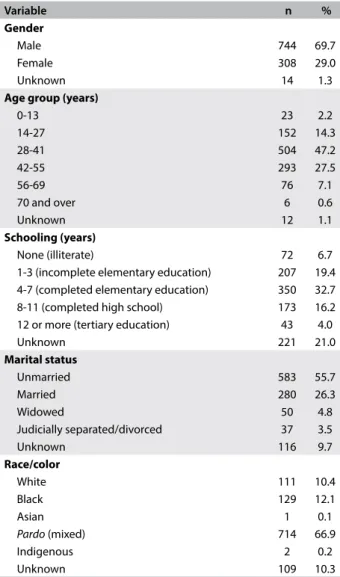
Among the 1,066 deaths due to AIDS in Teresina between 2003 and 2013, the highest numbers of cases occurred among men (69.7%) and among people aged 28-41 (47.2%). Although the high rate of unknown data (21%) hampered the analysis on schooling, the majority (32.7%) of the people for whom this was recorded had attended school for 4 to 7 years (complete elemen-tary schooling). In relation to marital status, there was a higher prevalence of unmarried people (55.7%). he race or color informed by the relatives was pardo (mixed) in 66.9% of the cases (Table 1). Figure 1 shows the distribution of deaths according to the type of occupation or activity performed.
Regarding the place where the AIDS-related deaths occurred, among the 1,066 deaths analyzed, 1,034 (97%) occurred at hos-pitals, 23 (2.2%) at home, six (0.6%) in an unknown place, two in other places (0.2%) and one (0.1%) at healthcare facilities other than hospitals (0.1%). Regarding the type of establishment where the deaths occurred, public institutions were most prevalent, with 970 (91%) of the deaths.
| ORIGINAL ARTICLE
Respiratory failure (35.6%) was the largest cause of death. AIDS was in ith place, with 5.2% of the deaths.
Regarding the causes associated with AIDS-related mortality in Teresina during the period studied, the distribution of the deaths according to the chapters of the Tenth Edition of the International Classiication of Diseases and Causes of Death (ICD-10) was as fol-lows (considering that more than one associated cause could be informed for the same death): for 1,030 deaths (99.0%), the associ-ated causes were in Chapter I, relating to infectious and parasitic dis-eases; for 271 deaths (26.1%), the causes were in Chapter X, respira-tory tract; for 42 deaths (4%), the causes were in Chapter XI, digestive tract; and for 35 deaths (3.4%), the causes were in Chapter IV, endo-crine, nutritional and metabolic diseases. Other, less frequently associ-ated causes were diseases of the genitourinary system (Chapter XIV),
for 32 deaths (3.1%); diseases of the nervous system (Chapter VI), for 30 deaths (2.9%); and diseases of the circulatory system (Chapter IX), for 21 deaths (2.0%).
Regarding the AIDS-related mortality rate, there was an increase of 160% over the period studied, from 5.5 deaths/100,000 inhab-itants in 2003 to 14.3/100,000 in 2013. Over the years analyzed, three times stood out: the year 2012, with the greatest signiicance, followed by 2009 and 2013. he series showed a progressive increase in mortality rates, as demonstrated by the Mann-Kendall test result (P = 0.032) and by the trend line, which conirmed that this rate will tend to increase over the coming years (Figure 2).
DISCUSSION
he proile of AIDS-related deaths in Teresina over the period studied corroborated the indings from previous studies, which reported that the population with HIV/AIDS consisted predominantly of adult men with no stable partner who had not completed high school.11
Variable n %
Gender
Male 744 69.7
Female 308 29.0
Unknown 14 1.3
Age group (years)
0-13 23 2.2
14-27 152 14.3
28-41 504 47.2
42-55 293 27.5
56-69 76 7.1
70 and over 6 0.6
Unknown 12 1.1
Schooling (years)
None (illiterate) 72 6.7
1-3 (incomplete elementary education) 207 19.4 4-7 (completed elementary education) 350 32.7 8-11 (completed high school) 173 16.2 12 or more (tertiary education) 43 4.0
Unknown 221 21.0
Marital status
Unmarried 583 55.7
Married 280 26.3
Widowed 50 4.8
Judicially separated/divorced 37 3.5
Unknown 116 9.7
Race/color
White 111 10.4
Black 129 12.1
Asian 1 0.1
Pardo (mixed) 714 66.9
Indigenous 2 0.2
Unknown 109 10.3
Table 1. Sociodemographic characterization of the epidemiological situation of acquired immunodeiciency syndrome (AIDS)-related mortality in Teresina (PI), Brazil, 2003 to 2013 (n = 1066)
Source of data: Health Information Center of the Municipal Health Foundation (NUINSA-FMS), Teresina (PI), Brazil.
Figure 1. Occupations of the individuals who died due to the acquired immunodeiciency syndrome (AIDS) in Teresina (PI), Brazil, 2003 to 2013 (n = 1066).
Homemaker
0 5 10 15 20 25 30 35
y = 1.7014x 2.1
2.3 2.8 2.9 3.7
5.2 6.0
13.8 14.9
15.3
32.1 Teacher
Driver General services
Self-employed Bricklayer
Student
Farmer Housekeeper Others Ignored
Underlying cause of death n %
Respiratory insuiciency 380 35.6
Cardiorespiratory arrest 121 11.4
Multiple organ failure 94 8.8
Acute respiratory insuiciency 69 6.5
AIDS 55 5.2
Septic shock 35 3.3
Sepsis 35 3.3
Neurotoxoplasmosis 31 2.9
Pneumonia 28 2.6
Pneumocystosis 24 2.3
Hypovolemic shock 12 1.1
Others 182 17.1
Table 2. Description of the underlying causes of death among acquired immunodeiciency syndrome (AIDS)-related deaths reported in Teresina (PI), Brazil, 2003 to 2013 (n = 1066)
According to the Ministry of Health, the coeicient of AIDS-related mortality among men is higher than among women: 8.4 and 4.2 deaths per 100,000 inhabitants, respectively.12 Another study
conirmed that there was higher mortality among men than among women, with general ratios of 2.5 for the coeicients and 2.4 for the number of deaths. Likewise, that study showed that the popu-lation studied consisted predominantly of men (69.7%).13
his dif-fered from more recent studies that have reported that the AIDS epidemic and mortality have become feminized.14,15
Women account for almost half of the 40.3 million people who have died due to HIV or AIDS worldwide. In Brazil, the numbers of AIDS cases among women have been increasing, in compar-ison with the number among men. hus, the mortality rate due to AIDS among men has shown a more signiicant decrease than the rate among women.16
In relation to age group, the mortality rate among older adults and elderly people aged 56 to 69 years was 7.1%), while among elderly people aged 70 years and over, it was 0.6%. his demonstrates that deaths due to AIDS among elderly people were signiicantly frequent. A previous study carried out in Teresina, which investi-gated the epidemiological characteristics of the incidence of elderly people with AIDS, identiied higher prevalence among elderly peo-ple aged between 60 and 69 years (88.5%).17
Other studies have considered schooling to be one of the main socioeconomic indicators negatively correlated with increased AIDS incidence and mortality, i.e. lower schooling would be linked to higher incidence and mortality. In this respect, the category of schooling with the highest number of deaths in the present study was that of 4 to 7 years of education (incomplete elementary school), which was concordant with other reports.2-18
Since the beginning of the 1990s, cases of AIDS-related mortal-ity have become more frequent among individuals with lower edu-cational levels. AIDS-related mortality in the years 2001 and 2010 occurred more among individuals with 4 to 7 years of schooling,
thus conirming the results from the present study.19
One expla-nation for this observation is that the greater that individuals’ education level is, the greater their knowledge about AIDS will be, which provides them with better social resources to live with the disease.20
One important issue that needs to be addressed is the large number of records with no information about schooling (21% of the 1,066 deaths examined here). Information that is missing from death certiicates is a problem faced by the epidemiological surveil-lance system. he main underreporting problem is that informa-tion is incomplete, especially regarding sociodemographic infor-mation, which restricts wider use of death certiicates.
Concerning marital situation, AIDS-related mortality was most prevalent among unmarried people (55.7%). Research on the epi-demiological proile of AIDS in Caruaru, state of Pernambuco, also reported that AIDS-related mortality was most prevalent among unmarried people (69.2%), followed by deaths among those who were married (21.2%), separated (3.8%) and widowed (2.9%). One of the theories for elucidating the high AIDS mortality rate among unmarried people is that they have a greater number of sex-ual partners and more frequently have unprotected sex and, thus, have greater chances of contracting the infection.21 With regard to
married women, there is evidence showing that they face diiculty in asking their husband to use a condom, since these women are expected to trust him and not raise suspicion about his idelity.22
In the present population, the largest racial group was
par-dos (66.9%), followed by blacks (12.1%) and whites (10.4%).
hese results difered from those of an analysis on race/color, on data in the health information systems of the Brazilian National Health System (Sistema Único de Saúde, SUS) for the city of São Paulo. According to that analysis, the distribution of deaths in this regard was stable, such that white race/color accounted for around 70.5% of AIDS-related deaths in 2010 in the city of São Paulo, while blacks accounted for 23.1% of these deaths in the same year.23
An epidemiological study conducted in the state of Santa Catarina showed that most patients who died from AIDS were white, followed by blacks.24 In a study conducted by the Ministry
of Health, individuals with white skin color accounted for 52.1% of AIDS cases in Brazil, while 36.9% were pardo and 10.3% were black.9 In comparing the studies, there was a diference that could
be explained by the predominance of white individuals who were the descendants of European immigrants in Santa Catarina.
Another variable analyzed was occupation, for which, like schooling, there was also a signiicant proportion of unknown data (13.8%). he results highlighted highest prevalences of house-keepers (15.3%) and farmers (14%). People living with HIV/AIDS who are housekeepers may have abandoned their jobs to hide their condition, while continuing to work at home, taking care of spouses and children.25
Figure 2. Standardized crude mortality rate for AIDS-related mortality in Teresina (PI), Brazil, 2003 to 2013 (n = 1066)
18
2003 2004 2005 2006 2007 2008 2009 2010 2011 2012 2013 y = 0.7718x + 7.4145
5.5 9.8
12.6 12.3
9.6
11.0
15.1
12.0 13.9
16.4
14.3 16
14
12
8 10
6
2
| ORIGINAL ARTICLE
he result relating to the place of death shows that, among the establishments included in the survey, hospitals had the highest death rate (97% of the cases). his response is in line with previ-ously published studies, which have reported that in most cases, people with HIV/AIDS only seek healthcare institutions ater developing some type of opportunistic disease.26,27 In addition,
public healthcare institutions predominated, accounting for 91% of deaths. hese numbers relect the change in the epidemiolog-ical situation regarding AIDS that has taken place: individuals of high socioeconomic level characterized the beginning of the epi-demic; subsequently, the disease spread, such that it now mainly afects those with low income.11
he results showed that AIDS was the main underlying cause of death in only 5.2% of the cases. his trend was also observed in a study conducted in the state of Amazonas on 129 AIDS patients who died and were subjected to necropsy. In that study, the most frequent cause of death was tuberculosis, accounting for 28%.28
Use of the concept of the underlying cause of death is essential for analysis on historical trends, for comparisons between countries and for common use for standardized procedures to guide pre-vention of death.29 Respiratory insuiciency was seen to be highly
prevalent among the individuals assessed in this study, afecting a total of 35.6%. A study carried out in the state of Ceará revealed that respiratory failure was the main complication (56%) among patients with AIDS, and it was a fundamental factor leading to the outcome of death, even during hospitalization (32.8%).30
Analysis on the distribution of deaths through the codes of causes described in the International Classiication of Diseases, 10th revision (ICD-10), made it possible to identify a higher rate of
infectious and parasitic diseases. he group of respiratory diseases was the second largest group in importance as associated causes of death. Another study in Teresina also showed that infectious and parasitic diseases were the main causes associated with deaths AIDS-related deaths, in this city, followed by pulmonary diseases.31
A study carried out in São Paulo showed that AIDS was the cause of 65.3% of the deaths investigated. Among these, tuberculo-sis was mentioned as the main associated cause; the progression of the disease was worsened by tuberculosis, which doubled the risk of death.32 Another study carried out in the state of São Paulo on
AIDS-related deaths that occurred in that state observed that the respiratory diseases group was in second place among the associ-ated causes of death.13 Regarding pulmonary infections due to AIDS,
a third study pointed out that 85% of the patients died with a low T-CD4+ count, and that pneumonia was the main associated cause.33
With regard to the AIDS-related mortality rate, the analysis of the present study showed that, over the period from 2003 to 2013, in Teresina, the number of deaths increased by 160%. In the irst year surveyed, the rate was equivalent to 5.5 deaths/100,000 inhabitants, whereas it was 14.3 in the last year. Despite the implementation of
speciic healthcare policies for individuals living with HIV/AIDS and use of antiretroviral therapy, this study showed that there is a trend towards growing numbers of cases of AIDS-related deaths in Teresina.
A study carried out at a referral hospital for transmitted dis-eases in Piauí, located in Teresina, revealed that the numbers of reports of AIDS in municipalities with less than 50,000 inhabitants are increasing. his indicates that the mortality rate will be increas-ing.17 Brazilian research bodies have been encouraging development
of further scientiic studies on the epidemiological characteristics of individuals living with infectious diseases,34 with the objective
of increasing the visibility of the Brazilian public healthcare sys-tem for investing in prevention and control strategies.
hrough the results presented and discussed in this study, it is possible to consider that AIDS-related mortality has reached heter-ogeneously diferent segments of the population studied, and that even with implementation of antiretroviral therapy, the mortality rate due to the disease is still increasing. Knowledge of the epide-miological situation of individuals who died due to AIDS-related conditions is necessary for planning and evaluating healthcare. In this regard, the indings from the present study not only provide support for elaboration of new healthcare policies but also make it possible to improve the quality of the care given to these individ-uals and furnish scientiic support for future studies.
he limitations of this study were its cross-sectional design and its use of information from death certiicates obtained from public databases, considering that under-registration of informa-tion exists, as observed for the variables of gender, age, school-ing, marital status and race/color. However, in view of the mag-nitude of the topic of this research, obtaining the results from other sources was not possible.
CONCLUSION
AIDS-related mortality in the Brazilian municipality studied here was most prevalent among men and among young adults of lower socioeconomic level. Furthermore, the mortality rate increased over the period studied. In this light, this study may constitute a basis for elaborating new healthcare policies and for improving the quality of the care provided to these indi-viduals. One suggestion would be to focus investments on infection prevention and control strategies and to elaborate new studies in order to broaden the scientific knowledge relat-ing to this subject.
REFERENCES
1. Carpes JS, Lobo E, Pereira J. Morbidade e Mortalidade por HIV/Aids em
Florianópolis: desaio para a gestão. Coleção Gestão Saúde Pública.
2013;8(1):112-23. Available from:
2. GBD 2015 HIV Collaborators, Wang H, Wolock TM, et al. Estimates of
global, regional, and national incidence, prevalence, and mortality of
HIV, 1980-2015: the Global Burden of Disease Study 2015. Lancet HIV.
2016;3(8):e361-87.
3. On the Fast-Track to end AIDS by 2030: Focus on location and population.
Geneva: UNAIDS/WHO; 2015. Available from: http://www.unaids.org/
sites/default/iles/media_asset/WAD2015_report_en_part01.pdf.
Accessed in 2017 (Sep 25).
4. Santos EM, Reis AC, Westman S, Alves RG. Avaliação do grau de implantação
do programa de controle da transmissão vertical do HIV em maternidades
do “Projeto Nascer” [Implementation evaluation of Brazil’s national vertical
HIV transmission control program in maternity clinics participating in the
“Nascer” Project]. Epidemiol Serv Saúde. 2010;19(3):257-69.
5. Costa Oliveira MT. O diagnóstico tardio e óbito por aids de pacientes
internados em 2005 em um hospital de referência para doenças
infecciosas em Belo Horizonte, Minas Gerais [thesis]. Belo Horizonte:
Universidade Federal de Minas Gerais; 2007.
6. Lorscheider JA. Geronimo K, Colacite J. Estudo da adesão à terapia
antirretroviral para HIV/Aids de pacientes atendidos no município de
Toledo/PR. Acta Biomedica Brasiliensia. 2012;3(1):41-51. Available from:
http://www.actabiomedica.com.br/index.php/acta/article/view/35/133.
Accessed in 2017 (Sep 25).
7. Brasil. Ministério da Saúde. Secretaria de Vigilância em Saúde.
Departamento de DST, Aids e Hepatites Virais. Protocolo clínico e
diretrizes terapêuticas para manejo da infecção pelo HIV em adultos.
Brasília: Ministério da Saúde; 2013. Available from: http://www.aids.gov.
br/pt-br/pub/2013/protocolo-clinico-e-diretrizes-terapeuticas-para-manejo-da-infeccao-pelo-hiv-em-adultos. Accessed in 2017 (Sep 25).
8. Brasil. Ministério da Saúde. Secretaria de Vigilância em Saúde.
Departamento de Vigilância Epidemiológica. Guia de vigilância
epidemiológica. 7a ed. Brasília: Ministério da Saúde; 2009. Available
from: http://bvsms.saude.gov.br/bvs/publicacoes/guia_vigilancia_
epidemiologica_7ed.pdf. Accessed in 2017 (Sep 25).
9. Brasil. Ministério da Saúde A experiência brasileira em sistemas de
informação em saúde. Brasília: Editora do Ministério da Saúde; 2009.
Available from: http://bvsms.saude.gov.br/bvs/publicacoes/experiencia_
brasileira_sistemas_saude_volume1.pdf. Accessed in 2017 (Sep 25).
10. Secretaria do Estado da Saúde do Piauí. QualiSUS Rede. Subprojeto
Estadual/PI: Região de Saúde Entre Rios/Piauí. Teresina: Secretaria do
Estado da Saúde do Piauí; 2012. Available from: http://portalarquivos.
saude.gov.br/images/pdf/2014/agosto/08/Subprojeto-QualiSUS-PI-web.pdf. Accessed in 2017 (Sep 25).
11. Lima RR, Santos MJL, Lira MCC, Mangueira SO, Damásio SLC. Peril
epidemiológico da infecção por HIV/AIDS relacionado a atividade
ocupacional [Epidemiological proile of HIV/Aids infection related
to occupational activity]. Journal of Nursing UFPE On Line.
2015;9(Suppl. 4):8012-8. Available from: http://www.revista.ufpe.br/
revistaenfermagem/index.php/revista/article/view/7214/pdf_7885.
Accessed in 2017 (Sep 25).
12. Brasil. Ministério da Saúde. Programa Nacional de DST e Aids. Boletim
epidemiológico Aids. Ano III - no 01. Brasília: Ministério da Saúde; 2006.
Available from: http://www.aids.gov.br/pt-br/node/82. Accessed in
2017 (Sep 25).
13. Santo AH, Pinheiro CE, Jordani MS. Causas básicas e associadas de
morte por AIDS, Estado de São Paulo, Brasil, 1998 [AIDS as underlying
and associated causes of death, State of S. Paulo, Brazil, 1998]. Rev
Saúde Pública. 2000;34(6):581-8.
14. Pedrosa NL, Paiva SS, Almeida RLF, et al. Série histórica da AIDS no
Estado do Ceará, Brasil [The historic data series on AIDS in the state of
Ceará, Brazil]. Ciênc Saúde Coletiva. 2015;20(4):1177-84.
15. Almeida ANS, Silveira LC, Silva MRF, Araújo MAM, Guimarães TA. Produção
de subjetividade e sexualidade em mulheres vivendo com o HIV/Aids:
uma produção sociopoética [Subjectivity and Sexuality Production in
Women Living With HIV/Aids: a Sociopoetic Production]. Rev Latino-Am
Enfermagem. 2010;18(2):163-9.
16. Costa R, Silva RRA. Fatores relacionados à feminização da epidemia
da AIDS: estudo informativo [Factors related to feminization of the
epidemy of AIDS: an information study]. Journal of Nursing UFPE On
Line. 2013;7(8):5340-4. Available from: http://www.revista.ufpe.br/
revistaenfermagem/index.php/revista/article/view/4793/pdf_3269.
Accessed in 2017 (Sep 25)
17. Silva HR, Medeiros MOC, Figueiredo TS, Figueiredo MLF. Características
clínico-epidemiológicas de pacientes idosos com aids em hospital
de referência, Teresina-PI, 1996 a 2009 [Clinical and epidemiological
characteristics of elderly patients with AIDS in a reference hospital,
Teresina-PI, 1996 to 2009]. Epidemiol Serv Saúde. 2011;20(4):499-507.
18. Silva RAR, Duarte FHS, Nelson ARC, Holanda JRR. Epidemia da Aids no Brasil:
Análise do peril atual. Journal of Nursing UFPE On Line.
2013;7(10):6039-46. Available from: http://www.revista.ufpe.br/revistaenfermagem/index.
php/revista/article/view/4882/pdf_3676. Accessed in 2017 (Sep 25).
19. Faqueti A, Rodriguez AMM, Woerner CB, Antonio GD. Peril epidemiológico
de mortalidade por aids na população adulta do Brasil de 2001 a 2010.
Revista de Saúde Pública de Santa Catarina. 2014;7(2):29-39. Available
from: http://esp.saude.sc.gov.br/sistemas/revista/index.php/inicio/article/
view/239/257. Accessed in 2017 (Sep 25).
20. Reis RK, Santos CB, Dantas RAS, Gir E. Qualidade de vida, aspectos
sociodemográicos e de sexualidade de pessoas vivendo com HIV/
AIDS [Quality of life, sociodemographic factors and sexuality of people
living with HIV/AIDS]. Texto Contexto Enferm. 2011;20(3):565-75.
21. Maciel SSSV, Maciel WV, Andrade MC, et al. Peril epidemiológico da
Aids no município de Caruaru-PE [Epidemiological proile of aids in
Caruaru City, PE]. Journal of Nursing UFPE On Line. 2010;4(4):1801-7.
Available from: https://periodicos.ufpe.br/revistas/revistaenfermagem/
article/view/6366/5612. Accessed in 2017 (Sep 26).
22. Silva CM, Vargens OMC. A percepção de mulheres quanto à
vulnerabilidade feminina para contrair DST/HIV [Women’s perception
about female vulnerability to STD and HIV]. Rev Esc Enferm USP.
| ORIGINAL ARTICLE
23. São Paulo. Secretaria da Saúde. Coordenação de Epidemiologia
e Informação. Análise do quesito raça/cor a partir de sistemas de
informação da Saúde do SUS [Analysis of race/color from the
information systems of the Brazilian health system]. (Boletim CEInfo
Análise, 5). São Paulo: Secretaria da Saúde; 2011.
24. Schuelter-Trevisol F, Pucci P, Justino AZ, Pucci N, Silva ACB. Peril
epidemiológico dos pacientes com HIV atendidos no sul do Estado de
Santa Catarina, Brasil, em 2010 [Epidemiological proile of HIV patients
in the southern region of Santa Catarina State in 2010]. Epidemiol Serv
Saúde. 2013;22(1):87-94.
25. Bastiani JAN, Padilha MICS, Vieira M, Maliska ICA, Maia ARCR.
Pessoas que vivem com HIV/AIDS em Florianópolis/SC, Brasil:
ocupação e status socioeconômico ocupacional (1986-2006)
[Persons living with HIV/AIDS in Florianópolis/SC, Brazil: occupation
and occupational socioeconomic status (1986-2006)]. Rev Eletr
Enf. 2012;14(3):579-87.
26. Thuler LCS, Hatherly AL, Góes PN, Silva JRA. Infecção pelo HIV: descritores
de mortalidade em pacientes hospitalizados [Mortality descriptors in
HIV inpatients]. Rev Saúde Pública. 1998;32(6):572-8.
27. Rezende ELLF. Mortalidade por aids no Brasil [thesis]. Brasília:
Universidade de Brasília; 2012.
28. Souza SLS, Feitoza PVS, Araújo JR, Andrade RV, Ferreira LCL. Causas de
óbito em pacientes com síndrome da imunodeiciência adquirida,
necropsiados na Fundação de Medicina Tropical do Amazonas [Causes
of death among patients with acquired immunodeiciency syndrome
autopsied at the Tropical Medicine Foundation of Amazonas]. Rev Soc
Bras Med Trop. 2008;41(3):247-51.
29. Santo AH. Potencial epidemiológico da utilização das causas múltiplas
de morte por meio de suas menções nas declarações de óbito, Brasil,
2003 [Epidemiological potential of multiple-cause-of-death data
listed on death certiicates, Brazil, 2003]. Rev Panam Salud Pública.
2007;22(3):178-86.
30. Pontes LB, Leitão TMJS, Lima GG, Gerhard ES, Fernandes TA. Características
clínico-evolutivas de 134 pacientes com histoplasmose disseminada
associada a SIDA no Estado do Ceará [Clinical and evolutionary
characteristics of 134 patients with disseminated histoplasmosis
associated with AIDS in the State of Ceará]. Rev Soc Bras Med Trop.
2010;43(1):27-31.
31. Campelo V, Gonçalves MAG, Donadi EA. Mortalidade por doenças
infecciosas e parasitárias no município de Teresina-PI (Brasil),
1971-2000 [Mortality due to infectious and parasitic diseases in the city of
Teresina-PI (Brazil), 1971-2000]. Rev Bras Epidemiol. 2005;8(1):31-40.
32. Santo AH, Pinheiro CE, Jordani MS. Causas múltiplas de morte
relacionadas à tuberculose no Estado de São Paulo, 1998
[Multiple-causes-of-death related to tuberculosis in the State of São Paulo, Brazil,
1998]. Rev Saúde Pública. 2003;37(6):714-21.
33. Costa CH. Infecções pulmonares na Aids. Revista Hospital Universitário
Pedro Ernesto. 2010;9(2):54-9. Available from: http://revista.hupe.uerj.
br/detalhe_artigo.asp?id=161. Accessed in 2017 (Sep 26).
34. Ferraz ML, Yoradjian A, Barbieri A, et al. Epidemiology of acute hepatitis
B in a university hospital in São Paulo, Brazil: retrospective study of two
ive-year periods. Sao Paulo Med J. 1998;116(3):1695-9.
Conlict of interest: None
Sources of funding: None
Date of irst submission: May 14, 2017
Last received: September 1, 2017
Accepted: September 10, 2017
Address for correspondence:
Camila Aparecida Pinheiro Landim Almeida
Centro Universitário UNINOVAFAPI, Programa de Mestrado Proissional
em Saúde da Família
Rua Vitorino Orthiges Fernandes, 6123, Uruguai
Teresina (PI) — Brasil
CEP 64073-505
Tel. (+55 86) 2106-0723
Fax. (+55 86) 2106-0740
E-mail: [email protected]