What Influences the Rate of Entry into Motherhood of
Women Enrolled in Full-Time Education?
A Difference-in-Differences Analysis of the Effect of the
German Unification
Gwendolin J. Blossfeld*
Abstract
The purpose of this paper is to study the entry into motherhood of women in full-time education in East and West Germany before and after German unification. Using longitudinal data from the ‘National Edu cational Panel Study’ (NEPS), we have conducted a difference-in-differences analysis and apply multi-variate methods. Our longitudinal analysis demonstrated that the conflict between the sequencing norm and the age norm is dependent on women’s age, social origin, and pro-natalist state support for women in full-time education. Women who are enrolled in education enter motherhood more often as age increases, since the pressure coming from the normative timing of motherhood is increasing, although with a declining slope. To avoid the jeopardizing consequences of motherhood on educational success, families from higher social origins have a stronger desire that women should first finish edu-cation before they have their first baby. The results of our analysis also demonstrate that the fertility behaviour of young East German women who are enrolled in full-time education has changed with German unification.
Keywords: educational enrolment, young motherhood, fertility, German unification.
Introduction
In recent decades, the fertility behaviour of women in East and West Germany has changed drastically. Today, German women are faced with low fertility (McDonald, 2006; Kohler, Billari & Ortega, 2002) and an increasing age at entry into first motherhood across birth cohorts (Huinink & Wagner, 1995). These changes in fertility have not occurred in isolation. They have been closely connected with increasing participation in the educational system in East and West Germany (Huinink & Wagner, 1995). Compared to men, women’s educational attainment level has particularly risen and they have even surpassed men among upper secondary school graduates [Abitur] and university fresh men (Weishaupt, Beathge, Dörbert et al, 2010). Higher educational attainment across cohorts, however, also means increasingly longer educational participation over the life course from one cohort to the next. Therefore, with rising age, there might be an increasing likelihood of women entering motherhood as long as they are participating in the educational system.
In other words, for more and more young women there is an increasing conflict between edu-cational participation and the realization of the desire to have a child. This conflict is partly reflected by the increasing age at entry into first motherhood, since more and more women postpone the entry into first motherhood until they have left the educational system (Blossfeld & Huinink, 1991). But
72 Gwendolin J. Blossfeld
still, some women get their babies while enrolled in full-time education. There are many life course studies analyzing women’s changing relationships between education, labour market participation and fertility. However, they did not study in detail the conflict between educational participation and fertility of women in full-time education. What is also missing is an analysis of this relationship in East and West Germany before and after German unification.
Although East and West Germans share the same history, after World War II, 40 years of socialism in the former German Democratic Republic (GDR) and conservative welfare state capitalism in the Federal Republic of Germany (FRG) have resulted in different life course patterns in the two parts of Germany (Dahlerup, 1994). In East Germany, the state provided economic security through guaranteed employment, subsidised marriage and births; it offered easy access to divorce and provided extensive family leave, free child care and easy abortion. By contrast the West German state considered marriage and child care for several decades predominantly a private matter. It was oriented towards the traditional model of the male breadwinner (or at least the primary-earner) model and married females were typically regarded as homemakers or part-time workers. After German unification, the law, the currency as well as the political and institutional structures of West Germany were imposed on the Eastern part of Germany so that the life course options of East Germans changed abruptly and dramatically.
In particular, East German women’s conflicts between education and fertility as well as work and fertility have increased strongly. For example, in the former GDR, broad coverage of free child care was reduced from 58% (in 1991) to 33% (1996) for small children (aged 0-3) and for older children (aged 3-6) from 89% (in 1991) to 85% (in 1996) (Kreyenfeld & Geisler, 2006). In addition, parental co-payments based on family income were introduced, at least charging a basic fee to almost every family. Thus, the cut through German unification has been particularly drastic for mothers with children under the age of three, and it clearly indicates that the policies of the unified Germany encourage women to care for their own children at home for the first few years. However, German unification did not only affect child care but also led to a cut in pro-natalist policies that were introduced in East Germany in the early 1970s (Nave-Herz, 2005). These policies supported mainly women enrolled in education. From the 1970s onwards, these women in the GDR were eligible for special financial support, which made them (to a certain extend) financially independent from a partner or parents. Especially, women in education were also allowed to move into their own publically subsidised housing. The sudden end of these policies after unification has, therefore, led to a massive increase in the conflict between educational participation and motherhood in East Germany.
In this paper we focus on entry into motherhood of women who are enrolled in full-time education in East and West Germany. Its aim is to study changes in the long-term development of educational participation and entry into motherhood using new life course data from the ‘National Educational Panel Study’ (NEPS). This dataset is particularly useful for an analysis of the impact of the German unification on women’s entry into motherhood during educational participation in East and West Germany, since we can draw on longitudinal data from birth cohorts born between 1944 and 1986. In particular, it allows a difference-in-differences analysis of the effects of changing state support for mothers in education before and after unification in East Germany and to compare these developments with changes in West Germany.
Theoretical perspectives
Cohort differentiation and German unification
Different theoretical models have been developed in order to explain the timing of motherhood over the life course for successive cohorts. Ryder (1965) has shown that historical changes often have different implications for individuals in various life stages. If these effects are long-lasting, there will be a cohort differentiation. In this paper, we are specifically interested in the consequences of the German unification leading to abrupt policy discontinuation in East Germany for women who have got a baby while in education. This kind of policy change might lead to different age-specific experiences of women particularly in East Germany and, therefore, to diverse birth-cohort specific adaption processes with lasting effects on completed fertility. The first hypothesis for our descriptive analysis is therefore that the fertility behaviour of East German women in full-time education is more strongly affected by German Unification than the fertility behaviour of West German women.
Life course approach: normative timing and normative sequencing of events
Life course studies have shown that normative sequences exist with regard to various life course transitions (Settersten & Mayer, 1997). For example, Hogan (1981) demonstrated that individuals move from school to work and then to marriage as well as parenthood. In order to satisfy this sequencing norm, young adults will be less likely to enter parenthood before they have finished schooling. In addition, attending school, university, or vocational training programs is associated with a high degree of economic dependence on parents or the welfare state (Blossfeld & Jaenichen, 1992; Blossfeld & Nuthmann, 1989). Women enrolled in full-time education may therefore consider themselves not ready for marriage and motherhood. Thus, the completion of education is expected to count as an important prerequisite for entering into parenthood. This norm did always exist for men as providers, but has also been increasingly important for women as costs of dropping out of school have risen sharply with their increasing labour force participation later in the life course (Oppenheimer, 1988). Hence, our second hypothesis is that young women will try to avoid the violation of the normative sequence of school and then motherhood and, therefore, only a small proportion of women will have their first baby when still enrolled in education.
74 Gwendolin J. Blossfeld
there is an increasing risk for violating the normative timing of motherhood. Some female students may consider the violation of the sequence of finishing education before entering into motherhood as less undesirable than the violation of the normative timing of motherhood (Yamaguchi, 1991). Therefore, we formulate a third hypothesis: Women who are enrolled in education should enter motherhood more often as age increases, since it is increasingly appropriate to have a first child.
New home economics
According to the economic theory of the family, men and women in modern societies are still characterised by a gender-specific division of work in the family and a sex-specific segregation in the labour market. This seems to be true in East and West Germany. Within couples, it is typically the mother’s time which is the major part of the total cost of child care and rearing children. Women’s value of time increases with investments in education and income opportunities. This immediately affects the relative costs of children (opportunity costs). Becker argues that “a growth in the earning power of women raises /…/ the relative cost of children and thereby reduces the demand for children” (Becker, 1981, p. 245-247). Better educated women, who are already working, have higher opportunity costs and will therefore postpone or even avoid motherhood. However, if women are still in full-time education they will not face any immediate income loss yet. So their relative costs of children should be quite similar for women with different educational attainment levels. Therefore, our fourth hypothesis is, if we control for age, that there should be only a small or even no effect of educational attainment level on entry into motherhood as long as these women are still enrolled full-time in education.
Social background
Social origin is an important individual resource that influences not only women’s educational attain-ment level but also the norms regarding the sequence and the timing of life course events (Marini, 1985; Blossfeld & Jaenichen, 1992). It is well known, that families want to maintain their class position from one generation to the next. They therefore want that their children reach an educational level that will allow them to attain a class position at least as good as that of their family of origin (Boudon, 1974; Breen & Goldthorpe, 1997).
Parents with a higher educational attainment level will therefore push their children to higher edu cational attainments. Yet, higher educational attainment means longer educational participation over the life course. For women from higher social origins, this means that they want to avoid the disrupting conflict between motherhood and educational participation and they will therefore be less likely to enter motherhood while in education Therefore, our fifth hypothesis is, if we control for age, that women from higher social origins should be less likely to enter motherhood during educational participation.
The two Germanies before and after unification
financial benefits and advantages as a couple when leaving university (Huinink & Wagner, 1995; Trappe, 1996). In particular, there was almost universal access to daylong childcare for students, who are dependent on flexible care facilities. Together, these policies therefore supported women so that they could have their children in their early twenties.
In contrast to the GDR, the FRG always considered childcare predominantly a private matter, based on the traditional model of the male breadwinner and the female homemaker. Particularly, there was no special state support for young mothers participating in education. They were basically left on their own. Implicitly, these FRG policies and institutional settings favoured the sequence of finishing education before having a first child when women did not want to be dependent on the support of their family and the state.
Of course, the policy differences between the GDR and FRG are supposed to have an impact on women’s life courses since they influence the way educational participation and family roles can be combined. As discussed above, educational activities and family roles are inherently in a time conflict, since acquiring education is a time-consuming activity that tends to be incompatible with equally time-consuming family related activities (Marini, 1985). Full-time students often have rigid and structured school and university timetables and they have to pass lots of examinations. This leads to time constraints that are difficult to reconcile with individual child care and child supervision (BMFSFJ, 2012). Comparing East and West Germany, qualitative studies suggest that the pro-natalist policies that supported women in education of the GDR have weakened the sequencing norm in East Germany before German unification (Bernardi, Keim & Von der Lippe, 2007; Mayer & Schulze, 2009). Our sixth hypothesis therefore is that up to German unification, more East German women will have their first baby in full-time education.
Immediately after the German unification in 1990, the socio-political structure has changed in both Germanies but much more drastically for the East German part. During the process of German unification, East Germany adopted not only the West German law and its currency, but also the whole political and institutional structures. In other words, the pro-natalist policies of the GDR disappeared abruptly. In the Eastern part of Germany, this has suddenly increased the conflict between educational participation and motherhood for young women. Mothers in education lost their privileged access to housing, have increasing difficulties to get daylong childcare, in particular without any copayments, and are missing former financial benefits. In our difference-in-differences analysis, we therefore expect in our seventh hypothesis that West German women in education are less affected by the process of unification than their East German counterparts. We particularly assume that the rate of having a child in full-time education will drop drastically in East Germany. In other words, a difference-in-differences analysis is a quasi-experimental approach which allows the measurement of the effect of a treatment in a given period of time. In our case, the treatment is the German unification. On the one hand, there are the East German women in the former GDR who experienced conditions quite favourable to giving birth while in full-time education (housing, financial support, child care facilities etc.). And there are the East German women after German unification who did not experience such favourable circumstances anymore. So, East German women in education can serve as a kind of experimental group. On the other hand, West German women in education can serve as a kind of control group for whom the conditions did not change much through unification.
Data, method of analysis, and variables
76 Gwendolin J. Blossfeld
the six NEPS cohorts1 is a representative sample of adults aged 23-65. For these respondents the NEPS offers retrospective fertility and educational histories for 5,342 East and West German women born between 1944 and 1986. The NEPS data collection took place from November 2009 until June 2010. For a detailed description of the NEPS project and the design of the NEPS study, we refer the reader to Blossfeld, Roßbach and von Maurice (2011).
Dependent variables. In this paper, we run two separate multivariate analyses with two different dependent variables. First, we analyze entry into first motherhood of women who are enrolled full-time in education. The event of a child birth to a woman in education could happen at any point in time, however, the NEPS only collects dates of transitions and events on a monthly basis. For our analysis, we define for each woman a spell starting at age 16. Since it is not the date of birth which is theoretically important but the timing of pregnancy, we are using in our analysis the time of conception leading to the first birth during educational participation as the event terminating a woman’s spell. Based on the NEPS data, the time of conception is defined as date of child birth minus nine months. The spells are right censored when women leave the educational system without getting pregnant or when women were interviewed before they have left the educational system.
In our second multivariate analysis, we analyze entry into first motherhood of all women – independent of whether or not a woman is enrolled in education. For our analysis, we define for each woman a spell starting at age 16. Again, we are using the time of conception leading to a first birth as the event terminating a woman’s spell. Right censoring happens when women turn older than 30 years without getting pregnant or when women were interviewed before they were 30 years old.
This leads to person-oriented spell data sets, where each woman in the sample has exactly one record of data, including a series of time-constant covariates and information when time-varying covariates change their values. We have then transformed these level data sets into a person-period data sets using the method of episode splitting (Blossfeld, Golsch & Rohwer, 2007), in which each woman has multiple records – one for each month.
Methods of analysis. We estimate a discrete-time event history logit model with time-constant and time-varying covariates xi (Yamaguchi 1984)
If we have estimated the discrete-time transition rate r (t) based on a specified event history model, it is easy to compute the survivor G (t) function for various constellations of the covariates
Unfortunately, we are not always able to include all important factors into the event history analysis. Therefore, we would like to control for unobserved heterogeneity.
In our analysis, we will use a model with an unobserved heterogeneity term uv with uv ~ N (0, σv2) representing individual-specific time-constant factors across v = 1,…, n individuals
to control for characteristics that cannot be measured. Thus, we can test with a likelihood ratio test, whether the standard deviation of unobservables σv is statistically significant (for further discussions see Steele, 2003).
1 This paper uses data from the ‘National Educational Panel Study’ (NEPS): Starting Cohort 6 – Adults (Adult Edu-cation and Lifelong Learning), doi:10.5157/NEPS:SC6:1.0.0. The NEPS data collection is part of the Framework Program for the Promotion of Empirical Educational Research, funded by the German Federal Ministry of Educa-tion and Research and supported by the Federal States.
r(t)=
α α α ⋯ α
α α α ⋯ α
exp (α0+α1× x1+α2× x2+⋯+αn× xn) 1 + exp (α0+α1× x1+α2× x2+⋯+αn× xn)
Π
α α α ⋯ α
α α α ⋯ α
α α α ⋯ α
α α α ⋯ α
G(t)= (1 – r ( l ) ) t
l= 1
Π
r(t)= exp (α0+α1× x1+α2× x2+⋯+αn× xn n n ) × exp (u ) 1 + exp(α0+α1× x1+ α2× x2+⋯+ αn× xn) × exp (u )
α α α ⋯ α
α α α ⋯ α
Independent variables. In our longitudinal analysis, we are using the following explanatory variables:
Age dependency (time-dependent covariate). The rate of entry into first birth is generally considered to have a non-monotonic age pattern in modern societies (e.g. Coale, 1971; Blossfeld, 1995). As women’s age increases, the rate of entry into motherhood initially rises, reaches a peak, and then declines. To control for monotonic or non-monotonic shapes of entry into first birth across age, we include two variables, age and age2, which allow to flexibly test these baseline shapes (Blossfeld & Huinink, 1991).
Women’s educational investments (time-dependent covariate). Differences in fertility behaviour of women have often been attributed to women’s educational investments. We model women’s edu-cational investments as a time-dependent covariate: each time when a woman attains a higher level of education, the educational attainment level will be adjusted. We distinguish nine educational attain-ment levels and express each degree as the number of years necessary to achieve it (see Blossfeld, Golsch & Rohwer, 2007).
Father’s educational attainment (time-constant covariate). To model father’s highest educational attain ment, we distinguish seven educational degrees and attach the number of years necessary to achieve these degrees (see Blossfeld et al., 2007). We expect that father’s educational attainment has a negative impact on women’s rate of entry into motherhood during educational enrolment if we control for age.
Historical periods (time-dependent covariates) and German unification. In the context of our difference-in-differences analysis, we are using two dummy variables to distinguish between East and West German women and the historical periods before and after German unification. We use the place of birth to identify East German women (dummy variable ‘East’, ref.: West German women). To distinguish the periods before and after unification in our analysis, we use the dummy variable ‘Period from 1990’ (ref.: ‘Period until 1990’). Finally, we include the interaction term ‘East*Period from 1990’ to estimate the effect of the ‘German unification’ on East German women participating in full-time education.
Marital status (time-dependent covariate). We include the time-dependent dummy variable ‘Mar-ried’ to identify married women (ref.: not married) in our model as well as an interaction term for ‘East*Married’.
Women’s educational participation (time-dependent covariate). In our analysis, we include a time-dependent dummy variable that has the value one, if a woman is enrolled in full-time education and zero otherwise. Additionally, we include a first order interaction term ‘East*Enrolled in education’ as well as a second order interaction term ‘East*Enrolled in education*Period from 1990.’
Table 1: Women who have got their first baby during full-time education in East and West Germany
Place of birth No child Child Total
East Germany 1,038 113 1,151
90.18 9.82 100.00
West Germany 4,073 118 4,191
97.18 2.82 100.00
Total 5,111 231 5,342
95.68 4.32 100.00
78
Gwendolin J. Blossfeld
Table 2: Women who have got their first baby during full-time education by highest educational attainment level in East and West Germany
Educational Attainment level East Germany West Germany Whole of Germany
No child Child Total No child Child Total No child Child Total
No degree 59 2 61 210 7 217 269 9 278
96.72 3.28 100.00 96.77 3.23 100.00 96.76 3.24 100.00
Lower secondary school qualification without vocational training
68 2 70 470 11 481 538 13 551
97.14 2.86 100.00 97.71 2.29 100.00 97.64 2.36 100.00
Middle school qualification without vocational training
282 20 302 993 26 1,019 1,275 46 1,321
93.38 6.62 100.00 97.45 2.55 100.00 96.52 3.48 100.00
Lower secondary school qualification with vocational training
50 6 56 368 15 383 418 21 439
89.29 10.71 100.00 96.08 3.92 100.00 95.22 4.78 100.00
Middle school qualification with vocational training
345 50 395 730 32 762 1,075 82 1,157
87.34 12.66 100.00 95.80 4.20 100.00 92.91 7.09 100.00
Abitur 134 10 144 1,023 11 1,034 1,157 21 1,178
93.06 6.94 100.00 98.94 1.06 100.00 98.22 1.78 100.00
Abitur with vocational training 47 4 51 188 5 193 235 9 244
92.16 18.75 100.00 97.41 2.59 100.00 96.31 3.69 100.00
Professional college qualification 13 3 16 28 4 32 41 7 48
81.25 18.75 100.00 87.50 10.00 100.00 85.42 14.58 100.00
University degree 40 16 56 63 7 70 103 23 126
71.43 28.57 100.00 90.00 10.00 100.00 81.75 18.25 100.00
Total 1,038 113 1,151 4,073 118 4,191 5,111 231 5,342
90.18 9.82 100.00 97.18 2.82 100.00 95.68 4.32 100.00
Results
Descriptive overview
Table 1 shows women in East and West Germany who gave birth to a child when still participating in education. It reveals that in absolute numbers 113 women from East and 118 women from West Germany have given birth to a first child during full-time education in our dataset. The absolute number of events in East and West Germany is surprisingly similar. However, one has to take into account, that the number of women at risk is much greater in West Germany (4,073) than in East Germany (1,038). Thus, almost 10 per cent of women in East Germany have given birth to a child during educational enrolment, whereas it is only three per cent in West Germany. In other words, the rate of women who have got a first baby in full-time education is more than three times higher in East Germany than in West Germany. In Table 1, it is also clear that there is a strong sequencing norm, since the huge majority of women (90% in East and 97% in West Germany) postpone entry into mother hood until they have left the educational system.
In Table 2, it is easy to see that it is mainly women with a high educational attainment level who are more likely to give birth to a child when enrolled in education. If we look at Germany as a whole, we see that 14.6% of women with professional college qualification and 18.3% of women with university degree have got their first babies in school. In contrast, only two to five per cent of women with lower educational qualifications have got their first child in school. This is not surprising, since women with a higher educational attainment level participate longer in education. As their age rises in the educational system, they are getting increasingly ready to enter motherhood because they are getting closer to the appropriate age to have a first child. In other words, with increasing age there is a growing conflict between normative sequencing and normative timing of events for women in education.
If we compare women in East and West Germany in Table 2, it is again clear, that East German women get their first baby more often in school across all educational attainment levels. However, the differences between East and West are obviously growing as women reach higher educational attain ment levels. In Table 2, we can see that almost 29% of women with university degree and about 19% of women with Abitur and vocational training or professional college qualification have got their first babies in full-time education in East Germany. In West Germany, the respective percentages are much lower (ten per cent for women with university degree, ten per cent for women with professional college qualification and about three per cent for women with Abitur and vocational training). It seems that women’s conflict between educational participation and fertility is much lower in East than in West Germany. However, it is still unclear, whether this difference is connected to the special conditions in East and West Germany before German unification.
80 Gwendolin J. Blossfeld
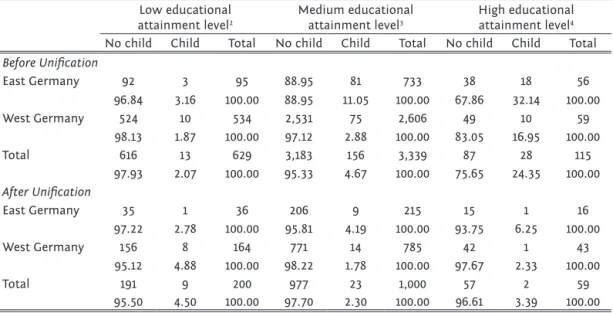
fertility of women in education after unification in East Germany. Interestingly, also for West German women with high educational attainment level, there is a decline in the fertility rate of women in full-time education. At this point of the analysis, it is however unclear whether the effect of German unification on the fertility rate of women in full-time education is a genuine effect or the result of compositional constellations.
Model estimation
234Using methods of discrete-time event history analysis, we conduct a difference-in-differences longitudinal study. Therefore, we follow up women enrolled in full-time education from age 16 until the event of a conception leading to the birth of a first child.
In Model 1 of Table 4a, we include age as a second degree polynomial . Our results clearly show that there is a first increasing and then decreasing age pattern as both variables age and age2 are significant and have opposite signs. This is a convincing indicator for the importance of normative timing on women’s entry into motherhood during educational participation. In other words, women who are enrolled in education enter motherhood more often as age rises, since it is increasingly appropriate to have a first child, although with a declining slope.
In Model 2 of Table 4a we add women’s educational attainment level as a time-dependent explanatory variable. This time-dependent educational attainment level variable increases for each woman step-by-step over the educational career. Contrary to our expectations, educational attainment
2 Low educational attainment level: No degree, Lower secondary school qualification without vocational training. 3 Medium educational attainment level: Middle school qualification without vocational training, lower second-ary school qualification with vocational training, middle school qualification with vocational training, Abitur, Abitur with vocational training.
4 High educational attainment level: Professional college qualification, University degree.
Table 3: Women who have got their first baby during full-time education before and after the German Unification by highest educational attainment level in East and West Germany
Low educational attainment level2
Medium educational attainment level3
High educational attainment level4
No child Child Total No child Child Total No child Child Total
Before Unification
East Germany 92 3 95 88.95 81 733 38 18 56
96.84 3.16 100.00 88.95 11.05 100.00 67.86 32.14 100.00
West Germany 524 10 534 2,531 75 2,606 49 10 59
98.13 1.87 100.00 97.12 2.88 100.00 83.05 16.95 100.00
Total 616 13 629 3,183 156 3,339 87 28 115
97.93 2.07 100.00 95.33 4.67 100.00 75.65 24.35 100.00
After Unification
East Germany 35 1 36 206 9 215 15 1 16
97.22 2.78 100.00 95.81 4.19 100.00 93.75 6.25 100.00
West Germany 156 8 164 771 14 785 42 1 43
95.12 4.88 100.00 98.22 1.78 100.00 97.67 2.33 100.00
Total 191 9 200 977 23 1,000 57 2 59
95.50 4.50 100.00 97.70 2.30 100.00 96.61 3.39 100.00
Table 4a: Covariate effects on the rate of entry into first motherhood for women in full-time education
Variables Model
1 2 3
Age dependency (time-dependent covariate)
Age 1.137*** 1.283*** 1.368***
Age2 –0.015*** –0.016*** –0.017***
Education (time-dependent covariate)
Woman’s educational attainment level –0.002 –0.003
Social background (time-constant covariate)
Father’s educational attainment level –0.069*
Place of birth (time-constant covariate)
West Germany (ref.) East Germany
Historic Period (time-dependent covariate)
Period until 1990 (ref.) Period from 1991 East*Period from 1991
Marital state (time-dependent covariate)
Not married (ref.) Married
East*Married
Intercept –14.883*** –14.426*** –31.918***
Number of events 231 231 231
Number of sub-episodes 637,23 637,23 637,23
Chi2 342.74 345.98 576.18
Degrees of freedom 1 2 4
Note: *p<0.05; *p<0.01; ***p>0.001.
Source: Estimations based on NEPS data from the adult study.
0.97 0.98 0.99 1.00
16 18 20 22 24 26 28 30 age
Father: Lower secondary school qualification Father: University degree
Figure 1: Plot of women in education who have not yet become mothers by father’s educational attain-ment level (survivor functions)
82 Gwendolin J. Blossfeld
Table 4b: Covariate effects on the rate of entry into first motherhood for women in full-time education
Variables Model
1 2 3 3*
Age dependency (time-dependent covariate)
Age 1.462*** 1.544*** 1.544*** 1.570***
Age2 -0.018*** -0.019*** -0.019*** -0.019***
Education (time-dependent covariate)
Woman’s educational attainment level -0.010 -0.011 -0.011 -0.011
Social background (time-constant covariate)
Father’s educational attainment level -0.079** -0.073** -0.072** -0.082**
Place of birth (time-constant covariate)
West Germany (ref.)
East Germany 1.318*** 1.695*** 1.701*** 1.814***
Historic Period (time-dependent covariate)
Period until 1990 (ref.)
Period from 1991 -0.127** -0.127** -0.161
East*Period from 1991 -0.986*** -0.986*** -1.052***
Marital state (time-dependent covariate)
Not married (ref.)
Married 0.030 0.034
East*Married 0.011 0.014
Intercept -33.865*** -35.561*** -33.693*** -34.700***
Number of events 231 231 231 231
Number of sub-episodes 637,23 637,23 637,23 637,23
Chi2 650.68 670.85 661.56 166.06
Degrees of freedom 5 7 9 9
σv 0.854 (0.322)
Note: *p<0.05; *p<0.01; ***p>0.001.
Source: Estimations based on NEPS data from the adult study.
0.92 0.94 0.96 0.98 1.00
16 18 20 22 24 26 28 30 age
Before German unification After German unification
Figure 2: Plot of East German women in education who have not yet become mothers before and after German unification (survivor functions of women with fathers who have attained middle school qualifica tion and vocational training)
level has no significant additional effect. This signals that women’s readiness to enter motherhood in full-time education does not differ by educational attainment level or human capital investments but is simply dependent only on age.
In Model 3 of Table 4a, we include women’s social origin as an explanatory variable. The results show a significantly negative effect. Families want to maintain their class position from one generation to the next. To avoid the jeopardizing consequences of motherhood on educational success, families from higher social origins have a stronger desire that women should first finish education before they have their first baby. In Figure 1, we illustrate the effect of age and social origin on the fertility behaviour of women in education. We simulate the survivor functions for women who have not yet become mothers by father’s educational attainment level based on the estimations of Model 3. With increasing age the percentages of women in education who become mother increases. This increase is however lower for women who come from families where fathers have higher educational attainment levels.
With Model 1 of Table 4b we start our difference-in-differences analysis. We first add a dummy variable for East Germany. The positive effect of this covariate shows that, compared to West German women, women in East Germany have their first babies much more often while in full-time education. In Model 2 we add a dummy variable for the historical period after German unification and an interaction term ‘East*Period after unification’. Both coefficients are – as expected - significantly negative. This indicates that in the unified Germany, women have reduced the entry into motherhood while in full-time education. This effect is ‘East*Period after unification’ suggests that the abolition of GDR pro-natalist measures supporting mothers in full-time education resulted in a declining fertility of women in education after unification particularly in East Germany. In other words, our analysis suggests that in the GDR the pro-natalist family and housing policies for mothers in education in terms of favoured housing access, free childcare as well as financial benefits were successful and increased women’s fertility. In Figure 2, we estimate and illustrate the survivor functions for women who have not yet become mothers before and after German unification. We focus on women with fathers who have attained middle school qualification and vocational training based on the estimations of Model 2. With increasing age the percentages of women in education who become mothers increase. This increase is however much lower for women who were enrolled in education after German unification. In Model 3 of Table 4b, we introduce woman’s marital status into our analysis. The main coefficient and its interaction term with East Germany are both not statistically significant. In other words, women’s decision to enter motherhood during full-time educational participation is not influenced by women’s marital state.
Model 3* of Table 4b shows the estimates of Model 3 with an additional unobserved heterogeneity term. The estimates show, that the standard deviation of unobservables is statistically significant. We therefore conclude that there is important unobserved heterogeneity at the level of the individual women. The coefficients of the covariates in Model 3 and Model 3* of Table 4b are very similar. Thus, for most of the explanatory variables we do not have to change our interpretations. There is, however, one important exception: the variable ‘Period after 1990’ is getting insignificant, if we control for unobserved heterogeneity. In other words, the fertility behaviour of West German women does not change through German Unification. The change for West German women in Model 3 is based on unobserved individual variables. The rate of entry into motherhood only declines for East German women who are enrolled in education. Thus, our difference-in-differences analysis suggests that the changes in the process of German unification have affected the fertility behaviour of East German women enrolled in education.
84 Gwendolin J. Blossfeld
independent of whether or not a woman is enrolled in education. The results in Table 5 show several interesting findings. First, the age dependency clearly indicates that there is a first increasing and then decreasing age pattern of entry into motherhood for all women. This supports the hypothesis of age norms that women are increasingly ready to enter into motherhood up to an appropriate age. Second, the significant negative effect of the time-dependent covariate ‘enrolled in education’ shows that women have a much lower rate of entry into motherhood as long as they are enrolled in education. This result supports the hypothesis that there is a sequencing norm and that women try to finish schooling before entering into motherhood. The positive effect of the age norm and the negative effect of the sequencing norm show that both norms are in a dynamic conflict and that they are competing with each other.
The significantly positive effect of ‘East Germany’ shows that East German women, even after German unification, have a lower age distribution of entry into motherhood. Thus, even after the dramatic change of the institutional context, East German women have different collective expec ta-tions about the appropriate age when women should have their first baby. This is a strong support of the hypothesis about the influence of the institutional setting.
The interaction term ‘East*Period from 1990’ shows that the German unification has led to a decrease of entry into motherhood for all women – whether or not they are enrolled in education. This represents the general effect of German unification on the fertility behaviour of all East German women. The significantly positive Effect for ‘East*Enrolled in education’ shows that East German women, indeed, had a higher fertility when they were enrolled in education. However, the second
Table 5: Covariate Effects on the rate of entry into first motherhood for all women up to the age of 30 years
Variables Model
1
Age dependency (time-dependent covariate)
Age 0.654***
Age2 -0.011***
Educational participation (time-dependent covariate) Not enrolled in education (ref.)
Enrolled in Education -1.273***
Place of birth (time-constant covariate)
West Germany (ref.)
East Germany 0.847***
Historic Period (time-dependent covariate)
Period until 1990 (ref.)
Period from 1991 -0.281***
Interaction terms (time-dependent covariates)
East*Period from 1991 -0.432***
East*Enrolled in Education 0.701***
East*Period from 1991*Enrolled in Education -0.518***
Intercept -13.829***
Number of events 3,195
Number of sub-episodes 904,222
Chi2 2242.48
Degrees of freedom 8
Note: *p<0.05; *p<0.01; ***p>0.001.
order interaction effect ‘East*Period from 1990*Enrolled in Education’ suggests that there is an effect of the specific policy change in the course of German unification affecting women in education. Mothers in education abruptly lost their privileged access to housing, have increasing difficulties to get daylong childcare, in particular without any copayments, and are missing former financial benefits. This reduced the rate of entry into motherhood of women enrolled in education in East Germany after unification.
Of course, our analysis is only based on observational data and we have not conducted a strict experiment testing the impact of policy intervention. So we have to be careful with policy recommendations based on this analysis. However, given the ‘natural experiment’ of a specific policy change in the course of German unification, the estimates of our event history models and the high external validity of our analysis, there seems to be some justification for the recommendation to increase fertility of women in modern Germany through pro-natalist policy measures.
Conclusion
This paper has empirically studied the factors influencing the fertility behaviour of women enrolled in full-time education. Our descriptive and multivariate analyses show that in Germany the rate of becoming a mother in full-time education is strongly influenced by two competing societal norms: First, a normative sequencing norm that women should first finish education before they have their first child. The huge majority of women (90% in East and 97% in West Germany) postpone entry into motherhood until they have left the educational system. Second an age norm, representing societal expectations about the appropriate age to start having children. If more and more young women postpone motherhood because they are enrolled in education, the risk of violating the normative timing of motherhood is also increasing. It is particularly women from lower social origin who violate the sequencing norm and enter into motherhood before finishing education.
Using longitudinal data from the National Educational Panel Study (NEPS), we have conducted a difference-in-differences analysis to study the effects of changing state support for mothers in education before and after unification in East Germany and to compare these developments with changes in West Germany. Our longitudinal analysis demonstrated that the conflict between the sequencing norm and the age norm is dependent on women’s age, social origin, and pro-natalist state support for women in full-time education. Women who are enrolled in education enter motherhood more often as age increases, since the pressure coming from the normative timing of motherhood is increasing, although with a declining slope. Women’s own educational attainment level has no significant effect on women’s entry into motherhood. On the other hand, social origin has a significantly negative effect which can be explained as follows: Women from higher social origin want to maintain their class position from one generation to the next. Thus they try to avoid the jeopardizing consequences of motherhood on educational success. Therefore, these women have a stronger desire to first finish education before they have their first baby. Additionally, our analysis shows that marriage has no effect on women’s entry into motherhood during educational participation.
86 Gwendolin J. Blossfeld
women in education after unification. In other words, our analysis suggests that in the GDR the pro-natalist family and housing policies for mothers in education were successful and increased women’s fertility.
Our analysis is not based on an experimental design testing policy interventions. It is only based on a ‘natural experiment’ and observational data, so we have to be careful with policy recommendations based on this analysis. However, our analysis suggests the following two policy recommendations: First, Germany should introduce comprehensive measures supporting mothers in full-time education to reduce the conflict between educational participation and motherhood. This is likely to increase fertility as was demonstrated by the GDR. Second, one should be careful not to introduce too much of an incentive to push women in full-time education into motherhood because acquiring education is a time-consuming activity that tends to be incompatible with equally time-consuming family related activities.
References
Becker, G. (1981). A Treatise on the Family. Cambridge, MA: Harvard University Press.
Bernardi, L., Keim, S., & Von der Lippe, H. (2007). Social influences on fertility. A comparative mixed methods study in East and West Germany. Journal of Mixed Methods Research, 1, 23-47.
Bertelsmann Verlag.
Blossfeld, H.-P. (1995). The new role of women. Family formation in modern societies. Boulder, Colorado: West-view Press.
Blossfeld, H.-P., Golsch, K. & Rohwer, G. (2007). Event History Analysis with Stata. London, UK: Lawrence Erl-baum Associates.
Blossfeld, H.-P., & Huinink, J. (1991). Human capital investments or norms of role transition? How Women’s Schooling and Career Affect the Process of Family Formation. American Journal of Sociology, 97(1), 143-168. Blossfeld, H.-P., & Jaenichen, U. (1992). Educational Expansion and changes in women’s entry into marriage
and motherhood in the Federal Republic of Germany. Journal of Marriage and Family, 54(2), 302-315. Blossfeld, H. P., & Nuthmann, R. (1989). Strukturelle Veränderungen der Jugendphase als Kohortenprozess
[Structural changes of the juvenile phase as a cohort process]. Zeitschrift für Pädagogik, 35, 845-857. Blossfeld, H.-P., Roßbach, H.-G. & J. von Maurice (2011). Education as a Lifelong Process. The German National
Educational Panel Study (NEPS). Zeitschrift für Erziehungswissenschaft, Special Issue 14.
Bundesministerium für Familie, Senioren, Frauen und Jugend (2012). Familiengründung und Elternschaft in Ausbildung und Studium [Family formation and parenthood during vocational training and studies]. Monitor Familienbericht. Berlin, Germany: Author.
Boudon, R. (1974). Education, Opportunity, and Social Inequality. Changing Prospects in Western Society. New York, NY: Wiley-Interscience.
Breen, R., & Goldthorpe, J. H. (1997). Explaining educational differentials towards a formal rational action theory. Rationality and Society, 9(3), 275-305.
Coale, A. J. (1971). Age patterns of marriage. Population studies, 25(2), 193-214.
Conrad, C., Lechner, M. & Werner, W. (1996). East German fertility after unification: Crisis or adaption?
Population and Development Review, 22, 331-358.
Elder, G. H. (1975). Age differentiation and the life course. Annual Review of Sociology, 1, 165-190.
Hogan, D. P. (1978). The variable order of events in the life course. American Sociological Review, 43(4), 573-586.
Huinink, J. & Wagner, M. (1995). Partnerschaft, Ehe und Familie in der DDR [Cohabitation, Marriage and Family in the GDR]. In J. Huinink, K. U. Mayer, M. Diewald, H. Solga, A. Sorensen. & H. Trappe (Eds.),
Kollektiv und Eigensinn [Collective and Self-Will] (148-188). Berlin, Germany: Akademie-Verlag.
Kohler, H. P., Billari, F. C., & Ortega, J. A. (2002). The emergence of lowest-low fertility in Europe during the 1990s. Population and Development Review, 28(4), 641-680.
Kreyenfeld, M., & Geisler, E. (2006). Müttererwerbstätigkeit in Ost-und Westdeutschland [Labour participation of mothers in East and West Germany]. Zeitschrift für Familienforschung – Journal of Family Research, 18(3), 333-360.
Marini, M. M. (1985). Determinants of the timing of adult role entry. Social Science Research, 14(4), 309-350. McDonald, P. (2006). Low fertility and the state: The efficacy of policy. Population and Development Review,
32(3), 485-510.
Mayer, K. U. & Schulze, E. (2009). Delaying family formation in East and West Germany – A mixed methods study on the onset of childbirth ans the vocabulary of motives of women of the birth cohort 1971. In G. Andersson, H. Bernardi, H. Kulu & G. Neyer (Eds.), The Demography of Europe: Trends and Perspectives. Berlin, Germany: Springer.
Nave-Herz, R. (2004). Ehe- und Familiensoziologie. Eine Einführung in Geschichte, theoretische Ansätze und empirische Befunde [Marriage and family sociology. An introduction into history, theoretical approaches and empirical findings]. Weinheim, Germany: Juventa Verlag.
Oppenheimer, V. K. (1988). A theory of marriage timing. American Journal of Sociology, 94(3) 563-591. Ryder, N. B. (1965). The cohort as a concept in the study of social change. American Sociological Review, 843-861. Settersten Jr, R. A., & Mayer, K. U. (1997). The measurement of age, age structuring, and the life course.
Annual Review of Sociology, 23, 233-261.
Steele, F. (2003). A discrete-time multilevel mixture model for event history data with long-term survivors, with an application to an analysis of contraceptive sterilization in Bangladesh. Lifetime Data Analysis, 9(2), 155-174.
Trappe, H. (1996). Work and family in women’s lives in the German Democratic Republic. Work and Occu-pations, 23(4), 354-377.
Weishaupt, H., Beathge, M. Dörbert, H., Füssel, H.-P., Hetmeier, H.-W. & Rauschenbach, T. et al (2010). Bildung in Deutschland 2010. Ein indikatorengestützter Bericht mit einer Analyse zu Perspektiven des Bildungswesens im demografischen Wandel [Education in Germany. An indicator supported report with an analysis on the perspective of education in the course of the demograhic change]. Bielefeld, Germany:
Yamaguchi, K. (1991). Event History Analysis. Newbury Park, CA: Sage.
Yamaguchi, K. (1986). Alternative approaches to unobserved heterogeneity in the analysis of repeatable events. Sociological Methodology, 16, 213-249.