Key words:
benign prostatic hyperplasia; tamsulosin; cyclooxigenase inhibitor; sleep quality
Int Braz J Urol. 2013; 39: 657-62
__________________
Submitted for publication: January 23, 2013
__________________
Accepted after revision: September 18, 2013 Purpose: We aimed to compare the effect and feasibility of a combined therapy with
ta-msulosin hydrochloride plus meloxicam, and tata-msulosin hydrochloride alone in patients with benign prostate hyperplasia symptoms and impact on nocturia and sleep quality. Materials and Methods: Four hundred male patients were included in this study between 2008 and 2011. Patients were randomly divided into two groups: one received tamsulosin hydrochloride 0.4 mg (Group 1, 200 patients) and the other tamsulosin hydrochloride 0.4 mg plus meloxicam 15 mg (Group 2, 200 patients) prospectively. Patients were evaluated for benign prostate hyperplasia (BPH) symptoms according to the American Urological Association clinical guidelines and sleep quality according to Pittsburgh Sleep Quality Index (PSQI). Patients were reevaluated after three months of treatment. The International Prostatic Symptom Score (IPSS), IPSS-Quality of Life (IPSS-QoL), maximal urinary flow rates (Qmax), average urinary flow rates (AFR), post void residual urine volumes (PVR), nocturia and Pittsburgh Sleep Quality Score (PSQS) were recorded at baseline and after three months.
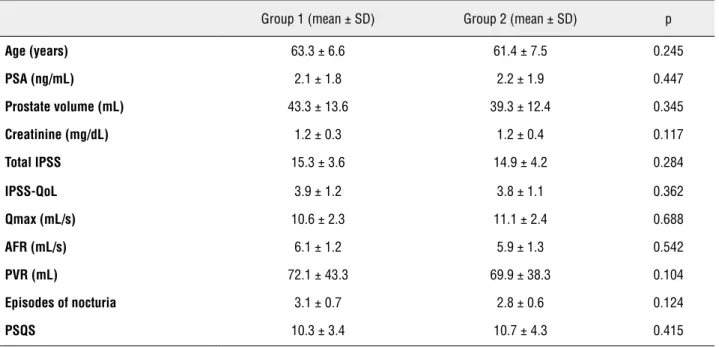
Results: Mean age was 63.3 ± 6.6 and 61.4 ± 7.5 years in groups 1 and 2, respective-ly (p = 0.245). There were no statisticalrespective-ly significant differences between both groups. Also, baseline prostate specific antigen (PSA), prostate volume, creatinine, International Prostatic Symptom Score (IPSS), IPSS-Quality of Life (IPSS-QoL), maximal urinary flow rates (Qmax), average urinary flow rates (AFR), post void residual urine volumes (PVR), nocturia and Pittsburgh Sleep Quality Score (PSQS) were similar in both groups.
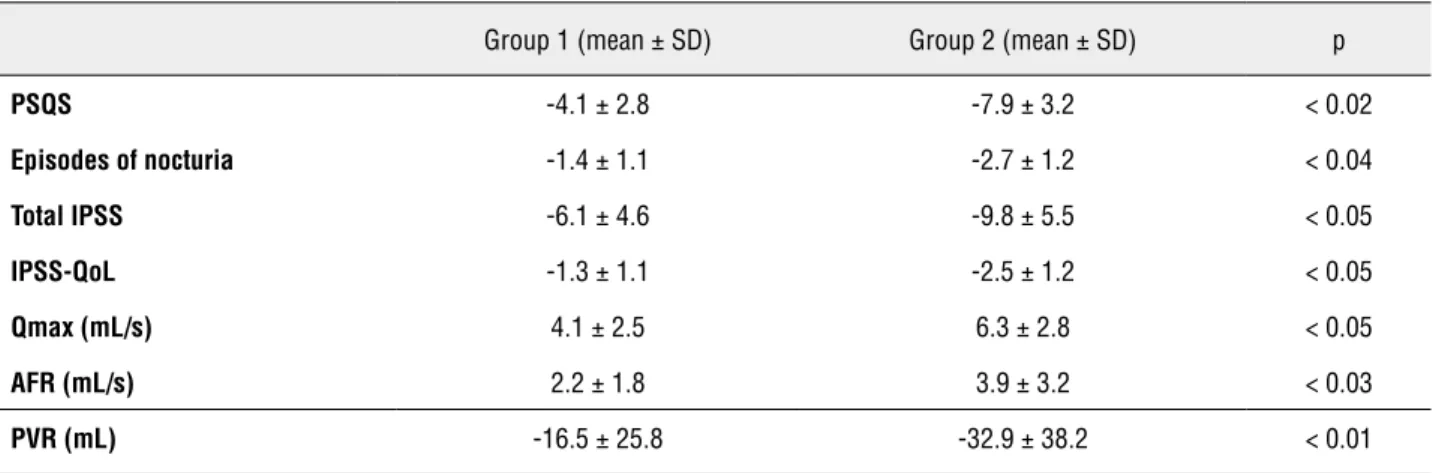
In addition, the total IPSS, IPSS-QoL, PVR, nocturia, and PSQS were significantly lower in Group 2 compared with Group 1 after treatment (p < 0.05). Qmax and AFR were higher significantly in Group 2 compared with Group 1 after treatment (p < 0.05).
Conclusions: Cyclooxygenase (COX)-2 inhibitors in combination with an alpha blocker may decrease benign prostatic hyperplasia symptoms and increase sleep quality without serious side effects.
INTRODUCTION
Benign prostatic hyperplasia (BPH) is one of the most common diseases affecting aging men.
In a study of men residing in Olmsted County, Min-nesota, 26 percent of those aged 40-49 years ex-perienced moderate to severe lower urinary tract symptoms, and this proportion increased to 45
The Effect of Combined Therapy with Tamsulosin
Hydrochloride and Meloxicam in Patients with Benign
Prostatic Hyperplasia Symptoms and Impact on Nocturia
and Sleep Quality
_______________________________________________
Sacit Nuri Gorgel, Ertugrul Sefik, Osman Kose, Vural Olgunelma, Evren Sahin
Izmir Katip Celebi University, Ataturk Training and Research Hospital, Izmir, Turkey
ABSTRACT
ARTICLE
INFO
percent among those aged 70-79 years (1). Lower urinary tract symptoms (LUTS) in elderly men were traditionally attributed to the enlarging prostate. The mechanisms invoked were one or all of the following: histological benign prostatic hyperpla-sia, benign prostatic enlargement, or benign pros-tatic obstruction (2).
Historically, it was assumed that alpha-1--blockers act by inhibiting the effect of endoge-nously released noradrenaline on prostate smooth muscle cells, thereby reducing prostate tone and bladder outlet obstruction. Contraction of the hu-man prostate is mediated predominantly, if not exclusively, by alpha-1A-adrenoceptors (3). Alpha blocker agents have been used for more than a de-cade in the treatment of LUTS. Previously published meta-analysis has shown that 30%-40% of patients with LUTS showed improvements in the symptoms, and there was a 20%-30% increase observed in the maximum flow after alpha blocker therapy (4).
More recently, some clinical trials were conducted for obtaining better results with medical therapy that compared the combination therapies and monotherapy for the treatment of BPH; en-couraging results were observed that favored com-bination therapies. In one of these clinical trials, combination therapy with finasteride and rofeco-xib, which is a selective cyclooxygenase (COX)-2 inhibitor, yielded better results when compared with finasteride monotherapy (5).
The association between BPH and inflammation has been known for several years. COX is a key enzyme in inflammation-converting arachidonic acid to prostaglandin and other eicosa-noids. Two isoforms of COX exist, namely, cycloo-xygenase-1 (COX-1) and COX-2. The highest level of COX in the human body has been shown to be found in the prostate, and the highest amount of COX-2 expression in the prostate occurs in the prostatic smooth muscle cells (6). So we used COX-2 inhibitors in a combined therapy with an alpha blocker for BPH symptoms.
BPH is known to be primarily a disease of prostatic smooth muscle cells, and prostaglandins have an essential role in the function and growing of smooth muscle cells. The knowledge of high le-vels of COX-2 expression in the prostatic smooth muscle cells in prostate cancer and BPH forms the
basis for the potential use of selective COX-2 inhi-bitors in the treatment of BPH (7).
Moreover, several clinical trials showed in-creased COX-2 expression and prostaglandin pro-duction in partial bladder outlet obstruction, whi-ch may cause detrusor overactivity due to bladder dysfunction (8-10).
In this study, we aimed to compare the effects of tamsulosin hydrochloride and me-loxicam combination therapy with tamsulosin hydrochloride monotherapy for benign prostate hyperplasia symptoms and impact on sleep qua-lity and nocturia.
MATERIALS AND METHODS
Four hundred patients were included in this study between 2008 and 2011. Patients were ran-domly divided into two groups: one received ta-msulosin hydrochloride 0.4 mg (Group 1, 200 pa-tients) and the other tamsulosin hydrochloride 0.4 mg plus meloxicam 15 mg (Group 2, 200 patients) prospectively. Patients were evaluated for benign prostate hyperplasia (BPH) symptoms according to the American Urological Association clinical gui-delines and sleep quality according to Pittsburgh Sleep Quality Index (PSQI).
The International Prostatic Symptom Score (IPSS), IPSS-Quality of Life (IPSS-QoL), maximal urinary flow rates (Qmax), average urinary flow ra-tes (AFR), post void residual urine volumes (PVR), nocturia and Pittsburgh Sleep Quality Score (PSQS) were recorded at baseline and again after three months.
This study included men aged 50-75 years, with symptoms of BPH (IPSS range 8-19), a ma-ximum urinary flow rate (Qmax) of ≥ 5 and ≤ 15 mL/s, total voided volume of ≥ 150 mL, 2 or more episodes of nocturia, and Pittsburgh Sleep Quality Score (PSQS) > 5.
or continuing medication with 5-alpha reducta-se inhibitors, alpha blockers, antiandrogens and phytotherapeutic agents. 46 patients were exclu-ded because of lost of follow-up.
This study was a prospective and ran-domized trial. Descriptive statistics were used to characterize variables in the population and in each group of treatment (mean ± SD). Mean changes adjusted for baseline are presented and tested using the Wilcoxon signed-rank test. Pair--wise treatment comparisons were made. All sta-tistical tests were two-tailed with a 0.05 level of significance for treatment effects. Ethical commit-tee approval was taken for combined therapy.
RESULTS
Four hundred consecutive patients who en-tered the study were randomized to treatment. There were 200 patients in group 1 and 200 patients in group 2. All 400 subjects completed the three month period of the study.
Mean age was 63.3 ± 6.6 and 61.4 ± 7.5 ye-ars in groups 1 and 2, respectively (p = 0.245). There
were no statistically significant differences between boths groups. Also, baseline prostate spesific anti-gen (PSA), prostate volume, creatinine, Internatio-nal Prostatic Symptom Score (IPSS), IPSS-Quality of Life (IPSS-QoL), maximal urinary flow rates (Qmax), average urinary flow rates (AFR), post void residual urine volumes (PVR), nocturia and Pittsburgh Sle-ep Quality Score (PSQS) were similar for the both groups (Table-1).
Mean decrease in total IPSS score after the treatment was 6.1 ± 4.6 and 9.8 ± 5.5 points in groups 1 and 2, respectively (p < 0.05). The average decrease in IPSS-QoL scores was 1.3 ± 1.1 points in group 1 and 2.5 ± 1.2 points in group 2 after the tre-atment (p < 0.05). Maximum flow rates (Qmax) were statistically higher in group 2 after the treatment (4.1 ± 2.5 vs 6.3 ± 2.8 mL/s) (p < 0.05). The mean increase of average urinary flow rates (AFR) was 2.2 ± 1.8 mL in group 1 and 3.9 ± 3.2 mL in group 2 after the treatment (P < 0.03). The mean decrease of PVR urine volumes was 16.5 ± 25.8 mL in group 1 and 32.9 ± 38.2 mL in group 2 after the treatment (P < 0.01). The mean decrease of PSQS was 4.1 ± 2.8 mL in group 1 and 7.9 ± 3.2 mL in group 2
Table 1 - Baseline characteristics of the patients for both groups.
Group 1 (mean ± SD) Group 2 (mean ± SD) p
Age (years) 63.3 ± 6.6 61.4 ± 7.5 0.245
PSA (ng/mL) 2.1 ± 1.8 2.2 ± 1.9 0.447
Prostate volume (mL) 43.3 ±13.6 39.3 ± 12.4 0.345
Creatinine (mg/dL) 1.2 ± 0.3 1.2 ± 0.4 0.117
Total IPSS 15.3 ± 3.6 14.9 ± 4.2 0.284
IPSS-QoL 3.9 ± 1.2 3.8 ± 1.1 0.362
Qmax (mL/s) 10.6 ± 2.3 11.1 ± 2.4 0.688
AFR (mL/s) 6.1 ± 1.2 5.9 ± 1.3 0.542
PVR (mL) 72.1 ± 43.3 69.9 ± 38.3 0.104
Episodes of nocturia 3.1 ± 0.7 2.8 ± 0.6 0.124
PSQS 10.3 ± 3.4 10.7 ± 4.3 0.415
IPSS = International Prostatic Symptom Score; QoL = Quality of Life, Qmax =Maximal urinary flow rates, AFR = Average urinary flow rates, PSQS =
after the treatment (p < 0.02). The mean decrease of nocturia episodes was 1.4 ± 1.1 mL in group 1 and 2.7 ± 1.2 mL in group 2 after the treatment (p < 0.04) (Table-2).
Treatments were generally well tolerated. No serious adverse events causing the discontinua-tion of the treatment were observed during the tre-atment course in both groups.
DISCUSSION
Lower urinary tract symptom severity is a risk factor for severe sleep disturbance in men. While nocturia was significantly associated with
sleep disturbance, other lower urinary tract symp-toms were also independent predictors of sleep dysfunction (11). Nocturia in patients with benign prostatic hyperplasia (BPH) is one of the most un-comfortable symptoms of the disease. It greatly affects quality of life by deteriorating the quality of sleep and disturbing activities during the day (12). The Pittsburg Sleep Quality Index (PSQI) is an effective instrument used to measure the quali-ty and patterns of sleep in adults (13). In our stu-dy, patients were evaluated for sleep quality ac-cording to Pittsburgh Sleep Quality Index (PSQI).
Benign prostatic hyperplasia and prosta-te cancer are chronic diseases that need a long
Table 2 - Mean changes over baseline of both groups after the treatment.
Group 1 (mean ± SD) Group 2 (mean ± SD) p
PSQS -4.1 ± 2.8 -7.9 ± 3.2 < 0.02
Episodes of nocturia -1.4 ± 1.1 -2.7 ±1.2 < 0.04
Total IPSS -6.1 ± 4.6 -9.8 ± 5.5 < 0.05
IPSS-QoL -1.3 ±1.1 -2.5 ±1.2 < 0.05
Qmax (mL/s) 4.1 ±2.5 6.3 ± 2.8 < 0.05
AFR (mL/s) 2.2 ± 1.8 3.9 ±3.2 < 0.03
PVR (mL) -16.5 ±25.8 -32.9 ± 38.2 < 0.01
IPSS = International Prostatic Symptom Score; QoL = Quality of Life; Qmax = Maximal urinary flow rates; AFR = Average urinary flow rates; PSQS =
Pittsburgh Sleep Quality Score; PVR = Post void residual urine volumes
period for development from small lesions to become clinically manifested (14). In these both prostatic diseases, there is an imbalance between prostate cell growth and apoptosis. This imbalance is complex and influenced by microenvironment around prostate such as growth factors, cytokines and steroid hormones. These factors stimulate pro-liferation and minimize cell apoptosis (15). The role of inflammation in prostate diseases is suggested by the presence of inflammatory cells within the prostate in both prostatic diseases (16).
Di Silverio et al. demonstrated a correlation of higher inflammatory infiltrates present in bigger prostate volume and more prone to progression of
symptoms, risk of acute urinary retention and risk for surgery (17).
Some clinical trials show better results with combination therapies in benign prostatic hyper-plasia symptoms. One of them is the MTOPS (Me-dical Therapy of Prostatic Symptoms) study that compared the long-term effects of combined thera-py with doxazosin plus finasteride with either drug alone. The results of MTOPS showed that combina-tion therapy was superior to monotherapy, which significantly reduced the risk of progression and the need for surgery in the long term (18).
COX is a key enzyme in inflammation and found in 2 isoforms, COX-1 and COX-2, the latter espe-cially activated during inflammation in the blad-der (20). Chronic inflammation continuously pro-duces cyclooxygenase-2 (COX-2) (21). Meloxicam is a non steroidal anti-inflammatory drug with a selective inhibition of cyclooxygenase-2 (COX-2) (2(COX-2). Although there is much more interest in chemoprevention of prostate cancer with COX-2, it has been shown that COX-2 expression is in-creased also in BPH and prostatic smooth mus-cle cells (23). The co-expression of COX-1 and COX-2 proteins in benign and malignant human prostates, and the induction and significantly greater expression of COX-2 in cancer were also associated with tumour grade. The regular use of nonsteroidal anti-inflammatory drugs is associa-ted with a reduced incidence of cancers. The pre-sent results provide the basis for a potential role for COX-2 inhibitors in the prevention and treat-ment of prostate cancer (24). Despite such strong association between inflammation, COX-2, and BPH, clinical trials evaluating the effects of COX-2 inhibitors in LUTS and BPH are scarce (COX-25).
Studies have shown that a reduction from baseline in IPSS of ≥ 30% and a Qmax improve-ment > 3 mL/s after treatimprove-ment is considered cli-nically significant. Kirby et al. showed in their integrated analysis of the two studies that among patients receiving doxazosin-GITS, 71.2% had a reduction from baseline in IPSS of ≥ 30% at the final visit, as did 71.1% of patients in the doxazo-sin-S group and 53.3% of patients in the placebo group. Considering better treatment outcomes in group 2 compared with 8 mg doxazosin, our re-sults may suggest that combined use of doxazosin with tenoxicam might be more effective (26).
In our study, combined therapy with me-loxicam, a selective COX-2 inhibitor, plus tam-sulosin hydrochloride resulted in better improve-ment of benign prostatic hyperplasia symptoms, nocturia and sleep quality compared with tamsu-losin hydrochloride alone.
We acknowledge limitations of this stu-dy. Absence of meloxicam or placebo only group may have changed our results, and therefore the favorable effect of combined therapy observed in our study should be interpreted with caution.
Limitations of the study: BPH is a chronic disease and this trial involved only a three month up period. There is no long term follow--up period.
CONCLUSIONS
In conclusion, we suggest that combina-tion therapy with an alpha blocker and COX-2 inhibitor may be a safe and effective treatment option for benign prostate hyperplasia symptoms and impact on sleep quality and nocturia. In par-ticular, patients suffering from mainly the sleep quality who do not respond to alpha blocker the-rapy might be offered combination thethe-rapy.
CONFLICT OF INTEREST
None declared.
REFERENCES
1. Sarma AV, Wei JT, Jacobson DJ, Dunn RL, Roberts RO, Girman CJ, et al.: Comparison of lower urinary tract symptom severity and associated bother between community-dwelling black and whitemen: the Olmsted County Study of Urinary Symptoms and Health Status and the Flint Men’s Health Study. Urology. 2003; 61: 1086-91.
2. Chapple CR, Roehrborn CG: A shifted paradigm for the further understanding, evaluation, and treatment of lower urinary tract symptoms in men: focus on the bladder. Eur Urol. 2006; 49: 651-8.
3. Michel MC, Vrydag W: Alpha1-, alpha2- and beta-adrenocep-tors in the urinary bladder, urethra and prostate. Br J Pharma-col. 2006; 147: S88-119.
4. Madersbacher S, Alivizatos G, Nordling J, Sanz CR, Emberton M, de la Rosette JJ: EAU 2004 guidelines on assessment, ther-apy and follow-up of men with lower urinary tract symptoms suggestive of benignprostatic obstruction (BPH guidelines). Eur Urol. 2004; 46: 547-54.
5. Di Silverio F, Bosman C, Salvatori M, Albanesi L, Proietti Pan-nunzi L, Ciccariello M, et al.: Combination therapy with rofe-coxib and finasteride in the treatment of men with lower uri-nary tract symptoms (LUTS) and benign prostatic hyperplasia (BPH). Eur Urol. 2005; 47: 72-8; discussion 78-9.
7. Hussain T, Gupta S, Mukhtar H: Cyclooxygenase-2 and pros-tate carcinogenesis. Cancer Lett. 2003; 191: 125-35. 8. Masick JM, Levin RM, Hass MA: The effect of partial outlet
obstruction on prostaglandin generation in the rabbit urinary bladder. Prostaglandins Other Lipid Mediat. 2001; 66: 211-9. 9. Park JM, Yang T, Arend LJ, Smart AM, Schnermann JB,
Briggs JP: Cyclooxygenase-2 is expressed in bladder during fetal development and stimulated by outlet obstruction. Am J Physiol. 1997; 273: F538-44.
10. Maggi CA: Prostanoids as local modulators of reflex micturi-tion. Pharmacol Res. 1992; 25: 13-20.
11. Helfand BT, McVary KT, Meleth S, Sharp V, Foster H, Naslund M, et al.: The relationship between lower urinary tract symp-tom severity and sleep disturbance in the CAMUS trial. J Urol. 2011; 185: 2223-8.
12. Asplund R, Aberg H: Health of the elderly with regard to sleep and nocturnal micturition. Scand J Prim Health Care. 1992; 10: 98-104.
13. Buysse DJ, Reynolds CF 3rd, Monk TH, Berman SR, Kupfer DJ: The Pittsburgh Sleep Quality Index: a new instrument for psychiatric practice and research. Psychiatry Res. 1989; 28: 193-213.
14. Nuñez C, Cansino JR, Bethencourt F, Pérez-Utrilla M, Fraile B, Martínez-Onsurbe P, et al.: TNF/IL-1/NIK/NF-kappa B transduction pathway: a comparative study in normal and pathological human prostate (benign hyperplasia and carci-noma). Histopathology. 2008; 53: 166-76.
15. Sciarra A, Mariotti G, Salciccia S, Autran Gomez A, Monti S, Toscano V, et al.: Prostate growth and inflammation. J Steroid Biochem Mol Biol. 2008; 108: 254-60.
16. Novara G, Galfano A, Berto RB, Ficarra V, Navarrete RV, Arti-bani W: Inflammation, apoptosis, and BPH: What is the evi-dence? Eur Urol Suppl. 2006; 5: 401-9.
17. Di Silverio F, Gentile V, De Matteis A, Mariotti G, Giuseppe V, Luigi PA, et al.: Distribution of inflammation, pre-malignant lesions, incidental carcinoma in histologically confirmed benign prostatic hyperplasia: a retrospective analysis. Eur Urol. 2003; 43: 164-75.
18. McConnell JD, Roehrborn CG, Bautista OM, Andriole GL Jr, Dixon CM, Kusek JW, et al.: The long-term effect of doxa-zosin, finasteride, and combination therapy on the clinical progression of benign prostatic hyperplasia. N Engl J Med. 2003; 349: 2387-98.
19. Nickel JC, Downey J, Young I, Boag S: Asymptomatic in-flammation and/or infection in benign prostatic hyperpla-sia. BJU Int. 1999; 84: 976-81.
20. Andersson KE: LUTS treatment: future treatment options. Neurourol Urodyn. 2007; 26: 934-47.
21. Caruso C, Balistreri CR, Candore G, Carruba G, Colonna-Romano G, Di Bona D, et al.: Polymorphisms of pro-in-flammatory genes and prostate cancer risk: a pharmacoge-nomic approach. Cancer Immunol Immunother. 2009; 58: 1919-33.
22. Mitchell JA, Akarasereenont P, Thiemermann C, Flower RJ, Vane JR: Selectivity of nonsteroidal antiinflammatory drugs as inhibitors of constitutive and inducible cyclooxygenase. Proc Natl Acad Sci U S A. 1993; 90: 11693-7.
23. Wang W, Bergh A, Damber JE: Chronic inflammation in be-nign prostate hyperplasia is associated with focal upregula-tion of cyclooxygenase-2, Bcl-2, and cell proliferaupregula-tion in the glandular epithelium. Prostate. 2004; 61: 60-72.
24. Madaan S, Abel PD, Chaudhary KS, Hewitt R, Stott MA, Stamp GW, et al.: Cytoplasmic induction and over-expression of cyclooxygenase-2 in human prostate cancer: implications for prevention andtreatment. BJU Int. 2000; 86: 736-41. 25. Di Silverio F, Bosman C, Salvatori M, Albanesi L, Proietti
Pannunzi L, Ciccariello M, et al.: Combination therapy with rofecoxib and finasteride in the treatment of men with low-er urinary tract symptoms (LUTS) and benign prostatic hy-perplasia (BPH). Eur Urol. 2005; 47: 72-8; discussion 78-9 26. Kirby RS, Andersen M, Gratzke P, Dahlstrand C, Høye K:
A combined analysis of double-blind trials of the efficacy and tolerability of doxazosin-gastrointestinal therapeutic system, doxazosin standard and placebo in patients with benign prostatic hyperplasia. BJU Int. 2001; 87: 192-200.