Analysis of the registration and content of surgical
safety checklists
Análise do registro e conteúdo de checklists para cirurgia segura
Análisis del registro y contenido de checklists para una cirugía segura
Marly Ryoko Amaya1
Eliane Crisina Sanches Maziero1
Luciana Gritem1 Elaine Drehmer de Almeida Cruz1
1. Universidade Federal do Paraná. Curiiba - PR, Brazil.
Corresponding author:
Marly Ryoko Amaya.
E-mail: [email protected]
Submited on 07/14/2014. Accepted on 04/27/2015.
DOI: 10.5935/1414-8145.20150032
A
bstrActObjective: To analyze and relate the registration of information and content of checklists with the objectives of the Safe Surgery Saves Lives Program. Methods: Documentary study with 257 checklists from orthopedic surgeries performed between 2011 and 2012 in a Brazilian hospital. The 12,629 items related to surgical safety were entered into an Excel spreadsheet and were analyzed using the Statistical Package for the Social Sciences. Results: 99.8% of the checklist items were checked and the content of the records showed, through documental checks, no guarantee of safety elements relative to the correct surgical site (objective 1), blood loss (objective 4), allergic reaction (objective 5) retention of instruments/compresses (objective 7), identiication of surgical specimens (objective 8) and communication (objective 9). Conclusion: The high adherence to completing the checklists allowed potential surgical risks arising from unconirmed safety actions to be identiied, requiring actions seeking to qualify the care.
Keywords: Checklist; Patient Safety; Surgical Procedures, Operative.
r
esumoObjetivo: Analisar e relacionar o registro de informações e conteúdo dos checklists com os objetivos do Programa Cirurgias
Seguras Salvam Vidas. Métodos: Pesquisa documental com 257 checklists de cirurgias ortopédicas realizadas de 2011 a 2012
em hospital brasileiro. Os 12.629 itens relativos à segurança cirúrgica alimentaram planilha do programa Excel e foram analisados com auxílio do programa Statistical Package for the Social Sciences. Resultados: 99,8% dos itens do checklist foram veriicados
e o teor dos registros evidenciam não garantia, por meio da checagem documental, de elementos de segurança relativos ao local cirúrgico certo (objetivo 1), perdas sanguíneas (objetivo 4), reação alérgica (objetivo 5), retenção de instrumentais/compressas (objetivo 7), identiicação de espécimes cirúrgicos (objetivo 8) e comunicação (objetivo 9). Conclusão: A alta adesão ao preenchimento do checklist permitiu identiicar potenciais riscos cirúrgicos decorrentes de ações de segurança não conirmadas,
exigindo ações em busca da qualiicação da assistência.
Palavras-chave: Lista de Checagem; Segurança do Paciente; Procedimentos Cirúrgicos Operatórios.
r
esumenObjetivo: Analizar y relacionar el registro de informaciones y contenido de checklists, con los objetivos del Programa Cirugías
Seguras Salvan Vidas. Métodos: Investigación documental con 257 checklists de cirugías ortopédicas realizadas en 2011 y
2012, en hospital brasileño. Los 12.629 ítems de seguridad quirúrgica fueron inseridos en una hoja de cálculo del Programa Excel y analizados en el Programa Statistical Package for the Social Sciences. Resultados: El 99,8% de los ítems fueron veriicados, pero el contenido de los registros demuestra no garantías, por medio de la comprobación, de elementos de seguridad acerca del local quirúrgico correcto (objetivo 1), perdidas de sangre (objetivo 4), reacción alérgica (objetivo 5), retención de instrumentales/gasas (objetivo 7), identiicación de muestras quirúrgicas (objetivo 8) y comunicación (objetivo 9). Conclusión: La adhesión al completar el checklist ha permitido identiicar potenciales riesgos quirúrgicos resultantes de acciones de seguridad
no conirmadas, exigiendo acciones para la caliicación de la asistencia.
INTRODUCTION
Deaths by errors or complications from the assistance in health care have contributed to the beginning of a worldwide movement in order to promote patient safety, deined as the reduction to the minimum of the acceptable risk associated to health care1.
In the context of care to the surgical patient, global estimate showed that half of postoperative complications were avoidable2, highlighting the potential level to prevent damages. In this con -text, in 2009, the World Health Organization (WHO) launched the program "Safe Surgeries Save Lives", which is part of the second Global Patient Safety Challenge. The program includes 10 key objectives presented in Chart 11.
As a strategy to achieve the proposed objectives, the WHO recommends health institutions to use a Checklist to be illed in at three stages or moments: before anesthetic induction, before the surgery and before the patient leaves the operating room.
The instrument aims at checking the items that could compromise patient safety1, regardless of the team's memory fallibility. It strengthens the scan memory and encourages the discipline of high performance3; its application have showed a decrease from 11% to 7% of surgical complications and 1.5 to 0.8% of deaths associated to surgical procedures4. In Brazil, the Ministry of Health instituted in 2013, the Safe Surgery Protocol, which calls for the systematic use of the Checklist5, and consti -tutes the National Program for Patient Safety6.
As part of institutional actions to promote quality of care, and following the WHO recommendations1, in 2010 a univer -sity hospital in the south of Brazil implemented the Checklist, initially in orthopedic surgeries, and adapted it to the reality of the institution. This instrument is distinguished from the model proposed by the WHO1 for it includes a veriication step during the patient reception at the surgical center, making it a total of four stages.
Orthopedic surgeries involve multiple and bilateral struc -tures, such as arms and legs, ingers, ribs and vertebrae, and present higher risk of surgical error. Those can be preventable
through the surgical site demarcation prior to surgery7. A study carried out in 2012 with 502 Brazilian orthopedists showed that 65.3% of them reported partial or total unawareness of the WHO Program; 72.1% said they had not received training for the application of the Safe Surgery Protocol, although 63.5% did the site demarcation prior surgery. Only 37.1% of the participants recognized that the protocol is important for the safety of the patient.
From the principle that situational diagnoses contribute to the process of improvement actions1, this study aimed at analyzing the information record and the content of the Che -cklists, and relate their results with the objectives of the WHO Safe Surgeries Save Lives program1.
METHODS
Quantitative approach, documental, held in 2013, at the central operating room of a university hospital in the south of Brazil. Orthopedic surgeries were pioneers as for the use of the Safe Surgery Checklist, which justiies its choice for this research. Inclusion criteria in this study comprise documents charac -terized as Checklists related to orthopedic surgeries performed from January 2011 to June 2012, in that surgical center and avai -lable in the hospital ile. In this period there were three diferent models at use as checklists in accordance with the modiications made by the institution to the originally adopted model. There was no exclusion criteria, since all checklists, partially or totally illed in were considered.
The variable considered (record of checklist items) refers to the illing, or not, of the instrument items, patient identiication, booking of the surgical site, blood supply, allergic patient iden -tiication, documentation and communication, among others. Each item to be checked allowed the registration of the answer yes, no and in some cases, not applicable, and indicated the completion of a single alternative.
For data collection a spreadsheet was created in the Micro -soft Excel® 2007 version program containing all items to be che -cked of the three models adopted in the period of this research,
Chart 1.
Objecives of the program "Safe Surgeries Save Lives". World Health Organizaion, 2009
1. The team will operate on the correct paient at the right surgical site.
2. The team will use methods known to prevent harm from anestheic administraion, while protecing the paient from pain.
3. The team will recognize and efecively prepare for life-threatening loss of airway or respiratory funcion.
4. The team will recognize and efecively be prepared for risk of major blood loss.
5. The team will avoid inducing an allergic or adverse drug reacion known to be a signiicant risk to the paient.
6. The team will consistently use methods to minimize the risk of surgical site infecion.
7. The team will prevent inadvertent retenion of sponges or instruments in surgical wounds.
8. The team will secure and accurately idenify all surgical specimens.
Table 1.
Compleion of items related to the recepion of the paients to the operaing room and to the corresponding
objecives of the WHO program "Safe Surgeries Save Lives". Curiiba, from 2011 to 2012
Item (Objecive) n (%)Yes n (%)No Not applicable n (%) Invalid n (%) Not answeredn (%) Total* n (%)
Ideniied paient (Objecive 1) 229 (89.1%) 13 (5.1%) - 1 (0.4%) 14 (5.4%) 257 (100%)
Pre-anestheic evaluaion (Objecives 2, 10) 226 (88%) 15 (5.8%) - - 16 (6.2%) 257 (100%)
Surgical Consent (Objecives 9, 10) 245 (95.3%) 3 (1.2%) - - 9 (3.5%) 257 (100%)
Anestheic consent (Objecives 9, 10) 152 (66.1%) 55 (23.9%) - - 23 (10%) 230 (100%)
Nursing evaluaion (Objecives 9, 10) 68 (89.5%) 6 (7.9%) - - 2 (2.6%) 76 (100%)
Surgical site set (Objecive 1) 166 (64.6%) 21 (8.2%) 49 (19%) - 21 (8.2%) 257 (100%)
Fasing (Objecive 3) 247 (96.1%) 2 (0.8%) - - 8 (3.1%) 257 (100%)
* Total of instruments that comprised the item.
Table 2.
Compleion of items related to the step before inducion of anesthesia and corresponding objecives of the
Surgery Program Secure Saves Lives WHO. Curiiba, from 2011 to 2012
Item (Objeive)
n (%)
Yes
n (%)
No
Not applicable
n (%)
Invalid
n (%)
Not answered
n (%)
Total*
n (%)
Conirmed idenity (Objecive 1)
252 (98%)
-
-
1 (0.4%)
4 (1.6%)
257 (100%)
Surgical site set (Objecive 1)
200 (77.8%)
15 (5.9%)
35 (13.6%)
-
7 (2.7%)
257 (100%)
Blood reserve (Objecive 4)
133 (51.8%)
98 (38.1%)
3 (1.2%)
-
23 (8.9%)
257 (100%)
* Total of instruments that comprised the item.
and the responses were recorded through number codes esta -blished by the researchers. Invalid response was applied when illing was unreadable, double or blurred. Data were checked by double typing and the discrepancies were corrected; the analysis was done using descriptive statistics, using the computer program Statistical Package for Social Sciences, the blue version 20.0. The results, presented in relative and absolute frequencies, were organized according to the steps of checking and associated with the corresponding objectives of the WHO program1.
This study was approved under registration CEP/SD 1102.027.11.04 and met the principles of the Ethics Committee.
RESULTS
257 iled checklists were consulted; among the 12,629 items checked, 8.5% (n = 1,071) were not answered. Among the 11,558 (91.5%) responded items, 99.8% (n = 11,537) were understanda -ble and 0.2% (n = 21) were not understanda-ble. The results were related to the objectives of the WHO1 program and are presented in accordance to each checking step tables. In table 1, data of the irst step of the check list is presented and is related to the reception of the patient to the operating room.
Table 2 presents data from the checking stage carried out before anesthetic induction, with the patient in the operating room. Table 3 shows the checking of the elements before the sur -gical incision, also called sur-gical step or time out.
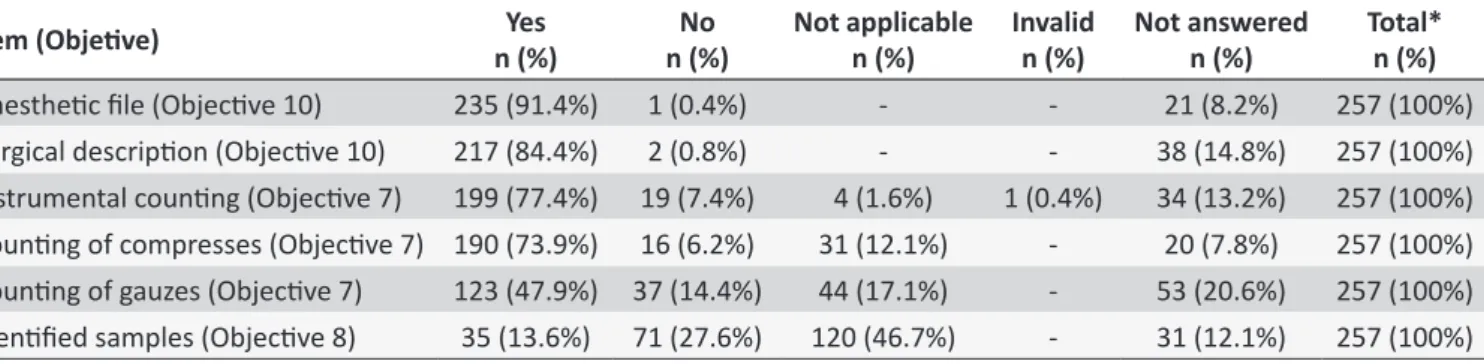
In table 4 items related to the fourth and the inal veriication step before the patient leaves the operating room are presented.
DISCUSSION
In this study 91.5% of the items of the checklists were illed in, 0.2% were invalid, such result is similar to other studies8,9 and evidence the challenge of the adherence to practices of checking and registering elements that are essential to the safety of the surgical patient.
The lack of completion of the records directs to actions that include reorientation and team motivation, identiication and understanding of factors that hinder the full veriication, as well as elucidation and discussion of ethical and legal aspects that involve professional performance. The checking items aim at preventing adverse events and ensuring the safety of the surgi -cal patient. They are based on the objectives pre-established by the WHO1, which guide the discussion of the results presented in this research.
Table 3.
Compleion of items related to the step before surgical incision and corresponding objecives of the WHO
program Safe Surgeries Save Lives. Curiiba, from 2011 to 2012
Item (Objeive)
n (%)
Yes
n (%)
No
Not applicable
n (%)
Invalido
n (%)
Not answered
n (%)
Total*
n (%)
Staf is introduced by their names and
funcions (Objecive 9)
13 (48.2%)
8 (29.6%)
0
1 (3.7%)
5 (18.5%)
27 (100%)
Conirms idenity and paient with
ideniicaion (Objecive 1)
243 (94.1%)
5 (1.9%)
0
0
10 (3.9%)
258 (100%)
Surgical site set (Objecive 1)
198 (77%)
13 (5.1%)
38 (14.8%)
0
8 (3.1%)
257 (100%)
Allergic paient (Objecive 5)
17 (9.4%)
147 (81.2%)
0
1 (0.6%)
16 (8.8%)
181 (100%)
Anibioic prophylaxis (Objecive 6)
219 (85.2%)
10 (3.9%)
0
0
28 (10.9%)
257 (100%)
* Total of instruments that comprised the item.
Table 4.
Compleion of items related to the stage before the paient leaves the operaing room and corresponding
objecives of the WHO program Safe Surgeries Save Lives. Curiiba, from 2011 to 2012
Item (Objeive)
n (%)
Yes
n (%)
No
Not applicable
n (%)
Invalid
n (%)
Not answered
n (%)
Total*
n (%)
Anestheic ile (Objecive 10)
235 (91.4%)
1 (0.4%)
-
-
21 (8.2%)
257 (100%)
Surgical descripion (Objecive 10)
217 (84.4%)
2 (0.8%)
-
-
38 (14.8%)
257 (100%)
Instrumental couning (Objecive 7)
199 (77.4%)
19 (7.4%)
4 (1.6%)
1 (0.4%)
34 (13.2%)
257 (100%)
Couning of compresses (Objecive 7) 190 (73.9%)
16 (6.2%)
31 (12.1%)
-
20 (7.8%)
257 (100%)
Couning of gauzes (Objecive 7)
123 (47.9%) 37 (14.4%)
44 (17.1%)
-
53 (20.6%)
257 (100%)
Ideniied samples (Objecive 8)
35 (13.6%)
71 (27.6%)
120 (46.7%)
-
31 (12.1%)
257 (100%)
* Total of instruments that comprised the item.
This study showed that less than 80% of surgical sites were set, allowing adverse events. In a study carried out in Sweden only 25% (n = 24) of the observed surgeries had their site pre -viously set by the staf11. The identity of the patient was conirmed in 83% of the opportunities. It is noted that where the surgical specialties involve double handedness, such as orthopedics, the possibility of error is even higher.
The conirmation of the patient's identity is also associated with safety in medication administration, including pain killers. It is evidenced then that the use of methods in preventing the damage in this context, is one of the check items that concern to the pre-anesthetic evaluation, gives opportunity to unfavorable conditions for surgery to be identiied beforehand; the surgery should not be performed if there is any disagreement1,12. In this sense, the results of the survey show that in 88% of the proce -dures the evaluation was carried out; and validates a study that highlighted the importance of this evaluation and demonstrated the low incidence of anesthetic complications after their syste -matic adoption12.
Another safety feature is the veriication of the preoperative fasting, linked to the objective 3 which calls for the preparation of staf for air loss or respiratory function. Fasting wasn’t conirmed in all surgeries (96.1%) although it is a key element to ensure
gastric emptying, avoiding aspiration, complications due to occlusion of airway1.
The reserve of blood and intravenous access, with luid planning, are items related to the objective 4 - the preparation of the team for the risk of major blood loss1. The national protocol for Safe Surgery calls for a previous discussion by the team on risk of critical events during the procedure, and recommends a review of surgical planning, with inclusion of checking the condition of equipment and prediction of luid replacement and blood components reserves5. The survey data show that in 51.8% of the procedures there was reserve of blood. Researchers emphasize the importance of blood transfusion in order to maintain hemoglobin levels, blood volume and favo -rable clotting factors for a safe surgical procedure13, This item must be contemplated before the operation when the risk of blood loss is greater than 500 ml in adults, or 1 ml per kilogram of body weight for children1.
related to risk of death. Therefore, the previous knowledge of this condition results in promoting security, prevention of complica -tions and reduced risk of death1.
Another study highlighted that nearly half of the adverse events in hospitalized patients was preventable, most of them related to surgery and use of medications14. Thus, investigating the status of the clinical conditions and the allergic status of the patients, through the proper evaluation and surgical planning, is an efective measure for the safety of the patient. As a member of the institutional checklist, the nursing assessment, performed preoperatively includes such research, and was performed in 89.5% of the procedures.
In order to minimize the risks of infection of the surgical site, corresponding to the objective 6, the team should conirm the use of antibiotic prophylaxis in the 60-minute period before the surgical incision5; This time coincides with the largest the -rapeutic level of the antibiotic at the time of tissue exposure to microorganisms1,5. This study showed the antibiotic prophylaxis was conirmed in 85.2% of the surgeries. It should be noted, also, the importance of established protocols to be applied and known by the teams, since improper use can induce resistance of microorganisms, rather than provide protection1.
The objective 7 refers to checking items before the patient leave the operating room, to make sure that all materials used were not retained in the operative ield, avoiding damages to patients. The institutional checklist includes counting the sur -gical instruments and needles, bandages and gauze; however, checking ranged from 47.9 to 77.4%, which corroborates to a study conducted at the same institution, in which there was no signiicant application of checking those items15. The inadvertent retention of materials results in hospitalization, surgery, hospital expenses and even death, stressing the importance of counting the materials, as well as the adoption of additional measures, such as taking x-rays when the count is uncertain1,16.
Regarding security and identiication of surgical speci -mens by the team, the objective 8 of the WHO program, the study noted that 27.6% of the samples were identiied and in 12.1% of the instruments this item wasn't answered. The use of a system of requisition of tests and identiication of samples contribute to the reduction of error in samples, adverse events and damages to patients, which may incur a misdiagnosis and delays in treatment1,17.
In addressing the issue of effective team communication and the exchange of information for operational security (objective 9), it was observed in this research a low application to the related items. The presentation of the time immedia -tely before the surgical incision, along with the review of the surgical plan and of the possible complications (time out), occurred only in 48.2% of the procedures, similar to the Swe -dish study which showed that in 58% of the procedures the staff was introduced by name and the function11. This measure
provides greater familiarity among professionals, sense of per -sonal empowerment and knowledge of the attributes of each member; at an unexpected situation it allows greater flexibility in the intervention1,11.
The tenth and inal goal of the WHO program1 states that hospitals and public health systems should establish routine surveillance of the surgical capacity, volume and results. Do -cuments such as the nursing preoperative evaluation and the pre-anesthetic, anesthetic and surgical description consist an important source of information related to the patient’s welfare and the quality of the services provided. These items were con -irmed at 89.5%; 88%; 84.4% and 91.4%, respectively, requiring a greater movement to its illing, since they also consist of do -cuments used in auditing and investigation of aggravation and post-operative death.
The written records contribute to the quality of care and correspond to evaluation indicators, and in the present context, is an indicator of process and result18. In health care institu -tions in Brazil, the Patient Safety Center is responsible for the analysis of records of incidents6. Documents related to hospital care constitute the record of relevant information in the chain of investigation of events, including surgical procedures, infections, surgical errors and occupational exposure to biological material. Thus, the records subsidize evaluation, revealing the conditions under which health services are provided and direct them to the safer practices.
The limitations of this study are related to the approach of the local reality and the speciic surgical specialty. However, con -sidering that the initiatives of the WHO and the Brazilian Health Ministry may still be considered recent, the results presented, along with other national studies, can contribute to better unders -tand the Brazilian reality in the investigated theme.
CONCLUSIONS
The results of the research allowed us to learn about the frequency of completion and the contents of checklists related to surgical safety in orthopedics. There was a high frequency of items answered relecting the adoption by the team to the completion of the instrument, applying knowledge of the insti -tutional program. However, the lack of completion of the records shows that safe actions, according to the documents, have been neglected by the surgical team.
The results can support the planning of institutional correcti -ve actions in order to check and record all items of the checklist and thus contribute to the full implementation and excellence of the "Safe Surgeries Save Lives" program in the institution and, most importantly, to develop a professional practice focused on the patient. This study will be able to guide activities aimed at promoting the culture of safety and awareness of health profes -sionals, leaders and managers and patient safety in the operating room; as well as serve as a parameter in relation to completing the checklist for further investigations.
REFERENCES
1. Organização Mundial de Saúde - OMS. Segundo desaio global para a segurança do paciente: Cirurgias seguras salvam vidas. Brasília (DF): Agência Nacional de Vigilância Sanitária; 2009.
2. Weiser TG, Regenbogen SE, Thompson KD, Haynes AB, Lipsitz SR, Berry WR et al. An estimation of the global volume of surgery: a modeling strategy based on available data. Lancet [on line]. 2008 jul;[citado 2014 mar 17];372(9633):[aprox.6 telas]. Disponível em: http://www.ncbi.nlm.nih.gov/pubmed/18582931.
3. Gawande A. Check list: como fazer as coisas bem feitas. Rio de Janeiro: Sextante; 2011.
4. Haynes AB, Weiser TG, Berry WR. A surgical safety checklist to reduce morbity and mortality in a global population. N Engl J Med [on line]. 2009;[citado 2013 nov 13];360(5):[aprox.9 telas]. Disponível em: http:// www.nejm.org/doi/full/10.1056/NEJMsa0810119
5. Agência Nacional de Vigilância Sanitária - ANVISA. Segurança do paciente Publicações. Protocolos básicos de segurança do paciente. 2013;[citado 2014 fev 24]. Disponível em: http://www20.anvisa.gov.br/ segurancadopaciente/index.php/publicacoes
6. Portaria nº 529, de 1º de abril de 2013. Institui o Programa Nacional de Segurança do Paciente (PNSP);[citado 2013 set 16]. Disponível em: http://bvsms.saude.gov.br/bvs/saudelegis/gm/2013/ prt0529_01_04_2013.html
7. Motta Filho GR, Silva LFN, Ferracini AM, Bahrc GL. Protocolo de cirurgia segura da OMS: o grau de conhecimento dos ortopedistas brasileiros. Rev. Bras. Ortop. [on line]. 2013;[citado em 2014 jun 29];48(6):[aprox.8 telas]. Disponível em: http://www.scielo.br/scielo. php?pid=S0102-36162013000600554&script=sci_abstract&tlng=pt 8. Fourcade A, Blache JL, Grenier C, Bourgain JL, Minvielle E. Barriers to
staf adoption of a surgical safety checklist. BMJ Qual Saf [on line].2011 nov;[citado 2013 nov 20];21(3):[aprox.7 telas]. Disponível em: http:// qualitysafety.bmj.com/content/early/2011/11/07/bmjqs-2011-000094.full/.
9. Freitas MR, Antunes AG, Lopes BNA, Fernandes FC, Monte LC, Gama ZAS. Avaliação da adesão ao checklist de cirurgia segura da OMS em cirurgias urológicas e ginecológicas, em dois hospitais de ensino de Natal, Rio Grande do Norte, Brasil. Cad. saude publica [on line].2014 jan;[citado 2015 abr 17];30(1):[aprox.12 telas]. Disponível em: http://www.scielo.br/scielo.php?pid=S0102-311X2014000100137&script=sci_abstract&tlng=pt
10. Avelar AFM, Salles CLS, Bohomol E, Feldman LM, Peterlini MAS, Harada MJCS et al. Cartilha 10 passos para a segurança do paciente. São Paulo: COREN-SP, REBRAENSP; 2010.
11. Rydenfält C, Johansson G, Odenrick P, Åkerman K, Larsson PA. Compliance with the WHO surgical safety checklist: deviations and possible improvements. Int J Qual Health Care [on line]. 2013;[cited em 2014 jun 28];25(2):[aprox.6 telas]. Disponível em: http://www.ncbi. nlm.nih.gov/pubmed/23335056
12. Schwartzman UP, Batista KT, Duarte LTD, Saraiva RA, Fernandes MCBC. Complicações anestésicas em cirurgia plástica e a importância da consulta pré-anestésica como instrumento de segurança. Rev. Bras. Cir. Plast. [on line]. 2011;[citado 2014 abr 24];26(2):[aprox.o telas]. Disponível em: http://www.sciencedirect.com/science/article/ pii/S0034709414000361
13. Grando JPS, Azevedo EMM, Souza VO, Couto JD. Análise crítica das indicações de transfusões sanguíneas em cirurgias. Semin., Cienc Biol. Saude [on line]. 2005;[citado 2014 mai 11];26(1):[aprox.6 telas]. Disponível em: http://www.uel.br/revistas/uel/index.php/seminabio/ article/view/3615
14. Vries EN, Ramrattan MA, Smorenburg SM, Gouma DJ, Boermeester MA. The incidence and nature of in-hospital adverse events: a systematic review. Qual Saf Health Care [on line]. 2008 Jun; [cited 2014 fev 05];17(3):[aprox.8 telas]. Disponível em: http://www.ncbi.nlm.nih. gov/pubmed/18519629
15. Maziero ECS. Avaliação da implantação do programa cirurgia segura em um hospital de ensino [dissertação]. Curitiba (PR): Programa de Pós-graduação em Enfermagem, Universidade Federal do Paraná; 2012.
16. Gümüs M, Kapan M, Önder A, Tekbas G, Baç B. A serious medicolegal problem after surgery: gossypiboma. Am J Forensic Med Pathol [on line]. 2012; [cited 2014 jul 02];33(1):[aprox. 4 telas]. Disponível em: http://www.ncbi.nlm.nih.gov/pubmed/21562399
17. Kim JK, Dotson B, Thomas S, Nelson KC. Standardized patient identification and specimen labeling: a retrospective analysis on improving patient safety. J Am Acad Dermatol [on line]. 2013 jan;[cited 2014 fev 07];68(1):[aprox.4 telas]. Disponível em: http://www.ncbi.nlm. nih.gov/pubmed/22841126