Is Primary Hyperparathyroidism a Risk Factor for
Papillary Thyroid Cancer? An Exemplar Study and
Literature Review
Udi Cinamon
1Dalia Levy
1Tal Marom
11Department of Otolaryngology, Head and Neck Surgery, Edith Wolfson Medical Center, Holon, Israel
Int Arch Otorhinolaryngol 2015;19:42–45.
Address for correspondence Udi Cinamon, MD, Department of Otolaryngology—Head and Neck Surgery, Edith Wolfson Medical Center, P.O. Box 5, Holon 58100, Israel (e-mail: [email protected]).
Introduction
The coexistence of thyroid nodule and primary hyperpara-thyroidism (PHPT) presents a clinical diagnostic and manage-ment challenges. Previous investigations have reported a relatively high, but versatile, incidence of 12 to 52% of thyroid nodules in patients with PHPT1–3 and 5 to 26% among
patients with PHPT with thyroid disease requiring surgery.3 Frequent thyroid nodules have also been detected by ultra-sound (US) in patients with secondary hyperparathyroidism (SHPT).4Other observations have indicated an increased risk for cancer in patients with PHPT, mainly of hematopoietic, breast, and urinary tract malignancies, but also endocrine neoplasms.5,6 With the exception of familial
Keywords
►
hyperparathyroidism
►
parathyroid adenoma
►
thyroid nodule
►
thyroid cancer
►
parathyroidectomy
Abstract
Introduction
Primary hyperparathyroidism (PHPT) is associated with several cancer
types, including papillary thyroid carcinoma (PTC).
Objective
To explore further the relation between PHPT and PTC.
Methods
By considering patients with PHPT as extra-suspicious for PTC, we studied an
exemplar group of patients with PHPT with a small (1 cm) thyroid nodule, which was
negative in preoperative cytologic examination. During parathyroidectomy, a frozen
section biopsy of the thyroid nodule con
fi
rmed PTC, as did the
fi
nal surgical specimen,
revealing that the preoperative cytology was false-negative. Additionally, relevant
reports retrieved from the English literature addressing thyroid cancer and
hyperpara-thyroidism were reviewed and processed.
Results
Four patients with PHPT were studied. Three had a multifocal thyroid disease,
and three had neck lymph node metastasis. Processing previous report data supported
an association between PHPT and PTC. Although thyroid nodularity among patients
with PHPT was similar to the general population, PTC incidence was higher. This was true
also for patients with secondary hyperparathyroidism.
Conclusions
This study emphasized that PHPT should be considered as a noteworthy
risk factor for PTC. Fine needle aspiration of a thyroid nodule is the most valuable
diagnostic procedure for thyroid cancer. Yet, false-negative results were reported in up
to 10% of cases, especially in small, subcentimeter nodules. In line with our data and the
literature, patients with PHPT should have both a detailed ultrasound addressing the
thyroid and cytology of any thyroid nodule, including small subcentimeter lesions.
Moreover, surgical
fl
exibility, allowing intraoperative thyroid nodule sampling, should
be considered even for
“
innocent
”
nodules.
received
August 11, 2014
accepted
November 4, 2014
published online
December 8, 2014
DOI http://dx.doi.org/ 10.1055/s-0034-1396520.
ISSN 1809-9777.
Copyright © 2015 by Thieme Publicações Ltda, Rio de Janeiro, Brazil
Original Research
endocrinopathies, the association between hyperparathy-roidism and thyroid cancer has neither frequently reported nor widely discussed. Therefore, the clinical significance of concomitant thyroid cancer and hyperparathyroidism re-mains unclear.
The objective of this study was to explore the presumed association between PHPT, thyroid nodularity, and thyroid cancer by conducting an exemplar case series study, specifi -cally addressing small (1 cm), otherwise“innocent,” non-suspicious thyroid nodules (by preoperative US and cytology) copresenting in patients with PHPT scheduled for parathy-roidectomy that intra- and postoperative surgical pathology revealed as papillary thyroid carcinoma (PTC). Additionally, relevant observations retrieved from the English literature addressing thyroid cancer and hyperparathyroidism (both PHPT and SHPT) were reviewed, processed, and presented.
Methods
This work has been approved by the local Institutional Review Board. An exemplar group of patients diagnosed with PHPT was studied. All had both a preoperative 99m Tc-MIBI (methoxyisobutyl isonitrile) scan and neck US suggesting a single parathyroid adenoma and were scheduled for an elec-tive parathyroidectomy. In addition, all preoperaelec-tive US stud-ies demonstrated a small, benign-appearing thyroid nodule. US-guided fine needle aspiration (FNA) results from these thyroid nodules were also reported to be benign (II, according the Bethesda system for reporting thyroid cytopathology).7
All the patients were otherwise healthy, and none had any risk factors related to thyroid cancer according to the Ameri-can Thyroid Association (ATA) 2009 guidelines (i.e., prior thyroid cancer, family history, or exposure to external irradiation).8
All patients underwent surgery in which a parathyroid adenoma was excised. By addressing these patients with PHPT as extra-suspicious for PTC, the thyroid lesion was sent for an intraoperative frozen section pathologic examina-tion, which confirmed PTC. Thus, as planned and discussed before surgery, with consent given, total thyroidectomy was performed in addition to the parathyroidectomy.
Results
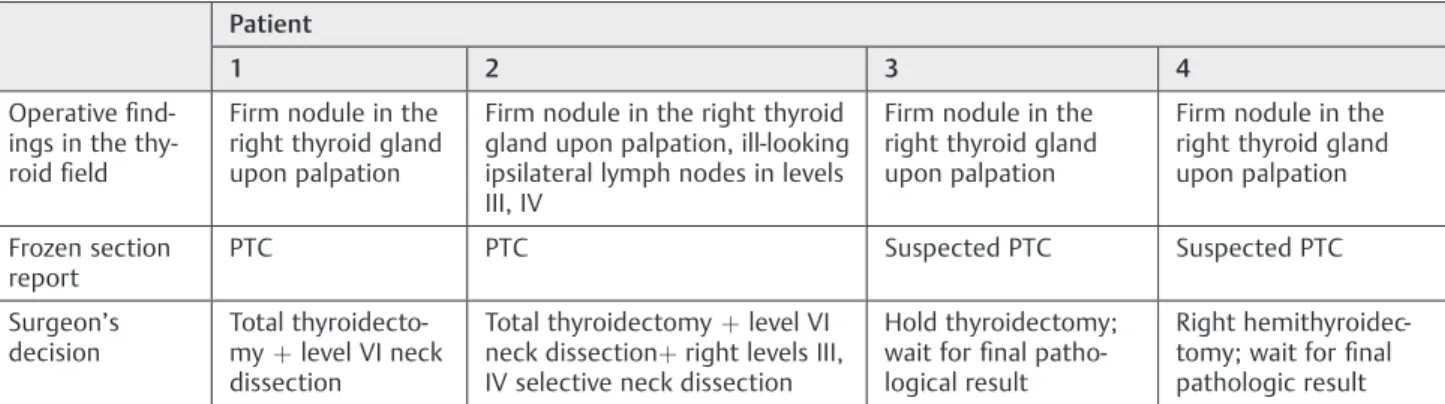
The preoperative workup and intraoperative courses of the four patients are summarized in ►Table 1 and ►Table 2, respectively. The postoperative recovery and follow-up were uneventful in all patients; postoperative parathyroid hor-mone and calcium blood levels returned to normal values. Surgical pathology of all the thyroid lesions was reported as PTC, classical variant, without evidence for an extracapsular spread (►Table 2). Patient 3 had an uneventful completion thyroidectomy 2 weeks after the first surgery, whereas patient 4 decided not to have completion thyroidectomy. Patients 1, 2, and 3 were later referred for ablative iodine 131 treatment.
The MEDLINE electronic database was searched to identify relevant studies. For this purpose, we used the following Table
1 Pr eo p e rat ive wo rk u p in fo u r p at ie n ts wi th p rim ar y hy p er p ar a th yr o id is m Ch a ra cte ri sti cs Pa ti en t 1 234 Ag e (y ) 32 55 39 49 G e nd e r M al e Fe ma le Fe ma le Fe ma le Pr eo p e ra tiv e PT H le vel a 75 12 0 12 0 12 1 Pr eo p e ra tiv e ca lc iu m le vel b 11 11 .2 11 .2 11 Pa rat hy roi d ad e no ma lo ca lizi ng st ud ie s c Ad jac e nt to the ri g ht thy ro id lo be, lo w er po le Lat e ra l an d d ee p to the ri g ht th yr o id lo b e N ea r the in fe rio r po le of the rig ht thy roi d lo b e De e p an d po st er io r to the rig ht th yr o id lo b e Ot he r ne ck ul tr as ou nd fi nd in gs 10 7-mm , ri gh t thy ro id lo be hy p oe cho ge ni c no d ul e, w it h re g ul ar bo rde rs, wi tho ut cal ci fi ca -tio ns , no ly mp ha d e no pa thy 5-mm no d ul e wi th fi ne ca lc i fi ca -tio ns in the rig ht thy roi d lo be an d 3 sm a lle r foc i ( < 2 mm ) in the le ft th yr o id lo b e 7. 5 5-mm hy po ec ho ic no du le w it h re gu la r b or d e rs in the rig ht thy roi d lo b e, no ly mp ha de no p at hy 9-mm no du le in the le ft thy roi d lo be, wi th so me fi ne cal ci fi ca ti o ns , no ly m ph ad e no p at hy Pr eo p e ra tiv e thy roi d FN A re p or t Be ni gn -ap pea ri ng fo llic ul ar cel ls Co lloi d an d be ni gn -ap pe ar in g fo llic ul a r cel ls A fe w be ni g n fo llic ul ar cel ls an d som e re d b lo od cel ls Fo llic u la r cel ls an d co lloi d Ab br ev ia ti on s: FN A , fi ne ne ed le asp ira tio n; P TH , pa rat hy roi d ho rm on e. aNo rm al P T H lev el ran ge : 10 – 65 p g/ m L. bNo rm a l se ru m ca lc ium ra ng e : 8. 5 – 10 .3 m g/ d L. c99 m T c-M IB I sc a n an d n ec k u lt ra so u n d st u dy .
International Archives of Otorhinolaryngology Vol. 19 No. 1/2015
free-text terms:“hyperparathyroidism” with “thyroid can-cer” or “risk factor” or “hypercalcemia,” and limited to
“human.”In addition, relevant studies were also extensively searched for by hand. Time and language limitations were applied to the years 1900 to 2014 and English, respectively. Data regarding the occurrence of thyroid nodules among patients with PHPT were reported to match the general population.9,10 However, processing reported information regarding PTC among patients with PHPT who were operated for parathyroid adenoma suggested a 5% incidence rate of coexistence of thyroid cancer and PHPT.1,2,9–15 The range varies between 3.3 and 15% (►Table 3).
Discussion
This study questioned whether patients with PHPT have a higher risk for PTC in comparison with the general popula-tion. All the same, to date the ATA guidelines do not consider PHPT a risk factor for thyroid cancer. An increased awareness
and earlier diagnosis of PHPT has been partially attributed to the popular routine automated biochemical testing, in addi-tion to targeting middle-aged women with blood calcium screening in an aging society.16Furthermore, other reports suggested that patients with PHPT may have an elevated risk to encounter cancer including thyroid cancer.5,6 Concurrent-ly, thyroid cancer incidence has been reported to increase worldwide. The reasons are not clear, yet an increased US detection rate of thyroid lesions is probably only a partial explanation.17–21 When based on physical examination alone, the incidence of thyroid nodularity was estimated to be 6.4% among female subjects and 1.5% in male subjects, and the incidence of thyroid nodules was 37 to 57% in autopsies series, with similarfigures when detected by US.22
Contemporarily, FNA is the most valuable diagnostic pro-cedure for PTC; however, false-negative results may be as high as 10%, especially in small, subcentimeter nodules.23–25 This issue has been addressed by the revised ATA manage-ment guidelines for patients with thyroid nodules and differ-entiated thyroid cancer. These recommendations concluded that“routine FNA is not recommended for sub-centimeter nodules . . . patients for whom consideration of FNA of a sub-centimeter nodule may be warranted include those with a higher likelihood of malignancy (high risk history), i.e., family history of PTC, history of external beam radiation exposure as a child, exposure to ionizing radiation in childhood or ado-lescence, history of prior hemithyroidectomy with discovery of thyroid cancer, and 18FDG-PET [fluorine-18fl uorodeox-yglucose positron emission tomography]-positive thyroid nodules.”8
Regarding“size,”the current study presented four patients with PHPT, without any ATA-recognized risk factors for thyroid cancer, who presented with a small, unsuspicious thyroid nodule, which would not have been studied other-wise but nevertheless proved to harbor PTC in the postoper-ative pathologic examination. Roti et al reported that tumors 10 mm accounted for 39% of all thyroid cancers, and local lymph node invasion occurred in 0.8% of tumors<5 mm and in 1.6 to 3.3% of patients with nodules 6 to 10 mm in size.26 Recent worldwide data reported the incidence of thyroid cancer to be2 to 12 per 100,000 per year new cases, and the Table 3 Papillary thyroid cancer among patients with PHPT
undergoing parathyroidectomy
Author No. of
PHPT patients
No. of patients with thyroid cancer
%
Attie and Vardhan2 948 31 3.3
Cinamon and Turcotte11 582 25 4.3
Strichartz and Giuliano12 308 11 3.5
Morita et al1 200 12 6
Rivo Vázquez et al13 124 6 4.8
Masatsugu et al9 109 19 17.4
Arciero et al14 94 6 6.4
Ogawa et al10 85 9 10
Gul et al15 60 9 15
Total 2,510 128 5
Abbreviation: PHPT, primary hyperparathyroidism.
Table 2 Intraoperative course of four patients with PHPT
Patient
1 2 3 4
Operativefi
nd-ings in the
thy-roidfield
Firm nodule in the right thyroid gland upon palpation
Firm nodule in the right thyroid gland upon palpation, ill-looking ipsilateral lymph nodes in levels III, IV
Firm nodule in the right thyroid gland upon palpation
Firm nodule in the right thyroid gland upon palpation
Frozen section report
PTC PTC Suspected PTC Suspected PTC
Surgeon’s
decision
Total
thyroidecto-myþlevel VI neck
dissection
Total thyroidectomyþlevel VI
neck dissectionþright levels III,
IV selective neck dissection
Hold thyroidectomy;
wait forfinal
patho-logical result
Right
hemithyroidec-tomy; wait forfinal
pathologic result
Abbreviation: PTC, papillary thyroid carcinoma.
International Archives of Otorhinolaryngology Vol. 19 No. 1/2015
estimated lifetime risk for developing thyroid among the general population was reported to be 1:842 for men and 1:324 for women (in the United Kingdom).17–21Our original assessment of previously reported data suggested a high (5%) rate of thyroid cancer among patients with PHPT undergoing parathyroidectomy (ranging 3.3 to 15%, 128 thyroid carcino-ma cases among 2,510 patients with PHPT;►Table 3).1,2,9–15 Although expressed in incomparable statistical measures, this rate suggests significance. Noteworthy are reports asso-ciating SHPT and thyroid cancer, thus contributing an addi-tional argument that hyperparathyroidism may indeed predispose for thyroid cancer.27–29
Finally, a nontraditional operative approach (i.e., obtaining an intraoperative biopsy of a small thyroid nodule with a benign preoperative cytology) in a high-risk patient (with PHPT) has been shown to be rewarding. It is important to note that the intraoperative examinations of the thyroid nodules have been proven to be reliable, as described in the same context.30
Conclusion
Larger population studies are required to determine if hyper-parathyroidism is a significant risk factor for PTC. At this time, we suggest that patients with PHPT should be regarded as extra-suspicious for PTC. Therefore, a comprehensive preop-erative thyroid workup, including FNA, should be performed in all patients with PHPT, even for small thyroid nodules (1 cm). Despite an otherwise innocent preoperative evalu-ation of a thyroid nodule in patients with PHPT, flexible surgical planning with optional intraoperative thyroid tissue sampling should be considered during surgery.
References
1 Morita SY, Somervell H, Umbricht CB, Dackiw AP, Zeiger MA.
Evaluation for concomitant thyroid nodules and primary hyper-parathyroidism in patients undergoing parathyroidectomy or
thyroidectomy. Surgery 2008;144(6):862–866, discussion 866–
868
2 Attie JN, Vardhan R. Association of hyperparathyroidism with
nonmedullary thyroid carcinoma: review of 31 cases. Head Neck
1993;15(1):20–23
3 Murray SE, Sippel RS, Chen H. Incidence of concomitant
hyper-parathyroidism in patients with thyroid disease requiring surgery.
J Surg Res 2012;178(1):264–267
4 Sanai T, Okamura K, Inoue T, Abe T, Tsuruya K, Node K.
Ultrasono-graphic detection of thyroid nodules in hemodialysis patients in
Japan. Ther Apher Dial 2010;14(3):323–327
5 Nilsson IL, Zedenius J, Yin L, Ekbom A. The association between
primary hyperparathyroidism and malignancy: nationwide co-hort analysis on cancer incidence after parathyroidectomy. Endocr
Relat Cancer 2007;14(1):135–140
6 Pickard AL, Gridley G, Mellemkjae L, et al. Hyperparathyroidism
and subsequent cancer risk in Denmark. Cancer 2002;95(8):
1611–1617
7 Cibas ES, Ali SZ; NCI Thyroid FNA State of the Science Conference.
The Bethesda System for Reporting Thyroid Cytopathology. Am J
Clin Pathol 2009;132(5):658–665
8 Cooper DS, Doherty GM, Haugen BR, et al; American Thyroid
Association (ATA) Guidelines Taskforce on Thyroid Nodules and
Differentiated Thyroid Cancer. Revised American Thyroid Associa-tion management guidelines for patients with thyroid nodules and
differentiated thyroid cancer. Thyroid 2009;19(11):1167–1214
9 Masatsugu T, Yamashita H, Noguchi S, et al. Significant clinical
differences in primary hyperparathyroidism between patients with and those without concomitant thyroid disease. Surg Today
2005;35(5):351–356
10 Ogawa T, Kammori M, Tsuji E, et al. Preoperative evaluation of
thyroid pathology in patients with primary hyperparathyroidism.
Thyroid 2007;17(1):59–62
11 Cinamon U, Turcotte RE. Primary hyperparathyroidism and
malig-nancy:“studies by nature.”. Bone 2006;39(2):420–423
12 Strichartz SD, Giuliano AE. The operative management of
coexist-ing thyroid and parathyroid disease. Arch Surg 1990;125(10):
1327–1331
13 Rivo Vázquez A, Rivo Vázquez JE, Cáceres Alvarado N, et al.
[Hyperparathyroidism, goiter and well-differentiated thyroid car-cinoma. A common association with diagnostic implications]. Cir
Esp 2007;82(1):32–36
14 Arciero CA, Shiue ZS, Gates JD, et al. Preoperative thyroid
ultra-sound is indicated in patients undergoing parathyroidectomy for
primary hyperparathyroidism. J Cancer 2012;3:1–6
15 Gul K, Ozdemir D, Korukluoglu B, et al. Preoperative and
postop-erative evaluation of thyroid disease in patients undergoing surgical treatment of primary hyperparathyroidism. Endocr Pract
2010;16(1):7–13
16 Adami S, Marcocci C, Gatti D. Epidemiology of primary
hyperpara-thyroidism in Europe. J Bone Miner Res 2002;17(Suppl 2):N18–N23
17 Davies L, Welch HG. Increasing incidence of thyroid cancer in the
United States, 1973–2002. JAMA 2006;295(18):2164–2167
18 Cancer Research UK. Thyroid cancer—UK incidence statistics.
Trends over time. Available at: http://info.cancerresearchuk.org/ cancerstats/types/thyroid/incidence. Accessed August 27, 2014
19 National Cancer Institute of Canada. Canadian Cancer Statistics 2009.
Time trends in incidence and mortality. Available at: www.cancer.ca
20 Pellegriti G, Frasca F, Regalbuto C, Squatrito S, Vigneri R.
World-wide increasing incidence of thyroid cancer: update on epidemi-ology and risk factors. J Cancer Epidemiol 2013;2013(13):965212
21 Aschebrook-Kilfoy B, Ward MH, Sabra MM, Devesa SS. Thyroid
cancer incidence patterns in the United States by histologic type,
1992–2006. Thyroid 2011;21(2):125–134
22 Dean DS, Gharib H. Epidemiology of thyroid nodules. Best Pract
Res Clin Endocrinol Metab 2008;22(6):901–911
23 Hambleton C, Kandil E. Appropriate and accurate diagnosis of
thyroid nodules: a review of thyroidfine-needle aspiration. Int J
Clin Exp Med 2013;6(6):413–422
24 Mehanna R, Murphy M, McCarthy J, et al. False negatives in thyroid
cytology: impact of large nodule size and follicular variant of
papillary carcinoma. Laryngoscope 2013;123(5):1305–1309
25 Shrestha M, Crothers BA, Burch HB. The impact of thyroid nodule
size on the risk of malignancy and accuracy offine-needle
aspira-tion: a 10-year study from a single institution. Thyroid 2012;
22(12):1251–1256
26 Roti E, Rossi R, Trasforini G, et al. Clinical and histological
charac-teristics of papillary thyroid microcarcinoma: results of a retro-spective study in 243 patients. J Clin Endocrinol Metab 2006;
91(6):2171–2178
27 Maisonneuve P, Agodoa L, Gellert R, et al. Cancer in patients on
dialysis for end-stage renal disease: an international collaborative
study. Lancet 1999;354(9173):93–99
28 Cengiz K. Increased incidence of neoplasia in chronic renal failure
(20-year experience). Int Urol Nephrol 2002;33(1):121–126
29 Miki H, Oshimo K, Inoue H, et al. Thyroid carcinoma in patients
with secondary hyperparathyroidism. J Surg Oncol 1992;49(3):
168–171
30 Yoon JH, Kwak JY, Kim EK, et al. How to approach thyroid nodules
with indeterminate cytology. Ann Surg Oncol 2010;17(8):
2147–2155
International Archives of Otorhinolaryngology Vol. 19 No. 1/2015