Bull Pan Am Hdh Organ 18(Z), 1984
A CONTINUING
FOCUS OF YELLOW
FEVER IN THE APURIMAC
RIVER VALLEY,
AYACUCHO,
PERU, AND THE FIRST
ISOLATION
OF YELLOW
FEVER VIRUS IN THAT COUNTRY1
Maria R. Mgndez,’ Charles H. Calisher,3 Hever Kruger,4 Felipe Sipan,
Sara S&chez,6 and John S. Lazuick’
Extensive outbreaks of hemorrhallc dtsease compatible with yellow fever (YF) occurred in southern Peru in 1977, 1978, and 198I. This article descrzbes the epidemiologic circumstances involved and the procedures applied to isolate YF
virus from SIX patients-the first time this virus has been isolated in Peru.
Introduction
Clinical sylvatic yellow fever (YF) in Peru may have been reported as early as 1913 by Rojas (I); however, the earliest known out- break that has been reported was that cited by Giles and Pinto (2) as occurring in Chancha- mayo (Junin Department) in 1925. It has also been shown that children living along the up- per Amazon River in Brazil and Peru during 1931 had antibody to YF virus (3); and sero- logic surveys for antibody to YF virus in 1933- 1934 in thesame general area indicated that the antibody prevalence increased with age- 10.6% of the study subjects under 15 years old being found with antibody to YF virus, as compared to 50.2 % of those 15 years and older (4). That this immunity was not due to infec-
‘Also appearm\ ,I in Spanish I” thr R&in de /a Qficuzn
Sanrlarla Panamertcana.
‘Chief, Virus D epartment. lnstltutr of Pubhr Health, Calle Capac Yupanqui No 1400. Apartado No 451, Lima, Peru.
3Chief, Arbo wrus Reference Branch, Division of Vec- tor-Borne Viral Diseases, Center for Infectious Diseases, Centers for Disease Control, Public Health Service, U.S Department of Health and Human Serwces, P.O. Box
20
9 7, Pathologist, Pathology Department, Fort Collins, Colorado 80522, U.S.A. Naval Medical Center, Lima, Peru.
5Epldemiologist, Bureau of Epidemiology, Mmlstry of Public Health, Lima, Peru.
6Technician, Virus Department. Institute of Public Health, Lima, Peru.
7Technologist, Division of Vector-Borne Viral Dis- eases, Center for Infectious D~scases, Fort Collins, Col- orado, U.S.A.
tion with attenuated strains of YF virus was demonstrated by the fact that fatal cases, con- tirmed by liver examination, were reported from Peru and elsewhere in the Amazon re- gion. More recently, Morales-Ayala found neutralizing antibody to YF virus in 64% of 208 individuals living in San Martin Depart- ment, two years before a 1969-1970 outbreak of jungle yellow fever that produced 86 re- ported cases and 61 deaths (5). In 1975, one case of yellow fever was reported in Peru (6).
In 1977, an extensive outbreak of a hemor- rhagic disease compatible with YF occurred in the Apurimac River Valley of south-central Peru’s Ayacucho Department. A massive vac- cination program was initiated, but the disease reappeared in Ayacucho Department and the adjacent department of Cuzco in 1978 (see Figure 1). This situation afforded an opportu- nity to study the outbreak and the attendant epidemiologic circumstances. That study, the results of which are reported here, indicated a situation involving the introduction of suscep- tible migrant workers into an enzootic focus and provided specimens which, for the first time, yielded YF virus isolates from Peru. The Study Area
Mindez et al. l YELLOW FEVER IN SOUTHERN PERU 173
Figure 1. A map of Peru showing departmental boundaries and the cities of Ayacucho, Cuzco, and Lima.
,r .
-,.r’ _
d’! BRAZIL
\Llrn.’
\ Junina .,/-‘1
mately 13” S, 73” W in an area near the con- fluence of the Apurimac *and Mantaro rivers (Figure 2). The Apurimac River Valley in this region extends over approximately 500 km”, ranges in altitudes from 650 to 1,000 m above sea level, and has ecologic characteristics of both high rain forest (7) and dry tropical forest (8) (see photo). High temperatures in the val- ley tend to fluctuate around 32’C in June and July, and precipitation is between 1,000 and 2,000 mm from December to March, with an attendant mean relative humidity of 80 %.
Within this region are 420 towns with an ap- proximate permanent population of 40,000 people living in about 18,000 residences. However, from January to March a massive immigration occurs. The migrants-con-
tracted temporarily to harvest coffee, cocoa, and other crops-are principally from the departments of Junin, Huancavelica, and Ayacucho. Languages spoken in the study re- gion are Spanish, Quechua, and local dialects. Common illnesses of the region include in- testinal parasitism, gastroenteritis, malaria, leishmaniasis, and respiratory infections.
174 PAHO BULLETIN l vol. 18, no. 2, 1984
Figure 2. A map of the Lower Apurimac River Valley area in Ayacucho and Cuzco departments showing where reported yellow fever cases occurred in
1978.
Legend:
tB Dopartmsnt capital Q Province capital - - - provincial boundary
l Location of cams
‘k , La Mar
\ @
@ Ayacucho
The natural vegetation of the high forest in this area is exuberant. It consists principally of trees belonging to the families Moracea (Secro- pia tessmennii, Ficus anthelmintica, Artrocarpus in- cisa), Bombacacea (Ochroma lagopus and pisca- toria), and Euforbiacia (Croton erythrochilus and Cedrela sp.), and of legumes and other plants and bushes typical of mountainous habitats.
The region’s fauna includes monkeys of the genera Alouatla and Aotus as well as small deer (Mazama americana), collared peccary (Tayassu tajacu), capybara (Hydrochoerus hydrochaeris), nine-banded armadillos (Dasypus novemcinctus), porcupines (Coendou sp.), agoutis (Dasiprocta
sp.), and others.
The occurrence of the first cases of YF in this area is not documented, but local clinical- epidemiologic reports since 1963 and viscero-
cuzco
@
\
tomy reports since 1977 confirm the presence of the disease (9). In 1976 a YF control pro- gram was initiated in Peru, and virologic, se- rologic, and histopathologic studies were made of individuals with hemorrhagic and other ill- nesses compatible with YF.
Materials and Methods
Mhdez et al.
l YELLOW FEVER IN SOUTHERN PERU175
A view of the Apurimac River Valley in La Mar Province,
Ayacucho Department, on the border of Cuzco
Department.
Attempts
were made in 1977, 1978, and
1981 to isolate virus from whole blood speci-
mens obtained
from these patients,
from six
patients ill in 1977 in Ayacucho,
and from four
patients ill in 1981 in Cuzco.’ These virus iso-
lation
attempts
were made by inoculating
suckling mice intracranially
with 0.03 ml of
whole blood from the patient, and also by inoc-
ulating suckling mouse, LLCMK,,
Vero, and
C6/36 (Aedes alhopictus mosquito)
cell cultures
and examining
the cultures for plaques or cy-
topathic
effects. Isolated
virus strains were
identified
by means of a serum dilution-
plaque reduction
neutralization
(N) test (10)
in Vero cells, or by a combination
of this test
and complement
fixation (II).
In addition,
serum specimens were collected
from 262 healthy individuals
in areas where 29
cases of YF had been reported
in 1977, and
where cases were being reported in 1978. Of
these sub.jects, 120 had been vaccinated with
YF (17D strain) the previous year or before,
92 had not been vaccinated,
and 50 had no
known history of vaccination.
These 262 sera
were tested for neutralizing
antibody
to the
17D strain.
Results
During the 1978 outbreak, a total of 27 cases
were diagnosed clinically,
histopathologically,
serologically,
or by virus isolation. Clinically,
the patients later shown by histopathologic
le-
sions or serologic conversion*
to have been in-
fected with YF virus had a similar presentation
and course of illness: sudden onset with a fever
of about 39OC, severe headache, and icteric
conjunctiva.
Later,
the symptoms
became
more acute with abdominal
pain,
marked
‘From 1977 through 1981, local authorities reported a continuous seasonal occurrence of yellow fever in the de- partments of Cuzco and Ayacucho. Such occurrences were reported to reach epidemic proportions from time to time.
176 PAHO BULLETIN . vol. 18, no. 2, 1984
jaundice of the skin and mucous membranes, choluria, hypothermia, epistaxis, restlessness, and often petechiae on the abdomen and thorax. Terminally, the patients experienced agitation and disorientation, generalized hem- orrhagic manifestations, melena, severe con- vulsions, and death.
Histopathologic observations were made on liver specimens obtained at autopsy from 17 cases. Findings from 14 of these can be de- scribed as classical for YF infection-with mid-zonal necrosis, microvacuolar fatty de- generation, the presence of Councilman bodies, conservation of lobular architecture, and moderate inflammatory infiltration of portal spaces. However, liver specimens from the three other patients showed diffuse nccro- sis, with normal cells (intercalated between nc- erotic cells and Councilman bodies) occurring into the periportal spaces and around the cen- trolobular vein.
Also, a bone marrow aspirate from one pa- tient contained normal cells as well as many megakaryocytes showing hyaline changes with loss of the nucleus, simulating Councilman bodies. (This megakaryocyte necrosis was noteworthy, because the observed changes could relate to the thrombocytopenia associ- ated with YF infection.)
None of the 27 patients had been vacci- nated; all but one were males; and, with the exception of a seven-year-old student, all were agricultural workers from outside the immedi- ate area of the outbreak. The 27 ranged in age from seven to 53 years, but most were between
15 and 40 years old (their average age was 26.9 years). The months of onset of their cases were January (two cases), February (nine cases), March (eight cases), April (two cases), May (one case), June (three cases), and July (two cases). Only two patients survived. Of the 25 who died, 23 died three to 10 days after the on- set of their illnesses, the average survival time being 6.4 days.
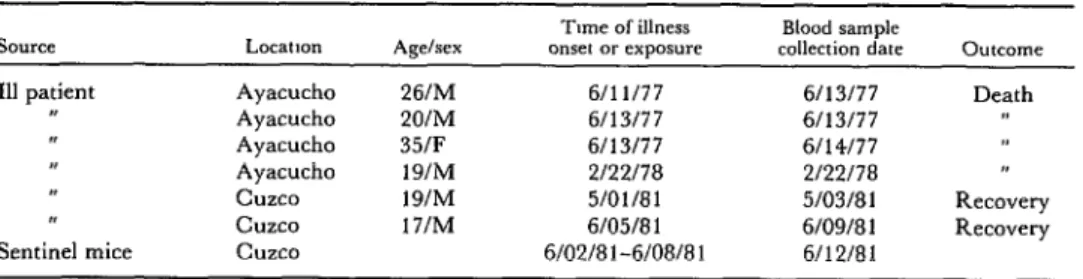
Regarding virus isolations, YF virus was isolated from blood samples provided by three of the six 1977 Ayacucho patients. (These samples had been stored at - 7O’C.) YF virus was also isolated from blood samples provided by one of the four 1978 Ayacucho patients and two of the four 1981 Cuzco patients, whose samples were also kept at - 70%. In addition, as Table 1 indicates, the virus was isolated from sentinel mice exposed near Cuzco in 1981.
During primary virus isolation attempts, all seven of the above isolates caused cytopathic effects on days 6-8 in C6/36 cells, but only five of the seven killed suckling mice. Therefore, supernatant fluids from infected C6/36 cells were supplemented with 20% heat-inactivated fetal bovine serum, stored at - 70°C, and used as a source of seed viruses. These prepa- rations were subsequently titrated by plaque assay in LLCMK, cells, using a double agar overlay technique, and were tested for virus identification with a serum dilution-plaque re- duction neutralization test in LLCMK, cells against (1) hyperimmune mouse ascitic fluids for 10 flaviviruses, (2) a grouped mouse ascitic
Table 1. Isolations of yellow fever virus from human and sentinel mouse blood samples collected in Ayacucho and Cuzco, Peru, 1977-1981.
Source
I11 patient
u I,
t,
I, I, Sentinel mice
LOCatlOn Ayacucho Ayacucho Ayacucho Ayacucho cuzco cuzco cuzco Age/sex 26/M 20/M 35/F 19/M 19/M 17/M
Tune of illness Blood sample Onset or exposure collection date
6/l 1177 6113177
6/13/77 6/13/77
6113177 6114177
2f22f78 2122178
5/oual 5/03/81
6/05/a 1 6/09/81
6/02/a I -6/08/a i 6/12/81
Mindez et al. l YELLOW FEVER IN SOUTHERN PERU 177
fluid for this group, and (3) suitable controls. The results of these tests are presented in Ta- ble 2.
Interestingly, when reisolation was at- tempted, the same observations were made with suckling mice and C6/36 cells, but no consistent pattern of cytopathic effects was ob- served with Vero or LLCMK, cells. Thus, C6/36 cell cultures were shown to be reliable indicators of the presence of the YF virus, but other systems were not. This supports and ex- tends the findings of Varma et al. (12) using AP-61 (Aedes pseudoscutellaris) cells. After a sin- gle additional passage of the virus in suckling
mice, however, patterns of virus replication were uniform.
Of the 262 individuals tested in the serologic survey, neutralizing (N) antibody (2 1: 10) was detected in 106 of 120 vaccinated subjects, 61 of 92 unvaccinated subjects, and 42 of 50 subjects with an unknown vaccination history. Results of these serologic tests, by ten-year age group, are shown in Table 3. The observed antibody prevalence rates were high in all three groups, irrespective of the subjects’ ages, but were of course slightly higher in the vacci- nated group. The relatively high rates seen in the group with unknown vaccination status
Table 2. Results of serum dilution-plaque reduction neutralization (N) tests with six virus isolates from humans and one from sentinel mice. These viruses were tested against antibody preparations (hyperimmune
mouse ascitic fluids) for the following flaviviruses: yellow fever (strain 788379), St. Louis encephalitis (TBH-28), Bussuquara (BeAn 4073), Naranjal(25008), Ilheus (original), Rocio (SPH 34675), Aroa (VENA-1809), dengue-1 (Hawaii), dengue-2 (TR 1751), and dengue-3 (H-87). Grouped mouse ascitic fluid and
suitable controls were also tested. The Bussuquara, Ilheus, Area, dengue-1, and dengue-3 ascitic fluids yielded titers of 640, 640, z 10, 240, 640, and 1,280, respectively, when tested with homologous virus; however, all
the tests conducted with our sera yielded titers below 20.
Virus
isolate Source
Primary isolation in: Date of
serum Suckling C6/36 collection nuce cells YF
Titer of N antibody to:
SLE Naranjal Rocio Dengue-2
1362177 Ill patient 6113177 + + 5,120 20 <20 40 <20
1368177 I, 6/13/77 - + 22,560 80 <20 <20 <20
1371/77 I, 6114177 - + 1,280 40 20 40 20
287f78 I, 2122178 + + 22,560 40 <20 <20 <20
189618 1 I, 5/03/81 + + 5,120 40 <20 <20 <20
189918 1 ,, 6/09/8 1 + Jr ~2,560 20 <20 <20 <20
1914/81 Sentinel mice 6/12/81 + + ~2,560 <20 <20
(Homologous) (10,240) (6::) (640) (6::) (640)
Table 3. Results of serum dilution-plaque reduction neutralization tests for YF antibody in 262 individuals, by history of vaccination with yellow fever (17D strain) and age group.
Vaccinated Unvaccinated Vaccination status unknown Age of
subjects Antibody % NO. Antibody % NO. Antibody % NO.
(in years) present positive tested present positwe tested present positive tested
O-10 5 83 6 2 100 2 3 100 3
1 l-20 29 83 35 27 59 46 15 79 19
21-30 27 90 30 14 78 18 9 82 11
31-40 18 90 20 8 67 12 7 100 7
41-50 13 87 15 6 86 7 3 100 3
51-60 5 100 5 4 67 6 2 67 3
~61 7 100 7 0 0 1 2 67 3
Unknown 2 100 2 0 - 0 1 100 3
178 PAHO BULLETIN . ool. 18, no. 2, 1984
suggest that most of this group’s members had been vaccinated, since the prevalence rates were comparable to those found in the vaccinated group.
Discussion and Conclusions
Tabulations of reported sylvatic YF cases in Peru during 1976-1980 (Table 4) suggest that, while this disease may occur periodically in ep- idemic form, its presence in the country is en- demic. Since essentially all individuals with YF in Ayacucho in 1978 were newly arrived migrants, and since the prevalence of neutral- izing antibody in permanent residents was high, it appears that the endemic presence of YF combined with an active vaccination cam- paign may have excluded nearly all but recent arrivals from the population at risk.
The migrant workers in this region gener- ally come from high mountain areas where YF virus is not known to occur. Morales-Ayala (5) has suggested that immigration of susceptible agricultural workers from the high sierra to the high forest areas of Peru endemic for YF may be responsible for the annual occurrence of the disease in humans, if not for periodic out- breaks. Also, the focus of YF activity in Ayacucho Department may have been associ- ated epidemiologically with endemic areas in neighboring valleys.
Working with population data from the Pe- ruvian Ministry of Health’s Office of Statis-
Table 4. Reported cases of human yellow fever in rural Peru, 1976-1980.
No of C~SCJ Departments 1976 1977 197s 1979 1980 ‘I‘otal
Loreto 1 2 1 4
San Martin 1 19 8 43 8 79
JWliIl 24 57 31 10 122
Apurimac 29 27 6 11 73
Madre de Dios and
PUIl0 10 15 25
Total repot-ted cases 1 82 93 97 30 303 Source Records of the National Institute of Health, Lima.
tics, it appears that there were 74.55 YF cases per 100,000 population (29 reported cases and 29 deaths) in villages of the Apurimac River Valley in 1977, 68.47 cases per 100,000 in 1978 (27 reported cases and 25 deaths), and 15 cases per 100,000 in 1979 (six reported cases and six deaths). However, if only the migrant workers (with an estimated yearly population of 10,000) are considered to constitute the group at risk, then the case rates are much higher (290, 270, and 60 cases per 100,000 in 1977, 1978, and 1979, respectively); and the average migrant’s chance of becoming ill and dying of yellow fever in those years was one in 345, one in 400, and one in 1,667, respec- tively.
Fortunately, the Peruvian Government has begun to take steps to prevent such occur- rences in the future by initiating mass vaccina- tion campaigns in the affected areas. How- ever, the difficulties involved in recognizing mild YF cases tend to result in underreporting and complicate prevention. Indeed, the ex- ceedingly high mortality reported here may be a reflection of underdiagnosis.
Although no attempts were made to isolate virus from mosquitoes in the area at the time of the outbreak, a wide variety of mos- quitoes-including Haemagogus capricornii, a recognized YF vector in Amazonia (13)-were reported present in areas neighboring local coffee plantations in 1977 (14). Using humans as attractants, we were able to collect four spe- cies of Anopheles, three of Aedes, two of Psorophora, and one each of Munsonia, Sabethes, and Culex in the hills neighboring the coffee plantations of four towns.
Mthdez et al. . YELLOW FEVER IN SOUTHERN PERU 179
that the study reported here, in combination serious and continuing disease problem in ru- with earlier works, will help call attention to a ral Peru.
SUMMARY
Beginning in 1977, an extensive outbreak of thors attempted to isolate YF virus from blood spec- hemorrhagic disease compatible with yellow fever imens provided by four 1977 patients, six 1978 pa- (YF) occurred in southern Peru; and despite a mas- tients, and four 1981 patients from the endemic sive vaccination effort, recurrent outbreaks oc- zone. For this purpose, whole blood from the pa- curred in subsequent years. Epidemiologic circum- tients was inoculated into suckling mice (intracrani- stances associated with the outbreaks suggest that a ally) and also into C6/36 (Aeder albopictus), suckling major contributing factor was annual reintroduc- mouse, LLCMK2, and Vero cell cultures. Virus tion of susceptible migrant workers into an enzootic strains isolated from six of these patients were sub-
focus of the disease. sequently identified as YF, the first time this virus
In the course of studying these outbreaks, the au- has been isolated in Peru.
REFERENCES
(1) Rojas, M. A. El vomit0 negro de Iquitos, In Proc @into Congress0 MLdico Latinoamericano. Lima, 1913.
(2) Giles, A., and M. Pinto. Apuntes acerca de la fiebre amarilla selvitica en la zona de Chancha- mayo. Bol de la Direct de Salubridad Pu’blica, 1941.
(3) Soper, F L Geographical distribution of im- munity to yellow fever in man in South America. Am J Trap Med 171457-511, 1937.
(4) Strode, G K. (ed.). Yellow Fever. McGraw- Hill, New York, 1951.
(5) Morales-Ayala, F. Fiebre amarilla selvatica en el Peni: I. Encuesta serologica en 208 pobla- dores de1 Departamento de San Martin. Rev Lat Am Microbial 15:5-g, 1973.
(6) World Health Organization. Yellow fever in 1975. Wee& Epidemiolo&cal Record 51.301-305, 1976.
(7) Pulgar Vidal, A. Las echo regiones naturales de1 Peru. In Atlas histdrico geogra’fico y de paisajks Pe- ruanos. Instituto National de Planificacibn, Lima, 1970, pp. 175-176.
(8) Tossi, J. Mapa ecol&ico de1 Perd. Instituto Geoffsico Militar de1 Peru, Lima, 1956.
(9) Archives, Oficina de Estadistica, Ministerio de Salud Ptiblica, Lima, 1977.
(IO) Lindsey, H. S., C. H. Calisher, and J. H. Mathews. Serum dilution neutralization test for California group virus identification and serology. J Clin Microbial 4:503-510, 1976.
,(]I) Casey, H. L. Standardized Dzagnostzc Comple- ment-fixation Method and Adaptation to Micro Test. II Adaptation of LBCF Method to Micro Technique. Public Health Monograph No. 74, USPHS Publication No. 1228. United States Public Health Service; Washington, D.C., 1965, pp. 3 l-34.
(12) Varma, M. G. R., M. Pudney, C. J. Leake, and P. H. Peralta. Isolations in a mosquito (Aedes pseudoscuteflaris) cell line (Mos. 61) of yellow fever virus strains from original field material. Inter- virology, 6:50-56, 1975-1976.
(13) Pinheiro, F. P., A. P. A Travassos da Rosa, and M. A. P. Moraes. An epidemic of yellow fever in Central Brazil, 1972-1973: II. Ecological studies. Am J Trap Med Hyg 30:204-211, 1981.
(14) Calderbn, F. G. Actividades entomoldgzcas en el Rio Apurz’mac. Informe de la Direction de Erradicacibn y Control de Enfermedades Transmi- sibles. Ministerio de Salud Publica, Lima, 1977
(15) Berge, T. 0. (ed.). International Catalogue of Arboviruses (second edition). DHEW Publ. No. (CDC) 75-8301. United States Department of Health, Ed- ucation, and Welfare; Washington, D.C., 1975.