(Annals of the Brazilian Academy of Sciences) ISSN 0001-3765
www.scielo.br/aabc
Limited replication of yellow fever 17DD and 17D-Dengue
recombinant viruses in rhesus monkeys
GISELA F. TRINDADE1,2, RENATO S. MARCHEVSKY3, ANA M.B. DE FILLIPIS2,
RITA M.R. NOGUEIRA2, MYRNA C. BONALDO1, PEDRO C. ACERO4, ELENA CARIDE3, MARCOS S. FREIRE3 and RICARDO GALLER3
1Departamento de Bioquímica e Biologia Molecular, Fundação Oswaldo Cruz, Av. Brasil, 4.365, Manguinhos
21045-900 Rio de Janeiro, RJ, Brasil
2Departamento de Virologia, Fundação Oswaldo Cruz, Av. Brasil, 4.365, Manguinhos, 21045-900 Rio de Janeiro, RJ, Brasil 3Instituto de Tecnologia em Imunobiológicos, Fundação Oswaldo Cruz, Av. Brasil, 4.365, Manguinhos
21045-900 Rio de Janeiro, RJ, Brasil
4Departamento de Genética, Fundação Oswaldo Cruz, Av. Brasil, 4.365, Manguinhos, 21045-900 Rio de Janeiro, Brasil
Manuscript received on August 20, 2007; accepted for publication on December 13, 2007; presented byALEXANDERW.A. KELLNER
ABSTRACT
For the development of safe live attenuated flavivirus vaccines one of the main properties to be established is viral replication. We have used real-time reverse transcriptase-polymerase chain reaction and virus titration by plaque assay to determine the replication of yellow fever 17DD virus (YFV 17DD) and recombinant yellow fever 17D viruses expressing envelope proteins of dengue virus serotypes 2 and 4 (17D-DENV-2 and 17D-DENV-4). Serum samples from rhesus monkeys inoculated with YFV 17DD and 17D-DENV chimeras by intracerebral or subcutaneous route were used to determine and compare the viremia induced by these viruses. Viral load quantification in samples from monkeys inoculated by either route with YFV 17DD virus suggested a restricted capability of the virus to replicate reaching not more than 2.0 log10PFU mL−1or 3.29 log
10copies mL−1. Recombinant 17D-dengue viruses were shown by plaquing and real-time PCR to be as attenuated as YF 17DD virus with the highest mean peak titer of 1.97 log10 PFU mL−1or 3.53 log
10 copies mL−1. These data serve as a comparative basis for the characterization of other 17D-based live attenuated candidate vaccines against other diseases.
Key words:yellow fever, dengue, vaccine, attenuation, replication, real-time RT-PCR.
INTRODUCTION
Flaviviruses are positive-strand RNA viruses primarily transmitted by infected mosquitoes or ticks. They in-clude major human pathogens, such as yellow fever, dengue, Japanese encephalitis, Tick-borne encephalitis and West Nile viruses (YFV, DENV, JEV, TBEV and WNV). Dengue viruses (DENV) has four distinct but closely related serotypes, 1, 2, DENV-3 and DENV-4 that are distinguished by neutralization test (Russell and Nisalak 1967) and constitute a distinct
Correspondence to: Ricardo Galler E-mail: [email protected]
No licensed dengue vaccine is available at this time, al-though there are some promising live attenuated vac-cine candidates under development (Blaney et al. 2005, Durbin et al. 2001, Edelman et al. 2003, Guirakhoo et al. 2006, Kanesa-Thasan et al. 2001, Sun et al. 2003, 2006, Sabchareon et al. 2002, 2004).
The genome of all flaviviruses encodes a single long polyprotein processed to yield capsid (C), premembrane (prM), and envelope (E) structural proteins, followed by seven nonstructural proteins (NS1, NS2A, NS2B, NS3, NS4A, NS4B and NS5) synthesized, in that order, in virus infected cells (Lindenbach and Rice 2001). This knowledge led to infectious clone technology, which al-lows direct manipulation of the viral genome and has opened new possibilities for flavivirus vaccine devel-opment. One major approach has been the creation of chimeric flaviviruses, using the backbone of an attenu-ated virus in which certain genomic regions of interest have been replaced with the equivalent regions derived from another flavivirus against which a vaccine is needed (reviewed by Lai and Monath 2003).
Towards the development of vaccines to dengue, numerous efforts have been directed at establishing an animal model that reflects the disease patterns observed in humans (Bente and Rico-Hesse 2006) but all have their limitations. Several species of nonhuman primates have been infected with dengue viruses but none has shown clinical signs attributable to the viral infection. Notwithstanding, monkeys show some degree of viremia
(up to 5 log10PFU mL−1) and a consistent neutralizing
antibody response. High viremias have been correlated with severe dengue in man (Vaughn et al. 1997, 2000).
Several monkey species are highly susceptible to
YFV with high viremia (up to 8 log10PFU mL−1) and
fatal infection with clinical manifestations that resemble YF in man (Monath 2003). A major characteristic of the attenuated vaccine 17D virus is the loss of hepatotropism and reduced viremia after intracerebral, intrahepatic or
subcutaneous inoculation (<3 log10PFU mL−1).
Con-sequently one parameter for considering the safety of recombinant 17D-dengue viruses is limited replication in nonhuman primates. Data from sub-cutaneous immu-nization of mice and monkeys with recombinant 17D-DENV-2 and 17D-DENV-4 viruses (Galler et al. 2005, Galler R, Marchevsky RS and MS Freire, unpublished
data) indicate that both elicited significant neutralizing
antibody responses. These responses correlated with
protection from challenge with wild type DENV-2 (Gal-ler et al. 2005).
Here, we have compared viremia levels of YFV 17DD vaccine virus, by plaque assay and real-time re-verse transcriptase-polymerase chain reaction (RT-PCR), after inoculation of monkeys by the intracerebral (i.c.) or subcutaneous (s.c.) routes. In addition viremias caused by chimeric 17D-DENV-2 and 17D-DENV-4 were com-pared to that of YF 17DD virus.
MATERIALS AND METHODS
MONKEYSERA
The rhesus monkeys (Macaca mulatta) were obtained from the Primatology Department of Center for Labora-tory Animals (CECAL) of the Oswaldo Cruz Foundation (FIOCRUZ), Rio de Janeiro, RJ, Brazil. Blood samples were drawn from monkeys used in different tests of im-munogenicity and attenuation of YF 17DD, 17D-DENV-2-4 viruses. The groups were: a) intracerebral inocula-tion with YF 17DD virus (monkeys V79; V75; V09; V11; V43; V45; V67; V81; V85; V91; T46; U18; V60; X13; X15; X55; X65; X85; X89; X95), or with 17D-DENV-2 (monkeys V08; V33; V39; V47; V51; V55; V61; V65; V77; V89); b) subcutaneous inoculation with YF17DD (monkeys U67; U23; U63; U69; U75, J22; J61), or with 17D-DENV-2 (monkeys I14; M14; U44) or 17D-DENV-4 (monkeys V2; R38; U60). The inoc-ulation and blood drawing have been described (Galler et al. 2005). These studies were carried out according to the protocol approved by the Institutional Commit-tee for Experimentation and Care of Research Animals (CEUA-FIOCRUZ: P0112/02).
VIRUSES
YF 17DD virus is the YF vaccine from Biomanguinhos, Oswaldo Cruz Foundation, Rio de Janeiro, Brazil. YF 17DD vaccine and 17D-DENV viruses were propagated in Vero cells. The supernatant was harvested when cyto-pathic effect (CPE) was pronounced, aliquoted and stored
at−70◦
serially diluted (10−1-10−7) in normal human sera and
used as control in real-time RT-PCR amplifications. The YF 17DD secondary seed lot 13Z virus was used as the reference preparation in the monkey neurovirulence test. Its behavior in monkeys has been reported previously (Marchevsky et al. 2006).
VIRALRNA EXTRACTION
Total viral RNA was isolated from 140µl of serial
di-lutions (10−1-10−7) of 17DD vaccine virus in normal
human sera and from monkey sera using QIAamp Viral RNA Mini Kit (QIAGEN Corporation, Germany), ac-cording to manufacturer’s instructions.
IN VITROTRANSCRIBEDRNA
In vitrotranscribed RNA was used for calibrating the real time RT-PCR. This control RNA was produced from plasmid pYFV-NS3amp (Bae et al. 2003). RT-PCR on this RNA produces an amplicon of 104 base pairs (YF genome position: 4857-4961, GenBank num-berK02749). Serial dilutions corresponding from 106to
100copies were used to generate the calibration curve.
REALTIMERT-PCR
Quantitative real time RT-PCR was performed in an ABI Prism 7000 Sequence Detection System (Applied Bio-systems, USA). For every assay, amplifications were car-ried out in triplicate reactions for standard RNA and negative control, and in duplicate for the specimens. Thermal cycling conditions were designed as follows:
reverse transcription at 45◦C for 30 min; enzyme
ac-tivation at 95◦
C for 10 min followed by 45 cycles of
95◦
C for 15 sec (denaturation), 60◦
C for 1 min
(an-nealing/extension), with an extension of 1 min at 72◦
C.
Each PCR reaction contained 12.5µL of TaqMan
One-Step RT-PCR Master Mix Reagents (Applied Biosystem,
USA), 3µL of RNA, 5µM of each primer and probe
and 0.5 µL of MultiScribe/RNase Inhibitor. The
nu-cleotide sequences of the sense and anti-sense primers were 5´-AGGTCCAGTTGATCGCGGC-3´ and 5´-GA-GCGACAGCCCCGATTTCT-3´, respectively. The se-quence from the fluorogenic probe was 5´-TGGTCAAC-GTCCAGACAAAACCGAGCTTG-3´ with FAM and TAMRA at the 5´ and 3´ ends, respectively. YF virus genome positions were 4857-4875, 4961-4942 and
4893-4921, respectively, based on GenBank numberK02749.
The threshold cycle (Ct) represents the PCR cycle at which the SDS software first detects a noticeable increase in reporter fluorescence above a baseline signal.
STATISTICALMETHODS
Variance analysis of regression model was calculated with software SPSS v.12.0 for Windows (SPSS, Inc 1989-2003). Comparative analyses of total viremia of YFV 17DD or recombinant viruses using Pearson chi-square test and Fisher exact test were performed with software StatXact v.3.1 for Windows (Cytel Software Corporation 1989-1997).
RESULTS
STANDARDIZATION OF REAL TIMERT-PCR
We have studied by real-time RT-PCR the replicative ca-pability of live attenuated YFV 17DD virus and two re-combinant viruses, 17D-DENV-2 and 4, after inoculation of rhesus monkeys.
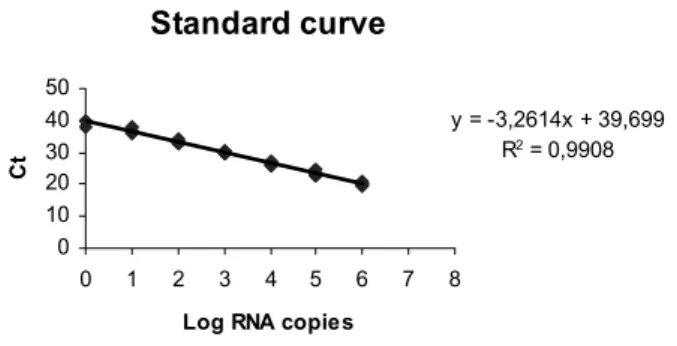
A standard curve was established to allow estimat-ing the number of RNA copies in monkey sera. Since all viruses studied contained the NS3 gene of YFV 17D the probes selected were directed at its sequence as es-tablished (Bae et al. 2003). The standard curve was
established usingin vitrotranscribed RNA in decreasing
concentrations (106-100copies).
Standard curve
y = -3,2614x + 39,699 R2 = 0,9908
0 10 20 30 40 50
0 1 2 3 4 5 6 7 8
Log RNA copies
C
t
Fig. 1 – Standard curve forin vitrotranscribed RNA. The standard curve was derived by linear regression including all Ct values shown in Table I. In the equation (y=ax+b),arepresents the slope (–3.3144) andbthe intersection at theyaxis (39.93);R2indicates the correlation coeficient between the variables.
de-TABLE I
Correlation of Ct (threshold cycle) value and RNA concentration.
Experiment Cts in different RNA concentrations (copies / reaction) 106 105 104 103 102 101 100 1 19.6 22.8 26.2 29.8 33.6 36.3 39.9
2 20.1 23.3 26.2 30.1 32.9 36.4 37.9
3 20.6 24.6 27.4 30.2 34.1 37.8 –
4 20.2 23.3 26.3 29.9 32.9 36.8 –
5 19.9 22.9 26.4 29.6 33.1 – –
Mean 20.1 23.4 26.5 29.9 33.3 36.8 38.9
SD 0.4 0.7 0.5 0.2 0.5 0.7 1.4
SD = standard deviation.
gree of reproducibility. These experiments yielded the data in Table I, which were used to generate the plot and equation shown in Fig. 1. This equation was used for estimating the number of RNA copies in biological samples. All experiments included two points with
dif-ferent concentrations ofin vitro transcribed RNA and
RNA extracted from YFV 17DD virus. These amounts of RNA represented a lower and an intermediate limit of detection. This procedure validated the standard curve and allowed for reliable viral RNA quantification in monkey sera.
Since we expected low amounts of viral RNA in monkey sera it was important to define the sensitivity of our assay. Based on 14 experiments with the am-plification of RNA from several concentrations of YFV
17DD virus (1.0 to 7.0 log10 PFU mL−1), our lowest
limit of detection was 1 copy/reaction or 143 copies
mL−1(R=0
.99). Linearity was observed until 2.0 log10
PFU mL−1(Ct 37, approximately). This is equivalent to
1,428 copies mL−1or 3.1 log
10copies mL−1(Table II).
QUANTITATION OFVIRALRNAINMONKEYSERA
Samples were restricted to sera from monkeys, which had been inoculated with YFV 17DD or 17D-DENV re-combinants. We have initially studied the YFV 17DD virus load after i.c. or s.c. inoculation. A second panel included a comparison between YF17DD and YF 17D-DENV-2 peripheral viremia after i.c. inoculation. The third refers to the peripheral viremia of 17D-DENV-4 after s.c. inoculation.
YFV 17DD RNA quantitation in peripheral blood after i.c. and s.c inoculation
The sera of 17 monkeys inoculated with YF 17DD virus were analyzed for viremia by real-time RT-PCR. Ten were inoculated by i.c. route (T46; U18; V60; X13; X15; X55; X65; X85; X89; X95) and bled from day 1 through 6 after inoculation. Seven were inoculated by s.c. route (U67; U23; U63; U69; U75, J22; J61). The first 5 animals were bled on days 2,4 and 6 after inocula-tion whereas monkeys J22 and J61 were bled from day 1 through 7. Data retrieved includes the number of animals found positive, mean titer and duration of viremia.
Figure 2 shows comparatively the total number of animals found positive by plaque assay on Vero cells and real-time RT-PCR. With regard to i.c. inoculation, 10/10 animals were found positive by plaquing at day 4 but several animals were viremic between days 2 through 6
as well (Fig. 2A) with a mean peak titer of 1.72 log10
PFU mL−1. Real-time RT-PCR detected viremia in 6
out of 10 animals restricted to days 3 to 5 p.i. (Fig. 2B)
and a mean peak titer of 2.97 log10copies mL−1. By the
TABLE II
Limit of detection of YFV 17DD virus RNA by real-time RT-PCR.
Ct PFU mL−1 PFU/reaction Copies mL−1 Copies/reaction Linearity 37 100(2 log10) 0.7 1,428(3.1 log10) 10 Sensitivity 40 10(1 log10) 0.07 143(2.1 log10) 1
i.c. inoculation (1.90 log10 PFU mL−1and 3.29 log10
copies mL−1).
Total viremia is represented by the percentage of time points found positive over the total number of time points analyzed for each group of animals. Therefore, a total of 50 time points were considered for the group of monkeys inoculated i.c. with YF 17DD virus. Like-wise, a total of 29 time points were analyzed for ani-mals inoculated subcutaneously with the same virus. The data suggest that i.c. inoculation led to more significant viremia (38/50 or 76%) than s.c. inoculation (14/29 or
48%) as shown by plaquing (χ2; P =0.01). However,
total viremia detected by real-time RT-PCR in sera of monkeys inoculated by either route was not significantly
different (9/50 or 18% i.c. and 8/29 or 27% s.c. (χ2;
P =0.32). The number of positive animals detected by
real-time RT-PCR analysis after i.c. or s.c inoculation (6/10 or 60% and 5/7 or 71.4% respectively) were not
significantly different (Fisher test,P=1.00).
Based on the total number of days analyzed for viremia by plaquing and real time RT-PCR, the former was shown to be more sensitive in samples from mon-keys inoculated intracerebrally with YF 17DD vaccine
virus (χ2; P = 0.001). However, this difference was
not significant in animals, which were inoculated
sub-cutaneously (χ2;P=0.10).
Comparison of peripheral viremia after i.c. inoculation of rhesus monkeys with YFV 17DD and 17D-DENV-2 viruses
Since neurotropism is a concern with YF 17D vaccines, a standardized neurovirulence test in monkeys was es-tablished to ensure the attenuation of any YF 17D virus. Although dengue in general is known to be non neurovir-ulent recent reports indicate cases of encephalitis after natural dengue infection (Solomon et al. 2000, Kalita and Misra 2006, Soares et al. 2006) Because YF
17D-Dengue chimeric viruses contain the replicative machin-ery of YFV 17D virus and the envelope genes of dengue viruses their safety should be assessed in the formal neu-rovirulence test. One of the parameters recorded in this test is peripheral viremia.
We have quantified the presence of viral RNA in serum samples from another group of 20 monkeys, which received i.c. YFV 17DD (V79; V75; V09; V11; V43; V45; V67; V81; V85; V91) or 17D-DENV-2 (V08; V33; V39; V47; V51; V55; V61; V65; V77; V89) viruses. The total of positive animals after YFV 17DD virus inoculation was by both methods 90% (9 out of 10 animals). The magnitude and period of viremia were
0.4 to 2.83 log10 PFU mL−1and 2-6 days by plaquing
(Fig. 3A) or 1.59-2.89 log10copies mL−1and 2-5 days
by real-time RT-PCR (Fig. 3B). The number of positive animals for 17D-DENV-2 virus was the same for both methodologies (5/10; 50%) and most viremia was de-tected in the second day after inoculation (Fig. 3C, D). Viremia lasted only 2 days as seen by plaquing (Fig. 3C) and 3 days by real-time RT-PCR (Fig. 3D). Viremia
ranged from 0.4 to 1.97 log10 PFU mL−1 by plaquing
and from 1.34 to 3.53 log10 copies mL−1by real-time
RT-PCR.
Table III indicates that for YFV 17DD virus the to-tal of positive assays was higher by plaquing (31/50 or 62%) than by real-time RT-PCR (20/50 or 40%) whereas for 17D-DENV-2 virus these numbers were close to each other (5/50 or 10% and 6/50 or 12%, respectively) but lower than those observed for YFV 17DD. This dif-ference between 17DD and 17D-DENV-2 by real-time
RT-PCR was statistically significant (χ2; P = 0.001).
By plaque assay, the mean peak titer was higher for
YFV 17DD virus than 17D-DENV-2 (1.62 log10 and
1.07 log10 PFU mL−1) whereas by real-time RT-PCR
these titers were very close 2.41 and 2.47 log10 copies
A
B
virem ia IC (plaquing)
0 5 10
1 2 3 4 5 6
days p.i.
p
o
s
iti
v
e
a
n
im
a
ls
virem ia IC (RT-PCR)
0 5 10
1 2 3 4 5 6
days p.i.
p
o
s
iti
v
e
a
n
ima
ls
C
D
virem ia SC (plaquing)
0 5 10
1 2 3 4 5 6 7 8
days p.i.
p
o
s
iti
v
e
a
n
ima
ls
virem ia SC (RT-PCR)
0 5 10
1 2 3 4 5 6 7 8 days p.i.
p
o
s
iti
v
e
a
n
im
a
ls
Fig. 2 – Detection of YFV 17DD virus inoculated by different routes. Intracerebral (Panels A and B); subcuta-neous (Panels C and D). Positive animals / days p.i., detected by plaque assay (Panels A and C) and by real time RT-PCR (Panels B and D).
TABLE III
Viremia of YFV 17DD and 17D-DENV-2 viruses.
17DD 17D-DENV-2
Real time Plaquing Real time Plaquing
log10copies mL−1 log10PFU mL−1 log10copies mL−1 log10PFU mL−1
Total viremia 40% 62% 12% 10%
Mean Peak Titer 2.41 1.62 2.47 1.07
(SD) (0.35) (0.76) (0.89) (0.72)
Duration 2–5 2–6 2–3 2–5
SD = standard deviation.
Comparison of peripheral viremia after s.c. inoculation of rhesus monkeys with 17D-DENV- 2 and 17D-DENV-4 viruses
A group of 6 naïve rhesus monkeys were inoculated subcutaneously with 17D-DENV- 2 or 17D-DENV-4,
A
B
17DD (plaquing)
0 5 10
1 2 3 4 5 6
days p.i.
p
o
s
iti
v
e
a
n
im
a
ls
17DD (RT-PCR)
0 5 10
1 2 3 4 5 6
days p.i.
p
o
s
iti
v
e
a
n
ima
ls
C
D
17D-DENV-2 (plaquing)
0 5 10
1 2 3 4 5 6
days p.i.
p
o
s
iti
v
e
a
n
im
a
ls
17D-DENV-2 (RT-PCR)
0 5 10
1 2 3 4 5 6
days p.i.
p
o
s
iti
v
e
a
n
im
a
ls
Fig. 3 – Detection of YFV 17DD and 17D-DENV-2. Parental YFV 17DD (Panels A and B) and 17D-DENV-2 (Panels C and D) were inoculated intracerebrally. Positive animals / days p.i. detected by plaque assay (Panels A and C) and real-time RT-PCR (Panels B and D).
viremia studied were positive by plaquing as compared to 4/21 or 19% by real-time RT-PCR. This difference was
not statistically significant (χ2;P =0.09). The peak of
viremia was around days 2 and 3 p.i. for both method-ologies with a higher mean peak titer detected by by
real-time RT-PCR as compared to plaquing (2.48 log10
copies mL−1and 1.77 log
10PFU mL−1, respectively).
DISCUSSION
We have been interested in developing new live attenu-ated flavivirus vaccines based on the creation of chimeric YFV 17D viruses. A major issue relates to the attenu-ation of the resulting viruses as compared to the origi-nal parental YFV 17D virus, the safety of which is well known. Viral attenuation appears to be a direct measure of the viral capability to replicate (Monath 2003). The
TABLE IV
Viremia of 17D-DENV-4 recombinant virus.
Plaquing Real time RT-PCR
log10PFU mL–1 log10copies mL–1
Total viremia 43% 19%
Mean Peak Titer 1.77 2.48
(SD) (0.41) (0.82)
Duration 2–6 2–3
SD = standard deviation.
degree of viral replication. Here, we have employed it to comparatively estimate the infectiousness of YFV 17DD and 17D-DENV recombinant viruses after experimental inoculation of monkeys.
The detection limits of the real time RT-PCR method
were at 10 copies mL−1, using as reference quantifiedin
vitrotranscribed RNA. It is noteworthy that in samples
with lower concentrations of RNA (<2-3 log10)
repro-ducibility within assays and between assays resulted in higher variation coefficients, as compared to more con-centrated samples. Table II shows linearity and sensi-tivity values established for YFV 17DD virus for real-time RT-PCR and Vero cell plaquing. Linearity was
down to 1,428 copies mL−1with the lowest sensitivity
of 143 copies mL−1, similar to what has been reported
by Drosten et al. (2002) for wild-type YFV. Puig et al. (2002) also have described similar values when analyz-ing hepatitis C-infected chimpanzee sera.
Houng et al. (2001) have suggested the limit for detection of dengue viruses in human sera is 20-50
PFU mL−1(1.3–1.7 log
10 PFU mL−1) with the lowest
limit being 0.04 PFU/reaction or 25 PFU mL−1(1.4 log
10
PFU mL−1) for DENV 4 virus. Putnak et al. (2005)
have evaluated the replication of live attenuated DENV 2 virus in rhesus monkey sera and were able to detect
2.1 log10 PFU. Poersh et al. (2005) reported detection
limits of 53 FFU (focus forming units) mL−1(1.7 log
10
FFU mL−1) of wild-type DENV viruses in human sera
using real-time RT-PCR. In our analyses the lowest de-tection limit for YFV 17DD virus (spiked human serum)
was 10 PFU mL−1. For 17D-DENV-4 this limit was
ap-proximately 2 log10 or 100 copies mL−1. Altogether, it
is suggested that the methodology of real-time PCR used here to detect viremia in rhesus monkeys infected with YFV 17DD and 17D-DENV recombinants has compa-rable sensitivity to that described for related viruses.
The Asibi strain of YF virus is extremely virulent for monkeys as its inoculation by the s.c. route leads to the death of the 95% of the animals within 4-7 days, being extremely viscerotropic (Theiler 1951). Monath et al. (1981) have reported high viremia between 2 and 6 days
after inoculation with titers close to 8.0 log10PFU mL−1.
Bae et al. (2003) have studied by real-time RT-PCR the amount of virus in serum from an individual naturally infected by YF virus. A reduction of the number of RNA
copies from 1.6×10⁸to 9.5×10⁶occurred within the
last 3 days before the patient death. These observations indicate the high replication rate of wild-type virus in the primate host.
On the other hand YF 17D viruses, which were derived from the Asibi strain by serial passaging have lost its viscerotropism and the capability to cause high
viremia, which is usually below 3.0 log10 PFU mL−1
(Marchevsky et al. 2003). Monkeys immunized with one human dose of YFV 17DD by the s.c. route showed
a mean peak titer of 3.29 log10copies mL−1, within the
viremia period of 4-6 days p.i. In humans vaccinated
with the same virus the mean peak titer was 2.23 log10
copies mL−1 with a period of viremia of 1-7 days p.i.
(Trindade G.F. unpublished data).
Guirakhoo et al. (2000) have inoculated subcuta-neously graded doses of recombinant 17D-DENV-2 virus
(ChimeriVaxTM-D2) in rhesus monkeys and noted no
differences in viremia (detected by plaquing) among the groups receiving the highest and the lowest dosage (1.34
and 1.65 log10 PFU mL−1, respectively). Guirakhoo
et al. (2002) reported viremia caused by other chimeric 17D-DENV viruses also by plaquing and all viruses con-sistently showed limited replication rates with low mean
peak titers (below 3.0 log10PFU mL−1). We constructed
a similar set of recombinant 17D-DENV viruses and studied their replication after s.c. inoculation. While our 17D-DENV-2 failed to produce viremia, despite se-roconversion to the respective dengue type, the viremia observed for our 17D-DENV-4 virus was of somewhat
lower magnitude as compared to ChimeriVaxTM-D4
(1.77 versus 2.4 log10PFU mL−1). These apparent
dis-crepancies may be due to differences in the nucleotide sequences among the structural genes used for the inde-pendent constructions and may reflect variable replica-tive properties.
The establishment of new YFV 17D seed viruses and recombinants thereof requires the analysis of viral attenuation by a standardized neurovirulence test in non-human primates (WHO 1998). Marchevsky et al. (2003) inoculated YFV 17DD virus by the i.c. route in 49
mon-keys with the highest viremia recorded being 2.7 log10
PFU mL−1. Here, we compared the magnitude and
real-time RT-PCR. Although onset, duration and mean peak titers were similar for both viruses, animals were more frequently found positive at the time points stud-ied after inoculation with 17DD than with 17D-DENV-2 virus.
We have used real-time RT-PCR to detect a seg-ment of the YFV 17D virus genome present in all viruses studied, the commercial YFV 17DD vaccine virus, and 17D-DENV recombinants to show their limited replica-tion. The low level of viral replication detected for these viruses by two inoculation routes provides additional ev-idence for their attenuation and support the use of these recombinant 17D-DENV viruses for future clinical trials towards the development of a tetravalent dengue vaccine.
ACKNOWLEDGMENTS
We thank the Instituto de Tecnologia em Imunobioló-gicos (Bio-Manguinhos) at Fundação Oswaldo Cruz for the continuous support to this work. We are also in-debted to Dr. Antônio M. Marinho (Centro de Criação de Animais de Laboratório – CECAL/FIOCRUZ) for providing the rhesus monkeys used in all experiments. The technical assistance of José M. da Silva, Idevaldo I. Ferreira, Mauro F. da Silva and Edney do Monte is greatly acknowledged. We thank Juliano Bordignon for critical reading of the manuscript. This work was supported by Conselho Nacional de Desenvolvimento Científico e Tecnológico [CNPq (50.1526/2003-0; 472809/2003-2)], Programa de Desenvolvimento Tec-nológico em Insumos para Saúde [PDTIS/FIOCRUZ (RVR10)] and the Millennium Institute for Vaccine Technology and Development.
RESUMO
Uma das principais propriedades a serem estabelecidas para o
desenvolvimento de vacinas seguras e atenuadas de flavivirus,
é a taxa de replicação viral. Neste trabalho, aplicamos a
meto-dologia de amplificação pela reação em cadeia da polimerase
em tempo real e titulação viral por plaqueamento para
deter-minação da replicação do vírus 17DD (FA 17DD) e
recombi-nantes, expressando proteínas do envelope de dengue sorotipos
2 e 4 (17D-DENV-2 e 17D-DENV-4). As amostras de soros
de macacos inoculados por via intracerebral ou subcutânea
com FA 17DD ou 17D-DENV foram usadas para determinar
e comparar a viremia induzida por estes vírus. A
quantifi-cação da carga viral em amostras de macacos inoculados por
ambas as vias com FA 17DD sugere restrita capacidade de
replicação com taxa não superior a 2,0 log10 PFU mL−1ou 3,29 log10cópias/mL−1. Os vírus recombinantes 17D-DENV mostraram-se tão atenuados quanto o vírus 17DD, tanto por
RT-PCR em tempo real quanto por plaqueamento, com título
médio máximo de 1,97 log10 PFU mL−1 ou 3,53 log 10 cópias/mL−1. Estes dados servem como base comparativa para caracterização de outros vírus vivos atenuados,
deriva-dos do vírus 17D, candidatos a vacinas contra outras doenças.
Palavras-chave: febre amarela, dengue, vacina, atenuação, replicação, RT-PCR em tempo integral.
REFERENCES
BAE H-G, NITSCHE A, TEICHMANN A, BIEL SS AND
NIEDRIGM. 2003. Detection of yellow fever virus: a comparison of quantitative real-time PCR and plaque as-say. J Virol Methods 101: 185–191.
BENTEDAANDRICO-HESSER. 2006. Models of dengue virus infection. Drug Discovery Today 3: 97–103. BLANEYJE JR, MATROJM, MURPHY BRANDWHITE
-HEADSS. 2005. Recombinant, live-attenuated tetrava-lent dengue virus vaccine formulations induce a balanced, broad, and protective neutralizing antibody response against each of the four serotypes in rhesus monkeys. J Virol 79: 5516–5528.
CALISHERCH, KARABATSOSN, DARYMPLEJM, SHOPE
RE, PORTERFIELDJS, WESTAWAY EGANDBRANDT
WE. 1989. Antigenic relationships between flaviviruses as determined by cross-neutralization tests with poly-clonal antisera. J Gen Virol 70: 37–43.
DURBINAPET AL. 2001. Attenuation and immunogenicity in humans of a live dengue virus type-4 vaccine candidate with a 30 nucleotide deletion in its 3’-untranslated region. Am J Trop Med Hyg 65: 405–413.
DROSTENC, GOTTIG S, SCHILLING S, ASPER M, PAN
-NINGM, SCHMITZ HANDGUNTHERS. 2002. Rapid detection and quantification of RNA of ebola and marburg viruses, lassa virus, crimean-congo hemorrhagic fever virus, rift valley fever virus, dengue virus, and yellow fever virus by real-time reverse transcription-PCR. J Clin Microbiol 40: 2323–2330.
EDELMANR, WASSERMANSS, BODISONSA, PUTNAKRJ, ECKELSKH, KANESA-THASANN, VAUGHNDW, IN
formula-tions of a tetravalent live-attenuated dengue vaccine. Am J Trop Med Hyg 69 (Suppl 6): 48–60.
GALLER R, MARCHEVSKY RS, CARIDE E, ALMEIDA
LFC, YAMAMURA AMY, JABOR AV, MOTTA MCA, BONALDO MC, COUTINHO ESF AND FREIRE MS. 2005. Recombinant yellow fever 17D-dengue type 2 virus: attenuation and immunogenicity for rhesus monkeys. Braz J Med Biol Res 38: 1835–1846.
GUBLERDJ. 2004. The changing epidemiology of yellow fever and dengue, 1900 to 2003: full circle? Comp Im-munol Microbiol Infect Dis 27: 319–330.
GUIRAKHOO F, WELTZIN R, CHAMBERS TJ, ZHANG
ZX, SOIKEK, RATTERREE M, ARROYOJ, GEORGA
-KOPOULUS K, CATALAN J AND MONATH TP. 2000. Recombinant chimeric yellow fever-dengue type 2 virus is immunogenic and protective in nonhuman primates. J Virol 74: 5477–5485.
GUIRAKHOOFET AL. 2002. Viremia and immunogenicity in nonhuman primates of a tetravalent yellow fever-dengue chimeric vaccine: genetic reconstructions, dose adjust-ment, and antibody responses against wild-type dengue virus isolates. Virology 298: 146–159.
GUIRAKHOO F ET AL. 2006. Live attenuated chimeric yellow fever dengue type 2 (ChimeriVaxTM-DEN2) vac-cine: phase I clinical trial for safety and immunogenicity. Human Vaccines 2: 60–67.
HOUNG HH, CHEN RC, VAUGHN DW AND KANESA -THASAN N. 2001. Development of a fluorogenic RT-PCR system for quantitative identification of dengue virus serotypes 1-4 using conserved and serotype-specific 3’ noncoding sequences. J Virol Methods 95: 19–32.
KALITA J AND MISRA UK. 2006. EEG in dengue virus infection with neurological manifestations: a clinical and CT/MRI correlation. Clin Neurophysiol 117: 2252–2256. KANESA-THASANNET AL. 2001. Safety and immunogenic-ity of attenuated dengue virus vaccines (Aventis Pasteur) in human volunteers. Vaccine 30: 3179–3188.
LAICJANDMONATHTP. 2003. Chimeric flaviviruses: novel vaccines against dengue fever, tick-borne encephalitis, and japanese encephalitis. Adv Virus Res 61: 469–509. LINDENBACHBDANDRICECM. 2001. Flaviviridae: The
viruses and their replication. In: FIELDS BN, KNIPE
DM, HOWLEY PM (Eds), Field´s Virology, Lippincott Williams and Wilkins, Phildelphia, p. 991–1041. MARCHEVSKY RS, FREIRE MS, COUTINHO ESF AND
GALLERR. 2003. Neurovirulence of yellow fever 17DD vaccine virus to rhesus monkeys. Virology 316: 55–63.
MARCHEVSKY RS, LEAL ML, HOMMA A, COUTINHO
ESF, CAMACHO LAB, JABOR AV, GALLER R AND
FREIRE MS. 2006. Molecular and phenotypic analysis of a working seed lot of yellow fever virus 17DD vaccine strain produced from the secondary seed lot 102/84 with an additional passage in chicken embryos. Biologicals 34: 191–197.
MONATHTP. 2003. Yellow fever vaccine. In: PLOTKINSA, ORENSTEINWD (Eds), Vaccines, WB Saunders, USA, p. 1095–1176.
MONATHTP, BRINKER KR, CHANDLER FW, KEMP GE
ANDCROPPCB. 1981. Pathophysiologic correlations in a rhesus monkey model of yellow fever. Am J Trop Med Hyg 30: 431–443.
POERSCH CO, PAVONI DP, QUEIROZ MH, BORBA L, GOLDENBERG S, SANTOS CN AND KRIEGER MA. 2005. Dengue virus infections: comparison of meth-ods for diagnosing the acute disease. J Clin Virol 32: 272–277.
PUIG M, MIHALIK K, YU MW, FEINSTONE SM AND
MAJOR ME. 2002. Sensitivity and reproducibility of HCV quantitation in chimpanzee sera using TaqMan real-time PCT assay. J Virol Methods 105: 253–263.
PUTNAKJRET AL. 2005. An evaluation of dengue type-2 inactivated, recombinant subunit, and live-attenuated vac-cine candidates in rhesus macaque model. Vacvac-cine 23: 4442–4452.
RUSSELPKANDNISALAKA. 1967. Dengue virus identifica-tion by the plaque reduidentifica-tion neutralizaidentifica-tion test. J Immunol 99: 291–296.
SABCHAREONAET AL. 2002. Safety and immunogenic-ity of tetravalent live-attenuated dengue vaccines in Thai adult volunteers: role of serotype concentration, ratio, and multiple doses. Am J Trop Med Hyg 66: 264–272.
SABCHAREONAET AL. 2004. Safety and immunogenicity of a three dose regimen of two tetravalent live-attenuated dengue vaccines in five- to twelve-year-old Thai children. Pediatr Infect Dis J 23: 99–109.
SOARES CN, FARIALC, PERALTAJM,DE FREITASMR
AND PUCCIONI-SOHLER M. 2006. Dengue infection: neurological manifestations and cerebrospinal fluid (CSF) analysis. J Neurol Sci 249: 19–24.
SOLOMON TET AL. 2000. Neurological manifestations of dengue infection. Lancet 355: 1053–1059.
SUN W, NISALAK A, GETTAYACAMIN M, ECKELS KH, PUTNAK JR, VAUGHN DW, INNIS BL, THOMAS SJ
AND ENDY TP. 2006. Protection of rhesus monkeys against dengue virus challenge after tetravalent live atten-uated dengue virus vaccination. J Infect Dis 193: 1658– 1665.
THEILERM. 1951. The virus. In: STRODEGK (Ed). Yel-low Fever. New York, McGraw-Hill Book Company, p. 39–138.
VAUGHN DW, GREEN S, KALAYANAROOJ S, INNIS BL, NIMMANNITYA S, SUNTAYAKORN S, ROTHMAN AL, ENNISFAANDNISALAKA. 1997. Dengue in the early febrile phase: viremia and antibody responses. J Infect Dis 176: 322–330.
VAUGHN DW, GREENS, KALAYANAROOJ S, INNIS BL, NIMMANNITYA S, SUNTAYAKORN S, ROTHMAN AL, ENNIS FA AND NISALAKA. 2000. Dengue viremia titer, antibody response pattern, and virus serotype corre-late with disease severity. J Infect Dis 181: 2–9.