JML-Based Formal Development of a
Java Card Application for Managing
Medical Appointments
Authors:
Ricardo Miguel Soares Rodrigues, 2064903
Advisor:
2
Acknowledgments
First of all, I would like to thank Professor Néstor Cataño, my thesis advisor, withouthis guidance I would surely have been lost. I’m grateful for his patience, support and specially his enthusiast on this work. I’m also grateful for the documents he provide me and his knowledge, advices on the formal methods and Java Modelling Language.
I would like also to thank João Pestana, my colleague, for his collaboration on this thesis and being by my side while we worked together. Our two thesis works complement each other. I’m grateful for his support in those hard times we had while working.
3
Index
Figures ... 4
Code ... 5
Tables ... 5
1. Introduction ... 6
2. Preliminaries... 7
2.1. Managing Medical Appointments... 7
2.1.1. General Description of the Problem ... 7
2.1.2. Problem analysis ... 7
2.1.3. Proposed solution ... 8
2.2. Smart cards and Java Card ... 11
2.2.1. Elements of a Java Card Application ... 12
2.2.2. Accessing the Smart Card (Communication in Java Card)... 13
2.2.3. Java Card Remote Method Invocation (JCRMI)... 14
3. Formal Software Development ... 16
3.1. Formal Methods in the Software Development Process ... 16
3.1.1. Formalization Strategies for Software Development Processes... 18
3.2. Software Correctness ... 19
3.2.1. Design by Contract ... 20
3.3. The Java Modelling Language (JML)... 26
3.3.1. The JML Specifications ... 26
3.3.2. Abstract Variables ... 29
3.3.3. The JML Common Tools ... 31
3.4. The JML - Based Software Development Strategy ... 31
4. The Approach ... 33
4.1. Domain Concepts ... 33
4.2. Use Cases... 35
4.2.1. System Actors... 37
4.2.2. Use Case models ... 38
4.3. Informal Functional Requirements ... 42
4.4. From Informal Functional Requirements to Formal Specifications ... 43
4.4.1. Semi-Formal Requirements... 43
4
4.4.3. System Invariants ... 45
4.5. Design... 45
4.5.1. Structure Modelling ... 46
5. Implementation... 51
5.1. Writing the Abstract Variables ... 52
5.2. Writing JML Invariants... 55
5.3. Writing JML Method Specifications ... 57
5.4. Writing the Code ... 61
6. Validation and Verification... 63
6.1. Static Assertion Checking ... 63
6.2. Runtime Assertion Checking ... 63
7. The HealthCard Application Metrics ... 67
8. A Client-Side Small Example... 68
9. A Prototype Tool for Generating JML Formal Specifications from Informal Software Requirements... 69
10. Conclusion ... 71
11. Bibliography ... 73
Figures
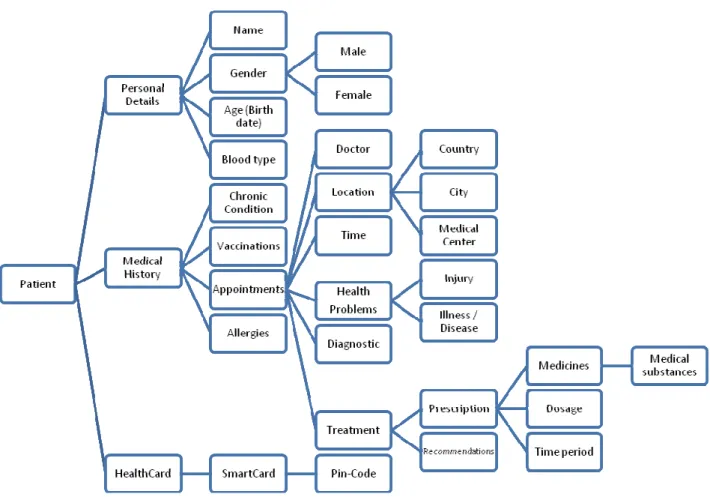
Figure 1. Proposed information held on a smart card for medical appointment management .. 9Figure 2. Proposed system using a smart card... 10
Figure 3. Architecture of a Java Card Application [2]... 12
Figure 4. Java Card Remote Method Invocation architecture [6]... 15
Figure 5. JCRMI applet implementation process [6] ... 16
Figure 6. The Software Development Process ... 32
Figure 7. Summary of the medical appointments concepts hierarchy ... 34
Figure 8. Main Use Cases diagram ... 39
Figure 9. Use Cases sub-diagram of Appointments ... 40
Figure 10. C: Appointments Use Cases Sub-Diagram... 47
Figure 11. Model Structure of Appointments remote java interface ... 49
Figure 12. Model Structure of Appointment and its implementation class ... 49
Figure 13. Model Structure of the Appointments and Appointment implementation classes .. 50
Figure 14. Structure Model of the Health Card... 51
Figure 15. Some runtime assertion checking test results of addAppointment ... 65
Figure 16. addAppointment test failure details ... 66
5
Code
Code 1. Example of a Medicines class specified with pseudo-specification... 21
Code 2. Pre-condition example for a factorial computation [14][12]... 22
Code 3. A redundant test [12]... 22
Code 4. Example of a Medicines class implementation with an invariant... 24
Code 5. Example of a Services class referencing Medicines and Appointments classes with a system invariant ... 25
Code 6. Example of how JML can be used to specify a method ... 29
Code 7. Example of how JML can declare an abstract variable ... 29
Code 8. Example of how JML abstract variables can be represented by concrete values ... 30
Code 9. Common and Appointment interfaces abstract variables... 53
Code 10. Concrete attribute fields of an Appointment and its model representations... 54
Code 11. Specification helper method toJMLValueSequence ... 55
Code 12. Class Invariant example as a JML invariant... 56
Code 13. System Invariant example as a JML invariant ... 56
Code 14. Representation of date_model in Medicine_Impl and Appointment_Impl ... 57
Code 15. JML helper method to support JML specifications ... 57
Code 16. JML specifications for addAppointment method... 61
Code 17. Implementation of method addAppointment from Appointments_Impl ... 62
Code 18. Method addAppointment header... 64
Code 19. Test data sets for Appointments_Impl ... 65
Code 20. Argument type JML specification for the method addAppointment ... 67
Code 21. From the client addAppointment method... 69
Tables
Table 1. A command APDU format [2]... 13Table 2. A response APDU format [2] ... 14
Table 3. A design by contract example [14] ... 21
Table 4. Some JML expressions... 27
Table 5. Textual specification of "Managing Appointments" from Appointments' Use Cases... 40
Table 6. Semi-Formal Requirements from Appointments informal functional requirements ... 44
Table 7. JML specifications from Semi-Formal Requirement SFR108... 58
Table 8. JML specifications from Semi-Formal Requirement SFR110... 58
Table 9. JML specifications from Semi-Formal Requirement SFR122... 59
Table 10. JML specifications from Semi-Formal Requirement SFR125... 59
Table 11. JML specifications from Semi-Formal Requirement SFR130... 60
Table 12. The HealthCard application metrics per module ... 67
6
1.
Introduction
Although formal methods can dramatically increase the quality of software systems, they have not widely been adopted in software industry. Many software companies have the perception that formal methods are not cost-effective cause they are plenty of mathematical symbols that are difficult for non-experts to assimilate. The Java Modelling Language (short for JML) Section 3.3 is an academic initiative towards the development of a common formal specification language for Java programs, and the implementation of tools to check program correctness. This master thesis work shows how JML based formal methods can be used to formally develop a privacy sensitive Java application. This is a smart card application for managing medical appointments. The application is named HealthCard. We follow the software development strategy introduced by João Pestana, presented in Section 3.4. Our work influenced the development of this strategy by providing hands-on insight on challenges related to development of a privacy sensitive application in Java. Pestana’s strategy is based on a three-step evolution strategy of software specifications, from informal ones, through semi-formal ones, to JML semi-formal specifications. We further prove that this strategy can be automated by implementing a tool that generates JML formal specifications from a well-defined subset of informal software specifications. Hence, our work proves that JML-based formal methods techniques are cost-effective, and that they can be made popular in software industry. Although formal methods are not popular in many software development companies, we endeavour to integrate formal methods to general software practices. We hope our work can contribute to a better acceptance of mathematical based formalisms and tools used by software engineers.
7
2.
Preliminaries
In the following, we present the HealthCard smart card application we have formally implemented using JML technology. We start presenting some problems related to the management of medical appointments, and define some important concepts for the domain application. Then, we propose a solution to the development of a Java Card Health Card Application that deals with privacy sensitive medical people information. We introduce the Smart Card technology that will provide support to the development of our application, and introduce the programming language Java Card, which will be used to develop the card side application.
2.1.
Managing Medical Appointments
In this section we present and discuss a common problem about medical appointments (Section 2.1.1). Next, we describe our solution to the development the HealthCard, in which we also make a short introduction to the proposed solution technologies, namely, smart cards.
2.1.1. General Description of the Problem
Finding a medical history is not always an easy task when a doctor is checking a patient, especially during the first checking. In most cases, medical histories are kept in a particular medical centre as hard-copy files. Hence, if a patient has to go to a different medical centre other than to the one he usually goes, it might be the case that he could not know how to tell the doctor about his medical problem, and if he could, doctors always need a dossier with patients’ information (that is, they need a medical history). Treating a patient without having his/her medical information can be time-consuming. The following case describes this problem in real life:
“
John is British and usually travels between Portugal and the USA. One day, while in Portugal, he got sick and went to the doctor. The Portuguese doctor started making a diagnosis. He asked John if he already got his Tetanus immune shot, but John didn’t know. After listening John and running some medical exams, the doctor identified the possible problem and then prescribed some medications to John.One week later, John went to New York and his health got worse, so he decided to go to the nearest medical centre to see a doctor. The American doctor asked him if he already had gone to see a doctor about his problem before, and what medication he has been taking. John didn’t know all the names of the medication prescribed by the Portuguese doctor, and worse, he couldn’t explain exactly what problem he was suffering!
”
2.1.2. Problem analysis
8 Typically, a patient would not know how to express to another doctor all the information about his health problems. He would not know what medication he’s taking, or his medical history, and drug allergies or other types of allergies he suffers, and could consequently be mistreated. In any case, even if the doctor explained the medical problem to the patient well and even if the patient could roughly explain his medical problem to others; a new doctor would anyway need a ”record" with the patient's information. This information is usually kept as "dossiers" in medical centres.
2.1.3. Proposed solution
We propose here a solution to the problem described above. Our solution builds on the software development strategy introduced by João Pestana (see Section 3.4), formal methods, JML (see Section 3.3), and smart cards (see Section 2.2). The reason why we use of this strategy in the development process of the HealthCard application is due to the application’s domain nature in which people’s medical information is involved. This information is privacy sensitive. Through the use of formal methods in this strategy we develop a correct smart card application. Formal methods ensure that the application behaves as described in its specification. When developing a software application for privacy sensitive domains, like medical ones, the programmer must implement mechanisms that ensure that information is not disclosed to non-authorized parts. In our work, such mechanisms are implemented through the use of JML formal specifications, and the use of formal methods tools to check program correctness (see Section 3 for a description about software correctness). Security properties such as authentication, confidentiality or integrity are difficult to express with JML, and are out of the scope of this master thesis work. [1]
The HealthCard application runs on smart cards. Therefore, a patient can carry his medical information on a card and use it when going to any medical centre with the appropriate system to read it. A smart card is a pocket-sized card with embedded integrated circuits that can hold and process data. A typical smart card includes in-card applications (the applets running on the card), a card reader-side, and back-end elements (a computer communicating with the card applets). For implementing the in-card applications we use the Java Card language (see Section 2.2). This language is a precise subset of the Java language used to program applets for devices such smart cards. In Java Card, smart cards provide two models for the communication between a host application and a Java Card applet.[2] The first model is the fundamental message-passing APDU model, which basically relies on the trade of messages in the APDU format between the in-card applets and the off-card applications. The second model is based on the Java Card Remote Method Invocation (JCRMI), in which a Java Card applet is the server and makes accessible functions to external client applications. The smart card technology provides patients with:
1.) A way to digitalize their information.
2.) A mechanism to convey their information to others.
3.) A security mechanism so that their information is not disclosed to non-authorized parts.
9 necessary patient’s information contained in the card rather than the structural description of the HealthCard. The information stored can be divided into the patient’s personal data, the scheduled appointments and his medical history. Information about the patient’s medical history includes allergies, vaccination, health problems and treatment plans associated with health problems. The treatment plans are associated with diagnostics, prescriptions and medical recommendations.
Figure 1. Proposed information held on a smart card for medical appointment management
For managing the data stored in the card we need at least an in-card applet that provides functions to manage it. Since we’ll use smart cards, we propose the use of Java Card for programming those in-card applets (i.e., the health card application). Java Card is a programming language that has in consideration the memory resource limitations of smart cards [2] (see Section 2.2). We can follow the strategy that supports the software development process of the Health Card application as at same time uses Java Modelling Language (JML)1
for formally specify the Health Card application based on the informal requirements. These JML formal specifications used in this strategy will lead us to a correct implementation of our application. Also, we propose the use of JML-based tools to check for correctness of the implementation.
2.1.3.1. Proposed System Architecture
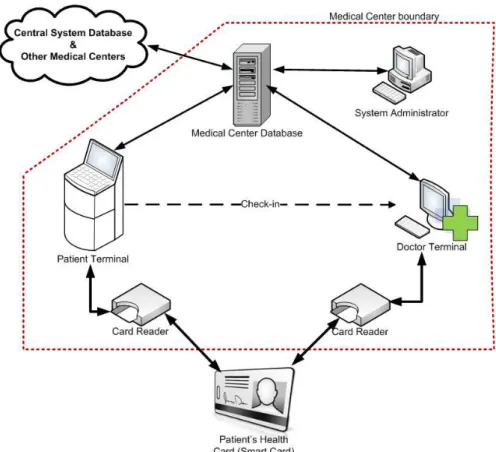
The architecture of our proposed application is illustrated in Figure 2. A patient can use his smart card in any medical centre that has our system implemented.
1 JML is a formal behavioral interface specification language for Java which includes the essential
10
Figure 2. Proposed system using a smart card
This system architecture consists of at least two card terminals. One is the patient terminal, which includes an attached smart card reader. This terminal may be used for appointment scheduling, appointment check-ins, visualization and modification of some in-card personal data, and for requesting medical prescriptions renewals. The second terminal is the doctor’s terminal, which also can include a smart card reader. This is used by medical staff, possibly a doctor providing a way to access the patient’s personal and medical information. The doctor may insert medical information into the patient’s card by using this terminal. Beyond those two terminals our architecture includes a Medical Centre database. This database provides support to the on-the-card patient’s information, by storing all known allergies, medicines and vaccines, and other medical standard designations. In this way, the card will only need to keep references to those items rather than the whole designation (i.e. the names of allergies, vaccines, medicines, etc.). Also, that database will provide support to the information about doctor’s available schedules and other medical centre information. This medical centre database may be linked to other medical centres and one of them may be the central system database. This central system would update medical information in all medical centres databases. Finally, there’s a system administrator that has the responsibility for operating and keeping the medical centre database updated.
Proposed System Components
This section presents the list of components of the proposed system architecture.
11 Card reader will serve as terminals for reading/writing the smart cards and linking points to client machines (Patient Terminal and Doctor’s computer).
Patient Terminal for appointment scheduling, checking-in and some other basic card operations made by the patient.
Doctor will have a terminal for accessing patient medical data contained on the card.
Medical Centre Database will contain doctor’s schedules, medical centre information, patient appointments, and lists of known allergies, health problems and vaccines.
System Administrator will be responsible for maintaining the medical centre database.
Central System Database will update all the medical centres systems.
2.1.3.2. Proposed System Scenario
At the end of the development of our system, the following scenario should be:
“
John has an appointment with his doctor today at 5:00 PM. John will be using his HealthCard smart card at the Yorkshire medical centre for checking-in prior to his appointment. The Yorkshire medical centre has a smart card compatible card reader set for patients to check-in uscheck-ing their HealthCards. Therefore, doctors can access patient’s medical check-information relevant to appointments, e.g., general description of the patient’s medical problem, past treatment information, historical of medicines used during past treatments, previous record of allergies related to a particular medical substance, age and gender of the patient, etc. HealthCards are dynamic: last week, when John was away on vacations in the United States, he fell back into illness after his 7 hours trip from Heathrow airport in London to the John Kennedy airport in New York. He visited an American doctor who read John’s medical information from his HealthCard. The American doctor prescribed an alternative complementary treatment for John’s health problem. The details of this complementary treatment were stored into John’s HealthCard smart card. John’s doctor will be able to consult the details of the American doctor’s prescription when John will be back into Yorkshire.”
2.2.
Smart cards and Java Card
12 2.2.1. Elements of a Java Card Application
A smart card system is composed by a card-side (the applets running on the card), a card reader-side, and back-end elements (a computer communicating with the card applets). [2]
!
"
# $
%&
% ' (
)
'
Figure 3. Architecture of a Java Card Application [2]
2.2.1.1. Back-End Application and Systems
Back-end applications are elements of the system that provide services that support in-card Java applets. For example, a back-end application could provide a connection to security systems that together, with credentials from the card, could result in a better security. In a credit card payment system, the back-end application could provide payment information and access to the credit-card.
2.2.1.2. Reader-Side Host Application
Reader-Side terminals can be a PC or an electronic payment terminal, a cell phone, or a security subsystem. In them reside host applications that can handle communication between the user, the Java Card applet, and the provider’s back-end application.
2.2.1.3. Reader-Side Card Acceptance Device
13 computer using a serial port, or it may be integrated into a terminal such as an electronic payment terminal (ex., at a restaurant or a gas station).
2.2.1.4. Card-Side Applets and Environment
In Java Card, an in-card application is an applet. A Java Card can have one or more applets residing the card, along with supporting software. The supporting software consists in the card’s operating system and the Java Card Runtime Environment (JCRE). The latter one includes the Java Card VM, the Java Card Framework and API’s, and some extension APIs.
All Java Card applets extend the Applet base class and must implement the install() and process() methods. Later, when installing the applet, JCRE calls install().And every time there is an incoming APDU message for the applet, JCRE calls process().
When loaded, Java Card applets are instantiated, and stay alive when the power is switched off. A card applet acts like as a server and is passive. Once a card is powered up, each applet remains inactive until it's selected. The applet is active only when an APDU has been dispatched to it.
2.2.2. Accessing the Smart Card (Communication in Java Card)
According to ISO 7816-5 standard, each smart card application must have an application identifier (AID). [3] These AIDs are sequence of bytes between 5 and 16 bytes in length, and in Java Card technology they are used to identify Java Card applets as well as packages of Java Card applets. When inserted a smart card into a card acceptance device, the running external application sends a command to the card containing the AID of the applet to perform the required operation. The AID is crucial for allowing the external applications accessing Java Card applications in smart cards. [4]
For accessing smart cards there are two models for the communication between a host application and a Java Card applet. The first model is the fundamental message-passing APDU model, and the second is based on Java Card Remote Method Invocation (JCRMI), a subset of the J2SE RMI distributed-object model.
A logical data packet is exchanged between the CAD and the Java Card Framework, which is called APDU (Application Protocol Data Unit). An APDU is sent by the CAD, received and then forwarded to the appropriate applet that processes the APDU command and returns a response APDU. [2]
A command APDU has a required header and an optional body, containing:
• CLA (1 byte): This required field identifies an application-specific class of instructions. • INS (1 byte): This required field indicates a specific instruction within the instruction
class identified by the CLA field.
• P1 and P2 (1 byte each) are required fields used to pass command specific parameters for the qualification of INS, or input data.
• Lc (1 byte): This optional field is the number of bytes in the data field of the command (length command).
• Data field (with length given by Lc): This optional field holds the command data. • Le (1 byte): This optional field specifies the maximum number of bytes in the data field
of the expected response (length expected).
14 Command APDU
Header
(required)
Body
(optional)
CLA INS P1 P2 Lc
Data
Field Le
A response APDU has a format much simpler:
• Data field (with a length determined by Le in the command APDU): This optional field contains the data returned by the applet.
• SW1 (1 byte) and SW2 (1 byte) are required status words. They contain the status information as defined in ISO 7816-4. [3] In case of successful execution, they contain 0x9000.
Table 2. A response APDU format [2]
Response APDU Body
(optional)
Trailer
(required)
Data
Field
SW1 SW2
Our Java Card implementation of the application for managing medical appointments is based on JCRMI (Java Card Remote Method Invocation). It adds an additional abstraction layer above the message-passing model, avoiding low-level communication through APDU’s [5] therefore simplifying the code written and saving memory space in the card. Simplifying the code makes it easier to specify the implementation, which leads to more concise and reliable code.
2.2.3. Java Card Remote Method Invocation (JCRMI)
15
Figure 4. Java Card Remote Method Invocation architecture [6]
The method call is invoked and the return value is translated to an APDU response message by the skeleton object, which then sends it to the client. On the client side the APDU message passes through the stub, which translates it back to a return value.
A JCRMI applet consists of at least one interface and two classes: - a remote interface; the
implementation of that interface, and the applet class.
• The remote interface extends java.rmi.Remote interface and defines what methods can be called with JCRMI. This interface must also be presented on the client side.
• The implementation of the remote interface is the implementation itself. It can be used to generate a stub class for the client.
• The applet class extends javacard.framework.Applet and contains the inherited install(),
select() and process() methods. This class act as the entry point for all method calls and directs these to the actual implementations. [6]
16
Figure 5. JCRMI applet implementation process [6]
3.
Formal Software Development
During this section, we introduce the use of formal methods in software development, describing the software correctness and its fundamental essence. We continue, giving a brief introduction to the Java Modelling Language (JML) and for last we consider the strategy of João Pestana, as followed strategy of this thesis work.
3.1.
Formal Methods in the Software Development Process
17 with large-scale systems, to frequent changes in requirements and designs in practice. [8] Sommerville [7] suggests that formal specification techniques have not been broadly used in industrial software development environments, because:
I. There is a lack of methodologies and tools to support the use of formal methods in software development. Barely minimal guidelines are provided on how to elicit and structure the requirements into formal notation. Lack of guidance makes it hard to developers use formal methods by themselves and from the lack of tools developers have difficulties of applying formal methods into their development cycles, especially to develop, analyze and process large-scale specifications using formal specification languages. The production of well-defined guiding lines and supporting tools are needed.
II. The use of formal methods requires the knowledge of discrete mathematics and symbolic logic. Most of the developers (i.e., software engineers, programmers, and designers) have not been trained in techniques required to develop formal software specifications. Techniques have been tested by Japanese researchers over the last fifteen years in formal methods education programs for undergraduate and graduate students at universities as well as practitioners at companies. [8]
III. The formal specifications are an inappropriate tool for communications with the end user at the later stages of requirements specification. More than the software developers, most end users who provide the requirements and approve their specifications are neither familiar nor comfortable with the formal specification languages. According to Sommerville [7], Hall suggests that one can paraphrase in natural language the formal specifications or use animated illustrations, that is, presenting the formal specifications in a form that can be understood by the client.
IV. The use of formal specifications at initial stages may hold back the creative side of developers, that is, having a poorly structured problem, the formal representations from it may restrain the developers from exploring alternatives. Formal specifications may not be an ideal tool for exploring and discovering the problem’s structure. The problem may have to be studied and understood before being formalized.
V. The use of formal specifications for development of user interfaces is hard. With the current techniques is practically impossible for specifying interactive components of user interfaces. Also, some other system components are hard to specify like parallel processing systems, such interrupt driven-systems.
VI. Most of software development managers are normally conservative and reluctant in using techniques whose benefits are not yet well-known. The recompense by using formal methods is not immediate and it is hard to quantify. Nevertheless, Sommerville [7] concludes that when a conventional software development process (i.e., without using formal methods) is used, validation costs are more than 50% of the whole development costs, and implementation and design costs are the double of the specification cost. With the use of formal methods, the specification, implementation and design costs are almost equal and validation costs are considerably reduced to less than the development costs.
18 system development effort, especially in large scale development projects. For this, viable strategies for supporting the integration of formal method technique into the software development process are important, and without existing strategies it may be difficult to integrate formal methods into the real-world development project.
3.1.1. Formalization Strategies for Software Development Processes
The way people can use formal methods to formalize their informal specifications (i.e., the client’s requirements to a system to be developed) into formal ones can be categorized into several strategy types. Some of the proposed strategies suggest going directly from informal specifications (i.e. high level, natural language) to formal specifications (i.e., low level, more mathematical language) making the software development’s specification activity being in the formal domain from the beginning. For example, according to Kemmerer [9] through his “Integrated” approach which defines that formal methods is completely integrated into the development cycle, we use critical requirements written in English and stated in precise mathematical terms to describe the system’s behaviour without giving to much implementation details, so later they can be incrementally detailed until the system can be coded according to them. Also Jones [10] uses a similar process through his suggestion that proof obligations of VDM decomposition rules can stimulate design steps. Others like Miriyala and Harandi, and Wing [10], have process propositions where high-level formal specifications of the system can be derived directly from a precise English statement of critical requirements. A strategy which goes directly from informal specifications to a formal specification without any transitional step is known by using a direct formalization process.
19
3.2.
Software Correctness
To determine if a software program is correct, first we must specify what the software is intended to do. We can’t check correctness of a software program in isolation, but only with respect to some specification. Even an incorrect program can perform some processing correctly, although it could be a different processing to the one the developers (or clients) have in mind. Obtaining the requirement specifications is vital as first step in the process of developing a correct software system. [11] To help us assess the correctness of a software program we can express these requirement specifications through the use of assertions. To prove the correctness of a software program’s routine body or instruction, these assertions must be checked against it. This proof can be explained here by a correctness formula (also called Hoare triples) as an expression of the form denoting the following property [12]. Notice that this formula is a mathematical notation, not a programming construct. It serves only to explain how we can prove the software correctness of a program’s routine:
{P} A {Q}
• Where, A is some operation (for example, an instruction or a routine body); and • P is an assertion called precondition; and
• Q is an assertion called postcondition.
The formula shown above denotes that A as an operation requires P to assure Q, where this must hold to A be correct. The general meaning of a total correctness formula is: - “Any execution of A, starting in a state where Pholds, will terminate in a state where Qholds.” [12]
As an example, let’s use a mathematical expression. Considering x as an integer value, the arithmetic operation x := x + 2, the precondition {x >= 5} and the postcondition {x >= 6}, we have the correctness expression:
{x >= 5}x := x + 2 {x >= 6}
Assuming a correct implementation of the integer arithmetic operation, the above expression holds: – if x >= 5 is true when calling the instruction x := x + 2, then x>= 6 will be true afterwards. And of course, if the precondition were false, then the integer arithmetic operation couldn’t assure nothing, i.e., the postcondition would be neither true nor false. However, now assuming an incorrect implementation of the above correctly specified expression, if the precondition is true and the postcondition is false, then we could conclude that the integer arithmetic operation was wrongly implemented according to what is specified, i.e., the tester would know that something was wrong with the implementation against the specifications. These preconditions and postconditions can be strengthen or weaken.
20 • Weaker postconditions are better: In postconditions, the situation is reversed. A strong postcondition means that a harder job by the routine must be made to assure all the postconditions. By this, the routine’s result has to respect a bigger set of conditions. However, the weaker a postcondition is the better for the routine’s job, which means that its result will be satisfied by more states. Asserting a postcondition as true is the weakest possible assertion, because it is satisfied by all states. [12]
The design by contract is a software correctness methodology that has its roots in Hoare logic. Like the Hoare triples formula: , the design by contract has the concept of preconditions and postconditions to document the change in state caused by a piece of a program . These pre- and postconditions are used to strengthen the conditions of a contract between a caller and a supplied routine. [12] Further, in Section 3.3, we present the Java Modelling Language (JML) which is a design by contract tool. In JML, the Hoare logic is applied through the use of requires (precondition - ) and ensures (postcondition - ) expressions that specifies some Java method’s body behaviour ( ).
3.2.1. Design by Contract
The essence of the design by contract methodology is that a contract exists between a routine class (supplier of certain services) and its callers (clients of those services). Some documents refer the routine classes (serving some services to others) as suppliers, server or server side, while callers can be referred as clients or client side. The design by contract makes the Hoare logic (see Section 3), a vital component in a program development strengthening the notion of contract. Like in the Hoare logic, in design by contract we may specify the routine task’s contract with two associated assertions: - precondition and a postcondition. The precondition defines the properties that must hold whenever the routine is called and the postcondition defines the expected return properties. These two assertions are a way to define a contract between the routine and its callers. [12] The Design by Contract, as a tool for a software development process can lead to the construction of more reliable object-oriented systems, provides a mechanism through assertions for checking the conformance of the code against its specification. [12]
Before discussing further the design by contract we’ll show below an example of a Medicines class operation specified with pseudo-specification on how assertions are used in practice [13]. Here, preconditions and postconditions are represented respectively by require and ensure keywords. [12] In JML, these two keywords are actually requires and ensures, with “s”.
class MEDICINES create make
feature
quantity: INTEGER
name_length: INTEGER is 20 ...
addMedicine (medicine: STRING) is
-- Adds a medicine into the list of medicines. requires
21
insert(medicine) ensures
quantity = old(quantity) + 1 end
…
end -- class MEDICINES
Code 1. Example of a Medicines class specified with pseudo-specification
In the example above, the precondition states that a client who calls the addMedicine
routine must assure that the medicine’s name length must be lesser or equal to the constant value of name_length which is 20. The postcondition states that the post-state of the method must verify that the quantity is updated and higher by 1 than the old medicine quantity. Note that when we say “client”, it refers to a routine that calls another, that is, the contract between a client and a supplier is made by a communication of software-software. [12]
3.2.1.1. Obligations and Benefits
The precondition is related to the client in a way that it defines the conditions under which is legitimate for a client call a method, i.e., it’s an obligation for the client and a benefit for that supplier (server). The postcondition is related to the class, which defines the conditions that must be ensured by the class routine on return, i.e., it’s a benefit for the client and an
obligation for the supplier. That is, from the previous statements we can say that the benefits are, for the client, the guarantee that he will get what he expects after the call, and for the supplier, the guarantee that certain assumptions will be satisfied when the routine is called, while the obligations are, for the client, to satisfy the requirements as defined by the precondition, and for the supplier, to produce results as defined in the postcondition. [12] The following example taken from [14] shows how design by contract plays out for the factorial computation in respect for client/suppliers’ benefits and obligations.
Table 3. A design by contract example [14]
Obligations Benefits
Client
(Satisfy precondition :) Pass
(From postcondition :) Receive computed
Supplier
(Satisfy postcondition :) Compute
(From precondition :) Can assume that
22 Following these obligations and benefits’ convention a developer can simplify its programming style while developing an application. Having specified preconditions that clients must respect when calling a routine, the developers may assume when writing the routine’s body that the preconditions are satisfied, i.e., the developer do not need to test them in the routine’s body. It helps to clear redundancy in the code as under no circumstances shall the body of a routine ever test for the routine’s precondition. This is called the principle of non-redundancy. [12]By this principle, we add the responsibility of validating the preconditions to the client, reducing the code on the supplier side (server side). For instances, from Table 3, the routine computing the factorial has a precondition that specifies n as a positive value or equal to zero, so in its body we haven’t to validate if n is respecting that condition.
3.2.1.2. Clearing redundancy
By following the non-redundancy principle we are clearing out the redundancy in our code. One of the main advantages of clearing redundancy is that it reduces considerably the quantity of lines of code when programming, and thus its complexity. Having been specified as preconditions the constraints that must be respected for calling a routine, we may assume that those constraints are satisfied when writing the routine body, and also we do not need to test them in the body. [12] So if a factorial computation meant to produce a positive integer as result, is of the form seen in Code 2:
fact(n: INTEGER): INTEGER is Factorial of n require
do … end
Code 2. Pre-condition example for a factorial computation [14][12]
We may write the “do … end” algorithm for computing the factorial without concerning whether is negative or not. This concern is taken care by the precondition which becomes the clients’ responsibility. [12] If the “do” clause was on the form as seen in Code 3:
if then
“Handle this erroneous case!” else
“Proceed with normal factorial computation”
end
Code 3. A redundant test [12]
23 reliability2 and may imply a performance penalty. [12] We have applied the principle of redundancy in the development of the HealthCard. By applying the principle of non-redundancy, we are light weighting the card side applications. When an external client makes a remote call on the card, it is assumed that the preconditions of remote methods in the card side are valid. These preconditions validations are made in the client side, so there is no need of validations in the card side. While developing the HealthCard system, employing this principle is advantageous due to the limited memory of smart cards.
The notion of a contract in design by contract can be extended down to the method/procedure level besides the concepts of preconditions and postconditions. A contract can also be strengthened by concepts like invariants, inheritance and exceptions.
3.2.1.3. Invariants
Besides having preconditions and postconditions, we can have invariants to express global properties of routine’s contracts between suppliers and clients. Preconditions and postconditions only describe properties of single routines. There is a necessity of expressing global properties of instances of a class, which must be preserved by all routines. We may consider an invariant as being an extension for both preconditions and postconditions of every class’s routines. [12] For instance, let A be a certain body of a routine (the set of instructions in its do clause), P is precondition, Q its postcondition and INV the routine’s class invariant. The correctness requirement on A may be expressed by using the notation introduced earlier in this section as:
{INV and P} A {INV and Q}
This expression above means that: – “any execution of A, started in any state in which INV
and P both hold, will terminate in a state in which both INV and Q hold”. [12] Here adding the invariant makes both the precondition and the postcondition stronger or equal, i.e., the invariant could either reinforce the conditions or could have no effect on them (redundant conditions). So when implementing the routine’s body A, the invariant INV makes the job easier in addition to the precondition P due to the assumption that the initial state satisfies
INV, further restricting the set of cases that must be handled by the precondition specification. However, in addition to the postcondition Q which A must ensure, the routine’s body must also ensure that the final state satisfies INV, making the implementation harder. Considering again the earlier implementation of the Medicines class example and its pseudo-specifications shown in this section, we demonstrate in Code 4 how we could specify a class invariant. [13]
class MEDICINES create make
feature
quantity: INTEGER
name_length: INTEGER is 20 total_medicines: INTEGER is 250 ...
addMedicine (medicine: STRING) is
-- Adds a medicine into the list of medicines. requires
medicine.length <= name_length
2 Reliability is the ability of a system or component to perform its required functions under stated
24
do
insert(medicine) ensures
quantity = old(quantity) + 1 end
… invariant
quantity <= total_medicines end -- class MEDICINES
Code 4. Example of a Medicines class implementation with an invariant
In this example, at Code 4, we can see that a total of medicines variable now exists. It’s an integer value of 250. In the example we specified that the quantity must always be lesser than or equal to the total of medicines. We specified this as an invariant, therefore all routines of the class must preserve it. Before having a specified invariant one could assume that the quantity could be any value upper than 250 on any routine of the class, i.e., it didn’t exist a limit to the quantity of medicines. The invariant represents a general consistency constraint obligatory for all routines of the class. [13] So to preserve this property defined by the invariant, one has to implement the routine’s body in a way to not violate what is stated in the invariant clause, in this example, the routine addMedicine must also ensure that the variable of quantity must not exceed the value defined by total_medicines.
So far we used invariants to express global properties of a single class, denominated by
class invariants, but there is another concept within the invariants known as system invariants
which describes instance properties that must be preserved by all routines from more than one class. For instances, let X and Y be two different classes. An invariant INV would be a system invariant if instances from both X and Y are affected by INV. A system invariant is basically described like a class invariant and it is specified at a class that has references to X
and Y objects.
In the following example shown in Code 5, X and Y are exemplified respectively by the classes Medicines and Appointments. The defined invariant is a system invariant because it affects instances of the two different classes which basically states that for every medicine object instances obtained through the Medicines instance, their prescription date attribute must be higher or equal to the respective appointment’s date, obtained through the Appointments instance, when the medicine was prescribed for the first time. That is, for all medicines and appointments instances if a medicine instance has an appointment ID attribute equal to another appointment instance ID attribute, then that medicine’s date must have a higher or equal value to the that appointment’s date. This invariant restricts that value of a medicine’s date.
class SERVICES create make
feature
meds: MEDICINES apps: APPOINTMENTS ...
25 forall( int i; i < meds.getMedicines().length && i >= 0;
forall( int k; k < apps.getAppointments().length && k >= 0; meds.getAppointmentID(i) == apps.getID(k)
==>
meds.getDate(i) >= apps.getDate(k) ))
end -- class SERVICES
Code 5. Example of a Services class referencing Medicines and Appointments classes with a system invariant
Another concept that extends the notion to contracts at a lower level within the design by contract and used to the preconditions, postconditions and even invariants is the inheritance.
3.2.1.4. Inheritance
The concept of inheritance allied with the notion of contracts from design by contract brings us to a new level, as contracts can also be inherited by subclasses in terms of object-oriented programming. A routine’s precondition and postcondition are inherited by their redefinitions in sub-classes as well as super-class invariants. This is actually the case in JML (see Section 3.3). Although inheritance is one of the pillars of the object oriented paradigm flexibility, many programmers have the difficulty in use it correctly. [15] Through the inheritance mechanism one can create new classes from those already existent, and the behaviour from their routines doesn’t necessarily have to be maintained by their sub-classes. It is possible to redefine the routines with a partial behaviour or even a complete distinct one. However, from these possibilities and the use of design by contract methods one could redefine a routine that produces an incompatible effect to the routine’s behaviour specification described (contract) in the super-class. [15] This incompatible redefinition is a problem attained with the bad use of the inheritance, which design by contract helps to avoid in a way that we can redefine those routines as longs as they respect the established original contract defined in the respective inherited routines from the super-classes. [15]
For instance, let X and X1 be two classes where X1 is a sub-class of X, and Y any class communicating with an instance of type X. Due to polymorphism, Y can actually be dealing with an instance of X1. The developer of Y knows that he must respect the defined contract in
X, but he doesn’t know of the existence of other classes inheriting X. So, Y could discover only in runtime that he is communicating with X1, and the contract of a certain inherited routine of
X1 could be different from the contract specified in the super-class X. That is, Y could be calling for a routine under a certain contract, while in reality is communicating with another completely different. In fact there are two things that could make a class deteriorate its super-class contract specification [15]:
3.3.1. 1. A sub-class could make its precondition to be more restrictive than the one from the super-class, causing the risk of any calls previously considered correct by the client class Y’s perspective (in a way that they satisfied the original conditions imposed to the client) to become violating the contract’s rules.
3.3.1. 2. A sub-class could be making its postconditions to be more permissive, returning a result less satisfactory than the promised to Y.
26 methods’ preconditions weaker. Besides the inheritance rules applied to preconditions and postconditions, also the inheritance mechanism has effect upon the invariants, in a way that these are passed to their inheritors. For instance, an invariant from X also would be inherited by X1, and this is the case in JML.
The result of the inheritance concept, in which every instance of a class is also an instance of every ascendant class, is also logically valid for the contract specifications defined in the super-classes to be applied to their sub-classes. That is, a set of invariants of a certain class is the sum of all invariants from the ascendant hierarchy of inheritance. [15]
Another concept extending the notion of a contract is the treatment of exceptions within a contract between a client and a supplier.
3.2.1.5. Exceptions
As a routine in design by contract is seen like an implementation of a certain specification rather than just a piece of code, and it is possible for that implementation to fail with respect to the specifications in runtime, then one can extend the notion of a contract to the exception handling. Besides errors in implementations, exceptions in a routine’s behaviour can happen due to unpredictable events like hardware malfunctions or another external event. So, in these situations it becomes useful to use exceptional specifications attached to contract specifications to describe exceptional behaviours when some strategy for fulfil a contract doesn’t succeed. By this definition and the notion of preconditions and postconditions from a contract, it is possible to establish the following rule: - A routine must not launch an exception when its preconditions is not fulfilled, as it doesn’t denote a failure within the routine but it does for the routine’s caller. When the routine fulfils its postconditions it must not launch an exception. – This is known as the principle of exception. [15]
As for the global properties from a class, routines and constructors must preserve and respect the invariants in both normal and abrupt terminations, that is, invariants are included in both normal and exceptional postconditions. [15]
3.3.
The Java Modelling Language (JML)
JML is a specification language for Java, which as a tool provides support for B. Meyer’s design by contract principles [16]. JML was started by Gary Leavens and his team at Iowa State University, but is now an academic community effort with many people involved through the development of tools providing support for the language [17; 18; 19; 20]. All the concepts discussed in the Design by Contract section (see Section 3.2.1), that is, the notion of contracts along with its preconditions and postconditions; and the concepts of invariants, inheritance and exceptions, also apply to JML.
3.3.1. The JML Specifications
JML specifications use Java syntax, and are embedded in Java code between special marked comments /*@ ... */ or after //@. A simple JML specification for a Java class consists of pre- and postconditions added to its methods, and class invariants restricting the possible states of class instances. Specifications for method pre- and postconditions are embedded as comments immediately before method declarations. JML predicates are first-order logic predicates formed of side-effect free Java boolean expressions and several specification-only JML constructs. Because of this side-effect restriction, Java operators like ++ and -- are not allowed in JML specifications.
27 JML provides notations for forward and backward logical implications, ==> and <==, for non-equivalence <=!=>, and for logical or and logical and, || and &&.
The JML notations for the standard universal and existential quantifiers are (\forall T x; E) and (\exists T x; E), where T x; declares a variable x of type T, and E is the expression that must hold for every (some) value of type T. The expressions (\forall T x; P; Q) and (\exists T x; P; Q) are equivalent to (\forall T x; P ==> Q) and (\exists T x; P && Q), respectively.
The JML numerical quantifier (\num_of T x; P; Q) returns the number of variables x of type T that make both predicates P and Q true; (\max T x; P; E) returns the maximum value of the expression E where its variables satisfy the range P; (\sum T x; P; E) returns the sum of possible values of E where its variables satisfy the range P.
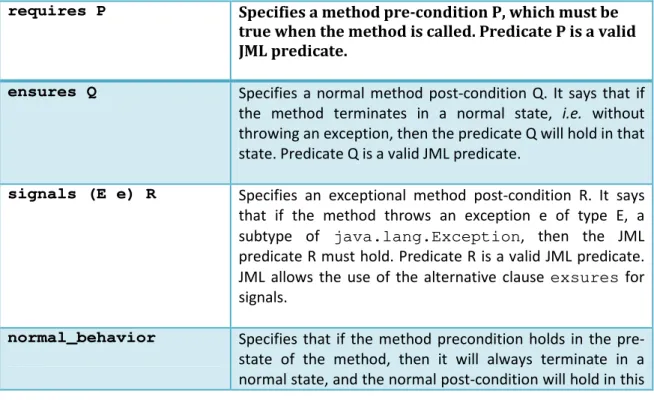
JML provides specifications for several mathematical types such assets, sequences, functions and relations. As JML is a tool to employ design by contract methods, there is some mechanisms used to support contracts like the specification of method’s preconditions and postconditions through the use of respectively the keywords requires and ensures; the specification of invariants by using the JML keyword invariant; the specification of exceptional behaviours to describe how to deal with unexpected behaviours; and also the JML specifications are inherited by sub-classes, i.e., sub-class objects must satisfy super-class invariants, and subclass methods must obey the specifications of all super-class methods that they override. In the following, we briefly review JML specification constructs. A brief description of some JML expressions used in specification can be seen in Section 3.3.1. 1, but the reader is invited to consult [21] for a full introduction to JML.
3.3.1. 1. JML Expressions
In this section we present some of the common JML expressions and a simple example based on the pop() method of a Stack class.
Table 4. Some JML expressions
requires P Specifies a method pre-condition P, which must be
true when the method is called. Predicate P is a valid JML predicate.
ensures Q Specifies a normal method post-condition Q. It says that if the method terminates in a normal state, i.e. without throwing an exception, then the predicate Q will hold in that state. Predicate Q is a valid JML predicate.
signals (E e) R Specifies an exceptional method post-condition R. It says that if the method throws an exception e of type E, a subtype of java.lang.Exception, then the JML predicate R must hold. Predicate R is a valid JML predicate. JML allows the use of the alternative clause exsures for signals.
28 state.
exceptional_behavior Specifies that if the method condition holds in the pre-state of the method, then it will always terminate in an exceptional state, throwing a java.lang.Exception, and the corresponding exceptional post-condition will hold in this state.
assignable L Specifies that the method may only modify location L. Any other location not listed in L may therefore not be modified. This must be true for both normal and exceptional post-conditions. Two special assignable specifications exist, assignable \nothing, which specifies that the method modifies no location, and assignable \everything, which specifies that the method may modify any location. JML allows the use of the alternative clauses modifies and modifiable for assignable.
\old(e) Refers to the value of the expression e in the pre-state of a
method. This specification can only be used in normal or exceptional method post-condition specifications.
\fresh(e) Says that e is not null and was not allocated in the pre-state of the method.
\result Represents the value returned by a method. It can only be used in a normal or an exceptional method post-condition.
invariant I Declares a class invariant I. In JML, class invariants must be established by the class constructors, and must hold after any public method is called. Invariants can temporally be broken inside methods, but must be re-established before returning from them.
The following example shows how a JML specification can be used to specify the method pop().
public interface Stack {
//@ public model instance JMLObjectSequence stack;
/*@ public normal_behavior
@ requires !stack.isEmpty();
@ assignable size, stack;
@ ensures stack.equals(\old(stack.trailer())); @ also
@ public exceptional_behavior
@ requires stack.isEmpty();
@ assignable \nothing;
@ signals(java.lang.Exception e) true;
29 public void pop( ) throws java.lang.Exception;
}
Code 6. Example of how JML can be used to specify a method
In the example shown in Code 6, we can see that method pop() has been given a normal and an exceptional behaviour formal specification. For the normal behaviour, the precondition is defined by the requires clause, which states that the stack must not be empty. Then the assignable clause specifies that the size and stack instances may suffer a change, that is, only the locations named through the assignable clause, and locations in the data groups associated with these locations, can be assigned to during the execution of the method. A JML assignable clause can be used in a method contract to specify which parts of the system state may change as the result of the method execution. The postcondition in the normal behaviour is defined by the ensures clause, which states that the stack will be equal to a portion of the old stack after the execution of pop(). The exceptional behaviour if the stack is empty when attempting to call pop() an exception will be thrown. The assignable clause in this case is \nothing because nothing is changed within pop() and the signals clause specifies a condition that will be true when an exception of type java.lang.Exception is thrown.
3.3.2. Abstract Variables
To have a higher level of abstraction in specifications, JML provides support for abstract variables. These are variables that exist at the level of the specification, but not in the implementation. Declarations of abstract variables have the same format as declarations of normal variables, but are preceded by the keyword model. As we can’t declare concrete variables in interfaces, the abstract variables can be used in interfaces and abstract java classes to describe abstractly the distinct data types used in the application. The abstract variables can be used to support the writing of correct code for concrete classes that implement the interfaces and the abstract Java classes. In the following Code 7 example we demonstrate a declaration of an abstract variable named dosage_model in interface Medicine. The abstract variable dosage_model represents the dosage quantity of a medicine.
public interface Medicine { ...
//@ public model instance double dosage_model;
... }
Code 7. Example of how JML can declare an abstract variable
30
public class Medicine_Impl implements Medicine {
...
public byte[] dosage;//@ in dosage_model; /*@ public represents
@ dosage_model <- dosage[0] + dosage[1]*0.1; @*/
... }
Code 8. Example of how JML abstract variables can be represented by concrete values
In the above example, the abstract variable dosage_model is related with the expression “dosage[0] + dosage[1]*0.1“, which maps the values in the byte array dosage into the double value calculated as the sum of the all the values in the array. For specifications purpose we can treat the dosage of a medicine like a double value, but in reality it can be implemented as an array of primitive bytes. In this case, the use of abstract variables gives a level of abstraction that allows us to implement a medicine’s dosage information in different ways as long as it respects the specifications.
Abstract variable specifications for interfaces and for abstract classes do not need to be written down again in implementing classes and sub-classes, since JML specifications are inherited by sub-classes and by implementing classes. This ensures behavioural sub-typing. That is, a sub-class object can always be used where a super-class object is expected. Therefore, a sub-class satisfies super-class invariants, and sub-class methods obey the specifications of super-class methods.
For abstracting complex data structures, i.e., modelling complex data structures into specifications, there are model data types provided by the JML, also known as JML abstract data types.
3.3.2.1. JML Abstract Data Types
The Java Modelling Language (JML) also provides abstract data types from the package org.jmlspecs.models to abstract complex data structures. Based on the description of Leavens [22], this package is a collection of types with immutable objects. An object is
immutable if it has no time-varying state. The types of the immutable objects in this package are all pure, meaning that none of their specified methods have any user-visible side-effects (although a few inherited from Object do have side effects). Their pure methods are designed for use in JML specifications. When using such methods we have to do something with the result returned by the method, as in functional programming. The original object's state is never changed by a pure method. For example, to insert an element e, into a set s, one might execute s.insert(e), but this does not change the object s in any way, instead, it returns a set that contains all the old elements of s as well as e. At first we shouldn't worry about the time and space used to make such set, because specifications are not mainly designed to be executed. However, there are justifiable reasons to worry about the efficiency of executing specifications for testing and debugging purposes.
31 JMLObjectSequence – This class defines immutable sequences of objects, including a series of pure methods for sequence manipulation. For example, insertFront(), insertBack(), itemAt(int i). This type can be used to declare abstract variables to model complex data structures containing objects.
JMLValueSequence – This class defines immutable sequences of values, and also including a series of pure methods for value sequence manipulation. This type can be used to declare abstract variables to model complex data structures containing values, such as characters of a String or Integer values of an array.
JMLEqualsSequence – This class is similar to JMLObjectSequence but has an “.equals” method to compare elements.
JMLType – There are classes which implements JMLType to reflect Java types like JMLByte to reflect Byte, JMLChar to reflect characters, JMLFloat to reflect float type, etc.
By using these data types in the specifications, one can abstract the way programmers can represent data structures. For example, an abstract variable of the type JMLObjectSequence abstracts a complex data structure to hold object instances, which besides simplifying the JML specifications it also gives the freedom, through their representation, of implementing concrete data structures in various ways (object arrays, stacks, queues, etc.) as long as the specifications are respected.
3.3.3. The JML Common Tools
The JML common tools [23] is a suite of tools providing support to run-time assertion checking of JML-specified Java programs. The suite includes jml, jmlc, jmlunit and jmlrac. The jml tool checks the JML specifications for syntax errors. The jmlc tool compiles JML-specified Java programs into a Java byte-code that includes instructions for checking JML specifications at run-time. The jmlunit tool generates JUnit unit tests code from JML specifications and uses JML specifications processed by jmlc to determine whether the code being tested is correct or not. Test drivers are run by using the jmlrac tool, a modified version of the java command that refers to appropriate runtime assertion checking libraries.
The JML common tools make it possible the automation of regression testing from the precise and correct JML characterization of a software system. The quality and the coverage of the testing carried out by JML depend on the quality of the JML specifications. The runtime assertion checking with JML is sound, i.e., no false reports are generated. The checking is however incomplete, e.g., users can write informal descriptions in JML specifications. The completeness of the checking performed by JML depends on the quality of the specifications and the test data provided. These JML Common Tools are available at [24].
3.4.
The JML - Based Software Development Strategy
32 based on data types and the conceptual metaphor of the design-by-contract [16]. In Figure 6, the strategy is outlined as a formal specification pseudo phase (bottom of Figure 6). This strategy is similar to the Kemmerer’s “Parallel” approach in that he also defines an intermediate step that introduces semi-formal specifications before writing the JML formal specifications.
Figure 6. The Software Development Process
The formal specification pseudo-phase runs in parallel with the analysis, design, and implementation phases in an integrated manner. There is no restriction in any phase to occur before or after any other phase, so that arrows 1 to 5 in Figure 6 convey information on usage rather than on precedence in time. Software development phases are iterative so that they can be revisited at later phases to obtain a correct implementation of the system. During the analysis phase, requirements are gathered, and two documents are produced, namely, the use cases document and the “informal” functional requirements document. As informal functional requirements are expressed in a natural language, inconsistencies can be introduced during the analysis phase.
Some aspect new in the strategy is the formal specification pseudo-phase, where the informal functional requirements document is first evolved into“semi-formal” requirements document (see Arrow 1), and then ported into (formal) JML specs (see Arrow 4). Having formal specifications expressed in JML makes it possible to use JML based formal methods tools to check for flaws. The semiformal requirements document is composed of three documents.

![Figure 3. Architecture of a Java Card Application [2]](https://thumb-eu.123doks.com/thumbv2/123dok_br/15680697.625633/12.892.125.751.238.686/figure-architecture-java-card-application.webp)
![Table 2. A response APDU format [2]](https://thumb-eu.123doks.com/thumbv2/123dok_br/15680697.625633/14.892.327.571.99.269/table-a-response-apdu-format.webp)
![Figure 4. Java Card Remote Method Invocation architecture [6]](https://thumb-eu.123doks.com/thumbv2/123dok_br/15680697.625633/15.892.248.647.135.473/figure-java-card-remote-method-invocation-architecture.webp)
![Figure 5. JCRMI applet implementation process [6]](https://thumb-eu.123doks.com/thumbv2/123dok_br/15680697.625633/16.892.261.637.102.546/figure-jcrmi-applet-implementation-process.webp)
![Table 3. A design by contract example [14]](https://thumb-eu.123doks.com/thumbv2/123dok_br/15680697.625633/21.892.229.667.103.264/table-design-by-contract-example.webp)