Karyne Kirley Negromonte Gonçalves
I, Jadiane Ingrid da Silva
I, Eduardo Tavares Gomes
II,
Liane Lopes de Souza Pinheiro
II, Thaisa Remigio Figueiredo
II, Simone Maria Muniz da Silva Bezerra
III Universidade de Pernambuco, Nossa Senhora das Graças Nursing School. Recife, Pernambuco, Brazil. II Universidade de Pernambuco, University Heart Hospital of Pernambuco. Recife, Pernambuco, Brazil.
How to cite this article:
Gonçalves KKN, Silva JI, Gomes ET, Pinheiro LLS, Figueiredo TR, Bezerra SMMS. Anxiety in the preoperative period of heart surgery. Rev Bras Enferm [Internet]. 2016;69(2):374-80. DOI: http://dx.doi.org/10.1590/0034-7167.2016690225i
Submission: 05-31-2015 Approval: 11-15-2015
ABSTRACT
Objective: to characterize the patients’ anxiety in the preoperative period of heart surgery. Method: We conducted a cross-sectional study in which 106 patients, between one and fi ve days from the date of surgery, were interviewed using a socio-demographic questionnaire and the Beck Anxiety Inventory. Results: The evaluated patients accounted for 59.4% (63) in minimal anxiety and 19.8% (21) in the range considered severe, and the sample had a mean in the mild anxiety level (15.8±19.79). The women had scores (22.13±23.41) signifi cantly (p=0.003) higher than men (10.76±14.71); as well as patients who had undergone previous heart surgery (24.4±28.05 X 13.14±15.74). There was no signifi cant difference between older adults and younger patients, nor in terms of weight variations, presence of diabetes, or alcoholism. Conclusion: We reinforces the importance of nurses in recognizing the preoperative anxiety and intervene through strategies of health education and nursing visits.
Key words: Anxiety; Heart Surgery; Health Education; Nursing; Preoperative Period.
RESUMO
Objetivo: caracterizar a ansiedade dos pacientes no pré-operatório de cirurgia cardíaca. Método: Foi realizado um estudo de corte transversal no qual 106 pacientes, entre um e cinco dias da data da cirurgia, foram entrevistados utilizando-se um questionário sócio-demográfi co próprio e o Inventário de Ansiedade de Beck. Resultados: Os pacientes avaliados se apresentaram em 59,4% (63) na ansiedade mínima e 19,8% (21) na faixa considerada grave, tendo a amostra uma média no nível de ansiedade leve (15,8±19,79). As mulheres tiveram escores (22,13±23,41) signifi cativamente (p=0,003) maiores que os homens (10,76±14,71); assim como os pacientes que já haviam sido submetidos a cirurgia cardíaca prévia (24,4±28,05 X 13,14±15,74). Não houve diferença signifi cativa entre idosos e pacientes adultos mais jovens, nem no tocante as variações de peso, presença de diabetes ou etilismo. Conclusão: Reforça-se a importância do enfermeiro reconhecer a ansiedade pré-operatória e intervir através de estratégias de educação em saúde e visita de enfermagem.
Descritores: Ansiedade; Cirurgia Cardíaca; Educação em Saúde; Enfermagem; Período Pré-Operatório.
RESUMEN
Objetivo: caracterizar la ansiedad de los pacientes en el preoperatorio de cirugía cardíaca. Método: se realizó un estudio de corte transversal en el cual 106 pacientes, entre uno y cinco días de la data de la cirugía, han sido entrevistados mediante un cuestionario sociodemográfi co propio y el Inventario de Ansiedad de Beck. Resultados: los pacientes evaluados se presentaron en el 59,4% (63) en la ansiedad mínima y el 19,8% (21) en la franja considerada grave, teniendo la muestra una media en el nivel de ansiedad leve (15,8±19,79). Las mujeres tuvieron scores (22,13±23,41) signifi cativamente (p=0,003) mayores que los hombres (10,76±14,71), así como los pacientes que ya habían sido sometidos a cirugía cardíaca previa (24,4±28,05 X 13,14±15,74). No hubo diferencia signifi cativa entre personas mayores y pacientes adultos más jóvenes, ni en relación a
Anxiety in the preoperative period of heart surgery
Ansiedade no período pré-operatório de cirurgia cardíaca
Ansiedad en el período preoperatorio de cirugía cardíaca
Eduardo Tavares Gomes E-mail: [email protected]
CORRESPONDING AUTHOR
INTRODUCTION
Surgery, despite the constant technological innovation and in-crease in the quality of interventions, is a difficult time for the human being. As a challenge for patients, the surgical procedure brings pre-and postsurgical limitations, such as changes in their life habits, besides the vulnerability of the trans-operatory period, which can generate significant levels of anxiety(1).
Several factors contribute to this aggravation in the hospital environment, ranging from the concrete or imaginary threats to the process of depersonalization, often resulting from de-humanised practices on the part of the health staff. This can impact individuals in a diversified way, particularly when they create fantasies before a surgical intervention, which may in-terfere in the course of the procedure and recovery, since their emotional state affects the functioning of their immune system and general physical condition. Depending on the degree of anxiety of the patient, many surgeries may be cancelled(2).
The preoperative phase is considered the period in which the patients are most vulnerable in their needs, both physi-ological and psychphysi-ological, becoming more prone to an emo-tional imbalance(2).
Lack of guidance regarding surgery and lack of support on the part of the health staff, such as preventing a proper thera-peutic relationship, cause the permanence of patients in the anxious and depressed state throughout the hospitalization. The presence of information about the surgery, however, con-tributes to reduce levels of anxiety(3).
Heart surgery and the disease itself require constant chang-es of physical, social, and psychological order, making the pa-tient adjust to a new reality abruptly imposed. These changes can be perceived as stressors and represent threats in the daily life of each individual, which mobilizes different strategies to face this process, based on their experiences(4).
The cultural association of the heart as a body related to life, death, and the generation of feelings stimulates fantasies and emotional wear in patients, both for the symbolic consid-eration of the heart and for the fantasies and fears related to death. Thus, of all types of surgeries, heart surgery is the least psychologically tolerated, being responsible for high levels of anxiety in the preoperate period, considering the emotions ex-perienced by patients, which have a significant role as a cause of complications in the postoperative period(5).
The heart surgical patient’s well-being must be the main objective of health professionals, especially nurses who pro-vide direct care to them, since it is in the preoperative phase that they can present considerable levels of stress and develop feelings that act negatively on their emotional state, making them vulnerable and dependent.
The nursing staff performs a decisive role in an attempt to
minimize the preoperative anxiety experienced by these pa-tients not only providing medications, but also knowledge in such a way that an informed decision can be taken. At every meeting with the patients, they must be ensured that they are physically and psychologically prepared to face both the pro-cedure and the surgical postoperative period(6).
Before anxiety, fear, and anguish evidences in the preoper-ative period, which are present among the individuals under-going heart surgery, to development nursing actions directed to minimize such effects becomes primordial. Among the tools that nurses can use to minimize the preoperative anxi-ety of heart surgery, to provide information about the surgical event, to promote illuminating dialogue, and the reception of patients are important strategies(7).
Through a preoperative visit of quality, the nurse adopts care strategies based not only in technical and scientific knowledge, but also on knowledge of the expectations and perceptions of the patient regarding the surgery to contem-plate all physical, emotional, and social aspects, thus system-atizing the assistance to be provided in this period(8).
This study presents an investigation that aimed to character-ize the patients’ preoperative anxiety of heart surgery, to com-pare anxiety between gender, age, and previous heart surgery, and to verify the association of anxiety with comorbidities in patients in the preoperative period of heart surgery.
METHOD
Ethical aspects
This study is part of a project approved by the Ethics and Re-search Committee of the complex Osvaldo Cruz University pital/Pronto-Socorro Cardiológico de Pernambuco [Heart Hos-pital of Pernambuco]. This study followed disciplinary standards of Resolution no. 466, December 12, 2012, of the Conselho Nacional de Saúde [National Health Council] (CNS), Ministry of Health. Regarding the resolution, the subjects who were part of this study have been previously invited to participate and were informed about the study’s objectives, risks and benefits, after which they signed an informed consent form. Were addressed only patients who were already hospitalized and aware of their diagnosis and the date of the surgery, in such a way that the participation in the research does not reflect on the care/com-munication with the staff of the sectors process.
Design, study location and period
This is a cross-sectional study, descriptive, with quantitative approach. The research was conducted in the wards of coro-nary disease, valvular heart disease, and cardiomyopathies of the Pronto-Socorro Cardiológico de Pernambuco Professor Luiz Tavares [Professor Luiz Tavares Heart Hospital of Pernambuco] las variaciones de peso, presencia de diabetes o etilismo. Conclusión: se refuerza la importancia del enfermero reconocer la ansiedad preoperatoria e intervenir mediante estrategias de educación en salud y visitas de enfermería.
(PROCAPE/UPE), north-northeast reference to cardiovascular dis-ease and cardiac surgery in adults and childrem, from March to June, 2014. The service provides care to the metropolitan region, municipalities in the countryside of the state, and other states, performing, on average, 60 heart surgeries/month in adults.
Population and sample
For sample delimitation, we performed a calculation using the equation for calculating the sample size for means, considering that the variable-outcome is continual quantitative. For the cal-culation we used an α error of 5%, which corresponds to the dif-ference between the estimated value of the research and the real value; a 95% confidence level, which is the probability that the actual sampling error is less than the sampling error admitted by the research. The maximum error adopted was of 1.0 point in the mean. Considering the finite population of 200 patients undergo-ing heart surgery, on average, for a period of five months of col-lection, the sample was estimated at 119 patients. However, we collected 106 patients, considering the inclusion criteria and at intervals with less surgeries in the service (holidays, recesses etc.)
The sample was composed of patients who were in pre-operative period, between one and five days from the date of surgery. We included all patients with knowledge of the sur-gery and the date, who would be submitted to the procedure of myocardial revascularization or valve replacement or repair surgeries. We excluded patients who had surgical indication for aortic and congenital diseases, who took antidepressants and antipsychotics or with clinical impairment that resulted in damaged verbal communication.
Study protocol
The collection instrument consisted of a questionnaire with socio-demographic (gender, age, religion, marital status, income in minimum wages prevailing in the period – BRL 724.00, edu-cation level, race, origin, occupation) and clinical data, and to evaluate the anxiety we used the Beck Anxiety Inventory. This instrument is a protocol of free use worldwide used both in re-search and in clinics to assess the levels of anxiety of patients undergoing a surgical experience. It consists of 21 items, with response alternatives ranging from nothing to mild, moderate, and severe, about which each subject reflects on the gradational levels of each symptom, being anxiety rated in minimal (0-10), mild (11-19), moderate (20-30), and severe (31-63)(9).
Analysis of the results and statistics
Data were analyzed in the SPSS 20.0 software. We considered significance of statistical tests for rejection of the null hypothesis at 5%. The characterization of patients is presented with resources of descriptive statistics in absolute and relative frequencies and mean±standard deviation. The measured anxiety scores are compared because of categorical dichotomous variables using the student’s t test for independent samples. The normal distribu-tion of anxiety values was assessed by the Kolmogorov-Smirnov test (p<0.001). To evaluate the internal reliability of the scale in use in the sample, we calculated the cronbach’s alpha (α) being considered high or significant values above 0.7.
RESULTS
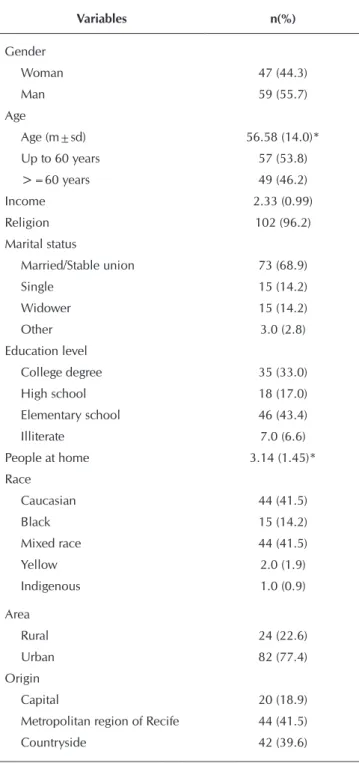
The sample was predominantly composed of male patients (55.7%), who claimed to be caucasian (41.5%), aged up to 60 years (53.8%), and mean of 56.58±14.0 years, married or in a stable union (68.9%), with religion (96.2%) and elemen-tary school (43.4%). Most of them we from the urban zone (77.4%), from the capital (18.9%), or from the metropolitan region (41.5%). There was a predominance of retirees (41.5 %) and mean income of 2.33±0.99 wages (Table 1).
Table 1 – Socio-demographical characterization of the sam-ple, Recife, Pernambuco, Brazil, 2014
Variables n(%)
Gender
Woman 47 (44.3)
Man 59 (55.7)
Age
Age (m±sd) 56.58 (14.0)* Up to 60 years 57 (53.8)
>=60 years 49 (46.2)
Income 2.33 (0.99)
Religion 102 (96.2)
Marital status
Married/Stable union 73 (68.9)
Single 15 (14.2)
Widower 15 (14.2)
Other 3.0 (2.8)
Education level
College degree 35 (33.0) High school 18 (17.0) Elementary school 46 (43.4)
Illiterate 7.0 (6.6)
People at home 3.14 (1.45)*
Race
Caucasian 44 (41.5)
Black 15 (14.2)
Mixed race 44 (41.5)
Yellow 2.0 (1.9)
Indigenous 1.0 (0.9)
Area
Rural 24 (22.6)
Urban 82 (77.4)
Origin
Capital 20 (18.9)
Metropolitan region of Recife 44 (41.5)
Countryside 42 (39.6)
Occupation
Employed 22 (20.8)
Unemployed 10 (9.4)
Retiree 44 (41.5)
Student 1.0 (0.9)
Rural worker 10 (9.4)
Housewife 19 (17.9)
Note: *mean (standard deviation)
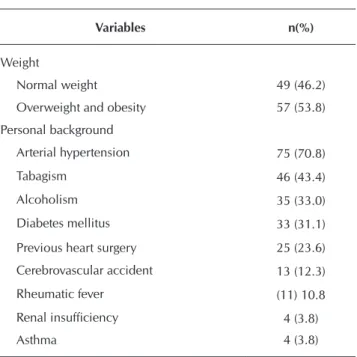
Regarding personal background, the patients had high rate of arterial hypertension (70.8%), tabagism (43.4%), and dia-betes (31.1%). Among the patients, 23.6% had already un-dergone previous heart surgery (Table 2). The sample was predominantly in the range of overweight or obesity (53.8%).
Most of the evaluated patients were within the extremes of anxiety levels, being 59.4% in minimal anxiety and 19.8% in the range considered severe. When assessing anxiety scores, the sample maintained a mean in the mild anxiety level (15.8±19.79), considering the internal reliability in the use of the scale applied (α=0.715) (Table 3).
Women had scores (22.13±23.41) significantly (p=0.003) higher than men (10.76±14.71). There was no significant difference between older adults and younger patients, nor in terms of weight variations, presence of diabetes, or alcohol-ism. We observed a significantly higher difference (p=0.012) in anxiety in the group of patients who had undergone previ-ous heart surgery (24.4±28.05 X 13.14±15.74) and among smokers (19.27±23.57 X 11.28±12.19; p=0.039) (Table 4).
Table 4 - Comparison between the means of the scores ob-tained, Recife, Pernambuco, Brazil, 2014
Variables Anxiety P value*
Sample 15.8 (19.79)
Men 10.76 (14.71)
0.003 Women 22.13 (23.41)
<60 years 17.84 (23.36)
0.25 >=60 years 13.43 (14.53)
Normal weight 16.53 (18.89)
0.727 Overweight and obesity 15.18 (20.68)
Previous heart surgery (HS) 24.4 (28.05)
0.012 Without previous HS 13.14 (15.74)
Diabetic 13.21 (15.61)
0.368 Non-diabetic 16.97 (21.41)
Hypertensive 17.27 (19.44)
0.238 Non-hypertensive 12.26 (20.50)
Smoker 19.27 (23.57)
0.039 Non-smoker 11.28 (12.19)
Alcoholic 14.69 (14.98)
0.686 Non-alcoholic 16.35 (21.86)
Notes: m (sd): mean (standard deviation); *Student’s t test.
DISCUSSION
The mean of age revealed a sample close to 60 years. Stud-ies show that anxiety and depression in preoperative period have higher incidence among older adults and that in this group it presents less postoperative reduction(10).
A cohort with 148 older adults who underwent revascular-ization surgery identified that the group with high preoperative anxiety featured, in regression analysis, risk of mortality or se-vere morbidity almost five times greater than the group with-out anxiety. (OR=5.1, CI95%1.27-20.2, p=0.02). In this same study, factors such as diabetes, hypertension, obesity, and other physical factors were not directly related to the presence of anxi-ety as well as in the findings presented in Table 4(11).
Table 3 - Levels of anxiety, Recife, Pernambuco, Brazil, 2014
Variables n(%) Mean±sd Median α
Anxiety 15.8±19.79 8.0 0.715 Minimal anxiety 63 (59.4)
Mild anxiety 15 (14.2) Moderate anxiety 7 (6.6) Severe anxiety 21 (19.8)
Notes: sd: standard deviation; Cronbach’s alpha (α).
Table 2 - Sample distribution regarding weight and per-sonal health background, Recife, Pernambuco, Brazil, 2014
Variables n(%)
Weight
Normal weight 49 (46.2)
Overweight and obesity 57 (53.8)
Personal background
Arterial hypertension 75 (70.8)
Tabagism 46 (43.4)
Alcoholism 35 (33.0)
Diabetes mellitus 33 (31.1)
Previous heart surgery 25 (23.6)
Cerebrovascular accident 13 (12.3)
Rheumatic fever (11) 10.8
Renal insufficiency 4 (3.8)
Asthma 4 (3.8)
The education level of the sample showed high level of patients with college degree (33.0%) and high school (17.7%), and only 6.6% of illiterates. A cohort of ten years with 180 patients with an education level mean of 11.4 showed that preoperative anxiety and low schooling were predictors of mortality post-discharge as much as EUROS-CORE, a score for heart surgery internationally used, which considers clinical variables as risk predictors(12).
The study previously mentioned also showed that among patients who died there was, in the preoperative period, a longer period of hospitalization, higher age, higher EU-ROSCORE, and lesser education level, whereas in the post-operative period this group showed highest rates and more persistence of anxiety and depression(12).
Another international research with 100 patients found 32% of incidence for anxiety and 19% for depression. In such research was also evaluated that preoperative anxi-ety had higher scores and higher persistence of pain in the postoperative period, as well as longer stay in the intensive care unit (ICU), without having been statistically significant the difference when the sample for the presence or absence of depression was dichotomized(13). In this study there was
no difference in incidence of mood disorders between gen-ders, however, the sample showed significant difference in anxiety mean, being higher among women (p=0.003).
On the other hand, in a national study on the preop-erative period of myocardial revascularization surgery, the presence of anxiety and depression investigated with the Hospital Anxiety and Depression Scale was of 34.4% and 28.1%, respectively(14).
In a cohort performed to evaluate the effect of anxiety and depression in up to four years of myocardial revascular-ization evidenced significantly higher death rate associated with anxiety among the 180 individuals surveyed(15).
An-other international cohort with mean follow-up of 4.4 years monitored 152 patients who underwent the heart trans-plant, starting the evaluation of anxiety and depression in the preoperative period. These patients were divided into two groups according to the heart failure cause and clinical indication for transplantation in ischemic and dilated car-diomyopathy cause. The ischemic cause group presented higher scores of depression and anxiety and higher mor-tality, the latter being associated with higher preoperative anxiety and depression outcomes in both groups(16). Both
studies reinforce that the predictive value of symptoms of anxiety and depression in the prognostic evaluation should be considered, as well as the need for developing protocols and intervention strategies to reduce these levels, in par-ticular health education in the preoperative period.
An international cohort of 162 patients concluded a significant association between physiological markers of stress (serum cortisol, C-reactive protein, and interleukin 6) with preoperative anxiety and as predictors of unwanted symptoms in the postoperative period. This study showed that patients who leaned on religious coping strategies and
social support also had better results after the surgery(17). A
national study showed that the consideration provided by the presence of the family is more significant for coping than the contact of nurses only, which was evaluated by lower levels of anxiety(18).
Using other evaluation tools, a national study showed improvement in quality of life regarding the generic aspects of mental health and emotional aspects after heart sur-gery, even without considering the spiritual and religious aspect(19).
When assessing the coping strategies used by patients in the preoperative period of heart surgery, another national study reported that the sustentative coping mode, which in-cludes spirituality, was used in 50% of cases(4). The
qualita-tive analysis has also demonstrated the presence of posiqualita-tive feelings and search for faith and hope in religiosity before heart surgery(20-21). Another study observed through
inter-views the high value of spiritual resources when coping heart surgery(21).
An exploratory study using a questionnaire for judging the relevance of defining characteristics of nursing diag-noses “Anxiety” and “Fear” by nurses of surgical clinics showed that patients associated fear with an intense event, with more physical effects such as tremors in the voice, in-crease in heart palpitations and rate, whereas anxiety was recognized by more subjective aspects related to psycho-logical issues such as reports of inability to relax, insom-nia, irritability, and impatience(22). This reference points
that nurses, most of the time, recognize anxiety, but little they include it in the systematization of their assistance or register alternatives to minimize it(22).
CONCLUSION
Preoperative anxiety here assessed presented incidence and values close to other studies, being higher among women and patients who had already undergone heart sur-geries previously, with statistically significant difference.
The elevated levels of anxiety, corroborating other re-search, indicate that nurses should include the investiga-tion of anxiety in their evaluainvestiga-tion, whether through gen-eral or validated instruments or, mainly, through the use of nursing diagnosis and defining characteristics. The nurse should understand the phenomenon and recognize its rel-evance to the immediate and late postoperative period.
REFERENCES
1. Tarasoutchi F, Montera MW, Grinberg M, Barbosa MR, Pi-ñeiro DJ, Sánchez CRM, et al. Diretriz Brasileira de Valvo-patias - SBC 2011 / I Diretriz Interamericana de ValvoValvo-patias - SIAC 2011. Arq Bras Cardiol [Internet]. 2011[cited 2015 Apr 19];97(5 supl1):1-67. Available from: http://publicacoes. cardiol.br/consenso/2011/Diretriz%20Valvopatias%20-%20 2011.pdf
2. Costa VASF, Silva SCR, Lima VCP. [The pre-surgery anx-iety of the patient: the alliance between the nurse and psychologist]. Rev SBPH [Internet]. 2010[cited 2015 Apr 19];13(2):282-98. Available from: http://pepsic.bvsalud. org/pdf/rsbph/v13n2/v13n2a10.pdf Portuguese.
3. Silva MEM, Zakir NS. [Instructional control and relaxation procedure as psychological preparation for pre-surgery pa-tients with heart disease]. Estud Psicol [Internet]. 2011[cited 2015 Apr 19];28(3):371-9. Available from: http://www.sci elo.br/pdf/estpsi/v28n3/a09v28n3.pdf Portuguese.
4. Umann J, Guido LA, Linen GFC, Freitas EO. Enfermagem perioperatória em cirurgia cardíaca: revisão integrativa da literatura. Rev Min Enferm [Internet]. 2011[cited 2015 Apr 19];15(2):275-81. Available from: http://www.reme.org. br/artigo/detalhes/36
5. Fernandes MVB, Aliti G, Souza EM. Perfil dos pacientes submetidos à cirurgia de revascularização do miocárdio: implicações para o cuidado de enfermagem. Rev Eletr Enferm [Internet]. 2009[cited 2015 Apr 19];11(4):993-9. Available from: http://www.fen.ufg.br/revista/v11/n4/pdf/ v11n4a25.pdf
6. Pritchard MJ. Managing anxiety in the elective surgi-cal patient. Br J Nurs [Internet]. 2009[cited 2015 Apr 19];18(7):416-9. Available from: http://www.ncbi.nlm.nih. gov/pubmed/19373185
7. Camponogara S, Soares SGA, Silveira M, Viero CM, Bar-ros CS, Cielo C. [Preoperative patients’ perceptions of car-diac surgery]. Rev Min Enferm [Internet]. 2012[cited 2015 Apr 19];16(3):382-90. Available from: http://www.reme. org.br/artigo/detalhes/541 Portuguese.
8. Alves PC, Silva APS, Santos MCL, Fernandes AFC. Knowl-edge and expectations of women in the preoperative mas-tectomy. Rev Esc Enferm USP [Internet]. 2010[cited 2015 Apr 19];44(4):989-95. Available from: http://www.scielo. br/pdf/reeusp/v44n4/en_19.pdf
9. Silva MEM, Zakir NS. [Instructional control and relaxation procedure as psychological preparation for pre-surgery pa-tients with heart disease]. Estud Psicol [Internet]. 2011[cit-ed 2015 Apr 19];28(3):371-9. Available from: http://www. scielo.br/pdf/estpsi/v28n3/a09v28n3.pdf Portuguese.
10. Krannich JHA, Weyers P, Lueger S, Herzog M, Bohrer T, Elert O. Presence of depression and anxiety before and af-ter coronary araf-tery bypass graft surgery and their relation-ship to age. BMC Psychiatry [Internet]. 2007[cited 2015 Apr 19];7:47. Available from: http://www.biomedcentral. com/1471-244X/7/47
11. Williams JB, Alexander KP, Morin JF, Langlois Y, Noiseux N, Perrault LP, et al. Preoperative Anxiety as a Predictor of
Mortality and Major Morbidity in Patients >70 Years of Age Undergoing Cardiac Surgery. Am J Cardiol [Internet]. 2013[cit-ed 2015 Apr 19];111(1):137-42. Available from: http://www. ajconline.org/article/S0002-9149%2812%2902077-2/pdf
12. Cserép Z, Losoncz E, Balog P, Szili-Török T, Husz A, Juhász B, et al. The impact of preoperative anxiety and education level on long-term mortality after cardiac surgery. Journal of Cardiothoracic Surgery [Internet]. 2012[cited 2015 Apr 19];7:86. Available from: http://www.cardiothoracicsurgery. org/content/pdf/1749-8090-7-86.pdf
13. Navarro-García MA, Marín-Fernández B, Carlos-Alegre V, Martínez-Oroz A, Martorell-Gurucharri A, Ordoñez-Ortigosa E, et al. Preoperative mood disorders in patients undergoing cardiac surgery: risk factors and postoperative morbidity in the intensive care unit. Rev Esp Cardiol [Internet]. 2011[cited 2015 Apr 19];64(11):1005-10. Available from: http://www.reves pcardiol.org/en/preoperative-mood-disorders-in-patients/ articulo/90034536/.
14. Carneiro AF, Mathias LAST, Rassi Júnior A, Morais NS, Goz-zani JL, Miranda AP. Avaliação da ansiedade e depressão no período pré-operatório em pacientes submetidos a pro-cedimentos cardíacos invasivos. Rev Bras Anestesiol [Inter-net]. 2009[cited 2015 Apr 19];59(4):431-8. Available from: http://www.scielo.br/pdf/rba/v59n4/05.pdf
15. Székely A, Balog P, Benkö E, Breuer T, Székely J, Miklós DKE. Anxiety predicts mortality and morbidity after coronary artery and valve surgery: a 4-year follow-up study. Psycho-som Med [Internet]. 2007[cited 2015 Apr 19];69:625-31. Available from: http://www.psychosomaticmedicine.org/con tent/69/7/625.full.pdf
16. Zipfel S et al. Effect of Depressive Symptoms on Survival After Heart Transplantation. Psychosom Med [Internet]. 2002[cited 2015 Apr 19];64:740-7. Available from: http://www.psych osomaticmedicine.org/content/64/5/740.full.pdf
17. Ai AL, Kabbaj M, Kathy LL. Body affects mind? preoperative behavioral and biological predictors for postoperative symp-toms in mental health. J Behav Med [Internet]. 2014[cited 2015 Apr 19];37:289-99. Available from: http://link.springer. com/article/10.1007%2Fs10865-012-9484-3
18. Assis CC, Lopes JL, Nogueira-Martins LA, Barros ALBL. [Embracement and anxiety symptoms in patients before cardiac surgery]. Rev Bras Enferm [Internet]. 2014[cited 2015 Apr 19];67(3):401-7. Available from: http://www. scielo.br/pdf/reben/v67n3/0034-7167-reben-67-03-0401. pdf Portuguese.
19. Dal Boni AL, Martinez JE, Saccomann IC. Qualidade de Vida de pacientes submetidos à revascularização do miocárdio. Acta Paul Enferm [Internet]. 2013[cited 2015 Apr 19];26(6):575-80. Available from: http://www.scielo. br/pdf/ape/v26n6/11.pdf
21. Koerich C, Baggio MA, Erdmann AL, Lanzoni GMM, Higashi GDC. Revascularização miocárdica: estratégias para o enfrentamento da doença e do processo cirúr-gico. Acta Paul Enferm [Internet]. 2013[cited 2015 Apr 19];26(1):8-13. Available from: http://www.scielo.br/pdf/ ape/v26n1/03.pdf