Original article (short paper)
Reference index and reduction in physical itness
tests proposed by PROESP-BR
Camila Fernanda Brandão
Núcleo de Aptidão Física, Informática, Metabolismo, Esporte e Saúde da Universidade Federal de Mato Grosso, MT, Brasil Universidade de São Paulo, Ribeirão Preto, SP, Brasil
José Henrique de Queiróz Fontes Arturo Alejandro Zavala Zavala Waléria Christiane Rezende Fett
Roberto Jaime dos Santos Carlos Alexandre Fett
Núcleo de Aptidão Física, Informática, Metabolismo, Esporte e Saúde da Universidade Federal de Mato Grosso, MT, Brasil
Abstract––The purpose of this study was to create an unifying index of the PROESP-BR tests for school aged teenagers
and propose a reduction in the physical itness tests. A total of 414 adolescents between the ages of 15 and 17 years old, representative of the public school population in the city of Cuiaba were evaluated. The tests include general physical itness, proposed by PROESP-BR. Multivariate factorial analysis was used, observing the commonality/ representativeness of each test with regard to the set, and the index was created for girls and boys. With this analysis
we can choose to use the following tests: female - throwing medicine ball, horizontal jump and run 20 meters; male -
throwing medicine ball, representing the overall performance. The created index was divided into quintiles and allowed
you to view the whole performance of the six tests, as well as their distribution within the group and away from the
ideal reference.
Keywords: performance, diagnosis, motor activity, physical exercise, health and physical itness.
Introduction
There is growing concern about identifying the existent con-ditions of risk for any change in the development of children
and adolescents (Zajons, Muller & Valentini, 2008). Physical
capabilities are directly related to health and sporting perfor-mance, and evaluating them has helped with the diagnosis and prevention of diseases as well as in detecting sporting talents
(Saraiva & Rodrigues, 2010).
Some international surveys that describe the proile of motor
performance of youngsters have observed the association
be-tween low physical itness and school performance (Koutedakis & Bouziotas, 2003). In addition, low physical itness in adoles
-cence has a negative relection on adult life (Mikkelsson et al.,
2006). Silva, Lima, Silva, and Prado (2009) found a prevalence of 83.1% of sedentary adolescents in the Brazilian population whereas other studies have observed variations between 39% and 93.5% of Brazilian students (Tassitano et al., 2007; Silva et al., 2005).
The lack of standardization of instruments for measuring physical activity hampers comparisons between Brazilian
regions, with the Mid-Western region being prejudiced by
the scarcity of studies (Silva et al., 2009; Hallal et al., 2007),
as well as comparisons with other populations in this area.
Therefore, it is crucial to establish equivalent normative values and reference parameters for Brazilian population
establishing parameters with others studies of other regions
and countries (Drews, Cardozo, Corazza, & Flôres, 2013).
Thus, to get a representative number of population it is necessary to have a large scale of the samples, the goal of our study was to evaluate the largest possible number of
children and adolescents. It would be interesting to have
a general evaluation index for all the factors, whether it is
with regard to health or to sporting performance. Therefore,
the more condensed the evaluations could be, the easier the
reproducibility will be.
Thus, the aim of this study was to create a general index of the tests performed by the parameters of Project Sport
Brazil (PROESP-BR) and verify the possibility of reducing
the number of tests established by PROESP-BR to the lowest
possible number and how reliable is.
Methods
Data was analyzed from 414 adolescents representing the study population of 11.006 high school level students of the 28 schools in the state public network. All of them were within the age-range of 15 to 17 years of age for both
sexes and residents within the urban perimeter of the
which held sporting diagnosis and health of students using
the parameters and classification of PROESP-BR (2011),
in the following tests: abdominal resistance, throwing the medicine ball, horizontal jump, 20-meter run (displacement
speed), 4x4 meter square (agility) and 9-minute run (Table 1 and 2).
The project was approved by the Research Ethics Committee
of “ University Hospital Júlio Muller”, Protocol No. 658/CEP/ HUJM/09 of July 26, 2009.
Table 1. Performance of PROESP-BR tests of 185 female students from 15 to 17 years of age from Public Network state schools in Cuiabá-MT, Brazil.
Excellent Very good
Good Reasonable Weak
Abdominal Resistance
% 0.00 3.24 15.14 21.62 60.00
Throwing
Medicine
Ball
% 2.16 17.30 18.92 25.41 36.22
Horizontal Jump
% 3.24 19.46 23.24 17.30 36.76
20-Meter
Run
% 1.08 43.78 19.46 13.51 22.16
Square % 0.00 3.24 16.22 16.22 64.32
9-Minute
Run
% 0.00 17.30 17.84 25.41 39.46
N = no. of subjects % = percentage of subjects with regard to sample of 185 students.
Table 2. Performance of PROESP-BR tests of 229 male students from 15 to 17 years of age from Public Network state schools in Cuiabá-MT, Brazil.
Excellent Very
good Good Reasonable Weak
Abdominal Resistance
% 0.00 9.17 17.03 24.02 49.78
Throwing
Medicine
Ball
% 1.31 24.02 30.13 21.40 23.14
Horizontal Jump
% 3.06 24.02 25.33 22.71 24.89
20-Meter
Run
% 16.16 37.99 31.00 6.55 8.30
Square % 0.44 8.73 24.02 18.34 48.47
9-Minute
Run
% 0.00 19.21 22.27 24.02 34.50
N = no. of subjects % = percentage of subjects with regard to sample of 229 students.
Statistical Analysis
Multivariate factorial analysis was used to detect the factor
of correspondence of each test and afterwards create the
in-dex. This was performed with the statistical software program Minitab version 15.0 which, by means of the raw data of the
variables found the matrix of correlation and determined the
number of factors necessary (≥1). We used commonality for
the proposed reduction of the variables with the correlation of
each variable being explained by all the factors.T herefore, the higher the value of communality (closer to 1.00); the higher the power of explanation of the variable would be. For the cre -ation of the students’ rating it was necessary to create a ‘gold
standard’ reference. Arbitrarily a “school best” was developed,
which was established from the best outcome of each test for
each sex. In short, no individual had the best marks in all tests,
so it was necessary to use the best result obtained in each test
for different schools.
The index was obtained by multiplying the standardized variables by the factors obtained, thereby we determined the amplitude between the indices obtained and the data
were grouped into 05 groups, in which the lowest values
corresponded to the greatest proximity to the values of the excellent adolescent students, therefore meaning the best
result.
Results
To create the index of each student, it was necessary observe
the score of each test on the whole (values of commonality),
thus we see the possibility to reduce the amount of testing and
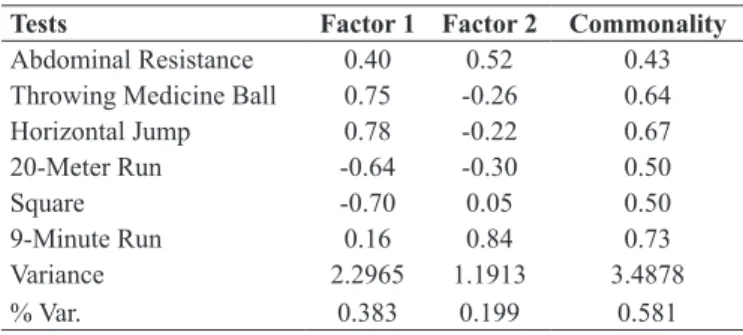
the difference between male and female groups. Regarding the proposal for reduction in the tests, there was a variance of 65% and 58% of the importance of each variable for female and male group, respectively. The female group had two tests with high
values, three with medium values, and one with a low value and in the male group there was one high, four medium and one low
test value. Thus, if we consider values of correspondence above 70% to represent the set, only two tests would be necessary for the female group and one test for the male group (Tables 3 and 4). However, we observed that there was correlation between the tests themselves, and only 01 test in each group had values below 50%.
Table 3. Result of correspondence factors of each physical test stipu
-lated by PROESP-BR of females.
Tests Factor 1 Factor 2 Commonality
Abdominal Resistance 0.66 -0.35 0.57
Throwing Medicine Ball 0.34 0.84 0.82
Horizontal Jump 0.75 0.38 0.72
20-Meter Run -0.83 0.03 0.69
Square -0.81 -0.15 0.69
9-Minute Run 0.64 -0.07 0.42 Variance 2.9052 1.0216 3.9268 % Var. 0.484 0.170 0.654
Table 6. Index created for classiication of males.
Interval N % Group Classiication
0.00 0.01 1 0.4 Excellent
-0.01 3.50 2 0.8 G1 Excellent
3.51 7.00 16 7.0 G2 Very Good
7.01 10.50 117 51.0 G3 Good
10.51 14.00 83 36.0 G4 Reasonable
14.01 more 11 4.8 G5 Weak
TOTAL 230 100
Excellent group: excellent student created
N and %: quantity of students in each group.
Figure 2. Dispersion graph according to the male group.
Discussion
The present study is a continuation of the work of Fontes
(2013) who had identiied a low performance of adolescent students in the PROESP-BR tests. Subsequently, we developed a
statistical analysis that allowed a different manner of observing the behavior between the genders with regard to the power of the
tests. In the female group, two tests were of high importance to
represent the overall performance whereas in male group only
one test seems high representative. In addition, an index that
represents the overall performance of the adolescent students was developed, which provides a spatial view of the distribu-tion of the physical capacity among these adolescent students
and in comparison with the excellent adolescent students.
This approach shows that these adolescent students had a low
physical performance because the best classiied among them
were equidistant from both the excellent adolescent students
and the worst classiication. Moreover, it allows an approach to a speciic classiication for this group, considering that with regard to the original PROESP-BR classiication, they are only at the margin of the excellent category.
Studies using multivariate factorial analysis have been
explored to a small extent in the ield of physical education up to now. In our study, the determination of an index may
help future evaluations with the proposal of a smaller number
of tests. Thus, we observed that the extraction of two factors
Table 4. Result of correspondence factors of each physical test stipu
-lated by PROESP-BR of males.
Tests Factor 1 Factor 2 Commonality
Abdominal Resistance 0.40 0.52 0.43
Throwing Medicine Ball 0.75 -0.26 0.64
Horizontal Jump 0.78 -0.22 0.67
20-Meter Run -0.64 -0.30 0.50
Square -0.70 0.05 0.50
9-Minute Run 0.16 0.84 0.73 Variance 2.2965 1.1913 3.4878 % Var. 0.383 0.199 0.581
Rotated Factors - Quartimax. Rotation
According to analysis, we obtained the index of adolescent students and with the creation of the excellent female and male
students within our own sample; we divided the classiication into ive groups, stratifying by the amplitude among the data. For the female classiication, the amplitude was 19.56 resulting in the interval of 3.85 for each classiication; for the male classi
-ication the amplitude was 17.49, resulting in the interval of 3.50 between the classiications. The classiication of each student
was determined by the distance between the school adolescent students from the excellent adolescent student, and the shorter
the distance between them, the better the result (Tables 5 and 6, Figures 1 and 2).
Table 5. Index created for classiication of females.
Interval N % Group Classiication
0.00 0.01 1 0.5 Excellent
-0.01 3.85 5 2.7 G1 Excellent
3.86 7.70 39 21.0 G2 Very Good
7.71 11.55 95 51.0 G3 Good
11.56 15.40 43 23.1 G4 Reasonable
15.41 more 3 1.7 G5 Weak
TOTAL 186 100
Excellent group: excellent student created
N and %: quantity of students in each group.
was possible, for girls and boys, these representing 65% and 58%, respectively, of the total variance in the results, showing
that these tests have greater impact on the entire battery of
evaluations performed.
A reduction in the number of tests may facilitate the development of the evaluations, since we observed that if some tests were not performed would not affecting the
final score of the overall index. Indeed, Peterson, Alvar & Rhea (2006) stated that the horizontal jump is sufficient in
the evaluation of power, speed and agility; while Guedes
(2007) reported that the 20-meter run is capable of providing information about the same physical fitness level. One of
the main reasons for physical follow-up is related to health; the components of force, resistance, and agility are directly related to the prevention of neuromuscular problems (Welk,
Going, Morrow, & Meredith, 2011) since it has been associ -ated with maintaince of the metabolism of some substrates
and hormone regulation (Guedes,, Miranda-Neto, Germano, Lopes & Silva, 2012).
Sharkey (1997), demonstrated that performance of physical tests that use greater muscle recruitment are more eficient in the diagnosis of overall physical itness of youngsters who are not athletes. This corroborates with the inding for the male
group in our study, in which the test with greatest score was
the 9-minute run. On the other hand, we found that the tests
with the greatest score, for the female group, were throwing
the medicine ball and horizontal jump. However, in the female
group this is not an absolute factor, because the horizontal
jump is considered important for overall evaluation.
Castro-Pinero et al. (2010), observed a strong association between the horizontal jump test and tests of muscle force of the upper and
lower limbs. Furthermore, they considered that this test could be used as a general index of muscle aptness in adolescents.
Further studies with different populations and biochemical analyses are necessary, in order, to better determine these
inter-gender variations.
With the factors of each test, we veriied that the female
group had more distributed physical performance results,
and only two tests were necessary to obtain the same index.
Differently, in male group, which was more homogeneous, only one test could be performed providing the same
informa-tion. With regard to classiication, we observed that the female group had better results than the male group. This differs from the classiication made by Fontes (2013) and other studies,
such as Dumith et al., (2010) and Guedes, Neto & Silva
(2011) which analyzed the difference between the genders in some physical itness tests and found that boys received higher scores than girls in the majority of the tests. Silva, Nahas, Hoefelmann, Lopes and Oliveira (2008) pointed out
that male adolescents are more physically active, particularly
in the ield of leisure and work, due to cultural inluences and the strong trend towards self-determination (Viana, Andrade & Matias, 2010).
The index created may facilitate the diagnosis and follow-up of school physical education in the population
diagnosed. Persisting with that which the study of Silva, Böhme, Uezu and Massa (2003) considered, the importance
of creating indices that provided references for each specific population, with the justification of helping with the fol-low-up of lessons; and considering that in the present study
the adolescent students presented low physical performance. This suggests that they are exposed to a low quality/quantity of motor activities. Similar to our results, Pelegrini, Silva, Petroski, & Glaner (2011) observed that adolescent Brazilian students presented inadequate levels of physical fitness.
This situation may be due to cultural changes, as regards
exposure to passive leisure, such as electronic games, TV
and other entertainment (Dumith et al., 2010). According to
Hallal, Knuth, Cruz, Mendes, and Malta (2010), the major
-ity of adolescents in the Mid-Western region of Brazil are insufficiently active.
Physical Education lessons, in turn, which must contribute to improving this situation, are apparently not changing the lack
of physical activity. Indeed, other studies have observed that the
level of physical effort in the Physical Education lessons are
not suficient to increase physical itness (Guedes & Guedes, 2001) both in public and private schools (Hallal et al., 2010;
Silva, Lima, Silva, & Prado, 2009). Another studied has re
-lated that only 49.2% of the adolescents in major Brazilian
cities responded to participating in two weekly physical
edu-cation classes (Hallal, Knuth, Cruz, Mendes & Malta, 2010).
Therefore, with the help of school planning, it is necessary for teachers to interact and develop socialization, challenging the processes of upbringing and lifestyles and demonstrating to the adolescent students the importance of physical activity as the opportunity to improve their quality of life (Gallahue
& Donnelly, 2008).
Although we created the excellent adolescent students with the best results in our sample, this is not the ideal, because
considering the general classiication used by PROESP-BR, those students are not within the 98th percentile; so far, obtain
-ing excellent results in at least two tests. The present index is representative for the sample population. Of note, we observed that the studied population lacks speciic evaluations, and this
instrument is useful for teachers to follow-up the development
of their pupils. Furthermore, knowledge of the local reality leads us to the need for formulating public policies and speciic
interventions with regard to physical education lessons and the
promotion of school sports.
Conclusion
With the results of factorial analyses we obtained the score of each test, allowing a reduction in the tests and showing that these tests do not have the same gradet for both sexes, there-fore, it is necessary to observe the most characteristic physical
qualities of each gender. From the factors analyzed, an index
could be created for each pupil, helping with visualization of the overall motor performance of adolescent students, and this can be used by Physical Education teachers for following-up
their pupils’ performance. This index facilitated visualization
of the results of the adolescent students’ performance, which
demonstrating that the intervention in physical activity may not
be adequate for this population.
References
Castro-Pinero, J., Ortega, F.B., Artero, E.G., Girela-Rejon, M.J., Mora, J., Sjostrom, M., & Ruiz, J. (2010). Assessing Muscular Strength In Youth: Usefulness Of Standing Long Jump As A General Index Of Muscular Fitness. Journal of Strength and Conditioning Research, 24, 1810-1817.
Drews, R., Cardozo, P.L., Corazza, S.T., & Flôres, F.S. (2013).
Análise do desempenho motor de escolares praticantes de futsal
e voleibol. Motricidade, 9, 105-116.
Dumith, S.C., Ramires, V.V., Souza, M.J.A., Moraes, D.S., Petry, F.G., Oliveira, E.S., Ramires, S.V., & Marques, A.C. (2010). Aptidão
física relacionada ao desempenho motor em escolares de sete a
15 anos. Revista Brasileira Educação Física e Esporte, 24, 5-14.
Fontes, J.H.Q. (2013). Diagnóstico do potencial olímpico de alunos de 15 a 17 anos da rede estadual de ensino de Cuiabá-MT. Dissertação
de mestrado.
Gallahue, D.L., & Donnelly, F.C. (2008). Educação Física desenvolvi
-mentista para todas as crianças, 4. ed., São Paulo: Phorte. Guedes, D.P. (2007). Implicações associadas ao acompanhamento do
desempenho motor de crianças e adolescentes. Revista Brasileira Educação Física e Esporte, 21, 37-60.
Guedes, D.P., & Guedes, J.E.R.P. (2001). Níveis de prática de atividade física habitual em adolescentes. Revista Brasileira Medicina do Esporte, 7, 187-99.
Guedes, D.P., Neto, J.T.M., & Silva, A.J. (2011). Desempenho motor em uma amostra de escolares brasileiros. Motricidade, 7, 25-38.
Guedes, D.P., Miranda-Neto, J.T., Germano, J.M., Lopes, V., & Silva, A.J.R.M. (2012). Aptidão física relacionada à saúde de escolares: Programa Fitnessgram. Revista Brasileira Medicina do Esporte,
18, 72-76.
Hallal, P.C., Dumith, S.C., Bastos, J.P., Reichert, F.F., Siqueira, F.V., Azevedo, M.R. (2007). Evolução da pesquisa epidemiológica em atividade física no Brasil: revisão sistemática. Revista de saúde pública, 41, 453-60.
Hallal, P., Knuth, A.G., Cruz, D.K.A., Mendes, M.I., & Malta, D.C. (2010). Prática de atividade física em adolescentes brasileiros.
Ciência e Saúde Coletiva, 15, 3035-42.
Koutedakis, Y., & Bouziotas, C. (2003). National physical education curriculum: motor and cardiovascular health related itness in Greek adolescents. British Journal of Sports Medicine, 37, 311-4.
Mikkelsson, L.O., Nupponen, H., Kaprio, J., Kautiainen, H., Mikkelsson, M., & Kujala, U.M. (2006). Adolescent lexibility,
endurance strength, and physical activity as predictors of adult
tension neck, low back pain, and knee injury: a 25 year follow up study. British Journal of Sports Medicine, 40, 107-13.
Pelegrini, A., Silva, D.A.S., Petroski, E.L., & Glaner, M.F. (2011).
Aptidão física relacionada a saúde de Escolares brasileiros: dados
PROESP-BR. Revista Brasileira Medicina do Esporte, 17, 92-96.
Peterson, M.D, Alvar, B.A, & Rhea, MR. (2006). The contribution of
maximal force production to explosive movement among young
collegiate athletes. Journal of Strength Conditioning and Research,
20, 867-73.
Projeto Esporte Brasil (PROESP-BR). (2011). Disponível em: <http:// www.proesp.ufrgs.br> Acesso em: 10 jul. 2011.
Saraiva, J.P., & Rodrigues, L.P. (2010). Relações entre atividade física,
aptidão física, morfológica e coordenativa na infância e
adolescên-cia. Motricidade, 6, 35-45.
Sharkey, B.J. (1997). Fitness and health. (4 ed.) Champaign: Human
Kinetics.
Silva, L.R.R, Böhme, M.T.S, Uezu, R., & Massa, M. (2003). A uti
-lização de variáveis cineantropométricas no processo de detecção, seleção e promoção de talentos no voleibol. Revista Brasileira Ciência e Movimento, 11, 69-76.
Silva, M.A., Rivera, I.R., Ferraz, M.R., Pinheiro, A.J, Alves, S.W., Moura, A.A., & Carvalho, A.C. (2005). Prevalência de fatores de risco cardiovascular em crianças e adolescentes da rede de ensino da cidade de Maceió. Arquivos Brasileiro de Cardiologia,
84, 387-92.
Silva, K.S., Nahas, M.V., Hoefelmann, L.P., Lopes, A.S., & Oliveira, E.S. (2008) Associações entre atividade física,
índice de massa corporal e comportamentos sedentários em
adolescentes. Revista Brasileira Epidemiologia, 11, 159-168.
Silva, D.A.S., Lima, J.O., Silva, R.J.S., & Prado, R.L. (2009). Nível de atividade física e comportamento sedentário em escolares.
Revista Brasileira Cineantropometria e Desempenho Humano,
11, 299-306.
Tassitano, R.M., Bezerra, J., Tenorio, M.C.M., Colares, V., Barros, M.V.G., & Hallal, P.C. (2007). Atividade física em adolescentes brasileiros: uma revisão sistemática. Rev Bras Cineantropom Desempenho Hum, 9, 55-60.
Viana, M.S., Andrade, A., & Matias, T.S. (2010). Teoria da autodeter
-minação: Aplicações no contexto da prática de exercícios físicos de adolescentes. Pensar a Prática, 13, 1-18.
Welk, G.J., Going, S.B., Morrow, J.R., & Meredith, M.D. (2011). Development of new criterion-referenced itness standards in the Fitnessgramge program: rationale and conceptual overview.
American Journal of Preventive Medicine, 41, 63-7.
Zajons, R., Muller, A.B., & Valentini, N.C. (2008). A inluência de fatores ambientais no desempenho motor e social de crianças da periferia de Porto Alegre. Revista Educação Física/UEM, 19,
159-171.
Authors’ note
Camila Fernanda Brandão, master in physical education of Federal
University of Mato Grosso and PhD student in the Ribeirão Preto Medical School, University of São Paulo
José Henrique de QueirozSources, Master in Biosciences, Federal
University of Mato Grosso
Arturo Alejandro Zavala Zavala, PhD in statistics and professor at
the Faculty of Economics of the Federal University of Mato Grosso;
Waléria Christiane Rezende Fett, PhD in Medical Sciences and pro -fessor at the Faculty of Physical Education, Federal University of
Mato Grosso
Roberto Jaime dos Santos, professor at the Faculty of Physical
Carlos Alexandre Fett, PhD Medical Sciences and professor at the Faculty of Physical Education, Federal University of Mato Grosso.
Corresponding author
Camila Fernanda Brandão
Faculdade de Medicina de Ribeirão Preto da Universidade de São Paulo, Anexo A, Bloco B, sala 103 - Avenida Bandeirantes, 3900, Vila Monte Alegre, Ribeirão Preto, SP, Brasil.
Email: [email protected]
Manuscript received on July 05, 2015 Manuscript accepted on January 13, 2016