ABSTRACT
Are torque values of preadjusted brackets precise?
Alessandra Motta STREVA1, Flávio Augusto COTRIM-FERREIRA2, Daniela Gamba GARIB3, Paulo Eduardo Guedes
CARVALHO2
1- DDS, MSc, Visiting Professor, Department of Orthodontics, Dental School, University of São Paulo, São Paulo, SP, Brazil. 2- DDS, MSc, PhD, Professor, Department of Orthodontics, Dental School, University of São Paulo, São Paulo, SP, Brazil.
3- DDS, MSc, PhD, Assistant Professor, Department of Pediatric Dentistry, Orthodontics and Community Health, Bauru School of Dentistry, University of São Paulo, Bauru, SP, Brazil.
Corresponding address: Dr. Alessandra Motta Streva - Rua 40, nº20 - sala 517 - Shopping 33 - Torre I - Vila Santa Cecília - Volta Redonda, RJ - Brasil - 27260-200 - Phone: +55-24-3342-4227 - e-mail: [email protected]
!" !
O
bjective: The aim of the present study was to verify the torque precision of metallic brackets with MBT prescription using the canine brackets as the representative sample of six commercial brands. Material and Methods: Twenty maxillary and 20 mandibular canine brackets of one of the following commercial brands were selected: 3M Unitek, Abzil, American Orthodontics, TP Orthodontics, Morelli and Ortho Organizers. The torque angle, established by reference points and lines, was measured by an operator using an optical microscope coupled to a computer. The values were compared to those established by the MBT prescription. Results: The results showed that for the maxillary canine brackets, only values (-7º). For the mandibular canines, American Orthodontics (-6.34º) and Ortho !"# ! $%& with all the other brands for maxillary canine brackets. For the mandibular canine brackets, ' %'%$ *+ // %1&'' clinically compromise the buccolingual positioning of the tooth at the end of orthodontic treatment.Key words: Torque. Orthodontic brackets. Cuspid.
INTRODUCTION
The completely programmed bracket system, created by Andrews1 (1989), was designed with the objective of using arches without bends. However, in spite of incorporating ideal torque characteristics in the structure of such brackets, in some cases it is necessary to apply additional or individual torques on some teeth. This would occur due to several factors10,27: mechanical side-effects25, morphological differences in the buccal faces of teeth4,6,9,21,22,26, changes in the position of the brackets2,16,22,29, different methods of bracket manufacturing12,30 and orthodontic wires24, the play between the wire and the bracket slot3,4,7,16,24,25, variations in the bracket designs8, properties of the materials constituting the brackets7,8,11,13,23 and wires24 and differences between the value of the torque informed by the
manufacturer and the real value of the torque of the brackets10.
The MBT system created by McLaughlin, Bennett and Trevisi17,18 <=>=@"DD" the brackets of incisors, molars and mandibular premolars, so that the clinical goals could be attained with the minimum insertion of bends in the wires, considering the play between the wire and the bracket slot. As regards the canines, brackets with three torque options were made available to professionals. For the maxillary canines, there are two types of brackets, which provide three types of torque: -7º, 0º e +7º and for the mandibular canines, also two types of brackets, providing three options of torque: -6º, 0º and +6º.
Group Median Mean SD m M p*
1 9.67 9.25 2.08 3.59 11.83 0.0283
2 9.73 9.47 2.11 2.79 12.58 0.0047
3 10.31 9.65 1.92 4.57 12.00 0.0004
*p<0.05
*Result of normality test of Shapiro-Wilks
SD= standard deviation
m= minimum torque
M= maximum torque
Table 1- Descriptive measurements and test of normality for method error (Shapiro-Wilks)
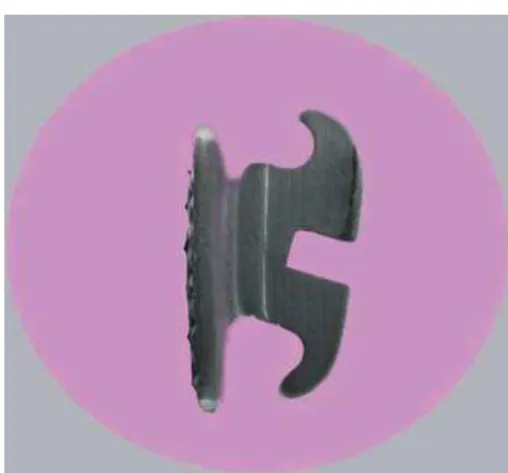
Figure 1- Fixation of the brackets in the template
Figure 2- Points B1 and B2
Figure 3- Points C1 and C2 brands. The canine brackets were selected due
to the importance of the appropriate positioning of those teeth at the end of the orthodontic treatment28.
MATERIAL AND METHODS
A s a m p l e o f 2 4 0 m e t a l b ra c k e t s w i t h 0.022”x0.028” slot of MBT prescription was selected (120 maxillary canine brackets with -7º of torque, and 120 mandibular canine brackets with -6º of torque). Six groups were selected, each one composed by 20 brackets of each of the brands commercially available in Brazil: Kirium Line (lot 3420; Abzil, São José do Rio Preto, SP, Brazil); Mini Master Series (maxillary canines lot 1301 and mandibular canines lot 0311; American Orthodontics, Sheboygan, WI, USA); Morelli MBT (maxillary canines lot 695388 and mandibular canines lot 706230; Morelli, Sorocaba, SP, Brazil); Gemini (lot D7120; 3M Unitek, Monrovia, CA, USA), Elite OPTI-MIM MBT (lots 541311 and 541581 of maxillary canines and 541311 and 541587 of mandibular canines; Ortho Organizers, Carlsbad, CA, USA) and Nu-Edge (lot 3014MLH series 6.749.426; TP Orthodontics, La Porte, IN, USA).
The brackets were placed on acrylic plates that served as templates. Holes were made in these plates (7 mm in diameter by 4 mm deep) and lines were also demarcated to guide positioning of the %1+Y%1& ' with starch based modeling clay so that half of %1& &' %' other half would be exposed for the assessment (Figure 1).
After insertion, the brackets were adjusted with a segment of 0.019”x0.025” stainless steel wire. + Z ' Y the bracket to be parallel to the template base and perpendicular to the optic visor of the microscope. A microscope (Jenalumar; Carl Zeiss, Jena, Thuringia, Germany) was used, coupled to a computer with a Charge Coupled Device (CCD) camera (KP-M1; \]&+1&\^&_ acquisition board (DT 55 fram grabber; Data Translation, Prague, Czech Republic). The images obtained by the microscope were analyzed in the Global Lab Image software (Data Translation) by a laboratorial technician instructed by the authors. When it was not possible to visualize the images adequately, they were submitted to one of the '
Comparison Mean difference p* Dahlberg
2x1 0.22 0.5420 0.96
3x1 0.41 0.1187 0.80
*Result test of Wilcoxon
Table 2- Descriptive measurements and test of normality for method error (Wilcoxon)
Maxillary canines (-7º)
Brands median mean SD m M p* test**
3M Unitek -7.07 -7.07 0.28 6.59 7.63 0.3240 a
Abzil -7.27 -7.14 0.86 5.64 9.80 0.5754 b
American Orthodontics -7.35 -7.18 0.49 6.19 7.81 0.1043 c
TP Orthodontics -6.84 -6.96 0.67 5.68 8.55 0.6274 d
Morelli -3.02 -3.33 2.33 0.61 7.63 <0.0001 a,b,c,d,f
Ortho Organizers -7.06 -6.97 0.38 6.28 7.60 0.8519 f
*Compared with the prescription
5HVXOWRIWKH0DQQ:KLWQH\WHVWZLWK%RQIHUURQLFRUUHFWLRQIRUPXOWLSOHFRPSDULVRQVWKHVDPHOHWWHUVLPSO\VLJQL¿FDQW difference.
SD= standard deviation; m= minimum torque; M= maximum torque
Table 3- Comparison of the mean torque value found for each bracket brand and the prescribed value for maxillary canines and intergroup comparisons
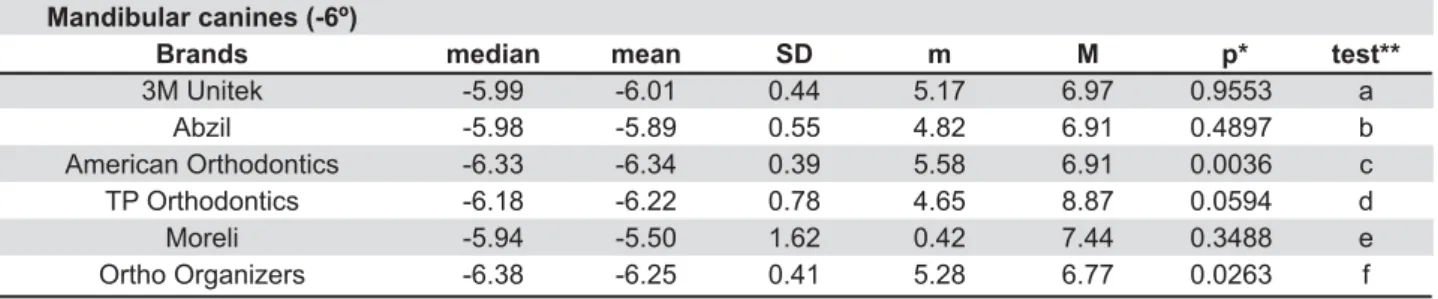
Mandibular canines (-6º)
Brands median mean SD m M p* test**
3M Unitek -5.99 -6.01 0.44 5.17 6.97 0.9553 a
Abzil -5.98 -5.89 0.55 4.82 6.91 0.4897 b
American Orthodontics -6.33 -6.34 0.39 5.58 6.91 0.0036 c
TP Orthodontics -6.18 -6.22 0.78 4.65 8.87 0.0594 d
Moreli -5.94 -5.50 1.62 0.42 7.44 0.3488 e
Ortho Organizers -6.38 -6.25 0.41 5.28 6.77 0.0263 f
*Compared with the prescription
5HVXOWRIWKH0DQQ:KLWQH\WHVWZLWK%RQIHUURQLFRUUHFWLRQIRUPXOWLSOHFRPSDULVRQVWKHVDPHOHWWHUVLPSO\VLJQL¿FDQW
difference
SD= standard deviation; m= minimum torque; M= maximum torque
Table 4- Comparison of the mean torque value found for each bracket brand and the prescribed value for mandibular canines and intergroup comparisons
/Y %' ` the internal face of the wings, denominated C1 and C2 (Figure 3). If the vertex in question was & & ' % formed between the line tangential to the internal ' ` +&'%{ |+`%1 &/ '& & vestibular-lingual inclination (torque) of the teeth in Z&'%{$
+ '% formed between the bracket base (Line B) and the %1 `{$+'
performed in the same software used to obtain the images, with a precision of 0.01 degree.
The Mann-Whitney test was applied to compare mean torque values of each group individually with the prescribed torque value. Mann-Whitney test with Bonferroni correction was used to compare the bracket brands. The casual and systematic error was calculated with Dahlberg formula5 and Wilcoxon test, respectively, repeating the measurements of 18 brackets (3 brackets of each brand) for 3 times with 1-month interval. The results were considered / #} + ' performed in the R software version 2.8.2 (R Foundation for Statistical Computing, available from http://www.r-project.org, Vienna, Bundesland Wien, Austria).
RESULTS
Method error
Comparison between torque values and established values of MBT brackets
The Morelli brand presented statistically significant differences in comparison to the prescription for the maxillary canine brackets (Table 3). For the mandibular canines, American Orthodontics and Ortho Organizers brackets comparison to the prescription (Table 4).
Intergroup comparison
There was a significant difference between Morelli brand and all other brands of the maxillary %1+% +' difference between the brands for the measurements of mandibular canine brackets (Table 4).
DISCUSSION
The preadjusted appliance was a great development in orthodontic mechanics. However, preadjustment of brackets to provide torque ' %`% them would be the precision of manufacture by the industry10,12,30
. The real value of the torque of the brackets should be in accordance with the nominal values informed by the manufacturers10. It is important to highlight that there is a lack of studies in the literature analyzing preadjusted bracket precision. Thus, the goal of this study was /&% of brackets of various commercial brands. The number of brackets was established by indication of a statistic, so that the number of repetitions would allow for greater reliability of the mathematical tests and would contribute effectively with precise information to orthodontists and manufacturers.
With regard to the methodology, various possibilities were investigated. Some authors that studied orthodontic materials developed mechanical devices to conduct their researches8,19,20. Others used computerized systems7 or graphic computation systems (CAD)14. Nevertheless, optical microscopy was frequently involved3,6,15,24,30. In view of this, to measure the torque of the brackets, the precision of the microscope was used in conjunction with Thus, there would be precision added to visualization.
For being small parts, orthodontic brackets ' % % % Thus, various templates were tested to handle the brackets, until one of them was as close as possible to the ideal. In principle, the brackets '& & &% material did not allow the brackets to be precisely adjusted. Furthermore, some brackets presented %Y &' Y&'
limit observation to only one of its proximal faces. /' & ' with modeling clay were chosen as the template. 'Y because of presenting an adequate consistency and less variation to thermal stimuli. The brackets were &Z that the proximal surface would be parallel to the template base. Thus, the microscope would capture the image correctly. The real torque was then % %'%1 %{|%1 `{$+ determination of the lines B and C was established by the current manufacture of brackets, which uses computer graphics (CAD) and computer systems (CAM)18. Table 3 shows the comparison between the torque values found and the MBT prescription values. Regarding the maxillary canines, it was found that Morelli brand presented statistically Y torque value of -7º. For the mandibular canines (Table 4), it was found that American Orthodontics and Ortho Organizer brands presented statistically Y torque value of -6º, but with good means, in addition to low amplitudes, and therefore showed manufacturing standardization.
The comparison among the six commercial brands is shown in Tables 3 and 4. Statistically ' brackets of maxillary canines. In Tables 3 and 4, for the maxillary canines, Mann-Whitney test with Bonferroni correction shows that the Morelli brand %
CONCLUSION
Based on the results of this study and in accordance with the sample and the methodology used, it may be concluded that in general, the mean torque values for the brackets were found to be within the values prescribed by the MBT technique, except for the Morelli brand for the maxillary canine brackets. The American Orthodontics and Ortho the mandibular canine brackets. The Morelli brand brands regarding the torques found in the maxillary canine brackets.
REFERENCES
1- Andrews LF. Straight wire - the concept and the appliance. San Diego: L.A. Wells; 1989. 407 p.
2- Balut N, Klapper L, Sandrik J, Bowman D Variations in bracket placement in the preadjusted orthodontic appliance. Am J Orthod Dentofacial Orthop. 1992;102:62-7.
3- Cash AC, Good SA, Curtis RV, McDonald F. An evaluation of slot size in orthodontic brackets - are standards as expected? Angle Orthod. 2004;74:450-3.
4- Creekmore TD, Kunik RL. Straight wire: the next generation. Am J Orthod Dentofacial Orthop. 1993;104:8-20.
5- Dahlberg G. Statistical methods for medical and biological ' 1* @ {* Unwin;1940.
! ] { ' appliance. Am J Orthod. 1978;73:290-9.
7- Fischer-Brandies H, Orthuber W, Es-Souni M, Meyer S. Torque transmission between square wire and bracket as a function of measurement, form and hardness parameters. J Orofac Orthop. 2000;61:258-65.
8- Flores DA, Choi LK, Caruso JM, Tomlinson JL, Scott GE, Jeiroudi MT. Deformation of metal brackets: a comparative study. Angle Orthod. 1994;64:283-90.
9- Germane N, Bentley B, Isaacson RJ, Revere JH Jr. The morphology of canines in relation to preadjusted appliances. Angle Orthod. 1990;60:49-54.
10- Gioka C, Eliades T. Materials-induced variation in the torque expression of preadjusted appliances. Am J Orthod Dentofacial Orthop. 2004;125:323-8.
11- Gmyrek H, Bourauel C, Richter G, Harzer W. Torque capacity of metal and plastic brackets with reference to materials, application, technology and biomechanics. J Orofac Orthop. 2002;63:113-28. 12- Graber TM. Orthodontics, current principles and techniques. St Louis: Mosby; 1985. 915 p.
13- Harzer W, Bourauel C, Gmyrek H. Torque capacity of metal and polycarbonate brackets with and without a metal slot. Eur J Orthod. 2004;26:435-41.
14- Kang B, Baek S, Mah J, Yang WS. Three-dimensional relationship the critical contact angle and the torque angle. Am J Orthod Dentofacial Orthop. 2003;123:64-73.
15- Kusy RP, Whitley JQ. Assessment of second-order clearances between orthodontics archwires and bracket slots via the critical contact angle for binding. Angle Orthod. 1999;69:71-80. 16- McLaughlin RP, Bennett JC. Bracket placement with the preadjusted appliance. J Clin Orthod. 1995;29:302-11.
17- McLaughlin RP, Bennett JC. The transition from standard edgewise to preadjusted appliance systems. J Clin Orthod. 1989;23:142-53.
18- McLaughlin RP, Bennett JC, Trevisi HJ. Mecânica sistematizada de tratamento ortodôntico. 1ª ed. São Paulo: Artes Médicas; 2002. 324 p.
19- Meling TR, Odegaard J. The effect of second-order couple on the application of torque. Am J Orthod Dentofacial Orthop. 1998;113(3):256-62.
20- Meling TR, Odegaard J, Seqner D. On bracket slot height: a methodologic study. Am J Orthod Dentofacial Orthop. 1998;113:387-93.
21- Miethke RR. Third order tooth movements with straight wire `/% ' vertical plane. J Orofac Orthop. 1997;58:186-97.
22- Miethke RR, Melsen B. Effect of variation in tooth morphology %1 ' preadjusted appliances. Am J Orthod Dentofacial Orthop. 1999;116:329-35.
23- Sadat-Khonsari R, Moshtaghy A, Schlegel V, Kahl-Nieke B, Möller M, Bauss O. Torque deformation characteristics of plastic brackets: a comparative study. J Orofac Orthop. 2004;65:26-33. 24- Sebanc J, Brantley WA, Pincsak JJ, Conover JP. Variability of effective root torque as a function of edge bevel on orthodontic arch wires. Am J Orthod. 1984;86:43-51.
25- Siatkowski R E. Loss of anterior torque control due to variations in bracket slot and archwire dimensions. J Clin Orthod. 1999;33:508-10.
26- Van Loenen M, Degrieck J, De Pauw G, Dermaut L. Anterior tooth morphology and its effect on torque. Eur J Orthod. 2005;27:258-62.
27- Kapur-Wadhwa R. Physical and mechanical properties affecting torque control. J Clin Orthod. 2004;38:335-40.
28- Zachrisson BU. Buccal uprighting of canines and premolars for improved smile esthetics and stability. World J Orthod. 2006;7:406-12
29- Zanelato RC, Grossi AT, Mandetta S, Scanavini MA. Torque individualization for cuspids when the preadjusted appliance is used. Rev Clin Ortodon Dental Press. 2004;3:39-55.