XI
Radiol Bras. 2013 Jul/Ago;46(4):XI–XII
Lucas Fiore1, Nivaldo Adolfo da Silva Junior2, Renata Bertanha3, Ines Minniti Rodrigues Pereira4, Fabiano Reis4
0100-3984 © Colégio Brasileiro de Radiologia e Diagnóstico por Imagem
WHICH IS YOUR DIAGNOSIS?
Fiore L, Silva Junior NA, Bertanha R, Pereira IMR, Reis F. Which is your diagnosis? Radiol Bras. 2013 Jul/Ago;46(4):XI–XII.
A 58-year-old woman was complaining of headache for six days. Study developed at Faculdade de Ciências Médicas da Universidade Estadual de
Campi-nas (FCM-Unicamp), CampiCampi-nas, SP, Brazil. 1. MD, Resident, Radiology Department, Facul-dade de Ciências Médicas da UniversiFacul-dade Estadual de Campinas (FCM-Unicamp), Cam-pinas, SP, Brazil. 2. MD, Physician Assistant, Radiology Department, Faculdade de Ciências Médicas da Universidade Estadual de Campinas (FCM-Unicamp), Campinas, SP, Brazil. 3. MD, Resident, Faculdade de Ciências Médicas da Universidade Estadual de Campinas
(FCM-Unicamp), Campinas, SP, Brazil. 4. PhDs, Professors, Faculdade de Ciências Médicas da Universidade Estadual de Campinas (FCM-Unicamp), Campinas, SP, Brazil. Mailing Address: Dr. Fabiano Reis. Hospital de Clínicas da Universidade Estadual de Campinas. Rua Vital Brasil, 251, Cidade Universitária Zeferino Vaz. Campinas, SP, Brazil, 13083-888. Caixa Postal 6142. E-mail: [email protected].
Figure 3. Head CT angiography, sagittal reforma-tion image.
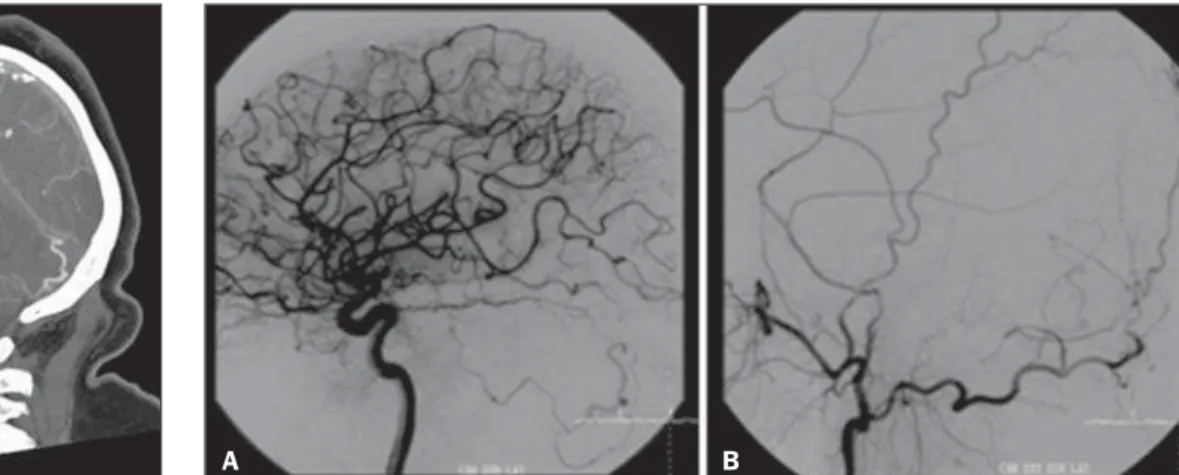
Figure 4. Selective internal(A) and external carotid artery angiography (B).
B A
Figure 1. Head unenhanced computed tomography (CT). A: Axial slice. B: Sagittal reformation image.
A B
XII Radiol Bras. 2013 Jul/Ago;46(4):XI–XII Images description
Figure 1. Head unenhanced CT scan. A: Axial plane discloses a cerebellar paren-chyma hematoma. B: Sagittal reformation image shows the cerebellar hematoma ad-jacent to the tentorium.
Figure 2. Head unenhanced axial MR T1-weighted image discloses an acute pa-renchyma hemorrhage in the cerebellar hemispheres. There is no signal abnormal-ity within the dural sinuses.
Figure 3. Head CT angiography. Sagit-tal reformation image demonstrates an ab-normal vascular dilation, probably corre-sponding to the vermian vein draining into the straight sinus.
Figure 4. Digital subtraction brain an-giography (DSA) with selective injection in the internal (A) and external carotid artery (B), disclosing a dural fistula at the cerebel-lar tentorium supplied by tentorial and (A) and occipital arteries (B). The venous drainage occurs through a cortical vein (vermian vein).
Diagnosis: Intracranial dural arterio-venous fistula.
COMMENTS
Intracranial dural arteriovenous fistulas (DAVFs) comprise 10% to 15% of all cere-brovascular malformations. Although such fistulas may occur at any location in the dura mater, they are most frequently found in the cavernous and transverse sinuses(1). Clinical findings include those associ-ated to intracranial hypertension (headache, nausea and vomiting, visual deficit, papille-dema), focal deficits, convulsions, mental state alterations, tinnitus(1–3).
The first classification of DAVFs was created in 1978, and showed that more ag-gressive symptoms and hemorrhage were usually associated to fistulas which had cortical venous drainage(4).
One of the most accepted classifications was developed in 1995 by Cognard et al., and correlates the fistula angioarchitecture with the neurological prognosis, particu-larly the risk for intracranial hemorrhage. Its main objective is to aid the decision treatment. Such classification categorized dural fistulas into five types as : a) type I –
venous drainage into to the dural sinus, and the flow direction of the fistula is the same of the physiological blood flow within the sinus; b) type II – subdivided into IIa, where the venous drainage occurs towards the venous sinus, but the drainage direction is opposite to the physiological blood flow within the sinus; IIb, as the venous drain-age occurs towards the venous sinus and there is also reflux into the cortical veins; and IIa+b, a combination of both previous descriptions; c) type III – fistulas draining directly into cortical veins without ectasia; d) type IV – those draining into the corti-cal veins associated with ectasia; e) type V – those draining into perimedullary veins(2). Types I and IIa DAVFs represent almost half of the fistula cases and are not usually associated with hemorrhage. Type I DAVFs are associated with functional symptoms such as tinnitus. About one third of type II DAVFs may be associated with intracranial hypertension. Fistulas with cortical venous drainage present considerable risk for hem-orrhage(2).
Another widely accepted classification is that developed by Borden et al. (1995), dividing the patients into three groups, the first one with sinusal or meningeal venous drainage; the second group with sinusal drainage associated with cortical venous reflux; and the third one with only cortical venous reflux(5).
Our case corresponds to the type II DAVF according to the classification devel-oped by Cognard et al.(4), considering the presence of a direct drainage into the cor-tical vein, without ectasia. These fistulas are commonly associated with aggressive symptoms, and in about 40% of cases they complicate with hemorrhage(2).
Pathological conditions involved in the development of DAVFs include: cranioen-cephalic trauma, cerebral thrombophlebitis, previous neurosurgery and infections(2).
DSA remains as the gold standard in the diagnosis of DAVF, but either 3D time-of-flight magnetic resonance angiography or 4D dynamic magnetic resonance angiogra-phy have high sensitivity and specificity in the diagnosis of moderate- to high-flow fistulas(6–8). 64-detector-row CT angiogra-phy represents a promising technique, both
for its lower invasiveness and higher diag-nostic sensitivity and specificity (93% and 98%, respectively)(9).
Therapeutic options for DAVFs include conservative, endovascular or surgical treat-ment. Currently, the endovascular treatment is most commonly indicated, with good results and low complications index. Dif-ferent materials, such as Onix® and micro-coils, can be utilized according to the medi-cal team experience and fistula angioar-chitecture(10,11). In cases where endovas-cular treatment is not possible, open sur-gery may be used, particularly in cases in-volving DAVFs in the anterior fossa(1).
REFERENCES
1. Kiyosue H, Hori Y, Okahara M, et al. Treatment of intracranial dural arteriovenous fistulas: cur-rent strategies based on location and hemodynam-ics, and alternative techniques of transcatheter embolization. Radiographics. 2004;24:1637–53. 2. Cognard C, Gobin YP, Pierot L, et al. Cerebral du-ral arteriovenous fistulas: clinical and angiographic correlation with a revised classification of venous drainage. Radiology. 1995;194:671–80. 3. Geibprasert S, Pongpech S, Jiarakongmun P, et
al. Radiologic assessment of brain arteriovenous malformations: what clinicians need to know. Radiographics. 2010;30:483–501.
4. Djindjian R, Merland JJ. Super-selective arteri-ography of the external carotid artery. Berlin: Springer-Verlag; 1978.
5. Borden JA, Wu JK, Shucart WA. A proposed clas-sification for spinal and cranial dural arterio-venous fistulous malformations and implications for treatment. J Neurosurg. 1995;82:166–79.
6. Nishimura S, Hirai T, Sasao A, et al. Evaluation of dural arteriovenous fistulas with 4D contrast-enhanced MR angiography at 3T. AJNR Am J Neuroradiol. 2010;31:80–5.
7. Wetzel SG, Bilecen D, Lyrer P, et al. Cerebral du-ral arteriovenous fistulas: detection by dynamic MR projection angiography. AJR Am J Roent-genol. 2000;174:1293–5.
8. Noguchi K, Melhem ER, Kanazawa T, et al. In-tracranial dural arteriovenous fistulas: evaluation with combined 3D time-of-flight MR angiogra-phy and MR digital subtraction angiograangiogra-phy. AJR Am J Roentgenol. 2004;182:183–90. 9. Lee CW, Huang A, Wang YH, et al. Intracranial
dural arteriovenous fistulas: diagnosis and evalu-ation with 64-detector row CT angiography. Ra-diology. 2010;256:219–28.
10. Cognard C, Januel AC, Silva NA Jr. Endovascular treatment of intracranial dural arteriovenous fis-tulas with cortical venous drainage: new manage-ment using Onyx. AJNR Am J Neuroradiol. 2008;29:235–41.