rca to r. u fc. b r
ISSN: 1984-2201
Copyright © 2002, Universidade Federal do Ceará
THE METROPOLITAN DIMENSION
OF HOUSING POLICY
ABSTRACT
The last decade (2000-2010) has been characterized by the resumption of the protagonism of housing policy in Brazil, with the consolidation of instruments and policies that have formed a consistent framework to address the issue in the country. However, despite the concentration of the problem in metropolitan areas, the policy and the national housing plan have essentially adopted municipal strategies. Given this context, how can the obstacles and limits to the regional articulation of municipal housing policies in metropo-litan regions be discussed? We start from the assumption that, while regional articulation is inevitable, the planning and management arrangements and instruments available have structural limitations that make the integration of municipal policies unfeasible. To discuss this issue, a previous question must be answered: how to investigate the factors that condition the integration of housing policies in metropolitan regions? This is the question that this article seeks to answer, resulting in the proposition of an analytical investigative structure that underlies future studies in this ield.
Keywords: Metropolitan region; Housing policy; Public policy analysis.
RESUMO / RESUMEN
DIMENSÃO METROPOLITANA DA POLÍTICA HABITACIONAL
A última década (2000-2010) se caracteriza pela retomada do protagonismo da política habitacional no Brasil, com a consolidação de instrumentos e políticas que conformaram um arcabouço consistente para enfrentamento da questão no país. Contudo, a despeito da concentração do problema nos espaços metro-politanos, a política e o plano nacional de habitação adotam estratégias essencialmente municipalistas. Diante deste contexto, como discutir os obstáculos e limites à articulação regional das políticas municipais de habitação nas regiões metropolitanas? Partimos do pressuposto que, ao mesmo tempo em que há uma inevitabilidade de articulação regional, os arranjos e instrumentos de planejamento e gestão disponíveis apresentam limitações estruturais que inviabilizam a integração das políticas municipais. Para discutir este tema, uma questão anterior deve ser respondida: como investigar os fatores que condicionam a integração das políticas habitacionais nas regiões metropolitanas? Esta é a pergunta que se procura responder neste artigo, resultando na proposição de uma estrutura analítica de investigação que embase futuros trabalhos na área.
Palavras-chave: Região metropolitana; Política habitacional; Análise de políticas públicas.
DIMENSIÓN METROPOLITANA DE LA POLÍTICA HABITACIONAL
La última década (2000-2010) se caracteriza por la reanudación del protagonismo de la política habitacional en Brasil, con la consolidación de instrumentos y políticas que conformaron un marco para enfrentar la cuestión en el país. Sin embargo, a pesar de la concentración del problema en los espacios metropolita-nos, la política y el plan nacional de vivienda adoptan estrategias esencialmente municipalistas. Ante este contexto, ¿cómo discutir los obstáculos y límites a la articulación regional de las políticas municipales de vivienda en las regiones metropolitanas? Partimos del supuesto de que, al mismo tiempo que hay una inevitabilidad de articulación regional, los arreglos e instrumentos de planiicación y gestión disponibles presentan limitaciones estructurales que inviabilizan la integración de las políticas municipales. Para dis-cutir este tema, una cuestión anterior debe ser respondida: ¿cómo investigar los factores que condicionan la integración de las políticas habitacionales en las regiones metropolitanas? Esta es la pregunta que se busca responder en este artículo, resultando en la proposición de una estructura analítica de investigación que emana futuros trabajos en el área.
Palabras clave: Región metropolitana; Política de vivienda; Análisis de políticas públicas.
(*) CORRESPONDING AUTHOR
Address: PUCPR) - Escola de Arquitetura e Design - Curso de Arquitetura e Urbanismo
R. Imaculada Conceição, 1155 - Prado Velho, CEP 80215-901, Curitiba (PR), Tel: (+55 41) 3271-2198 E-mail: [email protected] A rti cl e h is tor y: Re ce ive
d 8 O
ct obe r, 2017 A cc ept
ed 27 O
ct obe r, 2017 P ubl is he
r 20 N
ove
m
be
r, 2017
(a) Phd in Urban Management, Professor of the Pontiical Catholic University of Paraná (PUC-PR). http://lattes.cnpq.br/2399713645596610
(b) Phd in Urban Studies, Professor of the University of São Paulo (USP). http://lattes.cnpq.br/7348817908541292
w
w
w
.me
rca
to
INTRODUCTION
Housing policy in Brazil has taken on a prominent role in the last decade, both in academia and public management, and is characterized by a great paradox. At the same time as the progres-sive revaluing of the subject - with the approval of the City Statute (2001), the National Policy (2004), the National System (2005) and the National Housing Plan (2008), there is a weakening of this structure in favor of a policy of accelerated economic growth. Indeed, while on the one hand the quantitative results of the My Home My Life Program (Programa Minha Casa Minha Vida) suggest a positive outlook, the qualitative results clarify an obscure side. When delegating the pro-tagonism of the housing policy to the market, a pattern of social-territorial segregation and urban and environmental precariousness was reproduced that is similar to, or even worse than, the BNH (BONDUKI, 2008; ROLNIK, KLINK, 2011; SHIMBO, 2010).
Recent studies have demonstrated these limitations, with a recurrent lack of compatibility with land policy and the lack of integration between municipal policies in metropolitan areas (ROYER, 2009; CARDOSO, 2013; DENALDI, KLINK, SOUZA, 2010; GONÇALVES, 2011;
MARICA-TO, 2014). In this context, when more than half of the housing deicit (FJP, 2013) and about 80%
of the country’s irregular occupations (IBGE, 2010a) are concentrated in metropolitan areas, it is imperative to question the reasons why the articulation between municipal housing policies have not received attention.
Several authors point to the need for federal articulation in the implementation of housing policy. In a context of asymmetries between metropolitan municipalities, with a concentration of economic dynamics and socio-spatial segregation, one can frequently observe the “export” of the
housing deicit from the core municipalities (with high land prices) to the poorest municipalities,
where the price of the land is lower and the capacity to control the use and occupation of the land is reduced, creating the ideal conditions for a peripheral urbanization characterized by illegality
and the lack of infrastructure (FIX, PEREIRA, 2013; GONÇALVES, 2011; ROYER, 2013, MA
-RICATO, 2011; BONDUKI, 2013).
Municipalities with lower revenues and signiicant growth rates are forced to invest heavily not
only in the areas of housing and infrastructure but also in urban mobility, collective transportation, sanitation, solid waste management and social facilities. The panorama becomes more complex with each variable added: for example, when considering the distance between these settlements and employment, mostly located in the core municipality, the impact of the commuter movements on the road network creates an additional challenge.
Housing promotion has a close relationship with land use and occupation, which in turn is directly related to the directing of urban growth and the environmental preservation of certain are-as, such as water sources. The interdependence between municipalities and between their sectorial policies is clear, demanding intergovernmental coordination and federal cooperation arrangements.
In order to discuss this issue, one must also bring to the fore the debate on “the
(non)gover-nability of metropolises” (RIBEIRO, SANTOS JR., 2010). Despite its economic, political and
social importance, there is a picture of institutional fragmentation and political disinterest. As a symbol of the institutionalization of integrated planning and management, metropolitan regions were emptied (largely by post-88 municipalism) and have lost character due to the indiscriminate inclusion of municipalities that have no relationship with the metropolitan fact (BALBIM et al.,
2011; FIRKOWSKI, 2013, KLINK, 2013).
Ribeiro (2004a, 2004b) contributes to the above, pointing to the nonexistence of efective po
func-rca
to
r.
u
fc.
b
r
tional territory (metropolitan space) and the institutional territory (arrangements for metropolitan / intermunicipal management).
These indings indicate the urgent need to articulate the diferent spheres of government and
sectoral areas, in order to combat the fragmentation of policies and make performance feasible on the metropolitan scale. Given the above, how is it possible to think about the integration of public housing policies in metropolitan regions?
The adjective bleak could be used to describe this scenario, giving a dramatic tone to the
con-textualization. Thus, this would frame the relection in the hegemonic format of current academic
production, delineating a metropolitan leviathan for which no intervention attempt seems to succeed. In fact, it is necessary to recognize the multiplicity and complexity of metropolitan problems and it is not possible to evade discussing them.
However, starting with Ultramari’s (2013) challenge, it is necessary to get rid of the vice of
approaching this question as an insoluble enigma. For the author, the cumulative urban tragedy
experienced by Brazil throughout the 1970s, 1980s and 1990s has familiarized us with a reality of uncontrolled urban growth, a widespread lack of infrastructure and the peripherization of poverty, “in which no optimism seems possible,” overshadowing the perception that “new things are ha-ppening” (ibid, 167).
Despite the immense challenges, there should be a focus on policy developments as well as on
recent experiences. In relation to the irst, it is imperative to highlight the Statute of the Metropolis, Federal Law no. 13.809 / 2015, which brings legal advances on several fronts, especially in relation
to the formation of new metropolitan regions, the elaboration of Integrated Development Plans compatible with municipal master plans and the implementation of inter-federative governance.
Still in the legal sphere, it is important to highlight the relevance of the Federal Supreme Court’s Judgment regarding sanitation services in Rio de Janeiro’s MR, opening promising prospects for the efective recognition of the importance of integrated management in metropolitan spaces.
Regarding the experiences underway, recent cases have indicated possible alternatives for the management of metropolitan spaces, based on the coexistence of compulsory and voluntary arrangements, where public agents’ agreements are the result of multiple instances.
Particularly since the mid-2000s, there has been a proliferation of institutional arrangements
for metropolitan governance, articulating diferent actors and scales, usually from a monosectorial
approach. These arrangements, with a greater emphasis on inter-municipal consortia, are a mecha-nism of ascendant regional organization, allowing for cooperation based on the principle of juridical equality, in which the characteristic constraint of traditional metropolitan arrangements is avoided (CRUZ, 2002; DAVIDOVICH, 2004; LEAL, 2007; KLINK, 2010a; AZEVEDO, GUIA, 2004). In addressing the recent debates surrounding this issue, Klink (2009) inserts the public consortia into
an approach deined as regionalized municipalism, in which the consortium represents “an embryo
of a new institutional model for metropolitan governance [...] with broader arrangements of inter--federative collaboration, always driven by the autonomous will of the municipalities” (ibid, 424). However, although voluntary arrangements emerge as an alternative management of the me-tropolitan territory, its constitution and functioning are not free of challenges and impasses. Major obstacles to such cooperation include: the absence of regional identity, hindering the construction of a “metropolitan consciousness” of the territory’s management; the game of political interests, which hampers the formation of a commitment to build a metropolitan project of inter-municipal cooperation; the current legal and institutional structure, responsible for setting obstacles to me-tropolitan management and establishing a war between the municipalities to attract investments; and the absence of resources for intermunicipal integration (selective incentives), a key element in promoting articulation between the municipalities (MACHADO, 2009; GARSON, 2009; KLINK, 2009; LEAL, 2007; NASCIMENTO NETO, 2013; REZENDE, 2010; LINHARES, 2011; ROCHA,
w
w
w
.me
rca
to
The latter aspect, in particular, plays a central role in this discussion. Named by Abrucio, Sano and Sydow (2010) as the design of public policies, this strategy involves a federative model of
ar-ticulation that presupposes a coordinating, inducing and inancing role for the federal government,
without the autonomy of subnational governments being withdrawn, both in the implementation and
in the production of consensus on the policy. Thus, institutional design can “inluence not only the
greater articulation between levels of government, but also the consortium of federative entities” (ibid, 204), providing fundamental incentives for the formation of a collaborative environment and for stimulating cooperative action (GARSON, 2009; MAGALHÃES, 2010; SOUZA, 2004a).
In the ield of urban policies, the sanitation sector is signiicantly relevant, particularly in the
area of solid waste management, the focus of intense regulatory restructuring in recent years. The formulation of the sector’s legal frameworks and the formatting of federal policies to foster con-sortium has led to a substantial increase in the number of inter-municipal solid waste management
arrangements (NASCIMENTO NETO, 2013; PICININ, FORTINI, 2009).
At the same time, although it is a recent phenomenon, the emergence of inter-municipal arrangements in the transportation and urban mobility sector has also been observed (BORGES, DELGADO, 2011, BEST, 2011, URBS, 2012; PEDROSO, NETO, 2013). Initiatives were boos-ted by the approval of the National Urban Mobility Policy (Law 12587/2012), which foresees the articulation of federal entities to integrate public transport networks in its guidelines, delegating the responsibility for stimulating coordinated actions for common urban mobility policies in me-tropolitan regions to the Union.
Building on the thematic division adopted by the Ministry of Cities - Secretariats of (i) Trans-portation and Mobility, (ii) Environmental Sanitation and (iii) Housing1 - it could be assumed that
there is a similar efort by the federal government in the integration of housing policies. On the
contrary, the opposite is the case, with incipient governmental action in the integration of housing
policies and a small number of municipalities (75) involved in consortium actions, about 1% of the
total (ARRETCHE et al, 2012).
Even though the National Housing System is decentralized and the executive role is delega-ted to the state and municipal governments, the federal government plays a fundamental role in the coordination, regulation and supervision of subnational policies, so that the priorities of state and municipal governments are deeply conditioned by federal policies (ARRETCHE et al, 2012; GONÇALVES, 2011).
Despite the importance of the above observation, it is observed that the main instruments of housing policy in Brazil disregard metropolitan integration within its scope: the National Housing Policy only has occasional recommendations to stimulate the creation and strengthening of regional and metropolitan institutional structures. The National Housing Plan limits the strategies dealing with the housing problem to the local scale and the Minha Casa Minha Vida Program adopts the municipality as the only planning unit.
Contributing to the discussion, Costa et al (2010, p.102) argue that due to the deep social--environmental interdependence between metropolitan municipalities and the transversal character of the housing issue, housing and land-use planning policies “should prioritize the integration of the metropolitan agenda, for policies related to the road and transportation system, environmen-tal policies, and economic development and employment policies”, making it essential to create mechanisms for integrating the guidelines contemplated by municipal housing policies, avoiding the fragmented action that may also become a competitor in attracting funds from other spheres of government.
In addition, although PlanHab (MCidades, 2009) recognizes the absence of regional instances of articulation of the actions of states and municipalities in metropolitan areas, it only recommends the
rca
to
r.
u
fc.
b
r
integrated dimensioning of the land stock and housing deicit if the inability of each municipality to meet their needs in isolation is veriied. Recent studies highlight this “municipalization” of housing
policy, which exempts or relegates the metropolitan dimension to second place (BONDUKI, 2013; ROYER, 2013; SOUZA, 2009; COSTA et al, 2010; COSTA, MENDONÇA, 2010) reproducing the pattern of exclusionary urbanization and the peripherization of poverty characteristic of Latin
American countries (CARDOSO, ARAÚJO, ARAGÃO, 2011).
Despite the existence of studies evidencing the limitations of public housing policies, at diferent
levels of federalism, in promoting or establishing integration among metropolitan municipalities,
Brazilian scientiic production lacks research on the factors that generate obstacles and constraints
to the inter-municipal articulation in housing (NASCIMENTO NETO, MOREIRA, 2014). Arretche et al (2012) corroborate the above, stating that,
Little is known about how Brazilian municipalities cooperate in the provision of housing services. It is plausible to assume that, given the costs of the housing commodity, few Brazilian municipalities would
have suicient resources to implement large-scale housing programs and therefore depend on higher
levels of government to do so. However, to date, these relationships and their importance to housing supply have been examined very little (ARRETCHE et al, 2012, page 132).
Given this context, one question emerges: what are the real obstacles and limits to the regional articulation of municipal housing policies in metropolitan spaces? We believe that, while there is an inevitability of regional articulation, the planning and management arrangements and instruments available have structural limitations that make the integration of municipal policies unfeasible. In other words, between the discourse and the practice of integration in housing policy, there is an insurmountable gap within the existing legal and institutional frameworks.
This inding requires in-depth studies to corroborate it as a solid hypothesis. To discuss this
issue, a previous question must be answered: how to investigate the factors that condition the inte-gration of housing policies in metropolitan regions?
In previous research, we have already analyzed the panorama of housing production in the contemporary academic setting (NASCIMENTO NETO, MOREIRA, 2014) and discussed the im-portance of theoretical modeling for public housing policy analysis (NASCIMENTO NETO et al,
2015). From these studies it was possible to identify the lack of research that identiies the obstacles to inter-municipal cooperation in the ield of social interest housing.
It is this question that seeks to be discussed here.
In an exploratory way - and based on the extensive theoretical framework developed in previous works (see, for example, NASCIMENTO NETO, 2015) - this article proposes the construction of
an analytical research framework. Its purpose is to act as a “pair of lenses”, making ield research
possible, guiding the initial elements to be researched, the interviews to be carried out and the questions to be asked. This analytical research framework, far from embedding research within a statistical model of variables (in positivist terms), seeks to act as a starting point. Transporting the epistemological discussion carried out by Thiollent (2003) in relation to action-research, it is
a scientiic assumption that guides the investigation without disregarding the need to analyze the
data within the context in which the phenomenon is found.
In the area of policy analysis, these theoretical structures are a fundamental element,
allo-wing the representation of possible explanatory links that guide empirical research (FREY, 2000).
Dye (2009, 2011) corroborates the above, conceptualizing it as an abstraction of the real world in
order to synthesize it in its essence, seeking to understand what is efectively signiicant in a public
policy, relating constructs and suggesting relationships.
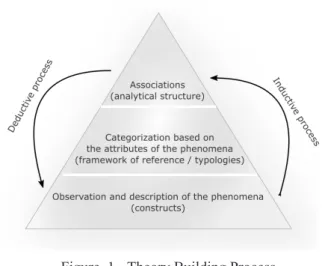
In this context, the eforts of Carlile and Christensen (2005) are noteworthy in systematizing the process of the construction of theories, structuring it within a scheme of interactive cycles. For
w
w
w
.me
rca
to in three stages - observation, categorization and association - and in deductive and deductive cycles that complement each other (Figure 1).
Figure 1 - Theory Building Process
Source: the author, based on Carlile and Christensen (2005).
Thus, the proposed analytical structure is the result of the development of the irst turn around the pyramid, where the theoretical-conceptual relections, gathered from the theoretical framework,
allows analytical constructs to be established and the organization of their relationships in a refe-rential frame. In future works, this analytical framework will be used as a “lens” to investigate the obstacles to inter-municipal cooperation in housing in targeted case studies. This is the second turn around the pyramid, verifying the adherence of the constructs to the reality and relevance of these variables in the integration of public housing policies in metropolitan regions.
BASIC THEORETICAL FRAMEWORKS: A
BRIEF EXPLANATORY DESCRIPTION
In order to subsidize the development of the analytical research framework and to construct a plausible pattern of interrelationship between the proposed constructs, references were sought in widely recognized theoretical models of public policy analysis. These explanatory frameworks, designed to provide an understanding of the public policy formulation process (SOUZA, 2006), provide the researcher with clues as to why public decisions and their results remain stable, change,
vary between diferent areas and impact their target audiences diferently (JOHN, 2003).
A model is a representation of political life, an abstraction of the real world with a view to sim-plifying and understanding the fundamental elements of a public policy (DYE, 2009; SABATIER,
1999). As John (2003) points out, what distinguishes the diferent models is the basic assumption that each adopts in the analysis of the social processes involved. The result is a set of diferent
analytical systems of human action, from which it is possible to identify, even within social
com-plexity, relationships arising from a speciic phenomenon.
The public policy frameworks used as a theoretical basis for consolidating the analytical fra-mework of research are structured within a non-positivist view of the political process. In contrast to linear models of decision making - for which certain factors generate certain decisions - these models advocate a less structured and deterministic process. This does not imply the abandonment of technical-rational planning, but only the recognition of the preponderant role of the limited ra-tionality of public managers and their political skills in increasing government performance. Based
rca
to
r.
u
fc.
b
r
Framework2 (KINGDON, 1995; CAPELLA, 2005; ENSERINK et al, 2013; WEIMER, VINING,
2011; PETERS, 2002; JOHN, 2003; BAUMGARTNER, JONES, 2010; BAUMGARTNER et al, 2009; SOUZA, 2006; JONES, BAUMGARTNER, 2012; GRIN, LOEBER, 2007; WEIMER, VINING, 2011; WEIBLE, SABATIER, 2007; SABATIER, JENKINS-SMITH, 2007; WEIBLE,
SABATIER, MCQUEEN, 2009). It is recommended that the reader consult the discussion conducted in Nascimento Neto et al (2015), in which these models are explored in greater depth.
RESEARCH ANALYTICAL FRAMEWORK:
A MODELING PROPOSAL
In order to build an analytical research framework of the inter-municipal cooperation in the
housing ield, extensive bibliographical and documentary research was carried out. Although not
presented in this article3 - an option made to ensure the cohesion and scope of the discussion - the
main authors and theoretical currents adopted are mentioned in the paragraphs below.
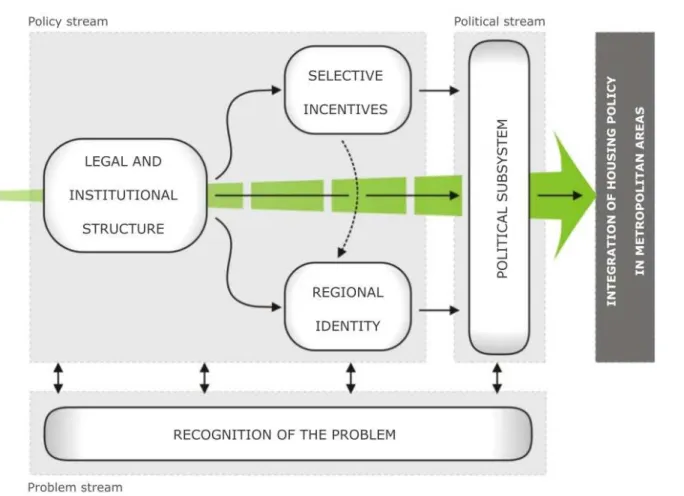
In view of the above, the proposed analytical structure was structured from ive basic cons
-tructs, which are also present in the bibliography. These are: (I) institutional architecture and legal structure; (II) regional identity between municipalities; (III) existence of selective incentives; (IV) recognition of the problem; and (V) the subsystem of policy.
The irst construct, related to the institutional architecture and legal structure, involves the set
of institutional arrangements (existing and legally foreseen), formal and informal rules that make up the universe of the federated entities surveyed. They are fundamental in the inter-municipal co-operation process, establishing the limits and conditions for decision-making. In this context, and on the basis of the concept of path dependence, which considers that past events play a fundamental role in the decisions taken by public managers in the present, this construct is directly related to
the promotion of regional identity (second construct), inluencing the adoption of a posture favo
-rable to cooperation by public managers (AZEVEDO, MARES GUIA, 2010; ABRUCIO, SANO, SYDOW, 2010; ALVES, 2007; RIBEIRO, 2004; MACHADO, 2009; KLINK, 2009; GARSON, 2009; LINHARES, 2011).
The irst construct also plays a fundamental role in the creation of selective incentives (third
variable), providing fundamental resources to stimulate cooperative action. In spite of the relevance of regional identity among the municipalities, several studies show the necessity of articulating
resources, fomenting and making the intentions for inter-municipal integration feasible (FARIA,
2008; AZEVEDO, MARES GUIA, 2010; ABRUCIO, SANO, SYDOW, 2010; GARSON, 2009;
MAGALHÃES, 2010; SOUZA, 2004a; FIX, PEREIRA, 2013; SOUZA, 2008).
In addition, it should be emphasized that regional articulation can be driven by the consensual perception of the public managers on the relevance of a certain theme, the urgency in intervening in it and the inevitability of inter-municipal cooperation as a viable alternative to solve the problem.
This issue makes up the fourth construct (perception of the problem), which also inluences the process of inter-municipal cooperation (LINHARES, 2011; ROCHA, FARIA, 2004; MOURA,
2012; LACERDA, 2011).
Finally, the policy subsystem (ifth construct) brings together actors from government, private
initiative and civil society involved in housing policy, who play their role of bargaining and nego-tiation, guided by their beliefs and values. In this context, an action for inter-municipal cooperation is directly related to the existence of regional identity between the municipalities involved or the availability of selective incentives that foster the integration of public policies.
(2) Recognized, even, as the most relevant in the ield of public policies, according to research by the American Political Science
Association (SHOUP, 2001).
w
w
w
.me
rca
to
At the same time, the impact of the game of political interests is inherent to this subsystem, which may hinder the formation of a commitment to construct a metropolitan project of inter--municipal cooperation. Particularly in the Brazilian case, where the federal system is characterized by the existence of three autonomous levels, government relationships are characterized by a high
complexity (ROLHA, 2009; ROCHA, FARIA, 2004; ROLNIK, 2009).
As political authorities are elected at all three levels of government, these relationships are of a singular complexity, since they also involve a political-electoral logic that often ends up guiding the various possible combinations of vertical-horizontal relationships. It is important to note that, with the process
of re-democratization, mayors gain a not inconsiderable power in the Federation, having fundamental
support from the political trajectory of important actors, interested in both legislative positions and positions in other levels of the Executive, since mayors have privileged access to agents of the local
electorate (ROCHA, FARIA, 2004, pp. 79-80).
Finally, it is important to emphasize the dialectical interaction between the policy construct
and the construct of the recognition of the problem. The inclusion of certain themes in the political agenda can originate from their broad social recognition, while the actors involved in the political
process can inluence the media and society to turn their attention to a particular theme.
The interrelationship of these constructs results from the conjunction of elements of the three theoretical frameworks of policy analysis addressed in item 2. In all these frameworks, the concept of limited rationality is a basic presupposition, arguing that public managers are subject to imper-fection and a restricted capacity of information processing, a short time for decision making and
the inluence of their own interests and of those groups in which they are involved.
From the Advocacy Coalition Framework (SABATIER, JENKINS-SMITH, 2007), the propo
-sed structure incorporates the conception of the structuring of the political process in interrelated subsystems that generate restrictions and incentives for the implementation of a given public
po-licy. In this context, the relections from the Punctuated Equilibrium Theory (BAUMGARTNER, JONES, 2012) are complementary, adopting the understanding that public policies tend to remain stable for long periods, interrupted by short periods of instability when signiicant changes take
place. Finally, based on the Multiple Streams framework (KINGDON, 1995), the proposed analyti
-cal framework adopts the concept of the three streams - problems, policy and politi-cal dynamics
–, advocating that opportunities for signiicant changes in the political agenda tend to occur when
there is a convergence between them, creating a policy window.
In summary, the proposed analytical research framework relates the issues that are believed to be preponderant to regional integration in housing policy among metropolitan municipalities
rca
to
r.
u
fc.
b
r
Figure 2 - Graphical representation of the analytical structure of the
investigation of inter-municipal cooperation for housing policy in MRs
Another assumption adopted is that these ive constructs interact in interdependent streams,
which relate to each other.4 In this context, changes would tend to take place at times of
convergen-ce between streams, where: (a) in the problem stream, there is a clear recognition of the demand (in this case, the housing problem in the metropolitan territory); (b) in the policy stream, there is an institutional legal framework that allows the integration of public policies and inter-municipal cooperation, reinforced by the presence of a cooperative environment between the municipalities and the existence of selective incentives; (c) in the political stream, there is a political environment conducive to cooperation.
It is essential to emphasize the interpretative nature of the proposed relational structure. As stated earlier in this chapter, its role is to be a “lens”, a starting point to guide the analysis and in-vestigation of the case study, with a view to identifying obstacles to the integration of MR housing policies. Thus, far from being a statistical correlation of variables (in positivist terms), the analytical research framework proposed in this chapter aims to synthesize the constructs and their possible relationships according to this researcher’s understanding.
This initial analytical framework conforms to a scientiic assumption, which guides the inves
-tigation without disregarding the need to analyze the data within the context in which the pheno-menon is found. Returning to Brandão’s (2004) broader discussion of the theoretical formulations of urban-regional development, we must now delve into the concrete and historical to capture the
(4) Although the graphic representation expresses a watertight ordering, the luid nature of these streams is defended, in which
w
w
w
.me
rca
to
structures, dynamics and central relationships of the phenomenon, with the challenge of retaining
the general determinations and diferentiating them from contextual particularities. This is the
purpose of our future work.
FINAL CONSIDERATIONS
The advances of social housing policy of the last decades are indisputable, as well as the counter-claims generated by a program that has been disconnected from its generating policy.
Unlike the 1970s and 1980s, where every efort was made to tackle the exponential problems of
the urban demographic explosion of the 1990s, where atomized alternatives for intervention were developed from the local scale, and from the 2000s, with the juxtaposition of great progress with
the persistence of old mistakes, the second decade of the twenty-irst century brings to the fore an
agenda of new discussions for housing policy in Brazil.
Although the issues of this new research and public management agenda involve obstacles that
historically have always been present, their relevance has changed. Issues such as inancialization,
the State-market relationship and the integration of housing policies in metropolitan areas have taken on a prominent role, either through the perception of the shortcomings of past experiences or the proposition of improvements in more recent experiences.
This inding inds support in Kuhn’s theory of scientiic revolutions (2011), which explains the progressive character of knowledge. After a certain scientiic revolution, other problems are
discussed, whose existence was not even considered by the previous generation. In fact, few of the problems discussed in contemporary times go back to the historical beginning of the phenomenon to which they are linked. As the author argues, “previous generations have dealt with their own problems, with their own instruments and canons of resolution. And it was not just the problems that changed, but the entire network of facts and theories “(KUHN, 2011, p.180).
In this context, the elements discussed at the beginning of this article demonstrate the indis-pensability of the integration of housing policies among metropolitan municipalities. It is argued here that this question does not refer simply to an improvement of the policy, but to the correction
of a failure from which a whole efort of attainment of the housing policy can be compromised.
Several studies demonstrate the impact of this lack of articulation in the implementation of the Minha Casa Minha Vida Program.
Given the above, how to investigate the factors that condition the integration of housing po-licies in Brazilian metropolitan regions?
It is on this issue that this article sought to advance, proposing an analytical research structure that could support future studies in the area. The theme is complex and multifaceted, requiring an analytical structure to contemplate the interpretative nature of political relationships, involving both public and private actors. According to Souza (2006a), in complex societies - such as contemporary
societies - the state has only a relative “autonomy” to act, being inluenced by external and inter
-nal pressures, as well as the formal and informal rules governing its institutions. This interaction between the various factors involved leads to the formation of certain capacities, which, in turn,
create speciic conditions for the implementation of public policies.
In this context, it is imperative to highlight the approval of the Statute of the Metropolis
(Federal Law 13,089 / 2015), which, despite almost two years of existence (it was sanctioned in January 2015), has not so far provided clear perspectives of its impact on sectoral public policies. Finally, it is necessary to point out that the empirical research carried out has restrictions due
rca
to
r.
u
fc.
b
r
that research limitations are characteristics intrinsic to their nature and are directly related to the development of future studies.
BIBLIOGRAPHIC REFERENCE
ABRUCIO, F. L.; SANO, H.; SYDOW, C. T. Radiograia do associativismo brasileiro: tendências, desaios e impactos sobre as regiões metropolitanas. In: MAGALHÃES, F. Regiões Metropolitanas no Brasil: um
paradoxo de desaios e oportunidades. Nova Iorque: Banco Interamericano de Desenvolvimento, 2010.
AZEVEDO, S. de; MARES GUIA, V. R. dos. Os “dois lados da moeda” nas propostas de gestão metropolitana:
virtude e fragilidade das políticas. In: CASTRO, E.; WOJCIECHOWSKI, M. J. (Orgs.). Inclusão,
colabo-ração e governança urbana: perspectivas brasileiras. Rio de Janeiro: Observatório das metrópoles, 2010.
BONDUKI, N. Política habitacional e inclusão social no Brasil: revisão histórica e novas perspectivas no
governo Lula. Revista eletrônica de Arquitetura e Urbanismo, São Paulo, n. 1, p. 70–104, 2008.
Dispo-nível em <http://www.usjt.br/arq.urb/numero_01/artigo_05 _180908.pdf>. Acesso em Jan. 2011.
BALBIM, R. N.; BECKER, M. F.; COSTA, M. A.; MATTEO, M. Desaios contemporâneos na gestão das
regiões metropolitanas. Revista Paranaense De Desenvolvimento, Curitiba, n.120, p.149-176, jan./jun. 2011.
BONDUKI, N. Planos locais de habitação: das origens aos dilemas atuais nas Regiões Metropolitanas. In:
DENALDI, R. Planejamento habitacional – Notas sobre a precariedade e terra nos planos locais de
habi-tação. São Paulo: Annablume, 2013.
BORGES, I. A.; DELGADO, J. P. M. A importância da gestão compartilhada nos consórcios públicos para
a gestão dos sistemas de transporte nas regiões metropolitanas. In: Seminário Urbanismo na Bahia - urbBA,
I, 2011, Salvador-BA. Anais.... Bahia: UFBA, 2011.
BEST, N. J. Cooperação e Multi-level Governance: o caso do Grande Recife Consórcio de Transporte
Metropolitano. Dissertação de Mestrado (Escola de Administração de Empresas de São Paulo), Fundação Getúlio Vargas (FGV), 2011, 215 p.
CARDOSO, A. L. (org). O programa Minha Casa Minha Vida e seus efeitos territoriais. Rio de Janeiro:
Letra Capital, 2013.
CRUZ, M. do C. M. T. Consórcios intermunicipais: uma alternativa de integração regional ascendente. In:
SPINK, P.; BAVA, S. C.; PAULICS, V. (Org.). Novos contornos da gestão local: conceitos em construção.
São Paulo: Instituto Pólis e Programa Gestão Pública e Cidadania – EAESP/FGV, 2002.
DAVIDOVICH, F. A “Volta da Metrópole” no Brasil: referências para a gestão territorial. In: RIBEIRO,
Luiz Cesar de Queiroz (org.). Metrópoles: entre a coesão e a fragmentação, a cooperação e o conlito. Rio
de Janeiro: Ed. Fase, 2004.
DENALDI, R.; KLINK, J.; SOUZA, C. Habitação, inclusão social e governança urbana colaborativa. In:
CASTRO, E.; WOJCIECHOWSKI, M. J. (Orgs.). Inclusão, colaboração e governança urbana:
perspec-tivas brasileiras. Rio de Janeiro: Observatório das metrópoles, 2010.
FIX, M.; PEREIRA, A. L. dos S. Metrópole brasileira nas políticas públicas setoriais. In: FURTADO, B. A.; KRAUSE, C.; FRANÇA, K. C. B. de (ed.). Território metropolitano, políticas municipais: por soluções
conjuntas de problemas urbanos no âmbito metropolitano. Brasília: IPEA, 2013.
FIRKOWSKI, O. L. C. F. Metrópoles e regiões metropolitanas no Brasil: conciliação ou divórcio? In: FUR
-TADO, B. A.; KRAUSE, C.; FRANÇA, K. C. B. de (ed.). Território metropolitano, políticas municipais:
por soluções conjuntas de problemas urbanos no âmbito metropolitano. Brasília: IPEA, 2013.
FUNDAÇÃO JOÃO PINHEIRO (FJP). Déicit habitacional municipal no Brasil. Belo Horizonte, 2013.
GARSON, S. Regiões metropolitanas: por que não cooperam? Rio de Janeiro: Letra Capital, 2009.
GONÇALVES, R. da R. Política habitacional na federação brasileira: o lugar dos governos Estaduais. XIV Encontro Nacional da ANPUR, Rio de Janeiro, 2011. Anais.... Rio de Janeiro: ANPUR, 2011.
INSTITUTO BRASILEIRO DE GEOGRAFIA E ESTATÍSTICA (IBGE). Aglomerados subnormais -
w
w
w
.me
rca
to
INSTITUTO BRASILEIRO DE GEOGRAFIA E ESTATÍSTICA (IBGE). Censo Demográico 2010. Rio
de Janeiro: IBGE, 2010b.
KINGDON, J. Agendas, Alternatives, and Public Policies. New York: Harper Collins, 1995.
KLINK, J. Globalização, reestruturação territorial e o desaio da governança metropolitana colaborativa: evidências recentes e perspectivas brasileiras das cidades-região. In: CASTRO, E.; WOJCIECHOWSKI, M. J. (Orgs.). Inclusão, colaboração e governança urbana: perspectivas brasileiras. Rio de Janeiro: Ob -servatório das metrópoles, 2010b.
KLINK, J. J. A construção de novas governanças para as áreas metropolitanas: o cenário brasileiro. In:
MAGALHÃES, F. Regiões Metropolitanas no Brasil: um paradoxo de desaios e oportunidades. Nova
Iorque: Banco Interamericano de Desenvolvimento, 2010a.
KLINK, J. J. Novas Governanças para as áreas metropolitanas: o panorama internacional e as perspectivas
para o caso brasileiro. Cadernos Metrópoles, São Paulo, v.11 n.22, p. 415-433. Julho/Dezembro 2009.
KLINK, J. Por que as regiões metropolitanas continuam tão ingovernáveis? In: FURTADO, B. A.; KRAUSE, C.; FRANÇA, K. C. B. de (ed.). Território metropolitano, políticas municipais: por soluções conjuntas
de problemas urbanos no âmbito metropolitano. Brasília: IPEA, 2013.
LEAL, S. M. R. A Cooperação Consorciada: aportes da experiência intermunicipal na frança para o caso
brasileiro. In: Encontro da Associação Nacional de Pós-Graduação e Pesquisa em Planejamento Urbano e
Regional, XII, 2007, Belém-PA. Anais... Belém: ANPUR, 2007.
LINHARES, P. de T. F. S. Evolução da cooperação intermunicipal no Brasil. In: Congresso CONSAD de Gestão Pública, IV, 2011, Brasília-DF. Anais.... Brasília: CONSAD, 2011.
MAGALHÃES, F. (org). Regiões Metropolitanas no Brasil: um paradoxo de desaios e oportunidades.
Nova Iorque: Banco Interamericano de Desenvolvimento, 2010.
MARICATO, E. O impasse da política urbana no Brasil. Petrópolis: Ed. Vozes, 2014.
MACHADO, G. G. Gestão Metropolitana e Autonomia Municipal: Dilemas das transações federativas.
Belo Horizonte: PUC Minas, 2009.
NASCIMENTO NETO, P. Resíduos sólidos urbanos: perspectivas de gestão intermunicipal em regiões
metropolitanas. São Paulo: Atlas, 2013.
PEDROSO, F. F. F.; NETO, V. C. L. Transportes e metrópoles: um manifesto pela integração. In: FURTADO,
B. A.; KRAUSE, C.; FRANÇA, K. C. B. de (ed.). Território metropolitano, políticas municipais: por
soluções conjuntas de problemas urbanos no âmbito metropolitano. Brasília: IPEA, 2013.
PICININ, J.; FORTINI, C. (org.). Saneamento Básico: estudos e pareceres à luz da Lei nº 11.445/2007.
Belo Horizonte: Ed. Fórum, 2009.
REZENDE, F. Em busca de um novo modelo de inanciamento metropolitano. In: MAGALHÃES, Fer
-nanda. Regiões Metropolitanas no Brasil: um paradoxo de desaios e oportunidades. Nova Iorque: Banco
Interamericano de Desenvolvimento, 2010.
RIBEIRO, L. C. de Q. A Metrópole: entre a coesão e a fragmentação, a cooperação e o conlito. In: RIBEI
-RO, Luiz Cesar de Queiroz (org.). Metrópoles: entre a coesão e a fragmentação, a cooperação e o conlito.
Rio de Janeiro: Ed. Fase, 2004b.
RIBEIRO, L. C. de Q. As metrópoles e a sociedade brasileira: futuro comprometido? In: RIBEIRO, Luiz
Cesar de Queiroz (org.). Metrópoles: entre a coesão e a fragmentação, a cooperação e o conlito. Rio de
Janeiro: Ed. Fase, 2004a.
RIBEIRO, L. C de Q.; SANTOS JR., O. A. dos. As grandes cidades e a questão social brasileira: relexões sobre o estado de exceção nas metrópoles brasileiras. In: CASTRO, E.; WOJCIECHOWSKI, M. J. (Orgs.).
Inclusão, colaboração e governança urbana: perspectivas brasileiras. Rio de Janeiro: Observatório das
metrópoles, 2010.
ROCHA, C. V.; FARIA, C. A. P. Cooperação intermunicipal, reterritorialização da gestão pública e provisão de bens e serviços sociais no Brasil contemporâneo: a experiência dos consórcios de saúde de Minas Gerais.
Cadernos Metrópole, Rio de Janeiro, n. 11, p. 73 – 105, jan/julho 2004.
rca
to
r.
u
fc.
b
r
Metropolitanas no Brasil: um paradoxo de desaios e oportunidades. Nova Iorque: Banco Interamericano
de Desenvolvimento, 2010.
ROLNIK, R.; KLINK, J. Crescimento Econômico e desenvolvimento urbano: por que nossas cidades con
-tinuam tão precárias? Revista Novos Estudos CEBRAP, n. 89, p. 89 – 109, Março de 2011.
ROLNIK, R.; SOMEKH, N. Governar as metrópoles: dilemas da recentralização. In: RIBEIRO, Luiz Cesar
de Queiroz (org.). Metrópoles: entre a coesão e a fragmentação, a cooperação e o conlito. Rio de Janeiro:
Ed. Fase, 2004.
ROYER, L. de O. Financeirização da política habitacional: Limites e perspectivas. Tese. Doutorado em
Arquitetura e Urbanismo - Faculdade de Arquitetura e Urbanismo da Universidade de São Paulo. 2009.
194f. São Paulo: USP, 2009.
ROYER, L. de O. Municípios “autárquicos” e região metropolitana: a questão habitacional e os limites
administrativos. In: FURTADO, B. A.; KRAUSE, C.; FRANÇA, K. C. B. de (ed.). Território
metropolita-no, políticas municipais: por soluções conjuntas de problemas urbanos no âmbito metropolitano. Brasília:
IPEA, 2013.
SOUZA, C. Regiões Metropolitanas: trajetória e inluência das escolhas institucionais. In: RIBEIRO, L. C.
de Q. (org.). Metrópoles: entre a coesão e a fragmentação, a cooperação e o conlito. Rio de Janeiro: Ed.
Fase, 2004a.
SHIMBO, L. Z. Habitação Social, Habitação de Mercado: a conluência entre Estado, empresas cons
-trutoras e capital inanceiro. Tese de Doutorado (Programa de Doutorado em Arquitetura e Urbanismo),
Universidade de São Paulo (USP), 2010, 361 p.
URBANIZAÇÃO DE CURITIBA S.A. (URBS). Convênio entre COMEC e URBS para
operacionali-zação do Sistema de Transporte Coletivo Metropolitano de Passageiros. 2012. Disponível em <http://
www.urbs.curitiba.pr.gov.br/ institucional/legislacao>. Acesso em Agosto de 2012.
ULTRAMARI, C. O futuro da cidade: a substituição da nostalgia pela melancolia. In: INSTITUTO
MUNI-CIPAL DE ADMINISTRAÇÃO PÚBLICA – IMAP (org.). Estado, planejamento e administração pública