THE PHILOSOPHICAL APPROACH TO INFORM ATION
SEEKING AND RETRIEVAL CALLED HERM ENEUS
Fabiano Duarte Beppler
Ph.D. in Know ledge Engineering and M anagement from The Federal Universit y of Sant a Cat arina, Brazil. Founding Partner of KNEWIN - Int elligence in Informat ion Ret rieval,
Brazil, and Researcher of Stela Instit ut e, Brazil. E-mail: [email protected]
Frederico Torres Fonseca
Ph.D. in Spatial Informat ion Science and Engineering from The Universit y of M aine, USA. Associate Professor of The College of Information Sciences and Technology at t he
Pennsylvania St ate Universit y, USA. Email: fredfonseca@ist .psu.edu
Roberto Carlos dos Santos Pacheco
Ph.D. in Product ion Engineering from The Federal Universit y of Sant a Catarina, Brazil. Adjunct Professor of The Federal Universit y of Sant a Cat arina, Brazil, and Lead
Researcher of Stela Instit ut e, Brazil. E-mail: [email protected]
Abstract
Inform ation seekers alw ays have a quest ion in mind even when t hey do not know exact ly w hat it is. How an inform at ion seeking and retrieval syst em can support users w hile t hey are st ill shaping t heir inform ation needs? We resort ed t o t he herm eneut ic circle philosophical concept of Heidegger and Gadam er t o provide t he principles of such a syst em . In our im plem ent ation users are able t o develop t heir ideas while brow sing t he inform ation and the concept s t hat represent t he inform at ion. We chose ont ologies t o implem ent t his herm eneut ic approach. Ont ologies im prove inform at ion retrieval syst em s regarding it s retrieval and present at ion of inform ation, w hich m ake t he t ask of finding inform ation m ore effect ive, efficient , and interact ive. We called our fram ework Herm eneus, w hich in Greek means t he int erpreter or t ranslat or. Hermeneus w orks as an int ermediary t hat facilit at es t he user t o m ove from t he init ial st at e of inform at ion need t o t he goal st ate of resolut ion. Our syst em int ends t o be t he bridge bet w een t he user’s quest ion and t he answ er t o be found w hile she or he navigates in t he ont ology concept s and t he inst ances of t hese concept s in a back and fort h way.
Keyw ords: Inform at ion seeking. Ont ology. Hermeneutic circle. Hermeneus.
1 INTRODUCTION
This paper is dedicat ed t o explore and reflect on a philosophical approach t o inform at ion seeking and ret rieval proposed by t he aut hors, w it h first result s published in t he
Dat aGramaZero - Journal of Inform at ion Science (BEPPLER; FONSECA; PACHECO, 2009), based
PhD t hesis in Know ledge Engineering and M anagem ent developed by Beppler (2008).
The inabilit y t o express precisely w hat inform at ion is needed induces users t o engage in an indet erm inat e sequence of int eract ions w it h an inform at ion syst em (M ARCHIONINI, 1989; KUHLTHAU, 1993; SONNENWALD, WILDEM UTH et al., 2001; CAPRA III; PÉREZ-QUIÑONES, 2005; JANSEN, BOOTH et al., 2008). This challenging posit ion is “ an anom alous st at e of know ledge, w hich prom pt s t he person t o engage in act ive inform ation-seeking behavior” (BELKIN; CROFT, 1992 p.2). The inform at ion-seeking process “ includes recognizing and int erpret ing t he informat ion problem , est ablishing a plan of search, conduct ing t he search, evaluat ing t he result s, and if necessary, it erat ing t hrough t he process again” (M ARCHIONINI, 1989 p.54). Furt herm ore, t he cognit ive m odel of users m ay be “ dynamic but not self-cont ained” (INGWERSEN; JÄRVELIN, 2005a p.9). The user’s st at e of know ledge changes by virt ue of engagem ent wit h ret rieved inform at ion t hat by it s t urn reflect s in som e change in the anom alous st at e of know ledge (BELKIN, 1993).
Hum an behavioral st udies show t hat t he inform at ion seekers, w hen using inform at ion syst em s, are lazy t o com pose queries and rarely adopt m ore com plex expressions in t heir crit eria (SPINK; WOLFRAM et al., 2001). A large percent age of users do not go beyond t he init ial result s, i.e., t hey have low t olerance t o go deep t hrough w hat w as ret rieved (SILVERSTEIN; HENZINGER et al., 1999; JANSEN; BOOTH et al., 2008). Furt herm ore, in order t o develop an informat ion-seeking behavior, users have t o int ervene and int eract wit h ret rieved docum ent s and w it h t he represent at ions of docum ent s and t heir relat ionships (BELKIN, 1993; INGWERSEN; LARSEN et al., 2010). Therefore, t his developm ent of an inform ation-seeking behavior requires syst em s t hat should provide high int eract ivit y, besides being m ore int uit ive and responsive (JÄRVELIN; INGWERSEN, 2004; INGWERSEN; JÄRVELIN, 2005b).
In t rying t o find an answ er for som e of t hese quest ions in an inform at ion seeking cont ext , w e resort ed t o Philosophy. M ore specifically, w e used Heidegger’s (1996) and Gadam er’s (1989) herm eneut ic circle as t he m ain principle behind our informat ion ret rieval syst em . The hermeneut ic circle is t he concept used by Heidegger and Gadam er t o explain how hum ans underst and. Before approaching any subject or quest ion, w e need t o have an idea (t he fore-st ruct ure) of w hat t he t hing is beforehand. In t he herm eneut ic circle w e go back and fort h bet w een t he t hing it self and our concept ualizat ion of it t ill w e finally grasp it s m eaning.
Our approach is designed t o help t he user t hrough t he inform at ion seeking process. The syst em is flexible enough t o allow for changes in t he user’s ideas and concept s during t he process. So, inst ead of invest ing in query com posit ion, w e invest ed in developing a st ruct ure t hat let s t he user build his or her ow n query. Furt herm ore, t his query building is not st at ic but dynam ic following t he hermeneut ic circle principles. In our approach t he user can see part ial result s, go back and for t h bet w een concept s and inst ances of t hese concept s, and change m odes of visualizat ion based eit her on concept s or inst ances of t hese concept s.
The archit ect ural opt ion w e chose t o im plem ent t his herm eneut ic approach t o inform at ion seeking and ret rieval w as t o use ont ologies t o represent t he concept s and t heir relat ionships. Ont ologies im prove inform at ion ret rieval (IR) syst em s regarding it s ret rieval and present at ion of inform at ion. Ont ologies can enhance t he search process m aking t he t ask of finding inform at ion m ore effect ive, efficient , and int eract ive. In t his cont ext ont ologies are considered an engineering art ifact , const it ut ed by a specific vocabulary used t o describe a cert ain realit y, plus a set of explicit assum pt ions regarding t he int ended m eaning of t he vocabulary w ords (GUARINO, 1998). As an engineering art ifact , ont ologies m ay be used t o generat e or validat e inform at ion syst ems com ponent s (FONSECA, 2007).
t he user’s quest ion and t he answ er t hat she or he will find in t he back and fort h m ovem ent bet w een t he concept s and t he inst ances.
Next , in order t o show how users of IR syst em s can com e t o new insight s about t he inform at ion t hey are brow sing, we describe t he hermeneut ic circle applied t o t he inform at ion seeking process. In sect ion 3, w e present and dem onst rat e our fram ew ork cont ext ualizing it s concept s in a prot ot ype and also describe t he role of ont ologies in our approach. We discuss Herm eneus in sect ion 4, present ing t he im port ance of herm eneut ic circle and ont ology, besides det ailing som e point s about int eract ion w it h addit ional inform ation. In sect ion 5, relat ed w orks are present ed and, finally, in sect ion 6, w e report our conclusions and an out look t o fut ure w ork.
2 PHILOSOPHICAL FOUNDATIONS: THE M ETAPHOR OF THE HERM ENEUTIC CIRCLE APPLIED TO THE INFORM ATION SEEKING PROCESS
The original m eaning and scope of herm eneut ics as t he art of int erpret at ion of t ext s w as great ly ext ended by t he w ork of Heidegger and Gadam er (GADAM ER, 1989; HEIDEGGER; STAM BAUGH, 1996). Heidegger explains t hat “ t he expression ‘herm eneut ic’ derives from t he Greek verb hermeneuein. That verb is relat ed t o t he noun of hermeneus, w hich is referable t o t he nam e of t he god Herm es by a playful t hinking t hat is m ore com pelling t han t he rigor of science. Herm es is t he divine m essenger. He brings t he m essage of dest iny; hermeneuein is t hat exposit ion w hich brings t idings because it can listen t o a m essage” (HEIDEGGER, 1982, p. 29).
We t hink t hat herm eneut ic play is t he cont ext in which t he user of an IR syst em w ill com e t o new insight s about t he inform at ion she or he is brow sing. To be effect ive, designers of IR syst em s m ust st ruct ure a cont ext t hat allow s users t o engage in t he spont aneit y of int erpret ive play. In our fram ew ork for inform at ion seeking and ret rieval w e t ook int o account t he four m ain com ponent s of herm eneut ics and used each one of t hem t o support t he com ponent s in our fram ew ork, as can be seen in Table 1.
Table 1 - Component s of hermeneut ics relat ed t o component s of the system
First , t here is t he fore-st ruct ure (w hich Gadamer calls prejudices), w hich is t he init ial idea t hat t he user has about t he subject . This is t he first inst rum ent t hat a user has t o st art brow sing a dat a set . In our framew ork fore-st ruct ure corresponds t o com put at ional ont ologies. Second, t here is t he t hing-in-it self or t hings t hem selves. This corresponds t o t he object ive w orld, t he fact s w e have; t he dat a w e have gat hered. In our fram ew ork, t hese are t he inst ances of t he concept s in t he ont ology. Finally, t here are play and applicat ion. Here w e consider t hat t he user int eract ion w it h t he inst ances and w it h t he concept s in t he ont ology is w hat represent s play. Users go back and fort h bet w een t he t w o (inst ances and concept s) alw ays having an applicat ion in m ind.
Heidegger says t hat t he process of underst anding involves a cont inual back and fort h dialogue bet w een t he dim ensions of analysis and synthesis aim ed at apprehending t he w hole, and t he dim ensions t hat aim at apprehending t he par t s. We can never avoid t he fact t hat one com es t o t he project of underst anding w it h assum pt ions about t he w hole, and/ or t he par t s.
Components of hermeneutics Components in the system
Fore-st ruct ure Com put at ional ont ology
Thing in it self Inst ances
Play User int eraction w it h t he inst ances and wit h the comput at ional ont ology
But one can, and m ust , reflect on t hose presupposit ions, w hile keeping t he object of inquiry, “ t he t hing it self” clearly in view. Heidegger says t hat our “ first , const ant , and last t ask is not t o let fore-having, fore-sight , and fore-concept ion be given t o it by chance ideas and popular concept ions, but t o guarant ee t he scient ific t hem e by developing t hese in t erm s of t he t hings t hem selves” (1996, p. 143). The process of underst anding som et hing new is “ a cont inuous dialect ical t acking bet w een t he m ost local of local det ail and t he m ost global of global st ruct ure in such a w ay as t o bring bot h int o view sim ult aneously” (GEERTZ, 1979) cit ed in (Bernst ein, 1983).
Heidegger says t hat “ every int erpret at ion w hich is t o cont ribut e som e underst anding m ust already have underst ood w hat is t o be int erpret ed” (1996, p. 142). Heidegger underst ands t hat t his proposit ion m ay be seen as a vicious circle. “ But if int erpret at ion alw ays already has t o operat e w it hin w hat is underst ood and nurt ure it self from t his, how should it t hen produce scient ific result s wit hout going in a circle, especially w hen t he presupposed underst anding st ill operat es in t he com m on know ledge of hum an being and w orld?” (HEIDEGGER; STAM BAUGH, 1996 p. 143) But Heidegger firm ly denies t hat t his is a vicious circle. He says t hat “ t he fulfillm ent of t he fundam ent al condit ions of possible int erpret at ion rat her lies in not m ist aking int erpret at ion beforehand w it h regard t o t he essent ial condit ions of it s being done” (HEIDEGGER; STAM BAUGH, 1996 p. 143). Furt herm ore, “ t his circle of underst anding is not a circle in w hich any random kind of know ledge operat es” but it is inst ead t he expression of our m ost fundam ent al and int uit ive know ledge. So following Heidegger’s suggest ion of “ w hat is decisive is not t o get out of t he circle, but t o get in it in t he right w ay;” w e built Herm eneus as one of t he w ays of get t ing int o t he herm eneut ic circle and enabling t he inform at ion seeker t o achieve w hat she or he w as looking for.
To Heidegger’s descript ion of t he herm eneut ic circle, Gadam er (1989) has added t w o crucial elem ent s: applicat ion and play. Inst ead of conceiving t he process of underst anding in t erm s of analysis and synt hesis alone, he has shown t he im port ance of t he dim ension of applicat ion t o t hat pr ocess. Underst anding t akes place in a cont ext in w hich t he concept s involved ent er int o som e sort of pract ice. This requires a judgm ent about t he im plicat ions for alt ernat ives possible in local sit uat ions. Gadam er has also point ed t o t he inevit ably playful, t o and fro, nat ure of t he herm eneut ic process. In play, t he part icipant is no longer t rapped in a subject ivism in w hich t he play is a kind of predicat e over against t he part icipat ing subject . Inst ead, t he player loses him or herself in t he play, becom ing, as it w ere, t he predicat e of t he play. The player’s m ovem ent s and decisions are const rained t o conform t o t he regenerative, t o and fro pat t erns of t he play. Our fram ew ork for inform at ion seeking and ret rieval t ries t o give users t he alt ernat ives m ent ioned by Gadam er.
t he user act ivit y of going back and for t h bet w een inst ances and concept s w hile he or she is t rying t o shape his or her ow n quest ions.
In t he next sect ion w e st art m aking t he shift from t he philosophical foundat ions of our fram ew ork t o it s com put at ional aspect s. We st art w it h a general descript ion of Herm eneus. Then w e deal w it h t he m ain element in t he t ranslat ion of t he herm eneut ic circle t o an IR int erface, t he ont ology. In our approach t he ont ology corresponds t o t he fore-st ruct ures and has t he role of anchoring t he inform at ion seeking process.
3 A FRAM EW ORK TO INFORM ATION SEEKING AND RETRIEVAL
Inform at ion search process is t he user’s const ruct ive act ivit y of finding m eaning from inform at ion in order t o ext end his or her st at e of know ledge on a part icular problem or t opic (KUHLTHAU, 1991). This act ivit y is consist ent ly int eract ive because users are const ant ly expanding t heir st at e of knowledge along wit h t he search process. Based on such issues, it is clear t hat IR syst em s should provide m echanism s t o facilit at e bot h t he users’ int eract ion and t he st at e of know ledge expansion.
3.1 Hermeneus
We t ook int o account t he above issues and developed a framew ork t o inform at ion seeking and ret rieval called Herm eneus t hat uses ont ologies t o enhance users’ int eract ivit y w it h IR syst em s. Our fram ew ork is com posed of t hree int eract ive com ponent s: ont ology
navigat or, ret rieved inst ances, and addit ional informat ion. In t he ontology navigat or
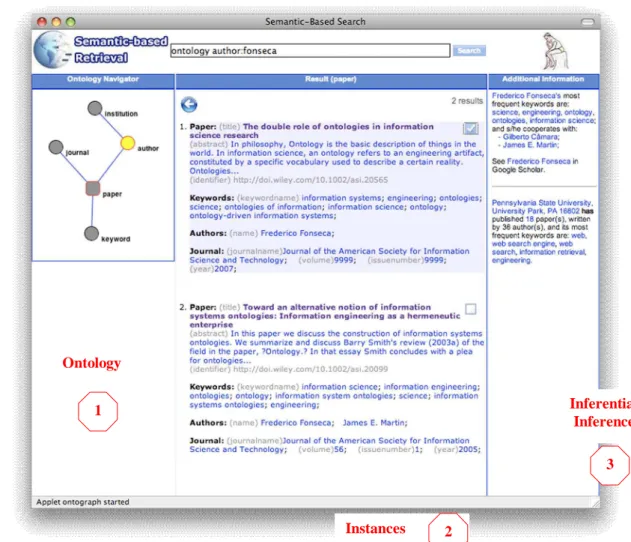
component (#1 in Figure 1), w here t he ont ology is graphically available, users can int eract w it h ont ology concept s and visualize how t hey are relat ed t o each ot her. In addit ion, users can select a cent ral concept in t he ont ology t o designat e w hich kinds of inst ances are being ret rieved (e.g., if cent ral concept is paper, t hen t he m ain ret rieved inst ances are papers). In t he prot ot ype used t o validat e our approach we creat ed a dat abase using 622 papers from t he Journal of t he Am erican Societ y for Inform at ion Science and Technology (JASIST). Each inst ance cont ains inform at ion about t he papers including t it le, aut hors, inst it ut ions, issues, and venue. Based on t he cont ent of such cit at ions, it w as conceived an ont ology com posed of five classes w it h relat ions am ong t hem. The classes and t heir respect ive propert ies represent t he concept s of paper, aut hor, inst it ut ion, journal, and keyw ord.
Users can int eract w it h all ret rieved cont ent available in t he ret rieved inst ances (#2 in
Figure 1) and addit ional informat ion (#3 in Figure 1) com ponent s. In t he ret rieved inst ancescomponent, users can visualize inst ances of a cent ral concept and inst ances of direct ly relat ed concept s. So, for exam ple, in an ont ology w it h t hree concept s, paper, aut hor,and dat e, w here t here is a relat ion bet ween t he paper and t he dat e concept s but not bet w een t he aut hor and t he dat e concept s, and t he cent ral concept is dat e, only inst ances about dat e and paper are present ed. In addit ion, w hen users select an inst ance a new search is perform ed considering such cont ent , like a refinem ent process. In t he addit ional informat ion
component, t his funct ion m ay w ork different ly, because such a com ponent can be
Figure 1 - Prot ot ype's result screen w it h ontology navigator (1), ret rieved inst ances (2), and addit ional information (3) com ponent s
3.2 The role of ontology in the architecture
Ont ology w it h st andard IR t ools can be used t o creat e enhanced search capabilit ies (M cGUINNESS, 1999). Ont ologies can also be used t o provide m ore accurat e answ ers t o queries because wit h ont ologies knowledge is formally represent ed and users are able t o com pose cont ext ualized queries (DECKER et al., 1999; M ELGAR et al., 2010). Furt herm ore, as ont ologies include axiom s t o express relat ionships bet w een concept s, it is possible t o derive inform at ion t hat has been specified only im plicit ly (DECKER et al., 1999). Ont ology is also a t echnology t hat can give support for t he developm ent of m ore int elligent syst em s (SOWA, 2002). The int elligent not ion, in our approach, m eans t o use t he ont ology t o assist users t o com pose m ore valuable queries, t o im prove t he accuracy of ret rieved inform at ion, and t o ext ract addit ional inform at ion t hat is not explicitly st at ed. All such feat ures are in accord w it h inform at ion-seeking research t hat st at es t he im port ance of int eract ive t ools t o support users during t he search process and t hat act ive int ervent ion and int eract ion are required by t he user (M ARCHIONINI, 1989; BELKIN, 1993; KUHLTHAU, 1993; INGWERSEN; JÄRVELIN, 2005a; LI; BELKIN, 2010).
The m ain com ponent of our approach is t he ont ology. The ont ology is t he foundat ion for creat ing a knowledge base com posed of inst ances. Each inst ance represent s a m at erialized view of a class defined in t he ont ology (e.g., given a professor’s class, a specific professor is an inst ance of such a class). In our approach, t he user is able t o navigat e bet w een t he inst ances
Ontology
Instances
Inferential Inference 1
2
and concept s of t he ont ology in a back and f ort h fashion. This w ay, t he result s set has a m ore act ive role during t he ret rieval and brow sing process due t o t he use of t he cont ext ual m eaning included in each inst ance. The ret rieved inform at ion is not present ed as sim ple t ext ual docum ent s but as ont ology inst ances. As ont ologies can be com posed of m ore t han one class, t here can be relat ionships am ong classes. These relat ionships indicat e w hich kind of inst ances should be ret rieved. For inst ance, if w e select t he aut hor concept as t he cent ral concept , inst ances of paper and inst it ut ion concepts are ret rieved. The addit ional inform at ion com ponent also uses t hese relat ionships, because inference t echniques can derive new know ledge building im plicit or indirect relat ionships based on t he explicit ly defined ones.
Ont ologies can becom e a m eans of com m unicat ion bet w een users and t he syst em and help t he overcoming of bot t lenecks in inform at ion access, w hich is prim arily based on keyw ord searches (SHAH; FININ et al., 2002). In our case, each concept defined in t he ont ology can be used t o com pose cont ext ualized queries. Ont ology t hus can guide users in t he form ulat ion of queries and t he select ion of appropriat e t erm s t hat are likely t o lead t o nonem pt y answ er set s. As users are able t o explicit ly define t erm s for specific concept s, t hey are com posing m ore accurat e queries aut om at ically. This means t hat t he ont ology is also used t o disam biguat e query t erm s. Com plex queries, using m ore t han one concept , for inst ance, can also be easily built due t o t he int erface support for choosing concept s and t yping t he corresponding t erm s. For inst ance, using t his funct ionalit y t he user could select t he “ aut hor” concept and t ype t he t erm “ fonseca,” t hen select t he “ paper” concept and t ype t he t erm “ information syst ems.” Figure 2describes in EBNF t he general form at of queries applied t o a search.
search ::= query | context ualized_query query ::= term [ term ]
cont ext ualized_query ::= concept “ :” t erm [ t erm ] “ ;” [ concept “ :” term [ t erm ] “ ;” ]
concept ::= <classes described in t he ont ology> t erm ::= lett er [ lett er ]- | digit [ digit ]- lett er ::= “ a” | “ b” | … | “ z”
digit ::= “ 0” | “ 1” | “ 2” | “ 3” | “ 4” | “ 5” | “ 6” | “ 7” | “ 8” | “ 9” Figure 2 - EBNF describing a query in a search
The use of ont ologies in inform at ion syst em s gives also an addit ional possibilit y t hat is t he capabilit y t o use inference t echniques t o derive addit ional know ledge. This is possible because t he ont ology is described in a formal language t hat includes axiom s for specifying relat ionships bet w een concept s. Hermeneus w as conceived t o allow t he user t o t ake advant age of such inference t echniques during t he search process. Therefore, besides t he ont ology’s graphical visualizat ion and t he list of ret rieved inst ances, users can also visualize and int eract w it h addit ional inform at ion for a given ret rieved inst ance. For exam ple, select ing a ret rieved inst ance about a specific paper, t he addit ional informat ion component could show , for inst ance, sim ilar papers, aut hors w it h papers in the sam e area or papers relat ed t o t he aut hors’ inst it ut ions.
know ledge base. The result s are displayed and t he user can int eract w it h t hem and creat e new or m odify exist ing queries.
Figure 3 - Ont ology-relat ed com ponent s available for user’s int eract ion
Furt herm ore, because t he ont ology drives t he w hole process, all t he t hree com ponent s (ont ology navigat or, ret rieve inst ances, and addit ional information) are st rongly int egrat ed. Therefore, act ions in a com ponent m ay affect t he ot hers. For exam ple, if t he user select s a piece of cont ent from a ret rieved inst ance in t he ret rieved inst ances component t o refine a query, t he ont ology navigator component highlight s aut om at ically t he concept associat ed t o such cont ent . In addit ion, t he user can select a new ret rieved inst ance in t he ret rieved inst ance component so as t o visualize addit ional inform at ion; t hus, t he addit ional informat ion component int erpret s t he select ed inst ance and ext ract s new inform at ion based on t he ont ology and t he inst ances direct ly relat ed.
One of t he m ain focuses of our syst em is t o help users underst and and develop t heir ow n inform at ion needs. In t he following w e discuss how our syst em can help users during t he process and how t he t ools available provide support for users t o develop and ext end t heir st at e of know ledge about a specific inform at ion need.
4 DISCUSSION
Alt hough it m ay seem aw kw ard t hat users init ially do not know exact ly w hat t hey are looking for, t he lit erat ure deals w it h t his uncert aint y called know ledge gap or st at e of incom plet eness. It is t his gap t hat drives users t o use int erm ediaries, such as IR syst em s, t o supply t heir inform at ion needs. Users, how ever, have t o develop t heir ow n inform at ion needs first so as t o be able t o figure out w hat t hey are looking for. In t his process of t rying t o underst and t heir ow n needs, t he users’ cognitive stat e m ay cont ain doubt s or problem s in int erpret at ion and t hen fall int o a st at e of uncert aint y (INGWERSEN; JÄRVELIN, 2005a). Users norm ally have a lack of know ledge, or an anom alous st at e of know ledge, about t he subject t hey are looking for (BELKIN, 1993). Bot h t he process of underst anding t he lack of know ledge and t he searching for inform at ion are cognitive t asks narrow ly relat ed t o each ot her during t he w hole cycle of inform at ion acquisit ion. It reinforces t he fact t hat IR syst em s should allow users t o int eract w it h t ools t hat can affect t heir st at e of uncert aint y in order t o st im ulat e a t ransform at ion in t heir st at e of know ledge (M ARCHIONINI, 1989; KUHLTHAU, 1993; HERT, 1997; INGWERSEN; JÄRVELIN, 2005a; AZZOPARDI, 2011). Herm eneus w as designed w it h t he purpose of giving t he users t he necessary support for t hem t o develop and underst and t heir ow n inform at ion needs. The herm eneut ic circle is t he principle behind t he syst em .
4.1 Hermeneus as the translator of the user’s information needs into meaningful queries
When int eract ing w it h an IR syst em t he m ost comm on w ay t o express inform at ion needs is com posing queries. Nevert heless, form ulat ing precise queries is not an easy t ask. We t ried
Ontology
Ontology
Navigator IDX
1. Instance A 2. Instance B 3. Instance C 4. Instance
Ontology
KB
Retrieved Instances
1. Inferred information X
2. Inferred information Z
Additional Information
t o address t hese issues allowing users t o com pose cont ext ualized queries. Since users are able t o int eract w it h t he ont ology, t hey can ident ify w hich concept s are available and use t hem t o form ulat e queries. A cont ext ualized query basically is com posed of t he concept ’s nam e and t he desired search t erm s. In our prot ot ype, users can int eract w it h t he ont ology t hrough m ouse-clicks; w hen t hey click on a concept it is autom at ically added t o t he current query’s cont ent so as t o assist t he com posit ion of cont ext ualized queries. For exam ple, a search for t he t erm “ dat amodeling” (i.e., init ially t he query cont ains just t he “ dat amodeling” t erm ) com bined w it h a click on t he concept aut hor available in t he ont ology, adds t he descript ion of such a concept t o t he query w it h t he colon sym bol (i.e., t he query now consist s of “ data modeling aut hor:” cont ent ) – so t he user m ay just insert t he t erm specifically relat ed t o t he author concept w it hout needing t o t ype t he concept ’s nam e (e.g., “ dat a modeling aut hor:Fonseca” ). In developing our solut ion w e follow ed t he hermeneut ic circle principle t hat t hrough t he int eract ion w it h t he ont ology, users get insight s about t heir needs and express t hem selves w it h m ore useful queries, and t hus obt ain m ore precise result s.
The user’s st at e of know ledge is dynamic rat her t han st at ic, changing as t he user proceeds during t he searching process (KUHLTHAU, 1991; HERT, 1997; LI; BELKIN, 2010). In our approach, since w e ret rieve inst ances and present t hem in a highly cont ext ualized environm ent , and each piece of ret rieved inform at ion has a sem antic link wit h concept s in t he ont ology, users can im prove t heir queries by adding cont ext ualized cont ent from relevant inst ances aut om at ically. For exam ple, in a very comm on sit uat ion w here a user t ypes just a few t erm s (e.g., “ semant ic” ) t o express his or her need, t he ret rieved inst ances can help him or her t o find a m ore precise descript ion and use such descript ion dynam ically. For inst ance, in our prot ot ype w hen searching for t he t erm “ semant ic,” users can visualize and int eract w it h t he follow ing t erm s relat ed t o t he keyw ord concept : lat ent semant ic indexing, semant ic net w ork, semantic informat ion, semant ic-based informat ion ret rieval, semant ic-based w eb ret rieval syst ems, semantic w eb, and semant ic search. Wit h t his kind of explorat ory int eract ion users are shielded from det ails of query form ulat ion besides being able t o const ruct m ore useful search st at em ent s (CAPRA III; PÉREZ-QUIÑONES, 2005; LI; BELKIN, 2010). For exam ple, searching for t he t erm “ web” in our prot ot ype, t he user receives 169 ret rieved inst ances. Next , clicking on t he “ semant ic w eb” cont ent present in one of t he ret rieved inst ances leads t o a new query com posed of “ w eb” t erm and “ keyword: semant ic w eb;” cont ent . The result is only 11 inst ances. Therefore, using our syst em users can experim ent w it h ret rieved cont ent t o form ulat e new queries as part of t he process of underst anding and developing t heir inform at ion needs.
docum ent s grouped according t o t he concept s in t he users’ queries reflect ing t he t ask, w ould enhance ret rieval perform ance.”
4.2 Ext racting and interacting w ith additional information
Addit ional inform at ion helps users have a bet t er underst anding about t he dom ain and facilit at es t hem t o learn m ore about a specific inst ance (GOLBREICH, 2004; M URDOCK et al., 2005). In our appr oach, t he addit ional informat ion component enables users t o visualize inform at ion t hat is not explicit ly st at ed in t he result list of ret rieved inst ances. Therefore, inferring new inform at ion for each ret rieved inst ance enables users t o get insight s about t heir inform at ion needs.
Inference, according t o Decker et al. (1999), is t he logical process of derivation of new dat a from a collect ion of dat a. We use t his t echnique com bined wit h rules t o ext ract inform at ion t hat w as only im plicit before. In our protot ype, for exam ple, w hen t he ret rieved inst ances are grouped by t he paper concept (i.e., t he cent ral concept is paper) and users pick out a specific inst ance, t he addit ional informat ion component present s inferred inform at ion about aut hors and t heir inst it ut ions. In t his case, as show n in Table 2, it is present ed t he aut hors’ m ost frequent keyw ords, considering all papers st ored in t he know ledge base, t he inst it ut ion t o w hich t he aut hors are affiliat ed w it h, and t he aut hors’ collaborat ors. In addit ion, users can see t he m ost frequent keyw ords for each inst it ut ion and t he papers t hat ment ion such inst it ut ion (Table 2). The inform at ion available in t he addit ional informat ion component can also be used for addit ional explorat ory act ivit y, because users can int eract w it h such inform at ion and refine t heir searches dynam ically. This int eract ive process has t he sam e principle available in t he ret rieved inst ances component .
Table 2 - A sample of the addit ional informat ion presented in t he additional informat ion component
Retrieved instance (paper) Additional Information
Tit le: The double role of ont ologies in informat ion science research
Aut hor: Frederico Fonseca
Keyw ords: information syst ems; ont ology; ont ologies; engineering; science; information science; ont ology-driven informat ion science;
Frederico Fonseca is connect ed to Pennsylvania St at e Universit y, University Park, PA 16802, his most frequent keyw ords are: ont ologies, ont ology, information science, engineering, science; and she or he cooperates w ith: - Gilbert o Câmara;
- James E. M art in;
Pennsylvania St ate Universit y, Universit y Park, PA 16802 has 18 paper(s), w ritt en by 36 aut hor(s), and its most frequent keyw ords are: w eb, w eb search, w eb search engine, information ret rieval, ont ologies.
4.3 Ontology graphical interaction
The aim of a graphical t ool is t o help hum an beings gain insight int o dat a. Visualizing an ont ology m eans t o view it s concept s and respect ive relat ionships (SPENCE, 2000). The added value of an ont ology’s graphical present at ion lies in it s expressivit y because concept s and t heir relat ionships (t he vocabulary of t he dom ain) become easier t o det ect (FLUIT et al., 2002; M ELGAR et al., 2010). Our approach t akes advant age of t his and enables users’ int eract ion w it h t he ont ology during t he w hole process of searching for inform at ion. The int erface of t he ont ology navigator component has been designed t o st im ulat e t he user t o explore t he inform at ion show n. It can assist users in underst anding t heir know ledge gap and t hen specify t heir inform at ion needs m ore precisely.
For exam ple, searching for “ aut hor: Smit h,” t he concept aut hor has a different color (yellow ) in t he ont ology. Users can also view w hat inform at ion is specifically relat ed t o each concept in accordance w it h t he query. Considering t he prior exam ple, t he aut hor box in t he ont ology show s “ Smit h” as it s cont ent . These kinds of graphical feat ures help users t o cont ext ualize t heir needs at a t im e t hat t heir underst anding of t he problem is st ill developing.
The graphical t ool also enables users t o have different perspect ives of t he result s set . This funct ionalit y has already been described before, but it is im port ant t o em phasize t hat t he changes in t he result s set ’s perspect ive is done t hrough m ouse-clicks on t he concept s available graphically. The t ype of inform at ion t he result s set is show ing is relat ed t o t he cent ral concept . The concept used as t he cent ral concept is draw n w it h a different shape (square) in order t o facilit at e visual ident ificat ion of w hich t ype of inform at ion is being present ed.
In w hat follow s, w e describe som e approaches relat ed t o inform at ion seeking research and ont ology applied in t he cont ext of inform at ion ret rieval syst em s w hich w ere relevant t o our proposal.
5 RELATED W ORK
Alt hough t here are several w orks describing IR approaches in t he cont ext of inform at ion seeking, none of t hem addresses all t he point s we do. Spink et al. (2002) described a t heoret ical fram ew ork t o analyze t he act ions t aken by inform ation-seekers in t heir search for inform at ion. Sit uat ed act ions, for inst ance, accor ding t o t he aut hors, occur during IR int eract ions over t ime due t o judgm ent s m ade by seekers during an evolving inform at ion-seeking process. Ot her concept s w ere also described like uncert aint y, cognit ive st yles, and successive searching behavior. Som e variables discussed by Spink et al. (2002) w ere also discussed in our approach, but w it h a different perspect ive. In our approach w e opt ed t o use t he herm eneut ic circle t o deal wit h sit uat ed act ions. The herm eneut ic circle explains t hat seekers have t he fore-st ruct ure, or prejudice, w hich is t he init ial idea t he user has about t he subject , and how user m ight com e t o new insight s w hen t hey int eract w it h new inform at ion in a cont inual back and f ort h m ovem ent . The herm eneut ic circle along w it h t he ont ology w ere used t o creat e our fram ew ork for it t o be an int er m ediary bet w een t he user and his/ her inform at ion needs.
Cole (1998) present ed a t heoret ical fram ew ork for int elligent IR on diagnost ic procedures used in m edicine, called differential diagnosis. According t o t he aut hor, an IR syst em can be an int erm ediary t hat int eract s w it h users like doct ors do w it h t heir pat ient s. In anot her w ork Cole et al. (1998) described a prot ot ype based on t he t heoret ical fram ew ork. In such a prot ot ype, t he user insert ed an assignm ent t hat broadly described his/ her inform at ion needs. The syst em applied an uncert aint y m easure on t he user’s report and t hen assigned a class in a classificat ion schem e of inform at ion needs. Aft erw ard, t he syst em visualized and sum m arized t he inform ation need t o t he user, so t hat he/ she could “ react t o it in an int uit ive, easy t o grasp m anner” (COLE et al., 1998, p. 722). While Cole’s syst em requires users t o describe t heir inform at ion needs w it hout helping, our approach enables t he user t o t ake advant age of dom ain know ledge so as t o get insight s about his/ her inform at ion needs and t o com pose queries m ore easily. Furt herm ore, in our approach t he user can int eract w it h ret rieved inform at ion in order, for exam ple, t o redefine his/ her search dynam ically.
users w ere able t o navigat e and choose one of t hem . This approach used a hierarchical st ruct ure and lim it ed t he com posit ion of m ore com plex queries relat ing concept s from different part s of t he hierarchy. To link one keyw ord to a specific concept w as also not possible (i.e., t he t yped keyw ords w ere applied t o all select ed cat egories). Furt herm ore, t he result s screen show ed only t he ret rieved records and did not present t he concept s associat ed w it h t he inform at ion used in t he search. Thus it is harder for t he user t o cont ext ualize t he result s in t he dom ain know ledge. In our approach, users are allow ed t o use t he ont ology as a guide t o com pose queries and define explicit ly for each concept it s specific t erm s (e.g., aut hor: fonseca paper: ont ology). In addition, in t he result s screen users can st ill int eract w it h t he ont ology and see w hich concept s w ere used in t he current search, besides being able t o int eract w it h t he ret rieved inst ances t o narrow dow n t he scope of t heir searches m ore dynam ically.
6 CONCLUSIONS AND FUTURE W ORK
If t he user does not know exact ly w hat she or he w ant s, how can a fram ew ork for inform at ion seeking and ret rieval help in t his process? We looked int o t he philosophy of Heidegger and Gadamer t o find t he principles t o guide our solut ion. We used t he concept of t he herm eneut ic circle as t he support for t he inform at ion seeking process. In t he herm eneut ic circle users develop t heir ideas as w hile brow sing t he inform at ion and t he concept s t hat represent t he inform at ion.
The solut ion w e present ed here w as t he fram ew ork called Hermeneus. We choose t he nam e Hermeneus, w hich in Greek m eans t he int erpret er or t ranslat or (KINGSLEY, 1993), follow ing Kuhlt hau’s (1991, 1993) concept t hat an IR syst em is an int erm ediary bet w een t he user’s need for inform at ion and t he achievem ent of t he resolut ion of t hat need. Inform at ion seeking t heory helped us underst and t hat t he user requires an environm ent w here he or she can int ervene and int eract m ore act ively. Finding inform at ion is an explorat ory act ivit y w here users apply t heir know ledge and int uit ion com bined w it h st rat egies and t ools t o find t he desired inform at ion (CAPRA III; PÉREZ-QUIÑONES, 2005; LI; BELKIN, 2010). Our fram ew ork enabled users t o engage in a sequence of int eract ions t hat helped t hem underst and w hat t hey w ere looking for.
Herm eneus is based on ont ologies in order t o enhance t he int eract ivit y w it h t he user. We used a dynamic process for query building so t hat users could brow se t he ont ology concept s and t he inst ances of t hese concept s in a back and fort h w ay. Doing so users could also change m odes of visualizat ion based on each concept described in t he ont ology. Users could also int eract w it h ret rieved inst ances so as t o use t heir cont ent s t o begin new searches aut om at ically. Furt herm ore, addit ional inform at ion could be ext ract ed for each ret rieved inst ance. Users w ere able t o visualize and int eract w it h know ledge w hich before w as just im plicit st at ed in t he ont ology and in t he know ledge base.
t he ont ology t o visualize t he result s set in different perspect ives. These funct ionalities, according t o Card et al. (1999) and Albert oni et al. (2005), augm ent user’s cognit ion and t hus reach t he goal st at e of resolut ion m ore quickly.
As fut ure w ork, w e are looking int o a new w ay t o present t he ret rieved inform at ion t aking advant age of t he sem ant ic cont ent described in t he inst ances and t he ont ology. We t hink t hat a m ore graphical w ay t o show t he result s set can enrich even m ore t he int eract ivit y bet w een t he users and t he syst em. We also underst and t hat users’ t raceabilit y could be st ored so as t o help ot her users w hen t hey are searching for sim ilar inform at ion. In t his case, t he syst em could “ underst and” new users’ behavior on-t he-fly enhancing t he assist ance t hroughout t he seeking process and giving new clues about t heir searches. We also envisage t he creat ion of a m echanism t hat could be used by users t o define t heir ow n ont ologies dynam ically and t hus configure t he IR syst em according t o t heir concept ualizat ions of a specific dom ain. User, in t his case, w ill be able t o creat e a personalized IR syst em and share it w it h ot hers if she or he w ant s.
A ABORDAGEM FILOSÓFICA PARA BUSCA E RECUPERAÇÃO DE INFORM AÇÃO INTITULADA HERM ENEUS
Resumo
Pessoas que buscam por informações sempre t êm uma pergunt a em ment e, mesmo quando não sabem exat ament e o que é. De que forma um sist ema de recuperação de informação pode dar suport e a usuários enquant o eles ainda est ão moldando as suas necessidades por informação? Recorreu-se ao conceito filosófico do círculo hermenêut ico de Heidegger e Gadamer para fornecer os princípios de um sist ema desse t ipo. Na present e propost a os usuários são capazes de desenvolver as suas idéias enquanto navegam nas informações e nos conceitos que represent am tais informações. Ut ilizou-se ontologias para desenvolver est a abordagem hermenêut ica. Ont ologias podem melhorar os sist emas de recuperação de informação quanto à sua recuperação e apresent ação da informação, o que torna a t arefa de encont rar informação mais eficaz, eficient e e int erat iva. Hermeneus é o nome dado ao framework proposto, que em grego significa o int érpret e ou t radutor. Hermeneus funciona como um int ermediário que auxilia o usuário a passar do estado inicial de necessidade por informação para o est ado de solução. O sist ema propost o pret ende ser a ponte ent re a questão do usuário e a resposta a ser encont rada enquanto ele navega nos conceit os da ontologia e nas instâncias desses conceitos em forma de vai e vem.
Palavras-chave: Recuperação e busca de informação. Ont ologia. Círculo hermenêutico. Hermeneus.
Art igo recebido em 26/ 03/ 2011 e aceit o para publicação em 24/ 08/ 2011
REFERENCES
ALBERTONI, R. et al. Inform at ion search: t he challenge of int egrating inform at ion visualizat ion and sem ant ic w eb. Sixteenth Int. W orkshop on Database and Expert Systems Applications, p. 529-533. 2005.
BELKIN, N. J. Interaction w ith Texts: Inform at ion Retrieval as Inform at ion-Seeking Behavior. Inform at ion Ret rieval '93: Von derM odellierung zu Anw endung, 1993.
______; CROFT, W. B. Inform at ion filt ering and inform at ion ret rieval: t w o sides of t he sam e coin? Communications of the ACM, v. 35, n. 12, p.29-38. 1992.
BEPPLER, F. D. Um M odelo para Recuperação e Busca de Informação Baseado em Ontologia e no Círculo Hermenêutico. Florianópolis: UFSC, 2008. 123 f. Tese (Dout orado em Engenharia e Conhecim ent o). Universidade Federal de Sant a Cat arina. 2008.
______; FONSECA, F. T.; PACHECO, R. C. S. Herm eneus: um a arquit et ura para recuperação e Busca de Inform ação. DataGramaZero - Revist a de Ciência da Inform ação, v. 10, n. 2, p. 1-25, 2009.
BERNSTEIN, R. J. Beyond Objectivism and relativism: science, herm eneut ics, and praxis. Philadelphia, PA, USA: Universit y of Pennsylvania Press. 1983
CAPRA III, R. G.; PÉREZ-QUIÑONES, M . A. Using web search engines t o find and refind inform at ion. IEEE Computer Society, v. 38, n. 10, p. 36-42. 2005.
CARD, S. K. et al. Readings in information visualization: using vision t o t hink. [S.l]: M organ Kaufm ann, 1999
COLE, C. Int elligent inform at ion ret rieval: diagnosing inform at ion need. Part I. The Theoret ical Fram ew ork for Developing an Int elligent IR Tool. Information Processing and M anagement, v. 34, n. 6, p. 709-720, 1998.
COLE, C. et al. Int elligent inform at ion ret rieval: diagnosing informat ion need. Part II. Uncert aint y Expansion in a Prot ot ype of a Diagnost ic IR Tool. Information Processing and M anagement, v. 34, n. 6, p. 721-737, 1998.
DECKER, S. et al. Ontobroker: ont ology based access t o dist ribut ed and sem i-st ruct ured inform at ion. DS-8: Kluw er Academ ic Publisher, 1999.
FONSECA, F. The double role of ont ologies in informat ion science. Journal of the American Society for Information Science and Technology, v. 58, n. 6, p. 786-793. 2007
FLUIT, C. et al. Ont ology-Based Inform ation Visualizat ion. In: (Ed.). Visualising the Semantic W eb: Springer Verlag, [S.l], [S. n], 2002.
GADAM ER, H. G. Truth and M ethod. (Original publicat ion 1960, as Wahrheit und M et hode). Crossroad, 1989
GEERTZ, C. From t he Nat ive’s Point of View : On t he Nat ure of Ant hropological Underst anding. In: RABINOW, P.; SULLIVAN, W. M . (Ed.). Interpretive social science: a reader. Berkeley: Universit y of California Press, 1979. p. 225-241
GUARINO, N. Formal Ontology in Information Systems. Net herlands: IOS Press, 1998.
HEIDEGGER, M . On the w ay to language. San Francisco: Harper & Row . 1982.
______; St am baugh, J. Being and time: A t ranslat ion of sein und zeit . Albany, NY: St at e Universit y of New York Press. 1996.
HERT, C. A. Understanding information retrieval interactions: t heoret ical and pract ical im plicat ions. London: Ablex Publishing Corporat ion, 1997
INGWERSEN, P.; JÄRVELIN, K. The sense of inform at ion: underst anding t he cognit ive condit ional inform at ion concept in relat ion t o inform at ion acquisit ion. Lecture Notes in Computer Science, Springer, v. 3507, p. 7-19, 2005a.
______. The Turn: Int egration of Inform at ion Seeking and Ret rieval in Cont ext . Net herlands: Springer, 2005b (The Inform at ion Ret rieval Series).
Ingw ersen, P. et al. Panel: Perspect ives on Adapt ivit y in Inform at ion Ret rieval Int eract ion (PAIRI). ASIST. 2010.
JANSEN, B. J. et al. Det erm ining t he Inform at ional, Navigat ional, and Transact ional int ent of Web Queries. Information Processing and M anagement, v. 44, p. 1251-1266, 2008.
JÄRVELIN, K.; Ingw ersen, P. Inform at ion Seeking Research Needs Ext ension Tow ards Tasks and Technology. Information Research: An Int ernat ional Elect ronic Journal, v. 10, n. 1, 2004.
KINGSLEY, P. Poim andres: t he et ym ology of t he nam e and t he origins of t he herm et ica. Journal of the W arburg and Courtauld Institutes, v. 56, p. 1-24, 1993.
KUHLTHAU, C. C. Inside t he search process: inform at ion seeking from t he user's perspect ive.
Journal of the American Society for Information Science, v. 42, n. 5, p. 361-371, 1991.
______. Seeking M eaning: A Process Approach t o Library and Inform at ion Services. USA: Ablex Publishing Corporat ion, 1993
LI, Y.; BELKIN, N. J. An explorat ion of t he relat ionship bet w een w ork t ask and int eract ive inform at ion search behavior. Journal of the American Society for Information Science and Technology, v. 61, n. 9, p. 1771-1789, 2010.
M ARCHIONINI, G. Inform ation-seeking st rat egies of novices using a full-t ext elect ronic encyclopedia. Journal of the American Society for Information Science, v. 40, n. 1, p. 54-66, 1989.
M cGUINNESS, D. L. Ontology-enhanced search for primary care medical literature. Phoenix, Arizona: Int . M edical Inform at ics Associat ion, 1999.
M URDOCK, J. W. et al. Encoding Extraction as Inferences. AAAI Spring Sym posium on M et acognit ion on Com put at ion: AAAI Press, St anford Universit y, 2005.
SHAH, U. et al. Inform ation Ret rieval On The Sem ant ic Web. In: INTERNATIONAL CONFERENCE ON INFORM ATION AND KNOWLEDGE M ANAGEM ENT, 11, 2002. Virginia, USA, 2002. p. 461-468.
SILVERSTEIN, C. et al. Analysis of a Very Large Web Search Engine Query Log. ACM SIGIR Forum, v. 33, n. 1, p. 6-12, 1999.
SONNENWALD, D. H. et al. A Research M et hod t o Invest igat e Inform ation Seeking Using t he Concept of Inform at ion Horizons: An Exam ple from a St udy of Low er Socio-Econom ic St udent s' Inform at ion Seeking Behaviour. The New Review of Information Behaviour Research, v. 2, p. 65-86, nov. 2001.
SOWA, J. F. Archit ect ures for int elligent syst em s. Systems Journal, Artificial Intelligence, v. 41, n. 2, p. 331, 2002.
SPENCE, R. Information visualization. [S.l]: Addison Wesley, 2000.
SPINK, A. et al. Inform at ion-seeking and m ediat ed searching. Part 1. Theoret ical Fram ew ork and Research Design. Journal of the American Society for Information Science, v. 53, n. 9, p. 695-703, 2002.
Spink, A. et al. Searching t he w eb: t he public and t heir queries. Journal of the American Society for Information Science, v. 53, n. 2, p. 226-234, 2001.
STAAB, S. et al. Knowledge processes and ont ologies. Intelligent Systems, IEEE, v. 16, n. 1, p. 26-34, 2001.
VAKKARI, P. Task-based inform at ion search. Annual Review of Information Science and Technology, v. 37, p. 413-464, 2003.