3D didactic model and useful guide of the semicircular conducts
Abstract
Ricardo D’Albora Rivas, MD1
1 Associate Professor. Vesibular Departement. Clinicas Hospital. School of Medicine of Uruguay. University of the Oriental Republic of Uruguay. Presented and registered in the Naional Library in the book 31, entry 800, on September 2008.
Address: Dr. Ricardo DAlbora Rivas. Rincón 728. Maldonado Maldonado. Uruguay. [email protected]
Paper submited to the BJORL-SGP (Publishing Management System – Brazilian Journal of Otorhinolaryngology) on August 22, 2010; and accepted on September 7, 2010. cod. 7283
K
nowledge of the anatomy and physiology of the semicircular canals and their central pathways is essential for the diagnosis of vestibular pathology. This 3 dimensional (3D) scheme of the Semi-circular Canals (SSCC) is a teaching tool and a useful reference guide for rapid consultation.Material and methods: A multicolored cardboard model is accompanied by a user manual which provides a thorough description of the tool for the most common vestibular diseases.
Results: Although results cannot be quantitatively assessed, the model has been well received at several Latin American scientific conferences. The model is often understood with verbal instruction only; nevertheless, a printed user manual is included.
Conclusions: This 3 dimensional (3D) model of the Semicircular Canals (SSCC) is a practical, low cost tool for use in private and academic settings.
ORIGINAL ARTICLE
Braz J Otorhinolaryngol. 2011;77(3):303-7.
BJORL
Keywords: vestibule labyrinth, semicircular canals, vestibular diseases.
INTRODUCTION
The management of vestibular pathology, peripheral or central, requires prior knowledge of the anatomy and physiology 1,2,3,4,5,6 of the semicircular canals 2,3,5 and their
central pathways 7. The anatomy and pathology of the semicircular canals are particularly difficult to interpret due to the complex geometry and physiological variations between the horizontal and the vertical semicircular canals.
This 3D model of the Semicircular Canals (SSCC) is intended for use as a didactic tool and a quick referen-ce guide when dealing with various pathologies of the labyrinth. It is especially effective in the diagnosis and possible treatment of Benign Paroxysmal Positional Vertigo (BPPV) 8,9,10,11, as well as the interpretation of the causes
of Vestibular Hypofunction 12, per the Head Thrust Test 7,9
and in the identification of different Neuritis (inflammatory neuropathies), Canal Fistulas 9 and Vascular Disorders,
based on a knowledge of physiology, innervation and vascular supply of the SSCC 4. It also describes Downbeat and Upbeat Nystagmus (Pitch) and Torsional Nystagmus (Roll) 7 as a part of the Central Vestibular Pathway in a
simple and practical way. It is not intended for use as an anatomically correct model, but as a rough spatial refe-rence. The model does not intend to explain the clinical examination nor pathology in detail, however, and requires some baseline knowledge of the vestibular system for a more complete understanding.
It is not intended to replace more complete reference books in this area. The model (SSCC3D) is portable and easy to use.
MATERIAL AND METHODS
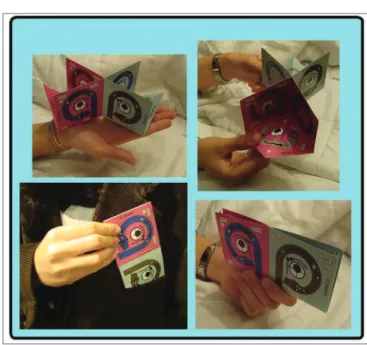
The multicolored cardboard model (Table 1) is accompanied by a 22-page user manual which provides a thorough description of the tool in the setting of the most common examples of vestibular pathologies.
model, both labyrinths are shown next to each other, the right to the left, for practical purposes. The left labyrinth is presented on a light blue background and the right labyrinth on a pink background. The model has 12 faces and the SSCC are represented on 10 of the faces in the three axes of space, front to back, with their corresponding ampullas and crista ampullaris. Each SSCC is color coded, and those which share the same color work together when stimulated. The Right Anterior Semicircular Canal and the Left Posterior Semicircular Canal are in blue. The Right Posterior Semicircular Canal and the Left Anterior Semi-circular Canal are in green. Both SemiSemi-circular Horizontal Canals are in grey (Fig. 1) (Fig. 2)
Table 1. Messures of the model
FOLDED cm INCH
Height 7 2.75
Lenght 14 5.5
UNFOLDED cm INCH
Height 7 2.75
Lenght 19.6 7.5
Depht 9.8 3.75
Weight 9gr
RESULTS
This 3D Model is the result of amalgamation of the
Figure 1. Anterior Face
Figure 2. 3D Model
Figure 3. 1-Acronym of the nerve, which innervates the semicircular canal. Ampullar Posterior Nerve. 2- Acronym of the saccule. The saccule shares its innervation with this semicircular canal. 3 -Initial Position of the otolith (t’0) 4- Direction of the tilt of the cupula 5 - Cupula. 6 - Crista.7 - Cupulolithiasis. 8 - Equation that estimates the total migration time of the otoconia crystals D: Duration, L: Latency, tNy: Time of duration of the nystagmus 9 - Acronym for the name which corresponds to the ear 10 - Gain of the semicircular canal. 11 - Position the eye adopts alter stimulating the canal. 12 - Vertical axis of the eye. 13 - Right ear. 14 - Name of the semicircular canal. 15 - Direction of the endolymph. 16 - The thick arrow shows that the excitatory stimulation is stronger than inhibition. 17 - The thin arrow shows the inhibitory stimulus. The inhibitory stimulus is ampullipetal. 18 – Each semicircular canal is color coded, and those which share the same color work together when stimulated. 19 – Slow phases. 20 – The round headed indicates that movement of the eye, and they are placed to remember that during the Ny, the rotatory motion is clearer seen when the patient look outward, and vertical motion when he look inward.
Figure 4. Central Pathway - Acronyms of figure 3: FLO: Cerebellar
Floc-culus, SVN: Superior Vestibular Nuclei, MVN: Medial Vestibular Nuclei, MLF: Medial Longitudinal Fasciculus, UBN: Up Beat Nystagmus (violet), NVI: Down Beat Nystagmus (red), NT: Torsional Nystagmus (green).
location. The faces of the horizontal canals are arranged differently, however, with the same concept. A partial diagram of the central symbology is displayed in Fig.4; however it is explained in greater detail in the users guide that accompanies the model. In the inferior faces of the horizontal SSCC there is a diagram of the most frequent vascular supplies to the inner ear, its innervation and vascular variations.
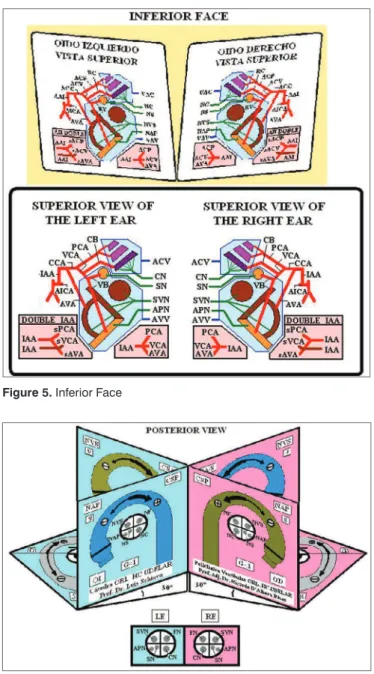
Following a color code, the arteries are in red, the veins in dark blue, and the venous drainage of the corres-ponding vein in light blue. The nerves are in green. Fig.5. In the posterior face of the SSCC there is a diagram that shows the distribution and relation of the different nerves that pass by the internal auditory canal (posterior sight) Fig. 6. The model has been very well received at various Latin American scientific conferences as listed below.
• 6º congreso Nacional de ORL y XVII encuentro
de ORL del Interior de la República. Hotel Jean Clevers. Punta del Este. Maldonado. Uruguay 31/10 y 1 y 2 /12 2008.
• Seminario de Interacoustics LimaPerú 13/12/2008. • VI Simposio INEBA de NeuroOtología 11 de Junio
de 2009. BsAs Argentina
• 71º Jornadas Rioplatenses de ORL 1416 de Julio
de 2010, as a Conference.
In addition, this model is used by the ENT Service of the Hospital de Clínicas, Facultad de
Medicina, Universidad de la República Oriental del Uruguay. The model is often understood after only verbal instruction; however, a print user manual is included.
DISCUSSION
This 3D model is a useful tool to teach concepts of anatomy, physiology and pathology without the need of texts. It is a practical, low cost tool for use in private and academic settings.
This essay has been abridged and we advise reading the complete user manual for a more complete unders-tanding of this tool.
CONCLUSION
This model is a practical, low cost tool for use in private and academic settings. It requires only basic prior knowledge and is easy to learn.
REFERENCES
1. Testut L. Sentido del Oído. Cap V. Tratado de Anatomía Humana. 7ª Edición. Tomo Tercero. Salvat. Editores. S.A. Barcelona; 1925. p. 83032.
2. Harsha WJ, Phillips JO, Backous DD. 4 Clinical Anatomy and Phy-siology. Vertigo and Disequilibrium. Webwe PC. Thieme Medical Publishers, Inc. New York. USA 2008.p. 4151.
3. Marelli E. Anatomofisiología del Sistema Vestibular. Sec. 1 Cap. 1. En Neurootología 1ª ReImpresión. PAR S.A Argentina. 2003. p. 1128. 4. Carmona S. Anatomía Vascular del Laberinto. Cap. 2 En Neurootología
1ª ReImpresión. PAR S.A Argentina. 2009.p. 2930.
5. Hain TC, Helminsky JO. Anatomy and Physiology of the Normal Vestibular System. Chapter 1. In Vestibular Rehabilitation 3º Ed. F.A Davis Company. Philadelphia USA 2007. p. 214
6. Zee DS. Vestibular Adaptation. Chapter 2. In Vestibular Rehabilitation 3º Ed. F.A Davis Company. Philadelphia USA; 2007. p.1931 7. Tusa RJ. History and Clinical Examination. Chapter 7 In Vestibular
Rehabilitation 3º Ed. F.A Davis Company. Philadelphia USA; 2007. p. 1156
8. Herdman S, Tusa RJ. Physical Therapy Management of Benign Posi-tional Vertigo. Chapter In Vestibular Rehabilitation 3º Ed. F.A Davis Company. Philadelphia USA; 2007. p. 23360
9. Brandt T, Dietirch M, Strupp M. Peripheral Vestibular Forms of Vertigo. In Vertigo and Dizziness. Springer; 2004. p.4188.
10. Epley JM. Reposición de partículas para tratar vértigo postural paro-xístico benigno. En Actualización en Otología y Neurootología, Parte I Clínicas ORL de Norteamérica. Vol. 2. McGrawHill Interamericana. 1996. p. 32937.
Figure 5. Inferior Face
Figure 6. Posterior Face - Acronyms of figures 1,2,4 and 5: A / SSC:
11. Ganança MM, Caovilla HH, Ganança FF, Munhoz MSL, Silva MLG. Vertigem Posicional Paroxística Benigna. Capítulo 2. Em Série Oto-neurológica. Quadros Clínicos Otoneurológicos Mais Comuns 3. Editora Atheneu; 2000. p. 919.