Determining Microvascular Obstruction and
Infarct Size with Steady-State Free Precession
Imaging Cardiac MRI
Wolfgang Wuest1*, Michael Lell1, Matthias May1, Michael Scharf1, Christian Schlundt2, Stephan Achenbach2, Michael Uder1, Axel Schmid1
1Radiological Institute, Friedrich-Alexander-University-Erlangen-Nuremberg, Erlangen, Germany,
2Department of Internal Medicine II, Division of Cardiology, Friedrich-Alexander-University-Erlangen-Nuremberg, Erlangen, Germany
Abstract
Purpose
In cardiac MRI (cMRI) injection of contrast medium may be performed prior to the acquisi-tion of cine steady-state free precession (SSFP) imaging to speed up the protocol and avoid delay before late Gadolinium enhancement (LGE) imaging. Aim of this study was to evalu-ate whether a condensed clinical protocol with contrast cine SSFP imaging is able to detect early microvascular obstruction (MO) and determine the infarct size compared to the find-ings of LGE inversion recovery sequences.
Materials and Methods
The study complies with the Declaration of Helsinki and was performed following approval by the ethic committee of the University of Erlangen-Nuremberg. Written informed consent was obtained from every patient. 68 consecutive patients (14 females/54 males) with acute ST-elevation myocardial infarction (STEMI) treated by percutaneous coronary revasculari-zation were included in this study. CMRI was performed 6.6±2 days after symptom onset and MO and infarct size in early contrast SSFP cine imaging were compared to
LGE imaging.
Results
MO was detected in 47/68 (69%) patients on cine SSFP and in 41/68 (60%) patients on LGE imaging. In 6 patients MO was found on cine SSFP imaging but was not detectable on LGE imaging. Infarct size on cine SSFP showed a strong agreement to LGE imaging (intra-class correlation coefficient [ICC] of 0.96 for enddiastolic, p<0.001 and 0.96 for endsystolic, p<0.001 respectively). Significant interobserver agreement was found measuring enddias-tolic and endsysenddias-tolic infarct size on cine SSFP imaging (p<0.01).
OPEN ACCESS
Citation:Wuest W, Lell M, May M, Scharf M, Schlundt C, Achenbach S, et al. (2015) Determining Microvascular Obstruction and Infarct Size with Steady-State Free Precession Imaging Cardiac MRI. PLoS ONE 10(3): e0119788. doi:10.1371/journal. pone.0119788
Academic Editor:Wolfgang Rudolf Bauer, University Hospital of Würzburg, GERMANY
Received:October 25, 2013
Accepted:February 3, 2015
Published:March 20, 2015
Copyright:© 2015 Wuest et al. This is an open access article distributed under the terms of the
Creative Commons Attribution License, which permits unrestricted use, distribution, and reproduction in any medium, provided the original author and source are credited.
Funding:The authors have no support or funding to report.
Competing Interests:The authors have declared
Conclusions
In patients after STEMI infarct size and presence of MO can be detected with contrast cine SSFP imaging. This could be an option in patients who are limited in their ability to comply with the demands of a cMRI protocol.
Introduction
Primary percutaneous coronary intervention (PCI) is the treatment of choice in acute myocar-dial infarction (AMI) to recover normal blood flow by recanalisation of the occluded artery to
reduce the extent of myocardial necrosis [1–2]. However, due to continuing microvascular
ob-struction (MO) reperfusion of the ischemic myocardium is incomplete in up to 30% of patients despite restoring epicardial blood flow. MO is associated with extensive ventricular remodel-ling and represents an important prognostic factor for impaired recovery of left ventricular
function and long term survival [3–8].
Because of its excellent contrast and good spatial resolution gadolinium enhanced cardiac MRI (cMRI) is considered as the reference standard for the detection and assessment of MO
and infarct volume [9]. Apart from late enhancement (LGE) imaging, which is commonly used
to identify MO, there are several other imaging techniques to visualize MO in the early course after contrast administration. They include first pass perfusion with single-shot saturation re-covery gradient-echo pulse sequences or early enhancement imaging with 3D inversion recov-ery gradient-echo sequences. However in clinical routine examination time is critical. To shorten the study duration standard cine steady-state free precession (SSFP) MRI imaging can be obtained after injection of contrast medium without loss of accuracy for regional and global
LV ventricular function [10].
Recently Raff et al. [11] validated the accuracy of contrast enhanced cine MR imaging in the
measurement of MO. Based on the findings of Raff el al. the aim of this study was to evaluate the differences of contrast-enhanced cine SSFP imaging and LGE imaging in a typical clinical protocol in order to assess the value of contrast enhanced SSFP imaging to serve as a backup option if LGE imaging is not evaluable or in case of an early abortion of the MRI scan.
Materials and Methods
Patients
68 consecutive patients (14 females/54 males) who presented with a first acute ST elevation myocardial infarction (STEMI) according to electrocardiographic and enzymatic criteria were
prospectively enrolled. The mean age of the patients was 63±11 years (range 44–88 years). All
patients had undergone successful PCI within 12 hours of symptom onset resulting in a Thrombolysis In Myocardial Infarction (TIMI) flow grade 2 or 3. Patients with a history of pre-vious coronary revascularization (i.e. PCI or coronary artery bypass surgery), prepre-vious myocar-dial infarction, hemodynamic instability, renal failure or contraindication to cMRI
examination (pacemaker, metal fragments, implants, severe arrhythmias or claustrophobia) were excluded. Local institutional review board approval was obtained and all patients gave written informed consent.
cMRI protocol
CMR imaging was performed on two 1.5-T MRI systems (Magnetom Avanto and Magnetom Espree, Siemens, Erlangen, Germany) with dedicated phased-array cardiac receiver coils. The patients were placed in a supine position, and images were acquired at end expiratory breath
hold with electrocardiogram gating. Initially scout images were acquired to localize the short axis of the heart. To depict myocardial edema a T2 weighted triple-inversion fast-spin-echo se-quence was employed in three long axis (2-chamber, 3-chamber, 4-chamber view) and three short axis views (apical, midventricular, basal).
As a modification of the standard imaging protocol in which functional cine imaging is per-formed before the administration of contrast agents, cine imaging was acquired after the ad-ministration of 0,2 mmol/kg of a gadolinium-based contrast agent (Gadovist, Bayer
Healthcare, Leverkusen, Germany). Three long axis and contiguous short axis views covering the entire left ventricle from the base to the apex were acquired with a retrospectively ECG-gated segmented k-space balanced steady state free-precession pulse sequence (trueFISP, Sie-mens medical Solutions). Image parameters were as follows: in plane resolution 1.6x1.6 mm, slice thickness 6 mm, gap 2 mm, echo time 1.6 ms, repetition time 3.2 ms, flip angle 60°, matrix
256x156, temporal resolution 35–50 ms.
LGE was performed 10–20 minutes after administration of contrast agents with a
segment-ed 2-dimensional inversion recovery gradient-echo (IR GE) pulse sequence, with slice position-ing identical to the SSFP cine images. In-plane resolution was 1.6x1.3 mm with a slice
thickness of 6mm (gap 2mm, echo time 3.22ms, repetition time 700ms, flip angle 25°, matrix 256x154, triggering to every other heart beat). The inversion time was determined by an
inver-sion-time scout sequence and typically ranged from 230–300ms to null the signal of
normal myocardium.
In order to rule out that MO findings could be at least partially related to the used SSFP im-aging sequence 7 additional consecutive patients (7 males/0 females) with a mean age of 60±10
years (range 49–76 years) were included
In these patients an early IR GE slice was immediately performed after each early cine SSFP slice with a MO finding during the first ten minutes and late cine SSFP slices were added during late IR GE imaging in cases when MO was present on early SSFP or early IR GE imaging.
cMRI analysis
cMRI analysis was performed by two observers (W.W. and S.A.) with more than 4 and 10 years experience in cMRI, respectively, who were blinded to all patient and other imaging data. The final value of infarct and MO size used was an average of the two readings.
A manual segmentation of the endo- and epicardial borders of the LV wall in the short axis SSFP images was done in the endsystolic and enddiastolic phase and the global mass and func-tional parameters were analysed by using dedicated software (ARGUS; Siemens Healthcare, Er-langen, Germany). The trabecular network and the papillary muscles were defined as part of the blood pool.
The following parameters were evaluated: ejection fraction (EF), enddiastolic volume (EDV), endsystolic volume (ESV), stroke volume (SV) and myocardial mass.
Infarcted tissue was defined as visually hyperenhanced myocardium in the inversion recov-ery sequence compared to the remote normal myocardium. MO was defined as mid- or suben-docardial hypoenhancement within the hyperenhanced region and was considered as part of the infarct volume. To exclude low signal intensity artifacts in cine SSFP imaging potentially
mimicking MO areas, a“true MO finding”was defined as a hypoenhancing myocardial area
surrounded by a hyperenhancing infarction zone constantly visible located at the same position
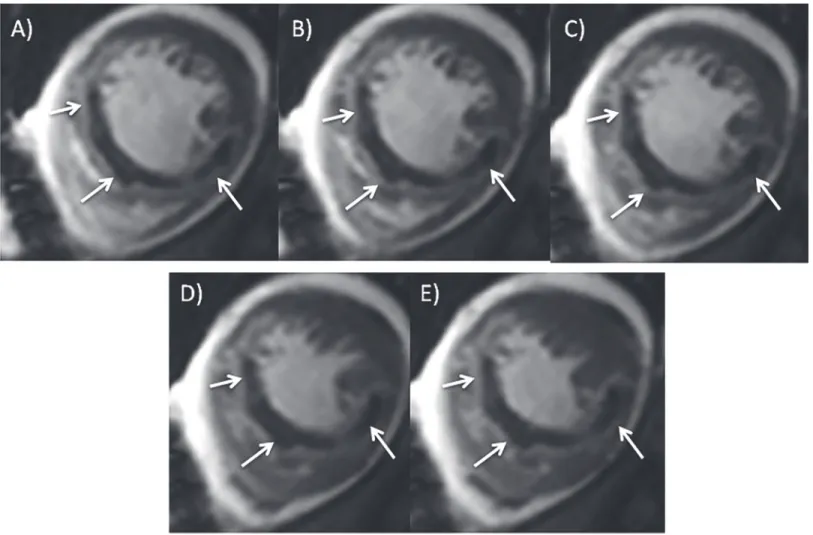
within the cardiac wall on each SSFP image during the complete cardiac cycle (seeFig. 1).
areas on each slice. Infarct volume was measured in both, ED and ES cine SSFP imaging, to evaluate which imaging time point correlated better with LGE imaging.
Total infarct size was expressed as a percentage of global LV myocardial mass, given by the sum of all volumes of hyperenhanced regions for all slices multiplied by myocardial density (1.05 g/mL and divided through the global LV mass. The size of the MO areas was indepen-dently assessed on LGE images and SSFP cine images, by manually contouring the hypoen-hanced areas within the infarcted myocardium. In SSFP images the whole cardiac cycle was evaluated regarding the presence of hypoenhancement within the infarcted myocardium. The total amount of MO was defined as the sum of MO areas for all slices multiplied by 1.05 g/mL and was expressed as a percentage of the total infarct size. To avoid bias, evaluation of delayed enhancement imaging and SSFP cine imaging was performed with a time delay of at least 4 weeks.
Statistical analysis
Values were given as mean ± standard deviation. Agreements between cine SSFP and LGE im-aging were determined by the intraclass correlation coefficient (ICC) and 95% confidence in-tervals. Bland-Altman plots were generated to graphically present the stability and consistency
of the agreement between both tests [12,13]. Pearson correlation coefficient was used for MO
Fig 1. Typical MO appearance on early cine SSFP imaging at the same slice position during the cardiac cycle (A-E).
doi:10.1371/journal.pone.0119788.g001
and infarct size and to evaluate the influence of the time period between contrast media appli-cation and the occurrence of MO as well as the influence of the size of the MO area.
After testing for normal distribution and variances in Levene's statistic, a non parametric Wilcoxon two paired test was used for MO values and for myocardial function studies. Signifi-cance was assessed at a p-level of 0.05. Statistical analysis was performed using the software package SPSS Statistics, Version 19 (SPSS Inc./ IBM, Chicago, IL).
Results
The infarct related artery was the left anterior descending artery in 29/68 (43%), the left cir-cumflex artery in 11/68 (16%) patients and the right coronary artery in 28/68 (41%) patients.
CMR imaging was performed 6.6±2 days after onset of myocardial infarction symptoms on average. Short axis cine SSFP imaging started 2.7±2.2 min and was completed 7.8±2.5 min after administration of contrast agent. The average time interval between the injection of con-trast medium and the slice on which MO was present on cine SSFP imaging was 4.6±1.6 min. LGE imaging was performed between 15.5±3 min and 21.6±3.7 min after administration of contrast agent. The average time interval between the injection of contrast medium and the de-tection of MO areas on late enhancement imaging was 17.3±2.5 min.
In all 68 patients, areas of hyperenhancement were visible with LGE imaging as an indica-tion of infarcted LV myocardium. The mean global extent of infarcted myocardium with LGE imaging was 27±20g, the mean total infarct size in correlation to LV mass was 18%±12%. In-farct size in ED and ES SSFP imaging was 29g±20g and 31g±20g respectively. The global extent of infarct size on ED and ES cine SSFP imaging showed a strong agreement to LGE imaging
(ICC ES: 0.955, 95% CI: 0.844–0.981, p<0.001 and ICC for ED: 0.963, 95% CI: 0.932–0.979,
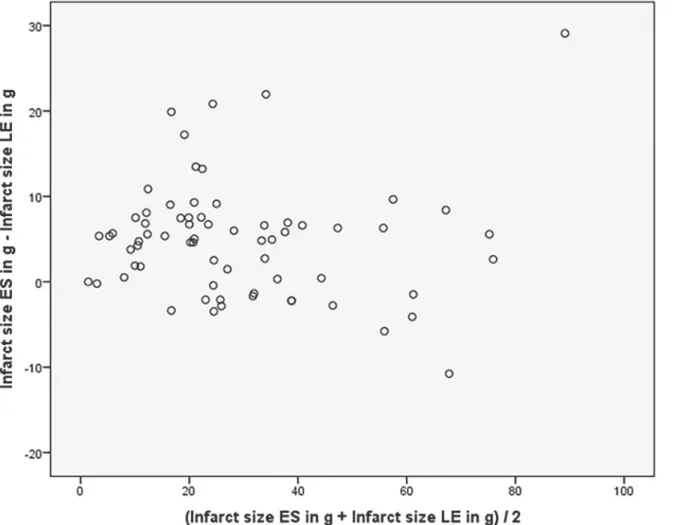
p<0.001). Bland-Altman plots indicated that variability of the differences between the two
tests (ED/ES cine SSFP vs. LGE imaging) for both measures was consistent and the majority of
them were within the 1.96 SD intervals (see Figs.2–3). Significant interobserver agreement was
found measuring ED and ES infarct size (pearson correlation: r = 0.81 and r = 0.83, p<0.01).
MO was present on 41/68 (60%) patients on LGE imaging. Patients with MO on LGE imag-ing had a significantly larger infarct size compared to patients without MO (33.3±25.6g vs. 15.3±15.3g, p = 0.001) and larger enddiastolic left ventricular volume (LVEDV 164±32ml vs. 147±33ml, p = 0.05). The difference in global left ventricular function (LVEF 49±11% in tients with MO vs. 51±11% in patients without MO, p = 0.3) and left ventricular mass in pa-tients with MO with LGE imaging (145±32g in papa-tients with MO vs. 130±34g in papa-tients without MO, p = 0.07) did not reach statistical significance.
On early cine SSFP imaging MO was identified in 47/68 (69%) patients. MO extent on cine
imaging correlated significantly with infarct size (pearson correlation: r = 0.826, p<0.01) and
with MO extent on LGE imaging (ICC of 0.946, 95% CI: 0.809–0.978, p<0.001) (seeFig. 4).
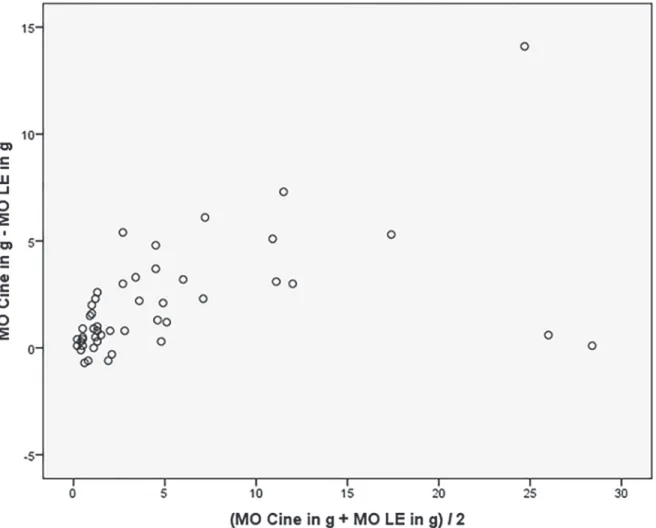
Bland-Altman plot indicated that variability of the differences between the two tests was
con-sistent and the majority of them were within the 1.96 SD intervals (seeFig. 5).
The global extent of MO detected on early cine SSFP imaging and the MO size in correlation
to infarct size and LV mass were significantly larger than those on LGE imaging (p<0.001, see
Table 1) representing an early hypoenhancement—late hyperenhancement pattern (seeFig. 6). MO size on cine SSFP imaging correlated with the difference between MO on cine SSFP and
LGE imaging (r = 0.623, p<0.01). MO size correlated inversely with the time point of
occur-rence on cine SSFP imaging without reaching significance (r =−0.28, p = 0.06). No significant
correlation was found between the time point of the occurrence of MO on early cine SSFP
im-aging and the difference of MO size on cine SSFP imim-aging and LGE imim-aging. (r =−0.115,
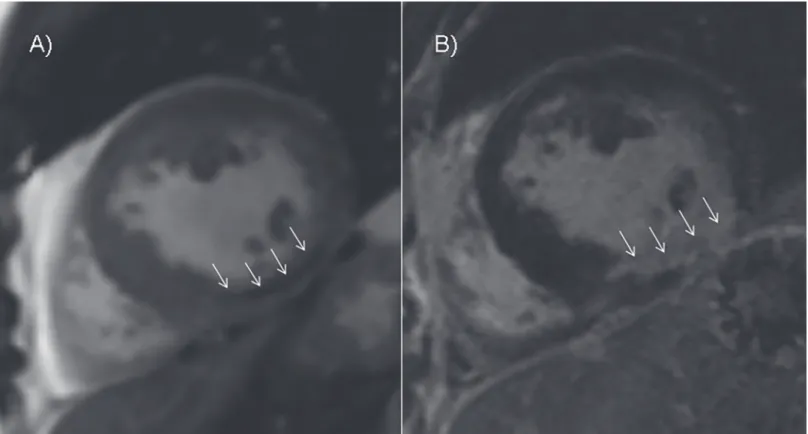
All areas of MO detected on LGE imaging were also demonstrated with early cine SSFP. In 6 patients MO was found on cine SSFP imaging but was not present on LGE imaging (see
Fig. 7). In these patients the size of the MO area in cine SSFP was 2.2±1.5g vs. 6.4±7.8g when
MO was seen in both sequences (seeTable 2). The infarct size of patients with MO only visible
on cine SSFP imaging was lower than in patients with MO on both imaging methods (26±17g, 17% ± 8% of LV mass vs. 34±26g, 23% ± 16% of LV mass).
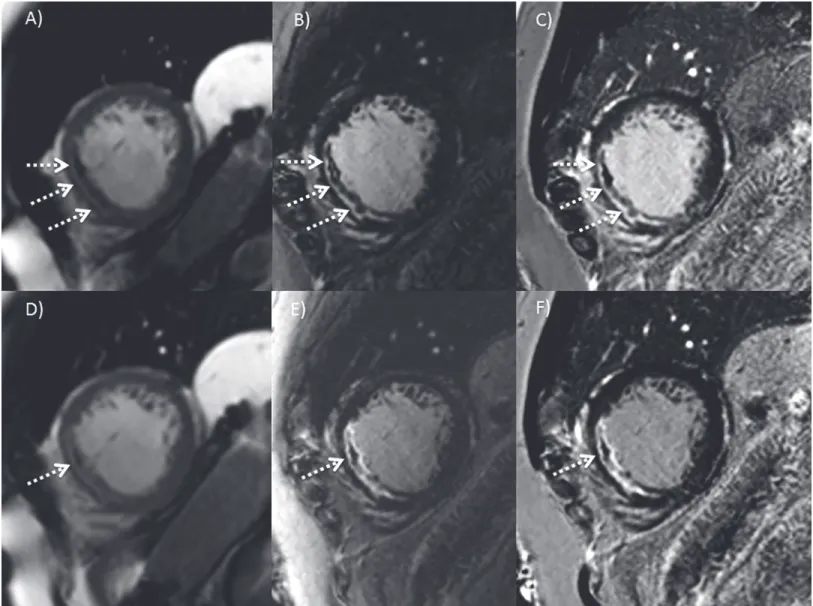
In the 7 additionally scanned patients MO was present in 5/7 cases. In all 5 cases, the extent of MO was equal on early SSFP imaging compared to early IR GE imaging as well as on late
SSFP imaging compared to late IR GE imaging (seeFig. 8). The extent of MO decreased
uni-formly on both sequences between early and late imaging.
Discussion
Our study demonstrates that SSFP cine imaging performed after contrast administration allows for detection of infarct size and microvascular obstruction in close agreement to LGE imaging.
Infarct size represents an important predictor for left ventricular remodeling which could
progress to heart failure and is associated with increased morbidity and mortality [14]. In our
study both enddiastolic and endsystolic steady-state free precession imaging allowed for
Fig 2. Bland-Altman plot for ES infarct size indicate that differences between the tests are consistent and the majority of them are within the 1.96 SD intervals.
doi:10.1371/journal.pone.0119788.g002
determining infarct size with a strong agreement with the gold standard LGE imaging. We found a significant positive correlation between infarct size and MO as it has been described
for other MRI techniques before [15–18].
Apart from infarct size, MO is an important predictor of heart failure after myocardial in-farction. If present, MO is associated with poor functional recovery and myocardial remodeling
[19–20] and represents an independent prognostic factor for adverse outcomes after acute
myocardial infarction [5,19,21]. MO is caused by compression of intramyocardial vessels by
in-tracellular edema [15,22], hypoxic endothelial damage [13], thromboembolic obstruction [7]
and regional spasm of small intramyocardial vessels [23] in the acute and subacute phase of
myocardial infarction. Angiography based techniques such as the corrected TIMI frame count or myocardial blush grade are lacking sensitivity and specificity for the assessment of MO since they do not allow direct visualization of perfusion at the level of the myocardial microvascular
system [16,24]. Moreover, the extent of MO has been shown to increase within the first 2 days
after myocardial infarction and, therefore, the total extent of MO may be underestimated if
as-sessed immediately after reperfusion [25]. In contrast, cMRI is an ideal, non-invasive imaging
modality, since it combines the highly accurate assessment of morphological and functional pa-rameters with the delineation of tissue necrosis and MO. Hypoenhancement within an area of
Fig 3. Bland-Altman plot for ED infarct size indicate that differences between the tests are consistent and the majority of them are within the 1.96 SD intervals.
hyperenhancing infarcted myocardium has been proven to represent persistent limited myo-cardial perfusion within the infarct core despite restoration of coronary blood flow after
reper-fusion [25,26]. These hypoenhancing defects within the infarction are verifiable only in the
course of acute and subacute infarction and disappear at later stages of chronic infarction [26].
However, studies on the incidence of MO differ in terms of the MRI sequence and the time delay at which MO has been assessed after the administration of contrast agents. While en-hancement defects within the infarcted myocardium persisting for more than 10 minutes after contrast administration (late MO) have been studied on inversion recovery gradient-echo se-quences designed for late enhancement imaging, the early course of perfusion defects within the first minutes after contrast administration has traditionally been assessed either by first-pass perfusion techniques or by 2D or 3D gradient-echo sequences (early MO). Some studies postulate that detection of MO in early enhancement leads to a higher risk for upcoming major adverse cardiac events (cardiac death, reinfarct, rehospitalisation due to heart failure, unstable
angina [5,23], some do not [21]. Bekkers et al. [27] studied 84 consecutive patients with a
reperfused AMI 5 and 104 days after admission using a single breath-hold 3D inversion recov-ery gradient echo (IR-GRE) pulse sequence. In 8 patients (10%) MO disappeared on LGE com-pared to early enhancement. These patients had an LVEF that was intermediate at baseline and after follow-up. Bekkers et al. speculated that these patients represent an intermediate risk group and should not be excluded from future therapies for MO.
The technique of contrast enhanced cine SSFP imaging as it has been performed in our
study has been proposed only once before in a study by Raff et al. [11]. They validated the
accu-racy of contrast enhanced cine MR imaging in the measurement of MO by comparing hypoen-hancing defect sizes between a standard cine SSFP sequence obtained after the administration
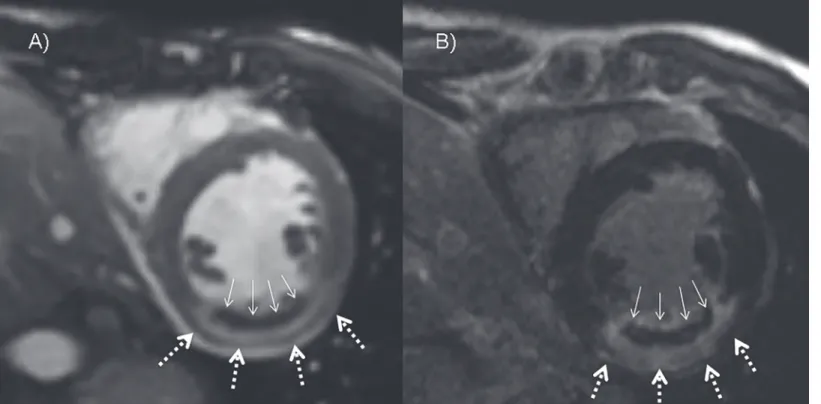
Fig 4. Cine and LGE imaging after 6 and 14.5 minutes respectively.Both images (A and B) show a well demarcated hyperintense midventricular inferolateral myocardium with a subendocardial located crescent shaped hypointensity representing myocardial infarction with MO (arrows: MO size, dotted arrows: infarct size).
doi:10.1371/journal.pone.0119788.g004
of contrast material and a first-pass perfusion gradient-echo sequence in 80 patients and an early inversion recovery gradient-echo sequence in 50 patients. Contrast enhanced cine SSFP imaging was performed immediately after first-pass perfusion imaging and the early inversion-recovery section, prepared by a preliminary inversion-time scout sequence, was obtained im-mediately after each contrast-enhanced cine section. No number is stated how many patients had early MO but late MO disappearance but they found early hypoenhancement-late hyper-enhancement in all of their 18 patients, who underwent repeat contrast enhanced cine MRI after 10 and 30 minutes. Findings at contrast-enhanced cine MR imaging agreed with the glob-al and transmurglob-al extent of microvascular obstruction at first-pass perfusion and inversion-re-covery gradient-echo MR imaging. The authors concluded that cine SSFP imaging provides data on MO with results that compare very closely to standard MR imaging techniques.
Fig 5. Bland-Altman plot for MO indicates that differences between the tests are consistent and the majority of them are within the 1.96 SD intervals.
doi:10.1371/journal.pone.0119788.g005
Table 1. MO/infarct size in patients with MO on SSFP cine and late enhancement imaging.
Sequence MO global extent MO size/infarct size MO size/LV mass
SSFP 5.9±7.5g 15%±10% 4%±4%
LE 3.9±6.2g 9%±9% 2%±3%
However, in a typical condensed clinical protocol, contrast enhanced cine MR imaging is ob-tained within the first minutes after the administration of contrast media, whereas
late-en-hancement imaging is obtained 10–20 minutes after the application of contrast media.
Therefore, even if comparable at approximately the same imaging time points as shown by Raff et al., the results of early contrast enhanced cine imaging and late enhancement imaging might
differ due to the influence of an early hypo-/late hyperenhancement pattern [15,23]. Based on
the findings of Raff el al. the aim of this study was to evaluate the differences of contrast-en-hanced cine SSFP imaging and LGE imaging in a typical clinical protocol in order to assess the value of contrast enhanced SSFP imaging to serve as a backup option if LGE imaging is not evaluable or in case of an early abortion of the MRI scan. Therefore, in contrast to Raff et al., besides MO size also infarct size was measured on ED and ES cine SSFP imaging and was eval-uated for correlation with LGE imaging. We found a good correlation between both, the size of the infarcted area as well as the size of the MO area on cine SSFP imaging and LGE imaging but a slightly greater extent of the overall MO area on early cine SSFP imaging compared to LE imaging. The greater extent of MO can be explained by the earlier imaging time points on cine SSFP compared to LGE imaging and is not related to the used imaging sequence as shown in the 5 additionally scanned patients. To draw a conclusion from the size of MO for therapy planning it is important to be aware of the imaging time point since early imaging slightly over-estimates MO. Generally, this could be explained by the effects of slow passive diffusion of con-trast media into the infarcted zone resulting in an early hypo-/ late hyperenhancement pattern
as described before by others [28–29]. The concept of a slow passive diffusion process of
con-trast media into the infarcted area might serve also as an explanation for the fact that in a cer-tain number of patients (6/47) with MO on SSFP imaging MO areas could be detected
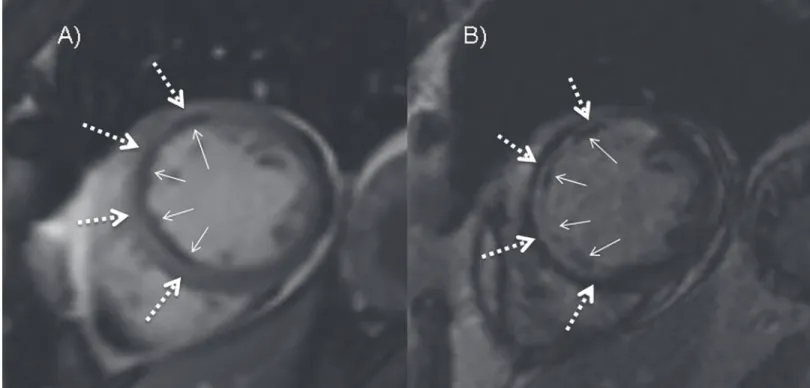
Fig 6. Comparison between MO on early cine SSFP and LGE.A) Cine imaging performed 4 minutes after contrast medium injection. Midventricular subendocardial MO reaching from septal, anteroseptal to anterior. B) LGE imaging 16.5 minutes after contrast medium injection. Hyperenhanced midventricular septal, anteroseptal to anterior myocardium with less MO compared to cine imaging (arrows: MO size, dotted arrows: infarct size).
doi:10.1371/journal.pone.0119788.g006
exclusively on early cine SSFP imaging without any hypoenhancing infarction core on LGE imaging.
While the median MO size (2g) in these patients was small compared to the overall median MO size (6g), small MO areas did not disappear in all cases between early and late enhance-ment imaging, indicating different diffusion properties in different patients. We can only spec-ulate but this could be due to different diffusion coefficients or pathological
permeability changes.
Since MO has been described as a negative predictor for the clinical outcome, our data is raising the question, whether this constellation of findings is representing a group of patients on an intermediate risk which, however, certainly warrants larger follow-up studies. Further-more, the clinical significance of a virtually absent decrease of MO area on LE imaging as ob-served in some patients with even larger MO extent remains unclear but could also be of potential interest for further investigations.
Fig 7. Comparison between MO on early cine SSFP and LGE.A) Cine imaging performed 4 minutes after contrast medium injection. A demarcated crescent shaped hypointensity representing MO in the midventricular inferior myocardium. B) LGE imaging 19 minutes after contrast medium injection. Hyperenhanced midventricular inferior myocardium missing MO at an identical slice position compared to cine imaging (see arrows for comparison).
doi:10.1371/journal.pone.0119788.g007
Table 2. MO/ infarct size in patients with MO on cine imaging not detectable on late enhancement im-aging compared to patients with MO on both SSFP and LE imim-aging.
Sequence MO size/infarct size MO size/LV mass
SSFP 10%±6% 1%±1%
SSFP+LE 16%±11% 4%±4%
Limitations
Some limitations need to be stated. First, the study was not designed as a longitudinal follow up of the functional recovery or the clinical outcome of the patients. Therefore it is not possible to draw any conclusions regarding prognosis particularly in the subgroup of patients with MO on cine SSFP imaging not found in LGE imaging. Secondly, the study population was rather small
and—even though only STEMI patients were included into the study—relatively
inhomogen-ous regarding infarct and MO size. Against this background, further subgroup analysis with re-spect to clinical outcome appears not to be reasonable.
Third, the study protocol was designed as a condensed protocol consisting of SSFP and IR-GRE sequences. Therefore, we did not compare post contrast cine SSFP imaging to other se-quences than IR-GRE.
Fig 8. MO with different imaging methods.Early enhancement 9 min after contrast agent: A) Cine SSFP B) IR GE imaging and C) PSIR. Late enhancement 23 min after contrast agent: D) Cine SSFP E) IR GE imaging and F) PSIR. Note the comparable extent of MO with SSFP and IR imaging at each time point, but the greater extent of MO at early imaging (A-C) compared to late imaging (D-F).
doi:10.1371/journal.pone.0119788.g008
Fourth, manual delineation was used to assess infarct size on LGE and SSFP images. An al-ternative technique is for example the use of a signal threshold (n-SD technique or full width half maximum) based on remote myocardium signal analysis. However at this time there is no
dedicated statement of the“Task Force”regarding the optimal method for quantitative
assess-ment [30].
Finally the time point of the occurrence of an infarction or MO area on cine SSFP imaging (roughly between 3 and 8 minutes post contrast administration) might represent a possible bias in our results. Since SSFP imaging has constantly been performed from the base towards the apex, more basal located MO areas might be overestimated compared to more apical locat-ed MO areas due to the difference in acquisition time point. While larger MO areas showlocat-ed sig-nificantly more decrease in size between CE cine SSFP imaging and LGE imaging compared to
smaller MO areas, no significant difference in the decrease in size of an“early”MO at a more
basal slice compared to a“late”MO on a more apical slice was obtained in our study cohort.
In summary, even if MO size is slightly overestimated on contrast enhanced cine SSFP im-aging in particular in the case of larger MO areas due to the earlier imim-aging time point, contrast enhanced cine SSFP imaging was able to detect all cases with MO on LGE imaging and could therefore indeed serve as a back-up if LGE imaging should not be evaluable.
Conclusion
In patients after STEMI infarct size and presence of MO can be detected with early contrast en-hanced cine SSFP imaging. This could be an option in patients who are limited in their ability to comply with the demands of a cMRI protocol.
Author Contributions
Conceived and designed the experiments: WW AS CS. Performed the experiments: MS MM WW AS. Analyzed the data: WW AS ML. Contributed reagents/materials/analysis tools: MU SA. Wrote the paper: WW AS ML.
References
1. Sheehan FH, Doerr R, Schmidt WG, Bolson EL, Uebis R, von Essen R, et al. Early recovery of left ven-tricular function after thrombolytic therapy for acute myocardial infarction: an important determinant of survival. J Am Coll Cardiol 1988; 12: 289–300. PMID:3392324
2. Grines CL, Cox DA, Stone GW, Garcia E, Mattos LA, Giambartolomei A, et al. Coronary angioplasty with or without stent implantation for acute myocardial infarction. Stent Primary Angioplasty in Myocar-dial Infarction Study Group. N Engl J Med 1999; 3411949–56. PMID:10607811
3. Ito H, Tomooka T, Sakai N, Yu H, Higashino Y, Fujii K, et al. Lack of myocardial perfusion immediately after successful thrombolysis. A predictor of poor recovery of left ventricular function in anterior myocar-dial infarction. Circulation 1992; 85: 1699–1705. PMID:1572028
4. Ito H, Maruyama A, Iwakura K, Takiuchi S, Masuyama T, Hori M, et al. Clinical implications of the "no-reflow" phenomenon. A predictor of complications and left ventricular remodeling in reperfused anterior wall myocardial infarction. Circulation 1996; 93: 223–228. PMID:8548892
5. Wu KC, Zerhouni EA, Judd RM, Lugo-Olivieri CH, Barouch LA, Schulman SP, et al. Prognostic signifi-cance of microvascular obstruction by magnetic resonance imaging in patients with acute myocardial infarction. Circulation 1998; 97: 765–772. PMID:9498540
6. Morishima I, Sone T, Okumura K, Tsuboi H, Kondo J, Mukawa H, et al. Angiographic no-reflow phe-nomenon as a predictor of adverse long-term outcome in patients treated with percutaneous translum-inal coronary angioplasty for first acute myocardial infarction. J Am Coll Cardiol 2000; 36: 1202–1209. PMID:11028471
8. Roe MT, Ohman EM, Maas AC, Christenson RH, Mahaffey KW, Granger CB, et al. Shifting the open-ar-tery hypothesis downstream: the quest for optimal reperfusion. J Am Coll Cardiol. 2001; 37: 9–18. PMID:11153779
9. Kim RJ, Chen EL, Lima JA, Judd RM. Myocardial Gd-DTPA kinetics determine MRI contrast enhance-ment and reflect the extent and severity of myocardial injury after acute reperfused infarction. Circula-tion 1996; 94: 3318–26. PMID:8989146
10. Krombach GA, Plum T, Koos R, Hoffmann R, Altiok E, Krämer NA, et al. Functional cardiac MR imaging with true fast imaging with steady-state free precession before and after intravenous injection of con-trast medium: comparison of image quality and accuracy. Eur Radiol. 2011; 21: 702–11. doi:10.1007/ s00330-010-1969-2PMID:20890762
11. Raff GL, O'Neill WW, Gentry RE, Dulli A, Bis KG, Shetty AN, et al. Microvascular obstruction and myo-cardial function after acute myomyo-cardial infarction: assessment by using contrast-enhanced cine MR im-aging. Radiology 2006; 240: 529–36. PMID:16864676
12. Bland JM, Altman DG. Statistical methods for assessing agreement between two methods of clinical measurement. Lancet 1986; 1: 307–310. PMID:2868172
13. Rogers WJ Jr, Kramer CM, Geskin G, Hu YL, Theobald TM, Vido DA, et al. Early contrast-enhanced MRI predicts late functional recovery after reperfused myocardial infarction. Circulation 1999; 99: 744– 750 PMID:9989958
14. Lund GK, Stork A, Muellerleile K, Barmeyer AA, Bansmann MP, Knefel M, et al. Prediction of left ven-tricular remodeling and analysis of infarct resorption in patients with reperfused myocardial infarcts by using contrast-enhanced MR imaging. Radiology 2007; 245: 95–102. PMID:17885184
15. Kloner RA, Ganote CE, Jennings RB. The“no-reflow”phenomenon after temporary coronary occlusion in the dog. J Clin Invest 1974; 54: 1496–1508. PMID:4140198
16. Yan AT, Gibson CM, Larose E, Anavekar NS, Tsang S, Solomon SD, et al. Characterization of micro-vascular dysfunction after acute myocardial infarction by cardiomicro-vascular magnetic resonance first-pass perfusion and late gadolinium enhancement imaging. J Cardiovasc Magn Reson 2006; 8: 831–7. PMID:17060106
17. Lund GK, Stork A, Saeed M, Bansmann MP, Gerken JH, Müller V, et al. Acute myocardial infarction: evaluation with first-pass enhancement and delayed enhancement MR imaging compared with 201Tl SPECT imaging. Radiology 2004; 232: 49–57. PMID:15166320
18. Bogaert J, Kalantzi M, Rademakers FE, Dymarkowski S, Janssens S. Determinants and impact of mi-crovascular obstruction in successfully reperfused ST-segment elevation myocardial infarction. As-sessment by magnetic resonance imaging. Eur Radiol. 2007; 17: 2572–80. PMID:17361420 19. Hombach V, Grebe O, Merkle N, Waldenmaier S, Höher M, Kochs M, et al. Sequelae of acute
myocar-dial infarction regarding cardiac structure and function and their prognostic significance as assessed by magnetic resonance imaging. Eur Heart J 2005; 26: 549–57. PMID:15713695
20. Nijveldt R, Beek AM, Hirsch A, Stoel MG, Hofman MB, Umans VA, et al. Functional recovery after acute myocardial infarction: comparison between angiography, electrocardiography, and cardiovascular magnetic resonance measures of microvascular injury. J Am Coll Cardiol. 2008; 52: 181–9. doi:10. 1016/j.jacc.2008.04.006PMID:18617066
21. de Waha S, Desch S, Eitel I, Fuernau G, Zachrau J, Leuschner A, et al. Impact of early vs. late micro-vascular obstruction assessed by magnetic resonance imaging on long-term outcome after ST-eleva-tion myocardial infarcST-eleva-tion: a comparison with tradiST-eleva-tional prognostic markers. Eur Heart J. 2010; 31: 2660–8. doi:10.1093/eurheartj/ehq247PMID:20675660
22. Manciet LH, Poole DC, McDonagh PF, Copeland JG, Mathieu-Costello O. Microvascular compression during myocardial ischemia: mechanistic basis for no-reflow phenomenon. Am J Physiol. 1994; 266: H1541–H1550 PMID:8184932
23. Piana RN, Paik GY, Moscucci M, Cohen DJ, Gibson CM, Kugelmass AD, et al. Incidence and treatment of‘noreflow’after percutaneous coronary intervention. Circulation 1994; 89: 2514–2518 PMID: 8205658
24. Gibson CM, Schömig A. Coronary and myocardial angiography: angiographic assessment of both epicardial and myocardial perfusion. Circulation 2004; 109: 3096–105. PMID:15226226 25. Rochitte CE, Lima JA, Bluemke DA, Reeder SB, McVeigh ER, Furuta T, et al. Magnitude and time
course of microvascular obstruction and tissue injury after acute myocardial infarction. Circulation 1998; 98: 1006–14. PMID:9737521
26. Wu KC, Kim RJ, Bluemke DA, Rochitte CE, Zerhouni EA, Becker LC, et al. Quantification and time course of microvascular obstruction by contrast-enhanced echocardiography and magnetic resonance imaging following acute myocardial infarction and reperfusion. J Am Coll Cardiol. 1998; 32: 1756–64. PMID:9822106
27. Bekkers SC, Backes WH, Kim RJ, Snoep G, Gorgels AP, Passos VL, et al. Detection and characteris-tics of microvascular obstruction in reperfused acute myocardial infarction using an optimized protocol for contrast-enhanced cardiovascular magnetic resonance imaging. Eur Radiol. 2009; 19: 2904–12. doi:10.1007/s00330-009-1489-0PMID:19588152
28. Judd RM, Lugo-Olivieri CH, Arai M, Kondo T, Croisille P, Lima JA, et al. Physiological basis of myocar-dial contrast enhancement in fast magnetic resonance images of 2-day-old reperfused canine infarcts. Circulation 2002 106: 1083–9. PMID:12196333
29. Gerber BL, Garot J, Bluemke DA, Wu KC, Lima JA. Accuracy of contrast-enhanced magnetic reso-nance imaging in predicting improvement of regional myocardial function in patients after acute myocar-dial infarction. Circulation 2002; 106: 1083–9. PMID:12196333