Cortical Linear Lesions in
Wernicke’s Encephalopathy:
Can Diffusion-Weighted
Imaging Herald Prognostic
Information?
To the Editor:Typical clinical fea-tures of Wernicke’s encephalopathy are caused by vitamin B1deficiency and include confusion, ataxia, and ophthalmoplegia.1,2Although it can occur in all malnourished patients, it is far more frequent in alcohol-ics.1,2Brain MRI is a central diag-nostic tool that usually discloses high signal lesions in T2-weighted imaging symmetrically affecting mammillary bodies, the thalamus, hypothalamus, periaqueductal gray matter, midbrain, and the cerebel-lum.2Cortical damage and diffu-sion-weighted imaging findings were both seldom reported in Wer-nicke’s encephalopathy.
Case Report
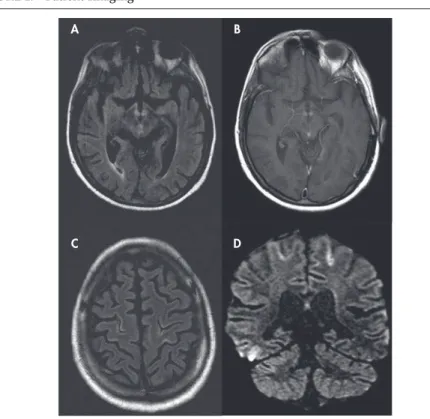
A 36-year-old man presented at the emergency department with an acute confusional state. He had excessive chronic daily alcohol abuse, averaging 200 grams per day, and he almost stopped eating in the prior week. Besides this, his prior medical history was unre-markable. When observed, he was confused, hallucinating, and disori-ented; complete ophthalmoplegia, with multidirectional gaze-evoked nystagmus, and bilateral ataxia were seen, with no abnormality on motor or sensory testing. Brain MRI disclosed symmetrical high signal lesions in the mammillary bodies, in T2-weighted imaging FLAIR (Figure 1, panel A) and
dif-fusion weighted imaging, which was enhanced after gadolinium administration (Figure 1, panel B). Linear high signal was also visible, in FLAIR (Figure 1, panel C) and diffusion weighted imaging (Figure 1, panel D), along the precentral and central sulci. Apparent diffu-sion coefficient mapping showed low signal in the mammillary bodies, consistent with water movement restriction, but normal values in the cortical lesions. With thiamine intravenous treatment, the patient gradually improved, being dismissed at day 9 with no ataxia or ocular signs but with a slight difficulty in retaining new informa-tion. An MRI taken at month 2 of
follow-up showed only slight atro-phy in the mammillary bodies.
Discussion
Linear cortical hyperintensities in T2-weighted imaging in a ribbon-like fashion were described in pos-tictal stages, posterior reversible leucoencephalopathy, and postan-oxic encephalopathy and, further-most, sporadic Creutzfeldt-Jakob disease.3,4Cortical damage in Wer-nicke’s encephalopathy, in the rare cases it was reported, essentially affected the pericentral regions in a symmetric pattern.3,5–8 It was pro-posed that this feature would have clinical (responsible for the motor FIGURE 1. Patient Imaging
A B
D C
A: Axial FLAIR shows bilateral symmetrical hyperintensities in mammillary bodies, with slight enlargement; B: Gadolinium-enhanced T1-weighted image discloses blood-brain barrier disruption in the same location; C: Axial FLAIR shows bilateral cortical
hyperintensities depicting precentral and central sulci; D: Coronal DWI reveals high signal lesions in the same location.
LETTERS
findings),3as well as prognostic (indicating worst outcome), rele-vance.5In our patient, this was not encountered as there was no motor defect and the patient had a good general outcome. The precocity of MRI assessment and thiamine reposition in our patient probably prevented us from seeing more extensive damage to the pericentral regions and these severe clinical consequences. Supporting this hypothesis is the absence of restric-tion to water molecules movement that we have observed: this finding is consistent with vasogenic edema, and as this is typically reversible, it can be a relevant prognostic fea-ture, indicating that the metabolic damage is not permanent and it will be treatment-responsive. Fur-thermore, as the histological find-ings in Wernicke’s encephalopathy confirm the existence of both cyto-toxic and vasogenic edema, it is possible that one (the vasogenic) precedes the other (the cytotoxic), making diffusion weighted imaging
an excellent tool to define the time window for successful thiamine treatment.
Previously presented as a poster at the annual meeting of the Portuguese Neurological Society, November 16, 2008.
A´lvaro Machado, M.D.
Neurology Department, Hospital de Sa˜o Marcos, Braga, Portugal
Manuel Ribeiro, M.D.
Joa˜ o Soares-Fernandes, M.D.
Neuroradiology Department, Hospital de Sa˜o Marcos, Braga
Joa˜ o Cerqueira, M.D., Ph.D. Ricardo Mare´, M.D.
Neurology Department, Hospi-tal de Sa˜o Marcos, Braga
References
1. Victor M, Adams RD, Collins GH: The Wernicke-Korsakoff syndrome: a clinical and pathological study of 245 patients, 82 with post-mortem examinations. Con-temp Neurol Ser 1971; 7:1–206
2. Sechi G, Serra A: Wernicke’s encephalop-athy: new clinical settings and recent advances in diagnosis and management. Lancet Neurol 2007; 6:442– 455
3. Zhong C, Jin L, Fei G: MR imaging of nonalcoholic Wernicke encephalopathy: a follow-up study. AJNR Am J Neurora-diol 2005; 26:2301–2305
4. Demaerel P, Sciot R, Robberecht W, et al: Accuracy of diffusion-weighted MR imaging in the diagnosis of sporadic Creutzfeldt-Jakob disease. J Neurol 2003; 250:222–225
5. Yamashita M, Yamamoto T: Wernicke encephalopathy with symmetric pericen-tral involvement: MR findings. J Comput Assist Tomogr 1995; 19:306 –308 6. D’Aprile P, Tarantino A, Santoro N,
et al: Wernicke’s encephalopathy induced by total parenteral nutrition in patient with acute leukemia: unusual involvement of caudate nuclei and cere-bral cortex on MRI. Neuroradiology 2000; 42:781–783
7. Doss A, Mahad D, Romanowski CA: Wernicke encephalopathy: unusual find-ings in nonalcoholic patients. J Comput Assist Tomogr 2003; 27:235–240 8. Liu YT, Fuh JL, Lirng JF, et al:
Correla-tion of magnetic resonance images with neuropathology in acute Wernicke’s encephalopathy. Clin Neurol Neurosurg 2006; 108:682– 687
LETTERS