Efect of Chitosan on the Properties of Electrospun Fibers From Mixed Poly(Vinyl Alcohol)/
Chitosan Solutions
Raquel P. Gonçalvesa, Willian H. Ferreiraa, Rodrigo F. Gouvêab, Cristina T. Andrade*a,b
Received: August 27, 2016; Revised: March 15, 2017; Accepted: May 01, 2017
Electrospun nanoibers were prepared from mixed solutions of partially hydrolyzed poly(vinyl alcohol) (PVA) and medium molar mass chitosan (CS) at diferent solution compositions, at 15 and 20 kV. The mats were visualized by scanning electron microscopy (SEM), and the average diameters of nanoibers were determined. Three of these solutions were chosen for further studies, to elucidate the inluence of CS on the mats properties. Electrospinning at 15 kV had a higher tendency to produce nanoibers free of defects, in which the diameters (157 to 189 nm) were not afected signiicantly by the total concentration and solution composition. Polymer interactions between the components were supported by infrared spectroscopy, thermogravimetry and dynamic mechanical analysis (DMA). The efect of CS composition was evidenced by DMA and tensile tests techniques. Immersion in water led to the breakage of nanoibers and lower-like morphologies.
Keywords: Electrospinning, Nanoibers, Chitosan, Poly(vinyl alcohol), Dynamic mechanical
analysis
* e-mail: [email protected]
1. Introduction
Chitosan, the biopolymer produced from chitin deacetylation, has attracted considerable interest for decades. Structurally, chitosan is composed of β-(1,4)-2-amino-2-deoxy-D-glucose and β-(1,4)-2-acetamido-2-deoxy-D-glucose repeating units. Its degree of acetylation and, consequently, the content of amino groups, may be modulated chemically.1-3 Chitosan is
known by its biodegradability and biocompatibility. Also, intrinsic properties of chitosan, such as the antioxidant, antihyperlipidemic, and antibacterial activities were recognized.4-7 Mainly because of all these properties,
chitosan has found numerous applications, especially in the biomedical ield, as a polymeric component in drug-release systems and of scafolds for bone tissue regeneration.8-10
For healing of skin injuries, the use of nanoibers mats as functional aids is highly recommended. Their high porosity and large surface area mimic the extracellular matrix structure and favor the release of bioactives.11 In this context, the
preparation of chitosan-based mats by electrospinning has received attention.12
Electrospinning consists of creating an electrically charged jet, from a drop of a polymer solution or melt, and collecting the resulting material as a loosely connected web of thin ibers. Electrospinning is inluenced by many parameters, related to the polymer and solution properties (molar mass, viscosity, surface tension, electrical conductivity), processing conditions (applied electric voltage, tip-to-collector distance,
feed rate) and ambient conditions (temperature, humidity).13-16
In general, to achieve a continuous jet, which would lead to defect-free ibers, high polymer concentrations (around the critical overlap concentration, c*) are necessary.17 At
such concentrations, acid solutions of medium molar mass chitosan show too high viscosities. Electrospinning of these high-viscosity solutions would require the application of high voltages. Also, repulsive forces between ionic groups on the chitosan chains prevent the formation of chain entanglements, necessary for maintaining iber continuity during jet stretching, whipping and bending, resulting in nanobeads instead of nanoibers.18 To overcome some of these diiculties, high
strength acids, which form stable salts with polycationic chitosan, were used as solvents to electrospin chitosan alone. Under these conditions, the surface tension was reduced and the solution conductivity was increased, which favored the process.19 Triluoroacetic acid (TFA), TFA/dichlorometane
and formic acid, and concentrated acetic acid (70 – 90%) were used by some authors for chitosan electrospinning.20-22
However, because of the toxic and corrosive nature of these acids, especially TFA, alternative methods were preferred.12
Among these methods, the use of mixtures of chitosan and other polymers, such as poly(ethylene oxide) (PEO),19,23,24
and poly(vinyl alcohol) (PVA) was reported.25-28
PVA, a nontoxic, biodegradable and biocompatible polymer, obtained by hydrolysis of poly(vinyl acetate) (PVAc), has found widespread applications in the biomedical ield. The electrospinning process of PVA alone from water solution was investigated. The efect of applied electric voltage,
a Instituto de Macromoléculas Professora Eloisa Mano, Universidade Federal do Rio de Janeiro,
Avenida Horácio Macedo 2030, 21941-598 Rio de Janeiro, RJ, Brazil;
b Programa de Pós-Graduação em Ciência de Alimentos, Instituto de Química, Universidade Federal
polymer concentration and of addition of sodium chloride on average iber diameters and morphology was reported.29
In the previously reported data on PVA/CS nanoibers, PVA samples with a high degree of hydrolysis were usually preferredas the component of mixed solutions for electrospinning.26,28 Also, the characterization of PVA/
CS blended nanoibers was not fully explored.25-28 None
of the characterization methods previously reported in the literature led to a straightforward response on the efect of CS on nanoibers properties. To the best of our knowledge, the dynamic mechanical properties of electrospun PVA/CS mats were not investigated. More important, for regenerative applications, such as wound dressing and tissue regeneration, mats are frequently submitted to diferent types of stress.
In this work, PVA and CS mixed solutions at varied compositions were electrospun under constant processing conditions, at 15 kV and 20 kV. The resulting membranes were visualized by electron scanning microscopy, and carefully evaluated. Homogeneity and iber average diameters were used to select three of them. The rheological properties of their corresponding solutions were investigated. The selected electrospun mats were submitted to further characterization.
2. Experimental
2.1. Materials
Poly(vinyl alcohol) (PVA) was supplied by Vetec Química Fina (Rio de Janeiro, RJ, Brazil). According to the supplier, this PVA sample has 88% degree of hydrolysis and viscosity-average molecular weight of 85,300. Medium molar mass chitosan (CS) was provided by Sigma Aldrich (São Paulo, SP, Brazil). The degree of acetylation (DA = 15%) of the CS sample was determined by 1H NMR spectrometry in D
2O/DCl
at 65ºC. The viscosity-average molecular weight of the CS sample (296,772) was obtained by using the Mark-Houwink equation. The intrinsic viscosity, [η] = 222.95 mL/g, was determined in HAc/NaAc bufer at 25ºC. The constants K = 1.81 x 10⁻³ mL/g and a = 0.93 were used.30 Analytical grade
acetic acid was purchased from Vetec Química Fina Ltda. (Rio de Janeiro, RJ, Brazil).
2.2. Preparation of solutions
Stock-solutions of PVA at 100 g/L in ultrapure water (Milli-Q) and of CS at 25 g/L in 2% (v/v) acetic acid were prepared at room temperature, under stirring for 16 h. Appropriate amounts of the two solutions, at PVA/CS volume ratios of 50:50 (mixture M1), 60:40 (Mixture M2), 70:30 (Mixture M3), 75:25 (Mixture M4), 80:20 (Mixture M5), 75:15 (Mixture M6) and 100:0 (Mixture M7) were mixed and homogenized by heating at 60ºC under stirring for 10 min. Electrospinning of the mixed solutions were carried out no more than 12 h after their preparation.
2.3. Electrospinning
A standard equipment KD Scientiic Inc. model 100 (Holliston, MA, USA) was used, which consisted of a syringe pump, a high voltage DC power supply, model PS/ FC60PO2.0-11 (Glassman High Voltage Inc., High Bridge, NJ, USA), and a stainless steel plate as collector, previously wrapped in aluminum foil. The mixed solutions were loaded into 5 mL syringes, and pumped through needles of 0.5 mm internal diameter (Hamilton Laboratory Products Inc., Reno, NV, USA) at a rate of 0.5 mL/h, for 15 min. To obtain thick membranes, which could be detached from the aluminum foil and characterized, the experiments were extended for 6 h. Ambient conditions were maintained at 25ºC and 60% relative humidity, and the collector was placed at a distance of 12 cm from the needle tip. The efect of positive output voltages of 15 and 20 kV, applied from the high voltage SC supply, were investigated.
2.4. Characterization of electrospun ibers
Scanning electron microscopy was used to characterize the morphology of the electrospun mats. The samples were visualized with a Jeol electron scanning microscope, model JSM-6460LV (Akishima-shi, Japan), at acceleration voltages of 20 or 10 kV. The surfaces were vacuum-coated with gold before measurements. The SEM images were used to measure ibers average diameters with the Size Meter® software (Laboratório de Controle de Processos, Universidade Federal de Santa Catarina, SC, Brazil). At least, 50 nanoibers were randomly selected from each of the SEM images, and the diameter size distribution was determined with the Origin® software.
Rheological measurements were performed for CS and PVA mixed solutions at 25ºC, 12 h after their preparation, using a controlled stress rheometer AR2000 (TA Instruments Inc., New Castle, DE, USA) itted with a cone–and–plate geometry, with cone of 40 mm diameter, 2º angle and 54 µm truncation. To determine the linear viscoelastic region, a strain sweep test was performed as the evolution of the complex modulus at 6.28 rad s-1. A frequency sweep step
(mechanical spectra) was performed from 10-1 to 2 x 10² rad s-1 at 5% strain, within the viscoelastic region. Steady state
low was carried out from 10-1 to 2 x 10² s-1, and from 2 x 10² s-1 to 10-1 s-1 shear rates. The latter results were considered.
The frequency sweep and steady low experiments were carried out in duplicate to verify the reproducibility of the results. The variation was less than 10%.
Infrared spectroscopy (FTIR) analyses were carried out for the selected mats from 4000 cm-1 to 600 cm-1, at ambient
Thermogravimetric analyses (TGA) were carried out in a TGA Q-500 equipment from TA Instruments. Approximately, 10 mg of sample were heated from 25 to 700ºC, at a 10ºC/ min rate, under nitrogen atmosphere.
Dynamic mechanical analyses (DMA) were performed in a Q800 DMA from TA Instruments, equipped with an accessory to measure tensile properties of ilms. Specimens with 13.0 ± 0.2 mm x 6.0 ± 0.02 mm x 0.09 ± 0.006 mm dimensions were used for the experiments. The dynamic experiments were carried out at 1 Hz in the tensile mode, from −100 to 200°C, at a heating rate of 3°C/min, after conditioning the samples at 25ºC and 50% relative humidity, for a period of at least 48 h. During the experiments, the strain amplitude was kept at 0.1% to ensure a linear viscoelastic response from the sample. The data were expressed as the variation of the storage modulus (E’) as a function of temperature, and the variation of the loss factor, given by the ratio between the loss modulus (E”) and E’ as a function of temperature.
Uniaxial tensile tests were performed in the same Q800 equipment, at 25ºC, with a force of 1 N. The average value was taken from a total of three measurements.
Immersion tests were performed with electrospun specimens of 5 cm in length and 1 cm in width. The specimens were treated in 25 mL water for 12 h. Then, the resulting membranes were dried and analyzed by SEM.
2.5. Statistical analysis
Statistical analyses were performed to evaluate the iber average diameters of PVA/CS electrospun nanoibers. Results were expressed as mean ± standard deviation. One-way analysis of variance (ANOVA) was applied to the data by using Statistica® v.8 software. A p-value equal or less than 0.05 was considered signiicant. The Fisher’s test was used to compare the average diameters of the samples.
3. Results and Discussion
3.1. Morphological characterization
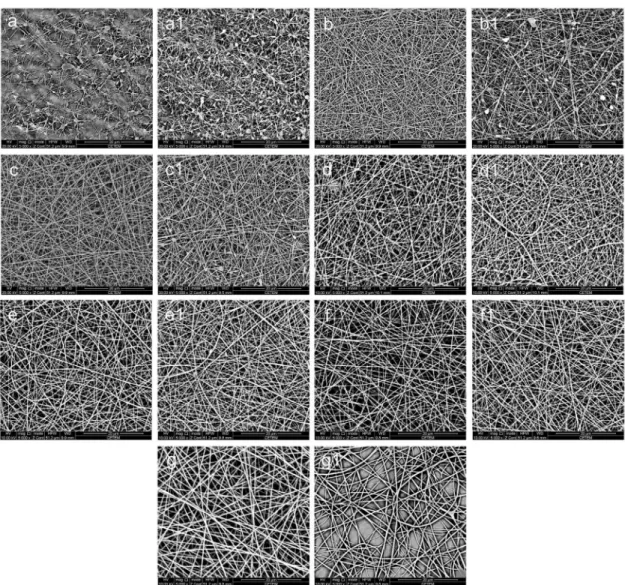
In preliminary experiments, the possibility of dispersing the PVA sample in water and the CS sample in 2% acetic acid at higher concentrations failed. The resulting solutions had very high viscosities, which made manipulation nearly impossible. The highest suitable concentrations of CS and PVA stock solutions, which allowed the preparation of the mixtures, were chosen for the study. Parameters, such as low rate, working distance and voltage were adjusted in preliminary experiments. To better investigate the electrospinning behavior of the mixtures and the morphology of the resulting mats, PVA and CS mixed solutions were electrospun at 15 and 20 kV. At irst, the 15 kV condition was discouraging, because electrospinning of other CS/
PVA aqueous solutions had been previously carried out at 15 kV, and the reported SEM images of the blended ibers were not free of defects.31 Figure 1 shows the SEM images
obtained for the M1 – M7 membranes, resulting from the electrospinning of PVA/CS mixed solutions.
In Figure 1a, ilm formation may be visualized above and below the web of ibers and bead defects. Beads are frequently observed when polymer chains do not form a conveniently deformable entangled network for conventional electrospinning. The origin of ilm formation may be attributed to the evaporation of residual solvent not vaporized during the process, and that remained encapsulated within ibers.24
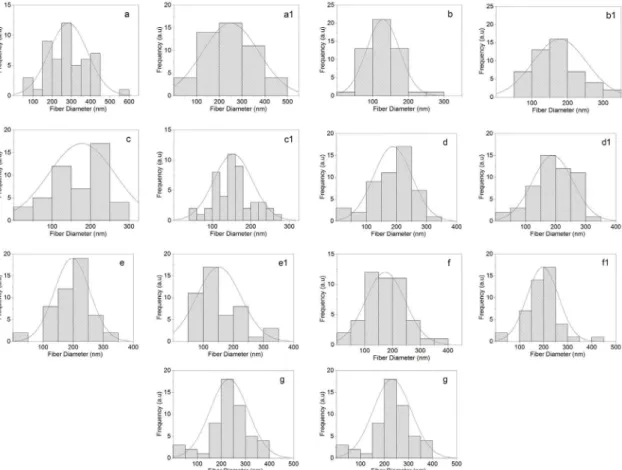
Apparently, the increase in the applied voltage from 15 kV to 20 kV reduced ilm formation in M1 (Figure 1a1), but did not prevent the formation of regular and irregular beads (Figure 1a1). Because of ilm formation and bead imperfections, the M1 mats were not considered for further studies. Figure 2 and Table 1 show that the average iber diameters varied from 129 nm to 189 nm, and from 127 nm to 181 nm, for PVA/CS mats electrospun at 15 kV and 20 kV, respectively.
According to some reported data, at least for poly(lactic acid), solutions at lower polymer concentrations give rise to electrospun ibers with smaller diameters.32 This behavior
was observed for the M2 mat, prepared from the lowest total concentration, and that presented the lowest average diameter. However, the M2 behavior was exception in relation to the other mats. It is worth observing that, in the case of PVA/CS mats of this work, as the content of PVA increased, the total polymer concentration also increased. At 20 kV, the total polymer concentration and CS composition afected signiicantly the iber diameter (Figure 2 and Table 1). Surprisingly, no such efect was observed at 15 kV for M3, M4, M5 and M6 mats from PVA/CS mixed solutions. This result indicated that, at 15 kV, the total mixture concentration and composition did not afect the average nanoiber diameter. Also, it is worth observing in Figure 1(b-f) that defect-free ibers tend to be formed preferentially at 15 kV (Figure 1b-f). Because of the unexpected result on the statistically equal diameters of their nanoibers, three mixed solutions (M3, M4 and M6) were chosen to be characterized by rheological tests. Also, these mixtures were electrospun for longer periods of time at 15 kV and the resulting mats were further characterized.
3.2. Rheological characterization of mixed
solutions for electrospinning
Figure 1. SEM images for PVA/CS nanoibers electrospun at 15 and 20 kV, respectively, from mixed solutions at 50:50 (mixture M1; a, a1), 60:40 (mixture M2; b, b1), 70:30 (mixture M3; c, c1), 75:25 (mixture M4; d, d1), 80:20 (mixture e, e1), 85:15 (mixture M6; f, f1), 100:0 (mixture M7; g, g1) compositions.
CS stock solutions at a 70:30 volume ratio, showed the typical behavior of a dilute system, without a G’ - G” crossover. No crossover was observed for the other two samples also. However, the crossover for M4 and M6 may be envisaged around 3 x
103 rads/s and 9 x 10² rad/s, respectively. This decrease in the
crossover frequency was expected, and relected the increase in total concentration, as the PVA composition was increased in the mixed solutions. The variation of viscosity as a function of shear rate was investigated for the samples (Figure 3b). A shear-thinning, pseudoplastic behavior was observed, which usually characterizes polymer solutions and dispersions. As expected, the viscosity values increased as the total composition increased.
3.3. Infrared spectroscopy (FTIR)
FTIR spectra were obtained for CS and PVA as powders (Figure 4a, traces I and II, respectively), and for the M3, M4
and M6 mats (Figure 4b, traces I, II and III, respectively). For the CS sample, the broad absorption in the range ~ 3600 cm-1 to 3000 cm-1 was assigned to O−H and N−H stretching
vibrations. The absorptions at 1658 cm-1 and 1590 cm-1 were
attributed, respectively, to the amide I (C=O stretching) and amide II (C‒N stretching and C‒N‒H bending vibrations) of amide functional groups in the solid state. For PVA, the absorption corresponding to the O−H stretching was observed at 3304 cm-1. The band at 1714 cm-1 was attributed
to C=O stretching of nonhydrolyzed vinyl acetate groups. The absorptions in the range 2930 – 2910 cm-1, present in
all spectra, were attributed to C−H stretching vibrations. The C−O asymmetric stretching band, which also appeared in the spectra obtained for all samples, was visualized around 1100 cm-1. Particularly for the mats, in relation to PVA, the
Figure 2. Diameter distributions for PVA/CS nanoibers electrospun at 15 and 20 kV, respectively, from mixed solutions at 50:50 (mixture M1; a, a1), 60:40 (mixture M2; b, b1), 70:30 (mixture M3; c, c1), 75:25 (mixture M4; d, d1), 80:20 (mixture e, e1), 85:15 (mixture M6; f, f1), 100:0 (mixture M7; g, g1) compositions.
Table 1. Fiber average diameters for PVA/CS mats
Sample PVA:CS volume ratio Fiber average diameter* at 15 kV (μm) Fiber average diameter* at 20 kV (μm)
M1 50:50 0.284 ± 0.100a 0.231 ± 0.137a
M2 60:40 0.129 ± 0.046b 0.178 ± 0.075b,c
M3 70:30 0.166 ± 0.095c 0.148 ± 0.058b
M4 75:25 0.188 ± 0.064c 0.180 ± 0.079c,d
M5 80:20 0.189 ± 0.069c 0.127 ± 0.088b
M6 85:15 0.157 ± 0.086c 0.181 ± 0.083c,d
M7 100:0 0.232 ± 0.079d 0.316 ± 0.116e
*Average diameters on the same column and with the same letter do not difer to the 5% level of signiicance.
– 3330 cm-1), whereas in relation to CS, the shift was to
lower wavenumbers. This result might be an indication of the formation of extensive intermolecular hydrogen bonds between PVA and CS chains. Some authors reported the disappearance of the band at 1255 cm-1 in CS/PVA mats, as
an indication of the formation of hydrogen bonds between the components.26 However, as can be observed in Figure 4,
the band located around 1250 cm-1 appeared in the spectra
obtained for PVA and for the PVA/CS mats.
3.4. Thermogravimetric analysis (TGA)
Figure 4. FTIR spectra for (a) chitosan (CS, trace I) and poly(vinyl alcohol) (PVA, trace II); (b) PVA/CS mats at 70:30 (M3, trace I), 75:25 (M4, trace II) and 85:15 (M6, trace III) compositions.
Figure 3. Storage modulus (open symbols) and loss modulus (full symbols) versus oscillation frequency at 25ºC and 5% strain amplitude (a), and viscosity versus shear rate at 25ºC and 5% strain amplitude (b), for the PVA/CS mixed solutions at 70:30 (squares), 75:25 (circles) and 85:15 (triangles) compositions, precursors of M3, M4 and M6 mats.
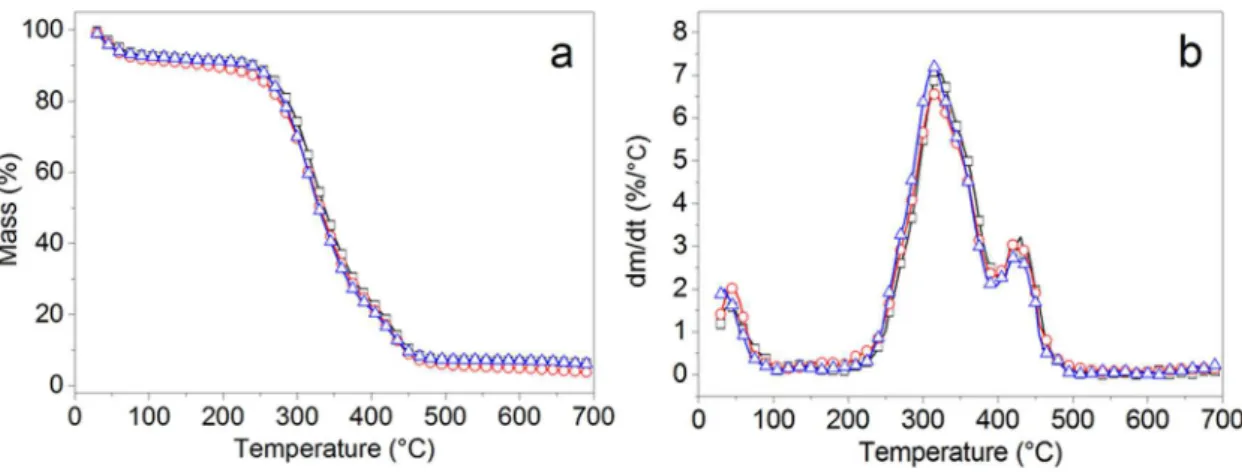
be observed in the DTG curves of Figure 5b. It is worth observing that CS alone (result not shown) showed the main thermal degradation in the range 273ºC to 375ºC, with Tmax = 293ºC, consistent with a recently reported result for CS,33
and signiicantly lower than that observed for the mats. Also, the TG curve for PVA alone showed three stages of mass loss. These stages were attributed to moisture loss, polymer dehydration and formation of polyacetylene-like structures (200ºC – 400ºC).34 Finally, around 400ºC and 550ºC, the
decomposition of PVA main chain would occur, leading to the release of carbon dioxide gas and formation of oxides.34
However, besides the peak with Tmax at 430ºC, no resolution of the peak with Tmax = 315ºC was observed in Figure 5b. The appearance of the shoulder at 360ºC might be another indication of intermolecular interaction, stabilized by hydrogen bonds, between PVA and CS macromolecular chains.
3.5. Dynamic mechanical analysis (DMA)
Dynamic mechanical analyses were carried out for the M3, M4 and M6 mats (Figure 6). Figure 6a shows the variation of the loss factor (tan δ) as a function of temperature. Two relaxations, β and α, were observed in the curves. The irst, located around –5.6ºC, had its intensity reduced as the composition of PVA decreased in the samples. This β relaxation is associated to motions of substituent groups, linked to polymers main chains. It is interesting to note that a similar event was also observed at –14.5ºC for a chitosan ilm (not electrospun) of medium molar mass.35 The occurrence
Figure 5. TG (a) and DTG (b) curves for PVA/CS mats at 70:30 (M3, squares), 75:25 (M4, circles), and 85:15 (M6, triangles) compositions.
Figure 6. Tangent delta (a) and storage modulus values (b) as a function of temperature for PVA/CS mats at 70:30 (M3, squares), 75:25 (M4, circles) and 85:15 (M6, triangles) compositions.
PVA, the substituent groups are much less constrained than the substituent groups in M3 and M4. The other more intense peak in the tan δ curves is attributed to the α relaxation and is associated to the dynamic glass transition temperature, which is generally higher than the Tg observed by DSC.
36
For the M6 sample, with the highest composition of PVA, this peak was observed at 100ºC. This peak was broader and shifted to higher temperatures, around 110ºC and 125ºC, respectively, for M4 and M3, with higher compositions of CS. Similarly, data reported by other authors on the DMA properties of PVA,37 and chitosan ilms alone,35 revealed
expressively lower Tg values (25ºC and 46.8ºC, respectively).
This behavior suggested restricted segmental motions in the amorphous region of the mats, and corroborated FTIR and TGA data, on the idea that these nanoibers are formed by interacting PVA and CS macromolecules.
Figure 6b shows the evolution of the storage modulus (E’) as a function of temperature for the M3, M4 and M6 samples. At low temperatures, in the glassy state, E’ decreased
Figure 7. Stress versus strain curves for PVA/CS mats at 70:30 (M3, squares), 75:25 (M4, circles) and 85:15 (M6, triangles) compositions.
Figure 8. SEM images for PVA/CS mats at 70:30 (M3, a), 75:25 (M4, b) and 85:15 (M6, c) compositions, after immersion in water.
temperature range studied. The E’ values recorded at 25ºC were 34 MPa, 128 MPa and 167 MPa for M6, M4 and M3, respectively. The M3 mat, with the highest content of CS, maintained higher E’ values even at its Tg, at 125ºC. This
stifening efect indicated the more restricted segmental motions in M3 macromolecules, when compared to the other mats, and conirmed the occurrence of intermolecular PVA/CS interactions, as detected by FTIR and TGA results.
3.6. Tensile tests
The mechanical properties of the M3, M4 and M6 mats were investigated by uniaxial tensile tests, and the stress
versus strain curves are shown in Figure 7. As expected, the mechanical parameters found for the mats were lower than those reported for a bulk ilm of medium molar mass CS, analyzed by a similar methodology.35 The highest Young’s
modulus (E = 201.7 ± 13.2 MPa), the lowest elongation at break (εmax = 3.96 ± 0.45%) and tensile stress at break (σmax = 4.15 ± 0.41 MPa) were determined for the M3 mat. This result indicated that CS contributed to the hardness and brittleness of this sample. With increasing PVA contents, expressive diferences were observed. The M4 sample presented intermediate values of E = 173.6 ± 12.6 MPa, σmax = 4.97 ± 0.53 and εmax = 7.53 ± 0.87%. The highest ductibility was obtained for M6, with the highest composition of PVA, for which E = 94.2 ± 10.2 MPa, σmax = 6.13 ± 0.72 MPa and εmax = 14.13 ± 1.25%. The highest value of εmax, found for the PVA-richest sample, characterized the most lexible mat.
3.7. Immersion of PVA/CS electrospun
membranes in water
The M3, M4 and M6 samples were immersed in water to investigate how their composition interfered on their morphology, after a possible dissolution of PVA. Other authors also reported on PVA extraction from mixed PVA/CS nanoibers, resulting in diferent morphologies. In the irst work, the PVA/CS nanoibers, prepared with a high molar mass PVA, were treated with aqueous NaOH. The pores and holes observed by the authors were
attributed to phase separation.25 On the other hand, extraction of
a high molar mass PVA (degree of hydrolysis 98 - 99%) with 0.5 M NaOH from PVA/CS mats led to nanoibers with decreasing diameters, from 150 – 300 nm to 80 – 150 nm.38 Contrarily, in
this study, no ibers could be observed. In the SEM images of the water-treated and dried membranes (Figure 8), broken nanoibers were agglomerated and transformed into sheets. This result seems to indicate that, at the breakage points, ibers were formed by PVA macromolecules alone, whereas the remaining sheets, resulting from nanoibers agglomeration, consisted of PVA and CS interacting macromolecules. Probably, the agglomeration of nanoibers was caused by swelling of PVA molecules, followed by adhesion of the PVA/CS ibers. For M3 and M4 (Figure 8a and 8b, respectively), the rigidity detected by DMA and by tensile tests was relected in the lower-like structures, which are clearly more rigid than those observed for the water-treated M6 sample (Figure 8c). In the latter case, although sheets were also visualized, their lexibility was evidenced by their inward features.
4. Conclusions
5. Acknowledgements
The authors acknowledge Conselho Nacional de Desenvolvimento Cientíico e Tecnológico (CNPq) (Grant Nº 471676/2013-6) for inancial support.
6. References
1. Lamarque G, Viton C, Domard A. Comparative Study of the irst Heterogeneous Deacetylation of α- and β-Chitins in a
Multistep Process. Biomacromolecules. 2004;5(3):992-1001.
DOI: 10.1021/bm034498j
2. Lamarque G, Lucas JM, Viton C, Domard A. Physicochemical Behavior of Homogeneous Series of Acetylated Chitosans in Aqueous Solution: Role of Various Structural Parameters. Biomacromolecules. 2005;6(1):131-142. DOI: 10.1021/bm0496357
3. Liu L, Zhou S, Wang B, Xu F, Sun R. Homogeneous acetylation of chitosan in ionic liquids. Journal of Applied Polymer Science. 2012;129(1):28-35. DOI: 10.1002/app.38701
4. Ngo DH, Vo TS, Ngo DN, Kang KH, Je JY, Pham HND, et al. Biological efects of chitosan and its derivatives. Food Hydrocolloids. 2015;51:200-216. DOI: 10.1016/j.foodhyd.2015.05.023 5. Anraku M, Fujii T, Kondo Y, Kojima E, Hata T, Tabuchi N, et al.
Antioxidant properties of high molecular weight dietary chitosan
in vitro and in vivo. Carbohydrate Polymers.
2011;83(2):501-505. DOI: 10.1016/j.carbpol.2010.08.009
6. Katiyar D, Singh B, Lall AM, Haldar C. Efficacy of chitooligosaccharides for the management of diabetes in alloxan induced mice: A correlative study with antihyperlipidemic and
antioxidative activity. European Journal of Pharmaceutical
Sciences. 2011;44:534-543. DOI: 10.1016/j.ejps.2011.09.015
7. Fernandes JC, Tavaria FK, Soares JC, Ramos OS, Monteiro MJ, Pintado ME, et al. Antimicrobial efects of chitosans
and chitooligosaccharides, upon Staphylococcus aureus and
Escherichia coli, in food model systems. Food Microbiology. 2008;25(7):922-928. DOI: 10.1016/j.fm.2008.05.003
8. Du H, Liu M, Yang X, Zhai G. The design of pH-sensitive
chitosan-based formulations for gastrointestinal delivery. Drug
Discovery Today. 2015;20(8):1004-1011. DOI: 10.1016/j. drudis.2015.03.002
9. Prabaharan M. Chitosan-based nanoparticles for tumor-targeted drug
delivery. International Journal of Biological Macromolecules.
2015;72:1313-1322. DOI: 10.1016/j.ijbiomac.2014.10.052 10. Basha RY, Kumar S, Doble M. Design of biocomposite materials
for bone tissue regeneration. Materials Science and Engineering:
C. 2015;57:452-463. DOI: 10.1016/j.msec.2015.07.016
11. Matthews JA, Wnek GE, Simpson DG, Bowlin GL. Electrospinning
of Collagen Nanoibers. Biomacromolecules.
2002;3(2):232-238. DOI: 10.1021/bm015533u
12. Elsabee MZ, Naguib HF, Morsi RE. Chitosan based nanoibers,
review. Materials Science and Engineering: C.
2012;32(7):1711-1726. DOI: 10.1016/j.msec.2012.05.009
13. Doshi J, Reneker DH. Electrospinning process and applications
of electrospun ibers. Journal of Electrostatics.
1995;35(2-3):151-160. DOI: 10.1016/0304-3886(95)00041-8
14. Agarwal S, Wendorf JH, Greiner A. Use of electrospinning technique for biomedical applications. Polymer. 2008;49(26):5603-5621. DOI: 10.1016/j.polymer.2008.09.014
15. Ghorani B, Tucker N. Fundamentals of electrospinning as a novel delivery vehicle for bioactive compounds in food
nanotechnology. Food Hydrocolloids. 2015;51:227-240. DOI:
10.1016/j.foodhyd.2015.05.024
16. Salles THC, Lombello CB, d’Ávila MA. Electrospinning of Gelatin/Poly (Vinyl Pyrrolidone) Blends from Water/Acetic
Acid Solutions. Materials Research. 2015;18(3):509-518. DOI:
10.1590/1516-1439.310114
17. McKee MG, Wilkes GL, Colby RH, Long TE. Correlations of Solution Rheology with Electrospun Fiber Formation of Linear
and Branched Polyesters. Macromolecules.
2004;37(5):1760-1767. DOI: 10.1021/ma035689h
18. Min BM, Lee SW, Lim JN, You Y, Lee TS, Kang PH, et al. Chitin and chitosan nanoibers: electrospinning of chitin and
deacetylation of chitin nanoibers. Polymer.
2004;45(21):7137-7142. DOI: 10.1016/j.polymer.2004.08.048
19. Klossner RR, Queen HA, Coughlin AJ, Krause WE. Correlation of Chitosan’s Rheological Properties and Its Ability to Electrospin. Biomacromolecules. 2008;9(10):2947-2953. DOI: 10.1021/ bm800738u
20. Ohkawa K, Cha D, Kim H, Nishida A, Yamamoto H. Electrospinning
of Chitosan. Macromolecular Rapid Communications.
2004;25(18):1600-1605. DOI: 10.1002/marc.200400253 21. Ohkawa K, Minato KI, Kumagai G, Hayashi S, Yamamoto H.
Chitosan Nanoiber. Biomacromolecules.2006;7(11):3291-3294.
DOI: 10.1021/bm0604395
22. Homayoni H, Ravandi SAH, Valizadeh M. Electrospinning of
chitosan nanoibers: Processing optimization. Carbohydrate
Polymers. 2009;77(3):656-661. DOI: 10.1016/j.carbpol.2009.02.008 23. Pakravan M, Heuzey MC, Ajji A. A fundamental study of chitosan/
PEO electrospinning. Polymer. 2011;52(21):4813-4824. DOI:
10.1016/j.polymer.2011.08.034
24. Cheng F, Gao J, Wang L, Hu X. Composite chitosan/poly(ethylene oxide) electrospun nanoibrous mats as novel wound dressing
matrixes for the controlled release of drugs. Journal of Applied
Polymer Science. 2015;132(24). DOI: 10.1002/app.42060
25. Li L, Hsieh YL. Chitosan bicomponent nanoibers and nanoporous
ibers. Carbohydrate Research. 2006;341(3):374-381. DOI:
10.1016/j.carres.2005.11.028
26. Jia YT, Gong J, Gu XH, Kim HY, Dong J, Shen XY. Fabrication and characterization of poly(vinyl alcohol)/chitosan blend nanoibers
produced by electrospinning method. Carbohydrate Polymers.
2007;67(3):403-409. DOI: 10.1016/j.carbpol.2006.06.010
27. Hadipour-Goudarzi E, Montazer M, Latii M, Aghaji AAG. Electrospinning of chitosan/sericin/PVA nanoibers incorporated
within situ synthesis of nano silver. Carbohydrate Polymers.
2014;113:231-239. DOI: 10.1016/j.carbpol.2014.06.082
29. Zhang C, Yuan X, Wu L, Han Y, Sheng J. Study on morphology of
electrospun poly(vinyl alcohol) mats. European Polymer Journal.
2005;41(3):423-432. DOI: 10.1016/j.eurpolymj.2004.10.027 30. Kaya M, Asan-Ozusaglam M, Erdogan S. Comparison of
antimicrobial activities of newly obtained low molecular weight scorpion chitosan and medium molecular weight
commercial chitosan. Journal of Bioscience and Bioengineering.
2016;121(6):678-684. DOI: 10.1016/j.jbiosc.2015.11.005
31. Zhang Y, Huang X, Duan B, Wu L, Li S, Yuan X. Preparation of
electrospun chitosan/poly(vinyl alcohol) membranes. Colloid
and Polymer Science. 2007;285(8):855-863. DOI: 10.1007/ s00396-006-1630-4
32. Tan SH, Inai R, Kotaki M, Ramakrishna S. Systematic parameter study for ultra-ine iber fabrication via electrospinning
process. Polymer. 2005;46(16):6128-6134. DOI: 10.1016/j.
polymer.2005.05.068
33. Zhang H, Luo X, Lin X, Lu X, Zhou Y, Tang Y. Polycaprolactone/
chitosan blends: Simulation and experimental design. Materials
& Design. 2016;90:396-402. DOI: 10.1016/j.matdes.2015.10.108
34. Mallakpour S, Abdolmaleki A, Khalesi Z, Borandeh S. Surface functionalization of GO, preparation and characterization of
PVA/TRIS-GO nanocomposites. Polymer. 2015;81:140-150.
DOI: 10.1016/j.polymer.2015.11.005
35. Bof MJ, Bordagaray VC, Locaso DE, García MA. Chitosan molecular weight efect on starch-composite ilm properties. Food Hydrocolloids. 2015;51:281-294. DOI: 10.1016/j. foodhyd.2015.05.018
36. Lewandowska K. Miscibility and thermal stability of poly(vinyl
alcohol)/chitosan mixtures. Thermochimica Acta.
2009;493(1-2):42-48. DOI: 10.1016/j.tca.2009.04.003
37. Cho MJ, Park BD. Tensile and thermal properties of
nanocellulose-reinforced poly(vinyl alcohol) nanocomposites. Journal of
Industrial and Engineering Chemistry. 2011;17(1):36-40. DOI: 10.1016/j.jiec.2010.10.006