*e-mail: [email protected]
Trabalho apresentado no XV CBECIMAT, Natal - RN, Novembro de 2002.
Morphological Analysis of Polymers on Hair Fibers by SEM and AFM
Valéria Fernandes Monteiro*, Aline Martins Duboc Natal,
Luís Edmundo Bastos Soledade, Elson Longo
CMDMC, LIEC, UFSCar
Rod. Washington Luís, km 235, C.P. 676, 13565-905 São Carlos - SP, Brazil
Received: February 4, 2003; Revised: July 27, 2003
The polyquaternium 7 polymer is widely used in cosmetic formulations. Morphologic al-terations in hair fibers were observed after the application of the polyquaternium 7 polymer, using SEM and AFM. Continuous applications of this product indicated that it accumulates on the fibers, improving the aspect of the hair surface. Quantitative analysis of the images obtained by AFM was undertaken. The data obtained for the hair surface roughness indicates that the fibers treated with the polymer presented higher roughness than the untreated hair fibers.
Keywords:Polymers, SEM, AFM
1. Introduction
The interactions between apolar solids and solids pre-senting low polarity take place by van der Waals type forces. These forces are labile and difficult to be analyzed by con-ventional methods. The hair is constituted basically by the keratin biopolymer. The keratin is formed by amino acids resulting in complex polymeric structures of low polarity. These polymeric structures interact with other polymers causing changes in the surfaces1.
The study of the behavior of human hair surface is of great interest for the cosmetic science. The hair surface is responsible for the diffusion of compounds that promote changes in the cuticular surface, such as the cosmetic prod-ucts that are deposited on the surface1.
Polymers are usually used in hair cosmetic formulations for the improvement of the hair surface. The polymeric materials adhere to the hair surface by van der Waals type forces. Several techniques have been proposed for the evalu-ation of the morphologic changes in the hair surface after treatments with solutions containing polymers1,3.
Cationic polymers are very used in shampoo formula-tions. These compounds added to the formulation lead to several surface modifications that range from the formation of a protecting film on the hair fibers to the synergic action that improves the performance of other products toward the improvement of the features related to the aspect of hair, such as softness and easiness of combing. These structures
interact with other polymeric structures, resulting in changes in the surface1.
The polyquaternium 7 polymer is thoroughly used in
cosmetic formulations. It is a cationic copolymer consti-tuted by acrylamide and diallyldimethyl ammonium chlo-ride.
Morphological changes of hair fibers, such as the ones due to the adsorption of polymers on hair fibers can be ob-served by means of SEM and AFM1,3.
The analysis based on SEM allows to evaluate gradual changes in the surface structure of human hair. Ruetsch
et al., using field emission scanning electron microscopy
(FESEM), monitored the effects of UV radiation on the physical nature of hair fibers. They observed solubilization of melanin granules that causes the loss of color of hair2.
502 Monteiro et al. Materials Research
are of the order of 10-9 N. AFM has two modes of applied
force, contacting and noncontacting modes. In the contact-ing mode, the force that the cantilever exerts on the sample caused by displacements in the z-axis of the piezoelectric sensor, allows the quantification of surface properties of the material being analyzed. In noncontacting mode the image is obtained by tapping the surface with an oscillating tip that measures the van der Waals interactions3,4.
Mattoso et al.4 compared the AFM and SEM techniques
to be applied in the analysis of polymeric materials. They indicate the advantages of AFM in terms of easier imaging of soft samples and obtaining better resolution of images at molecular and/or atomic scales.
Swift and Smith5, using AFM, had verified that the
cuticular surfaces of hair did not appear to be as smooth as had been previously supposed to be, when evaluated by SEM. They had observed that different features of the hair fibers gradually change along its length from the root to the end of the fiber.
This paper presents results of the use of SEM and AFM to investigate the changes in the morphology of hair fibers sub-mitted and not to a solution containing polyquaternium 7
polymer. The roughness of the surface is a feature of the hair morphology that will be herein discussed.
2. Experimental
2.1. Material
Untreated black Caucasian hair was obtained from De Meo Brothers, New York, USA. Hair tresses weighing ap-proximately 1.0 g each one were prepared for this work.
2.2. Testing Bleaching:
The bleach solution was prepared by mixing a 6% hy-drogen peroxide (H2O2) solution with a concentrated am-monium hydroxide solution and amam-monium persulfate pow-der in a 2:1:1 weight proportion, respectively. The hair tresses remained in the bleach solution for 30 min. The bleaching of the hair tresses without any further treatment is hereinaf-ter called control bleached treatment.
Hydrogen peroxide is normally used in hair paints. Hairs damaged by the action of oxidizing agents such as peroxides probably adsorb a higher amount of polymers, due to the higher irregularity of the damaged hair surfaces, what in-creases the contact area and the number of the fiber surface charges1.
Treatment with polyquaternium 7 polymer:
The polyquaternium 7 polymer, see structure in
Fig. 1, was acquired from Ciba Company.
The hair tresses were washed 5 times with a solution containing 1% of polyquaternium 7. 200 µl of the
solu-tion were kept for 30 s in contact with the hair fibers, which were rinsed in distilled water for 1 min and then dried at room temperature. This procedure represents one washing. The treatment with the polymer is always performed in hair tresses previously submitted to bleaching.
Two techniques were used to evaluate the hair surface polymer interaction, as well as to investigate the hair bleach-ing process:
The Scanning Electron Microscopy (SEM) technique has been used to identify morphological changes on the hair surface.
Longitudinal segments of bleached untreated fibers and fibers treated with the polymer were mounted in an aluminum substrate at an angle of 45° and coated with gold with thickness of approximately 90 Å. The hair fiber topography was examined with a ZEISS 940-A digital SEM. The objective was to analyze the morphological alterations in untreated hair and in the polymer-treated hair.
The Atomic Force Microscopy (AFM) technique was used to analyze the hair morphology at different environ-mental conditions. It allows the direct study of the cuticle roughness. The 1% polymer solution was analyzed by the deposition of a fine layer on a glass substrate by using a spin-coater.
Atomic force microscopy studies were performed using a Digital III- Instrument under atmospheric conditions at 25 °C. Imaging was obtained in the contact mode using sili-con nitride profile tips mounted in a cantilever of 3.6 nN force constant. AFM images were processed using the Nanoscope software.
3. Results and Discussion
3.1. SEM
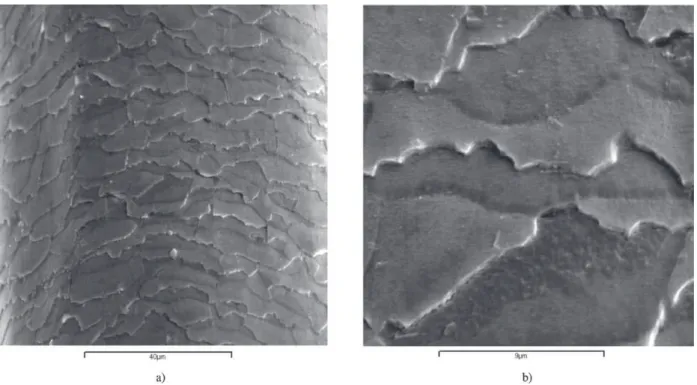
Images obtained by SEM of control bleaching treatment showed damaged cuticle edges (Fig. 2a and 2b). The bleached, hair treated 5 times with polyquaternium 7
so-lution showed a higher roughness, caused by the polymer deposition on the hair surface (Fig. 3a and 3b).
3.2. AFM
hair surface of 20 µm and 5 µm representing an
enlarge-ment of 8500× and 13000×, respectively (Fig. 4a - 4b, 5a - 5b
and 6a - 6b).
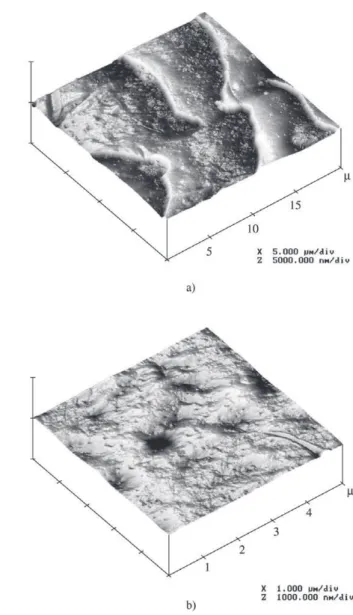
In Fig. 4a and 4b are showed the images of the polymer deposited on glass substrate by a spin-coater. The polymer morphology exhibits a rough surface with polymeric parti-Figure 2. Images obtained by SEM of control bleached hair. a) 1000×; b) 5000×.
504 Monteiro et al. Materials Research
cles of approximated 2.40 µm and their aggregates dispersed
on the surface. The value of roughness of this surface was 2.543 nm ± 0.16, as measured by AFM, see Table 1.
In Fig. 5a - 5b and 6a - 6b are presented surface images of untreated and polyquaternium 7 treated hair fibers,
re-spectively. Figures 5a and 5bB show the degraded cuticle surface and the detail of a cuticle face with the formation of pores, caused by the bleaching solution (Fig. 5b).
The root mean square (RMS) surface roughness of the bleached hair can be calculated by using the software of the AFM instrument. These data supply the quantification of the degradations suffered by the hair in the bleaching treat-Figure 4. AFM images of polyquaternium 7polymer deposited
on glass substrate: a) 20 µm; b) 5 µm. Figure 5. AFM images of control bleached hair: a) 20 µm; b) 5 µm.
Table 1. Roughness values (RMS) obtained in 1.719 × 1.719 µm areas, from 20 × 20 µm fields.
Process Roughness (nm)
Glass substrate on which 2.54 ± 0.16
Polyquaternium 7 was deposited.
Hair submitted to the 17.0 ± 6.3
bleaching treatment Hair sequentially submitted to
27.5 ± 7.0 bleaching and
Figure 6. AFM images of bleached hair treated with polyquaternium7 polymer: a) 20 µm; b) 5 µm.
Figure 7. Example of a quantitative roughness analysis of the com-plete image of polyquaternium7 polymer of a selected region of the image, using the Nanoscope software.
ment (Fig. 6a and 6b). The bleached hair, treated with polyquaternium 7 presents a higher surface roughness than
the control bleached hair images, indicating that the poly-mer interacted with the hair surface, remaining on the sur-face, even after the rinses (Fig. 6a - 6b). This result sug-gests that a kind of film is deposited on the bleached hair. This statement is supported by the diminishment of the static load observed in the hair treated with polyquaternium 7.
The easier combing observed for the polymer-treated hair supports this reasoning.
The changes in the surface of the hair fibers can be quan-tified by a software called Nanoscope. In the AFM images
it is possible to quantify the roughness of the total area and of small selected areas on the cuticular surface (Fig. 7).
The root mean square (RMS) roughness of a bleached hair and of a hair treated with a polyquaternium 7 was
calculated using the Nanoscope software. The medium
roughness values obtained after each treatment are presented in Table 1, as well the roughness of a surface of the poly-mer deposited on a glass substrate, as previously com-mented. Its was observed that the polyquaternium 7
poly-mer deposited on the hair surface increases the hair surface roughness. The change in the bleached hair surface rough-ness observed upon the treating with the polymer indicates its adsorption on the hair fibers. The interaction between the hair surface and the polymer suggested by the rough-ness modification can cause a decrease in the static load of the hair, increasing the softness of the hair by the decrease of the attrition among the fibers.
4. Conclusions
The use of SEM allowed to evaluate the morphological changes occurred in the bleached hair surface submitted or not to a treatment with polyquaternium 7.
mor-506 Monteiro et al. Materials Research
phological changes in the hair under ambient conditions. The polyquaternium 7 polymer interacted with the hair
surface, increasing the hair surface roughness. This result, the SEM images, the decrease of static loads and the easier combing of the polymer-treated hair indicate that a kind of film is deposited on the bleached hair, upon such a treat-ment.
Acknowledgments
The authors acknowledge the following Brazilian fund-ing support agencies: CNPq, CEPID, CAPES and FAPESP.
References
1. Robbins, C.R. Chemical and Physical Behavior of
Human Hair, SPRINGER - Ed. Verlag,3rd ed, p. 391,
1994.
2. Ruetsch, S.B.; Kamath, Y.; Weigmann, H.D. Photodegradation of Human Hair: An SEM Study Jour-nal Cosmetology Science, v. 51, p. 103-125, 2000.
3. Goddard, E.D.; Schmitt, R.L. Atomic force microscopy investigation into adsorption of cationic polymers, Cos-metic & Toiletries, v. 109, p. 55-61, 1994.
4. Mattoso, L.H.C.; Ferreira, F.C.; Herrmann, P.S.P.; Mar-tin, A. R.; Pereira-Da-Silva, M.A.; Paterno, L.G.; Piza, M.A.; Curvelo, A.A.S.; Colnago, L.A.; Denes, F. Atomic Force Microscopy as a Tool for the Evaluation of Natu-ral Fibers and Polymers Surface. The Fifth International Conference on Woodfiber-Plastic Composites, Madison,
Wisconsin, p. 43-56, 1999.