ISSN 0104-6632 Printed in Brazil
www.abeq.org.br/bjche
Vol. 34, No. 01, pp. 253 - 261, January - March, 2017 dx.doi.org/10.1590/0104-6632.20170341s20150418
Brazilian Journal
of Chemical
Engineering
SPINNABILITY, MORPHOLOGY AND
MECHANICAL PROPERTIES OF GELATINS
WITH DIFFERENT BLOOM INDEX
E. Niehues and M. G. N. Quadri
*Porous Systems Laboratory, Department of Chemical and Food Engineering, Federal University of Santa Catarina, UFSC, Centro Universitário (Trindade),
Zip Code: 88040900; Florianópolis - SC, Brazil. Phone: + 55 48 33319822, Fax: + 55 48 33319687
E-mail: [email protected]
(Submitted: July 3, 2015 ; Revised: October 14, 2015 ; Accepted: November 24, 2015)
Abstract - The influence of the concentration, viscosity, electrical conductivity and Bloom index of gelatin solutions on the electrospinning process and the fibrous membrane formed was evaluated. Electrospun membranes were produced at different concentrations for three Bloom values (90, 250 and 280); the solutions were evaluated in terms of viscosity and electrical conductivity and the fibrous membranes by SEM and tensile tests. Results indicate that the electrospinning was most successful when the solution viscosity was within the range of 300 to 700 mPa·s, regardless of the type of gelatin used in the investigated conditions. The average fiber diameter increased with the increased solution viscosity and the relationship between them was well described by a linear equation. With regard to the mechanical properties, GeB250 and GeB280 fibrous membranes showed elongation, on average, at least ten times higher than that of GeB90 membranes.
Keywords: Electrospinning; Biopolymer; Physical characterization.
INTRODUCTION
Natural polymers have been widely studied be-cause they are biodegradable, biocompatible and relatively inexpensive, thereby enabling applications in food, medical and pharmaceutical areas. Gelatin, an example of a natural polymer, has been studied pure or in composite formulas for several applica-tions such as tissue engineering scaffolds (Azhar et al., 2014), edible coating (Poverenov et al., 2014), adhesives for wound healing (Shefy-Peleg et al., 2014), and drug delivery (Phadke et al., 2014), among others. In the last decade, researchers have stimulated studies of gelatin applications using elec-trospinning and producing membranes with specific fiber arrangements (Ki et al., 2005; Song et al., 2008; Ratanavaraporn et al., 2010; Panzavolta et al.,
polymer properties, mainly molecular weight and ion formation in the solution. Therefore knowledge of the polymer solution characteristics to be electrospun is an important background.
Gelatin may be classified by the type, A or B, and the Bloom index. Gelatin type A is derived from acid-processed collagen, while type B is obtained through alkaline collagen treatment, resulting in products with different isoelectric points: pI 7–9 for gelatin type A and pI 4–5 for gelatin type B (Saxena
et al., 2005). The Bloom value is the weight, in grams, required for a specified plunger to depress the surface of a standard, thermostatted gel by 4 mm under standard conditions; a higher Bloom index indicates a higher gel strength (Schrieber and Gareis, 2007). In the literature, the relationship between the Bloom index, viscosity, triple helix and molecular weight can be found. The conversion of collagen to gelatin involves disruption of hydrogen bonding and van der Waals attractions between imino residues on different chains, destabilizing triple-helical regions of collagen, leading to a decrease in molecular order (Segtnan and Isaksson, 2004). The gel strength is mainly dependent on the proportion of fractions with a molecular weight of approximately 100000 g mol-1, whereas the viscosity is primarily a function of those with a molecular weight ranging from 200000 to over 400000 g mol-1. For this reason, depending on the method of manufacture, gelatins of the same Bloom value can have quite different viscosities (Schrieber and Gareis, 2007). Bigi et al. (2004) re-port that, in general, the Bloom number is propor-tional to the triple-helix content of a specific gelatin and the viscosity increases as the higher molecular weight fractions increase. Lai (2009) indicated that high Bloom strength gelatins have higher viscosity than samples with a low Bloom index.
Another characteristic of gelatin is that the higher the Bloom, the lighter the color. The coloration in-tensity of the gelatin increases with increasing reac-tion time due to the Maillard reacreac-tion between pro-teins and traces of carbohydrates in the raw material. Other chemical reasons, not yet precisely clarified, can be responsible for the increase in the color inten-sity of this kind of material. The addition of legally approved oxidizing or reducing bleaching agents such as hydrogen peroxide or sulfur dioxide can also render the product lighter in color (Schrieber and Gareis, 2007).
Researchers have electrospun gelatin by evaluat-ing the type of solvent used (Choktaweesap et al., 2007; Song et al., 2008; Songchotikunpan et al., 2008; Zha et al., 2012; Erencia et al., 2014), the experimental parameters (Huang et al., 2004; Ki et
al., 2005; okutan et al., 2014) and the type of gelatin hydrolysis, acid (type A) or basic (type B) (Ratanava-raporn et al., 2010). However, considering the varie-ty of different gelatin molecular structures, few stud-ies evaluate these propertstud-ies. The influence of Bloom index on mechanical properties of films produced by the casting mode have been investigated by Bigi et al. (2004) and, associated wth enzyme immobiliza-tion, by Kempka et al. (2014). However, this proper-ty has not yet been evaluated in the electrospinning process. The aim of this research was to investigate the effect of three different Bloom index gelatins on the spinnability, morphology and mechanical proper-ties of the fibrous membranes produced.
MATERIALS AND METHODS
Solution Preparation
Adequate amounts of gelatin powder type A, from porcine skin, with three different Bloom indexes (90, 250 and 280), kindly supplied by the Gelnex gelatin factory (Itá, Santa Catarina, Brazil), were dissolved in 3 mL of 90% acetic acid (v/v) and stirred at 40 °C for 30 minutes, followed by a subsequent stirring at room temperature for 60 min. In this paper, the gela-tin solutions in acetic acid were designated as GeB90, GeB250 and GeB280 in accordance with each Bloom index evaluated. Solutions prepared in various concentrations, ranging from 12 to 32% (w/v) for GeB90, and from 12 to 24% (w/v) for GeB250 and GeB280, were previously characterized by the apparent viscosity at 100 rpm using a Haake 6L Plus viscometer, and by the solution conductivity with a Tecnopon MCA-150 conductivimeter. The polymer and the solvent were used as provided with-out further purification. All measurements were du-plicated at 23.0±0.1 °C.
Electrospinning of Gelatin Solution
Two milliliters of completely dissolved gelatin solution were transferred to a 5 mL glass syringe with a 21 G syringe needle, and electrospun at 10 μL min-1 carefully at a controlled flow rate using a sy-ringe pump (N Era Pump Systems NE-300). The applied voltage was 17.0±0.5 kV, and the distance between the needle tip and the grounded collector (Al sheet, 60×60 mm2) was 17 cm. The tempera-ture was 23.0±0.5 °C, and relative humidity was 55.0±2.0%.
quality produced during the process. A bad classifi-cation corresponds to an electrospinning jet breaking up into small droplets frequently or difficulty in ejecting the jet; the good category means fiber for-mation with a few droplets reaching the collector, and the excellent classification was given to the con-dition when no droplets were observed in the collec-tor, yielding a homogeneous film.
Microscopy
The morphology of the as-spun fibers was exam-ined by scanning electron microscopy (SEM) (JSM-6390LV, JEOL), and the fiber diameters were deter-mined by performing at least 50 measurements for each specimen to obtain an average value, using the Size Meter 1.1 program (LCP-UFSC, 2012).
Mechanical Properties
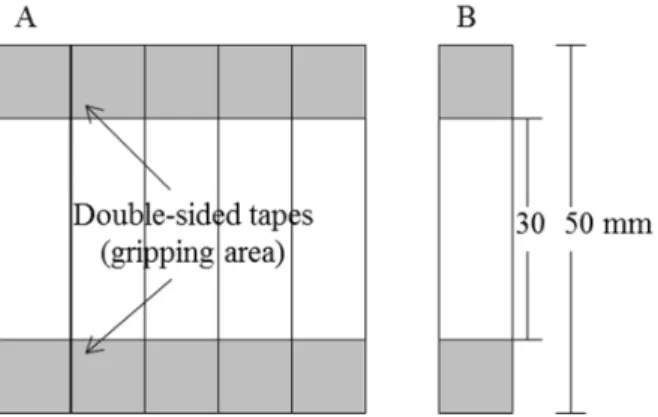
The samples submitted to a tensile test were pre-pared according to Huang et al. (2004) and Chen et al. (2009). First, double-sided tapes were glued onto the top and bottom areas of one side of a cut white paper template (50x50 mm2), as shown in Figure 1A. This template was glued onto the fiber mat topside, which was cut into rectangular pieces (10×50 mm2) along the vertical lines as shown in Figure 1B. Then, the aluminum foil was carefully peeled off and sin-gle-sided tapes were applied onto the gripping areas as end tabs.
Figure 1: (A) A paper template model used to pre-pare tensile specimens of the electrospun nonwoven fiber membrane, and (B) a tensile specimen model.
Tensile tests were performed using a texturometer (TA. HD. Plus, Stable Micro Systems) with a load cell of 500 N and displacement rate of 10 mm.min-1 at 23 °C. The initial distance between the texturome-ter grips was 30 mm. The fiber mat thickness was
measured by a digital micrometer (Digimess, IP54) and at least five measurements for each material were taken; the average was calculated for each elec-trospun mat.
RESULTS AND DISCUSSION
Effect of Solution Concentration
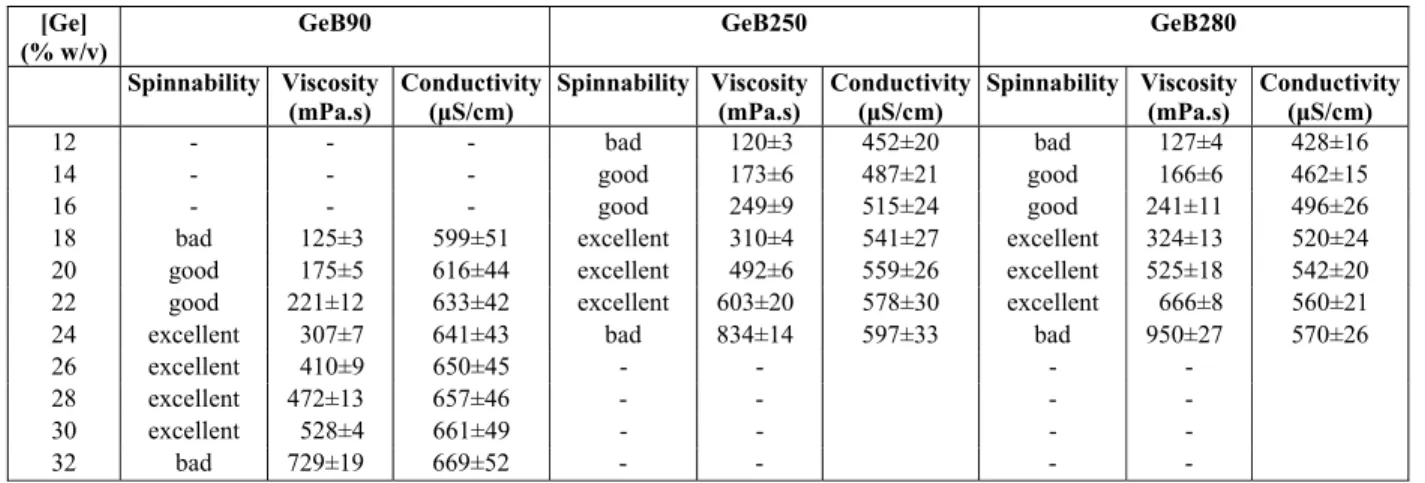
The spinnability, electrical conductivity and vis-cosity of GeB90, GeB250 and GeB280 gelatin solu-tions in 90% (v/v) acetic acid, at concentrasolu-tions from 18 to 32%, 12 to 24% and 12 to 24% (w/v), respec-tively, were evaluated. Table 1 presents the results of conductivity and viscosity, as well as the spinnability quality for all types of gelatin Bloom index. It was observed that conductivity increases as the solution concentration increases, which can be attributed to the increase in the total amount of ions in solution. It must be noted that gelatin is a kind of polyelectro-lyte, with ionizable groups such as amine and car-boxylic functional groups, susceptible to ionization by acidic agents; these groups can also be hydro-lyzed to carry positive or negative charges (Huang et al., 2004; Songchotikunpan et al., 2008). At the same concentration, the conductivity value increases as the Bloom index decreases; this provides evidence that the lower the Bloom index, the smaller the size of the polymer chains, thereby increasing the number of ionizable terminal groups, such as amine and car-boxyl groups.
The viscoelastic property of polymeric fluids has been identified as the most important parameter to be considered in the electrospinning process operation and this property can be well represented by a simple measurement of solution viscosity to indicate the spinnability (Ratanavaraporn et al., 2010). The vis-cosity values of the gelatin solutions were found to increase with increasing gelatin concentration [Ge] (Figure 2a), the result of a greater number of poly-mer chain entanglements within the solution. It can also be observed that the viscosity values for GeB90 were much smaller than those for GeB250 and GeB280 and the latter were very similar to each oth-er from 12 to 20% (w/v).
straight lines with different slopes. For the points at which the two straight lines in the former and the latter plot meet, a critical concentration can be de-fined (Hayahara and Takao, 1968). The existence of these critical quantities has been discussed in terms of the entanglements among polymer chains that are necessary to maintain the continuity of the jet and the fiber formation during the electrospinning (Gupta
et al., 2005; Ramakrishna et al., 2005; Shenoy et al., 2005). Figure 2b show the double logarithmic rela-tionship between apparent viscosity and polymer concentration of gelatin solutions having different Bloom index in 90% (v/v) acetic acid. As can be seen, a single straight line was well adjusted for each gelatin type (Equations, 1, 2 and 3 for GeB90, GeB250 and GeB280, respectively), indicating that the concentration ranges studied are above the criti-cal concentration because there was fiber formation for all solutions evaluated.
2 a
log 1.65 2.99log C R 0.99 (1)
2 a
log 0.96 2.79log C R 0.99 (2)
2 a
log 1.15 2.96log C R 0.98 (3)
The spinnability of GeB90, GeB250 and GeB280 at low concentrations showed bad spinnability char-acterized by droplet formation, resulting from low solution viscosity (Fong et al., 1999; Mit-Uppatham
et al., 2004). The spinnability improved with increas-ing concentration of the solution, but at excessively high concentrations, it became worse. At high con-centrations, the polymer solution shows a viscoelas-tic behavior, hindering the jet ejection. Although fibers were formed, a polymer solution instability at the needle tip was observed, and a thick jet was often ejected, reaching the collector without sufficient solvent evaporation. Excellent spinnability was ob-served for GeB90 in a higher concentration range than for GeB250 and GeB280. GeB90 does not form fibers in the range from 12 to 16% (w/v) and the best concentrations were from 24 to 30% (w/v), in con-trast with GeB250 and GeB280, for which the best range was from 18 to 22% (w/v). This behavior con-firms that the higher the gelatin Bloom number, the higher the solution viscosity.
If the spinnability is analyzed in terms of the results of viscosity, it is possible to observe that the best viscosity ranges for different gelatin Blooms is similar, i.e., 307 to 512 for GeB90, 322 to 603 for GeB250 and 324 to 666 mPa.s for GeB280. Based on the results shown in Table 1, it is difficult to es-tablish an accurate viscosity range, but they are in agreement with Songchotikunpan et al. (2008). They investigated the electrospinning of a gelatin extracted from Nile tilapia (Bloom 328 g) in acetic acid and concluded that droplets were formed when the solu-tion had shear viscosity values lower than 336 mPa.s. They also report that it was difficult to electrospin gelatin solution with 994 mPa.s using 90% (v/v) acetic acid.
(a) (b)
Figure 2: Viscosity as a function of gelatin concentration (a) and log-log plot between gelatin concentration and the solution viscosity (b) for solutions with different Bloom index values.
10 15 20 25 30 35
0 250 500 750 1000
GeB90 GeB250 GeB280
a (mPa s)
[Ge] (% w/v)
1.0 1.2 1.4 1.6
2.0 2.5 3.0
GeB90 GeB250 GeB280
log
a, m
P
a s
)
Table 1: Spinnability, viscosity and conductivity of different concentrations of GeB90, GeB250 and GeB280 solutions in 90% (v/v) acetic acid.
[Ge] (% w/v)
GeB90 GeB250 GeB280
Spinnability Viscosity
(mPa.s)
Conductivity (μS/cm)
Spinnability Viscosity (mPa.s)
Conductivity (μS/cm)
Spinnability Viscosity (mPa.s)
Conductivity (μS/cm)
12 - - - bad 120±3 452±20 bad 127±4 428±16
14 - - - good 173±6 487±21 good 166±6 462±15
16 - - - good 249±9 515±24 good 241±11 496±26
18 bad 125±3 599±51 excellent 310±4 541±27 excellent 324±13 520±24
20 good 175±5 616±44 excellent 492±6 559±26 excellent 525±18 542±20
22 good 221±12 633±42 excellent 603±20 578±30 excellent 666±8 560±21
24 excellent 307±7 641±43 bad 834±14 597±33 bad 950±27 570±26
26 excellent 410±9 650±45 - - - -
28 excellent 472±13 657±46 - - - -
30 excellent 528±4 661±49 - - - -
32 bad 729±19 669±52 - - - -
Morphology
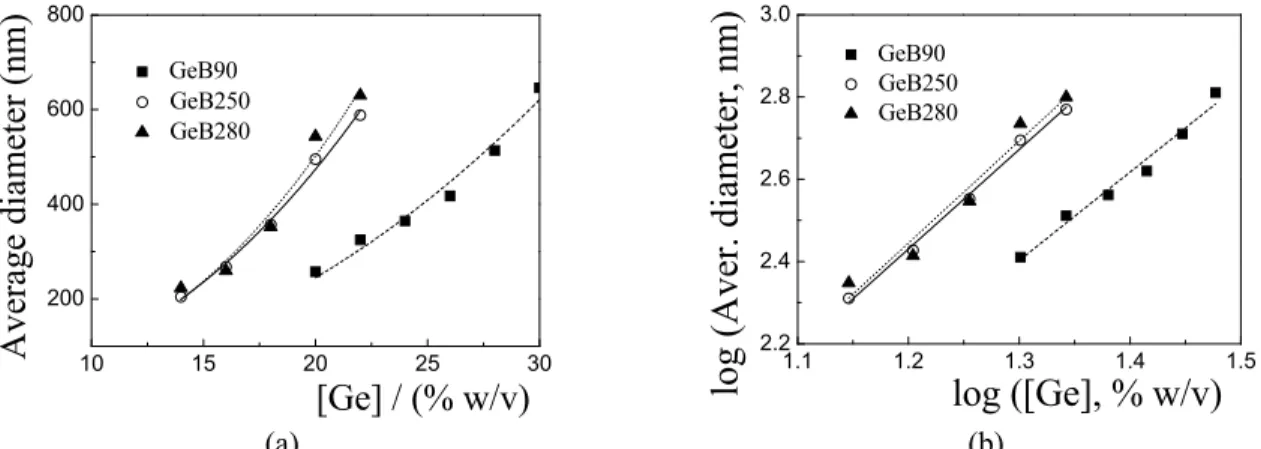
SEM micrographs (Figure 3) show the mor-phology of the good and excellent spinnability from GeB90, GeB250 and GeB280 fiber mats. In addition to interfering in the spinnability, concentration and viscosity also affected the electrospun fiber diameter, i.e., an increase in concentration or viscosity results in thicker fibers. This effect can be attributed to the increase in viscoelastic forces, generated by the in-crease in the degree of chain entanglements, leading to a stretching decrease of the polymeric jet and re-sulting in formation of thicker fibers (Li et al., 2005; Choktaweesap et al., 2007). Figure 4a illustrates the average diameter of electrospun GeB90, GeB250 and GeB280 fibers plotted as a function of the con-centration. The average fiber diameter for GeB90 increased from ca. 257.3 to 646.2 nm, for GeB250 from ca. 204.3 to 588.3 nm, and for Ge280 from ca. 222.7 to 630.1 nm. For a given solution concen-tration, GeB90 presented finer fibers than GeB250 and GeB280, which, from 14 to 18% (w/v), were found to be very comparable to each other. The log-log plots between the solution concentration (C) and average fiber diameters (D), Figure 4b, were well represented by single straight lines, confirming that the electrospinning solution concentration are above the critical concentration (Equations (4), (5) and (6) for GeB90, GeB250 and GeB280, respectively).
2
logD 0.388 2.15log C R 0.97 (4)
2
logD 0.473 2.42log C R 0.99 (5)
2
logD 0.533 2.48log C R 0.95 (6)
(a) (b)
Figure 4: Average diameter of electrospun GeB90, GeB250 and GeB280 fibers plotted as a function of the concentration (a) and log-log plot between fibers diameters and the solution viscosity of the three different gelatins (b).
Figure 5 shows a scatter plot of the average fiber diameter values as a function of viscosity in an asso-ciated form. The dispersion suggests that, independ-ent of the Bloom index, there is a common relation-ship between fiber diameter and solution viscosity, which is well described by a linear equation (Equa-tion (7)).
2 82.3 0.88 a ( 0.94)
D R (7)
Mechanical Properties
Mechanical properties of homogeneous electro-spun fibrous membranes obtained with excellent spinnability were evaluated by tensile tests (Figure 6), and the average Young’s modulus, the ultimate
strength and the elongation are summarized in Table 2. From the results for all different types of gelatin, higher concentration ranges produce thicker mem-branes. The increase in concentration causes an in-crease in solution viscosity, which is related to the entanglement degree of the polymer chains, as previ-ously mentioned. The analysis of the fibrous mem-brane thicknesses suggests that, above a certain vis-cosity there occurs a more stable Taylor cone, pro-moting better orientation of the fibers towards the collector. Huang et al. (2004) showed similar behav-ior, i.e., concentration of the electrospun gelatin solu-tion resulted in thicker membranes. However, the difference in thickness is minimized in the calcula-tion of the stress and strain parameters (Callister, 2007).
200 400 600 800
200 400 600 800
GeB90 GeB250 GeB280
Average
fiber d
iameter
(n
m)
Viscosity (mPa s)
Figure 5: Average diameter of electrospun GeB90, GeB250 and GeB280 fibers plotted as a function of the solution viscosity.
10 15 20 25 30
200 400 600 800
GeB90 GeB250 GeB280
Average diameter (nm)
[Ge] / (% w/v)
1.1 1.2 1.3 1.4 1.5 2.2
2.4 2.6 2.8 3.0
GeB90 GeB250 GeB280
Table 2: Tensile properties of the nanofiber membranes electrospun with gelatin solutions of different Bloom indexes.
[Ge]/ % (m/v)
Thickness / μm Young’s
modulus / MPa
Ultimate strength / MPa
Elongation / %
[B90] = 24 55.4 ± 12.7 88.0 ± 25.6 1.5 ± 0.1 1.2 ± 0.2
[B90] = 26 120.0 ± 7.0 80.8 ± 16.1 1.5 ± 0.2 2.0 ± 0.5
[B90] = 28 144.4 ± 1.1 72,0 ± 16,4 1.4 ± 0.1 1.8 ± 0.2
[B90] = 30 126.4 ± 10.4 91.0 ± 12.3 1.6 ± 0.1 1.6 ± 0.3
[B250] = 18 48.6 ± 9.4 55.1 ± 16.6 2.1 ± 0.4 19.7 ± 1.5
[B250] = 20 91.5 ± 2.1 74.1 ± 18.5 2.2 ± 0.3 28.9 ± 8.7
[B250] = 22 89.5 ± 4.1 87.9 ± 8.8 2.4 ± 0.4 23.4 ± 12.4
[B280] = 18 47.3 ± 5.4 49.7 ± 9.4 2.6 ± 0.3 22.6 ± 6.5
[B280] = 20 96.3 ± 5.4 87.4 ± 11,1 2.5 ± 0.2 22.2 ± 9.0
[B280] = 22 100.8 ± 6.1 90.4 ± 18.9 2.3 ± 0.3 18.9 ± 4.7
Different letters in the same column indicate significantly different values by the Tukey test (p≤ 0.05).
For the Young's modulus, only the concentration influence is meaningful in the response variability, with a value of determination coefficient of 0.68. However the Tukey test showed no difference at a significance level α = 0.05, indicating that, in the conditions studied, no changes are observed in the elastic modulus (Table 3). For the Ultimate strength, only the Bloom index is meaningful in the response variability, with a coefficient value of determination of 0.86 (significant Tukey test for all Bloom values, p <0.05 - Table 4). For the elongation, although the results of analysis of variance were not globally sig-nificant, significance was observed for Bloom equal to or greater than 250 compared to 90 (Table 5).
Table 3: Tukey's test applied for the Young's modulus of MF with different Bloom indexes.
Bloom B90 82.9
B250 71.5
B280 75.8
B90 0.104 0.375
B250 0.104 0.719
B280 0.375 0.719
Table 4: Tukey's test applied for the Ultimate strength of MF with different Bloom indexes.
Bloom B90 1.52
B250 2.22
B280 2.47
B90 0.000128 0.000128
B250 0.000128 0.0321
B280 0.000128 0.0321
Table 5: Tukey's test applied for the Elongation of MF with different Bloom indexes.
Bloom B90 1.66
B250 24.3
B280 21.2
B90 0.000128 0.000128
B250 0.000128 0.315
B280 0.000128 0.315
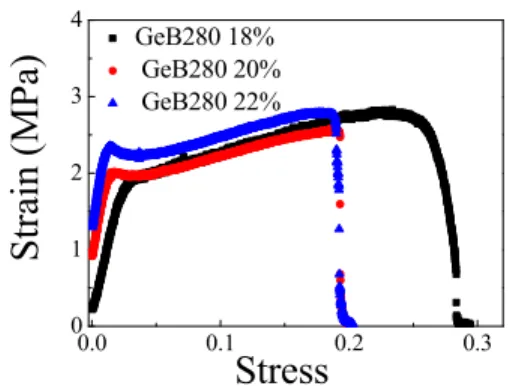
Figure 6 shows the results where the brittle be-havior of the GeB90 fibrous membrane contrasts with the plastic behavior of GeB250 and GeB280. The elongation of GeB250 and GeB280 electrospun membranes was, on average, at least ten times higher than that of GeB90 membranes. The increase is in agreement with a greater extensibility of the films containing greater amounts of triple-helix structure, which is proportional to the Bloom index (Bigi et al. 2004). In other words, by increasing molecular weight, a greater number of molecules seem to hold together the polymeric network. This causes an in-crease in flexibility and, consequently, higher tenacity.
0.0 0.1 0.2 0.3
0 1 2 3 4
GeB90 24% GeB90 26% GeB90 28% GeB90 30%
Strain (MPa)
Stress
0.0 0.1 0.2 0.3
0 1 2 3 4
GeB250 18% GeB250 20% GeB250 22%
Strain (MPa)
0.0 0.1 0.2 0.3 0
1 2 3 4
GeB280 18% GeB280 20% GeB280 22%
Strain
(M
Pa)
Stress
Figure 6: Stress-strain curves of electrospun GeB90, GeB250 and GeB280 at different concentrations.
CONCLUSIONS
In this work, the spinnability of gelatin solutions and the corresponding mechanical properties of the fibrous membranes formed were investigated. Taking into account the fact that viscosity is the most im-portant property for obtaining a successful electro-spinning, the lower the Bloom index of the gelatin, the more concentrated the solution should be to ob-tain ideal viscosity. Results indicated that an ade-quate viscosity range to obtain a homogeneous fi-brous membrane is above 300 and below 700 mPa.s. Hence, high Bloom gelatin can be a more economi-cal alternative than low Bloom gelatin. The fibrous membranes electrospun from GeB90 showed differ-ent mechanical behavior than GeB250 and GeB280, suggesting that low Bloom gelatin produces brittle fibrous membranes, while high Bloom gelatin gener-ates membranes exhibiting plastic behavior.
ACKNOWLEDGEMENTS
The authors gratefully acknowledge the financial support of CNPq. Research supported by LASIPO, Central of Analysis/EQA and LCME, Federal Uni-versity of Santa Catarina - UFSC.
REFERENCES
Azhar, F. F., Olad, A. and Salehi, R., Fabrication and characterization of chitosan-gelatin/nanohydroxy-apatite-polyaniline composite with potential ap-plication in tissue engineering scaffolds. Des. Monomers. Polym., 17(7), 654 (2014).
Bizarria, M. T. M., d’Ávila, M. A. and Mei, L. H. I., Non-woven nanofiber chitosan/PEO membranes
obtained by electrospinning. Braz. J. Chem. Eng., 31(1), 57 (2014).
Bhardwaj, N. and Kundu, S. C., Electrospinning: A fascinating fiber fabrication technique. Biotech-nol. Adv., 28(3), 325 (2010).
Bigi, A., Panzavolta, S. and Rubini, K., Relationship between triple-helix content and mechanical properties of gelatin films. Biomaterials, 25(25), 5675 (2004).
Callister, W. D., Materials Science and Engineering: An Introduction. New York (2007).
Chen, Z., Wei, B., Mo, X., Lim, C. T., Ramakrishna, S. and Cui, F., Mechanical properties of electro-spun collagen-chitosan complex single fibers and membrane. Mat. Sci. Eng., C, 29(8), 2428 (2009). Choktaweesap, N., Arayanarakul, K., Aht-Ong, D.,
Meechaisue, C. and Supaphol, P., Electrospun gelatin fibers: Effect of solvent system on mor-phology and fiber diameters. Polym. J., 39(6), 622 (2007).
Erencia, M., Cano, F., Tornero, J. A., Macanas, J. and Carrillo, F., Resolving the electrospinnability zones and diameter prediction for the electrospin-ning of the gelatin/water/acetic acid system. Langmuir, 30(24), 7198 (2014).
Fong, H., Chun, I. and Reneker, D. H., Beaded nanofibers formed during electrospinning. Poly-mer, 40(16), 4585 (1999).
Hayahara, T. and Takao, S., Relationship between polymer concentration and molecular weight in the viscosity behavior of concentrated solution. Colloid and Polymer Science, 225(2), 106 (1968). Huang, Z. M., Zhang, Y. Z., Ramakrishna, S. and Lim, C. T., Electrospinning and mechanical char-acterization of gelatin nanofibers. Polymer, 45(15), 5361 (2004).
Jun, Z., Hou, H., Schaper, A., Wendorff, J. H. and Greiner, A., Poly-L-lactide nanofibers by electro-spinning – influence of solution viscosity and electrical conductivity on fiber diameter and fiber morphology. E-Polym., 9, 1-9 (2003).
Kempka, A. P., Ulson de Souza, S. M. A. G., Ulson de Souza, A. A., Prestes, R. C. and Ogliari, D., Influence of Bloom number and plastifiers on gelatin matrices produced for enzyme immobi-lization. Braz. J. Chem. Eng., 31(01), 95 (2014). Ki, C. S., Baek, D. H., Gang, K. D., Lee, K. H., Um,
I. C. and Park, Y. H., Characterization of gelatin nanofiber prepared from gelatin-formic acid solution. Polymer, 46(14), 5094 (2005).
Lai, J., The role of Bloom index of gelatin on the interaction with retinal pigment epithelial cells. Int. J. Mol. Sci., 10(8), 3442 (2009).
University of Santa Catarina, Florianópolis - SC (2012). Site http://www.lcp.enq.ufsc.br (Consulted in 2012).
Guptaa, P., Elkinsb, C., Longb, T. E. and Wilkesa, G. L., Electrospinning of linear homopolymers of poly(methyl methacrylate): exploring relation-ships between fiber formation, viscosity, molecu-lar weight and concentration in a good solvent. Polymer, 46, 4799-4810 (2005).
Mit-Uppatham, C., Nithitanakul, M. and Supaphol, P., Ultratine electrospun polyamide-6 fibers: Effect of solution conditions on morphology and average fiber diameter. Macromol. Chem. Physics, 205(17), 2327 (2004).
Okutan, N., Terzi, P. and Altay, F., Affecting parame-ters on electrospinning process and characteriza-tion of electrospun gelatin nanofibers. Food Hydrocolloid, 39, 19-26 (2014).
Panzavolta, S., Gioffrè, M., Focarete, M. L., Gualandi, C., Foroni, L. and Bigi, A., Electrospun gelatin nanofibers: Optimization of genipin cross-linking to preserve fiber morphology after exposure to water. Acta Biomater., 7(4), 1702 (2011).
Phadke, K. V., Manjeshwar, L. S. and Aminabhavi, T. M., Biodegradable polymeric microspheres of gelatin and carboxymethyl guar gum for con-trolled release of theophylline. Polym. Bull., 71(7), 1625 (2014).
Poverenov, E., Zaitsev, Y., Arnon, H., Granit, R., Alkalai-Tuvia, S., Perzelan, Y., Weinberg, T. and Fallik, E., Effects of a composite chitosan-gelatin edible coating on postharvest quality and storability of red bell peppers. Postharvest Biol. Tec., 96, 106-109 (2014).
Ramakrishna, S., Fujihara, K., Teo, W. E., Lim, T. C. and Ma, Z., An Introduction to Electrospinning and Nanofibers. Singapore (2005).
Ratanavaraporn, J., Rangkupan, R., Jeeratawatchai,
H., Kanokpanont, S. and Damrongsakkul, S., Influences of physical and chemical crosslinking techniques on electrospun type A and B gelatin fiber mats. Int. J. Biol. Macromol., 47(4), 431 (2010).
Saxena, A., Sachin, K., Bohidar, H. B. and Verma, A. K., Effect of molecular weight heterogeneity on drug encapsulation efficiency of gelatin nano-particles. Colloid Surface, B, 45(1), 42 (2005). Schrieber, R. and Gareis, H., Gelatine Handbook -
Theory and Industrial Practice. Weinheim (2007). Segtnan, V. H. and Isaksson, T., Temperature, sample
and time dependent structural characteristics of gelatine gels studied by near infrared spectros-copy. Food Hydrocolloid, 18(1), 1 (2004). Shefy-Peleg, A., Foox, M., Cohen, B. and
Zilber-man, M., Novel antibiotic-eluting gelatin-alginate soft tissue adhesives for various wound closing applications. Int. J. Polym. Mater. Polym. Bio-materials, 63(14), 699 (2014).
Shenoy, S. L., Bates, W. D., Frisch, H. L. and Wnek, G. E., Role of chain entanglements on fiber for-mation during electrospinning of polymer solu-tions: Good solvent, non-specific polymer-poly-mer interaction limit. Polypolymer-poly-mer, 46, 3372-3384 (2005).
Song, J. H., Kim, H. E. and Kim, H. W., Production of electrospun gelatin nanofiber by water-based co-solvent approach. J. Mater. Sci-Mater. M., 19(1), 95 (2008).
Songchotikunpan, P., Tattiyakul, J. and Supaphol, P., Extraction and electrospinning of gelatin from fish skin. Int. J. Biol. Macromol., 42(3), 247 (2008).