ISSN 1517-7076 artigo 11562, pp.350-357, 2014
Corresponding Author: Gang Li Received on: 07/08/2014 Accepted on: 09/12/2014
Development and characterization of the
amidoxime/Europium (ІІІ)
-chelated
complex fibers
C. G. Hu 1, S. L. Wang 2, Z. Z. Wu 1, Z. Zao 3 , G. Li 4,5
1
College of Textile and Clothing Anhui Polytechnic University, Wuhu 241000, P.R.China e-mail: [email protected]
2
Anhui Business College of Vocational Technology, Wuhu 241000, P.R.China e-mail: [email protected]
3
State Key Lab of Advanced Technology for Materials Synthesis and Processing, Wuhan University of Technology, Wuhan 430070, P.R. China
e-mail: [email protected] 4
National Engineering Laboratory for Modern Silk, College of Textile and Clothing Engineering, Soochow University, Suzhou 215123, P.R.China
5
Nantong Textile Institute, Soochow University, Nantong, People’s Republic of China
ABSTRACT
This paper presents a study of the amidoxime/Europium (ІІІ)-chelated complex (AECC) fibers which can be used as functional fibers for technical textiles such as decorations, protections and medical textiles etc. First, the EuCl3 solution were prepared and reacted with amidoxime fibers using optimized process conditions at
50 °C, 5 hours. Subsequently, the morphology, element analysis, fluorescence and mechanical properties of the AECC fibers were systematically investigated. Finally, the effects of different pH values and temperature on the content of Eu (III) complexes fiber were studied, respectively. The results showed that the AECC fibers possess enhanced fluorescence intensity and good mechanical properties. The results also illustrated that coordination reaction was identified between Eu (III) ions and amidoxime fiber and the electronic energy of C1s, O1s, N1s and Eu (III) ions in amidoxime fibers has significant changes compared to original fibers. The fluorescence emission bands of the AECC fibers were observed when the excitation wavelength λ equal to 380 nm. In conclusion, this study provided a theoretical basis for the preparation and practical application of fluorescent fibers.
Keywords: Amidoxime/Europium (ІІІ)-chelated, complex fibers, fluorescence, mechanical properties.
1. INTRODUCTION
The rare earth luminous fiber has been increasingly used as functional fibers for technical textiles such as decorations, protections and medical textiles etc. The rare earth ions such as Sm (III), Eu (III), Tb (III), Dy (III) possess good fluorescence properties due to their special structural characteristics [1-4]. Chelating the amidoxime fibers with rare earth ions can produce amidoxime/Europium (ІІІ)-chelated complex (AECC) fibers which have excellent light-emitting intensity, good mechanical properties, and can free from harmful radiation [5,6]. They can absorb ultraviolet or visible light for ten minutes, and then can emit light continually for more than ten hours after removal of excitation resource [7, 8]. Such functional fibers can be used for technical textiles such as decorations, protections and medical textiles etc [5, 9-11]. However, few studies have been found about using chelating reaction method to fabricate AECC fibers.
The objective of this paper is to develop amidoxime/Europium (ІІІ)-chelated complex (AECC) fibers which have enhanced fluorescence intensity and good mechanical properties. First, the EuCl3 solution were
351
fibers, carbon fibers and films due to its good anti-oxidant and chemical stability [12,13,14]. Subsequently, the morphology, element analysis, fluorescence and mechanical properties of the AECC fibers were systematically investigated. Finally, the effects of different pH values and temperature on the content of Eu (III) complexes fiber were studied, respectively.
2. MATERIALS AND METHODS
2.1 Materials
Polyacrylonitrile (PAN) fiber was purchased from Anqing Petrochemical Plant; the water used for testing is deionized water; the amidoxime fiber was prepared using the previous method [15]; Eu2O3, Hydroxylamine
hydrochloride Sodium, Ethylenediaminetetraacetic acid disodium salt, Calcium carbonate and other reagents were of analytical grade.
2.2 Preparation of Amidoxime/Europium (ІІІ)-chelated complexes fiber
Adding 0.5030 g of Eu2O3 weight by analytical balance into a clean, dry small beaker, and dissolved into 15
ml of concentrated hydrochloric acid, then heating by water bath until the solution was transparent and Eu2O3
was completely dissolved. Stop heating until white crystals appear, remove the beaker and cool it at room temperature. Then dissolve the crystals in distilled water, and transfer it into 250 ml volumetric flask to co n-stant volume and europium chloride solution was obtained.
Weighting above 1.0 g amidoxime fiber into a 100ml of EuCl3 solution with certain concentration and
adjust the pH value of the solution, place it into a pot with a constant temperature water bath of 50 °C. After reacting about 5 hours, AECC fibers were prepared and then washed using 90 ml of deionized water for 10 times. The lotion and the rare earth ions solution after coordination reaction were blended together and then transferred into a 1000 ml of volumetric flask. Then determinate the concentrations of Eu (III) solution with method of complex metric titration, and calculate the content (T) of Eu (III) in AECC fibers using Equation (1). Choosing different pH values can obtain different AECC fibers with different colors.
T = (C0V0 - C1V1)×M/m (mg/g) (1)
Where: C0 is the concentration of Eu (III) solution before reaction (mmol/L); V0 reprents the volume of
Eu (III) solution before reaction, V0 = 0.1 L;C1 is the concentration of Eu (III) solution after reaction
(mmol/L); V1 reprents the molecular weight of Eu (III) at 151.965 g/mol; m is PAN mass (g).
2.3 Characterization of fluorescence and mechanical properties
The fluorescence spectra of AECC fibers were measured using HITACHIF-4500 fluorescence spectrometer. The tensile properties of AECC fibers were tested using LLY-068 electronic single fiber strength tester. The breaking strength and elongation at break of the fibers were repeated for 50 times by electronic single fiber strength tester and all data sets were expressed in terms of their mean and standard deviation.
2.4 X-ray photoelectron spectroscope
The samples were characterized with an X-ray photoelectron spectroscope (XPS) (Escalab MKII, Brit-ish,Vaccum Generator Co., Ltd.). Analyses were performed on a surface analysis system with a MgK X-ray source, vacuum rate 1.33×10⁻⁷Pa, 10 scans. Samples were attached to the aluminum sample platform with double-sided tapes. Quantitative analyses were performed using peak areas and elemental sensitivity factors. Mean values were gotten from five different areas on one sample.
3. RESULTS AND DISCUSSION
3.1 Effects of different pH on Eu (III) content in AECC fibers
The original color of amidoxime fibers is white. When the value of pH was 1.0, the color of the fibers did not change significantly. As the pH value increased, the color of fiber gradually deepened, while the value of pH was above 5.0, the fiber color faded.
352
groups of amidoxime fiber -NH2 and -OH changed to be -ŇH3 and -OH2 respectively, and lost the ability to be coordinated reaction with Eu (III). The color of fiber deepened as the acidity decreased at pH < 3, and it showed that the content of Eu (III) in the fiber increased. The color of fiber faded as the acidity decreased and the content of Eu (III) in the fiber significantly reduced while pH > 4. The color of fiber was the darkest when pH = 3.0. Meanwhile, the content of Eu (III) in the fiber also reached the highest, and the amidoxime groups and Eu (III) were matched into stable mating structure.
Table 1: Effect of pH value of reaction system on the color of fiber and Eu (III) content
PH VALUE COLOR OF FIBER EU (III) CONTENT T UNIT
1.0 White 0 (mg/g)
2.0 yellow-green (Deep) 94.90 ± 0.05 (mg/g)
3.0 yellow-green (Light) 40.56 ± 0.03 (mg/g)
4.0 yellow-green (Deep) 72.57 ± 0.14 (mg/g)
5.0 yellow-green (Light) 50.59 ± 0.03 (mg/g)
3.2 Effects of different temperature on Eu (III) content in AECC fibers
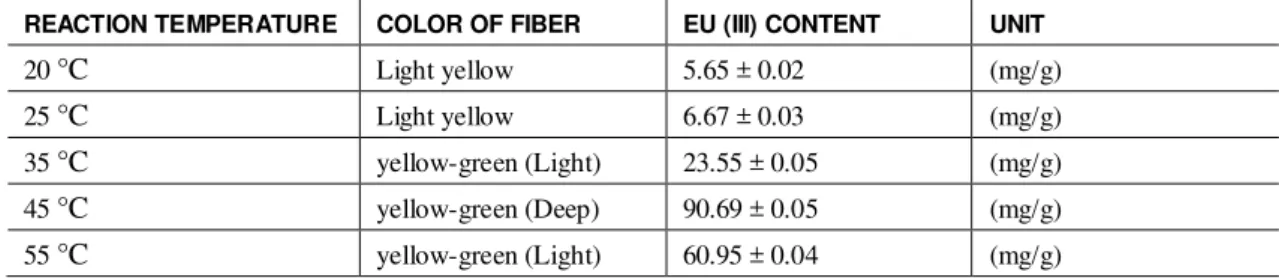
After blending 0.2 g amidoxime fibers with 25 ml Eu (III) solution in five erlenmeyer flasks, the pH of the solution was adjusted to 3.0, and then were placed at 20 °C, 25 °C, 35 °C, 45 °C and 55 °C to reaction for 5 hours, respectively. Finally, the fibers were removed and washed using deionized water. So different content AECC fibers were obtained. The Eu (III) content in AECC fibers under different reaction temperatures was calculated using Equation (1). The calculated results are given in Table 2.
Table 2: Effect of the reaction temperature on the color of fiber and the content of Eu (III) fiber
REACTION TEMPERATURE COLOR OF FIBER EU (III) CONTENT UNIT
20 °C Light yellow 5.65 ± 0.02 (mg/g)
25 °C Light yellow 6.67 ± 0.03 (mg/g)
35 °C yellow-green (Light) 23.55 ± 0.05 (mg/g)
45 °C yellow-green (Deep) 90.69 ± 0.05 (mg/g)
55 °C yellow-green (Light) 60.95 ± 0.04 (mg/g)
Temperature was an important factor affecting the reaction rate of PAN fibers and Eu (III) ion. Gener-ally, the reaction rate increased as the increasing of temperature. As the data given in Table 1, the content of Eu (III) in AECC fibers increased significantly while the temperature changed to 35 °C, and the color deep-ened obviously. Little change of the content was observed at the lower temperatures. When the measured temperature was reached at 45 °C, the Eu (III) content in AECC fibers reached at maximum. While the measured temperature was increased to 55 °C, the Eu (III) content in the fibers decreased rapidly. Mean-while, the color of fiber became lighter. Thus, the high temperature could destroy the structure of the fiber and decrease the mechanical properties.
3.3 XPS analysis of AECC fibers
353
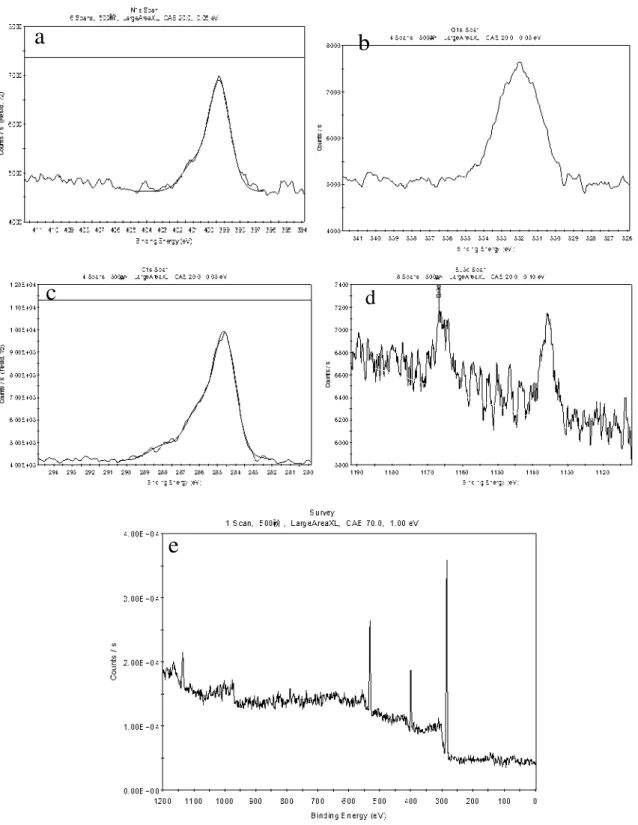
eV). It demonstrated that the coordination had occurred between N in -N2H- and rare earth ions. Meanwhile,
the electron energy of rare earth ions Eu (III) were all changed, which proved that the rare earth ions involved in the coordination reaction.
Figure 1: XPS spectras of different elements and AECC fibers: a - e are the binding energies of C1s, O1s, N1s, Eu (III) elements and AECC fibers
a
b
e
354 Table 3: The binding energy of different elements and AECC fibers
RARE EARTH IONS AMIDOXIME FIBERS AECC FIBERS
C1s 284.14 284.09
O1s 532.37 532.00
N1s 399.26 399.33
Eu (III) -- 1135.7
3.4 Morphology of AECC fibers
In Figure 2, the scanning electron microscope (SEM) photograph of the PAN fiber surface is uniform and smooth and has no obvious defects. While the surface of amidoxime fiber after reaction with hydroxylamine solution maintained a relatively smooth apparent morphology, some uniform rough dents were observed, which showed the apparent of PAN fiber changed after amidoxime. Hence, the emergences of a number of defects were induced on the surface of the fibers. AECC fibers preduced by the reaction of Europium (III) solution had rougher surface and more significant jagged dents, which showed that amidoxime fibers and rare earth solution had a full reaction, and the surface of the fibers was coordinated a large amount of rare earth ions. And they were uniformly distributed onto the surface of the fibers; meanwhile, it also showed the me-chanical properties of fiber were affected, so it’s breaking strength and elongation at break decreased.
Figure 2: SEM images of PAN fibers (a), amidoxime fibers (b) and AECC fibers (c).
3.5 Fluorescence spectra of AECC fibers
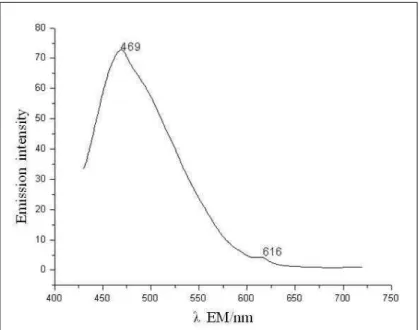
The electronic arrangement formula of Eu (III) is 4f76s2, the f shell electron of its secondary outer layer elec-tron is unfilled, and it belongs to be paramagnetic. In addition, the excited state of the ion (m *) energy layer (i.e. the f * energy layer which is transferred from f energy layer) located below the lowest excited state e n-ergy layer of the ligand, and there are no multi enn-ergy layers between m * and s0 energy layers. Thus, the
355 Figure 3: fluorescence spectra of AOCF-Eu (III) complexes fiber
3.6 Mechanical properties of AECC fibers
The breaking strength and elongation at break of fiber samples were measured for 50 times using electronic single fiber strength tester (LLY-068). The breaking strength and elongation at break of PAN fibers were 0.71 cN and 18.29%, their sample variances were 0.0017 and 2.47, respectively. The breaking strength and the elongation at break of amidoxime fibers were 0.68 cN and 19.86%, their sample variances were 0.0026 and 3.31, respectively. The breaking strength of amidoxime fibers was lower than that of the acrylic fiber (PAN). The reason is that after amidoxime reaction of the -CN in PAN, the polymer chain on the appearance of fiber became uneven and part of the polymer chain fractured, so the surface tension of the fib er declined while elongation at break increased. The fibers became thinner, the elastic of fibers became better, and the sample variance of test values before and after the reaction became larger, data became scattered. It illustrat-ed that the unstable properties of the fibers maybe inducillustrat-ed by the damage of fiber during the process of reac-tion.
The relationships among different Eu (III) content and breaking strength and elongation at break of fi-ber were derived (Table 4). As can be seen from Table 4, the breaking strength and elongation at break of fiber decreased with the increase of content of Eu (III). There are two reasons. First, when amidoxime groups coordinated with Eu (III), a body structure can be formed because one Eu (III) ion can coordinate with two amidoxime groups on different strand of fiber, so the elastic of the fibers decreased. Second, soaking solution with different pH and temperature can cause the swelling and corrosion role on the fiber, and some physical adsorption also destroyed the fiber polymer structure, hence the elasticity of original fibers was decreased. Compared to the PAN fibers, the breaking strength and elongation of AECC fibers were all decreased with the increase of the content of Eu (III) ion. But, the produced AECC fibers possess a good ability for yarn spinning.
Table 4: The relations among different content of Eu (III) and tensile property of AECC fibers
CONTENT OF EU (III) /(MG·G-1) BREAKING STRENGTH /CN ELONGATION AT BREAK /%
5.65 0.695 18.30
6.67 0.612 17.93
23.55 0.603 17.56
60.95 0.584 16.83
90.69 0.522 16.27
356 4. CONCLUSIONS
In this work, the AECC fibers were successfully prepared by chelating reaction using amidoxime fibers (made from PAN fibers) and Europium oxide. The highest Eu (III) content can be harvest when the optimum reaction condition was set at pH = 3.0 and temperature = 45 °C, time = 5 hours. Meanwhile, the fluorescence of the AECC fibers was the highest among other groups according to the results of a series of measurements. The emission intensity of AECC fibers increased as the increasing content of Eu (III). When the amidoxime
group fully reacted, the AECC fibers would occurred “concentration quenching” phenomenon with the in-creasing content of Eu (III). The mechanical properties of AECC fibers declined as the inin-creasing content of Eu (III). In conclusion, this study provided a theoretical basis for the preparation and practical application of fluorescent fibers.
5. ACKNOWLEDGEMENT
The work is supported by Priority Academic Program Development of Jiangsu Higher Education Institutions (PAPD) , National Natural Science Foundation of China under grant Nos. 20771002 & 11372205 and Project for Six Kinds of Top Talents in Jiangsu Province under grant No. ZBZZ-035, Science & Technology Pillar Program of Jiangsu Province under grant No. BE2013072
6. BIBLIOGRAPHY
[1] ZHANG, J., GE, M. Q., "A study of an anti-counterfeiting fiber with spectral fingerprint characteristics", Journal of the Textile Institute, v.102, pp.767-773, 2011.
[2] SUJATHA, N., MURUKESHAN, V., ONG, L., et al., "An all fiber optic system modeling for the gastro-intestinal endoscopy: design concepts and fluorescent analysis", Optics communications, v. 219, pp. 71-79, 2003.
[3] CHEN, M., QU, H., ZHU, J., et al. "Magnetic electrospun fluorescent polyvinylpyrrolidone nanocompo-site fibers", Polymer, v. 53, pp. 4501-4511, 2012.
[4] SANTOS, M. dos, FREIRE, C., "Study of the performance of films containing rare earth salts as corro-sion inhibitors of zinc-iron alloy electroplated steel", Matéria (Rio de Janeiro), v. 17, pp. 1144-1157, 2012. [5] YAN, Y., GE, M.Q., LI, Y., et al., "Morphology and spectral characteristics of a luminous fiber contain-ing a rare earth strontium aluminate", Textile Research Journal, v. 82, pp. 1819-1826, 2012.
[6] ZHANG, J., GE, M. Q., "Effects of transparent inorganic pigment on spectral properties of spectrum-fingerprint anti-counterfeiting fiber containing rare earths", Journal of Rare Earths, v. 30, pp. 952-957, 2012. [7] ZHU, Y., GE, M., CHEN, Z., "Preparation and properties of rare earth luminous fiber containing red organic fluorescent pigment", Journal of Rare Earths, v. 31, pp. 1043-1048, 2013.
[8] GUO, X., GE, M., ZHAO, J., "Photochromic properties of rare-earth strontium aluminate luminescent fiber", Fibers and Polymers, v. 12, pp. 875-879, 2011.
[9] GONCALVES, H.M., DUARTE, A. J., DAVIS, F., et al., "Layer-by-layer immobilization of carbon dots fluorescent nanomaterials on single optical fiber". Analytica chimica acta, v. 735, pp. 90-95, 2012.
[10] HUSSAIN, M., SHAMEY, R., HINKS, D., et al., "Synthesis of novel stilbene-alkoxysilane fluorescent brighteners, and their performance on cotton fiber as fluorescent brightening and ultraviolet absorbing agents", Dyes and Pigments. v. 92, pp. 1231-1240, 2012.
[11] MOTHUDI, B., NTWAEABORWA, O., KUMAR, A., et al., "Phosphorescent and thermoluminescent properties of SrAl 2 O 4: Eu 2+, Dy 3+ phosphors prepared by solid state reaction method" Physica B: Con-densed Matter. v. 407, pp.1679-1682, 2012.
[12] WAN, Y. Q., HE, J. H., WU, Y., YU, J. Y., "Vibrorheological effect on electrospun polyacrylonitrile (PAN) nanofibers", Materials Letters, v. 60, pp. 3296-3300, 2006.
[13] KONG, H.Y., He, J.H., et al., Polymer liquid membrane for nanofiber fabrication, Thermal Science, v. 17, n. 5, pp. 1479-1482, 2013
357