Introduction
Clinical Engineering started in the United States of America in the 70’s, when its activities aimed primarily at managing hospitals’ equipment. In the following years, the ield started to grow in terms of responsibilities regarding the evaluation, transfer, and management of technology.
In Brazil, on the other hand, the structuring of the Clinical Engineering ield started in the 90’s (Calil and Ramírez, 2000), but up to this date there is no clear consensus between professionals and the scientiic community regarding who can legally perform the duties of a clinical engineer.
Some authors say that the profession of clinical engineer is not actually regulated in Brazil (França, 2015; Souza and More, 2014), and a research conducted in 2014 (Souza and More, 2014) shows that there is a great diversity of professionals, with very different academic backgrounds and professionals attributes, occupying the role of clinical engineer. The research authors state, in the introduction to their paper, that a lot of clinical engineer roles are occupied by non-engineering professionals. However, we observe in their results that the vast majority of professionals who answered the questionnaires were those belonging to the Confea/Crea System, albeit with very heterogeneous proiles.
Several types of medical equipment are necessary for health professionals to perform critical duties in health assistance, including different types of medical diagnoses and life support. Also, health professionals are frequently required to deal with sensible technologies, such as ionizing radiation, which can save lives when correctly used, or bring dramatic consequences to society
when not (Goiás, 2012). Managing and maintaining
this kind of equipment is a key function in healthcare, and must be conducted with full legal responsibility,
Brazilian clinical engineering regulations: health equipment management
and conditions for professional exercise
João Gabriel Martin Del Solar*, Fabiano Araujo Soares, Cristiano Jacques Miosso Rodrigues
Mendes
Gama Faculty, University of Brasilia, Brasilia, DF, Brazil.
Abstract Introduction: In Brazil, professionals, scientiic community, and members of regulatory bodies have not yet
achieved a consensus regarding who can legally perform the professional duties of a clinical engineer. We aim
at clarifying this aspect, based on a detailed analysis of the pertinent regulations. Methods: We acted on three
fronts: (i) reviewing the current legislation regarding the clinical engineering exercise; (ii) visiting hospitals and working as trainee to understand how this exercise is implemented on Brazil’s Federal District; (iii) one of the authors
participated in virtual discussion groups of clinical engineering professionals, monitoring collective understanding of
regulations, checking consistency of proper knowledge, and acting as an active opinion leader in the subject among
peers. Results: We try to make a formal deinition of clinical engineer and indicate their characteristic activities.
We propose a synthesis of the regulation regarding healthcare products’ integrity protection and health technology management, identifying the engineering activities necessary to achieve those legal requirements. We analyze the
legal constraints and conditions to exert engineering, indicating the necessary professionals’ attributions and the way to obtain them. Finally, we provide a brief analysis of the technical requirements presented by the Brazilian Consumer Protection Code and of the 15.943 Brazilian Standard (NBR). Discussion: We conclude that, despite the
lack of consensus about the Clinical Engineering activity, there exists in Brazil a Clinical Engineering regulation, but it is spread in complex laws and normative resolutions, deining compulsory responsibilities and attributions,
as well as conditions and prerequisites for role performance.
Keywords Brazilian Clinical Engineering, Biomedical engineering, Anvisa, Confea/Crea system, Legislation, Regulation.
This is an Open Access article distributed under the terms of the Creative Commons Attribution License, which permits unrestricted use, distribution, and reproduction in any medium, provided the original work is properly cited.
How to cite this article: Del Solar JG, Soares FA, Miosso CJ.
Brazilian Clinical Engineering regulations: health equipment
management and conditions for professional exercise. Res Biomed Eng. 2017; 33(4):301-312. DOI: 10.1590/2446-4740.01517.
*Corresponding author: Faculdade UnB Gama – FGA, Universidade
de Brasilia, Área Especial de Indústria Projeção A Setor Leste, CEP 72444-240, Gama, DF, Brazil. E-mail: [email protected]
meaning that the professionals must be liable for their performance and effectiveness in assisting patients. Keeping the whole ield of clinical engineering in such an informal and unreliable situation can bring grave consequences to Brazilian society and risk the integrity of Brazilian people.
The Clinical Engineering Brazilian Association (ABEClin) initiated in 2013 a process inside the Brazilian Engineering and Agronomy Federal Counsel (Confea) with the objective of obtaining formal recognition of the profession (Brasil, 2013a; 2015a; Costa et al., 2015). But two of the oficial pronunciations by Confea about the theme show that there are already some rules regulating the matter (Brasil, 1998c; 2016a).
This article aims at clarifying the legal aspects regarding the Brazilian clinical engineering, specially the legal prerequisites needed in order to perform the clinical engineer activity.
Methods
This article consists primarily of a study on the current legislation regarding the clinical engineering exercise. We researched and analyzed a great diversity of public documents, information from several sources (internet news, manuals, norms, plenary decisions, resolutions, etc.), norms by Confea and by different instances of the Engineering and Agronomy Regional
Counsel – Crea (each instance corresponding to a different State in Brazil), and by the Sanitary Surveillance National Agency (Anvisa), as well as federal laws and decrees and the Federative Republic of Brazil’s Constitution. We also analyzed books and scientiic articles on this subject.
During these analyzes, we also conducted several consultations with highly regarded and experienced Professors and professionals, as well as with Anvisa and Confea/Crea representatives. The objective was to clarify some doubts and ambiguities.
We visited hospitals and clinics in Brazil’s Federal District, 27 in total, to see how clinical engineering was organized in our region. One of the authors worked for 6 months as a clinical engineer trainee, in order to acquire detailed information and experience on the sector.
Another approach we adopted, consisted of our active participation in virtual discussions boards and national work groups through WhatsApp, with clinical
engineering professionals and with ABEClin. Our focus was to know and monitor collective understanding of pertinent regulations, to check our particular understanding of regulatory directives and work as an active opinion leader among peers, spreading the results of our research.
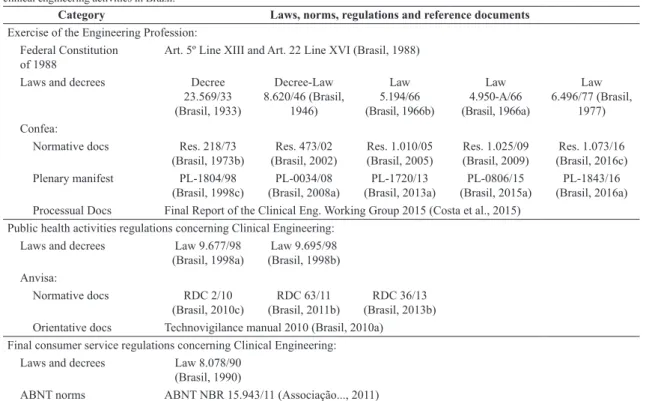
In Table 1, we show the most signiicant documents regarding clinical engineering regulation in Brazil. In terms of the pertinent formal legislation, we based our analyses mainly on these documents.
Table 1. A synthesis of the main analyzed regulatory sources. The table shows the references which are considered the most important in regulating
clinical engineering activities in Brazil.
Category Laws, norms, regulations and reference documents
Exercise of the Engineering Profession:
Federal Constitution
of 1988 Art. 5º Line XIII and Art. 22 Line XVI (Brasil, 1988) Laws and decrees Decree
23.569/33 (Brasil, 1933)
Decree-Law 8.620/46 (Brasil,
1946)
Law 5.194/66 (Brasil, 1966b)
Law 4.950-A/66 (Brasil, 1966a)
Law 6.496/77 (Brasil,
1977)
Confea:
Normative docs Res. 218/73
(Brasil, 1973b) (Brasil, 2002)Res. 473/02 Res. 1.010/05 (Brasil, 2005) Res. 1.025/09 (Brasil, 2009) (Brasil, 2016c)Res. 1.073/16
Plenary manifest PL-1804/98
(Brasil, 1998c) (Brasil, 2008a)PL-0034/08 (Brasil, 2013a)PL-1720/13 (Brasil, 2015a)PL-0806/15 (Brasil, 2016a)PL-1843/16 Processual Docs Final Report of the Clinical Eng. Working Group 2015 (Costa et al., 2015)
Public health activities regulations concerning Clinical Engineering: Laws and decrees Law 9.677/98
(Brasil, 1998a) (Brasil, 1998b)Law 9.695/98
Anvisa:
Normative docs RDC 2/10
(Brasil, 2010c) (Brasil, 2011b)RDC 63/11 (Brasil, 2013bRDC 36/13 ) Orientative docs Technovigilance manual 2010 (Brasil, 2010a)
Final consumer service regulations concerning Clinical Engineering:
Laws and decrees Law 8.078/90 (Brasil, 1990)
Results
Clinical Engineer in the current literature Highly regarded authors in the ield of Biomedical Engineering, such as Joseph D. Bronzino, Donald R. Peterson and Joseph F. Dyro (Bronzino and Peterson, 2015; Dyro, 2004), as well as the Brazilian Ministry of Health (Brasil, 2013a; 2017), agree when deining a clinical engineer. According to them, a clinical engineer is a biomedical engineer, focused on studying and applying engineering principles, such as electricity, electronics, mechanics, optics, in order to monitor, control, or modify biological systems. They are characterized, furthermore, by their work within hospitals or clinical environments, in which they provide support to clinical activities. Clinical engineers are technology specialists who can help physicians, nurses, physiotherapists, administrators to deal with, use, evaluate, acquire, manage, and adequately maintain and secure biomedical equipment. Some characteristic activities of the clinical engineer, among others described by Bronzino and Peterson (2015), are:
• Technology management: equipment inspection before delivery; deinition, direction and management of equipment’s maintenance program, including inspection, calibrations, and corrective, preventive and predictive interventions;
• Technology assessment: equipment speciications according to local, corporate, personal, and operational characteristics; evaluation and optimization of cost-effectiveness; equipment’s obsolescence evaluation and design of modernization programs.
The American College of Clinical Engineering (ACCE), on the other hand, provide the following deinition of a clinical engineer (American…, 1992):
A Clinical Engineer is a professional who supports
and advances patient care by applying engineering and managerial skills to healthcare technology.
While ABEClin states that (Associação…, 2017,
authors’ translation):
The Clinical Engineer is the professional who applies engineering techniques in managing health equipment
with the objective of guaranteeing traceability, usability, quality, eficacy, effectiveness, security, and performance
of the equipment and of promoting patient security.
Note that the deinitions provided by the ACCE and by ABEClin are more general than that in (Bronzino and Peterson, 2015). They don’t specify one technological branch in which clinical engineers work. In both deinitions, clinical engineers are those professionals
who work with health technology, or health equipment, in general. This could open a hermeneutics issue of considering all engineering activities in some health environment, including for example infrastructure technology, as clinical engineering. This study focuses its analysis primarily on biomedical technology.
Healthcare regulation
Clinical engineering, while direct implicated in the human healthcare, must comply with its legal regulation.
Heinous crimes against public health
Brazilian legislation, guided by the Constitutional principle of the inviolability of right to life (Brasil, 1988 - art. 5o), protects the integrity and reliability of
equipment with medicinal and therapeutic purposes, by establishing that the violation of such devices constitutes a heinous crime. Falsifying, corrupting, adulterating, and altering equipment with those purposes are all considered heinous crimes. Other activities that can be considered heinous crimes are importing, selling, distributing, or putting to be used equipment with medicinal and therapeutic purpose which is in one those conditions or which matches one or more of the following conditions: (i) is not properly registered, whenever required by the competent sanitary surveillance entity; (ii) is not in conformity with its project characteristics, as registered in the competent sanitary surveillance entity; (iii) is without the identity and quality characteristics admitted for commercialization; (iv) has its therapeutical value or activity reduced; (v) if of unknown origin; (vi) was acquired in places without license from the competent sanitary surveillance entity (Brasil, 1998a; 1998b). As a result of these legal protections, the professional activities of Brazilian clinical engineers increase in importance and gravity, and suffer notable limitations, for example, when impeded to make modiications in health product project.
Anvisa requirements over health technology management
Anvisa demands from health establishments the development of a health equipment management plan, in order to provide traceability, quality, eficacy, effectiveness, safety, and performance, from the entrance of each piece of equipment in the institution to its inal destination (Brasil, 2010a - Mod. 6; 2010c - Art. 2o).
The conditions of its selection, purchase, storage, installation, distribution, and disposal must also be maintained (Brasil, 2011b - Art. 54), and the risks involved in the equipment’s use must be analyzed, evaluated, controlled and monitored (Brasil, 2010c - Art. 19; 2013b - Art. 7o
Lines I and III, Art. 8o Lines I and IX). A higher-rank
must be designated for the task of designing and executing the management plan (Brasil, 2010c - Art. 8o).
There are also legal requirements over marketing and use of health products, including health equipment, which are not in the scope of this study (Brasil, 1973a; 1976; 2001a; 2001b; 2010b; 2015b; 2016b).
Engineering activities required in order to satisfy the Anvisa requirements
To achieve all these Anvisa’s prerequisites, the authors consider the following engineering activities necessary (Del Solar, 2017a):
• Direct, plan, manage, supervise, and execute the health equipment management plan;
• Adequately specify the equipment and evaluate the proposals before the acquisition, in order to effectively attend service needs and the current legislation, regulations and norms;
• Evaluate technical, economic, and environmental viability of existent solutions, in order to maintain appropriate cost-effectiveness metrics; • Design and provide all infrastructure needed for
equipment’s operation, in good conditions; • Design and implement procedures for inspections,
corrective, preventive and predictive maintenance, adjustments and calibrations;
• Make inspections, assessments, reports, and statements in adverse events, in order to identify and rectify health equipment failures.
Regulation of engineering activities
Constraints over freedom to exercise engineering activities
The Brazilian Constitution establishes one’s right to perform any job, occupation, or profession if all the conditions deined in law are satisied (Brasil, 1988 - Art. 5o, Line XIII), and reserves to the Union the
competence to legislate about conditions for performing professions (Brasil, 1988 - Art. 22 Line XVI). Federal laws and decrees deine, as characteristic of the engineering profession, the conduction of urban and rural services and equipment in its technical and artistic aspects (Brasil, 1966b - Art 1o Line c). They also establish that
engineering activities must be performed by licensed professionals and companies, and this applies to project design, plants, studies, reports, works direction, and execution, or any other engineering work (Brasil, 1966b - Arts. 13 and 15). They restrict: (I) the use of the title “Engineer” to professionals that it in the conditions
deined in law 5.194/66 (Brasil, 1966b - Art. 3o) and
to legal entities composed exclusively of engineers (Brasil, 1966b - Art. 4o); and (ii) the title “Engineering”
to commercial or industrial companies whose board is composed mostly by licensed professionals of Confea/Crea System (Brasil, 1966b - Art. 5o). Regarding engineering
exercise conditions, the federal laws and decrees state that the professionals and companies must: (i) be registered in the competent Crea (Brasil, 1966b - Art 6o
Line a and d, Art. 59 and 60; 1946 - Art. 8o); (ii) have
legal attribution to perform the speciic engineering service or work (Brasil, 1966b - Arts. 6o Line b and
e, 7o, 8o and 9o); (iii) make formal declaration to the
competent Crea of engineering roles and functions performed (Brasil, 1966b - Arts. 59 e 60; 1933 - Art. 8o);
(iv) formally declare to the competent Crea the authorship of all engineering services and works, thus registering technical responsibilities (Brasil, 1977 - Arts. 1o e 2o).
There are also regulations regarding technicians, technologists, and operation engineers (Brasil, 1967; 1968; 1969; 1973b; 1985; 1986; 2014). Although there are several common points between the regulation of (full) engineers and those professionals, this research focuses on the regulation of clinical engineers.
Means to obtain the required engineering attributions
The engineering attributions vary according to the different curricula in Brazilian Engineering Courses (Brasil, 1966b - Art. 10 and 11; 1946 - Art. 10º). Engineering professionals receive initial attributions when they register their undergraduate curricula in a Crea. With the establishment of resolution 1.073/16, professionals of the Confea/Crea System can extend their initial attributions based on Graduate courses, curricula supplementation, and sequential courses of speciic formation (Brasil, 2016a; 2016c - Art. 3o and Section
It is necessary to acquire the proper attributions from Crea (Brasil, 1966b - Art. 6o Line b).
Required attributions to perform clinical engineering services and related work
Professional attributions in engineering are described in two aspects: activities attributions and action ield. Regarding activities attributions, an engineering professional is authorized to perform assigned activities only in the allowed action ield (Brasil, 1973b; 2006; 2008b; 2011a). The authors consider that, in order to be a clinical engineer, one must perform the activities corresponding to directing, supervising, planning and managing works and technical services, as well as making projects, speciications, studies, analysis, evaluations, assessments, statements, inspections, reports, maintenance, and executing technical services, among others. This means that they need the plenitude of activities attributions, as deined in law 5.194/66 (Brasil, 1966b - Art. 7º, 13 and 15) and detailed in resolution 1.073/16 (Brasil, 2016c - Art. 5º; Del Solar, 2017a).
In the technological ield of action, considering that clinical engineers work primarily with biomedical
technologies (Bronzino and Peterson, 2015; Dyro,
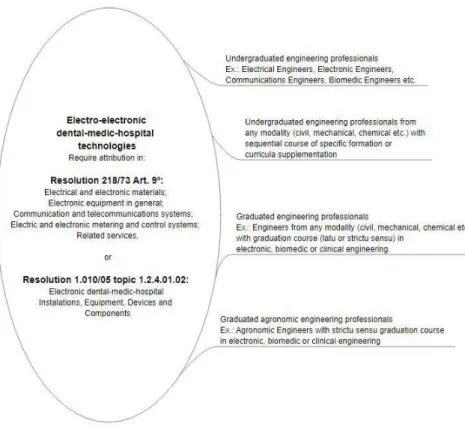
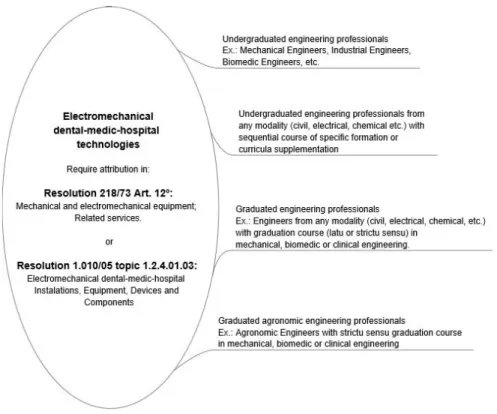
2004), they need the proper attribution to work with the biomedical equipment and technologies used in the health institution. These technologies are customarily classiied as electrical, electronic or electromechanical dental-medical-hospital installations, equipment, devices or components (Brasil, 2005 - Annex II, Order Number 1.2.4.01.00; 1998c). Each of those technology branches need a speciic attribution: electrical ones requires the attribution in article 8º from resolution 218/73 or in topic 1.2.4.01.01 from resolution 1.010/05 (Brasil, 1973b - Art. 8o; 2005 - Annex II); the electronic ield requires
the attribution in article 9º from resolution 218/73 or in topic 1.2.4.01.02 from resolution 1.010/05 (Brasil, 1973b - Art. 9o; 2005 - Annex II); and electromechanical
technologies require the attribution in article 12 from resolution 218/73 or in topic 1.2.4.01.03 from resolution 1.010/05 (Brasil, 1973b - Art. 12; 2005 - Annex II).
If someone wants to include in this analysis other health technologies present in the clinical environment, the same criteria must be applied. It is necessary to identify in which technology ield the health technology is inserted in order to identify which engineering professional is licensed to work with it. For example, in order to perform engineering activities with autoclaves or thermodisinfectors the professional must have the attribution in article 12 of resolution 218/73 (Brasil, 1973b - Art. 12) or its equivalent in resolution 1.010/05. In order to conduct water-purifying processes, the professional needs the attribution in article 17 or 18 of resolution 218/73 (Brasil, 1973b - Art. 17 and 18).
It isn’t in the scope of this work to perform a detailed analysis of the attribution required to perform engineering activities with respect to all health technology present in the health environment.
Brazilian undergraduate courses akin to Clinical Engineering
The authors identify the presence of two different emphases on engineering formation in Brazil, the generalist and the specialist formation. The generalist ones, put the bases of engineering knowledge over a great diversity of technology ields, preparing a versatile professional, able to transit through different technological ields, but without a deeply and specialized knowledge in a speciic technological branch. In this category, one can ind, for example, electrical, mechanical, civil and chemical engineering courses. An electrical engineer with a generalist formation, for example, can actuate in a great diversity of technological ields as energy generation, transmission and distribution; wired, radio and optical telecommunication systems; electronic hardware and software design; industrial control and automation; biomedical equipment speciication and clinical engineering.
The specialized courses search to form professionals better prepared to act in a speciic technological ield. It provides more detailed knowledge in its proper ield, but doesn’t give the minimum necessary bases on others engineering branches, restricting the scope of professional actuation of its egresses. In this category, one can ind a lot of engineering courses, as biomedical, acoustic, energy, control, computation engineering. Each of these professionals receives a deep knowledge of his speciic ield of action, but is restricted to act within it. A biomedical engineer, for example, although prepared to work with electrical, electronic and electromechanical biomedical equipment, isn’t allowed to work with electronic equipment in general, as televisions, radios, computers or industrial automation. Brazilian legislation gives a lot of liberty to engineering schools in the design of their courses with the emphasis they desire (Brasil, 1966b - Art. 10).
be either generalist or specialist professionals working in it, respecting each professional permissions and restrictions.
To date, although there is a lot of undergraduate professionals prepared to perform clinical engineering, the most akin to this this sector are the biomedical engineers. Their career is, among current Brazilian undergraduate engineering careers, the most proper prepared to work in the technological ield of clinical engineering. Although, one cannot generalize the proile of all Brazilian biomedical engineers, there isn’t, so far, a Confea’s resolution deining the minimum attributions of all biomedical engineers. So, there can be great diversity and variations on Brazilian biomedical engineering formations and its egresses attributions (Brasil, 2016d).
It is also necessary to emphasize that engineering formation and license are not restricted to undergraduate courses. One can achieve the necessary formation and attribution through undergraduate and graduate courses, curricula supplementation, and sequential courses of speciic formation (Brasil, 2016c - Art. 3o and Section IV).
Considering that, in general, the professionals who have the plenitude of activities attributions are (full) engineers (Brasil, 2016c - Art. 5o, §2o; 2014; 1986 -
Arts. 3o and 4o; 1985 - Arts. 4o and 6o; 1973b; 1969;
1966b - Art. 7o), Figures 1 to 3 show some identiied
(full) engineering professionals proiles able to receive the necessary attributions to work in clinical engineering. There are others engineering professionals (technicians, technologists, and operation engineers) able to work in clinical engineering, although, with some restrictions regarding the allowed engineering activities. It isn’t in the scope of this study to detail their proile characteristics.
Analysis of the health technology managers required by Anvisa
The professionals required by Anvisa in RDC 02/10 (Brasil, 2010c - Art 8o) to design and implement
health equipment’s management plans need, irst, the attribution corresponding to the speciic technology ield of action under their responsibility. And, second, they need, in the authors’ perception, at least the attribution to direct, manage, plan, and supervise works and technical services of that particular technology branch (Brasil, 2016c - Art. 5O, Activities 1, 2 and 5). This statement
can be veriied on the impediments deined by law 5.194/66 (Brasil, 1966b - Arts. 13 and 15) and on the deinition of engineering technical activities by the Confea Resolution 1.073/16 (Brasil, 2016c - Art. 5o and
Annex I; Del Solar, 2017a):
Figure 3. Schematic representation of the ield of action of electrical dental-medic-hospital technologies and some identiied (full) engineering professional proiles able to acquire attributions in it.
Direction – technical activity corresponding to determining the work or service, commanding, and
essentially deciding during the accomplishment of
work or service;
Management – a set of activities that encompass
the management of conception, elaboration, design, execution, evaluation, implementation, improvement,
and maintenance of goods and services and its attainment process;
Planning - activity that involves the systematic
formulation of a set of properly integrated decisions,
expressed in objectives and goals, and which speciies the available or necessary means to reach them, within
a given period;
Supervision - activity of monitoring, analyzing and
evaluating, from a superior functional plan, the
performance of the technical responsible for the execution of works or services.
Requisites of consumer protection code
Based on the Consumer Protection Code, all products and services offered to inal consumers must comply with the norms of the Competent Oficial Body or, if they don’t exist, with standards from the ABNT (Brazilian Technical Norms Association) or from another entity accredited by the Conmetro (National Metrology, Normalization, and Industrial Quality Counsel) (Brasil, 1990 - Art. 39 Line VIII). The Anvisa’s RDC 02/10 deines the minimum standard to be followed by health institutions in health technology management (Brasil, 2010c - Art. 1o). With
that, ABNT NBR (Brazilian Norm) Standard 15.943, which establishes guidelines for management programs regarding infrastructure equipment and health equipment for healthcare services (Associação.., 2011), is not required by the Brazilian Consumer Protection Code.
Discussion
The question regarding clinical engineering regulation has been present in the Brazilian society for at least 20 years, and an effort to conquer the desired clarity in this matter is perceptible in the formalized documents and articles.
With respect to the clinical engineer identity, this research could identify two tendencies in deining it. One, present in the work of highly regarded authors and in the Brazilian Ministry of Health, deine clinical engineers as biomedical engineers working in clinical environments and giving support to clinical activities. The other, present in ACCE and in ABEClin, identify clinical engineers in a more extensive way, putting the
base on the activities over healthcare technologies. This work focuses its analysis primarily on activities over biomedical technologies.
Referring to the clinical engineer regulation, although there isn’t a professional title deined in the Table of Professional Titles of Confea/Crea System (Brasil, 2002), we found several laws and normative resolutions deining compulsory responsibilities and attributions, license and formation proile required, conditions and requisites for role performance, and including a minimum allowed salary for the professional working in the ield (Brasil, 1966a; 1966b - Art. 82; Del Solar, 2017a).
As an engineering activity in health environment, this professional branch is submitted to regulation from federal laws, based on the Federal Constitution, from health entities and from engineering class counsels. This research focuses on regulations of health technology management and of engineering activities. It does not deeply analyze conditions regarding marketing and the use of health products. Also, it does not detail the conditions needed to perform other technical roles on a clinical engineering department. Its primary objective is to clarify the regulations regarding the professional activity of clinical engineers.
In the health area, the inclusion of heinous crimes against public health in the Brazilian Penal Code imposed a serious liability on the righteous use and management of medical equipment and, consequently, on the clinical engineering activity. Anvisa is the regulatory body that controls and regulates this activity while searching for quality, effectiveness, and security in the use of health equipment. Regulation from health entities is a particular characteristic of this sector, not common in other engineering ields, and one that imposes severe constraints over the engineering activities.
Clinical engineering, as an engineering activity, must comply with established legal conditions for professional exercise, in accordance with the Constitutional restrictions to professional freedom. The Confea/Crea System has the legal competence to regulate this professional class. Its current regulations confer a lot of lexibility over the reception of professional attributions. An engineering ield of action is no longer restricted to a few professional titles or to a couple of graduate degrees, except in the case of work security engineering.
speciic formation related to clinical engineering and recognized by the competent Crea.
In order to freely and fully practice clinical engineering, the one needs to be actively registered with the Crea of their speciic state or region, and must be regularly licensed for the exercise of their professional duties and liabilities, as dictated by the pertinent laws and regulations. In detail, one must be authorized to: i. practice engineering activities unreservedly, as is deined in law nº 5.194/66 (Brasil, 1966b - Art. 7º, 13 and 15) and detailed in resolution nº 1.073/16 (Brasil, 2016c - Art. 5º; Del Solar, 2017a); ii. work with the biomedical equipment and technologies used in the health institution, customarily classiied as electrical, electronic or electromechanical dental-medical-hospital installations, equipment, devices or components (Brasil, 2005 - Annex II, Order Number 1.2.4.01.00; 1998c). Each of these technology branches requires permission in a speciic area of practice: electrical – article 8º from resolution 218/73 or in topic 1.2.4.01.01 from resolution 1.010/05 (Brasil, 1973b - Art. 8o; 2005 - Annex II); electronic – article 9º from
resolution 218/73 or in topic 1.2.4.01.02 from resolution 1.010/05 (Brasil, 1973b - Art. 9o; 2005 - Annex II);
electromechanical – article 12 from resolution 218/73 or in topic 1.2.4.01.03 from resolution 1.010/05 (Brasil, 1973b - Art. 12; 2005 - Annex II). The professional must not overstep his professional competence formalized in his/her registry on Crea (Brasil, 1966b - Art. 6º). The concession of professional rights and obligations depends on the curricular background of the oficial engineering, technological, or technical school.
A health institution can hire a professional able to undertake the responsibility for all his biomedical technologies (some undergraduate biomedical engineers are capable of that and also others who have extended their competence) or can form a multidisciplinary team to work together, each professional responsible for the technologies of his/her area (for example, an electrical engineer responsible for electrical and electronic biomedical equipment and a mechanical engineer responsible for electromechanical biomedical equipment). The multidisciplinary team can also be responsible for other technologies in the health institution, like energy generators and batteries backup, electrical installations, telecommunication systems, autoclaves, thermodesinfectors, hydraulic and thermal installations, air conditioners etc., while a standard undergraduate biomedical engineer is commonly restricted to biomedical technologies (Brasil, 2008a). It’s up to the health institution to choose the organization strategy more convenient to its reality.
An engineering work or document made by an unlicensed or impeded professional or company does not have legal value (Brasil, 1966b - Art. 13 and 15). A particular document called Technical Responsibility
Annotation (ART), created 40 years ago – mandatory in all engineering contracts – is a guarantee provided by the Confea/Crea System that the professional is licensed, and is able to perform a speciic function, role, work or service, being technically liable for his decisions and its consequences (Brasil, 1977; Brasil, 2009; Del Solar, 2017b).
The most important contribution made by this research, in the authors’ perception, is a multi-faceted view over the Brazilian clinical engineering regulations. It presents legal and normative references that must guide the sector’s organization and improve security, quality, and eficacy in clinical engineering processes, works and services.
A clear knowledge of these legal requirements can: guide engineering schools in properly educating clinical engineers; clarify to health managers how to contract and formalize engineering services and works (Del Solar, 2017a; 2017b); raise engineering professionals’ awareness about their legal competence, their professional autonomy, and their limits in professional activities; raise awareness of engineering surveillance professionals from the Confea/Crea System and Anvisa about the reality of engineering in the healthcare system (Del Solar, 2017a); guide business professionals on how to build a business model complying with legal requisites in order to provide engineering services in health care environments; help health care establishment lawyers to improve organization juridical security; raise health professionals awareness about the complexity, relevance, and gravity of engineering activities in healthcare environments. In short, it can improve eficacy, effectiveness, and eficiency of health technologies in human and animal health care.
Acknowledgements
The authors thank the Brazilian Coordination for the Improvement of Higher Education Personnel (CAPES) for supporting one of the authors during his Masters Program, through the Social Demand research grant. We also thank the clinical engineering community from Brazil’s Federal District and the participants of the WhatsApp Groups “Engenharia Clínica Brasil” and “ABEClin Oicial”, who helped the development of this work. We especially thank Engineers Alzinete Cunha, Cláudia Martins and João Galdino and the Technologist Wagner Lacerda. Finally, we thank Rafaela Carvalho de Freitas for the English revision.
References
Associação Brasileira de Engenharia Clínica – ABEClin. Quem
somos [internet]. 2017. [cited 2017 Feb 16]. Available from: http://www.abeclin.org.br/index.php?p=9
Associação Brasileira de Normas Técnicas – ABNT. NBR 15.943: diretrizes para um programa de gerenciamento de
equipamentos de infraestrutura de serviços de saúde e de
equipamentos para a saúde. Rio de Janeiro: ABNT; 2011. Brasil. Decreto nº 23.569 de 11 de dezembro de 1933. Regula o exercício das profissões de engenheiro, de arquiteto e de aqrimensor. Diário Oficial da República Federativa do Brasil, Brasília, dez. 1933.
Brasil. Decreto-Lei nº 8.620, de 10 de janeiro de 1946. Dispõe sobre a regulamentação do exercício de profissões de engenheiro, de arquiteto e de agrimensor, regida peio Decreto nº 23.569, de 11 de dezembro de 1933, e dá outras providências. Diário Oficial da República Federativa do Brasil, Brasília, jan. 1946. Brasil. Lei nº 4.950-A, de 22 de abril de 1966. Dispõe sôbre
a remuneração de profissionais diplomados em Engenharia,
Química, Arquitetura, Agronomia e Veterinária. Diário Oficial da República Federativa do Brasil, Brasília, abr. 1966a. Brasil. Lei nº 5.194, de 24 de dezembro de 1966. Regula o exercício das profissões de Engenheiro, Arquiteto e Engenheiro-Agrônomo, e dá outras providências. Diário Oficial da República Federativa do Brasil, Brasília, dez. 1966b.
Brasil. Decreto-Lei nº 241, de 28 de fevereiro de 1967. Inclui entre as profissões cujo exercício é regulado pela Lei no 5.194, de 24 de dezembro de 1966, a profissão de engenheiro de operação. Diário Oficial da República Federativa do Brasil, Brasília, fev. 1967.
Brasil. Lei nº 5.524, de 5 de novembro de 1968. Dispõe sôbre o exercício da profissão de Técnico Industrial de nível médio. Diário Oficial da República Federativa do Brasil, Brasília, nov. 1968.
Brasil. Conselho Federal de Engenharia e Agronomia –
CONFEA. Resolução nº 178, de 9 de julho de 1969. Dispõe sobre as atribuições profissionais provisórias dos diplomados em
Cursos de Engenharia de Operação, nas diversas modalidades.
Diário Oficial da República Federativa do Brasil [internet], Brasília, jul. 1969. [cited 2017 Mar 30]. Available from: http:// normativos.confea.org.br/ementas/visualiza.asp?idEmenta=2 26&idTipoEmenta=5&Numero=
Brasil. Lei nº 5.991. de 17 de dezembro de 1973. Dispõe sobre o Controle Sanitário do Comércio de Drogas, Medicamentos, Insumos Farmacêuticos e Correlatos, e dá outras Providências. Diário Oficial da República Federativa do Brasil, Brasília, dez 1973a.
Brasil. Conselho Federal de Engenharia e Agronomia –
CONFEA. Resolução nº 218, de 29 de junho de 1973. Discrimina atividades das diferentes modalidades profissionais da Engenharia, Arquitetura e Agronomia. Diário Oficial da República Federativa do Brasil [internet], Brasília, jun. 1973b. [cited 2017 Sept 21]. Available from: http://normativos.confea. org.br/ementas/visualiza.asp?idEmenta=266
Brasil. Lei nº 6.360, de 23 de setembro de 1976. Dispõe sobre a Vigilância Sanitária a que ficam sujeitos os Medicamentos, as Drogas, os Insumos Farmacêuticos e Correlatos, Cosméticos,
Saneantes e Outros Produtos, e dá outras Providências. Diário Oficial da República Federativa do Brasil, Brasília, set. 1976. Brasil. Lei nº 6.496, de 7 dezembro de 1977. Institui a “ Anotação de Responsabilidade Técnica ” na prestação de serviços de
engenharia, de arquitetura e agronomia; autoriza a criação, pelo Conselho Federal de Engenharia, Arquitetura e Agronomia
- CONFEA, de uma Mútua de Assistência Profissional; e dá outras providências. Diário Oficial da República Federativa do Brasil, Brasília, dez. 1977.
Brasil. Decreto nº 90.922. Regulamenta a Lei nº 5.524, de 5 de novembro de 1968, que dispõe sobre o exercício da profissão de técnico industrial e técnico agrícola de nível médio ou de 2º grau. Diário Oficial da República Federativa do Brasil, Brasília, nov. 1985.
Brasil. Conselho Federal de Engenharia e Agronomia – CONFEA. Resolução nº 313, de 26 de setembro de 1986. Dispõe sobre o exercício profissional dos Tecnólogos das áreas submetidas à regulamentação e fiscalização instituídas pela Lei no 5.194, de 24 dez 1966, e dá outras providênciass. Diário Oficial da República Federativa do Brasil [internet], Brasília, set. 1986. [cited 2017 Mar 30]. Available from: http://normativos.confea. org.br/downloads/0313-86.pdf
Brasil. Constituição da República Federativa do Brasil de 1988. Diário Oficial da República Federativa do Brasil, Brasília, out. 1988.
Brasil. Lei nº 8.078, de 11 de setembro de 1990. Dispõe sobre a proteção do consumidor e dá outras providências. Diário Oficial da República Federativa do Brasil, Brasília, set. 1990. Brasil. Lei nº 9.677, de 2 de julho de 1998. Altera dispositivos do Capítulo III do Título VIII do Código Penal, incluindo na
classificação dos delitos considerados hediondos crimes contra
a saúde pública, e dá outras providências. Diário Oficial da República Federativa do Brasil, Brasília, jul. 1998a. Brasil. Lei nº 9.695, de 20 de agosto de 1998. Acrescenta incisos ao art. 1o da Lei nº 8.072, de 25 de julho de 1990, que dispõe sobre os crimes hediondos, e altera os arts. 2o, 5o e 10 da Lei no 6.437, de 20 de agosto de 1977, e dá outras providências. Diário Oficial da República Federativa do Brasil, Brasília, ago. 1998b.
Brasil. Conselho Federal de Engenharia e Agronomia –
CONFEA. PL-1804: competência profissional para portadores de certificados de pós-graduação em Engenharia Clínica [internet]. Brasília: CONFEA; 1998c. [cited 2017 Mar 30]. Available from: http://normativos.confea.org.br/ementas/ visualiza.asp?idEmenta=29704&
Brasil. Agência Nacional de Vigilância Sanitária – ANVISA. Resolução RDC nº 25, de 15 de fevereiro de 2001. Dispõe sobre a importação, comercialização e doação de produtos para saúde usados e recondicionados. Diário Oficial da República
Federativa do Brasil [internet], Brasília, fev. 2001a. [cited
2017 Mar 30]. Available from: http://portal.anvisa.gov.br/ documents/33880/2568070/RDC_25_2001.pdf/3e23255a-77b9-48a9-87c2-13a672cd133d
gov.br/documents/10181/2718376/RDC_185_2001_COMP. pdf/137bc575-8352-4f9a-9afb-e9a5dd1b8eb3
Brasil. Conselho Federal de Engenharia e Agronomia – CONFEA. Resolução nº 473, de 26 de novembro de 2002. Tabela de Títulos Profissionais. Diário Oficial da República Federativa do Brasil, Brasília, nov. 2002. [cited 2017 Mar 30]. Available from: http://normativos.confea.org.br/downloads/0473-02.pdf
Brasil. Conselho Federal de Engenharia e Agronomia –
CONFEA. Resolução nº 1.010, de 22 de agosto de 2005. Dispõe sobre a regulamentação da atribuição de títulos profissionais, atividades, competências e caracterização do âmbito de atuação dos profissionais inseridos no Sistema Confea/Crea, para efeito de fiscalização do exercício profissional. Diário Oficial da República Federativa do Brasil [internet], Brasília, ago. 2005. [cited 2017 Mar 30]. Available from: http://normativos.confea. org.br/downloads/1010-05.pdf
Brasil. Conselho Federal de Engenharia e Agronomia – CONFEA. PL-1247: infração à alínea “b” do art. 6° da Lei n° 5.194, de 24 de dezembro de 1966 [internet]. Brasília: CONFEA; 2006. [cited 2017 Mar 30]. Available from: http://normativos.confea. org.br/ementas/visualiza.asp?idEmenta=37120&idTiposEme ntas=&Numero=&AnoIni=&AnoFim=&PalavraChave=&bu scarem=&vigente=
Brasil. Conselho Federal de Engenharia e Agronomia –
CONFEA. PL-0034: Cadastramento do Curso de Graduação em Engenharia Biomédica oferecido pela Universidade do Vale do Paraíba – UNIVAP [internet]. Brasília: CONFEA; 2008a. [cited 2017 Sept 21]. Available from: http://normativos.confea. org.br/ementas/visualiza.asp?idEmenta=39560
Brasil. Conselho Federal de Engenharia e Agronomia –
CONFEA . PL-1929 - Infração ao art. 55 da Lei no 5.194, de 24 de dezembro de 1966 [internet]. Brasília: CONFEA; 2008b. [cited 2017 Mar 30]. Available from: http://normativos. confea.org.br/ementas/imprimir.asp?idEmenta=41699&idTip osEmentas=&Numero=&AnoIni=&AnoFim=&PalavraChav e=&buscarem=
Brasil. Conselho Federal de Engenharia e Agronomia – CONFEA. Resolução nº 1.025, de 30 de outubro de 2009. Dispõe sobre a Anotação de Responsabilidade Técnica e o Acervo Técnico Proissional, e dá outras providências. Diário Oicial da República Federativa do Brasil [internet], Brasília, out. 2009 [cited 2017 Mar 30]. Available from: http://normativos.confea. org.br/downloads/1025-09.pdf
Brasil. Agência Nacional de Vigilância Sanitária – ANVISA. Manual de tecnovigilância: abordagens de vigilância sanitária
de produtos para a saúde comercializados no Brasil [internet].
Brasília: ANVISA; 2010a. [cited 2017 Mar 30]. Available from: http://portal.anvisa.gov.br/documents/33868/327133/ Manual+de+Tecnovigil%C3%A2ncia+-+abordagens+de+vi gil%C3%A2ncia+sanit%C3%A1ria+de+produtos+para+a+s a%C3%BAde+comercializados+no+Brasil/0967528c-4af7-4df4-939b-95c6b327b09f
Brasil. Agência Nacional de Vigilância Sanitária – ANVISA. Manual para regularização de equipamentos médicos na Anvisa [internet]. Brasília: ANVISA; 2010b. [cited 2017 Mar 30]. Available from: http://portal.anvisa.gov.br/documents/33912/264673/ Manual+para+regulariza%C3%A7%C3%A3o+de+equipam
entos+m%C3%A9dicos+na+Anvisa/ad655639-303e-471d-ac47-a3cf36ef23f9
Brasil. Agência Nacional de Vigilância Sanitária – ANVISA. Resolução nº 2, de 25 de janeiro de 2010. Dispõe sobre o gerenciamento de tecnologias em saúde em estabelecimentos de saúde. Diário Oficial da República Federativa do Brasil [internet], Brasília, jan. 2010c. [cited 2017 Mar 30]. Available from: http://www20.anvisa.gov.br/segurancadopaciente/index. php/legislacao/item/rdc-2-de-25-de-janeiro-de-2010 Brasil. Conselho Federal de Engenharia e Agronomia – CONFEA. PL-0217: mantém o auto de notificação e infração no 715.102, do Crea-SP [internet]. Brasília: CONFEA; 2011a. [cited 2017 Mar 30]. Available from: http://normativos.confea.org.br/ ementas/visualiza.asp?idEmenta=46628&idTiposEmentas=& Numero=&AnoIni=&AnoFim=&PalavraChave=&buscarem= Brasil. Agência Nacional de Vigilância Sanitária – ANVISA. Resolução RDC nº 63 de 25 de novembro de 2011. Dispõe sobre os Requisitos de Boas Práticas de Funcionamento para os Serviços de Saúde. Diário Oficial da República Federativa do Brasil [internet], Brasília, nov. 2011b. [cited 2017 Mar 30]. Available from: http://www.saude.pr.gov.br/arquivos/ File/0SEGURANCA_DO_PACIENTE/rdc63_2011.pdf Brasil. Conselho Federal de Engenharia e Agronomia – CONFEA. PL-1720: aprova a constituição do Grupo de Trabalho sobre Engenharia Clínica, com o objetivo de discutir as questões
pertinentes ao reconhecimento da Profissão de Engenheiro
Clínico como profissão do Sistema Confea/Crea, e dá outras providências. [internet]. Brasília: CONFEA; 2013a. [cited 2017 Mar 30]. Available from: http://normativos.confea.org. br/ementas/visualiza.asp?idEmenta=53273
Brasil. Agência Nacional de Vigilância Sanitária – ANVISA. Resolução RDC nº 36, de 25 de julho de 2013. Institui ações
para a segurança do paciente em serviços de saúde e dá outras
providências. Diário Oficial da República Federativa do Brasil [internet], Brasília, jul. 2013b. [cited 2017 Mar 30]. Available from: http://bvsms.saude.gov.br/bvs/saudelegis/anvisa/2013/ rdc0036_25_07_2013.html
Brasil. Conselho Federal de Engenharia e Agronomia –
CONFEA. Resolução nº 1.057, de 31 de julho de 2014. Revoga a Resolução nº 262, de 28 de julho de 1979, a Resolução no 278, de 27 e maio de 1983 e o art. 24 da Resolução no 218, de 29 de junho de 1973 e dá outras providências. Diário Oficial da República Federativa do Brasil [internet], Brasília, jul. 2014. [cited 2017 Mar 30]. Available from: http://normativos. confea.org.br/ementas/visualiza.asp?idEmenta=54561&idTip oEmenta=5&Numero=
Brasil. Conselho Federal de Engenharia e Agronomia –
CONFEA. PL-0806: aprova a conclusão dos trabalhos do Grupo de Trabalho para discussões sobre o reconhecimento da profissão do Engenheiro Clínico e dá outras providências [internet]. Brasília: CONFEA; 2015a. [cited 2017 Mar 30]. Available from: http://normativos.confea.org.br/ementas/ visualiza.asp?idEmenta=56218
br/documents/33880/2568070/RDC_40_2015.pdf/ccfa7249-e8c0-469b-969a-b0844b09a8ce
Brasil. Conselho Federal de Engenharia e Agronomia – CONFEA. PL-1843: arquiva o processo CF-0496/2014, uma vez que o assunto referente a atribuições de cursos de pós-graduação (incluindo o de Engenharia Clínica) encontra-se abarcado pela Resolução n° 1.073, de 2016 [internet]. Brasília: CONFEA; 2016a. [cited 2017 Mar 30]. Available from: http://normativos. confea.org.br/ementas/visualiza.asp?idEmenta=60217&idTip osEmentas=6&Numero=1843&AnoIni=2016&AnoFim=201 6&PalavraChave=&buscarem=conteudo
Brasil. Agência Nacional de Vigilância Sanitária – ANVISA. Resolução RDC nº 95, de 27 de julho de 2016. Prorroga o prazo de vigência para adequação dos dossiês técnicos dos cadastros e registros vigentes da Resolução de Diretoria Colegiada - RDC nº 36, de 26 de agosto de 2015, que dispõe sobre a classificação de risco, os regimes de controle de cadastro e registro e os requisitos de rotulagem e instruções de uso de produtos para diagnóstico in vitro, inclusive seus instrumentos e dá outras providências; e prorroga o prazo para adequação dos dossiês técnicos dos cadastros vigentes da Resolução de Diretoria Colegiada - RDC no 40, de 26 de agosto de 2015, que dispõe sobre os requisitos de cadastro de produtos médicos. Diário Oficial da República Federativa do Brasil [internet], Brasília, jul. 2016b. [cited 2017 Mar 30]. Available from: http:// portal.anvisa.gov.br/documents/10181/2862781/%281%29R DC_95_2016_.pdf/1b174a72-a25a-46ed-8c73-f170c4f4067e Brasil. Conselho Federal de Engenharia e Agronomia – CONFEA. Resolução nº 1.073, de 19 de abril de 2016. Regulamenta a atribuição de títulos, atividades, competências e campos de
atuação profissionais aos profissionais registrados no Sistema
Confea/Crea para efeito de fiscalização do exercício profissional no âmbito da Engenharia e da Agronomia. Diário Oficial da República Federativa do Brasil [internet], Brasília, abr. 2016c. [cited 2017 Mar 30]. Available from: http://normativos.confea. org.br/downloads/1073-16.pdf
Brasil. Conselho Federal de Engenharia e Agronomia –
CONFEA. PC CF-1308/2016: encaminhamento do processo do curso de Engenharia Biomédica do Centro Universitário Franciscano – UNIFRA para sugerir a edição de resolução específica [internet]. Brasília: CONFEA; 2016d. [cited
2017 Sept 21]. Available from: http://www.confea.org.br/ media/0248_2016_PC_CF_1308_16.pdf
Brasil. Ministério da Saúde. Arquitetura e Engenharia em Saúde: áreas temáticas BVS MS. Brasília: CONFEA; 2017. [cited 2017 Fev 16]. Available from: http://bvsms.saude.gov. br/bvs/somasus/dicas.php
Bronzino JD, Peterson DR. The biomedical engineering handbook: medical devices and human engineering. 4th ed.
Boca Raton: Taylor and Francis Group; 2015.
Calil SJ, Ramírez EFF. Engenharia clínica: parte I - origens (1942-1996). Semin. Ciênc. Exatas Tecnol. 2000; 21:27-33. Costa JR, Souza AF, Fernandes I M, Holsbach LR. Relatório Final do Grupo de Trabalho Engenharia Clínica. Brasília: CONFEA; 2015. [cited 2017 Mar 16]. Available from: http:// www.confea.org.br/media/GTengenhariaclinica_relatoriofinal.pdf Del Solar JG. A Engenharia Clínica brasileira: objetivos, responsabilidades, requisitos [dissertation]. Brasília: Universidade
de Brasília; 2017a.
Del Solar JG. A formalização das atividades de engenharia clínica e hospitalar, próprias e terceirizadas. Engenharia Clínica Brasil Health Technologies; 2017b. [cited 2017 Mar 16]. Available from: https://engeclinbr.blogspot.com.br/2017/03/ engenharia-clinica-formal.html
Dyro JF. Clinical Engineering Handbook. 1st ed. San Diego:
Elsevier Academic Press; 2004.
França AS A. A atribuição profissional na gestão de tecnologias em estabelecimentos de saúde no Brasil. Rev Org Sist. 2015; 7:130-41.
Goiás. Secretaria de Estado da Saúde. Césio 137, o pesadelo que chocou o Brasil. Césio 137, o maior acidente radiológico do mundo. Goiânia; 2012. [cited 2017 Mar 22]. Available from: http://www.cesio137goiania.go.gov.br/index.php?idEditoria=9782
Souza A, More R. O perfil do profissional atuante em engenharia