Short Report
S
Printed in Brazil - ©2015 Sociedade Brasileira de Química 0103 - 5053 $6.00+0.00*e-mail: [email protected]
A New Straightforward Synthesis of 2’, 3’-Didehydro-2’,
3’-dideoxy-2’-(2”-(trimethylsilyl)ethylthio)thymidine, Key Intermediate for the Synthesis of
2’-Substituted Thionucleosides
Maralise P. Oliveira,a,b,c Lucas L. Franco,b Maria C. A. Lima,a Cláudia M. O. Simões,d
Suely L. Galdino,a Ivan R. Pitta,a Jean-Luc Découtc and Ricardo J. Alves*,b
aLaboratório de Planejamento e Síntese de Fármacos, Instituto Nacional de Ciência e Tecnologia
para Inovação Farmacêutica, Universidade Federal de Pernambuco, 50670-901 Recife-PE, Brazil.
bLaboratório de Química Farmacêutica Medicinal, Faculdade de Farmácia,
Universidade Federal de Minas Gerais, 31270-901 Belo Horizonte-MG, Brazil
cDépartement de Pharmacochimie Moléculaire, UMR 5063 CNRS,
Université Joseph Fourier, 38048 Grenoble, France
dLaboratório de Virologia Aplicada, Ciências Farmacêuticas,
Universidade Federal de Santa Catarina, 88040-900 Florianópolis-SC, Brazil
We describe herein a straightforward and efficient preparation of 2’,3’-dideoxy-2’-(2’’-(trimethylsilyl)ethylthio)thymidine, which allows the preparation of diverse potentially antiviral and/or anticancer nucleosides (disulfides, thiols, sulfides, thiocyanates).
Keywords: nucleosides, thionucleosides, antiviral, anticancer
Introduction
Chemical modifications of natural occurring nucleosides and nucleotides have led to a large number of drugs especially antiviral and antitumour agents.1-7
In the search for new bioactive agents and tools for biological studies, many sulfur containing nucleosides, nucleotides and oligonucleotides have been synthesized over 50 years.8-15
The explosion of interest in thionucleosides was ignited by discovery in early 1990’s that L-isomer of 2’-deoxy-3’-thiacytidine [(−)-β-L-3TC, lamivudine)] (1) (3TC, Figure 1) is a potent inhibitor of HIV and HBV viruses. Syntheses of 3TC analogues were extensively developed and the chemistry as well as biological activities of such compounds were reviewed.8-11,16,17 Thionucleosides are also interesting tools for enzymatic mechanistic studies18- 21 and, when incorporated into RNA or DNA, for the study of nucleic acids structure and functions, for instance, study of their binding to protein and of the mechanism
of catalysis performed by ribozymes.22-24 In synthesis chemistry, nucleosides carrying sulfide functions are valuable intermediates easily converted to other modified nucleosides such as sulfoxides and sulfones.8-11,21 These functionalities, after achieving their particular synthetic goals, can be readily removed from the final nucleosides either thermally (sulfoxides) or reductively (sulfones).25
In the search for antiviral and antitumour nucleosides, one or more hydroxyl functions carried by the ribose and 2’-deoxyribose can be replaced by a thiol function or the corresponding mixed disulfide functions that can be reduced
In order to improve the synthesis of nucleosides bearing an easy oxidizable thiol function on the sugar and of their mixed disulfides, a method of preparation of 2’-deoxy-2’-thionucleosides has been developed using intermediates 2’-deoxy-2’-(2”-(trimethylsilyl)ethylthio)nucleosides.25,27-29 These 2-(trimethylsilyl)ethylsulfides (TMSES) were efficiently converted to the corresponding mixed disulfides through reaction with dimethyl(methylthio)sulfonium tetrafluoroborate28 and/or with alkyl- and aryl-sulfinyl chlorides.29 The isolated mixed disulfides can be reduced in
situ, for example with dithiothreitol (DTT) or glutathione, to lead to the corresponding thiols.20,21, 27-29
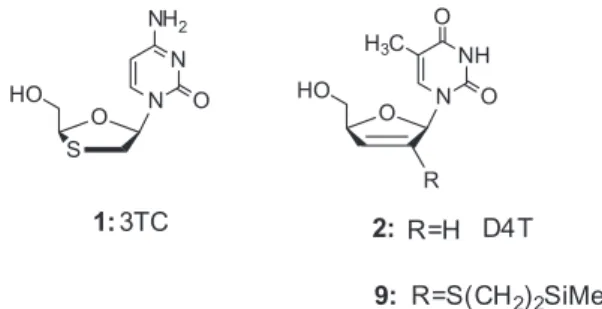
This method was applied to the synthesis of mixed disulfides of 2’,3’-didehydro-2’,3’-dideoxy-2’-(2”-(trimethylsilyl)ethylthio)nucleosides in the uridine, thymine and cytidine series.29 In the uridine series, the 2’-(4-nitrophenyl) disulfide was converted in one pot to the corresponding 2’-methylsulfide in two steps (i) reduction with DTT and (ii) alkylation of the obtained vinylthiol with methyl iodide.29 2’-Deoxy-2’-(2”-(trimethylsilyl) ethylthio)nucleosides could be also selectively converted in good yields to the corresponding 2’-thiocyanates by treatment with cyanogen bromide in methanol.30 In regard to the rich chemistry of the TMSES nucleosides which allows the preparation of diverse potentially antiviral and/or anticancer nucleosides (disulfides, thiols, sulfides, thiocyanates and others), we focused our work on the synthesis of the previously described 2’,3’-didehydro-2’,3’-dideoxy-2’-(2”-(trimethylsilyl)ethylthio)thymidine (9), parent compound to the antiviral drug 2’,3’-didehydro-2’,3’-dideoxythymidine (2) (stavudine, D4T, Figure 1).
Here, we report on a new straightforward efficient preparation of this nucleoside.
Results and Discussion
2’,3’-didehydro-2’,3’-dideoxy-2’-(2”-(trimethylsilyl) ethylthio)thymidine (9) was previously synthesized from the corresponding saturated TMSE sulfide (5) in four steps (64% overall yield): (i) 4,4’-dimethoxytritylation of the 5’-hydroxyl function, (ii) mesylation at the 3’-position, (iii) removal of the trityl group under acidic conditions, and (iv) elimination in the presence potassium carbonate in acetonitrile under reflux (Scheme 1).29 In this synthesis, the good mesyl leaving group has been introduced after selective protection of the 5’-hydroxyl group by tritylation. The detritylation was performed before elimination in order to avoid side reactions observed under acidic conditions during the detritylation of the unsaturated nucleoside.
The saturated TMSE intermediate (5) was prepared through the reaction of 2,2’-anhydrothymidine (4) with 2-(trimethylsilyl)ethanethiol (prepared from trimethylvinylsilane) at 120 °C in DMF (88% yield). 2,2’-Anhydrothymidine (4) can be prepared in 63% yield through (i) reaction of 5-methyluridine (3) with diphenyl carbonate in the presence of sodium hydrogen carbonate in DMF at reflux (1 h), (ii) precipitation from the reaction mixture in diethyl ether (1.8 L for 10 g of starting 5-methyluridine) to remove phenol, (iii) filtration and then (iv) crystallization in methanol. The main drawbacks of this synthesis result from the large volume of diethyl ether necessary for phenol removal and from the possible presence of moisture, (4)being very hygroscopic. Thus, we developed another method of preparation of (4) using dimethyl carbonate as reagent. According to the low boiling point of dimethyl carbonate, the reaction temperature was decreased (130 °C) and the reaction time increased (2 h) in comparison to the reaction performed with diphenyl carbonate. Compound(4) was obtained in 78% yield after precipitation in a small volume of diethyl ether, filtration and crystallization from methanol.
Then, from (5), we developed a straightforward synthesis of the unsatured thionucleoside (9) which was 3TC S O HO N N NH2
O HO O NH N O
O H3C
D4T
1: 2:
R
R=H
9: R=S(CH2)2SiMe3
Figure 1. Structures of thionucleosides Lamivudine (3TC), stavudine (D4T) and compound (9).
5 O S HO NH N O O Si H3C
9
(a) (b) (d)
O S OH HO NH N O O Si H3C
O S OH OTrDm NH N O O Si H3C
O S OMs OTrDm NH N O O Si H3C
O S OMs HO NH N O O Si H3C (c)
prepared in three steps (Scheme 2, 48% overall yield): (i) mesylation of the 3’ and 5’-hydroxyl functions, (ii)elimination in the presence of sodium benzoate in DMF at 90 ºC (iii) removal of the introduced 5’-benzoyl group under basic conditions (KOH/MeOH).
The saturated TMSE dimesyl intermediate (6) was obtained from (5) by reaction with methanesulfonyl chloride at room temperature for 1 h (Scheme 2, 87%). The 2’,3’-unsaturated nucleoside carrying a benzoyl group at the 5’-position (8)was isolated in 65% yield through reaction of (6) with sodium benzoate and purification by chromatography on silica gel.
The presence of two mesyl groups in (6) could be a source of side reactions decreasing the yield. Since compound (8) has a benzoate group at C-5’, we rationalized that this compound could also be prepared from a 3’,5’-dibenzoate derivative by selective elimination of the 3’-benzoate group. Thus, the saturated TMSE dibenzoyl intermediate (7) was prepared from (5) by reaction with benzoic anhydride at 60 ºC for 1 h (Scheme 2, 72% yield). Then, the obtained 2’,3’-unsaturated nucleoside carrying a benzoyl group at the 5’-position (8) was obtained in 62% yield by reaction of (7) with potassium carbonate. Finally, (8) was treated with potassium hydroxide at room temperature in MeOH to lead in good yield (86%) to corresponding the 2’, 3’-unsaturated nucleoside (9). Following this synthetic route compound (9) was obtained in 38% overall yield.
Both synthetic routes allowed the preparation of unsaturated thionucleoside (9) in a very straightforward manner. The main difference between the two methods was the high yield obtained in the preparation of dimesylate (6), which could be easily isolated by direct precipitation from the reaction mixture and filtration while the dibenzoate
(7) needed purification by column chromatography. Side products were detected by TLC and could be due elimination in the presence of pyridine. This led to a higher overall yield (48%) from the former route, compared to the 38% obtained via the second one. Although the synthetic routes depicted in this work had overall yields lower than the previously described method,29 they are one step shorter and can be easily scaled up, besides making use of cheaper and more stable reagents (methanesulfonyl chloride and benzoyl anhydride) as compared to the more expensive and less stable dimethoxytrityl chloride. Moreover, the new methods of synthesis of nucleoside (9) described here led rapidly to the unsaturated nucleoside (8) carrying a 5’-benzoyl protective group useful for further modifications of the sugar.
Conclusions
In summary, we have developed two new, simple and efficient methodologies for the synthesis of unsatured thionucleoside (9), akey-intermediate in the preparation of potentially antiviral or antiproliferative thionucleosides.
Experimental
General procedures
Thin-layer chromatography (TLC) was carried out on plates precoated with Merck silica gel 60 F254 (Darmstad , Germany). Detection was by UV at 254 nm. Column chromatography was carried out on silica gel (230-400 mesh). IR spectra were recorded with a Spectrum One Perkin Elmer (Waltham, USA) spectrometer from the
O OH OH HO
NH N O
O H3C
3
O OH HO
N N O
O
CH3
4
O S OH HO
NH N O
O
Si H3C
5
O S OMs MsO
NH N O
O
Si H3C
6
O S BzO
NH N O
O
Si H3C
OBz
7
O S BzO
NH N O
O Si H3C
8
O S HO
NH N O
O Si H3C
9
(a) (b)
(c) (d)
(e)
(f) (g)
Laboratory of Medicinal Chemistry, University Federal de Minas Gerais. Nuclear magnetic resonance spectra were obtained using Bruker Avance - 400 MHz spectrometers (Billerica, USA) from the Departément Pharmaco Chimie Molecularie, Université Joseph Fourier-Grenoble and Bruker Avance - 200 MHz (Billerica, USA) spectrometers from the Laboratory of Nuclear Magnetic Resonance, Department of Chemistry, University Federal de Minas Gerais. The assignments were confirmed by proton-proton homocorrelated and carbon-proton heterocorrelated spectra. HRMS experiments were performed using a Shimadzu LC-ITT OF Instrument (Kyoto, Japan) using electrospray ionisation, from the Department of Chemistry, University Federal de Minas Gerais and Shimadzu LC-ITT OF Instrument using electrospray ionisation (Kyoto, Japan) from the Institut de Chimie Organique et Analytique, Université d’Orléans, France. Optical rotations were measured with ADP220 –BS Bellingham Stanley Ltd. Polarimeter (Wales, England) from the Laboratory of Medicinal Chemistry, University Federal de Minas Gerais. Melting points were measured with MQAPF-301 from the Laboratory of Medicinal Chemistry, University Federal Minas de Gerais.
2, 2’-anhydrothymidine(4)
5-methyluridine (3)(15 g, 58.06 mmol) was dissolved in dry dimethylformamide (100 mL) and treated with dimetyl carbonate (6.95 mL, 81.87 mmol) and sodium hydrogen carbonate (0.31 g, 3.71 mmol). The mixture was heated at 130 °C for 2 h and poured into ether. The precipitated gum was then crystallized from methanol to give the 2,2’-anhydrothymidine (4) as colorless prisms (10.9 g, 78%); [α]D20,5 –0.09 (c = 0.4, MeOH); mp 240-242 °C; IR ν/cm-1 3070, 2890, 1666, 1550, 1480, 1240, 1060, 990, 790.
2’-Deoxy-2’-(2’’-(trimethylsilyl)ethyl)thiothymidine 5
Prepared according to described procedure 29, in 88% yield.
2’-Deoxy-3’, 5’-di-(O-methanesulfonyl)-2’-(2’’-(trimethylsilyl) ethyl)thiothymidine(6)
To a solution of 2’-deoxy-2’-(2’’-(trimethylsilyl)ethyl) thiothymidine (5) (0.7 g, 1.87 mmol) in anhydrous pyridine (10 mL), at 0 °C under argon, was added methanesulfonyl chloride (1.6 g, 11.25 mmol) and the resulting solution was stirred for 1 h at room temperature. The solution was treated with aqueous hydrochloride acid to pH 1.0. The resulting suspension was filtered. The product (6)was obtained as a white solid (0.86 g, 87%); [α]D
23 0.02 (c= 0.2, MeOH);
mp: 72-74 °C; IR ν/cm-1 2950, 1685, 1350, 1190, 940,
830; 1H NMR (200 MHz, CDCl
3), δ8.65 (s, 1H, NH), 7.35 (s, 1H, H-6), 6.10 (d, 1H, J 9.4 Hz, H-1’), 5.24 (d, 1H, J 5.8 Hz, H-3’), 4.52 (m, 3H, H-4’+ H-5’a + H-5’b), 3.52 (m, 1H, H-2’), 3.17 (s, 3H, SO2-CH3), 3.11 (s, 3H, SO2-CH3), 2.57 (m, 2H, S-CH2), 1.94 (s, 3H, 5-CH3), 0.77 (m, 2H, Si-CH2), -0.03 (s, 9H, Si-(CH3)3);
13C NMR
(50 MHz, DMSO-d6,) δ 163.0 (C-2), 150.2 (C-4), 135.1 (C-6), 112.3 (C-5), 88.7 (C-1’), 81.3 (C-4’), 79.5 (C-3’), 68.2 (C-5’), 48.9 (C-2’), 38.6 (SO2-CH3), 37.9 (SO2-CH3), 27.9 (S-CH2), 17.6(Si-CH2), 12.1 (5-CH3), -2.0 (Si-(CH3)3); HRMS m/z, observed: 531.0964; C17H31N2O9S3Si [M+H]+ requires: 531.0916.
2’-Deoxy-3’, 5’-di-(O-benzoyl)-2’-(2”-(trimethylsilyl)ethyl) thiothymidine(7)
To a solution of 2’-deoxy-2’-(2”-(trimethylsilyl) ethyl)thiothymidine (5)(1.66 g, 4.45 mmol) in anhydrous pyridine (30 mL), at 0 °C under argon, was added benzoic anhydride (10.1 g, 44.48 mmol) and the resulting solution was stirred for 6 h at 60 ºC, then evaporated. The residue was dissolved in dichloromethane (150 mL), washed twice with water (100 mL) aqueous sodium hydrogenocarbonate (5%; 200 mL), then the combined extracts were dried over MgSO4 and evaporated. The crude compound was purified by chromatography on silica gel in dichloromethane:methanol (95:5) to give compound (7) as a white solid (1.86 g, 72%); [α]D23,5 –0.11 (c = 0.4, CH2Cl2); mp: 68-70 °C; IR ν/cm
-1 3060, 2950, 1715, 1680,
1600, 1580, 1450, 1250, 840, 750; 1H NMR (400 MHz, CDCl3,) δ 8.08 (s, 1H, N-H), 8.08-7.46 (m, 10H, Ar), 7.15 (d, 1H, J 1.2 Hz, H-6’), 6.30 (d, 1H, J 8.4 Hz, H-1’), 5.68 (dd, 1H, J 2.4 Hz, J 6.0 Hz, H-3’), 4,79 (dd, 1H, J 3.2 Hz,
J 12,00 Hz, H-5’a), 4.68 (dd, 1H, J 3.2 Hz, J 12,00 Hz, H-5’b), 4.53 (1 H, m, H-4’), 3.59 (m, 1H, H-2’), 2.57 (m, 2H, S-CH2), 1.63 (s, 3H, 5-CH3), 0.73 (m, 2H, Si-CH2), -0,07(s, 9H, Si-(CH3)3;
13C NMR (100 MHz, CDCl 3,) δ 165.9 (COO), 165.8 (COO), 162.9 (C-2), 150.2 (C-4), 134.5(C-6), 133.8 (C-Ar), 130.0 (C-Ar), 129.5 (C-Ar), 129.4 (C-Ar), 129.0 (C-Ar), 128.6 (C-Ar), 112.1 (C-5), 88.7 (C-1’), 81.5 (C-4’), 74.6 (C-3’), 64.1 (C-5’), 50.5 (C-2’), 29.0 (S-CH2), 17.5 (Si-CH2), 12.1 (5-CH3), -0.0 (Si-(CH3)3); HRMS m/z, observed: 583.1926; C29H35N2O7SSi [M+H]
+
requires: 583.1890.
2’,3’-Didehydro-2’,3’-dideoxy-5’-(O -benzoyl)-2’-(2”-(trimethylsilyl)ethyl)thiothymidine(8)
90 °C for 4 h. After completion of the reaction as detected by TLC (dichloromethane:methanol, 95:5) 100 mL of dichloromethane was added. The resulting suspension was filtered and the filtrate evaporated to dryness. The residue was purified by chromatography on silica gel with hexane: ethyl acetate (1:1). The product (8)was obtained as a white solid (0.49 g, 65% yield).
A suspension of 2’-deoxy-3’,5’-di-(O -benzoyl)-2’-(2’’-(trimethylsilyl)ethyl)thiothymidine(7) (1.25 g, 2.14 mmol) and anhydrous potassium carbonate (1.48 g, 10.7 mmol) in dry DMF (60 mL) was stirred under argon at 120 °C for 4 h. After completion of the reaction, as detected by TLC (dichloromethane:ethyl acetate, 9:1) 200 mL of dichloromethane was added. The resulting suspension was filtered and the filtrate to dryness evaporated. The crude compound was purified by chromatography on silica gel in with dichloromethane:ethyl acetate (95: 5). The product (8) was obtained as a white solid (0.61 g, 62% yield).
[α]D
23,7-0.58 (c = 0.2, CH
2Cl2); mp: 52-54°C; IR
ν/cm-1 3040, 2950, 1720, 1680, 1450, 1250, 1100, 840, 670; 1H NMR (400 MHz, CDCl
3) δ 9,20 (s, 1H, NH), 8,0 (dd, 2H,
J 1.2 Hz, J 8.4 Hz Ar- Ha), 7.58 (m, 1H, Ar- Hc), 7.44 (t, 2H,
J 7.6 Hz, Ar- Hb), 6.96 (d, 1H, J 1.2 Hz, H-6), 6.92 (dd, 1H,
J 1.6 Hz, J 3.6 Hz, H-1’), 5,80 (t, 1H, J 1.6 Hz, H-3’), 5.16 (m, 1H, H-4’), 4,57 (dd, 1H, J 4.00 Hz, J 12.00 Hz, H-5’a), 4.51 (dd, 1H, J 4.00 Hz, J 12.00 Hz, H-5’b), 2.82 (m, 2H, S-CH2), 1.57 (s, 3H, 5-CH3), 0.91 (m, 2 H, Si-CH2), 0.02 (m, 9H, Si-(CH3)3); 13C NMR (100 MHz, CDCl3,) δ 166.3 (CO), 163.7 (C-2), 151.0 (C-4), 136.8 (C-2’), 135.0 (C-6), 133.5 (C-Ar), 129.6 (C-2Ar), 129.5 (C-Ar), 128.6 (C-2Ar), 121.6 (C-3’), 111.7 (C-5), 89.8 (C-1’), 84.2 (C-4’), 65.3 (C-5’), 28.6 (S-CH2), 16.2 (Si-CH2), 12.1 (5-CH3), -1.9 (Si-(CH3)3); HRMS observed: 461.1562; C22H29N2O5SSi [M+H]+ requires: 461.1522.
2’,3’-Didehydro-2’,3’-dideoxy-2’-(2”-(trimethylsilyl)ethyl) thiothymidine(9)
To a solution of 2’,3’-didehydro-2’,3’-dideoxy-5’-(O -benzoyl)-2’-(2” (trimethylsilyl)ethyl)thiothymidine (8) (0.130 g, 0.28 mmol) in anhydrous methanol (10 mL), at 0°C, was added potassium hydroxide (0.024 g, 0.42 mmol) and the resulting solution was stirred for 1 h at room temperature. The solution was neutralized with acid resin amberlist IRH-120 at pH 7.0. The resulting suspension was filtered, evaporated to dryness and the residue obtained was purified by chromatography on silica gel with dichloromethane:methanol (95:5). The product (9) was obtained as a white solid (0.086 g, 86% yield); mp: 59-61°C; IR ν/cm-1 3420, 2950, 1680, 1610, 1250, 1100, 890; 1H NMR (400 MHz, CDCl
3), δ 8.40 (s, 1H, N-H),
7.35 (d, 1H, J 0.8 Hz, H-6), 6.89 (d, 1H, J 2.0 Hz, H-1’), 5.78 (s, 1H, H-3’), 4.94 (d, 1H, J 0.8 Hz, H-4’), 3.92 (dd, 1H, J 2.8 Hz, J 12.6 Hz, H-5’a), 3.74 (dd, 1H, J 2.8 Hz,
J 12.6 Hz, H-5’b), 2.84 (m, 2H, S-CH2), 1.86 (s, 3H, 5-CH3), 0.92 (m, 2H, Si-CH2), 0.04 (9 H, s, Si(CH3)3). 13C NMR (100 MHz, CDCl3) δ 164.0 (C-2), 150.6 (C-4), 136.9 (C-6), 135.2 (C-2’), 123.5 (C-3’), 110.9 (C-5), 90.3 (C-1’), 87.4 (C-4’), 63.5 (C-5’), 28.5 (S-CH2), 16.3 (Si-CH2), 12.4 (5-CH3), -1.8 (Si(CH3)3); HRMS observed: 395.0932; C15H24N2KO4SSi: [M+K]
+ requires: 395.0863.
Supplementary Information
Relevant spectral data, including NMR, IR and mass spectra, are available free of charge at http://jbcs.sbq.org.br, as a PDF file.
Acknowledgements
The authors thank CNPq , CAPES-COFECUB for financial support.
References
1. Bergstrom, D.; Lin, X.; Wang, G.; Rotstein, D.; Beal, P.; Norrix, K.; Ruth, J.; Synlett1992, 3, 179.
2. Périgaud, C.; Gosselin, G.; Imbach, J. L.; Nucleosides Nucleotides 1992, 11, 903.
3. De Clercq, E.; Rev. Med. Virol. 2000, 10, 255. 4. Fischer, B.; Drug Develop. Res. 2000, 50, 338.
5. Vernekar, S. K. V.; Qiu, L.; Zacharias, J.; Geraghty, R. J.; Wang, Z.; Med. Chem. Commun. 2014, 5, 603.
6. Tadeusz, R.; Clin. Cancer Drugs2014, 1, 2.
7. Saudi, M.; Zmurko, J.; Kaptein, S.; Rozenski, J.; Neyts, J.; Van Aerschot, A.; Eur. J. Med. Chem.2014, 76, 98.
8. Wnuk, S. F.; Tetrahedron1993, 49, 9877. 9. Yokoyama, M.; Synthesis2000, 12, 1637.
10. Chambert, S.; Décout, J. L.; Org. Prep. Proc. Int. 2002, 34, 27. 11. Fernandez-Bolanos, J. G.; Al-Masoudi, N. A.; Maya, I.; Advan.
Carbohyd. Chem. Biochem. 2001, 57, 21.
12. Jasamai, M.; Balzarini, J.; Simons, C.; J. Enzyme Inhib. Med. Chem. 2008, 23, 56.
13. Mosselhi, M. A. N.; Break, L. M.; Nucleosides Nucleotides 2011, 30, 681.
14. Kikuchi, Y.; Yamazaki, N.; Tarashima, N.; Furukawa, K.; Takiguchi, Y.; Itoh, K.; Minakawa, N.; Bioorg. Med. Chem. 2013, 21, 5292.
15. Kananovich, D. G.; Reino, A.; Ilmarinen, K.; Roomusoks, M.; Karelson, M.; Lopp, M.; Org. Biomol. Chem.2014, 12, 5634. 16. Wilson, L. J.; Hager, M. W.; El-Kattan, Y. A.; Liotta, D. C.;
17. Gumina, G.; Chong, Y.; Choo, H.; Song, G-Y.; Chu, C. K.;
Current Topics Med. Chem. 2002, 2, 1065.
18. Robins, M. J.; Nucleosides Nucleotides 1999, 18, 779. 19. Robins, M. J.; Ewing, G. J.; J. Am. Chem. Soc. 1999, 121, 5823. 20. Covès, J.; Le Hir de Fallois, L.; Le Pape, L.; Décout, J. L.;
Biochemistry 1996, 35, 8595.
21. Le Hir de Fallois, L.; Décout, J. L.; Fontecave, M.; J. Chem. Soc., Perkin Trans. 1 (Int.Org. Bioorg. Chem.) 1997, 17, 2587. 22. Eckstein, F.; Lilley, D. M. J.; Springer Berlin 1996, 10, 417. 23. Gille, A.; Guo, J.; Mou, T. C.; Doughty, M. B.; Lushington, G.
H.; Seifert, R.; Biochem. Pharmacol. 2005, 71, 89.
24. Kumar, P.; Madsen, C. S.; Nielsen, P.; Bioorg. Med. Chem. Lett. 2013, 23, 6847.
25. Chambert, S.; Désiré, J.; Décout, J. L.; Synthesis. 2002, 16, 2319.
26. Roy, B.; Chambert, S.; Lepoivre, M.; Aubertin, A.-M.; Balzarini, J.; Décout, J. L.; J. Med. Chem. 2003, 46, 2565. 27. Gerland, B.; Désiré, J.; Balzarini, J.; Décout, J. L.; Bioorg. Med.
Chem. 2008, 16, 6824.
28. Chambert, S.; Gautier-Luneau, I.; Fontecave, M.; Décout, J.-L.;
J. Org. Chem. 2000, 65, 249.
29. Gerland, B.; Désiré, J.; Lepoivre, M.; Décout, J. L.; Org. Lett. 2007, 9, 3021.
30. Chambert, S.; Thomasson, F.; Décout, J. L.; J. Org. Chem. 2002,
67, 1898.
Submitted: October 17, 2014