
Investigation of the Surface Properties of an Oxide of Interest in the
Field of a Conductive Oxide System: Influence of Precursor and
Purification
Gilmar de Almeida Gomesa*, and Julien Françoise Coleta Boodtsa,b
aDepartamento de Química, Faculdade de Filosofia, Ciências e Letras de Ribeirão
Preto, Universidade de São Paulo, Av. Bandeirantes 3900, 14040-901 Ribeirão Preto - SP, Brazil
bDepartamento de Química, Universidade Federal de Uberlândia,
Av. João Naves de Ávila 2160, 38400-902 Uberlândia - MG. Brazil
As propriedades superficiais de TiO2 comercial e de amostras sintetizados por decomposição térmica, usando diferentes precursores, foram investigadas por microeletroforese. Os pie’s obtidos em função da força iônica, controlada com KNO3 ou KCl, revelaram que: 1) A amostra comercial e as sintetizadas a partir de precursor contendo cloreto dissolvido em HCl 1:1(v/v) apresentaram valores de pie muito baixos devido à inclusão de cloreto no óxido; 2) Os métodos de purificação explorados (suspensão do óxido em pH 12 e diálise) se mostraram ineficientes; 3) TiO2 sintetizado a partir de um precursor orgânico e condições livres de cloreto forneceu um pie de 5,9 valor em excelente concordância com a literatura.; 4) Adsorção específica de cloreto em TiO2 é fraca.
The surface properties of commercial TiO2 and samples synthesized by the thermal decompo-sition procedure using several precursor salts were investigated by a microelectrophoresis technique. The iep was determined as a function of the ionic strength which was controlled with KNO3 or KCl. The experimental results showed: 1) The commercial sample and the ones synthesized from the chloride salt dissolved in HCl 1:1 (v/v) show low iep’s due to chloride inclusion; 2) The purification methods explored (oxide suspension at pH~12 and dialysis) are inefficient; 3) TiO2 samples synthesized from an organic precursor salt under totally chloride-free conditions furnished an iep of 5.9 in excellent agreement with literature data; 4) Chloride specific adsorption on TiO2 is weak.
Keywords: electrocatalysis, surface properties, titanium dioxide, chloride specific adsorption
Introduction
Conductive metallic oxide electrodes, known as Di-mensionally Stable Anodes, DSA, are of outstanding tech-nological importance due to their excellent catalytic properties for the chlorine and oxygen evolution reac-tions1,2. The basic composition of DSA is a mixture of
RuO2(IrO2)+TiO2, the first oxides providing the catalytic
properties while TiO2 promotes the mechanical stability
and chemical inertness of the mixture. Frequently other oxides (modulators) are introduced into the mixture to modulate specific properties of the mixture. The overall electrocatalytic efficiency of an oxide electrode is influ-enced by both morphological (surface area) and synergistic
(electronic) features. So, the overall response is a combina-tion of the apparent (surface area effect) and real catalytic (synergistic) properties of the material. Unfortunately, ab-solute methods to determine the real surface area of these rugose materials are not available3 making the separation of morphological and synergistic features a difficult matter. Therefore the investigation of an intensive property (area independent) such as the acidity (pKa) or chloride specific
adsorption of the oxide4 are of interest to the field of electrocatalysis. However, more experimetal results are needed before a rationalization of the data can be at-tempted.
Freshly prepared oxides, obtained at relatively low temperatures (350-600 °C), are hydrophilic rapidly
react-Article
fax 55-16-6338151;
e-mail: [email protected]
ing with atmospheric moisture. This process results in an oxide surface covered by OH groups capable of mediating the interactions between the surface and its surrounding. Electrocatalysis being a surface phenomenon makes the investigation of the oxide surface properties (pKa, pCl),
which in turn define the intermediates (MOH2+, MO-,
MOCl-) existing at the oxide surface, of fundamental im-portance5 for a better understanding of the catalytic prop-erties with respect to the hydrogen, oxygen and chloride evolution reactions on these electrode materials. An ex-celent review of oxygen evolution at oxide electrodes and the correlation of electrocatalytic activity with the pzc of oxides was recently published by Ardizzone and Trasatti6. Due to the limited amount of data on acid/base surface properties and chloride specific adsorption available in the literature we initiated our investigation of oxides of interest to the field of electrocatalysis starting with TiO2. Despite
the fact this oxide in not an electrocatalyst we decided to start with this material since it is the most widely used oxide to stabilize electrocatalytic systems being frequently pre-sent in concentrations up to 70 mol %. Besides, the experi-mental procedure used to prepare oxide electrodes frequently causes synergistic effects making the investiga-tion of the individual components of interest. TiO2 is an
intensively investigated oxide due to its industrial impor-tance (e.g. paints). However, as far as we know the acid/base properties of TiO2 synthesized using conditions
as close as possible to electode preparation were only recently investigated by acid/base titration7.
Experimental
Preparation of the oxides
In order to stay as close as possible to the established experimental conditions used in the preparation of DSA, oxides were synthesized by the thermal decomposition route using TiCl4 (Ventron) and Ti[O(CH2)3CH3]4,
Ti(OBu)4, (Aldrich) as precursors. For comparison
com-mercial TiO2 (Ultrex brand from J. T. Baker) was also
included in the investigation. In the case of TiCl4 the
precursor was dissolved in HCl 1:1 (v/v) (Merck) while with Ti(OBu)4 1:2 (v/v) HNO3 (Merck) was used as a
solvent in order to avoid any trace of Cl-.
Initially, the solvent of the ~0.2 mol dm-3 precursor solution was evaporated at low temperature until dryness (~90 °C) and the residue calcinated at 450 °C for 1 h in an oven pre-heated at the desired temperature. The oxide was then suspended in 10-2 mol dm-3 KOH, ( pH ~12), and stirred for 24 h. The pH of the oxide suspension was ajusted periodically. Next, the oxide was isolated by filtration using a Millipore HA ∅ 0.45 µm membrane and air-dried for 1 h at 120 °C. A final 1 h calcination at 450 °C completed the procedure.
The above described suspension, filtration and calcina-tion (120 °C, 450 °C) sequence was repeated three times. The oxide obtained from TiCl4, already three times
puri-fied, was divided in two portions, A and B, and each portion submitted to one more purification step. Portion A was purified by dialysis for 21 days while portion B purified once more by suspension in 10-2 mol dm-3 KOH (pH ~ 12).
Oxide characterization
Oxide structure was obtained by X-ray diffraction using a Siemens model D5000 diffractometer (40 kV, 40 mA). X-ray fluorescence spectra were recorded on a Sequential X-ray Fluorescence Spectrometer, model VRA 30, Carl Zeiss (40 kV, 30 mA.)
Zeta potential measurements
Approximately 0.1 g of TiO2 was suspended in 1.0 dm3
of the appropriate supporting electrolyte (KNO3 or KCl) of
the desired ionic strength and stirred for 24 h prior to use. While a commercial product was used as a source of KCl (Merck p.a.), KNO3 was synthesized neutralizing HNO3
(Merck p.a.) with KOH (Merck p.a.). The KNO3 obtained
after crystallization contained less then 5 ppm of chloride. Aliquots of the 0.01% TiO2 suspension were adjusted to the
desired pH values using HNO3 or KOH. The pH of the
suspension was considered constant when it remained for at least 30 min at the desired value. Ionic strengths inves-tigated covered the 1 x 10⁻² --1 x 10⁻⁴ mol dm-3 range. Zeta potentials, ζ, were measured using a Zetasizer 4 equipment from Malvern (UK).
Results and Discussion
1 X-ray diffraction and fluorescence
Representative diffractograms of TiO2 samples are
shown in Fig. 1. Comparison of our spectra with published data8 (ASTM Cards) revealed TiO2 to be present in the
rutile structure in both the commercial product and the sample synthesized from the TiCl4 precursor dissolved in
HCl 1:1 (v/v). In the later sample a small amount of the anatase form of TiO2 was also identified by its
charac-teristic peaks. The oxide obtained from the organic precur-sor was pure anatase. Judged by the width of the peaks, the commercial oxide and the TiO2 sample obtained from TiCl4
showed a higher degree of crystallinity than the oxide obtained from Ti(OBu)4. Successive purification steps
re-sulted in an increase in the degree of crystallinity of the oxides as a consequence of the extra calcination time (each successive purification sequence involves a 1 h calcination step at 450 °C).
below the detection limit of the analytical technique. As expected, considering the experimental precautions taken during the synthesis of TiO2 from Ti(OBu)4 (any possible
chloride source was excluded), no Cl- was detected in this
sample. The presence of Cl- in the oxide synthesized from
TiCl4 was confirmed by X-ray fluorescence. This finding
is consistent with the results of UHV analysis of TiO2
-con-taining oxide electrodes9, prepared using similar
experi-mental conditions, in which Cl- was also detected. It is
worthwhile to mention that once the electrode material was submitted to strong oxygen evolution from 1.0 mol dm-3
HClO4 the presence of Cl- in the outer 20-30 nm region of
the oxide layer was no longer evidenced by XPS9.
Acid/base surface properties
Figure 2 shows a series of ζ-pH curves obtained in 10-3 mol dm-3 KNO3 as a function of the number of purifications
for TiO2 samples obtained from TiCl4. A representative
curve for the commercial sample is shown in Fig. 3. All curves exhibit some common features: (1) no posi-tive ζ-limit is observed in the curves and; (2) the iep’s obtained (2.3-3.5 for TiO2 samples prepared from TiCl4
and 2.9 for the commercial product) are all significantly lower than the values published in the literature7,10-12. These results suggest an excess of negative charge of the oxide which could be due to either Cl- specific adsorption or inclusion of Cl- in the oxide bulk as supported by X-ray fluorescence and XPS9 results. Substitution of O by Cl in the crystal lattice can be ruled out since this would lead to an excess positive charge. The results of the specific ad-sorption study (see Chloride specific adad-sorption section) and the inefficiency of extensive purification through sus-pension in 10-2 mol dm-3 KOH, expected to be efficient when dealing with a surface equilibrium process, all sup-port the idea of chloride inclusion into the oxide to be the main source of the excess negative charge.
The ζ-pH curves (see Figs. 2 and 3) show the surface of TiO2 suspended in 10-2 mol dm-3 KOH to be in the MO
-form. In the case where a surface adsorption process results in the low iep values, it is reasonable to presume that successive suspension steps would result in a displacement of the abnormally low iep values towards those of the literature. The purification procedure only caused a small increase of the iep from 2.3 to 3.5. This result not only supports chloride specific adsorption is of minor impor-tance but also that oxide purification by suspension in basic medium is an inefficient method when inclusion is the main cause of chloride contamination of the oxide.
Representative ζ-pH curves obtained at different ionic strengths (KNO3) of TiO2 samples synthesized from
Ti(OBu)4 precursor in HNO3 1:2 (v/v) are shown in Fig. 4.
All curves are symmetrical showing a single intersection point at ζ = 0 while the positive and negative branches have
Figure 2. Zeta potential as a function of pH. Numbers on the curves represent the number of purification steps (pH ~12) the sample was submitted to. TiO2 synthesized from TiCl4 (Ventron). [KNO3] = 1.0 x 10⁻³ mol dm-3; [ TiO2 suspension] = 0.01%.
Figure 1. X-ray diffractograms of thermally prepared TiO2 samples from: (A) Ti(OBu)4 in 1:2 HNO3; (B) TiCl4 in 1:1 (v/v) HCl (3 purifications at pH ~12).
almost identical ζ-values (ζ+max = ζ-min). An iep of 5.9 ± 0.2
was obtained. KNO3 is known as a supporting electrolyte
which is not subject to specific adsorption. This, together with the behavior of the ζ-pH curves as a function of ionic strength of the KNO3 supporting electrolyte furnishes a
pKa-value of 5.9 ± 0.2 for TiO2. This value is in excellent
agreement with literature data7,10-12. A comparison with the
value of 6.2 ± 0.1 obtained by Faria and Trasatti7, who investigated by acid/base titration TiO2 samples thermally
prepared from TiCl4 precursor dissolved in HCl 1:1 (v/v),
is of interest. Despite the fact that thermal synthesis of TiO2
from TiCl4 leads to Cl-inclusion (see above) these authors
obtained a pKa-value which, within the experimental error,
coincides with the value obtained for oxide samples syn-thesized under Cl-free conditions (from Ti(OBu)4 in
HNO3). This can be understood considering the differences
in the experimental procedures. While ζ-measurements are strongly affected by any phenomenon resulting in an excess charge at the oxide, acid/base titrations are less affected by them. Faria and Trasatti7 worked with an oxide which was pre-equilibrated suspending it for 24 h in KNO3. The
ex-perimental procedure used by these authors together with our finding that chloride specific adsorption on TiO2 is
weak (see Chloride specific adsorption item) explains the
excellent agreement observed between the pKa-values ob-tained by the two independent experimental methods. It also supports the idea that Cl-inclusion is the main cause for the anomalous iep observed for TiO2 samples
synthe-sized from chloride containing precursors.
Chloride specific adsorption
Chloride specific adsorption on TiO2 samples obtained
from Ti(OBu)4 was studied in KCl, changing the ionic
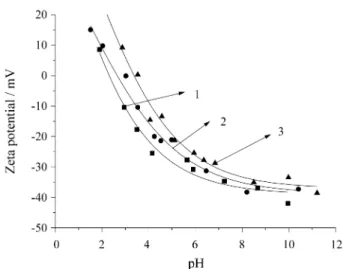
strength between 10-2-10-4 mol dm-3 KCl. Representative ζ-pH plots are shown in figure 5. The curves are slightly asymmetric with respect to the ζ-axis showing a single intersection at ζ = -10 mV from which an iep of 5.7 ± 0.2 was obtained. This result, together with the ζ-pH behavior, supports chloride specific adsorption on TiO2 to be weak.
Conclusions
a- TiO2 samples synthesized by the thermal
decompo-sition route from chloride precursor dissolved in strongly acid medium (HCl 1:1 (v/v)) results in an oxide showing a much lower iep than the well established pKa-value of ~6.1.
b- The iep, determined using a KNO3 supporting
elec-trolyte, of the oxide synthesized under Cl-free conditions (organic precursor; 1:2 (v/v) HNO3], furnishes a pKa = 5.9
± 0.2 in good agreement with literature data.
c- The anomalous iep of TiO2 sample synthesized from
chloride containing precursor solution is due to chloride inclusion in the oxide and not to chloride specific adsorp-tion.
d-The widely used techniques of suspending the oxide in alkaline solution and dialysis are inefficient purification methods when inclusion is the main source of excess charge at the oxide.
Figure 4. Zeta potential as a function of pH for different ionic strengths. [KNO3]: (▲) 1.0 x10⁻⁴; (•) 1.0 x 10⁻³; ( ) 1.0 x 10⁻² mol dm-3. TiO2 sample prepared from Ti(OBu)4 dissolved in 1:2 (v/v) HNO3 ; [oxide suspension] = 0.01%; Tcalc= 450 °C.
e- Chloride specific adsorption on TiO2, as supported
by ζ-pH data in KCl, is weak.
Acknowledgments
A. Gomes acknowledges a fellowship from the FAPESP Foundation. J.F.C. Boodts acknowledges finan-cial support from the FAPEMIG Foundation.
References
1. Trasatti S. In Electrodes of Condutive Metallic Oxides
Parts A & B, Elsevier, Amsterdam, 1980-1981. 2. Trasatti S. In Electrochemical Hydrogen
Technolo-gies Wendt, H., ed., Elsevier, Amsterdam, 1990. 3. Trasatti, S.; Petrii, O.A. Pure Appl. Chem. 1991, 63,
711.
4. Trasatti, S. Croat Chem. Acta1990, 63, 313.
5. Daghetti, A.; Lodi, G.; Trasatti, S. Mater. Chem. Phys. 1983, 8, 1.
6. Ardizzone, S.; Trasatti, S. Adv. Colloid Interface Sci.
1996, 64, 173.
7. Faria, L. A.; Trasatti, S. J. Electroanal. Chem1992,
340, 145.
8. The Joint Committee on Powder Diffraction Stand-ards, Powder Diffraction Files - Inorganic Volume, cards 21-1272, 21-1276, Philadelphia, USA, 1972. 9. Lassali, T.A.F.; Boodts, J.F.C.; de Castro, F.C.;
Trasatti, S. Electrochim. Acta 1994, 39, 95. 10. Parks, G.A. Chem. Rev. 1965, 65, 177.
11. Schindler, P.W.; Gamsjager, H. Kolloid Z. Z. Polym. 1972, 250, 759.
12. Furlong, D.N.; Parfitt, G. D. J. Colloid Interface. Sci. 1978, 14, 548.
Received: January 5, 1998
![Figure 5. Zeta potential as a function of pH for different ionic strengths [KCl]: ( ▲ ) 5.0 x 10 -4 ; (x) 5.0 x 10 -3 and ( ) 1.0 x 10 -2 mol dm -3](https://thumb-eu.123doks.com/thumbv2/123dok_br/18988401.459726/4.918.99.440.572.1015/figure-zeta-potential-function-different-ionic-strengths-kcl.webp)
