35 Rev Gaúcha Enferm. 2014 dez;35(4):35-41. Versão on-line Português/Inglês: www.scielo.br/rgenf
Revista Gaúcha
de Enfermagem
DOI: http://dx.doi.org/10.1590/1983-1447.2014.04.46916
Poor self-rated health and associated
factors among elderly urban residents
Autoavaliação de saúde ruim e fatores associados
em idosos residentes em zona urbana
Autoevaluación de mala salud y factores
asociados en ancianos residentes en la zona urbana
a Nurse. Master’s degree. Faculty Member of the
De-partamento de Enfermagem da Universidade Federal de Mato Grosso- UFMT.
b Nurse. PhD. Faculty Member of the Departamento
de Enfermagem da UFMT.
c Nurse. PhD. Faculty Member of the Departamento
de Enfermagem da UFMT.
d Nurse. Master’s degree. Faculty Member of the
Faculdade de Enfermagem do Centro Universitário de Várzea Grande -UNIVAG.
e Statistician. PhD. Faculty Member of the
Departa-mento de Estatística da UFMT.
Joana Darc Chaves Cardosoa
Rosemeiry Capriata de Souza Azevedob
Annelita Almeida Oliveira Reinersc
Cecília Victorazzo Louzadad
Mariano Martinez Espinosae
ABSTRACT
The purpose of this study was to examine the prevalence of bad self-rated health in the elderly and associated demographic and socioeconomic factors. This was an epidemiological, cross-sectional study. Data were collected through interviews using the BOAS (Brazil Old Age Schedule) questionnaire. The study included 573 elderly residents in the urban area of Cuiabá-MT, Brazil. The adopted measure of association was the prevalence ratio. For multivariate analysis, multiple Poisson regression was used. The prevalence of poor/very poor self-rated health was 30.9% and the associated factors were income, number of morbidities and urinary incontinence. The association of demographic and socioeconomic factors with poor/very poor self-rated health among the elderly in this study shows the need for assistance and policies that minimize the impact of these factors on the lives and health of the elderly.
Descriptors: Health status. Aged. Self-assessment.
RESUMO
Objetivou-se analisar a prevalência da autoavaliação de ruim/péssima e os fatores associados em idosos. Estudo epidemiológico, de corte transversal. Os dados foram coletados por meio de entrevista, utilizando o questionário BOAS (Brasil Old Age Schedule). Parti-ciparam do estudo 573 idosos residentes na zona urbana do município de Cuiabá-MT. A medida de associação utilizada foi a razão de prevalência. Na análise multivariada, utilizou-se a regressão múltipla de Poisson. A prevalência de autoavaliação de ruim/péssima foi de 30,9%, e os fatores que se mantiveram associados foram renda, número de morbidades e incontinência urinária. A associação de fatores demográfi cos, socioeconômicos e de saúde à autoavaliação de saúde ruim/péssima dos idosos deste estudo mostra a necessi-dade de medidas assistenciais e políticas para minimizar o impacto desses fatores na vida e saúde dos idosos.
Descritores: Nível de saúde. Idoso. Autoavaliação.
RESUMEN
Este estudio tuvo como objetivo examinar la prevalencia de autoevaluación de los factores de pobre / muy pobre y asociados sobre los ancianos. Estudio epidemiológico, transversal. Los datos fueron recolectados a través de entrevistas utilizando el buen cuestio-nario BOAS (Brazil Old Age Schedule). El estudio incluyó a 573 ancianos residentes en la zona urbana de Cuiabá-MT. La medida de asociación utilizada fue la razón de prevalencia. En el análisis multivariante, se utilizó la regresión múltiple de Poisson. La prevalencia de la autoevaluación de la mala / muy mala fue del 30,9% y los factores que se mantuvieron asociados eran ingresos, número de comorbilidades y la incontinencia urinaria. La asociación de los factores socioeconómicos, demográfi cos, y la autoevaluación de la salud de los pobres / muy mal estado de salud de los adultos mayores en este estudio muestra la necesidad de atención y las políticas para minimizar el impacto de estos factores sobre la vida y la salud de las medidas de mayor edad.
INTRODUCTION
Self-rated health has been used as a reliable method to measure and monitor the health status of individuals, and is a practical, low-cost method for healthcare services. It is an indicator of quality of life, morbidity and functional decline, and, above all, a solid predictor of morbidity, which is essential to evaluate the health conditions of elderly people(1). This general self-classifi cation of health status
en-compasses several aspects of the individual’s life, such as physical, functional, cognitive and emotional factors, and well-being(2).
There is a growing number of studies and research on self-rated health among the elderly(3-4). Information on
self-rated health among older people provides evidence on their health status and the impact it has on their lives.
Studies that focus on poor self-rated health among the elderly, however, are still scarse(5-6). Existing studies on
this topic show that poor self-rated health is associated to several factors, such as sedentarism, low weight and obe-sity, extensive use of medication and functional incapacity. Moreover, the risk of mortality associated to poor self-rated health is greater than in other objective health status as-sessments, such as physician-rated health (1).
In this study, the concept of elderly was adopted from the World Health Organization (WHO), that establish-es that an elderly person is 60 years or older. The object of this study was to analyse the prevalence of poor/very poor self-rated health among the elderly urban population considering associated demographic, socioeconomic and health-related factors.
METHOD
Research for this study was based on a master’s dis-sertation titled, “Condições de saúde autorreferidas da pop-ulação idosa do município de Cuiabá-MT” (Self-rated health conditions among the elderly population of the munic-ipality of Cuiaba-MT)(7). Epidemiological cross-sectional
research was conducted by means of home interviews in the municipality of Cuiabá-MT, Brazil. Elderly people who lived in long-stay institutions (LSI), hospitals, prisons, con-vents, lodging houses and support houses were excluded from the study. Other exclusions were elderly people with cognitive problems or any condition that prevented them from answering the questions, and those who resided in rural areas.
Sample group size was determined using the formu-la for the fi nite popuformu-lation. The probability-type sample was based on a stratifi cation selection technique by
cen-sus sector, reconsidering a confi dence interval of 95%, a sample error of 5% and an estimated proportion of 50% for the proportions of interest. This cluster sampling was used to determine the number of census sectors that would be visited, totalling 11 sectors. Considering a usual pattern eff ect of 1.5 to reach the desired research preci-sion, the total corrected sample was 573 elderly individ-uals. To determine the number of elderly persons that would be interviewed in the urban districts of Cuiabá, the total number of elderly people living in each district strat-ifi ed by sex was considered.
Data were collected at the homes of the elderly resi-dents from December 2011 to March 2012, by trained in-terviewees using a BOAS (Brazil Old Age Schedule) ques-tionnaire. This multi-dimensional tool has been used in several studies to explore various aspects related to the lives and health of the elderly population.
The variables analysed in this study and their respective categories were: Dependent variable – self-rated health, obtained from the question: In general, would you say that your health is excellent, good, poor or very poor? Indepen-dent variables – demographic characteristics: sex (male; fe-male), age (60 to 69 years; 70 to 79 years; 80 years or older), martial status (married/stable union; widowed; single/sep-arated/divorced). Socioeconomic characteristics (illiterate; up to 4 years of schooling; more than 4 years of schooling), monthly income (less than 2 minimum wages; 2 to 3 mini-mum wages; more than 3 minimini-mum wages). Health condi-tions: number of self-referred morbidities (0 to 1 morbidity; 2 to 3 morbidities; 4 or more morbidities), use of medica-tion (yes; no) and urinary inconsistence (UI) (yes; no).
Interview data were processed using SPSS 15.0 (Statisti-cal Package for Social Sciences). Associations between de-pendent and indede-pendent variables underwent bivariate analysis by means of the chi-squared test and the preva-lence ratio (gross prevapreva-lence ratio (PR) with the respective confi dence intervals 95% (CI 95%). Subsequently, the Pois-son regression model was used to conduct a multivariate assessment of associations between the variable response or outcome and independent variables to obtain the ad-justed prevalence. This model included all independent variables or factors that presented p<0.20 in bivariate anal-ysis. The backward model was used to enter variables in the model. For these analyses, responses of the self-rated health variable, which at fi rst had four questionnaire cate-gories (excellent; good; poor; very poor) was transformed into a dichotomous variable (excellent/good and poor/ very poor).
proto-col number 132/2011. All participants signed an informed consent statement.
RESULTS
Of the 573 elderly persons, 254 were men and 319 were women. Average age was 71.6 years (DP=8.38), with pre-dominance of the 60 to 69 age group (45.9%). In relation to marital status, 72.8% of the men were married or in a stable union and 43.6% of the women were widowed. In terms of education, 26.5% did not know how to read or write and 44.4% had fi nished primary school. Most of the elderly in-terviewees (73.1%) stated they had an income of less than two minimum wages.
Almost 70% of elderly participants evaluated their health status as excellent or good (69.1%). Of these, most were women (53.6%) were in the 60 to 69 age group
(46.6%); were married or had companions (54.6%); knew how to read and write (78.7%), being that 45.5% had up to four years of schooling; and 67% claimed an income of under two minimum wages.
Of the elderly people who self-rated their health as poor or very poor (30.9%), most were women (60.8%); in the 60 to 69 age group (45.4%); married or with a compan-ion (52.8%); knew how to read and write (61.4%), being that 45.5% had up to four years of schooling; and 86.4% mentioned an income of under two minimum wages.
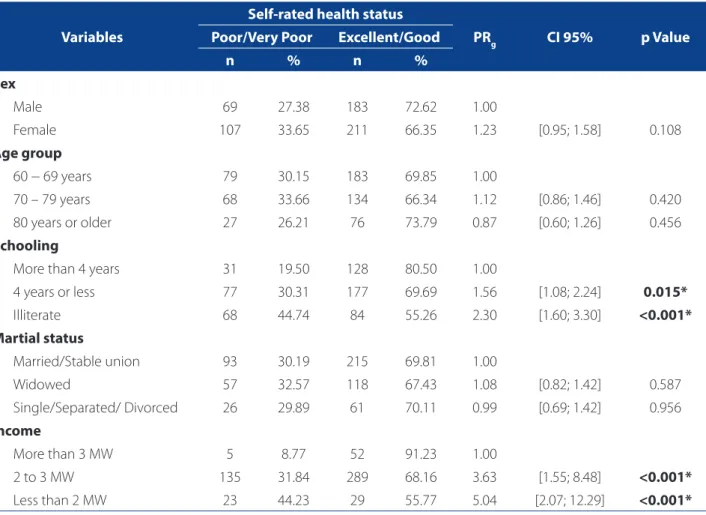
The prevalence ratio of poor/very poor self-rated health among the elderly with up to four years of schooling was 0.56 times higher in comparison to the elderly with more than four years of schooling, with a risk that was 1.30 times greater for those who were illiterate.
In relation to income, elderly participants with two to three minimum wages had a 2.63 greater risk of self-rating
Variables
Self-rated health status
PRg CI 95% p Value
Poor/Very Poor Excellent/Good
n % n %
Sex
Male 69 27.38 183 72.62 1.00
Female 107 33.65 211 66.35 1.23 [0.95; 1.58] 0.108
Age group
60 − 69 years 79 30.15 183 69.85 1.00
70 – 79 years 68 33.66 134 66.34 1.12 [0.86; 1.46] 0.420
80 years or older 27 26.21 76 73.79 0.87 [0.60; 1.26] 0.456
Schooling
More than 4 years 31 19.50 128 80.50 1.00
4 years or less 77 30.31 177 69.69 1.56 [1.08; 2.24] 0.015*
Illiterate 68 44.74 84 55.26 2.30 [1.60; 3.30] <0.001*
Martial status
Married/Stable union 93 30.19 215 69.81 1.00
Widowed 57 32.57 118 67.43 1.08 [0.82; 1.42] 0.587
Single/Separated/ Divorced 26 29.89 61 70.11 0.99 [0.69; 1.42] 0.956
Income
More than 3 MW 5 8.77 52 91.23 1.00
2 to 3 MW 135 31.84 289 68.16 3.63 [1.55; 8.48] <0.001*
Less than 2 MW 23 44.23 29 55.77 5.04 [2.07; 12.29] <0.001*
Table 1. Bivariate analysis of the association between poor/very poor self-rated health status among the elderly, according to demographic and socioeconomic factors, Cuiabá-MT, Brazil, 2012.
Source: Research data.
their health status as poor/very poor than those with more than three minimum wages. The elderly participants who earned less than two minimum wages had a 4.04 great-er risk when compared to the eldgreat-erly who received more than three minimum wages (Table 1).
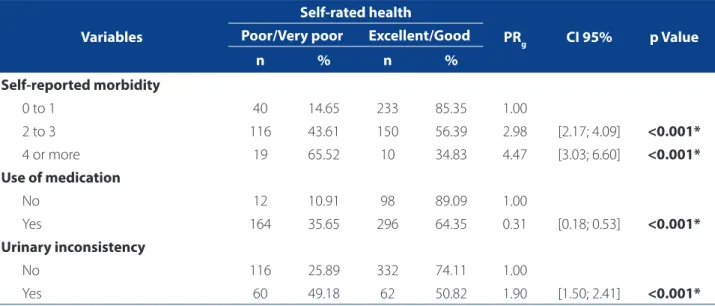
In relation to health variables, the use of medication and UI also proved to be associated with poor/very poor self-rated health, being that the former presented a preva-lence ratio of under one (CI 95%=0.18-0.53), indicating that this is a protection factor. That is, the use of medication reduced the risk of an elderly person self-rating health as poor/very poor. Contrarily, UI is a risk factor for poor/very poor self-rated health in the elderly (CI 95% = 1.50-2.41) (Table 2).
During multivariate analysis, the variables income, self-reported morbidity and UI remained associated with poor/very poor self-rated health in PR adjusted by robust Poisson regression, selected using the backward method (Table 3).
Evidence showed that the elderly participants with an income of two to three minimum wages presented a 1.34 greater risk of presenting poor/very poor self-rated health in comparison to those with more than three minimum wages. Of the elderly with less than two minimum wages, this risk was 1.68 times greater (Table 3).
The elderly with four or more self-reported morbidities presented poor/very poor self-rated health 3.28 times more
frequently than those who reported they did not have mor-bidities or only suff ered from one disease (Table 3).
Finally, it was observed that elderly participants with UI presented 0.33 times more risk of self-rating their health as poor/very poor, when compared to those who did not have UI (Table 3).
DISCUSSION
The prevalence of poor/very poor self-rated health in this study was 30.9%, which is higher to the value found in the general population that included people that were 20 years old or older (5.6%)(7). This is probably due to the
fact that this research was only conducted with people over the age of 60. Academics show that poor self-rated health gets worse with age (8). When compared to younger
adults, elderly people tend to have poorer health, diffi culty in accessing healthcare services, and a lower level of formal education and income (3,6).
However, when the prevalence found in this study is compared to others on elderly populations, the frequen-cy of poor self-rated health was similar in some studies (27.7%(3) and 27.5%(5)) and diff erent in others (17.1%(6) and
49.6%(9)). One of the reasons for these diff erences can be
the health context of these elderly individuals. Variables such as structure of the healthcare system and access and use of health services has been associated to poorer
Variables
Self-rated health
PRg CI 95% p Value
Poor/Very poor Excellent/Good
n % n %
Self-reported morbidity
0 to 1 40 14.65 233 85.35 1.00
2 to 3 116 43.61 150 56.39 2.98 [2.17; 4.09] <0.001*
4 or more 19 65.52 10 34.83 4.47 [3.03; 6.60] <0.001*
Use of medication
No 12 10.91 98 89.09 1.00
Yes 164 35.65 296 64.35 0.31 [0.18; 0.53] <0.001*
Urinary inconsistency
No 116 25.89 332 74.11 1.00
Yes 60 49.18 62 50.82 1.90 [1.50; 2.41] <0.001*
Table 2. Bivariate analysis of the association between poor self-rated health status based on health variables, Cuiabá-MT, Brazil, 2012.
Source: Research data.
self-rated health (10). Furthermore, socioeconomic factors,
such as income and schooling, can refl ect social inequal-ities in Brazil and their repercussions on the health of the population (11).
Another fi nding of this investigation was a strong as-sociation of poor/very poor self-rated health with years of schooling, that is, with the elderly participants that had less years of schooling there was a progressive increase of PR in those who rated their health as being poor/very poor. This has been frequently confi rmed in literature (4). Studies show
that elderly people who are illiterate or have lower educa-tion levels are more likely to evaluate their health as poor in comparison to those with more years of schooling (5,8).
Recent research shows that the frequency of people who self-rated their health as poor/very poor was higher among people with lower education levels (22.3%)(8).
This probably occurs because in Brazil today’s elderly population had less access to education in comparison to the younger population (12). Consequently, improvements
in the educational levels of people may favour the adop-tion of a healthier lifestyle and encourage the search of healthcare services and access to information (4).
Another observed association is related to the use of medication and poor/very poor self-rated health. Studies have found associations of the use of medication with poor self-rated health(5). In other words, those who rate their
health negatively consume a greater number of pharma-ceutical drugs (9).
In this study, this variable appeared as a protection factor. This could be because when older people perceive
themselves as sick, they seek health services to solve their problems, which are minimized or controlled by prescrib-ing medication. For this purpose, the Política Nacional de Assistência Farmacêutica (National Pharmaceutical Assis-tance Policy) ensures the availability of resources to ac-quire medication, organize services and train professionals. Moreover, it facilitates access and rational use of medica-tion and eff ective insermedica-tion of pharmaceutical assistance in the scope of the SUS, or Unifi ed Health Service(13). It is
believed that access to health services and the prescription and use of medication may lead the elderly to better self-rate their health.
There is a consensus in literature that the use of med-ication is essential for the well-being of the elderly, espe-cially of those with chronic diseases or ailments. However, authors emphasize that despite their benefi cial eff ect, they can be harmful when used incorrectly, when treatment is not followed adequately, or as a result of their adverse eff ects and drug interactions. This can lead to negative re-percussions on the health status and quality of life of the el-derly and may increase the rate of morbidities and death (9).
One of the fi ndings of this work was a stronger asso-ciation between poor/very poor self-rated health and in-come than with schooling (p=0.001). A similar result was found in a North American study, in which income was a more robust predictor of self-rated health than educa-tion(10). In fact, academics have proved that income is one
of the main determining factors of people’s health status, especially of the elderly. When income is low, it interferes negatively on how individuals perceive and care for their
Variables PRa CI 95% p Value
Income
More than 3 MW 1.00
2 to 3 MW 2.34 1.08 to 5.02 0.030
Less than 2 MW 2.68 1.19 to 6.07 0.018
Self-reported morbidity
0 to 1 1.00
2 to 3 2.94 2.10 to 4.11 <0.001*
4 or more 4.28 2.87 to 6.39 <0.001*
Urinary inconsistency
No 1.00
Yes 1.33 1.04 to 1.70 0.023
Table 3. Prevalence distribution of poor/very poor self-rated health in the elderly. Cuiabá-MT, Brazil, 2012.
Source: Research data.
own health, on their access and use of health services and on their adherence to treatment (14). Another hypothesis
for this fi nding is the large number of elderly people who live with their families. This can result in a better income and access to health services, which favourably infl uenc-es the way they rate their health.
A positive association between poor/very poor self-rated health and the number of chronic diseases was also found in this study and corroborated by other authors (15). A study
conducted in Brazilian capital cities and the Federal District showed that the PR of poor health in the presence of four or fi ve morbidities was 6.9 for women and 11.4 for men in comparison to those who did not have morbidities (15).
These fi ndings indicate the negative infl uence of the number of chronic diseases in self-rated health. It is notori-ous that chronic disease, especially among the elderly, im-pairs functional capacity and the performance of everyday activities (16). This impairment can bring implications to the
elderly, their families, their community and health services by directly interfering in the quality of life and well-being of this population (17).
Policies that address the promotion of health and the prevention and treatment of chronic diseases have proven more eff ective to control their implications, consequently increasing life span and quality of life (18).
The strong association of UI with poor/very poor self-rated health was another factor revealed in this study and corroborated by fi ndings of other authors (19). A study
with data of the Saúde, Bem Estar e Envelhecimento (SABE) project conducted in the municipality of São Paulo on an elderly population showed that for people aged 75 or more who self-rated their health as good, the prevalence of UI was 22.5%, while among those who stated that their health was regular or poor, this percentage almost dou-bled, reaching 41.5%(19). These data showed that this
con-dition signifi cantly infl uences the way the elderly evaluate their own health.
In fact, UI is a prevalent condition among the elderly, more so among women than men, and among those with chronic diseases(20). This condition causes embarrassing and
stressful situations that negatively impact their self-esteem and quality of life, oftentimes resulting in social isolation (19).
CONCLUSION
This is one of the few studies conducted in Brazil that sought to analyze poor self-rated health in elderly urban residents. Furthermore, the sample is considerable and representative of the urban population in the municipality, allowing generalizations.
The results of this study provide further knowledge on issues related to the lives and health of the elderly pop-ulation in Brazil. It can also help managers plan activities that focus on promoting health and preventing the aggra-vations and incapacities that aff ect this population. More-over, it can encourage healthcare professionals, especially in the fi eld of nursing, to incorporate self-rated health in routine practices and the global evaluations of elderly us-ers to identify their vulnerabilities.
It was concluded that the prevalence of poor/very poor self-rated health was 30.9% and that associated fac-tors were income, number of morbidities and UI. The use of medication as a protection factor was a unique fi nding, considering that in other studies it is singled out as a risk factor.
The association of these factors to poor/very poor self-rated health among the elderly of this study shows the need for care measures and policies that minimize their im-pact on the lives and health of this population.
This study did have some limitations. Firstly, the sam-ple was restricted to elderly urban residents and does not refl ect the reality of the entire population of people aged 60 or over in the municipality. Therefore, considering that the locations in which people reside determine aspects of their lives and health, studies that show these specifi cities are important.
Secondly, research did not include institutionalized el-derly patients. This segment is more vulnerable given their health condition, which could interfere with the results found in this study. Consequently, investigations on poor self-rated health among the institutionalized elderly would provide important additional information to better assist and understand this population.
REFERENCES
1. Giltay EJ, Vollaard AM, Kromhout D. Self-rated health and physician-rated health as independent predictors of mortality in elderly men. Age Ageing. 2012;41:165-71. doi: 10.1093/ageing/afr161.
2. Simon JG, De Boer JB, Joung IMA, Bosma H. Perceived Health. How is your heal-th in general? A qualitative study on self-assessed healheal-th. Eur J Public Healheal-th. 2012;15(2):200-8. doi:10.1093/eurpub/cki102.
3. Hu YN, Hu GC, Hsu CY, Hsieh SF, Li CC. Assessment of individual activities of daily living and its association with self-rated health in elderly people of Taiwan. In-ternational J Gerontol. 2012;6:117-21. doi:10.1016/j.ijge.2012.01.024. 4. Borim FSA, Barros MBA, Neri AL. Autoavaliação da saúde em idosos: pesquisa
de base populacional no Município de Campinas, São Paulo, Brasil. Cad Saúde Pública [Internet]. 2012 [accessed Jan 12, 2013];28(4):769-80. Available at: http://www.scielo.br/pdf/csp/v28n4/16.pdf.
[Internet]. Rio de Janeiro. 2011 [accessed Sept 23, 2012];27(8):1593-602. Avai-lable at: http://www.scielosp.org/pdf/csp/v27n8/14.pdf.
6. Nunes APN, Barreto SM, Gonçalves LG. Relações sociais e autopercepção da saúde: projeto envelhecimento e saúde. Rev Bras Epidemiol [Internet]. 2012 [Accessed Jan 12, 2013];15(2):415-28.Available at: http://www.scielo.br/pdf/ rbepid/v15n2/19.pdf.
7. Cardoso JDC. Condições de saúde autorreferidas da população idosa do municí-pio de Cuiabá-MT [dissertation]. Cuiabá: Universidade Federal de Mato Grosso; 2013.
8. Moraes JR, Moreira JPL, Luiz RR. Associação entre o estado de saúde autorrefe-rido de adultos e a área de localização do domicílio: uma análise de regressão logística ordinal usando a PNAD 2008. Ciênc. Saúde Colet [Internet]. 2011[Ac-cessed Sept 12, 2012];16(9):3769-80. Available at: http://www.scielo.br/pdf/ csc/v16n9/a13v16n9.pdf.
9. Silva RJS, Smith-Menezes A, Tribess S, Rómo-Perez V, Virtuoso Júnior JS. Preva-lência e fatores associados à percepção negativa da saúde em pessoas idosas no Brasil. Rev Bras Epidemiol [Internet]. 2012 [Accessed Jan 20, 2013];15(1):49-62. Available at: http://www.scielosp.org/pdf/rbepid/v15n1/05.pdf. 10. Louvison MCP, Lebrão ML, Duarte YAO, Santos JLF, Malik AM, Almeida ES.
Desi-gualdades no uso e acesso aos serviços de saúde entre idosos do município de São Paulo. Rev Saúde Pública [Internet]. 2008 [Accessed June 12, 2012];42(4):733-40. Available at: http://www.scielo.br/pdf/rsp/v42n4/6846.pdf.
11. Dachs JNW, Santos APRS. Auto-avaliação do estado de saúde no Brasil: aná-lise dos dados da PNAD/2003. Ciênc Saúde Colet [Internet]. 2006 [Accessed June 12, 2012];11(4):887-894. Available at: http://www.scielo.br/pdf/csc/ v11n4/32327.pdf.
12. Barros MBA, Francisco PMSB, Lima MG, César CLG. Social inequalities in heal-th among heal-the elderly. Cad Saúde Pública [Internet]. 2011 [Accessed June 12, 2012];27 Supl 2:S198-S208. Available at: http://www.scielo.br/pdf/csp/ v27s2/08.pdf.
13. Conselho Nacional de Secretários de Saúde (BR). Assistência farmacêutica no SUS. Brasília: CONASS, 2007.
14. Lima-Costa MF, Facchini LA, Matos DL, Macinko J. Mudanças em dez anos das desigualdades sociais em saúde dos idosos brasileiros (1998-2008). Rev Saúde Pública [Internet]. 2012 [Accessed Feb 23, 2013];46(Supl 1):100-7. Available at: http://www.scielosp.org/pdf/rsp/v46s1/ao4207.pdf.
15. Barros MBA, Zanchetta LM, Moura EC, Malta DC. Auto-avaliação da saúde e fa-tores associados, Brasil, 2006. Rev Saúde Pública [Internet]. 2009 [Accessed Jan 12, 2012];43(Supl 2):27-37. Available at: http://www.scielo.br/pdf/rsp/v43s2/ ao792.pdf.
16. Nunes DP, Nakatani AYK, Silveira EA, Bachion MM, Souza MR. Capacidade fun-cional, condições socioeconômicas e de saúde de idosos atendidos por equipes de saúde da família de Goiânia (GO, Brasil). Ciênc Saúde Colet [Internet]. 2010 [Accessed June 12, 2012];15(6):2887-98. Available at: http://www.scielo.br/ pdf/csc/v15n6/a26v15n6.pdf.
17. Alves LC, Leimann BCQ, Vasconcelos MEL, Carvalho MS, Vasconcelos AGG, Fon-seca TCO, et al. A infl uência das doenças crônicas na capacidade funcional dos idosos do Município de São Paulo, Brasil. Cad Saúde Pública [Internet]. 2007 [Accessed June 12, 2012];23(8):1924-30. Available at: http://www.scielo.br/ pdf/csp/v23n8/19.pdf.
18. World Health Organization. Envelhecimento ativo: uma política de saúde. Suza-na Gontijo (tradutor). Brasília: Organização Pan-AmericaSuza-na da Saúde, 2005. 19. Tamanini JTN, Lebrão ML, Duarte Y, Santos JLF, Laurenti R. Analysis of the
preva-lence of and factors associated with urinary incontinence among elderly people in the municipality of São Paulo, Brazil: SABE study (health, wellbeing and aging). Cad. Saúde Pública [Internet]. 2009 [Accessed June12, 2012];25(8):1756-62. Available at: http://www.scielosp.org/pdf/csp/v25n8/11.pdf.
20. Burti JS, Santos AMB, Pereira RMR, Zambon JP, Marques AP. Prevalence and clini-cal characteristics of urinary incontinence in elderly individuals of a low income. Arch Gerontol Geriatr. 2012;54(2):e42-e46.
Author’s address:
Joana Darc Chaves Cardoso
Faculdade de Enfermagem da UFMT
Avenida Fernando Correa da Costa, 2367, Boa Esperança 78060-900, Cuiabá, MT
E-mail: [email protected]