FACIAL ANTHROPOMETRIC MEASUREMENTS
ACCORDING TO DIAGNOSIS OF BREATHING MODE
AND GENDER IN ADULTS
Medidas antropométricas faciais de adultos segundo diagnóstico
do modo respiratório e o sexo
Luana Cristina Berwig(1), Mariana Marquezan(1), Maria Elaine Trevisan(2),
Lais Chiodelli(2), Andrielle de Bitencourt Pacheco Rubim(3),
Eliane Castilhos Rodrigues Corrêa(1), Ana Maria Toniolo da Silva(1)
(1) Universidade Federal de Santa Maria, UFSM, Santa Maria,
RS, Brasil.
(2) Departamento de Fisioterapia e Reabilitação da
Univer-sidade Federal de Santa Maria, UFSM, Santa Maria, RS, Brasil.
(3) Hospital Infantil Pequeno Anjo, Itajaí, SC, Brasil.
Source of support: scholarship granted by the Coordenação de Aperfeiçoamento de Pessoal de Nível Superior (CAPES).
Conlict of interest: non-existent
Taking into account the possible damages to the individual, mouth breathing mode has been addressed in several studies, especially involving the child population. The altered breathing mode, oronasal or mouth breathing, may persist until adulthood if not appropriately treated in childhood.
Nevertheless, it can be observed that only a few studies have sought to assess the impact of mouth breathing in adults, which motivated this research. It is believed that the study of the orofacial morphology in adult mouth breathers may contribute to the clinical practice and the completion of other studies, considering that the impact of mouth breathing in adulthood, after the pubertal growth period, has not been clearly evidenced to date.
The craniofacial morphology can be studied through orofacial anthropometric assessment as a qualitative method complementing the clinical
INTRODUCTION
Mouth breathing is a pathology that can cause alterations in the structures and functions of the stomatognathic system, in body posture, cranio-facial morphology and dental occlusion, as well as in the patients’ behavior and quality of life1,2.
ABSTRACT
Purpose: to compare the facial anthropometric measures in adults according to the breathing mode and genre. Methods: the study sample comprised 82 adult subjects, aged 18 to 35 years old, 59 females and 23 males. From the speech pathology and otorhinolaryngologic assessments, 46 nasal breathers and 36 mouth breathers were diagnosed. The facial measures were achieved with a caliper and compared according to the subject’s breathing mode diagnosis and genre, through the Student’s
t-test and Pearson’s Correlation, with a signiicance level of 5%. Results: the vertical anthropometric
measures (middle third, lower third, facial height, upper lip and lower lip) were found to be signiicantly
greater in mouth breathers and displayed positive correlation with the breathing mode. All facial measurements performed were found to be higher in males and showed positive correlation with the variable genre. Conclusion: the facial anthropometric measures of vertical plane were found to be greater in mouth breathers, suggesting a more elongated facial pattern of growth in these subjects. All the facial anthropometric measures obtained in the vertical, horizontal and transverse planes were found to be higher in male subjects.
having experience in orofacial motricity. A Western®
digital caliper, resolution 0.01mm and precision ± 0.02mm, was the instrument used to obtain the measures. In order to obtain the measure of facial
width, 8.25cm metal extensions were adapted to the instrument nozzles for external measurement6.
During the assessment, the subject remained
in front of the examiner, in sitting position, the feet lat on the ground, natural head position, lips
enclosed and the teeth in centric occlusion without pressure5,7,8.
Subsequently, to identify the precise local-ization, the craniofacial spots were palpated and marked in the skin with dermographic pencil. The anthropometric measurements were performed without pressing the caliper ends against the skin surface, because that could alter the results. All the measurements were performed twice for greater reliability. The result on each measurement was achieved through the average of two collections in milimeters5,7,8.
The anthropometric measurements were collected as follows:
• middle third of the face: distance from the glabella to the subnasal (g-sn);
• lower third of the face: distance from the subnasal to the gnathion (sn-gn);
• facial height: distance from the glabella to the gnathion (g-gn);
• facial width: distance between the prominence of the zygomatic arches (zy-zy);
• right side: distance from the outside corner of the
right eye to the right labial commissure (ex-ch); • left side: distance from the outside corner of the
left eye to the left labial commissure (ex-ch); • upper lip height: distance from the subnasal to
the lowest point of the upper lip (sn-sto);
• lower lip height: distance from the highest point of the lower lip to the gnathion (sto-gn).
For data analysis, the Kolmogov-Smirnov test was used to verify the normality of the facial anthropometric measures distribution. Aiming to compare the anthropometric measures according to the breathing mode and gender, the Student’s t-test was used. To assess the association of the variables ‘breathing mode and gender’ with the facial anthropometric measurements, the Pearson’s Correlation test was used. The statistical analyses were performed by the SPSS (Statistical Package assessment, and constitutes one of the evaluation
items for the protocols in the orofacial myology and motricity area3,4. It is widely used as it is a
simple, low-cost, non-invasive method, and easy to interpret5.
Based on the above, the purpose of this study was to compare the facial anthropometric measure-ments in adults according to the breathing mode and gender.
METHODS
This analytic cross-sectional study was approved by the research ethics committee of the Federal University of Santa Maria under the protocol number 04039912.7.0000.5346. All the participants had the Free and Informed Consent Term signed.
The sample comprised subjects from orthodontic, otorhinolaryngology, speech-language pathology and physiotherapy clinics, and the wider community, with previous divulgation in newspapers, radio
stations, social networks and posters aixed in
health service facilities, characterizing a non-proba-bility convenience sample.
Subjects aged 18 to 35, leukodermas, both
sexes, were included in the study. Subjects with
craniofacial syndrome and/or malformation, presenting with a history of orthodontic and/or speech-language pathology and/or physiotherapy
treatment were excluded.
In order to form groups according to the breathing mode, the subjects underwent speech-language and othorhinolaryngologic assessment. The speech-language was performed based on the MBGR protocol (clinical history and orofacial myofunctional assessment)3,4. Based on this assessment, it was
veriied the morphological and functional charac -terization of the stomatognathic system, which contributed to the breathing mode diagnosis and served as a basis to verify the conformity with the criteria for the formation of the nasal and mouth breathers groups.
The otorhinolaryngologic assessment comprised the anamnesis, oroscopy, anterior rhinoscopy,
otoscopy and nasoibropharyngoscopy. The endoscopic examination was performed with nasoi
-broscope Pentax FNL – 10 RP3, 3.7mm diameter,
inserted into the nasal cavity to the region of the
rhinopharynx, where the presence of pharyngeal
On the other hand, no correlation or diferences
were found in the averages of cross-sectional (sides of the face) e horizontal (facial width) measures between the nasal and mouth breathers (Tables 1 and 3).
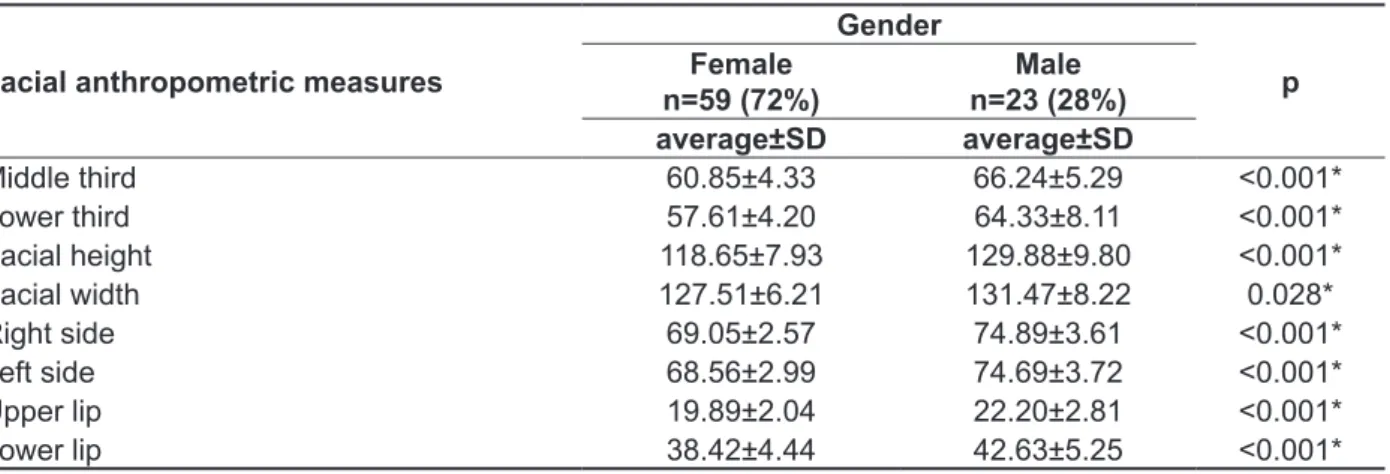
In gender comparison, it became evident that all averages of facial anthropometric measures were
signiicantly higher in males (Table 2). Additionally,
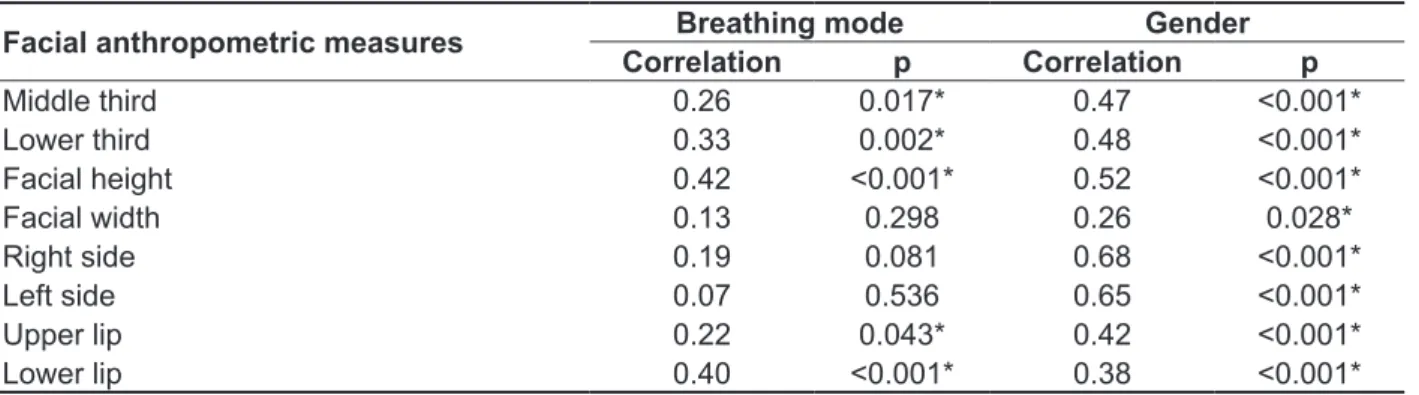
all facial anthropometric measures displayed positive correlation with the variable ‘gender’, with a weak correlation with facial width and a moderate correlation with other measures (Table 3).
RESULTS
Through the results analysis, it was veriied
that all the averages of the vertical anthropometric measures (middle third, lower third, facial height,
upper lip and lower lip) were signiicantly higher in
mouth-breathing subjects than in nasal breathers (Table 1). It was also possible to observe a moderate positive correlation between the breathing mode and the measures of the lower third, facial height and lower lip, as well as a weak positive correlation between the breathing mode and the measures of the middle third and upper lip (Table 3).
Table 1 – Comparison of facial anthropometric measures in breathing mode
Facial anthropometric measures
Breathing mode
p NB
n=46
MB n=36
average±SD average±SD
Middle third 61.16±4.95 63.89±5.16 0.017*
Lower third 57.65±4.49 61.86±7.47 0.002*
Facial height 118.19±7.79 126.42±10.36 <0.001* Facial width 127.89±5.35 129.68±8,45 0.298 Right side 70.02±3,78 71.54±3,94 0.081
Left side 70.02±4.51 70.61±3.86 0.536
Upper lip 20.05±2.33 21.17±2.59 0.043*
Lower lip 37.83±3.86 41.86±5.46 <0.001*
Legend: NB=nasal breathing; MB=mouth breathing; SD=standard deviation; (*)=signiicance in Student’s t-test (p<0.05).
Table 2 – Comparison of facial anthropometric measures according to gender
Facial anthropometric measures
Gender
p Female
n=59 (72%)
Male n=23 (28%)
average±SD average±SD
Middle third 60.85±4.33 66.24±5.29 <0.001*
Lower third 57.61±4.20 64.33±8.11 <0.001*
Facial height 118.65±7.93 129.88±9.80 <0.001* Facial width 127.51±6.21 131.47±8.22 0.028* Right side 69.05±2.57 74.89±3.61 <0.001*
Left side 68.56±2.99 74.69±3.72 <0.001*
Upper lip 19.89±2.04 22.20±2.81 <0.001*
Lower lip 38.42±4.44 42.63±5.25 <0.001*
in the averages of the middle third in none of the age groups studied.
On the other hand, it became evident that the measures of the sides of the face and facial height correlate only with gender (Table 3), the averages being higher in males (Table 2), with no association
with the breathing mode veriied.
Regarding the averages obtained, it can be observed that the middle third and lower third of the face are close to the values suggested by the literature on adult patients (55 to 65 mm)20. An
aspect that draws attention are the higher values of the middle thirds than those in the lower thirds, which is in accordance with only one study selected,
that have found the middle third signiicantly higher
in adult nipo-brazilian women when compared with black and white women, whose lower third was higher12. These results difer from other studies that
veriied that the middle third was lower than the
lower third8,11,21,22. Despite the fact that only
leuko-derma subjects have been included, the ample racial miscegenation in Brazil, found especially in
the state of Rio Grande do Sul, have probably inlu -enced this outcome, since most of the studies with other samples of Brazilians showed that the middle third is lower than the lower third.
Another interesting inding refers to the average value of the upper lip measure, which was signii -cantly higher in mouth-breathing subjects than in nasal breathers. Although some studies mention the shortened upper lip as one of the clinical characteristics of the mouth breather23,24, as well
as in other research carried out with children8,19,
DISCUSSION
The present study aimed to assess the impact of breathing mode on craniofacial morphology in adult subjects, based on the comparison of anthropo-metric measurements in nasal and mouth breathers. No studies were found regarding anthropometric
assessment in adult mouth breathers, which justiies the comparison of some indings with studies carried
out with children. Facial anthropometric measure-ments were also compared between genders, since
several studies have demonstrated diferences in
facial anthropometric measures between males and females9-13.
Through the comparison of facial measures
between breathing modes, it was veriied that all
vertical measures (middle third, lower third, facial
height, upper lip and lower lip) were signiicantly
higher in mouth breathers, with a positive, weak to moderate correlation between these variables.
The literature reports that mouth-breathing
patients frequently exhibit the habitual tongue position on the loor of the mouth14,15, open or
half-open lips15,16, which favors the posteroinferior
rotation of the mandible17, an increase in the
mandibular plane17 and the antigonic incisura18,
characterizing a predominantly vertical
cranio-facial growth, dolichocranio-facial type. This can explain the indings of the present study, conirming the inluence of breathing mode on the increase of all
measurements performed in the vertical plane.
The indings in this study partially support results
of other authors19, who compared the facial
anthro-Table 3 – Correlation of breathing mode and gender with orofacial anthropometric measures
Facial anthropometric measures Breathing mode Gender
Correlation p Correlation p
Middle third 0.26 0.017* 0.47 <0.001*
Lower third 0.33 0.002* 0.48 <0.001*
Facial height 0.42 <0.001* 0.52 <0.001*
Facial width 0.13 0.298 0.26 0.028*
Right side 0.19 0.081 0.68 <0.001*
Left side 0.07 0.536 0.65 <0.001*
Upper lip 0.22 0.043* 0.42 <0.001*
Lower lip 0.40 <0.001* 0.38 <0.001*
anthropometric measures, as demonstrated in previous studies. Accordingly, it is recommended further research that applies a similar analysis model, taking into account other variables that may impact the facial anthropometric measures.
In this study, it was possible to detect that mouth-breathing subjects showed a predominantly vertical
pattern of growth, conirming therefore the inluence
of the breathing mode alteration on craniofacial morphology. For this reason, it must be stressed the need of multidisciplinary follow-up and treatment of mouth breathing mode during childhood, to minimize
the negative efects before the period of craniofacial
growth spurt.
CONCLUSION
The facial anthropometric measures of the vertical plane were higher in mouth breathers, suggesting a more elongated facial pattern of growth in these subjects.
Sexual dimorphism was observed in all the
measures obtained (vertical, horizontal and cross-sectional plane), with all the measures being higher in males.
was veriied in the measure of the upper lip by
analyzing the variable ‘habitual resting position’ with and without labial closure, which was higher in the
irst situation25.
In the analysis of facial measurements according
to the variable ‘gender’, it was veriied that all the anthropometric measures performed were signii -cantly higher in males than in females (Table 2), which is in accordance with the literature10,11,13.
This study conirmed the hypothesis that there is a sexual dysmorphism in facial measurements in
adults, since all the anthropometric measurements showed an association with the variable ‘gender’
in Pearson’s Correlation test (Table 3). This inding conirms the need to take into account this variable
when designing studies involving facial anthropo-metric measurements.
On the basis of the aforementioned, it was possible to verify that the variable ‘breathing mode’ is associated with the anthropometric measure-ments performed in the vertical plane in adult subjects; on the other hand, the variable ‘gender’ is associated with all the anthropometric measures obtained. However, other independent variables that have not been studied, such as race/ethnicity9,11,26-28
and facial typology10,29, may also impact the facial
RESUMO
Objetivo: comparar as medidas antropométricas faciais de adultos segundo o modo respiratório e o
sexo. Métodos: a amostra do estudo foi constituída por 82 sujeitos adultos, na faixa etária entre 18 e
35 anos, 59 do sexo feminino e 23 do sexo masculino. A partir das avaliações fonoaudiológica e otor -rinolaringológica, foram diagnosticados 46 respiradores nasais e 36 respiradores orais. As medidas
faciais foram obtidas com paquímetro e comparadas segundo diagnóstico do modo respiratório e sexo dos sujeitos, utilizando-se o teste t de Student e da Correlação de Pearson, com nível de signiicância de 5%. Resultados: as medidas antropométricas verticais (terço médio, terço inferior, altura facial,
lábio superior e lábio inferior) foram signiicantemente maiores nos respiradores orais e apresenta -ram correlação positiva com o modo respiratório. Todas as medidas faciais realizadas fo-ram maiores
no sexo masculino e mostraram correlação positiva com a variável sexo. Conclusões: as medidas antropométricas faciais do plano vertical foram maiores nos respiradores orais, sugerindo padrão de crescimento facial mais alongado nesses sujeitos. Todas as medidas antropométricas faciais obtidas
nos planos vertical, horizontal e transversal foram maiores nos sujeitos do sexo masculino.
anthroposcopic approach. Pró-Fono R Atual. Cient. 2007;19(4):347-51.
15. Andrada e Silva MAd, Marchesan IQ, Ferreira LP,
Schmidt R, Ramires RR. Posture, lips and tongue tone and mobility of mouth breathing children. Rev CEFAC. 2012;14(5):853-60.
16. Pacheco AdB, Silva AMTd, Mezzomo CL, Berwig LC, Neu AP. Relation between oral breathing
and nonnutritive sucking habits and stomatognathic system alterations. Rev CEFAC. 2012;14(2):281-9.
17. Lessa FCR, Enoki C, Feres MFN, Valera FCP, Lima WTA, Matsumoto MAN. Breathing mode inluence in craniofacial development. Rev Bras
Otorrinolaringol. 2005;71(2):156-60.
18. Cotrim-Ferreira F, Valle-Corotti KMd, Lopes PdML, Junqueira TH, Stocco JR. Associação entre
o padrão respiratório e a morfologia mandibular. Rev odontol Univ Cid São Paulo. 2009;21(1):18-23. 19. Cattoni DM, Fernandes FD, Di Francesco RC, De
Latorre MoR. Quantitative evaluation of the orofacial
morphology: anthropometric measurements in
healthy and mouth-breathing children. Int J Orofacial
Myology. 2009;35:44-54.
20. Suguino R, Ramos AL, Terada HH, Furquin LZ, Maeda L, Silva Filho OGd. Análise facial. Rev dent press ortodon ortop maxilar;. 1996;1(1):86-107.
21. Cattoni DM, Fernandes FD. Facial measurements and proportions in children: contributions to orofacial myofunctional evaluation. Pró-Fono R Atual. Cient. 2004;16(1):7-18.
22. Cattoni DM, Fernandes FDM, Andrade CRFd,
Larorre MdRDdOL. Estudo sobre as medidas faciais em crianças: correlações com alteração de
mordida e uso de aparelho ortodôntico. Rev Soc Bras Fonoaudiol. 2005;10(1):1-6.
23. Di Francesco RC, Passerotii G, Paulucci B,
Miniti A. Mouth breathing in children: diferent
repercussions according to the diagnosis. Rev Bras Otorrinolaringol. 2004;70(5):665-70.
24. Sies ML, Farias SRd, Vieira MM. Respiração oral: relação entre o tipo facial e a oclusão dentária
em adolescentes. Rev Soc Bras Fonoaudiol. 2007;12(3):191-8.
25. Daenecke S, Bianchini EM, da Silva AP. Anthropometrical measurements of the height of the upper lip and length of the philtrum. Pró-Fono R Atual. Cient. 2006;18(3):249-58.
26. Porter JP, Olson KL. Anthropometric facial
REFERENCES
1. Marchesan IQ, Krakauer LR. The importance of respiratory activity in myofunctional therapy. Int J
Orofacial Myology. 1996;22:23-7.
2. Berwig LC, Silva AM, Côrrea EC, Moraes AB,
Montenegro MM, Ritzel RA. Hard palate dimensions
in nasal and mouth breathers from diferent etiologies. J Soc Bras Fonoaudiol. 2011;23(4):308-14.
3. Genaro KF, Berretin-Felix G, Rehder MIBC,
Marchesan IQ. Orofacial myofunctional evaluation: MBGR protocol. Rev CEFAC. 2009;11(2):237-55.
4. Marchesan IQ, Berretin-Félix G, Genaro KF.
MBGR protocol of orofacial myofunctional evaluation
with scores. Int J Orofacial Myology. 2012;38:38-77. 5. Bolzan GdP, Berwig LC, Prade LS, Weinmann
ARM, Moraes ABd, Silva AMTd. Agreement between Anthropometry and cephalometry methods
in classiication of the facial type. Rev CEFAC.
2014;16(1):222-7.
6. Bolzan GdP, Souza JA, Boton LdM, Silva AMTd, Corrêa ECR. Facial type and head posture of nasal and mouth-breathing children. J Soc Bras
Fonoaudiol. 2011;23(4):315-20.
7. Cattoni DM, Fernandes FDM, Di Francesco
RC, Latorre MdRDdO. Anthropometric orofacial
measurements and proportions in mouth breathing children. Rev Soc Bras Fonoaudiol. 2008;13(2):119-26.
8. Bolzan GdP, Silva AMTd, Boton LdM, Corrêa
ECR. Study of anthropometric measurements and orofacial proportions of nasal- and mouth-breathing
children from diferent etiologies. Rev Soc Bras
Fonoaudiol. 2011;16(1):85-91.
9. Zhuang Z, Landsittel D, Benson S, Roberge R, Shafer R. Facial anthropometric diferences among
gender, ethnicity, and age groups. Ann Occup Hyg. 2010;54(4):391-402.
10. Ramires RR, Ferreira LP, Marchesan IQ,
Cattoni DM, Andrada e Silva MAd. Adult facial anthropometric measurements according to facial type and gender. Rev CEFAC. 2011;13(2):245-52.
11. Nascimento WV, Cassiani ReA, Dantas RO. Efect of gender, height and race on orofacial
measurements. Codas. 2013;25(2):149-53.
12. Sá TBFd, Cattoni DM, Nemr K. Nipobrazilians
orofacial measurements after pubertal growth. Rev CEFAC. 2013;15(2):411-9.
29. Guedes SPdC, Teixeira BV, Cattoni DM.
Orofacial measurements in teenagers from Rio
de Janeiro State according to facial typology. Rev
CEFAC. 2010;12(1):68-74.
28. Salah M, Higzi MA, Ali RW, Naini FB. The
Sudanese female face: Normative craniofacial measurements and comparison with
African-American and North African-American White females. J Craniomaxillofac Surg. 2014;42(8):1704-9.
http://dx.doi.org/10.1590/1982-021620151765215
Received on: April 14, 2015
Accepted on: July 08, 2015
Mailing address:
Luana Cristina Berwig
Avenida Roraima, 1000, Prédio 26, Sala 1418
Camobi, Km 9 – Santa Maria – RS - Brasil
CEP: 97105-900