Modelling Inflections in Romanian Language
by P Systems with String Replication
Artiom Alhazov, Elena Boian, Svetlana Cojocaru, Yurii Rogozhin
Abstract
The aim of this article is the formalization of inflection process for the Romanian language using the model of P systems with cooperative string replication rules, which will make it possible to automatically build the morphological lexicons as a base for different linguistic applications.
1
Introduction
Natural language processing has a wide range of applications, the spec-trum of which varies from a simple spell-check up to automatic trans-lation, text and speech understanding, etc. The development of ap-propriate technology is extremely difficult due to the specific feature of multidisciplinarity of the problem. This problem involves several fields such as linguistics, psycholinguistics, computational linguistics, philosophy, computer science, artificial intelligence, etc.
As in many other fields, solving of a complex problem is reduced to finding solutions for a set of simpler problems. In our case among the items of this set we find again many traditional compartments of the language grammar. The subject of our interest is the morphology, and more specifically, its inflectional aspect.
The inflectional morphology studies the rules defining how the in-flections of the words of a natural language are formed, i.e., the aspect
c
of form variation (of the inflection, which is the action of words modi-fication by gender, number, mood, time, person) for various expressing grammatical categories.
In terms of natural language typology the morphological classifica-tion can be analytical and synthetic. Of course, this classification is a relative one, having, however, some irrefutable poles: Chinese, Viet-namese, as typical representatives of the analytical group, and Slavic and Romance languages serving as examples of synthetic ones. The En-glish language, with a low degree of morpheme use, is often among the analytical ones, sometimes is regarded as synthetic, indicating however that it is “less synthetic” comparatively with other languages from the same group. It is evident that it is the inflectional morphology of syn-thetic languages that presents special interest, being a problem more complex comparatively with analytical class.
The object of our studies is the Romanian language, which be-longs to the category of synthetic flective languages. The last notion stresses the possibility to form new words by declension and conjuga-tion. Moreover, the Romanian language is considered a highly inflec-tional language, because the number of word-forms is big enough.
The inflection simplicity in English makes that the majority of re-searchers in the field of computational linguistics neglect the inflection morphology. For efficient processing of other natural languages, includ-ing Romanian, it is necessary to develop suitable computational models of morphology of each language. In the case of Romanian language, some inflectional models are known [25], [19],[7].
2
Description of the inflection process
To develop a formalism for the inflection process description we invoke a number of definitions and notions which allow us to understand the essence of this process. Inflection is a part of morphology - the science which “includes the rules considering the word forms and the formal modifications of the words” [24]. From the morphological point of view the words are classified corresponding to the part of speech, and their structure is described in terms of inflection, derivation and composition. Inflection is the systematic variation of the word form which allows to obtain different semantic and syntactic functions [10]. The words combine in themselves two components: aconstant and avariable [12]]. The root of primary lexical units is called the constant. For the derivative ones the termlexical theme is used. Since in our study this distinction does not play any role, for both cases we use a single term “root”.
The variable is the bearer of grammatical meanings, it consists of one or more morphemes being called also flective. This term will be used in exposure below. In accordance with [24] we identify three ways of achieving the inflections:
analytical: the flective is a free morpheme (separated from root) and the root remains invariable (e.g., adverb, bine – mai bine (engl. well - better));
synthetic: the flective is a conjunctive morpheme (group of mor-phemes), related to the root (e.g., for noun, pronoun;student˘a – studente – studentei; care-c˘areia-c˘aruia-c˘arora (engl. student – students – student’s, who-whose-whom), etc.).
synthetic and analytical: the flective consists of free and conjunctive morphemes (e.g., adjective, verb, frumos – frumoas˘a – mai fru-moas˘a; cˆantasem – am cˆantat (engl. beautiful – beautiful – more beautiful, singing – I sang), etc.).
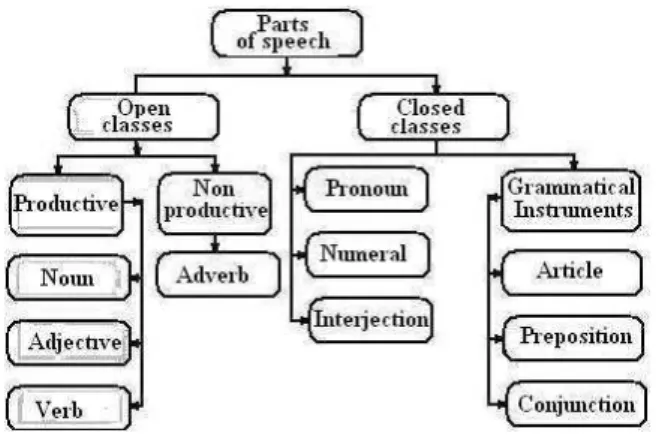
rules. Following the model from [10] we present in Figure 1 the classifi-cation of Romanian language parts of speech in terms of the inflection process.
Figure 1. The classification of the Romanian language parts of speech (in terms of the inflection process.)
The class of opened productive parts of speech is the most inter-esting in terms of inflection, and it will be the primary object of our investigations.
Indeed, opened classes, containing tens of thousands of elements, are characterized by a productive process of inflection, derivation and composition, while the closed ones include a reduced number of items (practically excluding the possibility of the new ones apparition), be-cause the morphological processes of word formation are poorly pro-ductive [12]. Moreover, in the case of opened classes the problem is complicated not only because we cannot enumerate the elements, ex-isting at the moment, but also because a successful formalism should be able to “serve” the future neologisms that could occur in language de-velopment process. In the following we will operate with the paradigms of inflection, by which we imply the systematic arrangement of all in-flection forms of a word [13].
their variable parts. Hereinafter by paradigm we mean a list of flectives. For each flective we can put into correspondence a set of morpho-logical attributes.
Example. Let us examine the morphological attributes for mascu-line nouns of Romanian language [25].
N noun (part of speech), m masculine gender, s singular number, p plural number,
d direct (nominative – accusative cases), o oblique (genitive – dative cases), v vocative case,
y yes – definiteness, n no – definiteness.
(Given that the Romanian forms for nominative and accusative cases coincide, as well as for the genitive and dative ones, we reduced the paradigm merging both word forms, and respective attributes.)
Thus, the list of flectives F = {−,−,−, ul, ului, ule, i, i, i, ii, ilor, ilor}, where “−” denotes the empty word, can be regarded as a morphologically annotated one.
Fmorf ={ (−, N msdn),(−, N mson),(−, N msvn), (ul, N msdy),(ului, N msoy),(ule, N msvy),
(i, N mpdn),(i, N mpon),(i, N mpvn),
(ii, N mpdy),(ilor, N mpoy),(ilor, N mpvy)}.
Let us mention the use of paradigmatic model for the Romanian language [8, 9, 20, 21, 22].
in the root, taken by the authors from researches of acad. G. Moisil, namely: each alternation is presented in the root by a distinct code. In paper [11] it is found a (incomplete) set of rules, which indicates the way of concatenation of flective for nouns and adjectives without con-cerning the problem of the alternations in the root. Therefore, having the aim to achieve the synthetic model of inflection, we must develop a formalism, which should include two processes:
- making the alternation in the root, and - concatenation of a flective.
The starting point of our approach was the dictionary [13], in which the flective words of Romanian language are classified according to the way of inflections formation. There were set 100 groups of inflec-tion for masculine nouns, 273 – for verbs, etc. A dicinflec-tionary of about 30,000 words with the specification of the number of the group was constructed. The classification was made taking into account all lin-guistic aspects, e.g. accents. In our case we will focus only on the way of writing a word, which in equal measure simplifies and complicates the problem. However this classification is extremely useful suggesting us the idea of defining a special class of grammars to formalize the inflection process [2, 3, 4, 5].
In general case, from a whole variety of inflection groups, we can identify two classes:
– without alternations, and – with alternations.
In the first case the inflection is made in the following manner. Let
ℑbe a set formed from lists of flectives, F ={f1, f2,· · ·, fn},w=w′α is a word-lemma, where |α| ≥ 0. In the simplest case the inflected words will be those of the formw′fi,fi ∈F, (i= 1,· · ·, n).
General case: Let w=w1a1w2a2· · ·wmα. The inflected words will be of the form:
w(1)=w1 a1 w2 a2 · · · wmfi1,
w(2)=w1 u(2)1 w2 u(2)2 · · · wmfi2,
· · ·
where wi, ai ∈ V+, ui(j) ∈ V∗, fi1 ∈ F
(1), . . . , f
is ∈ F
(s), and F(1) ∪ . . .∪F(s) forms a complete paradigm.
Note: the analysis of inflection rules allowed us to ascertain that for the Romanian language m≤4,s≤3.
Example 1. Inflection of masculine nouns without alternations. LetF ={−,−,−, ul, ului, ule, i, i, i, ii, ilor, ilor}– a list of flectives, where ’-’ denotes the empty word. Let w =‘stejar’ (engl. oak), |α|= 0, |F| = 12. The set of inflected words supplied by morphological attributes will be:
{ (stejar,N msdn), (stejar,N mson), (stejar,N msvn), (stejarul, N msdy), (stejarului,N msoy), (stejarule,N msvy), (stejari, N msdn), (stejari,N mpon), (stejari, N mpvn), (stejarii,N mpdy), (stejarilor,N mpoy), (stejarilor, N mpvy)}
Taking advantage of paradigmatic ordering of the elements from the list of flectives, in what follows we will omit the explicit writing of mor-phological attributes implying their conformity to respective flectives.
Example 2. Inflection of masculine nouns with alternations. Let w=tˆan˘ar (engl. young),|α|= 0. The vowel alternations ˆa→i
and˘a→ewill be used. The obtained rootsw=‘tˆan˘ar’ andw′ =‘tiner’ are respectively annexed by the endings: F1 ={−,−,ul, ului, ule}and
F2={e,i, i, i, ii, ilor, ilor},|F1|+|F2|= 12.
{ (tˆan˘ar, N msdn), (tˆan˘ar, N mson), (tˆan˘arule, N msvy), (tˆan˘arul,N msdy), (tˆan˘arului, N msoy), (tinere, N msvn), (tineri, N msdn), (tineri, N mpon), (tineri, N mpvn), (tinerii,N mpdy), (tinerilor, N mpoy), (tinerilor, N mpvy) }
– irregular, for example, those which can not have the plural definite form (instance, the wordgnu);
– those which are singularia tantum (nouns which appear only in the singular form), ianuarie etc.;
– those which are pluralia tantum (nouns that appear only in the plural and do not have a singular form), for example,ochelari, pantaloni etc.
In general, the 100 groups of inflection of masculine nouns in rela-tion to the number of words produced at inflecrela-tion, present the follow-ing table:
Forms of the lemma Number of forms Number of groups
all forms 12 80
singularia tantum 6 13
pluralia tantum 6 4
irregular 6-8 3
Modern dictionaries contain hundreds of thousands of words– lemma. Their forms of inflexion (the amount of which exceeds mil-lions) are needed for developing various applications based on natural language: from the spell-checker up to the systems understanding the speech. Obviously, to solve the problem of creating a dictionary with a morphologically representative coverage, as well as to build various applications based on it, effective mechanisms are needed, especially those that allow parallel processing. One of the possible ways to per-form parallel computation is based on biological models.
Our paper tries to expand the area of potential applications of P systems to linguistics problems, introducing a formalism to capture inflections with their morphological attributes.
To formalize the inflection process for the Romanian language the model of cooperative membrane P systems with replication will be used [17].
3
P systems with string replication and input
Let us recall the basics of P systems with string objects and input. The membrane structure µ is defined as a rooted tree with nodes labeled 1,· · ·, p. The objects of the system are strings (or words) over a finite alphabet O. A sub-alphabet Σ⊆ O is specified, as well as the input regioni0, 1≤i0≤p. In this paper we need to use cooperative rewriting
rules (i.e. string rewriting rules, not limited by context-free ones) with string replication and target indications.
A rule a → u1, where a ∈ O+ and u1 ∈ O∗, can transform
any string of the form w1aw2 into w1u1w2. Application of a rule
a → u1||u2|| · · · ||uk transforms any string of the form w1aw2 into
the multiset of strings w1u1w2, w1u2w2, · · ·, w1ukw2. If in the right
side of the rule (ui, t) is written instead of some ui, 1 ≤ i ≤ k,
t ∈ {out} ∪ {inj | 1 ≤ j ≤ p}, then the corresponding string would be sent to the region specified by t.
Hence, such a P system is formally defined as follows: Π = (O,Σ, µ, M1,· · ·, Mp, R1,· · ·, Rp, i0), where
Mi is the multiset of strings initially present in region i,1≤i≤p,
Ri is the set of rules of region i, 1≤i≤p, and O,Σ, µ, i0 are described above.
region. The computation halts when no rules are applicable. The re-sult of the computation is the set of all words sent out of the outermost region (called skin).
4
Describing the inflection process by P
sys-tems
Let us define the P system performing the inflection process. LetLbe the set of words which form opened productive classes. We will start by assuming that the words inL are divided into groups of inflection, i.e. for each w∈Lthe number of inflection group is known [13]. The inflection group is characterized by the set G = {α, RG, FG}, where
|α| ≥ 0 is the length of ending which is reduced in the process of inflection, FG is the set of the lists of flectives, the assembly of which forms complete paradigm, RG is the set of the rules, which indicate vowel/consonant alternation of typea→u, a∈V+,u∈V∗, and also the conformity of the roots obtained by the lists of flectives from FG. To each group of inflexion a membrane system ΠG will be put into correspondence.
As it was mentioned earlier, we will investigate two cases: – without alternations, and
– with vowel/consonant alternation.
The first modelis very simple. For any groupG= (α,∅,{f1G, f2G,
· · ·, fnG}) of inflection without alternation, ΠG = (O,Σ,[ ]1,∅, R1,1), where
O = Σ =V ∪ {#},
V = {a,· · ·,z}is the alphabet of the Romanian language, and
R1 = {α#→(f1G, out)||(f2G, out)|| · · · ||(fnG, out)}
system would not be able to distinguish the termination to be reduced from any other occurrence ofα.
The general model will require either a more complicated struc-ture, or a more sophisticated approach. Let G be an arbitrary in-flection group, with m−1 alternationsa1 =a(1)1 a(1)2 · · ·a(1)n1,· · ·, am =
a(1m)a(2m)· · ·a(nmm). Let the set of flectives consist of s subsets, and for subset FkG = {f
(k) 1 ,· · ·, f
(k)
p1 }, 1 ≤ k ≤ s, the following alternations
occur: a1 → u1(k), · · ·, am → u( k)
m (the alternations are fictive for
k = 1), and Ss
k=1FkG corresponds to a complete paradigm. For in-stance, Example 2 corresponds to s= 2 sublists (singular and plural), and m−1 = 2 alternations.
The associated P system should perform the computation
w# = m−1
Y
j=1
(wjaj)wmα#⇒∗
⇒∗
m−1
Y
j=1
³ wju(jk)
´
wmfik |1≤k≤s, fik ∈F
(k)
,
whereu(1)j =aj, 1≤j≤m.
The first methodassumes the alternating subwordsaj are present in the input word in just one occurrence, or marked. Moreover, we assume that carrying out previous alternations does not introduce more occurrences of the next alternations.
Π′G = (O,Σ, µ,∅,· · ·,∅, R1,· · ·, R1+(s−1)m,1), where Σ = V ∪ {#},
O = Σ∪E,
µ = [ [ ]2[ ]3· · ·[ ]1+(s−1)m ]1,
E = {#k|2≤k≤s} ∪ {Ak,j|1≤k≤s, 1≤j≤m},
V = {a,· · ·,z} is the alphabet of the Romanian language, (V can be extended by marked letters if needed), and the rules are given below.
R1 = {α#→A1,m||(#2, in2)|| · · · ||(#s, ins)}
∪ {Ak,j →(λ, ink+(s−1)j)|2≤k≤s,1≤j ≤m−1}
∪ {Ak,m→(f1(k), out)|| · · · ||(fp(mk), out)|1≤k≤s},
Rk+(s−1)(j−1) = {aj →(uj(k)Ak,j, out)}, 2≤k≤s, 1≤j ≤m−1,
Rk+(s−1)(m−1) = {#k→(Ak,m, out)}, 2≤k≤s.
The work of P system Π′G is the following. First,scopies of the string are made, and the first one stays in the skin, while others enter regions 2,· · ·, s. Each copy in regionkis responsible to handle thek-th subset of inflections. The first one simply performs a replicative substitution in the end, and sends the results out, in the same way as ΠG works. Consider a copy of the input in region k, 2 ≤ k ≤ s. When j-th alternation is carried out, the string returns to the skin, and symbol
Ak,j is additionally produced. This symbol will be used to send the string in the corresponding region to carry out alternationj+1. Finally, ifj=m, then the system performs a replicative substitution in the end, and sends the results out.
1 ≤j ≤m. It is also worth noticing that it is possible to reduce the time tom+ 1 steps by using tissue P systems with parallel channels.
The second method avoids the limiting assumptions of the first methods. More exactly, it performs the first alternation at its leftmost occurrence, the second alternation at its leftmost occurrence which is to the right of the first one, etc. Formally, such a P system discovers the representation of the input string as Qm−1
j=1 (wjaj)wmα, where aj has no other occurrences insidewjaj except as a suffix.
A theoretical note: overlapping occurrences or occurrences with context can be handled by rules withalonger left-hand side. A differ-ent order of occurrences of the alternations can be handled by renum-bering the alternations. Should the specification of a group require, e.g., second-leftmost occurrence fora→u, this can be handled by in-serting a fictive substitution a→a beforea→ u, etc. Therefore, this is the most general method.
We construct the following P system, which takes the input in the form
#lw#r= #l m−1
Y
j=1
(wjaj)wmα#r.
Π′′G = (O,Σ,[ ]1,∅, R1,1), where
Σ = V ∪ {#l,#r},
O = Σ∪E,
E = {Ak,j |1≤k≤s, 0≤j≤m},
V = {a,· · ·, z} is the alphabet of the Romanian language,
and the rules are given below.
R1 = {#l→A1,0|| · · · ||As,0} (1)
∪ {Ak,j−1γ →γAk,j−1|γ ∈V \ {a(1j)},
1≤k≤s, 1≤j≤m} (2)
∪ {Ak,j−1a(1j)vγ →a (j)
|v|<|aj| −1, γ∈V \ {a1(|v|+2)}, 1≤k≤s,1≤j≤m}(3)
∪ {Ak,j−1aj →u( k)
j Ak,j|1≤k≤s, 1≤j≤m} (4)
∪ {αAk,m#r →(f1(k), out)|| · · · ||(fp(km), out)|1≤k≤s}. (5) The rules are presented as a union of 5 sets. The rule in the first set replicates the input for carrying out different inflection subsets. The symbol Ak,j is a marker that will move through the string. Its index
k corresponds to the inflection subset, while index j tells how many alternations have been carried out so far.
The rules in the second set allow the marker to skip a letter if it does not match the first letter needed for the current alternation. The rules in the third set allow the marker to skip one letter if some prefix of the needed subword is found, followed by a mismatch. The rules in the fourth set carry out an alternation, and the last set of rules perform the replicative substitution of the flectives.
This system halts in at most|w|+ 2 steps.
5
Determining the inflection group
The rules of the systems described above define, in fact, the way of inflection at algorithmic level:
– deleting the given number of symbols at the end of the word (α), – obtaining the roots by making substitutions (vowel and consonant alternations),
– attachment of the respective endings to each root.
possible to establish the model of inflection (in the conditions indicated above) knowing the part of speech? The answer is negative in this case too. For confirmation we can bring a list of examples, which show us that without invoking phonetic information or the etymological one we cannot determine the model of inflection. Let us illustrate this assertion by analyzing female noun mas˘a. Following the meaning of furniture object we will form pluralmese, using the model with vowel alternation
a→e. But if you are following the meaning “compact crowd of people” [23], the pluralmase will be produced without alternation. The origin of this phenomenon is etymological: in the first case the origin of the word is from Latinmensa, and in the second – from the French word masse [23]. But the problem can be tackled in another way: we can set certain criteria that allow us as a result of analysis of the word structure to conclude, if it is possible to determine the inflection model or not. If so, we determine precisely which is the respective model.
In [6] the algorithm had been proposed, which, analyzing the dic-tionary of classification into morphological groups with entries of type (w, σ), wherew is a word in natural language, andσ – number (label) of inflection group, constructs two groups of setsA={A1, A2, . . . , Ak} and P ={P1, P2, . . . Ps},∩ki=1Ai =∅,∩si=1Pi=∅. Ai∩Pj =∅.
These sets consisted of subwords αi of the words w=w′αj, where 1≤ |αj| ≤ |w|. In [6] it is shown that for certain categories of words it is possible to construct such setsAi, that from the fact thatαj ∈Ai it results unequivocally that the word w belongs to the single inflection group σ, and these words being named “absolutely regular”. With the help of the same algorithm there are constructed also such setsPi, that from the fact that αj ∈ Pi it results that w = w′αj can belong to several inflection groupsσ1, . . . , σm, and the respective words being named “partially regular”.
6
Conclusions
The membrane system to describe the inflexional process when the inflexional morphological model is known is investigated in this article. In the case when the model is not known in advance, it can be determined by using the algorithm from [6]. The membrane systems presented in this paper can be also adapted for other natural languages with high level of inflection, such as Italian, French, Spanish etc., hav-ing structured morphological dictionaries, similar to the Romanian one. Future work: we plan to also consider the problem of representa-tion of the algorithm determining the inflecrepresenta-tion group by membrane systems.
Acknowledgments The authors acknowledge the support of the Sci-ence and Technology Center in Ukraine, project 4032 “Power and effi-ciency of natural computing: neural-like P (membrane) systems”. The first author also acknowledges the support of the Japan Society for the Promotion of Science, and the Grant-in-Aid, project 20·08364. The fourth author gratefully acknowledges the support of the European Commission, project MolCIP, MIF1-CT-2006-021666.
References
[1] A. Alhazov, E. Boian, S. Cojocaru, Yu. Rogozhin. Modelling In-flections in Romanian Language by P Systems with String Repli-cation. Preproc. of the Tenth Workshop on Membrane Computing (WMC10), Curtea de Arge¸s, 2009, 116–128.
[2] E. Boian, S. Cojocaru. The Inflexion Regularities for the Roma-nian Language.Computer Science Journal of Moldova, 4, 1, 1996, 40–58.
[4] E. Boian, A. Danilchenco, L. Topal. The Automation of Speech Parts Inflexion Process. Computer Science Journal of Moldova, 1(2), 1993, 14–26.
[5] S. Cojocaru. Romanian Lexicon: Tools, Implementation, Utiliza-tion. in: Language and Technology. (Lexicon romˆan: instrumen-tar, implementare, utilizare. In: Limbaj ¸si tehnologie), Academia Romˆan˘a, Bucure¸sti, 1996, 37–40 (in Romanian).
[6] S.Cojocaru. The Ascertainment of the Inflexion Models for Ro-manian. Computer Science Journal of Moldova, 14, 1(40), 2006, 103–112.
[7] S. Cojocaru, M. Evstiunin, V. Ufnarovski. Detecting and Correct-ing SpellCorrect-ing Errors for Romanian Language. Computer Science Journal of Moldova, 1(1), 1993, 3–22.
[8] C. Co¸sman. Paradigmatic Morphology of Romanian language. En-vironment of development – actualization. (Morfologia paradig-matic˘a a limbii romˆane. Mediu de dezvoltare-actualizare. Tez˘a de licent¸˘a), Facultatea de Informatic˘a, Universitatea “A.I.Cuza”, Ia¸si, 2002. (http://consilr.info.uaic.ro) (in Romanian).
[9] D. Cristea, C. For˘ascu. Linguistic Resources and Technologies for Romanian Language. Computer Science Journal of Moldova, 14, 1(40), 2006, 34–73.
[10] R. Hausser. Foundations of Computational Linguistics. Human-Computer Communication in Natural Language. 2nd edition, re-vised and extended. Springer, 2001.
[11] T. Hristea, C. Moroianu.Generation of Flexional Forms of Nouns and Adjective for Romanian Language (Generarea formelor flex-ionare substantivale ¸si adjectivale ˆın limba romˆan˘a). in: Building Awareness in Language Technology. F.Hristea, M.Popescu (eds.), Editura Universit˘at¸ii din Bucure¸sti, 2003, 443–460 (in Romanian). [12] D. Irimia.The Grammar of Romanian Language (Gramatica
[13] A. Lombard, C.Gˆadei. Morphological Romanian Dictionary (Dic-tionnaire morphologique de la langue roumaine). Bucure¸sti, Edi-tura Academiei, 1981 (in French).
[14] S. Marcus, Gh. P˘aun , C. Mart´ın-Vide, Contextual grammars as generative models of natural languages, Computational Linguis-tics, v.24 n.2, June, 1998, 245–274.
[15] G. Bel Enguix, M. D. Jimenez Lopez. Linguistic Membrane Sys-tems and Applications.in: Applications of Membrane Computing. G. Ciobanu, M. J.P´erez-Jim´enez, Gh.P˘aun, (Eds.) 2006, 347–388. [16] R.Gramatovici, G. Bel Enguix, Parsing with P automata. in: Applications of Membrane Computing. G. Ciobanu, M. J.P´erez-Jim´enez, Gh.P˘aun, (Eds.) 2006, 389–436.
[17] Gh. P˘aun.Membrane Computing: an Introduction. Springer, 2002. [18] L. Peev, L. Bibolar, E. Jodal. A Formalization Model of Roma-nian Morphology.in: Language and Technology (Un model de for-malizare a morfologiei limbii romˆane. ˆın: Limbaj ¸si Tehnologie.) Editura Academiei Romˆane, Bucure¸sti, 1996, 67–72 (in Roma-nian).
[19] L. Peev, F. S¸erban. Methods of Romanian Text Linguis-tic for Terminological Extraction. In Tools and Resources. (Metode de analiz˘a lingvistic˘a a textelor ˆın limba romˆan˘a pentru extragerea terminologic˘a. Instrumente ¸si resurse.) - in http://dtil.unilat.org/seminar bucuresti 2008/actes/peev serban. htm (in Romanian)
[20] D. Tufi¸s.Paradigmatic Morphology Learning.Computers and Ar-tificial intelligence 9(3), 1990, 273–290.
[22] D. Tufi¸s, L. Diaconu, C. Diaconu, A. M. Barbu.Morphology of Ro-manian Language, a Reversible and Reusable Resource.In: Lan-guage and Technology (Morfologia limbii romˆane, o resurs˘a lingvis-tic˘a reversibil˘a ¸si reutilizabil˘a. ˆIn: Limbaj ¸si Tehnologie). Editura Academiei Romˆane, Bucure¸sti, 1996, 59–65 (in Romanian). [23] The explanatory Romanian Dictionary (Dict¸ionarul explicativ al
limbii romˆane.) Academia Romˆan˘a, Institutul de Lingvistic˘a “Iorgu Iordan”, Editura Univers Enciclopedic, 1998 (in Roma-nian).
[24] The Grammar of Romanian language (Gramatica limbii romˆane), vol.I, Editura Academiei Republicii Populare Romˆane, Bucure¸sti, 1963 (in Romanian).
[25] nl.ijs.si/ME/V3/msd/html/
[26] http://www.thefreedictionary.com/paradigm/
Artiom Alhazov1,2
, Elena Boian1
, Received October 2, 2009 Svetlana Cojocaru1
, Yurii Rogozhin1,3 1
Institute of Mathematics and Computer Science Academy of Sciences of Moldova
Academiei 5, Chi¸sin˘au MD-2028 Moldova E–mail: {artiom,lena,sveta,rogozhin}@math.md
2
IEC, Department of Information Engineering, Graduate School of Engineering Hiroshima University, Higashi-Hiroshima 739-8527 Japan
3