ISSN: 2067-533X
INTERNATIONAL JOURNAL
OF
CONSERVATION SCIENCE
Volume 3, Issue 2, April-June 2012: 79-86 www.ijcs.uaic.ro
EVALUATING THE RATE OF STONE ART DETERIORATION IN
WADI MAGHARA AND WADI MUKATTAB, SINAI, EGYPT
Sayed HEMEDA1*, Walid ALGHAREB2
1) Conservation Department, Faculty of Archaeology, Cairo University, Egypt, 2) Ministry of Antiquities, Egypt.
Abstract
One of the key reasons for the status of Wadi Maghara and Wadi Mukattab as World Heritage Sites is the abundance of stone art present there. Unfortunately, in time, much of the stone art heritage in the two archaeological sites was lost, due to natural stone weathering processes, to static and dynamic actions and lately, due to the lack of preservation measures and to the action of people. That fragile art heritage is non-renewable and, therefore, it requires specialized management. Several stone facades in Wadi Maghara have embossed inscriptions of early rulers of Egypt, that document their expeditions to mine precious minerals, primarily turquoise and copper, that were found in the area. Wadi Mukattab (south of Wadi Maghara) is the valley of inscriptions. Over a distance of 3 km along this valley inscriptions can be found on the mountain rocks that have mostly been made by Nabateans (2nd and 3rd Century) but also by others, such as pilgrims, soldiers, merchants, throughout the centuries. In our case study, inscriptions from specific study areas were analyzed by using SEM, polarizing microscope, XRD, SEM with EDX, Grain Size Distribution, Pore Media Characterization and some stone samples were tested in the stone mechanics laboratory, to determine the physical and mechanical characteristics of the stone with carved inscriptions. Digital photographs were taken, with Geographic Information Systems software. Older images were compared with more recent ones and in order to classify and quantify the amount of deterioration that occurred over time. Various methodologies were applied to classify the images, and it was found that manual digitizing provided the best means for quantifying the amount of deterioration. Results showed that the damage was primarily caused due to the instability of stone structures, because of the extensive jointing and rock fall gravity, due to dynamic actions and the granular disaggregation of the stone surface. The methodology used in this study can be utilized to evaluate the rate of decay of stone art and therefore a useful tool for determining priorities with regard to the conservation of the Wadi Maghara and Wadi Mukattab sites. In addition, the rate of deterioration is useful in evaluating and quantifying the contribution of stone weathering to landscape evolution.
Keywords: Stone art deterioration, Petrography and SEM analyses, mechanical testing of stone materials, Wadi Maghara, Wadi Mukattab
Introduction
Deterioration and vandalism of stone art sites is a widespread and disturbing problem. The types of damage sustained by these sites includes spray-painted graffiti, scratched initials, incised additions to ancient motifs, and bullet holes.
expected – mixed results. Some treatments were recommended by conservators, yet, the majority of currently applied treatments were as effective as any other home remedy.
Having been asked repeatedly during recent months to assess vandal damage to stone art and to propose treatments, we came across the results of various kinds of attempts to undo the damage and to make repairs, maintenance and preservation works, protection from future damage, deterioration, or decay and the repairs or renovation works of deteriorated or damaged works of art. Our research in art history relied heavily on 20th- and 21st-century technical and scientific advances in art restoration [1]. Modern conservation practices adhere to the principle of reversibility, which dictates that treatments should not cause permanent changes to the object.
The Monuments, Buildings and Inscriptions of Wadi Maghara and Wadi Mukattab
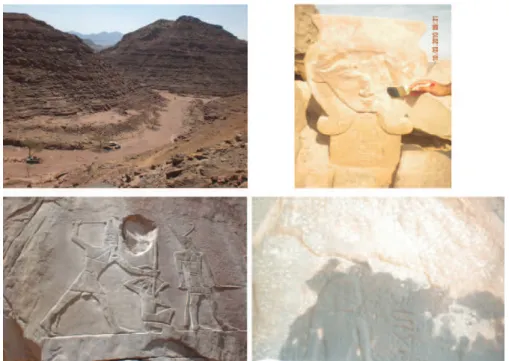
Wadi Maghara and Wadi Mukattab are located in the southwest of the Sinai Peninsula, to the east of Abu Rudeis, on the coast road and just to the north of Wadi Feiran (Fig. 1 and 2). Several stone facades in the wadi have embossed inscriptions of mentioning the early rulers of Egypt and their expeditions to mine precious minerals, primarily turquoise and copper, that were found in the area. Those minerals were brought down from the gebel on an ancient track, which still exists today, to the port of Markha, to be transported by boat to Egypt. Turquoise was particularly precious because it was used in jewellery and statuary complexes in ancient Egypt. The mines at Wadi Maghara were a profitable source of turquoise and copper, at least until the New Kingdom [2, 3].
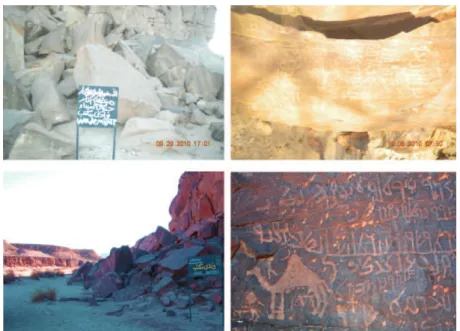
Fig. 2. Wadi Mukattab inscriptions - present state.
Wadi Mukattab (just south of Wadi Maghara), the valley of inscriptions spreads over a distance of 3 km. Along this valley inscriptions can be found on the mountain rocks that have mostly been made by Nabateans (2nd and 3rd Century), but also by others, pilgrims, soldiers, merchants, throughout the centuries [4].
Many archaeologists studied this area. Palmer, a British explorer, uncovered some of the more important carvings in the 1860's and Flinders Petrie, who was responsible for the first systematic exploration of South Sinai, uncovered twelve bas-reliefs in the Wadi.
The site was rediscovered in 1809 by Ulrich Jasper Seetzen and since then it was studied by several excavation teams. Richard Lepsius's excavation in 1845 was the first one. Major C. K. McDonald's visits to the site, including his residence at the site from 1854 to 1866 (and an effort to mine turquoise there) resulted only in surface finds (arrowheads and such) with no further excavation. A British Ordnance Survey of the site was made in 1868-1869, a Harvard University expedition in 1932 and several Israeli excavations between 1967 and 1982, among others [5]. In addition to pharaonic monuments, an Old Kingdom settlement was found on the summit of a hill in Wadi Igneh, containing 125 rough stone structures that contained wood ash and potsherds, some of which made of Nile Valley clay.
Materials and Methods
Various techniques were used to establish the causes of the stone art deterioration in Wadi Maghara and Wadi Mukattab. The first group of techniques was used to establish site parameters and it included photographic recording, petrographic analysis of the stone type, microclimate data, ground water composition and ultra violet radiation levels.
Results and Discussion
Bulk Structure and Durability Aspects of Stone Art Structures SEM-EDX
The Nubian Sandstone in the Wadi Maghara and Wadi Mukattab (Fig. 3) is most commonly brown or reddish, but in places it shows a much wider variety of colours. The ancient temples and tombs in Sinai were carved from this stone. In certain places it is extremely friable and in others compact and hard. The sand in the Sinai deserts was primarily derived from it, carried by the prevailing winds. Where it is covered by a sheet of eruptive rock (charrah), it is protected from erosion. Nubian sandstone frequently includes strata of clay and shale and thin seams of coal or lignite. This indicates that it was deposited in seas that were relatively shallow at the time.
Characteristic meniscus geometries formed by kaolinitic infiltration are observed in Nubian sandstones collected from the study area. Based on petrographic and scanning electron microscope (SEM) observations (Fig. 4), the kaolinite forming the menisci consists of mixed-size discrete platelets that gather into the corners around the framework of grain-to-grain contacts. Specifically, the internal fabric of menisci indicates a general organizing trend from (1) the centre, where the platelets coat the framework grains, (2) to the peripheral zone, where they are oriented tangentially to grain surfaces, (3) to the pore linings with curvatures that are consistent with theoretical considerations of air–water interfaces. This typical arrangement suggests a detrital origin of kaolinite platelets formed by mechanical infiltration into the sediments lying above the water level, in vadose conditions. This type of clay cementation occurring during early diagenesis, can prevent (delay) deep burial diagenetic processes and therefore preserve excellent reservoir properties [6, 7].
Fig. 3. Thin section analysis of the Nubian sandstone from Wadi Maghara (a) and Wadi Mukattab(b) (X500)
The rock can be characterized as medium grained with uniform relative grain size, angular to sub angular grain shape with equidimensional form and rough surface texture. Sound pieces of rock can be characterized of medium compactness and durability and the weathered pieces characterized of low compactness and durability. It must be mentioned that weathering attacked strongly the rock formations, started from the surface and continuing inward thus loosing the mineral fabric.
The EDX micro analysis indicated that, the elemental arrangement for the Nubian sandstone rock samples collected from Wadi Maghara and Wadi Mukattab can be put in a decreasing order according to their concentration as follow: O (48.72%), Na (15.26%), N (11.59%), C (10.84%), Si (7%), Cl (5%), Mg (0.98%), Fe (0.42%), Ca (0.33%), S (0.08%), P (0.08%).
XRD
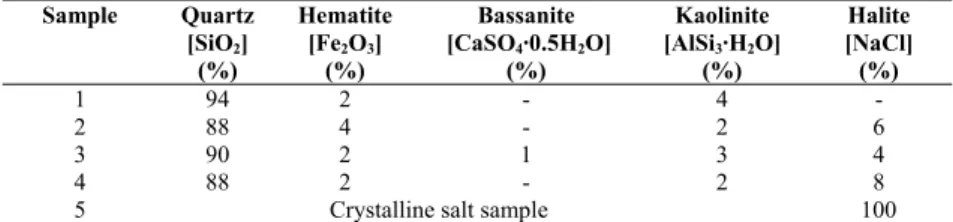
Diagrams of representative rocks, inscriptions and specific layer samples were recorded. Some representative semi-quantitative mineralogical determination results (using the XRD diagrams) are presented in table 1.
Table 1. XRD results for rock samples collected from Wadi Maghara and Wadi Mukattab.
Sample Quartz [SiO2]
(%)
Hematite [Fe2O3]
(%)
Bassanite [CaSO4·0.5H2O]
(%)
Kaolinite [AlSi3·H2O]
(%)
Halite [NaCl]
(%)
1 94 2 - 4 -
2 88 4 - 2 6
3 90 2 1 3 4
4 88 2 - 2 8
5 Crystalline salt sample 100
The inscriptions of Wadi Maghara and Wadi Mukattab are carved in Nubian sandstone, which is reddish, massive, and fine to medium-grained, cross-bedded sandstone, cemented with iron oxides cement. Intersected conjugated joints, filled with very fine friable sand saturated with water are present in the lower parts. The unit is underlined by loose Nubian sandstone. The construction material (stone), characterized as Nubian Sandstone, is mainly composed of Quartz, SiO2 (87%), Hematite, Fe2O3 (3%), Bassanite, CaSO4·0.5H2O (1 %), Kaolinite,
AlSi3·H2O (3%), and Halite, NaCl (6 %).
Pore media characterization
In the rock samples collected from sound or non weathered layers (core samples) at the same sites, we noticed that the pore diameter distribution of rock samples was 10-20Å (18.667%), 20-50Å (15.065%), 50-100Å (17.667%), 100-200Å (10.956%), 200-1996Å (37.34%), nm =1.99145E-05, BET(m2/g) =1.15777, TPV (mL/g) = 0.00249 and micro porosity % was 1.12966.
Geotechnical Properties of the Stone Art Structures
A specific set of laboratory tests was carried out in the framework of this study, in order to determine the physical and mechanical properties of the rocks where the inscriptions were carved. Those studies included the following:
Physical properties.
Physical properties measurements indicated that the specific density of sandstone ranged between 1.96 and 2.1g/cm3, water absorptions were between 6 and 8% and the apparent porosity ranged from 9.5 to 15.
Seismic P-wave Velocities.
Seismic P-wave velocities of rock samples were measured in the laboratory (ASTM 597, ASTM D 2845-83). They varied from 3.3 to 4.1 km/s (with an average of 3.6 km/s) with a standard deviation of 176 m/s for an orientation perpendicular on the bedding plane. The P-wave velocities parallel to the bedding plane show higher velocities, ranging from 3.4 to 4.4 km/s, (with an average velocity of 3.17 km/s).
Brazilian Strength (BTS).
The mean Brazilian tensile strength (BTS) values of the rock was 2.8 MPa.
Uniaxial Compression Test.
The unconfined uniaxial compressive strength (UCS) was between 12.3 and 19.55 MPa. The static Young’s modulus E = 600-800 MPa, ν = 0.28-0.30.
Direct Shear Tests for Rock Joints.
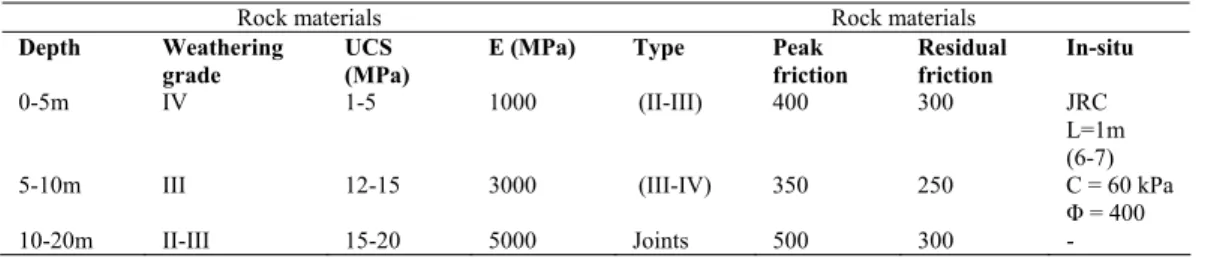
The results of direct shear tests performed on rock samples are presented in table 2. Additional direct shear test were carried out on some weathered rock samples.
Triaxial Compressive Strength.
Table 2 presents the results of the isotropic compression test performed on undistributed samples. We found that the rock samples had the following mechanical and elastic properties: c = 60 kPa, φ = 40º, E = 3000 to 4500 MPa, ν = 0.28-0.29, shear modulus G = 2000 to 2500 MPa, bulk modulus K = 3100 to 4100 MPa.
Table. 2. Geotechnical properties for rock materials and rock discontinuities collected from Wadi Maghara and Wadi Mukattab.
Rock materials Rock materials
Depth Weathering grade
UCS (MPa)
E (MPa) Type Peak friction
Residual friction
In-situ
0-5m IV 1-5 1000 (II-III) 400 300 JRC
L=1m (6-7) 5-10m III 12-15 3000 (III-IV) 350 250 C = 60 kPa
Φ = 400
10-20m II-III 15-20 5000 Joints 500 300 -
Causes of Stone Art Deterioration in the Area Under Study
constituted the dominating feature affecting the major weathering processes. The only causes of weathering not directly linked to water were those caused by wind and by temperature changes. The most common causes of stone art deterioration, with our suggested corrective actions, are described below.
Wadi Maghara and Wadi Makattab are some of the most important ancient archaeological sites in Egypt, because of the important rock inscriptions scattered in the area, dating from before the earliest Egyptian dynasties, to later periods. Those rock inscriptions suffered serious damages, due to natural weathering, salt efflorescence and other physiochemical weathering factors. The Wadi Maghara and Wadi Mukattab sediments were formed by alluvial fan braided stream and consisted mainly of Nubian sandstone. They were affected by a very low grade regional metamorphism characterised by the presence of iron oxides [8, 9]. In time, the rock inscriptions were affected by several types of deterioration, namely, exfoliation, flakes, pits, joints, fissures, overloading, thermal expansion, dissolution and salt efflorescence. The Wadi Maghara and Wadi Mukattab quarries were influenced by natural hazards, including torrential rains and flash floods, salt efflorescence, mechanical and chemical weathering. In most cases those hazards and the weathering agents work together by influencing or strengthening each other. Wind erosion, moisture and rains are considered the primary factors of deterioration of the stone carvings in the studied area. The interaction between stone and moisture, or rain, resulted in the appearance of destructive subsurface patterns, such as flaking, crumbling and cracking of the stone surface.
Site Restoration
The surface of the cliffs of different rock shelters is usually uneven and in some places there are cracks. Water sometimes penetrates those cracks and causes the surface layer to peel off and may even cause large stone blocks to fall off. It is advised to fill the cracks that appeared on the rock inscriptions and to secure those rock blocks that are prone to fall with an organic high molecular adhesive. Some cliffs are almost perpendicular on the ground, having no projections in the upper part and in such cases inscriptions were often seriously affected by rain, weathering and erosion. In order to prevent further damage, effective covers, such as roofs, should be set up as soon as possible for that part of the rock with inscriptions. The erosion of the rock paintings may also be stopped by devising small water drains. Because of the hot climate, damp air and strong sunlight, in most parts of Sinai, the rock paintings faded. By coating the paintings with aqueous carbonate we believe we can preserve their original colour. Similar methods involve spraying a transparent chemical membrane on the exposed paintings and it may also help preserve the rock paintings.
Site Protection
the source of pollution and keep the environment clean. It is encouraging to see that a few stone art sites were included in the World Heritage List and converted into National Parks, in order to protect and preserve the rock inscriptions, as well as the ecological balance in the area.
Conclusions
A summary of the present state of the stone art in Wadi Maghara and Wadi Mukattab, Sinai, Egypt has been presented. In order to assess the pathology of the stone art in Wadi Maghara and Wadi Mukattab detailed laboratory and field surveys and tests have been carried out. The rock material (Nubian sandstone) has an important intrinsic sensitivity to weathering factors especially the underground water and salt weathering effect. The infiltration of the water through the porous rock is one of the main problems of these sites. The weathering process is linked to the textural characteristics, like poor geotechnical properties, chemical composition, and presence of soluble salts in the porous system. The durability of the rock is moderate due to its high free silica content. The strength of the rock where stone art is carved is moderate where the Rock Mass Rating (RR) = 25 and Rock Quality Designation (RQD) = 20-30%.
Considering all other affecting factors and this moderate rock strength affects seriously the safety of these structures both under static and seismic loading conditions.
The present study may be considered as a preliminary pilot study for future conservation efforts of these historical monuments, in order to assess the vulnerability of these structures to different hazards and to propose appropriate strengthening retrofitting measures especially to reduce the geotechnical and seismic risk.
References
[1] S. Hemeda, Scientific evaluation of salt weathering and its effect on limestone and sandstone which utilized in monumental and historical buildings in different environments in Egypt, and strategies for restoration, MsC Thesis, Conservation Department, Faculty of Archaeology, Cairo University, Egypt, 2003.
[2] A. Gauntier, Fauna dometicated, Encyclopedia of the Archeology of Ancient Egypt
(Editors Bard K.A., Shubert S. B.), Routledge, New York, 1999, pp. 300-309.
[3] G. D. Mumford, Wadi Maghara, Encyclopedia of the Archeology of Ancient Egypt
(Editors Bard K.A., Shubert S. B.), Routledge, New York, 1999, p. 875.
[4] J.D. Cooney, Major Macdonald, a Victorian Romantic, The Journal of Egyptian Archaeology, 58, 1972, pp. 281-288.
[5] A. Barrois, The Mines of Sinai, The Harvard Theological Review, 25(2), Apr 1932, pp. 119-123.
[6] A.A. Shata, Hydrogeology of the Great Nubian Sandstone Basin, Desert Research Institute, Egypt, 1982.
[7] El Sayed, A Study of Hydrogeological Conditions of the Nubian Sandstone Aguifer in
the Area between Abu Simbel & Toschka, Western Desert, Egypt, American
Geophysical Union, 2001
[8] B. Issawi, Review of Upper Cretaceous-Lower Tertiary Stratigraphy in Central and Southern Egypt, American Association of Petrol. Geol. Bull., 56(8), 1973, pp. 112-115 [9] E.A.Sounbul, Applied scientific study for treatment and conservation of building materials
utilized in construction of Serapit el-khadem temple, Sinai, Egypt, MsC Thesis, Conservation Department, Faculty of Achaeology, Cairo University, Egypt, 2007.