J of Evolution of Med and Dent Sci/ eISSN- 2278-4802, pISSN- 2278-4748/ Vol. 4/ Issue 53/ July 02, 2015 Page 9236
COMPARISION AND CORRELATION OF PAP SMEAR WITH COLPOSCOPY
AND HISTOPATHIOLOGY IN EVALUATION OF CERVIX
Zainab S. Nayani1, Pravin Chandra Hendre2
HOW TO CITE THIS ARTICLE:
Zainab S. Nayani, Pravin Chandra Hendre. Comparision and Correlation of Pap Smear with Colposcopy and Histopathiology in Evaluation of Cervix. Journal of Evolution of Medical and Dental Sciences 2015; Vol. 4, Issue 53, July 02; Page: 9236-9247, DOI: 10.14260/jemds/2015/1341
ABSTRACT: AIMS AND OBJECTIVES: Correlate pap smear findings with colposcopic findings, To localize the lesion by colposcopy and obtain biopsyand to provide appropriate treatment wherever possible. MATERIAL AND METHODS: This was a prospective comparative study of 104 patients who attended the Gynecology OPD of KIMS from may2012 to may2014. INCLUSION CRITERIA: 1.Women of age between 20-65 years. 2. Women with symptoms like vaginal discharge, post coital bleeding, postmenopausal bleeding, intermenstrual bleeding and persistent leucorrhoea. 3. Women with normal looking cervix but symptomatic. EXCLUSION CRITERIA: 1.Women with bleeding at the time of examination. 2. Women with frank lesions. 3. Women with clinical evidence of acute pelvic infection. 4. Women who was previously treated for carcinoma cervix. 5. Pregnant women. RESULTS:
Sensitivity of pap smear was found to be very low which was 31.25% compared to its specificity which was 94.44%. Which means pap smear shows higher no. of false negative smears Colposcopy showed a high sensitivity 96.57% and a good specificity 88.55% compared to pap smear.
CONCLUSIOS: It is evident that colposcopy is definitely more sensitive and accurate than pap smear. By combining pap smear with colposcopy, we can maximize the sensitivity and specificity of cancer cervix screening.
KEYWORDS: Colposcopy, Pap smear, Cervical intraepithelial lesions, Suspicious looking cervix.
ABBREVIATIONS:
ASCUS - Atypical Squamous cells of undetermined significance. AW - Acetowhite lesion.
CIN - Cervical Intraepithelial Lesion. CIS - Carcinoma in situ.
HSIL – High grade squamous intraepithelial lesion. HPV – Human papilloma virus.
IMB - Intermenstrual bleeding. INF – Inflammatory.
LBC – Liquid based cytology.
LSIL - Low grade squamous intraepithelial lesion. M – Menorrhagia.
N – Normal.
PCB - Post coital bleeding. PMB - Post menstrual bleeding. RCI – Reid colposcopic index. SQM - Squamous metaplasia.
J of Evolution of Med and Dent Sci/ eISSN- 2278-4802, pISSN- 2278-4748/ Vol. 4/ Issue 53/ July 02, 2015 Page 9237
INTRODUCTION: Unhealthy cervix is a very common finding in our country due to poor genital hygiene, malnutrition and multiparity.1 The naked eye evaluation of unhealthy cervix is deceptive sometimes and it so happens that intra-epithelial lesions are considered as simple cases of erosion due to inflammation.
Cancer uterine cervix is a serious health problem in India.2 India which accounts for one sixth
of the world’s population also bears one firth of me world’s burden of cervical cancer. There are approximately 1,30,000 new cases of cervical cancer in India each year and the disease is responsible for almost 20 person of all female deaths. India's cervical cancer age standardized incidence rate (30.7 per 1,00,000) and age standardized mortality rate (17.4 per 1,00,000) are the highest in South Central Asia.3
Invasive cancer of cervix has been considered a preventable cancer because it has a long pre-invasive state, cervical cytology screening programs are available and the treatment of pre-pre-invasive lesions is effective.4 the unique accessibility of the cervix to direct visualization and the possibility of cellular and tissue sampling has permitted extensive investigations on lesions of cervix. There is excellent evidence that invasive cancer of the cervix develops, from carcinoma in situ or dysplasia.
Therefore screening of the cervix by cytology and colposcopy can significantly reduce the rate of invasive cancers.
AIMS AND OBJECTIVES:
1. Correlate pap smear findings with colposcopic findings. 2. To localize the lesion by colposcopy and obtain biopsy. 3. To provide appropriate treatment wherever possible.
DETAIL RESEARCH PLAN:
MATERIAL AND METHODS: Source of Data: This was a prospective comparative study of 104 patients who attended the Gynecology OPD of KIMS from May 2012 to May 2014 (24 months).
Methods of collection of data Informed consent was taken from each patient relevant obstetrics & gynecology history was taken and recorded
Women of age between 20-65 years.
Women with symptoms like vaginal discharge, post coital bleeding, postmenopausal bleeding, intermenstrual bleeding and persistent leucorrhoea.
Women with normal looking cervix but symptomatic.
Exclusion Criteria:
Women with bleeding at the time of examination.
Women with frank lesions.
Women with clinical evidence of acute pelvic infection.
Women who was previously treated for carcinoma cervix.
Pregnant women.
J of Evolution of Med and Dent Sci/ eISSN- 2278-4802, pISSN- 2278-4748/ Vol. 4/ Issue 53/ July 02, 2015 Page 9238
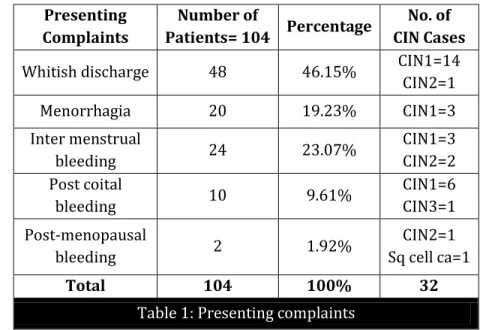
Presenting Complaints
Number of
Patients= 104 Percentage
No. of CIN Cases
Whitish discharge 48 46.15% CIN1=14
CIN2=1
Menorrhagia 20 19.23% CIN1=3
Inter menstrual
bleeding 24 23.07%
CIN1=3 CIN2=2 Post coital
bleeding 10 9.61%
CIN1=6 CIN3=1
Post-menopausal
bleeding 2 1.92%
CIN2=1 Sq cell ca=1
Total 104 100% 32
Table 1: Presenting complaints
Presenting Complaints: Among the complaints, majority of women complaint of excessive white discharge per vagina. Excessive vaginal discharge playing a role in contributing to the development of CIN was proved in many studies in our study, 46.15% patient had pv discharge and high incidence of CIN 46.87% (15/32) was seen in this group. Post coital bleeding was found in 9.61% of cases. Among these women who had post coital bleeding, 70% had benign findings Intermenstrual bleeding was seen in 23.07% of cases Post-menopausal bleeding was present in1.92% (2/104) of cases only, but out if which one patient was diagnosed with squamous cell carcinoma and other with CIN2
Cervical Examination
Number of
cases=104 Percentage
Total No. of CIN Cases
Normal 14 13.46% CIN1=11
Cervical
erosion 88 84.61%
CIN1=15 CIN2=3 CIN3=1 Suspicious
looking cervix 2 1.92%
CIN2=1 Sq cell ca=1
Total 104 100% 32
Table 2: Per speculum examination of cervix
J of Evolution of Med and Dent Sci/ eISSN- 2278-4802, pISSN- 2278-4748/ Vol. 4/ Issue 53/ July 02, 2015 Page 9239
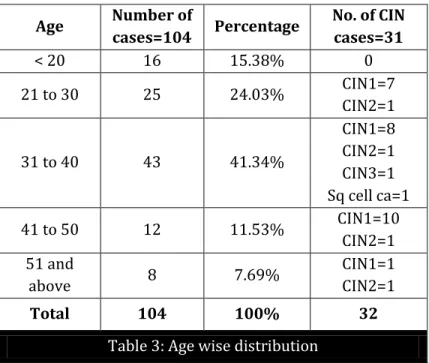
Age Number of
cases=104 Percentage
No. of CIN cases=31
< 20 16 15.38% 0
21 to 30 25 24.03% CIN1=7
CIN2=1
31 to 40 43 41.34%
CIN1=8 CIN2=1 CIN3=1 Sq cell ca=1
41 to 50 12 11.53% CIN1=10
CIN2=1 51 and
above 8 7.69%
CIN1=1 CIN2=1
Total 104 100% 32
Table 3: Age wise distribution
Regarding age distribution, high incidence of CIN was found among the age group of 31 to 50 years.
Parity Number of
Cases Percentage
No. of CIN cases
Nulliparous 3 2.33% CIN1=1
Para1 18 17.30% CIN1=2
Para2 42 40.38%
CIN1=10 CIN2=2 Sq cell ca=1
Para3 26 25%
CIN1=7 CIN2=1 CIN3=1
para4 8 7.69% CIN1=4
Para5 or more 7 6.73% CIN1=2
CIN2=1
Total 104 100% 32
Table 4: Parity wise Distribution
Regarding parity, our study showed increased incidence of CIN among multiparous women. 40.62% were para2, 28.12% were para3, 12.5% were para4 and 9.37% were para5 and more.
J of Evolution of Med and Dent Sci/ eISSN- 2278-4802, pISSN- 2278-4748/ Vol. 4/ Issue 53/ July 02, 2015 Page 9240
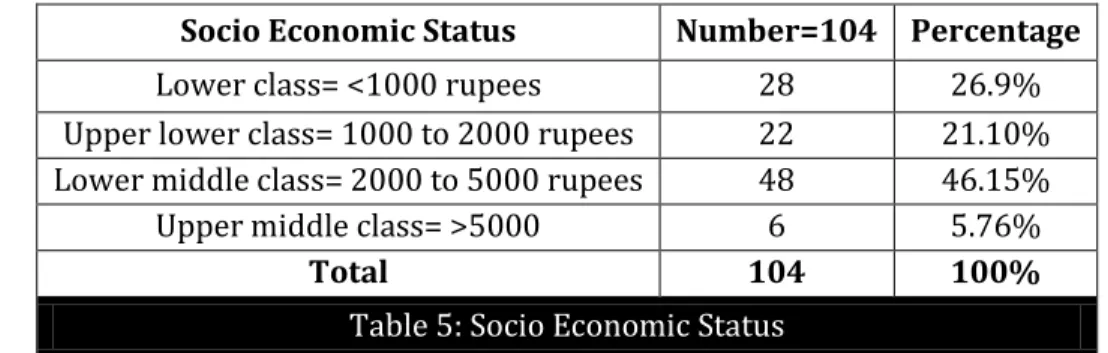
Socio Economic Status Number=104 Percentage
Lower class= <1000 rupees 28 26.9%
Upper lower class= 1000 to 2000 rupees 22 21.10% Lower middle class= 2000 to 5000 rupees 48 46.15%
Upper middle class= >5000 6 5.76%
Total 104 100%
Table 5: Socio Economic Status
Socio economic status had always been playing an epidemiological role in genesis of dysplasia. In our study, the incidence of CIN was found to be higher among the lower middle class.
Education No. of
Cases Percentage
No. of
CIN Cases Percentage
Illiterate 53 50.96%
CIN1=9 CIN2=2 CIN3=1 Sq cell ca=1
40.62%
Up to 10thstanderd 44 42.30% CIN1=12
CIN2=1 40.62%
degree 7 6.73% CIN1=5
CIN2=1 18.75%
Total 104 100% 32 100%
Table 6: Education
Regarding the literacy, CIN was more prevalent among the illiterates, in our study, 40.62% (13 out of 32) of CIN was found among the illiterates. And, 40.62% (13 out of 32) was found in patients studied up to std. 10th. This was attributed to lack of awareness of symptoms and failure to seek medical care.
Duration No. of
Cases Percentage
No. of CIN Cases
Less than 5 years 13 12.5% CIN1=6
5 to 10 years 37 35.57% CIN1=7
CIN2=1
10 to 20 years 34 32.69%
CIN1=10 CIN2=2 CIN3=1
More than 20 years 20 19.23%
CIN1=3 CIN2=1 Sq cell ca=1
Total 104 100% 32
J of Evolution of Med and Dent Sci/ eISSN- 2278-4802, pISSN- 2278-4748/ Vol. 4/ Issue 53/ July 02, 2015 Page 9241 Duration of marriage and duration of exposure to sexual intercourse had a distinct role in genesis of cervical dysplasia. In our study, the incidence of CIN was 40.62% among 10 to 20 years duration of marriage The severity of underlying CIN increased with increase in the duration of marital life and hence the increase in the duration of sexual intercourse.
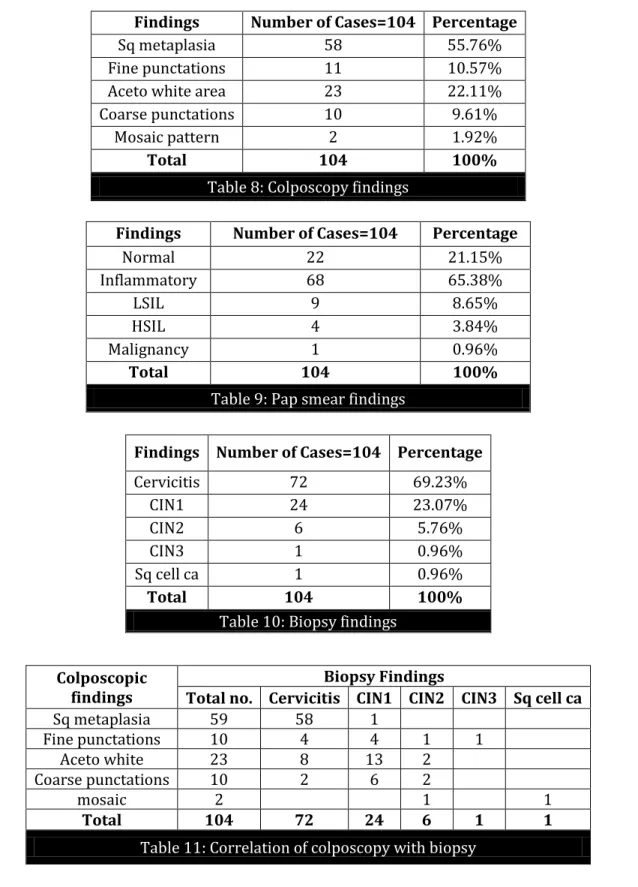
Findings Number of Cases=104 Percentage
Sq metaplasia 58 55.76%
Fine punctations 11 10.57%
Aceto white area 23 22.11%
Coarse punctations 10 9.61%
Mosaic pattern 2 1.92%
Total 104 100%
Table 8: Colposcopy findings
Findings Number of Cases=104 Percentage
Normal 22 21.15%
Inflammatory 68 65.38%
LSIL 9 8.65%
HSIL 4 3.84%
Malignancy 1 0.96%
Total 104 100%
Table 9: Pap smear findings
Findings Number of Cases=104 Percentage
Cervicitis 72 69.23%
CIN1 24 23.07%
CIN2 6 5.76%
CIN3 1 0.96%
Sq cell ca 1 0.96%
Total 104 100%
Table 10: Biopsy findings
Colposcopic findings
Biopsy Findings
Total no. Cervicitis CIN1 CIN2 CIN3 Sq cell ca
Sq metaplasia 59 58 1
Fine punctations 10 4 4 1 1
Aceto white 23 8 13 2
Coarse punctations 10 2 6 2
mosaic 2 1 1
Total 104 72 24 6 1 1
J of Evolution of Med and Dent Sci/ eISSN- 2278-4802, pISSN- 2278-4748/ Vol. 4/ Issue 53/ July 02, 2015 Page 9242
Correlation of Colposcopy with Biopsy:
Sensitivity-=31/32x100=96.87%.
Specificity=58/72x100=88.55%.
PPV=32/46x100=69.56%.
NPV= 58/58x100=98.30%.
Accuracy= 32+58/100=86.53%.
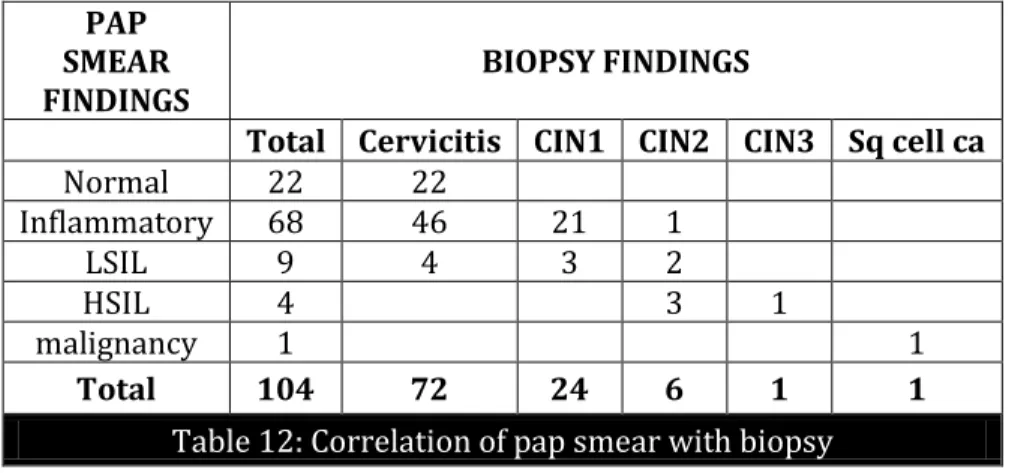
This data suggested that with colposcopy as a screening tool, the rate of false negative cytology could be significantly reduced. Colposcopy enhanced cervical screening particularly in women with otherwise negative smear.
Correlation between pap smear and biopsy was poor as far as CIN1 was concerned. But was good for CIN2 and CIN3.
Correlation between colposcopy findings and biopsy showed a good correlation for higher grade lesions.
Colposcopy showed a high sensitivity and a low specificity compared to pap smear. Low specificity was due to high incidence of acetowhite area which might be due to inflammation, immature metaplasia or latent HPV infection.
PAP SMEAR FINDINGS
BIOPSY FINDINGS
Total Cervicitis CIN1 CIN2 CIN3 Sq cell ca
Normal 22 22
Inflammatory 68 46 21 1
LSIL 9 4 3 2
HSIL 4 3 1
malignancy 1 1
Total 104 72 24 6 1 1
Table 12: Correlation of pap smear with biopsy
Correlation of Pap smear with Biopsy:
Sensitivity= 10/32x100 = 31.25%.
Specificity= 68/72x100 = 94.44%.
PPV= 10/14x100 = 77.42%.
NPV= 68/90x100 = 75.55%.
Accuracy= 10+68/104x100 = 75%.
Pap smear was taken for all cases. It showed inflammatory smear for 65% of cases, LSIL was seen in 8.65% and HSIL in 3.84%
J of Evolution of Med and Dent Sci/ eISSN- 2278-4802, pISSN- 2278-4748/ Vol. 4/ Issue 53/ July 02, 2015 Page 9243
Pap Smear findings
Colposcopic Findings
Total Sq metaplasia
Aceto white
fine punctations
Coarse punctations
Mosaic Pattern
Normal 22 20 2
Inflammatory 68 38 5 18 7
LSIL 9 4 3 2
HSIL 4 2 1 1
Malignancy 1 1
Total 104 58 11 23 10 2
Table 13: Correlation of pap smear with colposcopy
Correlation of Pap smear with Colposcopy:
Sensitivity= 14/46x100 = 30.43%.
Specificity= 58/58x100 = 100%.
PPV= 14/14x100 = 100%.
NPV= 58/90x100 = 64.44%.
Accuracy= 14+58/104x100 = 71.28%.
Correlation Sensitivity Specificity PPV NPV Accuracy
Colposcopy with biopsy 96.87% 88.55% 69.56% 98.30% 86.53% Pap smear with biopsy 31.25% 94.44% 77.42% 75.55% 75% Pap smear with colposcopy 30.43% 100% 100% 64.44% 71.28%
Table 14: Correlation of pap smear, colposcopy and biopsy findings
Efficacy of colposcopy and pap smear.
DISCUSSION: Cervical cancer is the second most frequent cancer worldwide, in women after breast cancer. However, invasive cancer of the cervix was considered to be preventable condition as it is associated with a long pre invasive stage (CIN) making it amenable to screening and treatment.
In the present study, screening was done in 104 women with symptoms like vaginal discharge, post coital bleeding, postmenopausal bleeding, intermenstrual bleeding and persistent leucorrhoea. Women with unhealthy cervix, with persistent inflammatory smear were included.
Regarding age distribution high incidence of CIN was found among the age group of 31 to 50 years.
Anujabhalerao et al, in their study showed the prevalence of CIN was higher in women over 30 years.5
J of Evolution of Med and Dent Sci/ eISSN- 2278-4802, pISSN- 2278-4748/ Vol. 4/ Issue 53/ July 02, 2015 Page 9244 Ashmita D et al showed maximum patient of CIN between the age group 30 to 50 similar results were seen in following studies.7
Regarding parity, our study showed increased incidence of CIN among multiparous women. 40.62% was para 2, 28.12% were para 3, 12.5% were para4 and 9.37% were para5 and more.
Similar study by anujabhalerao et al showed the mean parity 2.6 in patient with higher no. on CIN.5
N gopal, prashant s joshi, showed increased incidence of CIN in para 2.8 S sharma, M saini et al showed maximum CIN in para 2.9
Regarding the literacy, CIN was more prevalent among the illiterates, in our study, 40.62% (13 out of 32) of CIN was found among the illiterates. And, 40.62% (13 out of 32) was found in patients studied up to std. 10th. This was attributed to lack of awareness of symptoms and failure to seek medical care.
Socio economic status had always been playing an epidemiological role in genesis of dysplasia. In our study, the incidence of CIN was found to be higher among the lower middle class.
D hegde, H shetty n et al had showed that lower middle class had a higher incidence of CIN.10 Vaidya had showed that low socio economic status had a definite role in development of dyskaryosis.11
Duration of marriage and duration of exposure to sexual intercourse had a distinct role in genesis of cervical dysplasia. In our study, the incidence of CIN was 40.62% among 10 to 20 years duration of marriage The severity of underlying CIN increased with increase in the duration of marital life and hence the increase in the duration of sexual intercourse.
Kushtagi et al had demonstrated the severity of underlying CIN increased with increase in the duration of marital life and hence the increase in the duration of sexual intercourse.12
Among the complaints, majority of women complaint of excessive white discharge per vagina. Excessive vaginal discharge playing a role in contributing to the development of CIN was proved in many studies.
In our study, 46.15% patient had pv discharge and high incidence of CIN 46.87% (15/32) was seen in this group.
Anujabhalerao et al, showed that the most common symptom was vaginal discharge which was 71%.5
Asmita D, showed complaints of pv discharge in 30% of cases.7
Post coital bleeding was found in 9.61% of cases. Among these women who had post coital bleeding, 70% had benign findings cell carcinoma and other with CIN2.
Ramesh G, sudha R et al, showed 3.75% of cases having post-menopausal bleeding Ramesh G, sudha R et all, among the complaints, 6.25% cases had post coital bleeding Intermenstrual bleeding was seen in 23.07% of cases.
Ramesh G, sudha R et al, showed 16.25% of cases with intermenstrual bleeding.13
Post-menopausal bleeding was present in1.92% (2/104) of cases only, but out if which one patient was diagnosed with squamous.
Regarding the clinical appearance of cervix, the most common finding was cervical erosion where the squamous epithelium of ectocervix was replaced by columnar epithelium of endocervix. Erosion was seen in 84.6% of cases out of which, 21.59% had CIN.
J of Evolution of Med and Dent Sci/ eISSN- 2278-4802, pISSN- 2278-4748/ Vol. 4/ Issue 53/ July 02, 2015 Page 9245 When 5% acetic acid was applied to suspicious area, one showed coarse punctations while the other showed mosaic pattern. On pap smear, one was diagnosed as CIN2 and the other as sq cell ca.
This data suggested that with colposcopy as a screening tool, the rate of false negative cytology could be significantly reduced. Colposcopy enhanced cervical screening particularly in women with otherwise negative smear.
Correlation between pap smear and biopsy was poor as far as CIN was concerned. But was good for CIN2 AND CIN3.
Correlation between colposcopic findings and biopsy showed a good correlation for higher grade lesions.
Colposcopy showed a high sensitivity and a good specificity compared to pap smear.
SUMMARY: This study was a comparative study conducted in the department of obstetrics and gynaecology during the period from may2012 to may2014 in 104 women who fulfilled the inclusion criteria.
Pap smear, colposcopy and biopsy were done for all the cases after proper counseling.
The results were tabulated and analyzed majority of CIN 68.75% occurred in the age group of 31 to 50 years.
Regarding parity, our study showed increased incidence of CIN among multiparous women. 40.62% were para2, 28.12% were para3, 12.5% were para4 and 9.37% were para5 and more in our study, the incidence of CIN was found to be higher among the lower upper class 34.37% (11/32) the incidence of CIN was 40.62% among 10 to 20 years and 15.67% in duration of marriage more then 20years 46.15% patient had pv discharge and high incidence of CIN 46.87% (15/32) was seen in this group.
Post coital bleeding was found in 9.61% of cases. Among these women who had post coital bleeding, 70% had benign findings.
Post-menopausal bleeding was present in1.92% (2/104) of cases only, but out if which one patient was diagnosed with squamous cell carcinoma and other with CIN2.
Erosion was seen in 84.6% of cases out of which, 21.59% had CIN. Suspicious looking cervix was seen in 1.92% (2/104) of cases.
Pap smear was taken for all cases. It showed inflammatory smear for 65% of cases, LSIL was seen in 8.65% and HSIL in 3.84%.
Sensitivity of pap smear was found to be very low which was 31.25% compared to its specificity which was 94.44%. Which means pap smear shows higher no. of false negative smears Colposcopy showed a high sensitivity 96.57% and a good specificity 88.55% compared to pap smear.
CONCLUSION: Early diagnosis of CIN in adult women is a desirable goal. CIN lesions and early invasive cancers should be diagnosed in an earlier stage for instituting.
Appropriate management. Invasive cancer of cervix is considered to be preventable since it is associated with a long pre-invasive stage (CIN) making it amenable to screening and treatment.
J of Evolution of Med and Dent Sci/ eISSN- 2278-4802, pISSN- 2278-4748/ Vol. 4/ Issue 53/ July 02, 2015 Page 9246 Colposcope in general has a role in the evaluation of women with abnormal pap smears, unhealthy cervix, and seems to be more accurate in detecting CIN. Hence, primary colposcopy may be incorporated into screening at first visit.
Thus colposcopy offers an excellent tool in evaluating cervical lesions. It is an easy and perspective method and its importance lies in teaching, diagnosis and management of cervical lesions, both neoplastic and non-neoplastic There is a need to introduce and encourage the practice of colposcopy, in all medical institutions to evaluate and to manage patients with clinically suspicious cervix and abnormal pap smears.
BIBLIOGRAPHY:
1. Arora R, K Vijaya, Habeebullah S., O. Asha. Colposcopic evaluation of unhealthy cervix. J Obstet Gynecol Ind 2000; 50:102-103.
2. Kumar K., Iyer V.K., Bhatla N., Kriplani A., Verma K. Comparative evaluation of smear cytology and hybrid capture for the diagnosis of cervical cancer. Indian J Med Res 2007; 126: 39-44. 3. Rasha D., Jyothi v., Martha J. A strategic assessment of cervical cancer prevention and treatment
services. Reproductive Health 2005; 2: 11.
4. Jonathan S. Berek. Berek and Novak S Gynecology. 13 Edn. Lippincon Williams and Wilkins, Philadelphia; 2002: 11.99.
5. Bhalerao A, Kulkarni S, Ghike S. Correlation of Pap smear, Colposcopy and Histopathology in women with unhealthy cervix. JSAFOG. May-August 2012; 4(2): 97-98.
6. Pradhan B, Pradhan SB. Correlation of PAP smear finding with clinical finding and cervical biopsy. Kathmandu University Medical Journal (2007), Vol. 5, No. 4, Issue 20, 461-467.
7. Ashmita D, Shakuntala PN. Comparison and correlation of PAP smear, colposcopy and histopathology in symptomatic women and suspicious looking cervix in a tertiary hospital care centre. Int J of Health Sciences and Research, Vol.3, Issue 5, May 2013.
8. N. Gopal, Prashant. S. Joshi, Ravindra Pukale, Shamashoor. Colposcopic findings in Unhealthy Cervix and its comparison with Cytology and Histopathology . Journal of Evolution of Medical and Dental Sciences 2013; Vol2, Issue 26, July 1; Page: 4663-4671.
9. S. Sharma, M Saini. Colposcopic evaluation of patients with abnormal cervical cytology and its histopathological correlation. The Internet Journal of Gynaecology and Obstetrics. 2014. Vol 18, No. 1.
10. D Hegde, H Shetty, P K Shetty, S Rai, Diagnostic value of VIA comparing with conventional pap smear in the detection of colposcopic biopsy proved CIN. September-December 2011; Vol. 9 (No.3); 134-139.
11. Vaidya A, Comparison of pap test among high risk and non-risk female, kathmandu university, medical journal, 2003, Vol. 1, No. 1, P: 8-13.
12. Kushtagi P, Fernandez. P, Significance of Persistent Inflammatory, Cervical smears in sexually active women of reproductive age. The Journal of Obs and Gyn. of India, 2002, Jan-Feb; 52 (1): 124-6.
J of Evolution of Med and Dent Sci/ eISSN- 2278-4802, pISSN- 2278-4748/ Vol. 4/ Issue 53/ July 02, 2015 Page 9247
AUTHORS:
1. Zainab S. Nayani 2. Pravin Chandra Hendre
PARTICULARS OF CONTRIBUTORS:
1. Resident, Department of Obstetrics & Gynaecology, Krishna Institute of Medical Sciences, Karad, Maharashtra.
2. Assistant Professor, Department of Obstetrics & Gynaecology, Krishna Institute of Medical Sciences, Karad, Maharashtra.
FINANCIAL OR OTHER
COMPETING INTERESTS: None
NAME ADDRESS EMAIL ID OF THE CORRESPONDING AUTHOR:
Dr. Zainab S. Nayani, 202, Mandi Palace,
Nishanpada X Lane, Dongri, Mumbai-400009, Maharashtra. E-mail: [email protected]