Fisioter. Mov., Curitiba, v. 28, n. 1, p. 41-48, Jan./Mar. 2015 Licenciado sob uma Licença Creative Commons DOI: http://dx.doi.org.10.1590/0103-5150.028.001.AO04
[T]
Acute cardiovascular responses to a session
of Manual Lymphatic Drainage
[I]
Respostas cardiovasculares agudas a uma
sessão de drenagem linfática manual
[A]
Plínio dos Santos Ramos[a, c], Isabelle Regina Moreira Marinho Cunha[a], Mariana Cristina Rachel[a], Priscilla Stephan Souza Pacca[a], Ana Paula Ferreira[a, b, c], Djalma Rabelo Ricardo[a, c]*
[a] Faculdade de Ciências Médicas e da Saúde de Juiz de Fora (FCMS-JF), Juiz de Fora, MG, Brazil [b] Universidade do Estado do Rio de Janeiro (UERJ), Rio de Janeiro, RJ, Brazil
[c] Hospital Maternidade Therezinha de Jesus, Juiz de Fora, MG, Brazil
[R]
Abstract
Introduction: Manual Lymphatic Drainage (MLD) creates pressure differentials to promote the movement of lymph and interstitial fluid, for their relocation into the bloodstream and can thus act on the variables responsible for determining blood pressure (BP). Objective: To investigate the behavior of hemodynamic parameters, such as BP and Heart Rate (HR) during and immediately after a session of MLD. Materials and methods: 23 healthy young volunteers with a mean age of 22 ± 2.97 years (18-29), underwent a session of
* PSR: PhD, e-mail: [email protected] IRMMC: Grad., e-mail: [email protected] MCR: Grad., e-mail: [email protected] PSSP: Grad., e-mail: [email protected]
APF: MSc student, e-mail: [email protected]
42
MLD and evaluation of systolic BP, diastolic BP and HR after 10 minutes of initial rest, at the end of the imple-mentation of the protocol in SP, PP and after 15 minutes of final rest. Results: No changes were found in sys-tolic BP or diassys-tolic BP before, during and immediately after the MLD session (p = 0.57, p = 0.20, respectively). There was increased heart rate after the final 15 minute rest when compared to the HR after MLD in SP (72 ± 1.9 vs. 76 ± 1.9, p = 0.002), however, without clinical relevance. Conclusion: During a session of MLD with healthy young women, no significant hemodynamic changes occurred, demonstrating that this tech -nique is safe from the cardiovascular point of view.
[P]
Keywords: Drainage. Blood pressure. Heart rate.
[B] Resumo
Introdução: A Drenagem Linfática Manual (DLM) tem por objetivo criar diferenciais de pressão para
pro-mover o deslocamento da linfa e do fluido intersticial, objetivando a sua recolocação na corrente sanguínea, podendo, dessa forma, atuar nas variáveis responsáveis pela determinação da pressão arterial (PA). Objetivo:
Investigar o comportamento das variáveis hemodinâmicas, como PA e Frequência Cardíaca (FC), durante e imediatamente após uma sessão de DLM. Materiais e métodos: 23 voluntárias jovens e saudáveis com idade
média de 22 ± 2,97 anos (18-29), foram submetidas a uma sessão de DLM e avaliação da PA Sistólica, da PA Diastólica e da FC após 10 minutos de repouso inicial, no fim da realização do protocolo em DD, em DV e após 15 minutos de repouso final. Resultados: Não foram encontradas alterações na PA Sistólica e na PA Diastólica antes, durante e imediatamente após a sessão de DLM (p = 0,57; p = 0,20, respectivamente); por outro lado, verificou-se aumento da FC após o repouso final de 15 minutos, quando comparado com a FC após a DLM em DD (72 ± 1,9 vs. 76 ± 1,9; p = 0,002), porém sem relevância clínica. Conclusão: Durante uma sessão de DLM
em mulheres jovens saudáveis, não ocorrem alterações hemodinâmicas importantes, demonstrando que essa técnica é segura do ponto de vista cardiovascular. [K]
Palavras-chave: Drenagem. Pressão arterial. Frequência cardíaca.
Introduction
Manual Lymphatic Drainage (MLD) was created by the Danish biologist Emil Vodder and his wife Estrid Vodder in 1936, with this technique being charac-terized by some movements and orientation of the direction of lymph drainage. Later, in the same year as its creation, the systematization of the technique was published in Paris and with this several groups adopted these concepts, which are used to this day by professionals from different spheres of practice, such as beauticians, biologists, occupational thera-pists, nurses, and physiotherapists (1). The MLD tech-nique is one of the cornerstones in the treatment of lymphedema, which is characterized by excessive and persistent accumulation of extravascular and
extra-cellular fluid and proteins in the tissue spaces, the consequence of an inefficient lymphatic system and
a chronic condition in which there is excessive
accu-mulation of fluid in the interstice (2). This technique
maintains the water balance of the interstitial spaces and also enables the elimination of degradation resi-dues resulting from cellular metabolism (3).
The purpose of lymphatic drainage is to create pressure differentials to promote the displacement
of lymph and interstitial fluid, aiming for their relo
-cation into the blood stream (1), in order to empty the metabolic waste by maneuvering the lymphatic system and lymph nodes (4). It aims to improve lym-phatic function and blood circulation (5), and to de-congest the lymphatic vessels resulting in improved absorption and transport of liquids (6).
The maneuvers performed in MLD follow basic principles, with the evacuation (removal) and uptake (absorption) of the lymph (4). The external pressure, exerted by manual massage, should overcome the physiological internal pressure, which can reach 25-40 mmHg in the major lymphatic vessels (7). This technique should be carried out as follows:
43
this negates the mechanical feeling and provides the maneuver with a pleasant feeling, at a determined fre-quency and correct time, where the pressure should always be directed in the physiological direction of lymphatic drainage (8). In the application of this tech-nique it is essential for the patient to be in a comfort-able position, preferably lying down, with the region to be treated uncovered (9).
Manual lymphatic drainage has been used in healthy people, mastectomy patients, in post-operative plastic surgery, for elephantiasis, nasal ob-structions and colds, headaches, migraine, scarring, nerve pain (post-surgery), head and neck edema, rheumatic swellings, gynoid lipodystrophy, paraly-sis edema and other edema types. In spite of this, there are some absolute contraindications to per-forming this technique, such as acute thrombosis in the edematous region and acute bacterial or viral
inflammation of the swollen region, among others,
with some relative contraindications, such as hypo-tonia, pregnancy, bronchial asthma, cardiovascular diseases and arterial hypertension (9).
Hemodynamic changes originating from the use of MLD are not well described in the literature. Leduc et al.(5), with a group of patients with heart failure
and lower limb edema, found significant changes in
the heart rate when performing MLD only in the ede-ma region, conversely, another study that performed MLD with elderly patients found no statistically
sig-nificant differences (10). Based on this it is appropri
-ate to investig-ate whether MLD promotes any acute change in the cardiovascular system, given that this technique promotes the displacement of
extravas-cular fluid into the cardiovasextravas-cular system which can
change the current volume and perchance the blood pressure (BP) and the variables involved with this physiological phenomenon. Therefore, the aim of this study was to investigate the behavior of hemo-dynamic variables, such as BP and HR (Heart Rate), during and immediately after a Manual Lymphatic Drainage session.
Materials and methods
Sample
This is clinical trial type, quasi-experimental study, with a sample of 23 healthy young female volunteers aged 22 ± 2.97 (mean ± standard deviation) between
18 and 29 years (minimum and maximum) selected by convenience. Women with any contraindication related to undergoing the MLD protocol and those who were using medications that might affect the autonomic nervous system were excluded from the sample. The study volunteers were instructed not to perform intense physical activity in the 24 hours pre-ceding the study protocol, and not to consume alcohol or coffee in the 12 preceding hours. All participants read and signed the informed consent form prior the procedures being performed, in accordance with Resolution 196/96 of the National Health Council. This study was approved by the ethics committee of the institute under procedure No. 0279/11.
Experimental protocol
The volunteers were instructed to eliminate urine prior to the MLD (5) procedure, then the an-thropometric evaluation was performed, with the volunteers then remaining at rest for 10 minutes in the supine position (SP). After 10 minutes of rest the systolic blood pressure (SBP), diastolic blood pressure (DBP) and the HR at rest was measured using a digital sphygmomanometer OMRON - HEM 710 INT (11).
With the volunteers in the SP the MLD protocol was initiated. At the end of the realization of the Protocol in the SP the SBP, DBP and HR were again as-sessed, also with the patient in the SP. The volunteer was then asked to change position to the prone posi-tion (PP) for the continuaposi-tion of the MLD protocol
and when the MLD protocol in the PP was finished the
volunteer was asked to return to the SP for the new
measurement of SBP, DBP and HR. When finishing the
MLD protocol the volunteer was asked to remain at rest for 15 minutes in a sitting position and the SBP, DBP and HR were again reevaluated.
Lymphatic drainage
44
and the end of the MLD session. The BP and HR were also measured after 15 minutes of the MLD session.
Statistical analysis
Initially the normality (Kolmogorov-Smirnov) and the homocedasticity of the data distribution were tested, validating the use of parametric statistics. For the description of the sample, the central tendency and variability of the data were expressed as mean ± standard deviation, minimum and maximum, while for the data used in the statistical inference, the re-sults were presented as mean ± standard error of the mean. A repeated measures analysis of variance (ANOVA) was used to compare the mean values of
SBP, DBP and HR in the rest, PP, SP and final mo
-ments. Statistical calculations were performed using the Prism version 5.01 program (GraphPad, USA),
considering a significance level of 5%.
Results
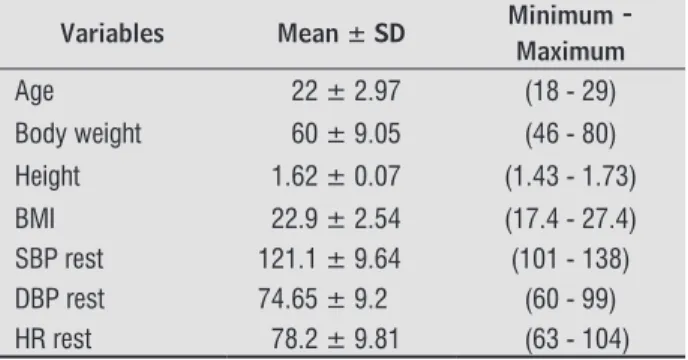
The demographic characteristics of the sample are presented in Table 1.
No changes were observed in the SBP or DBP, be-fore, during and immediately after the completion of the Manual Lymphatic Drainage, p = 0.57 and p = 0.20 respectively (Figure 1).
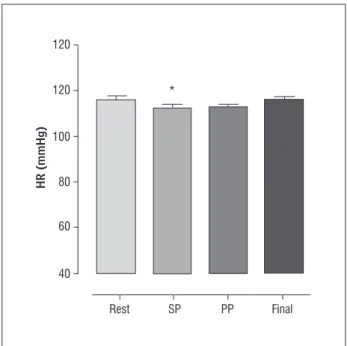
Conversely, after the final rest of 15 minutes in
a sitting position, the HR was higher than after the completion of the MLD in the SP (72 ± 1.9 bpm vs. 76 ± 1.9 bpm; p = 0.002) – Figure 2.
The following protocol guided the procedure: 1) with the patient in the supine position the thera-pist started with call-up of the axillary and brachial nodes of the breast, supra-mammary reabsorption, call-up of axillary and brachial nodes of the breast, infra-mammary reabsorption, call-up of axillary and brachial nodes of the breast, reabsorption diagonal-ly above the breast, call-up of axillary and brachial nodes of the breast, reabsorption diagonally below the breast, call-up of axillary and brachial nodes of the breast, reabsorption of upper abdomen from medial to brachial ascending diagonally, call-up of axillary and brachial nodes of the breast. Subsequently, ingui-nal call-up, lower abdomen reabsorption from
bra-chial to medial descending diagonally from the flanks
to the pubis and inguinal call-up were performed. In the upper limbs (ULs), call-up was performed for the axillary, deltoid, arm, elbow, forearm, palm,
and finger nodes, with reabsorption of the fingers,
forearm, palm and back of the hand, call-up of the elbow, reabsorption of the arm, and call-up of the axillary and deltoid nodes. In the lower limbs (LLs) call-up was performed for the inguinal, thigh, popli-teal fossa, leg, malleoli, sole of the foot and toe nodes, with reabsorption of the toes, sole and instep of the foot, call-up of the malleoli, reabsorption of the in-ner anterior region of the leg, call-up of the popliteal fossa, reabsorption of the inner region of the thigh, and call-up the inguinal nodes. 2) With the patient in the prone position the therapist started with call-up of the malleolar, inguinal, popliteal fossa, and calf nodes, reabsorption in the calf, call-up of popliteal fossa, inguinal, and posterior thigh, reabsorption of the posterior thigh, call-up of inguinal, iliac crest nodes, call-up of the gluteal nodes, reabsorption in the gluteal nodes, call-up in the inguinal, iliac crest nodes, call-up of brachial breast, axillary, and scapu-lar nodes, reabsorption in the dorsal region, call-up of brachial breast, axillary and shoulder nodes. Each
session lasted for one hour and fifteen minutes, with the technique application time being fifty minutes.
Evaluation of heart rate and blood pressure
Blood pressure was measured using a validated and calibrated digital sphygmomanometer OMRON - HEM 710 INT (11). This was carried out using the left arm of the volunteer after the 10 minutes initial rest period, at the moment before the change of position,
Table 1 - Demographic characteristics of the sample
Variables Mean ± SD Minimum - Maximum
Age 22 ± 2.97 (18 - 29)
Body weight 60 ± 9.05 (46 - 80) Height 1.62 ± 0.07 (1.43 - 1.73) BMI 22.9 ± 2.54 (17.4 - 27.4) SBP rest 121.1 ± 9.64 (101 - 138) DBP rest 74.65 ± 9.2 (60 - 99) HR rest 78.2 ± 9.81 (63 - 104)
45
Figure 1 - Behavior of the systolic and diastolic blood pres-sure before, during and immediately after MLD
Note: Systolic blood pressure (SBP); diastolic blood pressure (DBP); supine position (SP); prone position (PP).
Figure 2 - Behavior of heart rate before, during and imme-diately after MLD
Note: Supine position (SP); prone position (PP); heart rate (HR).
DBP (mmHg)
SBP (mmHg)
80
60
40
20
0
120
100
80
60
40
Rest SP PP Final
HR (mmHg)
120
* 120
100
80
60
40
Rest SP PP Final
Discussion
This study contributes to the body of knowledge by addressing the behavior of cardiovascular vari-ables in young, healthy women that underwent a MLD session employing the Leduc technique. The behav-ior of the BP during MLD is a factor discussed in the clinical practice and some professionals consider it to be a contraindication to performing the technique in patients with systemic hypertension, as it is believed that MLD can further enhance the BP values after its performance, however, little evidence directly ad-dressed the issue. In the present study, the behavior
of BP and HR was verified during and immediately
after a MLD session.
Changes in BP during and after a MLD session can
be justified by the physiology involved in the tech
-nique and in the responses to the application of this procedure. Primarily, the physiological function of the lymphatic system needs to be addressed, as this
is responsible for collecting the interstitial fluid and
relocating it into the blood-vascular system (4). The MLD technique uses graded and constantly chang-ing pressures, thereby mimickchang-ing the contractions of the smooth muscle of the lymphatic vessels and accompanying their rhythm (13).
Manual lymphatic drainage increases lymphatic
transport, helping in the removal of interstitial fluid;
the method consists of a pressure phase followed by a relaxation phase (14). The lymphatic system has several important functions, such as the control of macromolecular homeostasis, absorption of lipids,
immune function and the control of interstitial fluids (15). Its main role is to remove fluid and proteins
from the interstitial spaces, and the elimination of these elements is only possible through the lymphatic capillary membrane, as this is more permeable than the blood capillary membrane (16). As it is a second-ary blood circulation route, it permits the draining
of a filtrate from the blood, called lymph, from in
-terstitial space into the blood vascular system and is responsible for transporting the lymph from the periphery to the center in one direction (16, 17).
A second point to be addressed is the function of the MLD technique, which consists of directing the
fluid from the interstitial space to the drainage center,
through specialized kinesic maneuvers called “Manual Lymphatic Drainage”. This external compression is responsible for promoting a pressure differential
46
contained in a lymph vessel, allowing a reduction of pressure within the lymphatic vessel and aiding the entry of the excess liquid contained in the interstitium into the interior through the pressure difference (4).
The maneuvers are performed rhythmically, slow-ly and gentslow-ly in the direction of the slow-lymphatic circula-tion and about the lymph nodes (18). The
intersti-tial fluid removed and relocated into the lymphatic
vessels, is directed to the vascular system, in turn increasing the volume in the intravascular bed, which can interfere with the BP and HR values so that the BP is expressed by the cardiac output and peripheral vascular resistance (19). Any change in these com-ponents can interfere with the pressoric levels and during MLD changes in cardiac output are possible.
In the present study no changes in BP values were observed when the values obtained while resting, during the MLD, and after the procedure were com-pared, as presented in (Figure 1). Most probably no differences were found because all the study volun-teers were healthy and the cardiac and vascular com-ponents that generate and BP and are controlled by complex mechanisms were healthy, thereby allowing the regulation and maintenance of the variation of the BP from moment to moment, thus controlling the size
of the vessels, the vascular reactivity, the fluid dis
-tribution into and out of the vessels and the cardiac output (20). In addition, the BP is not governed by a single system, but by an interrelationship of
mecha-nisms that perform specific functions, divided into
fast and slow control mechanisms (21-23).
Fast control is performed by the baroreflex that
is activated by arterial baroreceptors, which are mechanoreceptors (24). The arterial baroreceptors constitute one of the most important BP control mechanisms, these being free, branched nerve end-ings, which are primarily in the carotid sinus and the aortic arch walls (25). For baroreceptor activation to take place, a distension of the vascular walls has to occur, with them then acting as mechanoreceptors
that regulate the BP through the reflex regulation
of HR, cardiac output, myocardial contractility, and peripheral vascular resistance (26).
In the present study there may have been an in-crease in intravascular volume and therefore car-diac output, thus promoting the stimulation of the baroreceptors, with these acting to maintain the SBP and DBP values of the volunteers, also considering that the subjects were healthy and most probably had healthy systems. In the study by Nakamura et al.
(10) where, in a group of eight elderly women with the BP measured using an aneroid sphygmomanom-eter, there were no changes in BP values after the MLD sessions.
Another important factor that should be taken into consideration is the urge to urinate after the MLD technique, which, according to Krupek et al. (12), is commonly reported by individuals who perform the procedure. In this study the amount of urine pre and post MLD was compared and, after analysis of the results, an increase in urine after the MLD ses-sion compared to the urine sample before MLD was
observed, however, without statistical significance.
In the present study, some participants presented this need for urination, which can be related to the inhibition of ADH (antidiuretic hormone). The main role of this hormone is to conserve body water and
regulate the tonicity of the bodily fluids, with its ac
-tion occurring in the renal collecting tubules and ducts. Minimum amounts are required for the an-tidiuretic action, however, when ADH is present in higher amounts, it causes a powerful constriction of the arterioles of the entire body and consequently the increase in BP (27).
The urge to urinate present in some volunteers may be related to the inhibition of this hormone, considering that in circumstances where there is a low plasma concentration caused by the increase in
circulating fluid possibly generated by MLD, there is
less absorption of water into the renal distal collec-tor tubules, promoting the excretion of urine for the maintenance of the plasma concentration, which can
thus influence the reduction of intravascular volume
and maintenance of the pressoric values (28, 29). The other variable analyzed in this study was the HR, which underwent minor changes during the MLD, showing statistical differences between the HR in the
final rest period when compared to the HR at the end of the MLD in the SP. After 15 minutes of final resting
47
with the patient sitting, with this change of the position of the volunteer being required so that after a MLD session the patient did not remain lying down, thereby increasing the external validity of the study.
The study of Leduc et al. (5), however, presented a
significant reduction in HR after MLD when compared
to the HR prior to the MLD, which may have been
justified by the application of the technique only in
the lower limbs in nine patients with congestive heart failure and edema of the lower limbs. This result was also reported by Nakamura et al.(10), who performed the technique with 8 elderly people, where the HR af-ter the MLD decreased when compared to the HR
pri-or to MLD, however, without statistical significance.
Furthermore the regions in which the technique was applied were not described in the study, which may
have influenced the results when compared with the
present study, in which the technique was applied to the entire body except the face.
Conclusion
In the present study it was found that during a
MLD session with healthy young women, significant
hemodynamic changes do not occur, showing that this technique is safe from the cardiovascular point of view. The changes found in the heart rate of the volunteers after MLD, despite presenting statistical differences, are not relevant from a clinical point of view. Further studies with MLD over the entire
body, in specific groups of patients with cardiovas
-cular diseases or risk factors for their development, for example, systemic hypertension and congestive
heart failure, are needed to affirm the safety of the
MLD technique.
References
1. Godoy JMP, Godoy MFG. Drenagem linfática manual: novo conceito. J Vasc Br. 2004;3(1):77-80.
2. Veiros I, Nunes R, Martins F. Complicações da mas-tectomia: linfedema do membro superior. Acta Med Port. 2007;20:335-40.
3. Meirelles MCCC, Mamede MV, Souza L, Panobianco MS. Avaliação de técnicas fisioterapêuticas no tratamento do linfedema pós-cirurgia de mama em mulheres. Rev Bras Fisioter. 2006;10(4):393-9.
4. Piccinin AM, Mello PB, Bem DM, Silva A, Rosa PV. Redução do edema em membros inferiores através da drenagem linfática manual: um estudo de caso. Rev Inspirar Mov Saude. 2009;1(2):10-4.
5. Leduc O, Crasset V, Leleu C, Beptiste N, Koziel A, Dela-hie C, et al. Impact of Manual Lymphatic Drainage on hemodynamic parameters in patients with heart failure and lower limb edema. Lymphology. 2011; 44(1):13-20.
6. Leal NFBS, Carrara HHA, Vieira KF, Ferreira CHJ. Trata-mentos fisioterapêuticos para o linfedema pós-câncer de mama: uma revisão de literatura. Rev Latino-am Enfermagem. 2009;17(5):730-6. doi: 10.1590/S0104- 11692009000500021.
7. Guirro E, Guirro R. Fisioterapia dermato-funcional. 3. ed. São Paulo: Manole; 2004.
8. Soares MM, Sancho AG, Lucena RS, Silva DD. Aborda-gem fisioterapêutica no linfedema secundário pós -vulvectomia com linfadenectomia inguinal. Revista Cient HCE. 2007;3(2):60-9.
9. Herpertz U. Edema e drenagem linfática. 2. ed. São Paulo: Roca; 2006.
10. Nakamura CM, Vanini TM, Chingui LJ, Silva CA. Aval-iação de repercussões cardiovasculares da drena-gem linfática manual em mulheres idosas. Anuário da Produção de Iniciação Científica Discente. 2010; 13(17):43-51.
11. Coleman A, Freeman P, Steel S, Shennan A. Validation of the Omron MX3 Plus oscillometric blood pressure monitoring device according to the European Society of Hypertension international protocol. Blood Press Monit. 2005;10(3):165-8.
12. Krupek T, Oliveira LP, Moraes LRS, Vizoni SL. Análise Laboratorial de urina pós drenagem linfática Saud Pesq. 2012;5(1):75-85.
13. Ornelas FA, Rodriguez JRP, Uemura G. Análise sensitiva convencional no pós-cirúrgico de câncer de mama. Rev Bras Mastol. 2009;19(2):53-9.
48
15. Rezende LF, Pedras FV, Ramos CD, Gurgel MSC. Avalia-ção das compensações linfáticas no pós-operatório de câncer de mama com dissecção axilar através da linfocintilografia. J Vasc Bras. 2008;7(4):370-5. doi: 10.1590/S1677-54492008005000002.
16. Rezende LF, Pedras FV, Ramos CD, Gurgel MSC. Função Linfática do membro superior no pré-operatório de câncer de mama. Rev Assoc Med Bras. 2011;57(5):540-4. doi: 10.1590/S0104-42302011000500012.
17. Ridner SH, Poage-Hooper E, Kanar C, Doersam JK, Bond SM, Dietrich MS. A pilot randomized trial evaluating low-level laser therapy as an alternative treatment to Manual Lymphatic Drainage for breast cancer-related lymphedema. Oncol Nurs Forum. 2013; 40(4):383-93. doi: 10.1188/13.ONF.383-393.
18. Antonio FE, Santos PS, Tamara MV, Chingui LJ, Silva CA. Avaliação de parâmetros bioquímicos na drena -gem linfática manual em mulheres idosas. Anuário da Produção de Iniciação Científica Discente 2010; 13(17):53-61.
19. Brandão DSN, Almeida AF, Silva JC, Oliveira RGCQ, Araújo RC, Pitangui ACR. Avaliação da técnica de drenagem linfática manual no tratamento do fibro edema gelóide em mulheres. ComScientiae Saúde. 2010;9(4):618-24.
20. Luna RL. Conceituação da hipertensão arterial e sua importância epidemiológica. Rev SOCERJ. 2002; 15(4):203-9.
21. Wehwein EA, Joyner MJ. Regulation of blood pres-sure by the arterial baroreflex and autonomic nervous system. Handb Clin Neurol. 2013;117:89-102. doi: 10.1016/B978-0-444-53491-0.00008-0.
22. Okutucu S, Karakulak UN, Kabakçi G. Circadian blood pressure pattern and cardiac autonomic functions: different aspects of same pahophysiology. Anadolu Kardivol Derg. 2011;11(2):168-73.
23. Estañol B, Porras-Betancourt M, Sanchez-Torres Z, Martinez-Memije R, Infante O, Senties-Madrid H. Neu-ral control of the peripheNeu-ral circulation and blood pressure. Arch Cardiol Mex. 2009;2(Suppl 2):109-16.
24. Fazan VPS. Nervo depressor aórtico: importância dos estudos morfológicos na compreensão dos mecanis-mos fisiológicos do controle da pressão arterial? Rev Bras Hipertens. 2002;9(4):413-5.
25. Haibara AS, Santos RAS. Descobrimento e importân -cia dos barorrecptores. Rev Bras Hipertens. 2000; 7(2):113-5.
26. Wehrwein EA, Joyner MJ, Hart ECJ, Wallin BG, Karlsson T, Charkoudian N. Blood pressure regulation in humans: calculation of an “error signal” in control of sympa-thetic nerve activity. Hypertension. 2010;55(2):264-69. doi: 10.1161/HYPERTENSIONAHA.109.141739.
27. Canali ES, Kruel LFM. Respostas hormonais ao exer-cício. Rev Paul Educ Fís. 2001;15(2):141-53.
28. Naves LA, Vilar L, Costa ACF, Domingues L, Casulari LA. Distúrbios na secreção e ação do hormônio antidi-urético. Arq Bras Endocrinol Metab. 2003;47(4):467-81. doi: 10.1590/S0004-27302003000400019.
29. Irigoyen MC, Lacchini S, De Angelis K, Michelini LC. Fisiopatologia da hipertensão: o que avançamos? Rev Soc Cardiol Estado de São Paulo. 2003;13(1):20-45.
Received: 11/10/2013
Recebido: 10/11/2013
Approved: 06/21/2014