ISSN 1806-3713 © 2016 Sociedade Brasileira de Pneumologia e Tisiologia
http://dx.doi.org/10.1590/S1806-37562016000000003
Idiopathic pulmonary ibrosis
can be a transient diagnosis
Martina Rodrigues de Oliveira1, Daniel Antunes Silva Pereira1,
Olívia Meira Dias1, Ronaldo Adib Kairalla1, Carlos Roberto Ribeiro Carvalho1,
Bruno Guedes Baldi1
1. Divisão de Pneumologia, Instituto do Coração – InCor – Hospital das Clínicas, Faculdade de Medicina, Universidade de São Paulo, São Paulo (SP) Brasil.
TO THE EDITOR:
Usual interstitial pneumonia (UIP) can be accompanied by various clinical conditions, probably the most important
of which is idiopathic pulmonary ibrosis (IPF), although the exact incidence and prevalence of IPF, in Brazil or
elsewhere, remains unknown.(1-3) The diagnosis of IPF can be established only after the exclusion of other diseases potentially associated with the UIP pattern, such as chronic hypersensitivity pneumonitis, connective
tissue diseases, especially rheumatoid arthritis, drug
toxicity, and asbestosis.(1,2,4,5) The association between antineutrophil cytoplasmic antibody (ANCA)-positive
vasculitis and interstitial lung disease (ILD) has recently been described, including another possible etiology for
the UIP pattern. Here, we report the case of a patient
with an initial diagnosis of IPF who later developed
ANCA-positive vasculitis.
A 62-year-old nonsmoking male patient, a bricklayer, presented with a one-year history of dry cough and slowly progressive dyspnea, classiied as grade 2 on the modiied Medical Research Council scale. He was being treated with omeprazole, bromopride, and simvastatin for gastroesophageal relux disease and dyslipidemia. Pulmonary auscultation revealed crackles at both lung
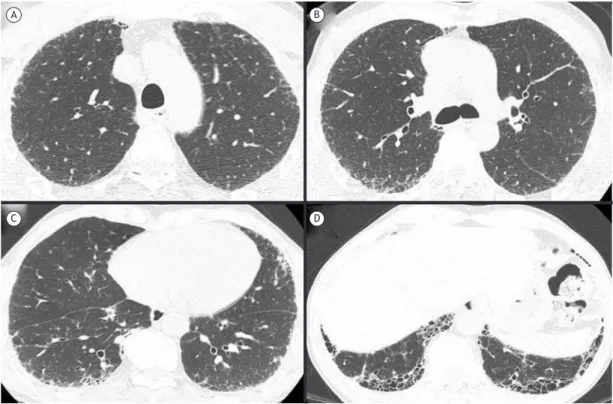
bases, and the SpO2 was 97% on room air. The indings
of an HRCT scan of the chest (Figure 1) were consistent
with a UIP pattern. Pulmonary function tests revealed
a mild restrictive pattern (FVC, 78% of predicted/3.6 L; FEV1, 81% of predicted/2.8 L; FEV1/FVC ratio, 0.78; and total lung capacity, 75% of predicted/5.25 L) with normal DLCO (92% of predicted/27.6 mL/min/mmHg). During a six-minute walk test, there was no desaturation
(minimum SpO2, 96%), and the six-minute walk distance
was 548 m.
The results of laboratory tests were normal, and
autoantibody tests were negative, including tests for
rheumatoid factor, antinuclear antibodies, anti-Jo-1,
anti-Scl-70, and ANCA. The indings of a transthoracic echocardiogram were also normal. A surgical lung biopsy
performed at another institution was reviewed and was
found to show the UIP histopathological pattern, conirming the diagnosis of IPF. At that time, the patient was still under treatment for gastroesophageal relux disease.
After one year of clinical stability, the patient was admitted to the hospital with a one-month history of
daily fever (38°C) and hematuria, together with swelling and purple lesions in the lower limbs. Laboratory tests revealed anemia (hemoglobin, 9.5 g/dL), elevated C-reactive protein (155 mg/L; reference range, < 5 mg/L) and elevated creatinine (4.5 mg/dL; estimated
creatinine clearance, 14 mL/min). Urinalysis showed
hematuria, proteinuria, and leukocyturia. There were
also a mild reduction in complement C3 (86 mg/dL; reference range, 90-180 mg/dL) and C4 (9.6 mg/dL, reference range, 10-40 mg/dL), as well as positivity for myeloperoxidase-ANCA (1/320), antinuclear antibodies (1/320, with ine-speckled nuclear staining pattern), and rheumatoid factor (97 IU/mL).
A new kidney biopsy was performed, and the
anal-ysis of the biopsy sample conirmed the diagnosis of pauci-immune crescentic glomerulonephritis associated with microscopic polyangiitis (MPA), and a skin biopsy
of the lower limbs showed leukocytoclastic vasculitis.
Methylprednisolone pulse therapy was administered at 1 g/day for three days, after which the patient was started on prednisone at a dose of 1 mg/day that was gradually tapered thereafter. Subsequent treatment with mycophenolate (1.5 g/day) produced gradual clinical
improvement. After two years of treatment, the patient
continued to have mild dyspnea (modiied Medical Research Council scale grade 1), to show normal kidney function, and to test negative for ANCA, and well as to have stable HRCT and pulmonary function test indings.
In patients with ANCA-positive vasculitis, particularly
MPA, ILD is an uncommon inding and usually affects
older men, with myeloperoxidase-ANCA and a UIP pattern
on histopathology. However, the pathophysiology of the association of ILD and ANCA-positive vasculitis has not
been fully elucidated.(6)
Recent studies have demonstrated that there is a subset of IPF patients who are ANCA-positive at diagnosis or who convert to ANCA positivity during follow-up and subsequently develop MPA.(6,7) Kagiyama et al.(7)
evaluated ANCA positivity and the incidence of MPA in 504 patients with IPF. The authors found that 36 (7%) of the patients were ANCA-positive at diagnosis of IPF. Of the 264 patients who were subsequently tested, 29 (11%) converted to ANCA positivity during the irst ive
years of follow-up. Of the 35 patients who were either
ANCA-positive at diagnosis or subsequently converted to ANCA positivity, 9 were diagnosed with MPA.
Two drugs, nintedanib and pirfenidone, both of which slow the decline in lung function, were recently approved for the treatment of IPF.(8,9) However, to date, there is
no recommendation regarding the use of those drugs in patients with ILD associated with ANCA-positive vasculitis, in whom it has been suggested that the use of
corticosteroids plus cyclophosphamide or rituximab is a J Bras Pneumol. 2016;42(1):74-75
74
Oliveira MR, Pereira DAS, Dias OM, Kairalla RA, Carvalho CRR, Baldi BG
better approach.(6) The combination of mycophenolate and corticosteroids can also be considered.
The prognosis of patients with ILD associated with
ANCA-positive vasculitis has not been fully established.
In a study of 49 such patients (82% with MPA), mortality was 34% in the irst 60 months after the diagnosis. In a review of 65 patients (85% with a UIP pattern) that were followed for 45 months, 35% showed progression of ILD and the remaining 65% showed stability or
improvement,(6) which suggests that the prognosis of
ILD associated with ANCA-positive vasculitis is better than is that of IPF.(6)
In conclusion, this report underscores the potential
for the occurrence of ILD, including a UIP pattern, in
patients with ANCA-positive vasculitis. In that form of
vasculitis, interstitial lung involvement can precede
systemic manifestations and patients can be initially
diagnosed with IPF. We emphasize the importance of an extensive etiological investigation of patients who
show a UIP pattern, especially of those in whom the
disease has an indolent course. The diagnosis of a secondary cause could facilitate the deinition of the best therapeutic strategy and the determination of the prognosis in such patients.
A
C
B
D
Figure 1. Chest HRCT scans showing indings consistent with the pattern of usual interstitial pneumonia: A) discrete
subpleural reticular opacities in the upper lobes; B) subpleural reticular opacities and discrete areas of ground-glass abnormalities at the level of the carina; C) peripheral reticular opacities, traction bronchiolectasis, and discrete areas of ground-glass abnormalities predominantly in the lower lobes; and D) peripheral honeycombing and traction bronchiolectasis in the lower lobes.
REFERENCES
1. Raghu G, Collard HR, Egan JJ, Martinez FJ, Behr J, Brown KK, et
al. An oficial ATS/ERS/JRS/ALAT statement: idiopathic pulmonary ibrosis: evidence-based guidelines for diagnosis and management. Am J Respir Crit Care Med. 2011;183(6):788-824. http://dx.doi. org/10.1164/rccm.2009-040GL
2. Baddini-Martinez J, Baldi BG, Costa CH, Jezler S, Lima MS, Ruino R. Update on diagnosis and treatment of idiopathic pulmonary ibrosis. J Bras Pneumol. 2015;41(5):454-66.
http://dx.doi.org/10.1590/S1806-37132015000000152
3. Baddini-Martinez J, Pereira CA. How many patients with idiopathic pulmonary ibrosis are there in Brazil? J Bras Pneumol. 2015;41(6):560-1. http://dx.doi.org/10.1590/S1806-37562015000000165
4. Wuyts WA, Cavazza A, Rossi G, Sverzellati N, Spagnolo P. Differential diagnosis of usual interstitial pneumonia: when is it truly idiopathic? Eur Respir Rev. 2014;23(133):308-19. http://dx.doi. org/10.1183/09059180.00004914
5. Smith M, Dalurzo M, Panse P, Parish J, Leslie K. Usual interstitial pneumonia-pattern ibrosis in surgical lung biopsies. Clinical, radiological and histopathological clues to aetiology.
J Clin Pathol. 2013;66(10):896-903. http://dx.doi.org/10.1136/
jclinpath-2013-201442
6. Comarmond C, Crestani B, Tazi A, Hervier B, Adam-Marchand S, Nunes
H, et al. Pulmonary ibrosis in antineutrophil cytoplasmic antibodies (ANCA)-associated vasculitis. Medicine (Baltimore). 2014;93(24):340-9. http://dx.doi.org/10.1097/MD.0000000000000217
7. Kagiyama N, Takayanagi N, Kanauchi T, Ishiguro T, Yanagisawa T, Sugita Y. Antineutrophil cytoplasmic antibody-positive conversion and microscopic polyangiitis development in patients with idiopathic pulmonary ibrosis. BMJ Open Respir Res. 2015;2(1):e000058. http://dx.doi.org/10.1136/bmjresp-2014-000058
8. King TE Jr, Bradford WZ, Castro-Bernardini S, Fagan EA, Glaspole I,
Glassberg MK, et al. A phase 3 trial of pirfenidone in patients with idiopathic pulmonary ibrosis. N Engl J Med. 2014;370(22):2083-92. http://dx.doi.org/10.1056/NEJMoa1402582
9. Richeldi L, du Bois RM, Raghu G, Azuma A, Brown KK, Costabel U, et al. Eficacy and Safety of nintedanib in idiopathic pulmonary ibrosis. N Engl J Med. 2014;370(22):2071-82. http://dx.doi.org/10.1056/
NEJMoa1402584