CEMENT BASED FIBER-REINFORCED MORTAR: THE FIBER
INFLUENCE ON THE MORTAR PERFORMANCE
Cristiana Gonilho-Pereira*1, Paulina Faria2, Raul Fangueiro3, Pedro Vinagre1 e Ana Martins1 1
Polythecnic Institute of Setubal (ESTB) - Setúbal, Portugal 2
Nova University of Lisbon, Faculty of Science and Technology - Caparica, Portugal 3
University of Minho, Departament of Textil Engineering - Guimarães, Portugal
*Email: [email protected]
ABSTRACT
The extraction and processing of natural resources is accompanied by a significant amount of waste materials - only 1/3 of extracted raw material is used to produce industrial output; the rest 2/3 turn into waste materials and by-products (AABMCI, 2009). The textile sector is responsible for a significant percentage of the waste material produced. Nevertheless, it is also the textile sector the one that presents successful by-products and/or second-line products. Although the usage of waste fibrous materials in the building construction industry is nowadays a reality, namely in the production of thermal and acoustic insulation panels, the disposal of waste materials in landfills is still reality common practice. Waste fibrous materials are accumulated at textile factories and the technical challenge is the search for new applications for waste fibers with more added values. An interesting application for the waste fibers seems to be the reinforcement of mortars for masonry applications.
The selection of appropriate mortar mixtures is an important research problem once three main factors should be considered in their design - compatibility, durability and economy. Fiber reinforced cement based mortars have been suggested as one of the most effective methods to improve performance behavior, namely: mechanical (Segre et al, 1998); shrinkage, expansion and related phenomena which lead to cracks (Veiga, 1997), (Puertas et al, 2003); and durability (Puertas et al, 2003). Fibers present the ability to act as a bridge between the grains of the cement mortar matrix. When the fibers are uniformly distributed into the mortar, plastic shrinkage may be minimized and micro cracks are prevented from developing into macro cracks. Therefore the consequent strength reduction, water intake increase and subsequent decay of the mortar by freezing–thawing cycles, and aesthetic involvements may be avoided.
In the present paper, the behavior of cement-based mortars reinforced with waste fibers is described. An experimental work is presented which main objective is the evaluation of the influence of the percentage of fibers usage on the performance of cement based fiber-reinforced mortars.
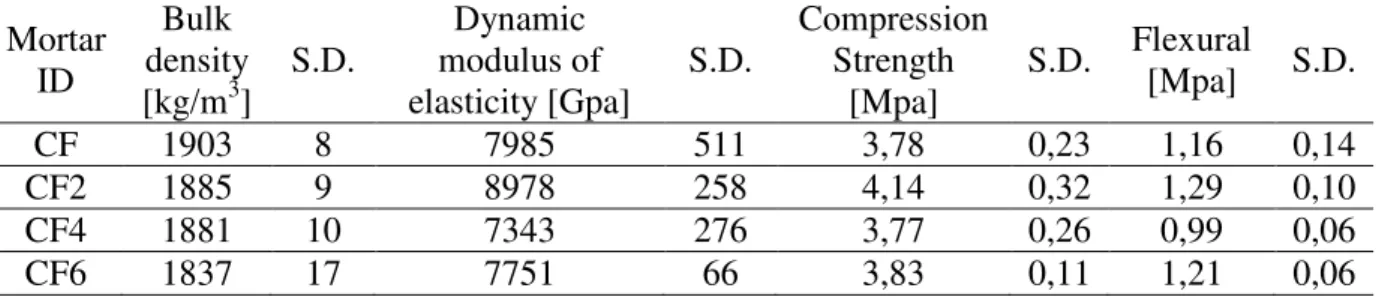
The mixture of the mortars components was mechanical and the procedure was maintained constant between mixtures. Despite the percentage of waste fibers added, the same quantity of water was added. Special attention was paid to the waste fibers in order to guarantee their correct dispersion. The waste fibers were dispersed in the mixing water prior to enter in the mixer recipient. Mortar samples were produced using prismatic metallic moulds 40x40x160 mm and mechanical compaction and were subjected to 95 ± 5% relative humidity, at 20 ± 3 ºC temperature until age test – 30 days. Mortars performance evaluation was carried out through flow consistency, bulk density, dynamic modulus of elasticity, flexural and compressive strength tests and test results are presented in Table 2. Mortars presented flow consistency from 123,13mm (CF6) to 145,02 (CF2).
Table 1. Mortars composition
Mortar ID Volumetric composition Waste fibers [%] Mortar Mix
CF
1:6
0 2 volumes of coarse sand
1 volume of fine sand CEM II/B-L 32,5N Water/Binder =0,7
CF2 0,125
CF4 0,25
CF6 0,5
Table 2. Mortars tests results (average values and standard deviation- S.D.)
Mortar ID
Bulk density [kg/m3]
S.D.
Dynamic modulus of elasticity [Gpa]
S.D.
Compression Strength
[Mpa]
S.D. Flexural
[Mpa] S.D.
CF 1903 8 7985 511 3,78 0,23 1,16 0,14
CF2 1885 9 8978 258 4,14 0,32 1,29 0,10
CF4 1881 10 7343 276 3,77 0,26 0,99 0,06
CF6 1837 17 7751 66 3,83 0,11 1,21 0,06
The addition of this type of fibers can optimize the mortars characteristics and complementary mortars will be made with other percentages of fibers addition. Also complementary tests will be made in order to evaluate other mechanical (like adherence to substrate) and physical characteristics (in terms of water capillary and drying).
REFERENCES
AABMCI, Overconsumption? Our use of the world’s natural resources, Working Committee “Forum mineralische Rohstoffe” of the Austrian Association for Building Materials and Ceramic Industries, Austria (2009).
Puertas, F., Amat, T., Fernandez-Jimenez A., and Vazquez, T., Mechanical and durable behaviour of alkaline cement mortars reinforced with polypropylene fibres, Cement and Concrete Research 33 (2003), pp. 2031–2036.
Segre, N., Tonella E. ,and Joekes, I. ,Evaluation of the stability of polypropylene fibers in environments aggressive to cement-based materials, Cement and Concrete Research 28 (1998), pp. 75–81.
Toledo, R.D., and Sanjuan, M.A., Effect of low modulus sisal and polypropylene fibre on the free and restrained shrinkage of mortars at early age, Cem Concr Res 29 (1999), pp. 1597– 1604.