DEVELOPM ENTAL STUDY OF EARLY POSTURE
CONTROL IN PRETERM AND FULLTERM INFANTS
Eliane Mew es Gaet an
1, Maria Valeriana L. Moura-Ribeiro
2ABSTRACT - In a prospect ive st udy, 10 infant s born bet w een 32 t o 36 w eeks of gest at ion and 10 infant s born at fullt erm w ere observed on day 15, and in mont hs 1, 2 and 3. The invest igat ion show ed t hat t he development of early post ural cont rol t akes place in a sequent ial w ay in pret erm infant s, similar t o t hat of in fullt erm infant s. How ever, some movement component s for t he acquisit ion of mot or abilit ies show ed a different t rend in t he development of pret erm infant s w hen compared t o fullt erm infant s: t he onset for t he acquisit ion of t he ext ensor and flexor pat t erns w as slow er and t he dist ribut ion of t he load bearing w as less mat ure.
KEY WORDS: early post ure cont rol, pret erm and t erm infant s, movement component s, load bearing.
Estudo do desenvolvimento do controle postural precoce em crianças pré-termo e a termo
RESUM O - Em um est udo prospect ivo 10 crianças nascidas com idade ent re 32 e 36 semanas de gest ação (corrigida a idade gest acional) e 10 crianças a t ermo foram observadas no 15o dia, 1, 2 e 3 meses de vida. Foi const at ado que o desenvolviment o do cont role post ural precoce evolui de forma seqüencial em crianças pré-t ermo, semelhanpré-t e ao das a pré-t ermo. Enpré-t repré-t anpré-t o, alguns componenpré-t es de movimenpré-t os, para aquisição das habilidades mot oras, most raram t endência diferenciada no desenvolviment o de crianças pré-t ermo, quando comparadas com as a t ermo: o início da aquisição do padrão ext ensor e flexor acont eceu de maneira mais lent a e a descarga de peso foi menos madura.
PALAVRAS-CHAVE: controle postural precoce, pré-termo e a termo, componentes de movimento, descarga de peso.
The assessment of mot or development during t he first t hree mont hs of life in infant s born at t erm, and mainly in t hose born at pret erm, is st ill a chal-lenge for physiot herapist s. According t o Campbell, pediat ric t herapist s are looking for t est s t o evaluat e t he qualit y of movement , post ural cont rol and align-ment , balance and coordinat ion, and funct ional abi-lit y measures t o provide informat ion based on t he evolut ion of infant s w it h a slow er movement deve-lopment rat e1.
The t eam at Chailey Herit age Clinical Service, En-gland, w hile invest igat ing t he mot or behavior of nor-mal children t o t he point t hey could sit indepen-dent ly, iindepen-dent ified and described sequent ial levels of early post ural cont rol for lying in supine and prone posit ions and for sit t ing, creat ing t he Chailey Levels of Abilities scale2,3. This instrument takes into account
t hat t he mot or development depends on t he child’s behavioral st at e, t he surrounding environment , bio-mechanics and t he mot or t ask it self. The same eva-luation w as carried out in children w ith cerebral palsy4.
Taking int o considerat ion t hat t he use of t his instrument of evaluation could meet the expectations
of an evolut ionary st udy of t he mot or development , a longitudinal follow up w as carried out w ith a group of healt hy pret erm and fullt erm infant s, during t heir first t hree mont hs of age.
M ETHOD
The st udy group consist ed of t en pret erm healt hy in-fant s, gest at ional age bet w een 32 and 36 w eeks (mean age 33 w eeks 6 days) and 10 fullt erm infant s used as t he cont rol group, aged bet w een 38 w eeks 2 days and 41 w eeks 1 day (mean age 39 w eeks 4 days); all of t hem born at t he Universidade Est adual de Londrina Hospit al in Londrina, Paraná, Brazil. The gest at ional age w as det er-mined by eit her t he Capurro met hod5 or t he New Ballard met hod6 and correct ed at 40 w eeks for t he pret erm group. Birt h w eight of t he pret erm infant s varied from 1490g t o 2280g (mean w eight 1833.50g) and t hat of t he fullt erm from 2910g t o 4040g (mean w eight 3404g). One pret erm infant w as ident ified as small for it s gest at ional age and t hree fullt erm infant s w ere classified as big. Out of 20 infant s, 16 (80%) w ere considered adequat e t o t heir gesta-tional age. None of the preterm infants required mecha-nical ventilation. Average length of stay in hospital w as 21.9 days for the preterm and 2 days for the fullterm infants.
Depart ament o de Fisiot erapia da Universidade Est adual de Londrina, Londrina PR, Brasil: 1M est re, Professor Assist ent e, Disciplina de
Fisiot erapia Aplicada à Pediat ria; 2Professor Associado, Disciplina de Neurologia Infant il, Depart ament o de Neurologia, Faculdade de
Ciências M édicas, Universidade Est adual de Campinas, Campinas SP, Brasil.
Received 25 February 2002, received in final form 12 June 2002. Accept ed 26 June 2002.
Infants w ith periventricular hemorrhage and leukomala-cia, infections, genetic abnormalities and malformations were excluded from the study. All infants w ere submitted to the Neurological Developmental Assessment7 in order to con-firm w hether their development w as w ithin normal limits.
The met hodological foundat ion of t his st udy comes from w orks by Pount ney et al.3 and Green et al.4, follow ing t he Chailey Levels of Abilit y assessment . In t his scale, t he evolut ion of early post ural cont rol is show n t hrough six levels of abilit ies for each one of t he supine and prone posit ions, and seven levels for sit t ing. These levels are set s for t he observat ion of spont aneous act ivit ies by t he infant , focusing on changes in posit ion and movement s of t he shoulder girdle and pelvis, head and limbs as w ell as t heir relat ion w it h changes in load bearing, abilit y t o m ove w it hin, int o and out of posit ion.
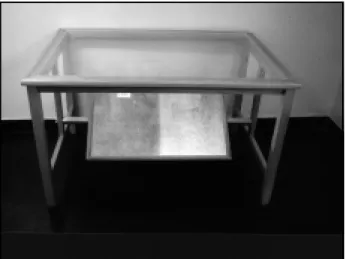
All infant s w ere phot ographed and videorecorded at t he research laborat ory of t he Universit y Hospit al Physio-t herapy DeparPhysio-t menPhysio-t . A special Physio-t able (Fig 1) w as designed for t he phot ographic sessions, follow ing t he Chailey Heri-t age model3. The t able, w it h an acrylic t op and a mirror angled at 45o show s t he areas of body cont act w here t he w eight bearing occurs w hen t he infant is on t he t able lying in supine and prone posit ions and sit t ing. For t he recording session, a cushioned and st urdy plat form w as used and t he infant s w ere evaluat ed in t he follow ing posi-t ions: lying in prone and supine, pulled posi-t o siposi-t and siposi-t posi-t ing. Room t emperat ure ranged from 26o t o 30o.
The most mat ure abilit y present ed for each posit ion (phot os or videos) w as considered and a grade w as assig-ned t o each of t hem. All t he observat ions w ere made w hen t he infant s w ere at st at e 4 (alert and minimum mot or act ivit y) or st at e 5 (alert and considerable mot or act ivit y), according t o Brazelt on’s paramet ers8. The first assessment w as made at 15 days, follow ing assessment at 1 month, 2 month and 3 month of age, w ith 5 day anticipation or de-lay being accept ed.
Et hical approval w as given by t he Universit y Hospit al Commit t ee of M edical Et hics, and consent obt ained from t he infant ’s mot her prior t o inclusion in t he st udy.
RESULTS
All pret erm and fullt erm infant s present ed a se-quential development of postural control during their first t hree mont hs of age. A t horough analysis (Table 1 and 2) up t o t he t hird mont h of age, show s t hat seven pret erm infant s and eight fullt erm infant s pre-sent ed a change in t heir level of mot or abilit y in su-pine. The preterm infants persisted in asymmetry and demonst rat ed more ext ended post ure t han t he full-t erm infanfull-t s w hich is show n by full-t he presence of a larger number of pret erm infant s in Level 2.
A change in prone w as also verified in nine pre-t erm infanpre-t s and nine fullpre-t erm. In pre-t his posipre-t ion, pre-t he performance of t he pret erm infant s got closer t o t hat of fullt erm infant s, how ever, t he posit ion maint e-nance w as less long-st anding.
The infants w ho remained at the same supine and prone ability level improved their competence of move-ments, in a slow w ay, but never w ithout any progress. In sit t ing, t w o pret erm infant s w ere classified at Level 1 during t heir first mont h of age, due t o t he difficult y in bringing t hem t o t he seat ed posit ion w hen pulled by t heir arms. These infant s did not fix t heir pelvis on t he surface for t he t runk t o t ilt ; on the contrary, they slipped forw ard. In the third month of age all infant s w ere at Level sit t ing 2. Alt hough no change of ability levels w ere observed for this po-sition, a progress on extension capacity w as acquired so that the infants could keep themselves upright.
In 19 cases (95%), a change from one abilit y level to another occurred right after the infants completed t he previous st age. One pret erm child in prone posi-t ion, for insposi-t ance, moved from Level 2 (in posi-t he second mont h) t o Level 4 (in t he t hird mont h).
The infant s present ed changes in t he abilit y from one level t o anot her in bot h prone and supine posi-t ions, simulposi-t aneously, in 12 occasions ouposi-t of 74 ob-servat ions.
A link betw een lying (prone and supine) and sit-ting w as found; infants w ho had reached Levels 3 and 4 in prone and supine w ere still at Level 2 for sitting. No significant differences w it hin t he groups w ere found using t he Cochram Q Test . A comparat ive st u-dy of t he groups using t he Wilcoxon Test (Table 3) also show ed no significant st at ist ical difference, ex-cept for Level 1 supine posit ion (inabilit y t o maint ain t he back on t he t able and t herefore rolling lat erally) w hich show ed a significant difference bet w een ful-lt erm and pret erm groups at 15 days.
DISCUSSION
In t his st udy, t he exist ing relat ionship bet w een t he acquisit ion of new mot or pat t erns and
ment s w it h alt erat ions in t he load bearing areas and w eight shift w as observed. This last fact or helped explain t he slight differences observed bet w een t he pret erm and fullt erm infant s. Alt hough in st at ist ical t erms t he pret erm infant s present ed a sequence in t he development of post ural cont rol similar t o t hat of the fullterm infants, and w ere w ithin the age range at each level show ed by Pount ney et al.3 for normal
inf ant s, t hey present ed a dif f erent t rend in t he acquisit ion of mot or abilit ies.
Det ailed observat ions of mot or development w e-re e-recorded using t he inst rument designed by t he Chailey Herit age t eam3,4. A very rich range of
spon-t aneous movemenspon-t s by prespon-t erm infanspon-t s as w ell as fullt erm infant s w as observed. How ever, t he mot or performance of some pret erm infant s at t he same level of abilit y proved t o be less mat ure. It is believed t hat t he occurrence of Level 1 in supine posit ion, for t he pret erm infant s, is a response t o a less organized behavioral condit ion observed by excessive
move-Table 1. Pret erm group: mot or abilit y levels.
AGE
Case
Day 15 M ont h 1 M ont h 2 M ont h 3
sup pron sit sup pron sit sup pron sit sup pron sit
1 n/a n/a n/a 2 2 1 2 2 2 2 3 2
2 1 2 1 2 2 2 3 2 2 4 4 2
3 n/a n/a n/a 2 2 2 2 2 2 3 3 2
4 1 2 2 2 2 2 3 3 2 3 3 2
5 2 2 2 2 2 2 3 2 2 3 3 2
6 1 1 2 2 2 2 2 2 2 2 2 2
7 2 1 2 2 2 2 2 2 2 2 3 2
8 n/a n/a n/a 2 2 2 2 2 2 2 3 2
9 1 2 2 2 2 2 n/a n/a n/a 2 2 2
10 1 1 2 n/a n/a n/a 2 2 2 2 3 2
sup, supine; values 1,2,3,4, levels of abilit ies; pron, prone; sit , sit t ing; n/a, not at t ended.
Table 2. Fullt erm group: mot or abilit iy levels.
AGE
Case
Day 15 M ont h 1 M ont h 2 M ont h 3
sup pron sit sup pron sit sup pron sit sup pron sit
1 2 2 2 2 2 2 2 2 2 2 3 2
2 1 1 2 1 2 2 2 2 2 3 3 2
3 1 1 2 2 2 2 3 2 2 3 3 2
4 2 1 2 2 2 2 3 3 2 3 3 2
5 2 2 2 2 2 2 2 3 2 3 3 2
6 2 2 2 2 2 2 3 2 2 n/a n/a n/a
7 2 2 2 2 2 2 2 2 2 3 3 2
8 2 1 2 2 1 2 2 2 2 2 3 2
9 2 1 2 2 2 2 3 3 2 4 4 2
10 2 1 2 2 2 2 3 3 2 3 3 2
ment s w hen t he infant s w ere undressed and chan-ged places (on lap, cushioned plat form and t able). It show ed t hat t hey needed some kind of const raint t o help t hem come in cont act w it h somet hing so t hat t he lat eral posit ion w ould be favorable t o a fle-xion, w hich seems t o be more prot ect ive for t hem. One may also consider t hat in t heir first mont hs of age, t he pret erm infant ’s t ransversal t runk diamet er may be similar t o t he ant eropost erior diamet er and t hat t heir muscle mass may be reduced t o adapt t he back t o t he surface.
Some of t he pret erm infant s, at t he age of t hree mont hs, st ill remained at Level 2 in supine posit ion due to a less developed flexion than the one observed in fullt erm infant s. There seems t o be no consensus in explaining t he more ext ended posit ion of pret erm infant s in supine. Several aut hors suggest it is due t o a global muscle t one low er t han normal9,10; ot hers
t o an increased muscle pow er of t he t runk ext en-sors11-14; and one t o lack of t act ile and propriocept ive
st imulat ion as a result of t he limit ed int ra-ut erine space at t he end of pregnancy11. All t hese
supposi-t ions could change supposi-t he adequasupposi-t e muscle consupposi-t rol supposi-t o overcom e t he inf luence of ext ra-ut erine gravit y. Supine load bearing varied, according t o t he level, from t runk, pelvis and feet .
The group of pret erm infant s had more difficult y in maint aining a long-last ing posit ion, in prone, and soon expanded the areas of load bearing, demanding less part icipat ion of head and limbs t o explore t he environment . Wit hout t he displacement of w eight t ow ards t he low er part s of t he body, in prone, such as t he low er abdomen and pelvis, t hese body
seg-ment s w ould not be able t o adapt and favor st abilit y and, consequent ly, t hey w ould not allow t he limbs t o change t heir roles according t o t he cont ext . This observat ion is support ed by Pount ney et al.3 w ho
st at ed in t heir w ork t hat mot or development is evi-denced by t he change from one abilit y t o anot her follow ed by ot her concurring changes in t runk, head and limbs cont rol.
It is not possible t o make any conclusive st at e-ments in the presence of Level 1 at the sitting position (as observed in t w o of our pret erm infant s). It w as an occasional occurrence observed in t he correct ed first mont h of age. Aft erw ards, t he infant s could be placed in t he sit t ing posit ion (Level 2). The presence of Level 1 did not impede t he acquisit ion of ot her abilit ies such as lying and sit t ing, up t o t he t hird mont h of age. How ever, a longer follow up period is needed. In Green et al.4, Level 1 w as observed only in
infants w ith cerebral palsy and not in normal infants. This data w as consistent w ith our control group.
Different from preterm infants, most fullterm in-fants presented a more harmoniously rounded trunk and their acquisition of a more upright position see-med to be more mature. The analysis of the videos confirmed that there w as a longer-lasting attempt to keep the trunk upright in the fullterm infants. For the preterm infants this attempt w as inconsistent and brief as if they w ere losing their muscle tone degree.
The 3-mont h-old infant s w ho part icipat ed in t his research did not present t he abilit y t o sit indepen-dent ly (Level 3), alt hough t w o of t hem reached Level 4 for supine and prone, probably because t heir abi-lit ies w ere not mat ure enough and needed a longer t ime t o improve t he balance of t heir ext ension and flexion component s. According t o Bly15, t he more
rectified dorsum in the sitting position may be related t o t he improvement of t he performance of t he t runk ext ending act ivit y in prone by normal infant s.
The pret erm infant s also present ed hyperext en-sion of the neck w hereas the fullterm already show ed less hyperext ension, w hich proved t hat t here w as an improvement of t he ant igravit y cont rol of t he flexing and extending muscles of head and neck, con-sequent ly, increasing head and shoulder alignment . Load bearing on t he ischial t uberosit ies w as predo-minant in all infant s in t he sit t ing posit ion.
In Pount ney et al.3, assessment s t ook place every
w eek up t o w eek 6 of age, and every fort night , up t o mont h 9, or w henever t he infant could move from lying t o sit t ing (Level 6 for lying posit ion),and t he observat ion of pret erm and f ullt erm groups w as
Table 3. Comparison of levels of abilit y bet w een pret erm and fullt erm groups.
Evaluat ion n (PT) n (FT) Wilcoxon t est p-value
Supine15d 7 10 0.0455*
Prone15d 7 10 0.5354
Sit t ing15d 7 10 0.2821
Supine1m 9 10 0.3991
Prone1m 9 10 0.3991
Sit t ing1m 9 10 0.3428
Supine2m 9 10 0.5045
Prone2m 9 10 0.1814
Supine3m 10 9 0.1763
Prone3m 10 9 0.3590
recorded every fifteen days during the first month and every month up to the third month. Thus, according to Chailey Heritage research team, the changes from one to the subsequent ability level in lying and sitting positions w ere observed as soon as they emerged and the connection among them w as established.
Variat ions of Level 1 and 2 bet w een t he 15t h day
and one mont h of age, in t he supine and prone posi-t ions, w ere relaposi-t ed posi-t o posi-t he physiological muscle posi-t one and not t o t he changes of pat t erns t hat could just ify significant differences in t he acquisit ion of abilit ies. The infant s w ere close t o st able during a couple of w eeks and, f rom m ont h 2 on, it w as possible t o observe changes in t he levels, t hus evidencing t he acquisit ion of new mot or behaviors (Levels 3 and 4). The aut hors of t his st udy agree w it h t he Chailey Herit age t eam as t o t he st at ement s of Precht l16 t hat
t he birt h of an infant is not accompanied by great alt erat ions in neurological and behavioral repert ories but a dramat ic neurological change occurs at t he end of t he second mont h of life, alt hough during t heir first mont hs of life t he infant s keep many fet al mot or charact erist ics and only bet w een t he 8t h and
10t h w eeks of age does t he ant igravit y post ure
be-come apparent .
The use of Chailey Levels of Abilities is appropriate for infants w ith cerebral palsy as w ell as for w as pre-term ones. This study represents the first phase of a much broader follow up study w ith preterm and full-term infants; nevertheless, all infants in this research are being longitudinally studied to verify w hether the development of postural control of preterm infants
continues to evolve according to the patterns presen-ted by their control group, that is, fullterm infants.
REFERENCES
1. Camp bell SK. Framew o rk fo r the measurement o f neuro lo g ic impairment and disability. In Contemporary management of motor control problems. Proceedings of the II STEP Conference. Alexandria. Phys Ther 1991:143-154.
2. Mulcahy CM. An approach to the assessment of sitting ability for the prescription of seating. Br J Occup Ther1986;49:367-368.
3. Pountney TE, Mulcahy CM, Green EM. Early development of postural control.Physiotherapy 1990;76:799-802.
4. Green EM, Mulcahy CM, Pountney TE. An investigation into the develop-ment of early postural control. Dev Med Child Neurol1995;37:437-448. 5. Capurro H, Konichezky S, Fonseca D, Caldeyro-Barcia R. A simplified
method for diagnosis of gestacional age in the newborn infant. J Pediatr 1978;93:120-122.
6. Ballard JL, Novak KK, Driver M. A simplified score for assessment of fetal maturation of newly born infants. J Pediatr 1979;95:769-774. 7. Diament AJ, Cypel S. Neurologia infantil 2.Ed. São Paulo: Atheneu, 1996. 8. Brazelto n TB. Neo natal behavio ral assessment scale. Clinics in
Developmental Medicine, 88. London: Blackwell Scientific Publi 1984. 9. Saint-Anne Dargassies S. Desarrollo neurologico del recien nacido de termino
y prematuro. Buenos Aires: Editorial Médica Panamericana, 1977. 10. Kurtzberg D, Vaughan HGJr, Daum C, Grellong BA, Albin S, Rotkin L.
Neurobehavioral performance of low-birthweight infants at 40 weeks conceptional age: comparision with normal fullterm infants. Dev Med Child Neurol 1979;21:590-607.
11. Gorga D, Stern FM, Ross G. Trends in neuromotor behavior of preterm and fullterm infants in the first year of life: a preliminary report. Dev Med and Child Neurol 1985;27:756-766.
12. Geo rgieff MK, Bernbaum JC, Ho ffman-W illiamso n M, Daft A . Abnormal truncal tone as a useful early marker for developmental delay in low birth weight infants. Pediatrics 1986;77:659-663.
13. d e Gro o t L, Ho p kins B, To uw en BCL. A metho d to assess the development of muscle power in preterms after term age. Neurope-diatrics1992;23:172-179.
14. de Groot L, van der Hoek A, Hopkins B, Touwen BCL. Development of the relationship between active and passive muscle power in preterms after term age. Neuropediatrics 1992;23:298-305.
15. Bly L. Motor skills acquisition in the first year. Tucson: Therapy Skill Builders, 1994.