Diarrheal Diseases
Microorganisms in Childhood Diarrheat
The last decade has been an exciting one for clinicians and scientists interested in acute childhood diarrhea. In addition to well-known microbial causes of human diar-rhea (Vibrio cholerae, Salmonellae, Shigellae, and certain strains of Escherichia coli), rotavirus, Campylobacter, and Yersinia are now recognized and our knowledge of the mechanisms involved in E. coli diarrhea has grown.
Epidemiological studies have highlighted the world-wide importance of rotavirus and E. coli diarrhea and this review will concentrate on these organisms.
Rstavirus
Rotavirus causes perhaps 50 per cent of childhood diar-rhea increasing to 80 per cent in temperate climates dur-ing the winter. It was first identified in children in 1973, but had previously been found in other young mammals. In young patients, watery diarrhea preceded by vomit-ing should suggest rotavirus infection. Dehydration oc-curs particularly rapidly because of vomiting and, al-though recovery is usually uneventful with proper rehy-dration treatment, deaths do sometimes occur. Though a proven cause of diarrhea, rotavirus has been found in the stools of healthy, newborn infants.
Loss of electrolytes and water. Rotavirus is thought to cause diarrhea by destruction of the cells lining the small intes-tine. The cells replacing those shed into the intestinal lumen are less able to absorb sugars. Unabsorbed sugar draws fluid from the rest of the body into the intestine by osmosis. At the same time, the process of sodium and wa-ter transfer, which depends on sugar absorption in the up-per intestine, becomes less efficient. The overall effect is a huge loss of electrolytes and water from within the small intestine which the large intestine is then unable to reab-sorb. The result is diarrhea and further dehydration.
Escherichia coli
Only certain strains of E. coli cause diarrhea in humans
and these strains are classified in three groups:
* Enterotoxigenic E. coli (ETEC). These E. coli pro-duce enterotoxins which stimulate the small intestine to secrete electrolytes and water. Two enterotoxins of E. coli are recognized: a high molecular weight protein readily
1
Rohde, J. E., and R. S. Northrup. Taking science where the diar-rhoea is. Acute diardiar-rhoea in childhood. Ciba Found Symp 42:339-366, 1975.
destroyed by heating-heat-labile toxin (LT) and a low molecular weight heat-stable toxin (ST).
* Enteroinvasive E. coli (EIEC). EIEC invade the mucosa of the ileum and the colon, unlike ETEC, which remain on the mucosal surface.
* Enteropathogenic E. coli (EPEC). EPEC do not pro-duce either LT or ST, nor do they invade the intestine; yet they certainly cause diarrhea. They have been impli-cated by epidemiological means in outbreaks of diarrhea
in infants.
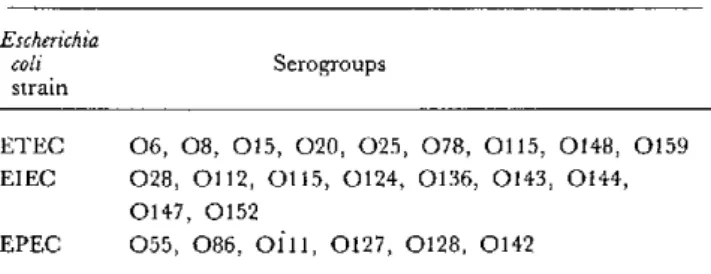
Serologic classification. E. coli can also be classified sero-logically on the basis of a bacterial cell wall antigen (O an-tigen). At present, 164 distinct O serogroups are recog-nized. ETEC, EIEC, and EPEC strains tend to have distinctive O serogroups (Table 1). However, E. coli pos-sessing these O serogroups are not always pathogenic and E. coli which have not been serotyped may also cause diar-rhea.
Nevertheless, the serotype of E. coli is a useful epide-miological tool since other means of identifying potential-ly pathogenic E. coli are difficult, expensive, and not widely available.
Injections. Infections with ETEC cause copious, watery diarrhea and are an important cause of warm season diar-rhea in young children in developing countries.
EIEC produces fever, abdominal cramps, urgent and painful defecation (tenesmus) and watery diarrhea, fol-lowed by scanty discharges of blood and mucus (dysen-tery). Microscopic examination of methylene-blue stained fecal mucus shows pus and red cells.
EPEC can produce sudden cholera-like diarrhea in adults, whereas in infants the disease often tends to be more prolonged, with high mortality. It is possible that these organisms produce uncharacterized enterotoxins.
Another factor which may determine the ability of E. coli to cause diarrhea is whether they can produce hair-like structures calledfimbriae or pili. 2 These fimbriae
an-Table 1. O Serogroups in which ETEC, EIEC, and EPEC strains commonly occur.
Escherichia
coli Serogroups
strain
ETEC 06, 08, 015, 020, 025, 078, 0115, 0148, 0159 EIEC 028, 0112, 0115, 0124, 0136, 0143, 0144,
0147, 0152
EPEC 055, 086, Oill, 0127, 0128, 0142
2
Stickiness and sickness. Diarrhoea Dialogue Issue 2, 1980, page 3.
chor E. coli to the lining of the small intestine, overcoming the attempts of the intestine to expel them and allowing colonization.
Vibrio cholerae
The vibrio associated with cholera was probably con-fined to the area around Calcutta until 1813 when a series of pandemics occurred. Improved sanitation in industrial-ized countries now keeps cholera at bay, but it is still en-demic in parts of Asia. Diarrhea caused by cholera looks like rice water and a liter or more of fluid can be lost every hour for several days. An enterotoxin almost identical to LT is the cause of this sympton.
Campylobacter
Campylobacter have been reported mainly from Europe, South Africa, and North America where as high as 15 per cent of infant diarrhea may be due to this organism. Ab-dominal pain, fever, diarrhea and, occasionally, dysen-tery are the usual features. Pet dogs, poultry, and milk are likely sources of infection.
Yersinia
Yersinia enterocolitica has been identified as a cause of gastroenteritis in children in Canada, Europe, Japan, and South Africa. It produces pain severe enough to suggest a surgical emergency. Yersinia are invasive and also produce ST. Special bacteriologic techniques are needed to grow Yersinia and Campylobacter from stools. During incubation, high temperatures favor Campylobacter and low tempera-tures encourage Yersinia.
Shigellae and Salmonellae
Shigellae are an important cause of diarrhea in infants aged six months to two years. Since shigellosis is spread by person-to-person contact, incidence is higher where environmental health and personal hygiene are poor.3 As few as 10 swallowed bacteria are enough to cause the dis-ease.
Salmonellae are foodborne and contamination of animal carcasses in slaughterhouses is the usual source. Symp-toms resemble those produced by Campylobacter.
Salmonellae and Shigellae are invasive and probably release toxins from inside the intestinal cells. These cause secretion of fluid in the upper intestine and cell damage in the lower intestine.
3
Kahn, M. U. Soap, water, and shigellosis. Diarrh')ea Dialtgue, Issue 2, 1980, page 3.
Protozoal infections
Giardia lamblia and Entamoeba histolytica are single cell microorganisms (protozoa) which have been reported in most countries. G. lamblia grows in the small intestine and is thought to be a cause of both acute and chronic diar-rhea, by unknown mechanisms. E. histolytica prefers tropical zones and causes ulceration of the large intestine.
Other causes
Diarrhea may be due to infections outside the intestine, such as pneumonia, and this possibility must be con-sidered in any child with diarrhea.
Conclusions
At present, the main treatment for acute diarrhea is replacement of water and electrolyte losses. Even in rota-virus infections, when sugar absorption is impaired, the intestine has sufficient reserves to allow successful treat-ment of diarrhea by oral rehydration with sugar and salt solutions.
In the future, it may be possible to offer specific preven-tive measures or treatment for specific causes of diarrhea. Simple, low-cost methods for detecting the causative organisms will then be of great importance. Rotavirus can already be detected in stools by a test relying on antibod-ies against the virus (enzyme-linked immunosorbent assay-ELISA) which can be carried out without expen-sive equipment such as electron microscopes.
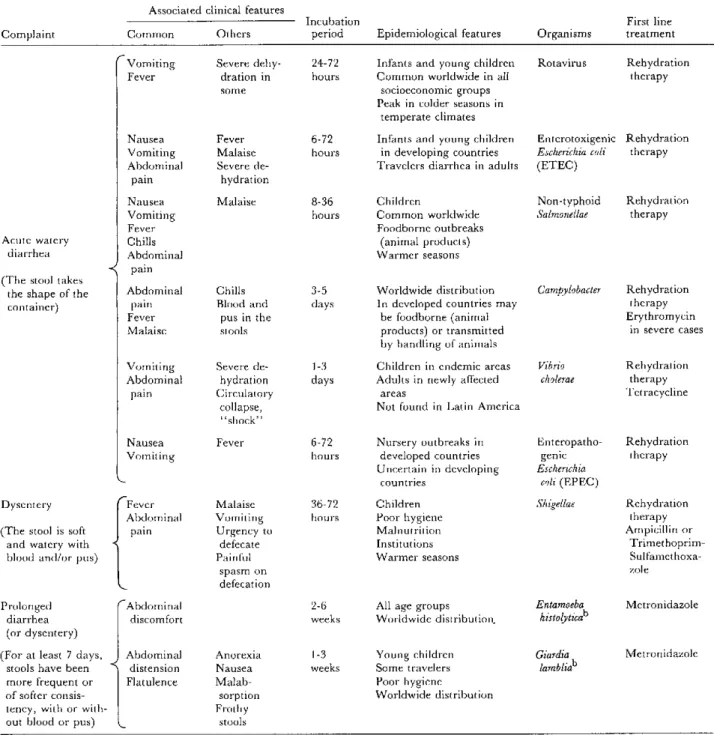
The use of simpler tests in the field will mean that spe-cific therapy will be given only when necessary (Table 2) and that antibiotics will not be administered when contra-indicated (e.g. rotavirus) or where such drugs may actual-ly prolong the illness (e.g. Salmonellae). Accomplishing these goals will depend on the ability of health workers to recognize the causative organism in the early stages of the disease.
Oral Rehydration in Costa Rica
Since a trial oral rehydration therapy (ORT) project was begun in Costa Rica at the beginning of 1978, ORT has proved an effective life-saver in both bacterial and rotaviral infant diarrhea, including neonates.4'5 Routine implementation of OR in the National Children's Hospi-tal has resulted in more than an 80 per cent reduction in mortality. The technique is easily understood both by
4
Nalin, D. R., el al. Oral rehydration and maintenance of children with rotavirus and bacterial diarrhoeas. Bull WHO 57:453-459, 1979.
5
Pizarro, D., el al. Evaluation of oral therapy for infant diarrhoea in an emergency room setting; the acute episode as an opportunity fbr in-structing mothers in home treatment. Bull WHO 57:983-986, 1979.
10
o
Table 2. Clinician's guide to the etiology of diarrheal diseases.a
Associated clinical features
Incubation First line
Complaint Common Others period Epidemiological features Organisms treatment
r .._..._ ...
Acute watery diarrhea
(The stool takes the shape of the container)
Dysentery
(The stool is soft and watery with blood and/or pus)
Vomiting Fever Nausea Vomiting Abdominal pain Nausea Vomiting Fever Chills Abdominal pain Abdominal pain Fever Malaise Vomiting Abdominal pain Nausea Vomiting Fever Abdominal pain
Severe dehy-dration in some
Fever Malaise Severe
de-hydration
Malaise
Chills Blood and
pus in the stools
Severe de-hydration Circulatory collapse, "shock" Fever Malaise Vomiting Urgency to
defecate Painful
spasm on defecation
24-72 Infants and young children hours Common worldwide in all
socioeconomic groups Peak in colder seasons in
temperate climates
6-72 Infants and young children hours in developing countries
Travelers diarrhea in adults
8-36 Children
hours Common worldwide
Foodborne outbreaks (animal products) Warmer seasons
3-5 Worldwide distribution
days In developed countries may be foodborne (animal products) or transmitted by handling of animals
1-3 Children in endemic areas days Adults in newly affected
areas
Not found in Latin America
6-72 Nursery outbreaks in hours developed countries
Uncertain in developing countries
36-72 Children
hours Poor hygiene
Malnutrition Institutions Warmer seasons
Rotavirus Enterotoxigenic Escherichia coli (ETEC) Rehydration therapy Rehydration therapy
Non-typhoid Rehydration
Salmonellae therapy
Campylobacter Rehydration therapy Erythromycin
in severe cases
Vibrio cholerae
Enteropatho-genic
Escherichia coli (EPEC)
Shigellae Rehydration therapy Tetracycline Rehydration therapy Rehydration therapy Ampicillin or
Trimethoprim- Sulfamethoxa-zole
Prolonged diarrhea (or dysentery)
(For at least 7 days, stools have been more frequent or of softer consis-tency, with or with-out blood or pus)
Abdominal discomfort
Abdominal distension Flatulence
2-6 All age groups
weeks Worldwide distribution.
Anorexia Nausea Malab-sorption Frothy stools
1-3 Young children
weeks Some travelers
Poor hygiene
Worldwide distribution
aThis table is greatly simplified. For example, some agents produce a variety of clinical features. Only agents of major worldwide importance have been included. In certain areas, at certain times, the picture may be quite different. Also, there are a number of other conditions associated with diarrhea such as infections outside the intestine (e.g. measles and malaria), malnutrition, food intolerance, etc.
bCan be identified on examination of the stools with a light microscope. Blood and pus from Shigellae and Campylobacter can also be identified.
Produced in collaboration with the Ross Institute of the London School of Hygiene and Tropical Medicine and The Save the Children Fund.
health personnel and mothers visiting the emergency unit at the hospital.6 In addition, health centers in both urban
6
pizarro, D., et al. Oral rehydration of neonates with dehydrating diarrhoeas. Lancet 2:1209-1210, 1979.
and rural areas have also been able to introduce oral re-hydration therapy.
Field Project
A field project to monitor oral rehydration therapy
given by mothers to their children in rural areas was started by the Institute for Research in Health (" Instituto de Investigaciones en Salud," INISA) in 1980. Mothers soon learned the technique and treated children success-fully. At the same time, comprehensive teaching material for health personnel was prepared by the state welfare system, while the Ministry of Health established a na-tional program of diarrheal disease control with technical cooperation from PAHO.
Sharing Experiences
During the past three years, the Costa Rican experi-ence has been shared with several Latin American coun-tries. Health personnel from Bolivia, El Salvador, Guate-mala, Honduras, Panama, Paraguay, and Venezuela visited Costa Rica for a first-hand view of the OR pro-gram. Visiting physicians spent a week in the emergency unit of the National Children's Hospital, INISA's rural program in Puriscal, the rural hospital in Grecia, and the Department of Maternal and Child Health of the Health Ministry.
Decrease in Mortality Rates
Since 1978, about 15,000 dehydrated children (includ-ing 160 neonates) have been rehydrated in the emergency unit of the National Children's Hospital. Mothers have been taught about the causes, transmission, and manage-ment of diarrhea as well as techniques to rehydrate and prevent dehydration among infants.
All these effort have had a considerable impact on both
hospital mortality rates and overall diarrheal disease mor-tality in Costa Rica.7
(Source. Diarrhoea Dialogue, Issue 7, 1981.)
Editorial Comment
This article focuses on two aspects of diarrheal diseases which constitute a major cause of morbidity and mortality in children in Latin America and the Caribbean.8
The PAHO Diarrheal Disease Prevention and Control Program carries out the WHO expanded diarrheal dis-ease program's commitment to reduce infant mortality and malnutrition related to diarrhea. It assumes a collab-orative role with national diarrheal disease control pro-grams, and emphasizes interdisciplinary strategies which are integrated into the existing primary health care infra-structure. These strategies include treatment through oral rehydration, maternal and child nutrition, adoption of measures aimed at improving water supplies, sewerage, and food hygiene facilities, intensification of health educa-tion efforts, and establishment of surveillance systems to detect and control epidemics and evaluate the program's impact. A final component of the PAHO program is sup-port for research in all aspects of diarrheal diseases.
These diseases are critically important and develop-ments in epidemiology, clinical aspects, research findings, and efforts aimed at their control should be emphasized. The PAHO Epidemiological Bulletin provides a forum whereby developments in the aforementioned areas are highlighted for all diseases; contributions in the specific area of diarrheal diseases are welcome.
7Mata, L. J. Diarrhoeal diseases. How Costa Rica won.
World Health F)lrum 2:141-142, 1981.
8
See PAHO Epiderniological Bulletin 1: 2, 1980.
Reports of Meetings and Seminars
Meeting on Emergencies caused by Communicable Disease Epidemics
A group of specialists from several countries met from 9-13 November 1981 at WHO Headquarters in Geneva to discuss emergency situations caused by communicable disease epidemics. Participants included staff from the six WHO regions (America, Europe, Africa, Eastern Medi-terranean, Southeastern Pacific, and Western Pacific).
The main objectives of the meeting were: to find more
dynamic means of cooperation among countries and be-tween these and WHO during emergencies caused by common disease epidemics, and to establish guidelines for surveillance, prevention, and control of certain commu-nicable diseases.
As a framework for discussions, the characteristic ele-ments of epidemics which threaten or cause emergency situations were defined to include the following (although
12