*e-mail: [email protected]
1. Introduction
Pure water is an essential requirement for the survival of human beings. To meet the requirements of potable, industrial and agricultural water, the immediate need is to treat wastewater, which contains both dissolved and suspended particles. These efluents are highly undesirable and unsafe. The removal of contaminants from wastewater is a must before they can be reused1. The removal can be accomplished
by gravitation (very slow), by coagulation (dependent on electric charge situation) and by locculation (not dependent on electric charges and the fastest)2. Coagulation is one of
the most important physicochemical operations used in water, and wastewater treatment and can be achieved by chemical and electrical means3. Coagulation and locculation occur in successive steps intended to overcome the forces stabilizing the suspended particles, allowing particle collision and growth of loc. Coagulation has been deined as the addition of a positively charged ion of metal salt or catalytic polyelectrolyte that results in particle destabilization and charge neutralization. Coagulation targets the colloid particles of size 10-7 to 10-14 cm in diameter. The colloid particles exhibit Brownian movement through the water; their surface is negatively charged so they repel one another, and they form a stable dispersed suspension4. If colloid particles or ions of positive electric charge are added it neutralizes the electric negative charge. Flocculation refers to the successful collision that occurs when destabilized particles are driven toward each other by the hydraulic shear force in the rapid
mix and locculation basin. It agglomerates of a few colloids then quickly bridge together to form microlocs which is turned into visible loc masses5. Coagulation happens by the addition in the water to be treated of inorganic salts, based on aluminium or iron (aluminium sulfate - alum, ferric sulfate, ferric chloride, ferrous sulfate, and sodium aluminate) while locculation happens by the addition of organic polymers.
Polymers have been utilized in coagulation/locculation processes for water puriication for at least four decades. Some of the advantages of them use are the following: lower coagulant dose requirements, a smaller volume of sludge, a smaller increase in the ionic load of the treated water, reduced level of aluminium in treated water, cost savings6.
Polymers used in water treatment are water soluble and are broadly characterized by their ionic nature: cationic, anionic and non-ionic. Usually, but not always, cationic polymers possess quaternary ammonium groups that have a formal positive charge irrespective of pH (poly(diallyldimethyl ammonium chloride) or cationic polyacrylamides). Anionic polymers contain weakly acidic carboxylic acid groups, so the charge density depends on pH (anionic polyacrylamides). Synthetic polymers often described as non-ionic actually contain some 1-3% of anionic groups, as in the case of polyacrylamide where they arise from hydrolysis of the amide groups under the preparative conditions employed6.
Mechanisms of locculation of particles by polymers can be described by the polymer bridging, charge neutralization including “electrostatic patch” effects and depletion locculation. The last one which depends on the presence
Synthesis and Characterization of Poly(Acrylamide-
Co
-Acrylic Acid)
Flocculant Obtained by Electron Beam Irradiation
Gabriela Craciuna, Daniel Ighigeanua, Elena Manailaa*, Maria Daniela Stelescub
aElectron Accelerators Laboratory, National Institute for Laser, Plasma and Radiation Physics –
INFLPR, Atomistilor St. 409, 077125, Magurele, Romania
bNational R&D Institute for Textile and Leather, Leather and Footwear Research Institute,
Ion Minulescu St. 93, Bucharest, Romania
Received: May 13, 2015; Revised: July 17, 2015
The goal of the paper was to prepare a class of locculants by free-radical copolymerization of acrylamide with acrylic acid in aqueous solutions in the presence/absence of potassium persulphate as initiator. Reaction medium was submitted to electron beam treatment of 0.6 to 1.5 kGy in atmospheric conditions and at room temperature. Because of the complexity of reaction mechanisms involved in radio-induced polymerization, was necessary to establish the connection between absorbed dose and initiator concentration, both of them very important in free radical production. Unlike the conversion coeficient and residual monomer concentration, intrinsic viscosity and Huggin’s constant are sensitive to the initiator concentration variation for all used irradiation doses. The copolymerization was conirmed by FTIR measurements. The locculation characteristics were evaluated in 0.2 wt % kaolin suspension at room temperature using different polymer dosages between 0 to 10 ppm. High locculation eficiency was obtained using the polymer having high values of intrinsic viscosity, molecular weight and radius of gyration.
of free unabsorbed polymer is not signiicant in water treatment practice6.
The extensive use of polymers as locculants is due to their distinct characteristic attributes: are convenient to use and they not affect the pH of the medium, they are used in small quantities (1-5ppm) unlike the inorganic salts and, in the most cases, the locs formed during locculation by organic polymers are bigger and stronger than during coagulation with inorganic salts. Moreover, large tonnage use of inorganic compounds produces higher volumes of sludge. Among polymeric locculants, the synthetic polymers can be tailor made by controlling molecular weight, molecular weight distribution, the structure of polymers and the nature and percentage of ionic groups5,6.
During the last 30 years, the production of polymeric locculants has rapidly increased. Radiation research in the ield of polyelectrolytes chemistry was irst developed using
60Co sources7. In the authors of the present work laboratory, the
locculants based on acrylamide and acrylic acid, have been synthesized by electron beam irradiation8-10. Polyacrylamide
based locculants, which are used in the locculation process, are high molecular weight compounds that are soluble in water and have major advantages such as lexibility and effectiveness in treating wastewater11. The performances
of polyacrylamide as locculant are superior, compared with those of organic and inorganic coagulants, in terms of lower utilization dosages and lower volumes of sludge. Also, their effectiveness is only slightly inluenced by the pH level of water to be treated11. Based on studies, some experimentalists have established which are the major advantages of radiation induced polymerization processes: very easy to manipulate the molecular weight, from low to very high, by simply changing the feed composition as well as the composition of the product by incorporating different monomers; higher conversion eficiency (near 100%); very low residual monomer contents; no production of waste matter or evolution of noxious gases; no production of hazardous efluents; very clean process8-10. The processing of materials
by irradiation with accelerated electrons removes many drawbacks of conventional technology, because ionizing radiation initiates polymerization without thermal input from the outside, due to free radicals that are formed at the interaction of these rays with monomers and especially with the solvent (water in this case) in which these monomers are found. So a good solution is to use ionizing radiation to produce polymer materials, especially using accelerated electron beams which actually direct all their energy in the volume of irradiated monomer solutions. The research line of the authors of the present work laboratory is to done the processing of materials for research and industrial applications especially for polymerization, cross-linking or monomers grafting onto polymers, by electron beam irradiation (EB)12-17.
In this paper, physico-chemical characteristics of polymeric materials (locculants) obtained by electron beam irradiation, are presented. The paper also presents the results of the locculation studies in order to demonstrate the locculation eficiency of the polyelectrolyte. One possible mechanism for the reaction acrylamide and acrylic acid is also proposed.
2. Experimental
2.1. Materials
The materials used for locculants obtaining were:
acrylamide – AMD (molar mass 71.08 g/mol; density 1.13 g/cm3;
solubility in water 2.04 kg/L at 25 °C); acrylic acid – AA (molar mass 72.06 g/mol; density 1.051 g/cm3;solubility
in water: miscible) and potassium persulphate – PP (molar mass 270.322 g/mol; density 2.477 g/cm3; solubility in water
1.75 g/100 mL at 0 °C). All reagents listed above were of 99% purity and have been acquired from LACHEMA, Germany, and used directly, without puriication. Other chemicals used in this study for physico-chemical characterization of the locculants were of analytical grade.
2.2. Experimental installations and polymer
preparation
Experiments were carried out with an experimental installation consisting mainly of the following units: an electron linear accelerator of 6.23 MeV energy and 75 mA peak current of the EB (ALIN-10 from National Institute for Laser, Plasma and Radiation Physics) and an irradiation chamber containing the samples of monomer solution. The ALIN-10 accelerator is a travelling-wave type, operating at a wavelength of 10 cm and having 164 W maximum output power. The accelerating structure is a disk-loaded tube operating in the π/2 mode. The optimum values of the EB peak current IEB and EB energy EEB to produce maximum
output power PEB for a ixed pulse duration τEB and repetition frequency fEB are as follows:
EEB= 6.23 MeV
IEB =75 mA
PEB = 164 W (fEB = 100 Hz, τEB = 3.5 μs)
The EB effects are related to the absorbed dose (D) and absorbed dose rate (D*). The absorbed dose is the major parameter in the accelerated electron radiation18. The polymerization
and copolymerization process performances are provided by the strict control of this parameter15,18. The relation deining the absorbed dose is:
d D
dm ε
= (1)
where dε is the mean energy given up by the ionizing radiation to the mass amounts dm of the substance interacting with this ionizing radiation.dm is emphasized to be very low but not so low that the mean energy dε given up by the radiation would undergo a signiicant luctuation. Absorbed dose is measured in Joule/kg. The SI unit measure for the absorbed dose is the gray (Gy):
/
1 Gy 1 Joule kg = (2)
Electron beam dose rate was ixed at 2 kGy/min in order to accumulate doses between 0.6 and 1.6 kGy. The thickness of 2.5 cm of the irradiated samples was established in accordance with the samples densities (of about 1 g/cm3
on acrylamide and acrylic acid. Table 1 represents reaction conditions to synthesize the locculants.
2.3. Polymer characterization
2.3.1. Physico-chemical characteristicsIn order to determine the conversion coeficient (Cc) and the residual monomer concentration (Mr), 2 grams from each of the polymers were placed in 200 ml distilled water for 24 hours and then every sample was stirred for 1 hour at 400 rpm to ensure a very well mixing. The conversion coeficient and the residual monomer concentration were determined by titrimetric method. In this method, bromine reacts with the double bond of residual monomer19,20. After
complete dissolution in water, the polymers were treated excessively with a bromide-bromate solution and the bromine excess was determined by means of the iodatometry method in presence of sodium thiosulphate solution (1 M).
The intrinsic viscosity (ηintr.) and the Huggins’ constant (kH) were determined by the viscosimetry method, using the Hoppler type BH-221.The principle of falling-ball
viscosimeters is based on the fact that the viscosity of liquid modiies the speed of ball falling through this liquid. The time of fall of the ball through the polymeric solution was measured for ive different concentrations of it. As a solvent, sodium nitrate 1 M was used and the working temperature was 30°C. Using the time of fall of the ball through the polymeric solution (t) and the time of fall of the ball through the solvent (t0) the relative viscosity (ηrel= t / t0) was obtained. Speciic viscosity was calculated from the relation, ηsp = (ηrel.–1). Reduced viscosity was determined
using the relation ηred = (ηsp/c), where c is the polymer
concentration (g/dL). From the graphical representation of the ηred as a function of the copolymer concentration, by
extrapolation, was obtained the intrinsic viscosity ηintr and
tgα. Linearity constant was determined from the following relation: kH = tg α/[ηintr]2. Intrinsic viscosity is a measure
of the hydrodynamic volume occupied by the individual polymer molecules in isolation22. In dilute solutions, the
polymer chains are separate and the [ηintr] of a polymer in
solution depends only on the dimensions of the polymer chain. Because [ηintr] indicates the hydrodynamic volume of
the polymer molecule and is related to the molecular weight, it provides deep insights on the molecular characteristics23. From the Mark-Houwink equation the relationship among the molecular weight and viscosity are given below:
[ ]
η K* Mwa =[
]
(3)where [η] is the intrinsic viscosity (dL/g), Mw is molecular weight (g/mol), K and a are constants for a particular polymer – solvent system (K and a are 3.73*10-4 and 0.66
in 1 M aqueous sodium nitrate at 30 °C)21,24.
Radius of gyrations is a parameter which characterizes the size of a particle of any shape. As the radius of gyration will be higher, the molecular dimension of the polymer will be much higher and that will affect synergistically the locculation characteristics25. Radius of gyration was
determined by the following relation26,27:
Rg = 0.0147 * Mw0.59 (4)
2.3.2. FTIR analysis
In order to obtain spectral information regarding the polyelectrolyte chemical structure, a FTIR spectrophotometer – JASCO FT/IR 4200 was used by ATR measurement method. Samples spectra are the average of 30 scans realized in absorption, in the range of 4000 – 600 cm-1, with a resolution of 4 cm-1.
2.4. Flocculation studies
Flocculation studies were carried out on kaolin suspension (0.2 wt %), at room temperature (20-25 °C) using the standard Jar test apparatus (Velp FC 6S, Italia). The jar test apparatus consists of 6 stirrer blades connected to a variable speed (0-100 rpm) motor through a gear system. In each beaker, 500 mL of kaolin suspension was taken and placed on the locculator dipping the stirrer blades in the suspension. Under a slow stirring condition, the polymer solution was added by means of a pipette in order to determine the polymer concentration inluence (1-10 ppm). Immediately after addition of polymer solution, the suspensions were stirred at a constant speed of 60 rpm for 15 min, and then allowed to sediment for 15 min. Clear supernatant was drawn from the top layer (up to depth 1-2 cm) and its transmittance was measured at 620 nm using a Cary Bio-100 UV-VIS spectrophotometer.
3. Results and Discution
3.1. Physico-chemical properties
The characteristics of poly(acrylamide-co-acrylic acid) locculants are inluenced by the following factors: chemical composition of the solutions to be irradiated and absorbed dose level28-30. Electron beam induced copolymerization
reaction, under proper irradiation conditions and for ixed
Table 1. Flocculants synthesis details.
Flocculant Amount of chemicals (mol/L) Irradiation dose (kGy)
AMD AA PP FS HS
F1-1... F1-6 5 0.5 0 1.1 x 10⁻³ 0.5
0.6; 0.8; 1.2; 1.4; 1.5; 1.6; F2-1... F2-6 5 0.5 0.75 x 10⁻⁴ 1.1 x 10⁻³ 0.5
F3-1... F3-6 5 0.5 1.5 x 10⁻⁴ 1.1 x 10⁻³ 0.5
F4-1... F4-6 5 0.5 3 x 10⁻⁴ 1.1 x 10⁻³ 0.5
F5-1... F5-6 5 0.5 4 x 10⁻⁴ 1.1 x 10⁻³ 0.5
F6-1... F6-6 5 0.5 5 x 10⁻⁴ 1.1 x 10⁻³ 0.5
chemical composition of the monomer mixtures to be irradiated, gives higher conversion eficiency (near 100%) and lower residual monomer concentration (under 0.01%) than classical copolymerization (by heating). In radiation copolymerization/polymerization, a completely “inert” reactant does not exist. Any substance when added to a monomer absorbs the radiation energy, resulting in various secondary processes, which inally lead to an additional production of free radicals. Indeed, due to water presence in the EB irradiated system, our experiments show that the role of the radicals originated from irradiated water is predominant compared to the radicals which come directly from the monomer irradiation. Thus, irradiated water radicals facilitate the copolymerization process and decrease the required absorbed dose level. The main function of the ionizing radiation in a radiation-initiated polymerization is limited to the primary events. The initiation step leads to the production of free radicals and the subsequent steps of propagation, termination and chain transfer proceed as in
a chemically catalyzed process. Because of the complexity of reaction mechanisms which are happening in case of copolymerization process induced by irradiation we tried to establish a connection between EB absorbed dose and initiator concentration (PP), both of them very important in free radical production. The results presented in Figures 1-4 show that the polymerization process is complete at a low EB absorbed dose rates and using a very small initiator concentration. In that case, the principal source of free radicals is water used as solvent in monomer mixture. Conversion coeficient is the irst parameter characterized and it is required to be higher than 95%, because a high conversion coeficient is equivalent with high monomer transformation eficiency in polymerization process and a substantial reduction of residual monomer concentration. From the results obtained it is observed that conversion coeficient increases slowly with the amount of initiator increase (Figure 1). Can be noticed that, for samples that contain a small amount of initiator (0.75 × 10⁻⁴mol/L),
Figure 1. The effect of initiator concentration and EB absorbed dose on conversion coeficient (CC).
Figure 2. The effect of initiator concentration and EB absorbed dose on residual monomer content (Mr).
Figure 3. The effect of initiator concentration and EB absorbed dose on intrinsic viscosity (ηintr.).
even at the lowest irradiation dose (0.6 kGy), conversion coeficient is over 95%. Simultaneously with the conversion coeficient increasing, residual monomer decreases with amount of initiator and absorbed dose increase (Figure 2).
For the intrinsic viscosity, ηINTR , we expected to obtain
values over 6 dl/g, which means liniar polymer, whitout ramiications and with water solubility. Regarding the linearity constant, kH, we aim to obtain values below 1 because only in this case is ensured solubility and a good locculation of the polymer. Unlike the conversion coeficient Cc and residual monomer concentration Mr, intrinsic viscosity ηintr and Huggin’s constant kH remain sensitive to the initiator concentration variation for all used irradiation doses (Figures 3 and 4). Usually, the intrinsic viscosity ηintr increases rapidly with initiator concentration increasing, reaches a maximum and then decreases rapidly at lower irradiation doses and slower at higher irradiation doses.
Intrinsic viscosity of a polymer is indicative of its hydrodynamic volume in solution, which depends on its molecular weight, structure and nature of the solvent as well as the temperature of the medium. For two polymers with approximately similar molecular weight, the branched polymer has lower hydrodynamic volume compared to its linear counterpart and thus has lower intrinsic viscosity value. Furthermore, the longer the branching the higher is the intrinsic viscosity and vice versa31. The intrinsec viscosity
of a polymer is dependent on its molecular weight and chain dimension32,33. In dilute solutions, the polymer chains are
separate, so intrinsic viscosity of a polymer in solution depends only on the dimensions of the polymer chain and on the molecular weight23,32. Huggin’s constant k
H, follows
exactly the variation of intrinsic viscosity. Thus, it rises and falls with practically the same rate that intrinsic viscosity ηintr, falls and rises, depending on the initiator concentration.
We can say that, by getting high values for the intrinsic viscosity ηintr, are obtained minimum values for the linearity constant kH. The measured values of Huggin’s constant kH are well below 1 even for low values of intrinsic viscosity ηintr,
and that is a very important result because polyelectrolytes eficiency is assured by their linearity, i.e. by kH<1.
3.2. FTIR study
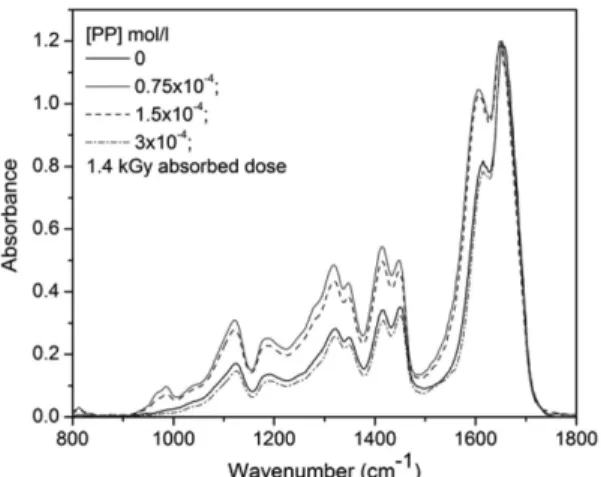
Fourier transform infrared spectroscopy is one of the most widely employed techniques for analyzing polymeric materials. The spectra of polymeric locculants obtained at 1.4 kGy in the range of the 4000-650 cm-1 are depicted in Figures 5 and 6. We have chosen to represent the FTIR of these samples because it exhibits the best results for all four characteristics: conversion coeficient, residual monomer content, intrinsic viscosity and linearity constant.
The FTIR spectra conirm the formation of copolymer of acrylamide and acrylic acid as is evident from bands that appeared in the range of 3100–3500 cm−1 (O–H and
N–H stretching)34. The absorption located in the regions 3350-3330 cm-1 and 3200-3185 cm-1 corresponds to the
asymmetric and symmetric NH2 stretching vibrations from
acrylamide35,36. On the other hand, the broad absorption bands from 3400 cm-1 to 2950 cm-1 can be assigned to the
–OH from the carboxylic group37. The methylene group
vibrations are used to monitor the extent of polymerization.
The intensity bands appearing in the regions 2950-2940 cm-1 and 2915-2900 cm-1 are assigned to both asymmetric and
symmetric CH2 stretching vibrations. In addition, the absorption band in the region 2790-2770 cm-1 is assigned to
CH stretching vibration of polymer backbone. The shoulder in the same region also suggests the presence of COOH in copolymers. At 1653-1645 cm-1, a stretching of the C=O
group from the AMD and AA unit appears in all spectra. At this wave number there is also the OH angular deformation from water, which explains the existence of this band in the polyacrylate spectrum35. The characteristic peak which appeared in the range of 1620-1600 cm-1 is due to the NH
2
bending from AMD. The absorption band in the region 1455-1445 cm-1, is assigned to CH
2 stretching vibration. The absorption located in the regions 1450-1410 cm-1 has
been assigned to C-N stretchingvibrations35,36. Bands at 1560 and 1406-1410 cm-1 are due to the symmetric and
asymmetric stretching of COO−of acrylate (acrylic acid
neutralized with NaOH)34. The presence of adsorbed water
can be seen by the band at 3300 cm-1 in all spectra. Figure 5. FTIR spectra of samples obtained at 1.4 kGy in range of 650-1800 cm-1.
3.3. Flocculation studies
When locculant is added in water which requires treatment, an interface is formed. Above it is the supernatant liquid while below is the suspension containing the contaminants. Under the action of the locculating agent, that is along with the progress of the locculation process, that interface descends, until all contaminants are settled at the bottom2.
The most important characteristics of polymeric locculants are molecular weight and radius of gyration2,38. Conventionally,
polymers are regarded as having, low, medium or high Mw, corresponding to Mw values in the ranges: <105, 105–106 and >106, respectively38. Radius of gyrations is a parameter which
characterizes the size of a particle of any shape. The higher the radius of gyration larger will be the polymer dimensions, affecting the locculation characteristics synergistically31.
The molecular weight and radius of gyrations are represented in Figures 7 and 8.
For locculation tests were chosen the copolymers obtained at 1.4k Gy absorbed dose, because it exhibits the best results for all four characteristics: conversion coeficient, residual monomer content, intrinsic viscosity, linearity constant, molecular weight and radius of gyrations. The locculation tests were performed at different polymer dosages, which varied from 0 to 10 ppm at the measured pH of 7. The locculation performance is explained in terms of transmittance of the supernatant liquid versus polymer concentration. It was obtained a higher locculation eficiency from the polymer with higher intrinsic viscosity and therefore with higher molecular weight and radius of gyrations (Figure 9). Flocculation eficiency increased for copolymers with higher viscosity is due to higher afinity for contaminants, which can be explained by a greater spreading of the polymer chains in contaminated water.
In Figure 9 is observed that the locculation eficiency increased with increasing locculant dosage for all locculants and reached the maximum at 5 and 6 ppm dosage. After 6 ppm dosage, the locculation eficiency decreases. At low polymer dosages, the settling rates were low due to insuficient polymer available for bridging particles together and the locs were not large enough to provide adequate settling rates. As the polymer concentration increased, more particles were bridged and bigger locs were obtained, hence a signiicant increase in the settling rates resulted39. It is well known
that bridging is one of the major locculation mechanisms of polymeric locculants. The mechanism is favored when the polymers has a long chain. In order to create effective bridges, there must be suficient polymeric chains, which are able to extend far enough to facilitate the attachment of other particles31. From the experiments is observed the
effectiveness of polymers as the bridging locculants depends greatly on their properties: molecular weight and thus the intrinsic viscosity. The molecular weight directly inluences the effective size of molecules in solution and in the adsorbed state. Polymers with higher molecular weight are found to be more effective locculants39.
3.4. Reaction mechanisms
The advantage of radio-induced copolymerization is that radicals can be formed by decomposition of all reactants (initiator, solvent, and monomers) present in the system.
Figure 7. The effect of initiator concentration and EB absorbed dose on molecular weight (Mw).
Figure 8. The effect of initiator concentration and EB absorbed dose on radius of gyration (Rg).
The main function of ionizing radiation with accelerated electrons is to achieve the irst step of the polymerization process: the initiation phase leading to free radical formation and to some speciic side effects. The next polymerization phases, propagation, completion and the chain transfer process, take place almost identically to classic polymerization processes. Potassium persulphate on its own or in redox systems is one of the water soluble initiators, frequently used in polymerization and copolymerization processes of acrylamide. In accelerated electron ield, it is considered that takes place the mechanism of potassium persulphate decomposition presented in Figure 10a. If surrounding water molecules make up a potential barrier against separation of free radicals by diffusion, the latter remain isolated as in a cage (cage effect). This facilitates their destruction by recombination. Thus, in the general scheme of radical formation from initiator, reactions determined by this cage effect are considered to take place (Figure 10b).Water is an extremely important environment in the speciic case of the polymerization process. When a high kinetic energy electron covers a water layer, it gradually loses energy by Coulomb interaction with molecules in the environment21,40,41. These interactions result in ionizations and excitations of water molecules. The water ionizing process is thus simply treated, obtaining H2O+ and e-, which further undergoes
a neutralization process obtaining a highly excited water molecule, which will dissociate into radicals (Figure 10c). Radicals, precursors of the copolymerization reaction can also form due to the interaction of accelerated electrons with the
two monomers, acrylamide and acrylic acid (Figure 10 d, e), forming, in the irst phase, two excited states.
Based on the obtained results and existing literature studies42,43, is proposed a possible mechanism for the
copolymerization of acrylamide and acrylic acid by electron beam irradiation in Figures 11 and 12.The reaction mechanism is the same in the presence of “initial radicals” formed from water or initiator, the only difference is in the stage of initiation when free radicals, precursors of copolymerization reaction, are formed. The possible reaction mechanisms are presented in Figure 11.
In absence of initiator, when acrylamide and acrylic acid are exposed together to ionizing radiation (electron beam), one double bond (from AMD or AA) was broken and free radicals are formed43. These free radicals react with each
other and a copolymeric AMD/AA locculant is produced. Figure 12 show the possible copolymerization mechanism by which one of the excited states obtained from AMD turns into radicals and thus participates to the propagation reaction, and further to obtaining the inal product. Ionizing radiation produces an excitation of polymer molecules in the vicinity of the impinging radiation. The energies associated with the excitation depend on the absorbed dose of electrons. The interaction results in formation of free radicals formed by dissociation of molecules in the excited state or by interaction of molecular ions15-20. The free radicals or molecular ions can
react by connecting the polymer chains directly or initiating reactions. In the case of acrylic acid, schemes are identical.
4. Conclusions
In this study, we synthesized poly(acrylamide-co-acrylic acid) locculants in aqueous solutions in the presence or absence of potassium persulphate by electron beam irradiation in atmospheric conditions and at room temperature of 25 °C. The experimental results show that physico-chemical characteristics (conversion coeficient, residual monomer content, intrinsic viscosity, linearity constant, molecular weight and radius of gyration) increase with increasing of the absorbed dose and amount of initiator. The best results were obtained at 1.4 kGy absorbed dose and 5 × 10⁻⁴ mol/L
amount of initiator. Also, the locculants obtained at 1.4 kGy was characterized by FTIR and copolymerization was conirmed. The locculation tests were performed at
different polymer dosages, which varied from 0 to 10 ppm. The experimental results show that the higher locculation eficiency is obtained from the polymer with higher intrinsic viscosity and therefore, with higher molecular weight and radius of gyrations. We proposed some possible reaction mechanisms for obtaining radicals by electron beam irradiation of poly(acrylamide-co-acrylic acid) in presence of “initial radicals” formed from water or initiator, and for copolymerization of acrylamide and acrylic acid. It can be concluded that, for obtaining locculants with a given chemical composition by electron beam irradiation, there is an optimal EB absorbed dose where the physico-chemical characteristics reach maximum values and the locculation eficiency is increased.
Figure 11. Possible mechanism for obtaining of poly(acrylamide-co-acrylic acid) in presence of “initial radicals” formed from water or
initiator.
References
1. Tripathy T and De BR. Flocculation: a new way to treat the waste water. The Journal of Physiological Sciences. 2006; 10:93-127.
2. Brostow W, Lobland HEH, Pal S and Singh RP. Polymeric flocculants for wastewater and industrial effluent treatment.
Journal of Materials Education. 2009; 31(3-4):157-166. 3. Pernitsky D and Edzwald J. Selection of alum and polyaluminum
coagulants: principles and applications - Practical Paper.
Journal of Water Supply: Research & Technology - Aqua. 2006; 55(2):121-144.
4. Bache DH, Johnson C, Papavasilopoulos E, Rasool E and McGilligan FJ. Sweep coagulation: structures, mechanisms and practice. Journal of Water Supply: Research & Technology - Aqua. 1999; 48:201-210.
5. Sahu OP and Chaudhari PK. Review on chemical treatment of industrial waste water. Journal of Applied Sciences and Environmental Management. 2013; 17(2):241-257.
6. Bolto B and Gregory J. Organic polyelectrolytes in water treatment. Water Research. 2007; 41(11):2301-2324. http:// dx.doi.org/10.1016/j.watres.2007.03.012. PMid:17462699.
7. Dragusin M, Martin D, Radoiu M, Moraru R, Oproiu C, Marghitu S, et al. Hydrogels used for medicine and agriculture. Progress in Colloid & Polymer Science. 1996; 102:123-125.
8. Martin M, Dragusin M, Radoiu M, Moraru R, Radu A, Oproiu C, et al. Polymers for waste water treatment. Progress in Colloid & Polymer Science. 1996; 102:147-151.
9. Martin D, Radoiu M, Dragusin M, Cramariuc R, Indreias I, Oproiu C, et al. Electron beam technologies for preparation of polymeric materials used for waste water treatment, agriculture, and medicine. Materials and Manufacturing Processes. 1999; 14(3):347-364. http://dx.doi.org/10.1080/10426919908914832. 10. Martin M, Dragusin M, Radoiu M, Moraru R, Oproiu C, Toma
M, et al. Ionizing radiation in the polyelectrolytes technology.
Czechoslovak Journal of Physics. 1999; 49(S1):513-520. http:// dx.doi.org/10.1007/s10582-999-0070-z.
11. Bae YH, Kim HJ, Lee EJ, Sung NC, Lee SS and Kim YH. Potable water treatment by polyacrylamide base flocculants, coupled with an inorganic coagulant. Environmental Engineering Research. 2007; 12(1):21-29. http://dx.doi.org/10.4491/eer.2007.12.1.021. 12. Manaila E, Craciun G, Stelescu MD, Dinca CL, Surdu L and
Gurau D. Polymeric composites based on flax wastes and natural rubber. Industria Textila. 2014; 65(1):53-60. 13. Manaila E, Craciun G, Stelescu MD, Ighigeanu D and Ficai M.
Radiation vulcanization of natural rubber with polyfunctional monomers. Polymer Bulletin. 2014; 71(1):57-82. http://dx.doi. org/10.1007/s00289-013-1045-6.
14. Stelescu MD, Manaila E and Craciun G. Vulcanization of ethylene-propyleneterpolymer-based rubber mixtures by radiation processing. Journal of Applied Polymer Science. 2013; 128(4):2325-2336. http://dx.doi.org/10.1002/app.38231. 15. Stelescu MD, Manaila E and Zuga N. The use of polyfunctional
monomers in the radical cure of chlorinated polyethylene.
Polymer Journal. 2011; 43(9):792-800. http://dx.doi.org/10.1038/ pj.2011.53.
16. Stelescu MD, Manaila E, Craciun G and Zuga N. Crosslinking and grafting ethylene vinyl acetate copolymer with accelerated electrons in the presence of polyfunctional monomers. Polymer Bulletin. 2012; 68(1):263-285. http://dx.doi.org/10.1007/ s00289-011-0629-2.
17. Stelescu MD, Manaila E, Craciun G and Dumitrascu M. New green polymeric composites based on hemp and natural
rubber processed by electron beam irradiation. The Scientiic
World Journal. 2014; 2014(684047):684047. http://dx.doi. org/10.1155/2014/684047. PMid:24688419.
18. Fiti M. Dozimetria chimica a radiatiilor ionizante. Bucuresti: Academiei Republicii Socialiste Romania; 1973.
19. Selvapathy P and Reddy MJ. Effects of polyelectrolytes on turbidity removal. Water Supply. 1992; 10(4):175-178. 20. Caulfield MJ, Hao X, Qiao GG and Solomon DH. Degradation
on polyacrylamides. Part II. Polyacrylamide gels. Polymer. 2003; 44(14):3817-3826. http://dx.doi.org/10.1016/S0032-3861(03)00330-6.
21. Dimonie M, Boghina C, Cincu C, Marinescu M and Marinescu N. Poliacrilamida. Bucuresti: Tehnica; 1986.
22. Richardson RK and Kasapis S. Rheological methods in the characterization of food biopolymers. Developments in Food Science - Instrumental methods in food and beverage analysis. 1998; 39:1-48. http://dx.doi.org/10.1016/S0167-4501(98)80006-X. 23. Rao MA. Introduction: food rheology and structure. In: Rao
MA, editor. Rheology of luid and semisolid foods: principles
and applications. 2nd ed. Heidelberg: Springer; 2007. p. 1-24. http://dx.doi.org/10.1007/978-0-387-70930-7_1.
24. Zeynali ME and Rabbii A. Alkaline hydrolysis of Polyacrylamide and study on Poly(acrylamide-co-sodium acrylate) properties.
Iranian Polymer Journal. 2002; 11(4):269-275.
25. Pal S, Mal D and Singh RP. Synthesis and characterization of cationic guar gum: a high performance flocculating agent.
Journal of Applied Polymer Science. 2007; 105(6):3240-3245. http://dx.doi.org/10.1002/app.26440.
26. Shogren RL. Flocculation of kaolin by waxy maize starch phosphates. Carbohydrate Polymers. 2009; 76(4):639-644. http://dx.doi.org/10.1016/j.carbpol.2008.11.027.
27. Patterson PM and Jamieson AM. Molecular weight scaling of the transport properties of polyacrylamide in water. Macromolecules. 1985; 18(2):266-272. http://dx.doi.org/10.1021/ma00144a025. 28. Martin D, Cirstea E, Ighigeanu D, Craciun G, Oproiu C, Iovu
H, et al. Polyelectrolytes derived from electron beam induced polymerization. Vacuum. 2005; 4(11):475-484. http://dx.doi. org/10.1016/j.vacuum.2004.09.007.
29. Martin D, Mateescu E, Craciun G, Ighigeanu D and Ighigeanu A. Polymeric flocculants processing by accelerated electron beams and microwave heating. Radiation Physics and Chemistry. 2002; 64(5):423-428. http://dx.doi.org/10.1016/ S0969-806X(01)00679-X.
30. Manaila E, Martin D, Craciun G, Ighigeanu D, Matei C, Oproiu C, et al. Application of polyelectrolytes obtained by radiation processing to potable and waste water treatment. IEEE Transactions on Industry Applications. 2005; 41(3):698-706. http://dx.doi.org/10.1109/TIA.2005.847294.
31. Xie C, Feng Y, Cao W, Teng H, Li J and Lu Z. Novel biodegradable flocculating agents prepared by grafting polyacrylamide to Konjac.
Journal of Applied Polymer Science. 2009; 111(5):2527-2536. http://dx.doi.org/10.1002/app.29198.
32. Khouryieh HA, Herald TJ, Aramouni F and Alavi S. Intrinsic viscosity and viscoelastic properties of xanthan/guar mixtures in dilute solutions: Effect of salt concentration on the polymer interactions. Food Research International. 2007; 40(7):883-893. http://dx.doi.org/10.1016/j.foodres.2007.03.001.
33. Flory PJ. The structure of vinyl polymers. In: Flory PJ, editor.
Principles of polymer chemistry. Ithaca: Cornell University
Press; 1953. p. 308-314.
35. Magalhaes ASG, Almeida MPA No, Bezerra MN, Ricardo NMPS and Feitosa JPA. Application of ftir in the determination of acrylate content in poly(sodium acrylate-co-acrylamide)
superabsorbent hydrogels. Quimica Nova. 2012; 35(7):1464-1467. http://dx.doi.org/10.1590/S0100-40422012000700030. 36. Murugan R, Mohan S and Bigotto A. FTIR and polarised
raman spectra of acrylamide and polyacrylamide. Journal of the Korean Physical Society. 1998; 32(4):505-512.
37. Ray D, Mohanta GP, Manavalan R and Sahoo PK. Synthesis and characterization of acrylic based copolymeric hydrogel nanoparticles: an approach to drug delivery. International Journal of ChemTech Research. 2009; 1(3):627-633. 38. Bolto B and Gregory J. Organic polyelectrolytes in water
treatment. Water Research. 2007; 41(11):2301-2324. http:// dx.doi.org/10.1016/j.watres.2007.03.012. PMid:17462699.
39. Basaran HK and Tasdemir T. Determination of flocculation characteristics of natural stone powder suspensions in the
presence of different polymers. Physicochemical Problems of Mineral Processing. 2014; 50(1):169-184.
40. Fiti M. Actiunea radiatiilor ionizante asupra apei si solutiilor apoase. Bucuresti: Editura Academiei Republicii Socialiste
Romania; 1967.
41. Holm NW and Bery RJ. Manual on radiation dosimetry. New
York: Marcel Dekker Inc; 1970.
42. Bardajee GR, Pourjavadi A, Sheikh N and Amini-Fazl MS. Grafting of acrylamide onto kappa-carrageenan via g-irradiation: optimization and swelling behavior. Radiation Physics and Chemistry. 2008; 77(2):131-137. http://dx.doi.org/10.1016/j. radphyschem.2007.04.004.