*e-mail: [email protected]
1. Introduction
Nanocrystalline soft magnetic Fe-B-(Si) based alloys due to their structure and chemical composition exhibit useful magnetic beneits such as a high saturation magnetic lux density (BS), high permeability (μE) and low coercive force (HC) as well as almost zero magnetostriction (λ). The ferromagnetic bcc-Fe grains in reduced size well below 100nm are immersed in amorphous matrix1-7. The Fe-B-(Si)
systems in combination with a small amount of C (as well as with addition of Cu) also have been frequently studied. Alloying with Si and Cu is known to improve magnetic and thermal properties of this system, making these nanostructured materials suitable for many electrical, magnetic and other power applications with lowered material cost6-10. These additions
into the Fe-B system improve the glass forming ability and the resulting physical properties. Optimization of the structure by adding a small amount of Cu leads to the enhancement of formation of large number of small clusters from amorphous matrix, creating thus a greater number of smaller crystalline bcc-Fe grains6,11-13. A proper combination of these alloying
elements into the eutectic Fe-B system can lead to the improved glass forming ability and then resulting physical properties, which depend on the inal crystalline structure and its proportion to the amorphous matrix: the important and requested properties depend on the inal structure of ferromagnetic crystals as well as on their volume content in the remaining amorphous matrix. Only a few combinations of B-(Si)-C additions have been studied so far12. In this
work we studied the physical properties – transformation of ferromagnetic phases in (Fe85B15-xSix) 98-yC2Cuy systems, where x=0; 5 and y=0; 1 with the aim to maintain the quality found in systems containing more expensive additions. Present work is oriented onto the characterization of these simple metallic systems. The compositional tuning of the Curie temperature TC of the amorphous phase, the onset of
bcc-Fe phase crystallization - TX, the temperature of maximal rate of phase transformation TMAX, and also the changes of activation energies of ferromagnetic Fe phase were investigated. The phase evolution from amorphous matrix by controlled isothermal annealing and/or linear heating is shown. The thermal stability and thermal parameters of the studied alloys were studied. With the methods described in Jen & Yang14, Blázquez et al.15, Yuan et al.16 and Švec &
Kristiakova17 it was possible to determine the activation
energy in the course of crystallization reaction from the isothermal resistivity measurements.
2. Experimental Procedure
The amorphous ribbons 6 mm wide and ~20 μm thick were prepared by the planar low casting (PFC) technique. Chemical analysis of their composition was performed by the inductionally coupled plasma spectroscopy. The sequence of crystallization stages from the amorphous structure was investigated on linearly heated as well as isothermally annealed samples. The kinetic parameters (TX (10 K/min), TMAX (5, 10, 20, 40, 80 K/min),TC (10 K/min)) were studied by differential scanning calorimetry (DSC7 Perkin Elmer) and by thermogravimetry with the small applied magnetic ield (TGA7 Perkin Elmer), both in protective argon atmosphere. The activation energies EAKT were determined from the temperatures of maximal rate of phase transformation TMAX using different heating rates by DSC. Dependencies of the electric resistivity on time and temperature were measured by the high precision four-point probe method in terms of relative electric resistivity (standardized ratio R(T)/R(T0=300 K) or R(t)/R(t=5 sec)) under high vacuum. Structure of the as-cast samples as well as of the isothermally annealed ones was investigated by the X-ray diffraction (XRD) using Bruker D8 diffractometer using CrKα radiation and by transmission electron microscopy (TEM) using JEOL 2000FX operating
Crystallization in Rapidly Quenched Fe-B-Si System with Additions of C and Cu
Irena Janotováa*, Juraj Zigoa, Peter Šveca, Igor Maťkoa, Dušan Janičkoviča, Peter Švec Sra
aInstitute of Physics, Slovak Academy of Sciences – SAV, Bratislava, Slovakia
Received: October 20, 2014; Revised: October 6, 2015
Glass formability and phase transformations in rapidly quenched ferromagnetic nano-structured (Fe85B15-xSix)98-yC2Cuy (where x=0; 5 and y=0; 1) systems were investigated. The consecutive crystallization stages of bcc-Fe and borides were determined by resistometry, differential scanning calorimetry and by thermogravimetry, where the values of important transformation parameters were estimated and mutually correlated with the results from the structure analysis by TEM and XRD. Morphology of the nano-sized Fe grains in amorphous matrix and their transformation to borides matrix was observed by TEM in dependence on the chemical composition and thermal treatment. The effects of systematic alloying on the transformation process and on the resulting structure have been correlated with selected magnetic properties of the samples after suitable annealing.
at 200 kV. The structure of the samples and the phases present were identiied by in-situ TEM observation during both isothermal (30, 60, 90, 150 min) and in-situ XRD linear annealing (2 K/min) of selected samples using CuKα radiation.
3. Results and Discussion
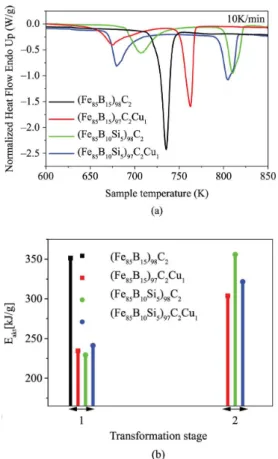
The transformation from amorphous state into the crystalline one takes place typically in more than one stage – at irst the ferromagnetic phases crystallizes, and subsequently the evolution of borides phases from the remaining amorphous matrix appears. The crystallization onset of the samples studied can be seen in Figure 1a as smooth decrease of normalized heat low. Shape of the transformation curves peaks relects the nature and the kinetics of these phase changes. The Fe-B-C alloy is an exception to this behavior as it exhibits only a single stage transformation at higher temperatures. This effect is similar to the one observed in Fe-B-P system18,19 – of additions of Cu to basic
Fe-B-P/Fe-B-C systems, which inluences the temperatures of crystallizations onsets. The crystallization in the Fe-B-C sample with addition of 1 at. % Cu (Figure 1a) splits into two stage transformation, where the irst stage appears at lower temperatures. Shape of the transformation curves relects
the nature and the kinetics of these phase changes. Other studied alloys exhibit two stage transformations where the irst stage takes place below 700 K and has the character of nanocrystallization20. The addition of Si affects the
stability of the amorphous remains, which was assessed by the temperature (time) interval between the two subsequent different transformations stages as studied by DSC.
Using the measured values of TMAX for both transformation stages in all samples, the activations energies EAKT were determined by the Kissinger method. The inluence of chemical composition on the EAKT of the transformations is shown in Figure 1b: the value for the irst reaction lies above 225 kJ/mol and for the second one between 300-360 kJ/mol, the impact of additions is unsystematic. Exception is found in the basic Fe-B-Si system, where the activation energy for this “polymorphous” transformation is around 350 kJ/mol. By the alloying it is possible to tune the structural and kinetic properties as well as the Curie temperature of the amorphous phase. The transition from ferromagnetic to paramagnetic state as measured by thermogravimetry (TGA) is seen in Figure 2. The downfall and the rise of the magnetic weight indicate the temperature of the change of magnetization and the growing amount of ferromagnetic phase. Comparison of the results shows an important inluence of Si and Cu on the phase transformation process – the TC for Fe-B-Si-C-Cu system is about 625 K.
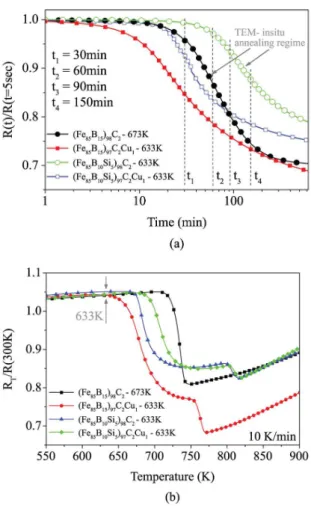
The thermal parameters and the different character of the transformations were also observed by the measurements of relative electrical resistivity dependency on temperature and time. Different kinetics of the irst crystallization stage as well as the shift of TX in temperature is shown for different compositions in Figure 3a. The temperature chosen for the XRD analysis (633 K) is marked in the igure, as well. Kinetics of structural changes was observed also by the resistivity evolution during isothermal annealing (Figure 3b), at 673 K for Fe-B-C sample and at 633 K for the other investigated samples. Higher annealing temperature is shown for the latter one, because this sample exhibits higher temperature of crystallization onset (TX higher than 700 K). By this experiment the annealing regime for the TEM observation by in-situ annealing as well as the times for the observation of inal structure were chosen.
Figure 1. (a) Temperature dependence of normalized heat low
measurement by DSC, for the systems with different chemical composition, inset shows the effect of separated additions in the base composition. (b) Activation energies for each transformation stage in studied systems determined by Kissinger method (DSC), accuracy of Eakt determination is better than +/– 5 kJ/mol.
The amorphous state of the as-quenched samples was checked by X-ray diffraction. The patterns from ribbons in the as-cast state exhibit only a typically broad hallo, Figure 4. After the isothermal annealing at 633 K/30 min the samples with Si content exhibit a growing amount of bcc-Fe phase as a product of the irst transformation. The phase evolution from the amorphous matrix for selected compositions - the base: Fe-B-C (Figure 5a); and the “full”: Fe-B-Si-C-Cu (Figure 5b) was investigated by XRD by in-situ annealing. The obtained XRD maps show clearly the comparison between the “polymorphous” transformation, where bcc-Fe and Fe3B are formed at the same time (Figure 5a), and the two stage transformation (Figure 5b), where the second step- the onset of evolution of Fe3B boride is shown as well.
Kinetics of structural changes has been observed also by resistivity evolution during isothermal annealing, shown in Figure 3b for 633 K. For the Fe-B-C sample the higher annealing temperature – 673 K was used, because this sample exhibits higher temperature of crystallization onset. Thermal regime for the TEM observation by in-situ annealing for the sample Fe-B-C (Figure 6) and Fe-B-Si-C (Figure 7) has been
selected on the basis of the time evolution of crystallization from Figure 3b. The aim of this experiment was to monitor the evolution of grain size and morphology with proceeding transformation and the differences due to the addition of Si into the basic Fe-B-C system. The growth of the crystalline phase at the expense of the amorphous matrix is illustrated in Figure 6. By comparison of the resulting structures the Figure 4. XRD patterns taken from the marked samples in as cast state and after isothermal annealing with interpretation of the diffracted peaks.
Figure 3. (a) Temperature dependence of the relative electrical resistivity for the systems with different chemical composition, marked - the temperature chosen for isothermal annealing for XRD analysis. (b) Evolution of relative electrical resistivity for the studied systems during isothermal annealing at 633 K and 673 K (t1=30 min, t2=60 min, t3=90 min, t4=150 min).
Figure 6. Structure evolution by TEM micrographs of rapidly quenched (Fe85B15)98C2 system observed during in-situ isothermal annealing 673 K at the time: t1=30 min, t2=60 min, t3=90 min, t4=150 min.
Figure 7. Structure evolution by TEM micrographs of rapidly quenched (Fe85B10Si5)98C2 system observed during in-situ isothermal annealing 633 K in time: t1=30 min, t2=60 min, t3=90 min, t4=150 min.
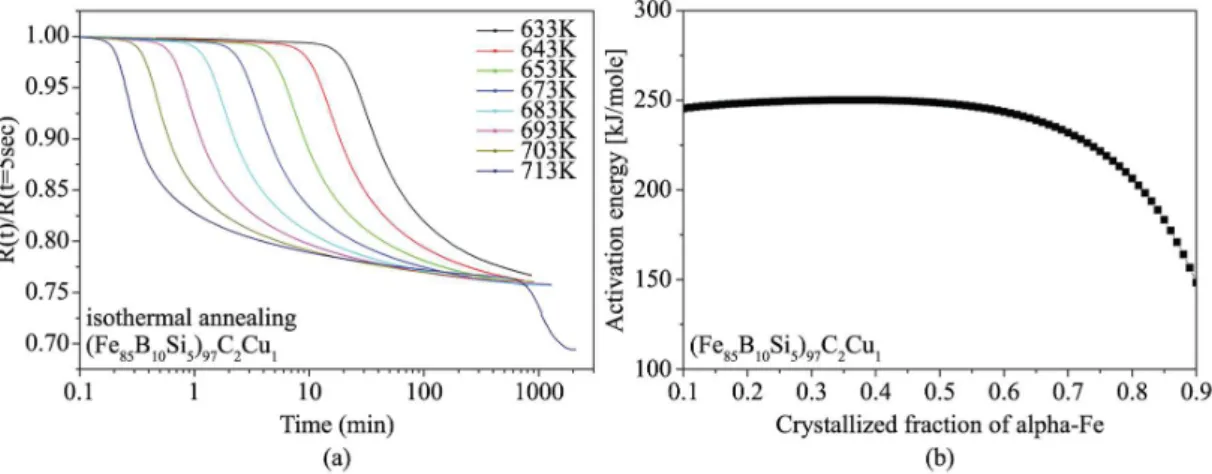
Figure 8. (a) Evolution of relative electrical resistivity for the Fe-B-Si-C-Cu system during isothermal annealing at marked temperatures. (b) Dependence of activation energy of crystallization of bcc-Fe during the irst stage of transformation.
effect of Si content is evident: the grains of bcc-Fe are smaller and more regular.
The dependence of activation energy (Figure 8) of crystallization of alpha-Fe during the irst stage of transformation of (Fe85B10Si5)97C2Cu1 was calculated according to Švec &
Kristiakova17 using the isothermal resistivity data shown
4. Conclusion
The study of transformation of the systems based on Fe-B-(Si)-C-(Cu) has indicated the inluence of individual addition or the combination of additions of Si and Cu into the basic Fe-B-C system on the grain size morphology and the inal structure. This complex metastable system transforms in two stages, as proved by resistivity changes. The exception is the Fe-B-C system where only a single stage transformation occurs. This can serve as a basis for the comparison with similar behavior of Fe-B-P system18,19.
Different contents of the ferromagnetic bcc-Fe phase are obtained using the same thermal processing depending on the chemical composition of the alloy. The addition of Si leads to the smaller and more regular bcc-Fe grains, which should guarantee to achieve improved magnetic properties (with low anisotropy) and increase of temperature interval between the two crystallization stages, resulting in a better stability of the ferromagnetic phase and the remaining
amorphous matrix, as desired. The addition of Cu makes a small shift of crystallization onset temperature. The used combination of additions in the Fe-B-Si-C-Cu sample have lead to the required stability increase and also to optimization of activation energy for transformation of the ferromagnetic phase. Therefore, this composition can be considered as perspective for use in practical applications and so that it will be the subject for further more detailed studies.
Acknowledgements
This work was supported by the Competence Centre for New Materials, Advanced Technologies and Energy, ITMS code 26240220073, supported by the Research and Development Operational Programme funded by the ESDF (75%). Projects VEGA 2/0189/14, APVV-0492-11, APVV-0647/10, APVV-0460-12 and CEX FUN-MAT are acknowledged for further support.
References
1. Yoshizawa Y, Oguma S and Yamauchi K. New Fe-based soft magnetic alloys composed of ultrafine grain structure. Journal of Applied Physics. 1988; 64(10):6044-6046. http://dx.doi. org/10.1063/1.342149.
2. Yoshizawa Y. Magnetic properties and microstructure of nanocrystalline Fe-based alloys. Materials Science Forum. 1999; 307:51-62. http://dx.doi.org/10.4028/www.scientific. net/MSF.307.51.
3. Makino A, Hatanai T, Inoue A and Masumoto T. Nanocrystalline soft magnetic Fe-M-B (M=Zr, Hf, Nb) alloys and their aplications. Materials Science and Engineering A. 1997; 226-228:594-602. http://dx.doi.org/10.1016/S0921-5093(96)10693-6.
4. Herzer G. Modern soft magnets: amorphous and nanocrystalline materials. Acta Materialia. 2013; 61(3):718-734. http://dx.doi. org/10.1016/j.actamat.2012.10.040.
5. Willard MA, Claassen JH, Stroud RM and Harris VG. Structure and magnetic properties of (Co,Fe)- based nanocrystalline soft magnetic materials. Journal of Applied Physics. 2002; 91(10):8420-8422. http://dx.doi.org/10.1063/1.1453946.
6. Yoshizawa Y, Fujii S, Ping DH, Ohnuma M and Hono K. Magnetic properties of nanocrystalline Fe-Co-Cu-M-Si-B alloys (M: Nb, Zr). Materials Science and Engineering A. 2004; 375-377:207-212. http://dx.doi.org/10.1016/j.msea.2003.10.227.
7. Willard MA and Daniil M. Nanocrystalline soft magnetic alloys two decades of progress. Handbook of Magnetic Materials. 2013; 21:173-342. http://dx.doi.org/10.1016/B978-0-444-59593-5.00004-0.
8. Zhang Z, Sharma P and Makino A. Role of Si in high Bs and low core-loss Fe85.2B10-XP4Cu0.8SiX nano-crystalline alloys. Journal of Applied Physics. 2012; 112(10):103902. http:// dx.doi.org/10.1063/1.4765718.
9. Shih JC, Bourgeois L, Suzuki K and Garitaonandia JS. Grain growth process of two-phase nanocrystalline soft magnetic materials. Journal of Magnetism and Magnetic Materials. 2006; 304(2):693-696. http://dx.doi.org/10.1016/j.jmmm.2006.02.173. 10. Svec P, Janotova I, Vlasak G, Janičkovic D, Marcin J, Kovac
J, et al. Evolution of structure and magnetic properties of rapidly quenched Fe-B based systems with addition of Cu. IEEE Transactions on Magnetics. 2010; 46(2):408-411. http:// dx.doi.org/10.1109/TMAG.2009.2034333.
11. Ohta M and Yoshizawa Y. Magnetic properties of high-Bs Fe-Cu-Si-B nanocrystalline soft magnetic alloys. Journal of Magnetism and Magnetic Materials. 2008; 320(20):750-753. http://dx.doi.org/10.1016/j.jmmm.2008.04.064.
12. Fan XD, Men H, Ma AB and Shen BL. Soft magnetic properties in Fe84−xB10C6Cux nanocrystalline alloys. Journal of Magnetism and Magnetic Materials. 2013; 326:22-27. http://dx.doi. org/10.1016/j.jmmm.2012.08.045.
13. Mat’ko I, Illeková E, Švec P and Duhaj P. Crystallization characteristics in the Fe-Si-B glassy ribbon system. Materials Science and Engineering A. 1997; 225(1-2):145-152. http:// dx.doi.org/10.1016/S0921-5093(96)10567-0.
14. Jen SU and Yang SM. Isothermal crystallization kinetics of amorphous Fe86B14 and Fe82B18. Journal of Magnetism and Magnetic Materials. 1988; 71(2):165-171. http://dx.doi. org/10.1016/0304-8853(88)90081-9.
15. Blázquez JS, Conde CF, Conde A and Kulik T. A direct extension of the Avrami equation to describe the non-isothermal crystallization of Al-base alloys. Journal of Alloys and Compounds. 2007; 434-435:187-189. http://dx.doi.org/10.1016/j.jallcom.2006.08.274.
16. Yuan ZZ, Chen XD, Wang BX and Wang YJ. Kinetics study on non-isothermal crystallization of the metallic Co43Fe20Ta5.5B31.5 glass. Journal of Alloys and Compounds. 2006; 407(1-2):163-169. http://dx.doi.org/10.1016/j.jallcom.2005.06.022.
17. Švec P and Kristiakova K. Crystallization of metallic glasses by continuous distribution analysis. Materials Science Forum. 2001; 360-362:475-480. http://dx.doi.org/10.4028/www. scientific.net/MSF.360-362.475.
18. Janotová I, Švec P, Mat’ko I, Janičkovič D and Švec P Sr. The structure of rapidly quenched Fe–Co–B–Si based systems and the influence of addition of Cu and P. Journal of Alloys and Compounds. 2014; 615:S198-S202. http://dx.doi.org/10.1016/j. jallcom.2013.12.044.
19. Janotová I, Hosko J, Švec P, Mat’ko I, Janičkovič D, Švec P Sr, et al. The study of structure of Fe-B-P based metallic glasses. Applied Surface Science. 2013; 269:102-105. http:// dx.doi.org/10.1016/j.apsusc.2012.10.110.