ISSN 0104-6632 Printed in Brazil
www.abeq.org.br/bjche
Vol. 25, No. 02, pp. 237 - 246, April - June, 2008
*To whom correspondence should be addressed
Brazilian Journal
of Chemical
Engineering
IMMOBILISATION OF
Bacillus subtilis
NRC33a
LEVANSUCRASE AND SOME STUDIES
ON ITS PROPERTIES
M. A. Esawy
1,2*, D. A. R. Mahmoud
1and A. F. A. Fattah
11Department of Chemistry of Natural and Microbial Products,
National Research Center, Dokki, Cairo, Egypt.
2
Laboratoire de Microbiologie IRD, IFR-BAIM, Universités de Provence et de la Méditerranée, Phone: +(33) (4) 9182-8573, Fax: +(33) (4) 9182-8570,
ESIL case 925, 13288 Marseille Cedex 9, France.
E-mail: [email protected], E-mail: [email protected]
(Received: April 02, 2007 ; Accepted: January 18, 2008)
Abstract - Bacillus subtilis NRC33a levansucrase was immobilised on different carriers using different immobilisation methods including physical adsorption, covalent binding, ionic binding and entrapment. The immobilised enzyme prepared by covalent binding on chitosan through 3% gluteraldehyde had the highest
immobilization yield (81.51%). Therefore, it was used as a typical example for Bacillus subtilis NRC33a
immobilised levansucrase and its properties were investigated. The time of the reaction and substrate concentration revealed that the activity of the immobilised enzyme was relatively lower than the free enzyme. The immobilised levansucrase showed a slight increase in activity compared with the free enzyme above
35°C. The activation energies were 6.62 and 9.27 kcal mol-1 for free and immobilised enzyme respectively.
Although the thermal stability of the immobilised levansucrase was significantly improved in comparison to the free form, the deactivation energy of the immobilised enzyme was lower than that of the free enzyme. The half life of the immobilised and free levansucrase was also determined. The effect of different pH values reported that at acidic pH the activity of the immobilised levansucrase was higher than that of the free enzyme. The study of pH stability of free and immobilised levansucrase showed that the immobilisation process protected the enzyme from alkaline and severe acidic media. The effect of various metal ions showed that the free levansucrase was more sensitive to the inhibitory effect of the investigated substances. Immobilised levansucrase retained 51.13% after 14 repeated uses.
Keywords: Immobilisation; Bacillus subtilis; Levansucrase; Fructooligosaccharides.
INTRODUCTION
Immobilisation is very important for commercial uses, where the immobilised enzyme can be reused and easily removed from the hydrolysed mixture. The immobilisation process may or may not change the properties of the immobilised enzyme (Clarke, 1994).
Levansucrase (EC 2.4.1.10) is a ß-D- fructosyltransferase enzyme and its activity is characterised by the formation of free fructose, oligosaccharides and polysaccharides (Chambert et al, 1974). According to Hettwer (1995) levansucrase
Brazilian Journal of Chemical Engineering
can be carried out by different methods, i.e. adsorption, covalent binding and gel entrapment. It was reported that the immobilisation of levansucrase from Zymomonas mobilis was done by different methods, like ionic binding, covalent binding, cross linking and matrix entrapment (Marx et al, 1999). The highest activity, stability, and immobilisation efficiency were in Ca-alginate beads. Also several researchers have introduced the immobilisation techniques of levansucrase using different immobilisation matrixes. It was found that the pure levansucrase from Bacillus subtilis was immobilised by covalent binding to glutraldehyde-activated amino silica and spherosil (Parlot and Mansen 1984). Immobilisation of levansucrase from Bacillus natto
was prepared by dipping the honeycomp-shaped ceramic support in an enzyme solution (Iizuka et al, 1993). Finally, it was found that levansucrase immobilisation on calcium alginate gel strongly increased its polymerase activity (Chambert and Petit-Glatorn, 1993).
In the present study, Bacillus subtilis NRC33a levansucrase was immobilised on different carriers using different methods of immobilisation including, physical adsorption, covalent binding and entrapment. The immobilised enzyme performed by covalent binding on chitozan through a 3% glutraldehyde had the highest immobilisation yield .Therefore, this immobilised enzyme preparation was used as typical example for Bacillus subtilis NRC33a immobilised levansucrase and its properties was investigated. Chitosan has been known as an ideal support for enzyme immobilisation because of its hydrophilicity, biocompatibilty, biodegradibilty, and anti-bacterial property (Durate et al, 2002, Karim and Hashinaga, 2002).
EXPERIMENTAL
Microorganism and Growth Condition
Bacillus subtilis NRC33a was obtained from the
Center of Cultures Collection of National Research Center (NRC). Nutrient agar medium was used for the culture maintenance and stock cultures. It had the following composition (g/L): peptone, 5.0; meat extract, 15.0; NaCl, 5.0; agar, 15.0; the pH was adjusted to 7.0. Unless otherwise specified, the following medium was used as culture medium for levansucrase production with some modification to obtain the optimized yield. This medium had the following composition: (g/L): Backers yeast, 20.0; sucrose, 200.0; MgSO4, 0.15; K2HPO4, 5.0;
completed by distilled water to L and the pH was
7.8 before autoclaving. The preparation of inoculum was done by adding 5 ml of sterile distilled water to 24-h old slants, which were scratched and transferred to each 300 ml Erlenmeyer flask. Cultivation of Bacillus subtilis
NRC33a was carried out in 300 ml Erlenmeyer flasks. Each containing 100 ml of the cellular production and sterilized for 15 min at 121°C. The flasks were then inoculated with 5 ml of inoculum. The preparation of inoculum was done by adding 5 ml of sterile distilled water to 24-h old slants, which were scratched and transferred to each 300 ml Erlenmeyer flask. The flasks were incubated in a static incubator for 24 h at 30°C. The culture broth was then centrifuged in a refrigerated centrifuge (JANEKTZKI, K70, Germany) to separate the bacterial cells from the culture medium. The final pH, the biomass production and protein content were determined.
Assay of Levansucrase
This was done according to the method of (Yanase et al, 1991) with some modification. 0.5 ml of culture filtrate was incubated with 1 ml of 20% sucrose and 1 ml of 0.1 M acetate buffer at pH 5.2 was incubated at 30°C for 15 min. The reducing sugars produced were measured by glucose oxidase kits.
One unit of enzyme activity was defined as the amount of enzyme that produces reducing sugars equivalent to 1µmol of glucose per min.
The presence of levansucrase was confirmed by paper chromatography and HPLC (Abdel-Fattah et al 2005).
Determination of Protein
It was estimated according to the method of Lowry et al, (1951).
Fractional Precipitation with Acetone
Brazilian Journal of Chemical Engineering Vol. 25, No. 02, pp. 237 - 246, April - June, 2008
Immobilisation Techniques
Physical Adsorption
It was carried out according to Woodward (1985). The carriers (1g) of chitosan, alumina, asbestos, and polyvinyl alcohol were incubated each with the 60% acetone enzyme fraction (100 U/g carrier) dissolved in 2.0 ml of 0.2 M acetate buffer (pH 5.2) at room temperature for 1 h. The unbound enzyme was removed from the carriers by washing three times with acetate buffer (pH 5.2).
Ionic Binding
It was carried out according to Woodward (1985). Whereas 1.0 g of each cation or anion exchangers Dowex 1-XB particle size 0.075-0.15 mesh, cellulose triacetate, DEAE-cellulose and sephadex A-50) was equilibrated with acetate buffer (0.2 M, pH 5.2), incubated with 2 ml of enzyme solution (100 U of the levansucrase).
Covalent Binding
It was carried out as follows, 1.0 g chitosan was shaken in 5ml 0.1M HCl containing 2, 3 or 5% (v/v) glutraldehyde (GA) for 2 h at 30°C. The solubilized chitosan was precipitated by addition of one ml of 0.1M NaOH. The precipitates were collected by filtration and washed with distilled water to remove the excess GA. The wet chitosan was mixed with 2.0 ml of enzyme solution (100 U levansucrase). After being shaken for h at 30°C, the unbound enzyme was removed by washing with distilled water.
Entrapment
Entrapment-in Ca-alginate beads was carried out according to Fraser and Bickerstaff (1997). Different concentrations of sodium alginate (1, 2, and 3%) were prepared by dissolving sodium alginate in distilled water. Then, 2 ml of the partially purified enzyme solution was mixed with 20 ml of each alginate solutions. The alginate-enzyme mixture was made into beads by dropping the alginate solution in 0.15 M CaCl2 as cross- linking agent. The beads
were left for further 20-30 min before collecting, washing with acetate buffer (0.2 M, pH 5.2) collecting and kept in the same buffer for a suitable time to remove the unbound enzyme. Entrapment in agar and agarose was carried out according to the method of Woodward (1985. Different concentrations of agar or agarose were prepared to give final concentrations of 2, 3 and 4% then the
enzyme solution was added. After solidification it was cut into 1 mm3 fragments and washed with acetate buffer (0.2 M at pH 5.2) to remove the unbound enzyme.
pH Stability and Thermal Stability
The pH stability of the free or immobilised enzymes was examined after pre-incubating the enzyme samples at 30°C for 60 min at different pHs, followed by adjusting the pH to the value of standard assay system. Then the residual activity was assayed under the standard conditions. The enzyme samples were incubated with acetate buffer (0.2 M, pH 5.2) at the design temperature (30-60°C) for 15 to 60 min and the residual activity was assayed under the standard conditions.
Operational Stability
It was performed with 1.0 g of immobilised levansucrase (wet) containing about 30 U of the enzyme. The immobilised form was incubated with 4 ml of sucrose substrate in acetate buffer (0.2 M, pH 5.2) at 30°C for 15 min. At the end of the reaction period, it was collected by centrifugation at 6000 rpm for 10 min, washed with distilled water and resuspended in 4 ml of freshly prepared substrate to start a new run. The supernatant was assayed for levansucrase activity.
Kinetic Studies
The Activation Energy (EA)
It was determined from the slope of linear representation of Log (VM) according to 1/T,
resulting from the Arrhenius law:
Log (VM) = Cte-EA/(RT).
The enzyme activity (VM) was expressed in Mol min-1, the temperature (T) in degree Kelvin (K), the gas constant (R=1.987) in cal K-1 mol-1, and the activation energy (EA) in cal mol-1.
The Deactivation Energy
Plotting activity data (Log of Ar (residual activity)/A0(initial activity) as a function of the time,
the deactivation rate constant (kd) was obtained.
From Arrhenius equation:
Brazilian Journal of Chemical Engineering
Plotting ln of kdas a function of the inverse of the
absolute temperature, the energy of deactivation (Ed)
is obtained as the product of the angular coefficient of the adjusted straight line times R, the universal gas constant.
Determination of the Half Life
Another important parameter related to enzyme stability is the enzyme half life (t1/2) which
corresponds to the time period necessary for the residual enzyme activity to decrease to 50% of its initial value. It can be calculated from the equation:
T1/2 = 0.693/kd
Immobilisation Yield (U/g carrier)
It was calculated from the equation:
Immobilised enzyme (U/g carrier) = Enzyme added (U/g carrier) - Unbound enzyme (U/g carrier) (%).
RESULTS AND DISCUSSION
Bacillus subtilis NRC33a was a good producer of
an inducible extracellular levansucrase, where the presence of levansucrase was confirmed by paper chromatography and HPLC. Fructose was shown to be the only component of the levan hydrolysate synthesized by levansucrase from Bacillus subtilis
NRC33a. This result was coincided with those of Gross et al (1999) and Abdel-Fattah et al (2005).
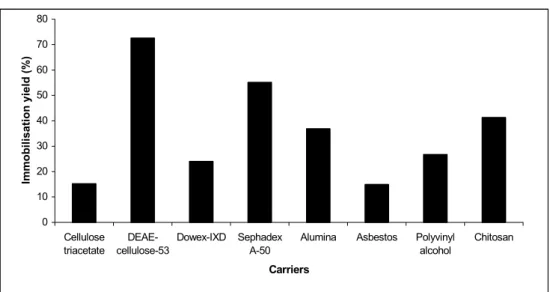
In the present study, Bacillus subtilis NRC33a levansucrase was immobilised on different carriers using different methods of immobilisation including, physical adsorption, covalent binding, ionic binding and entrapment. The immobilisation yield is the key parameter, since it represents the general output of the efficiency of the immobilisation process (Brinbaum, 1994). The enzyme fraction precipitated at 60% acetone showed the highest specific levansucrase activity (32.87, U mg-1 protein) which represented 2.49 fold purification of that of the culture filtrate and was thus selected for preparation of the immobilised partially purified levansucrase. The immobilisation by ionic binding (Figure 1) showed high immobilisation yield was exhibited by the enzyme immobilised on DEAE-cellulose-53 (72.55%) and sephadex A-50 (55.11%). On the other hand, the immobilised enzyme on cellulose triacetate and Dowex-IXD showed low immobilisation yield. Jang et al (2001) reported that the immobilisation of FTFase enzyme from Bacillus cereus by ionic binding on DEAE-cellulose-53 showed the highest immobilisation yield (75%). Mostafa (2006) obtained
approximately the same immobilisation yield (76.29 %) for FTFase from Zymomonas mobilis on titanium-activated magnetite. Also it was found that ȕ -galactosidase immobilized on DEAE-agarose and PEI-Sepabeads showed highest immobilisation yield (Pessela et al, 2003). Immobilisation of levansucrase by physical adsorption (Figure 1) reported low immobilisation yield in all the used carriers (Alumina, Asbestos, Polyvinyl alcohol, Chitosan). This could be due to the weak binding between the carriers and the levansucrase. On the contrary it was reported that the immobilised FTFase prepared by physical adsorption on polyvinyl alcohol (PVA) had the highest immobilisation yield (71.42 %) (Mostafa 2006) The data for the immobilisation of the extracellular levansucrase by entrapment (Figure 2) suggested that gradual increase of the carrier concentration led to decrease in entrapping efficiency and the immobilisation yield. This could be due to the decrease of porosity and consequently to the limited diffusion. Similar observations were previously reported for the entrapped Į-amylase (Abde-Naby; 1998, Mostafa, 2006).
The data for the immobilisation of the extracellular levansucrase by covalent binding (Figure 3) indicated a good immobilisation yield with chitosan through a spacer groups (gluteraldehyde) which showed good loading efficiency and good immobilisation yield (81.51%). The good loading efficiency for the immobilisation by covalent binding could be due to the formation of stable crosslinking between the carrier and the enzyme through spacer groups (gluteraldehyde) molecule. The results (Figure 3) showed that 3% gluteraldehyde crosslinking was found to be the best concentration to activate the support (chitosan) to give the highest yield of immobilised enzyme. It was reported that the amount of the immobilised glucose oxidase on chitosan was increased by increasing the length of the spacer groups (formaldehyde) (Yang et al 2004). On the contrary it was found that the best concentration of glutaraldehyde was 1% for ß-glactosidase activity immobilised on chitosan (Carrara and Rubiolo, 1994). The immobilised enzyme prepared by covalent binding on chitosan with 3% glutaraldehyde was used as a typical example for Bacillus subtilis
NRC33a immobilised levansucrase and its properties were investigated.
Brazilian Journal of Chemical Engineering Vol. 25, No. 02, pp. 237 - 246, April - June, 2008
0 10 20 30 40 50 60 70 80
Cellulose triacetate
DEAE-cellulose-53
Dowex-IXD Sephadex A-50
Alumina Asbestos Polyvinyl alcohol
Chitosan
Carriers
Im
m
o
b
ilisatio
n
yield
(%
)
Figure 1: Immobilisation of the partially purified levansucrase from
Bacillus subtilis NRC 33a by ionic binding and physical adsorption.
0 5 10 15 20 25 30 35 40 45
Agar Agarose Calcium alginate
Immo
bi
li
sat
ion yi
e
ld (
%
)
1%
2% 3%
Carrier
Figure 2: Immobilisation of the partially purified levansucrase from Bacillus subtilis
NRC 33a by entrapment in agar, agarose and calcium-alginate.
Figure 3: Immobilisation of the partially purified levansucrase from
Brazilian Journal of Chemical Engineering
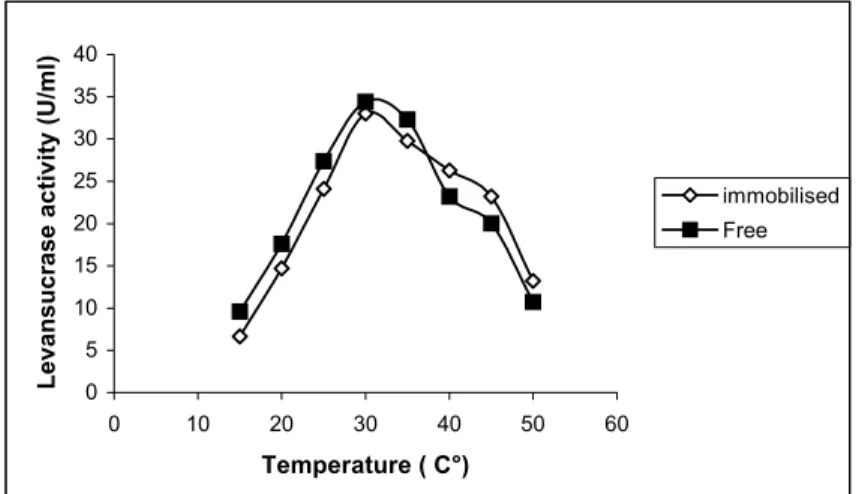
The results (Figure 4) showed that the free enzyme had higher activity (U/ml) than the immobilized enzyme up to 35°C after that the immobilised enzyme was more stable and showed a slight increase in activity. The immobilised enzymes by covalent binding (multiple point attachment) resulted in an increase of the enzyme rigidity, which is commonly reflected by increase in stability toward denaturation (Gottschalk and Jaenicke, 1991). The activation energy of the free and immobilised enzymes obtained from Arrhenius plots were 6.62 and 9.27 kcal /mol respectively (Figure 5). The higher values of activation obtained for the immobilised levansucrase indicated that the applied immobilisation procedures
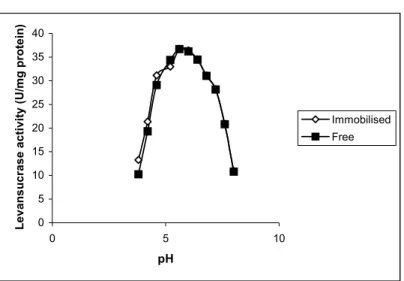
introduced changes in the structure of the enzyme molecule which impeded the enzyme catalyzed reaction (Krajewsk et al, 1990). Similar result was reported by (Gottschalk and Jaenicke 1991) whereas the activation energy of the free Į-amylase was lower than the immobilised form. The investigation of the free and immobilised enzymes at different pHs (Figure 6) showed that the activity (U/ml) of the immobilised enzyme was similar to the free enzyme. It was observed that the immobilisation process -to some extent-protected levansucrase in the acidic range.(from pH 3.8 up to 4.6). It was observed that the immobilisation process protected FTFase in the acidic range (Mostafa, 2006).
0 5 10 15 20 25 30 35 40
0 10 20 30 40 50 60
Temperature ( C°)
Levansucr
ase ac
tivity
(U/ml)
immobilised
Free
Figure 4: Effect of temperature on the activity of the free and immobilised
levansucrase from Bacillus subtilis NRC 33a.
0 0.5 1 1.5 2 2.5
3.25 3.3 3.35 3.4 3.45 3.5
1000/T (1/K)
Log relative
activity
Figure 5: Arrhenius plot of activation rate constant of the free (Ŷ) and immobilised
Brazilian Journal of Chemical Engineering Vol. 25, No. 02, pp. 237 - 246, April - June, 2008
0 5 10 15 20 25 30 35 40
0 5 10
pH
L
evan
su
cr
as
e activi
ty
(U
/m
g
p
ro
tei
n
)
Immobilised
Free
Figure 6: Effect of different pH values on the free and immobilised
levansucrase from Bacillus subtilis NRC 33a.
The results in (Figure 7) showed that although the thermal stability of the immobilised levansucrase was significantly improved in comparison to the free form, the immobilised enzyme at 50°C lost the activity faster than the free form (15-60 min). This result could be explained that the rate constant of that part of the free enzyme that is still active, continues to increase with temperature (Tijskens et al, 2001). This interpreted the low value of the deactivation energy of the immobilised enzyme (14.1 kcal/mol) in comparison to the free enzyme (21.6 kcal/mol) at 50, 55, 60°C respectively (Figure. 7, 8). It was reported that Ed of the immobilised acid phosphatase is low
compared to the free enzyme (Chang and Juang, 2004). On the contrary it found that the Ed of the
immobilised invertase was higher than the free form (Bassetti et al, 2000). The half life were 231, 115.5, and 69.3 min for immobilised levansucrase at 50, 55 and 60°C respectively. The half life of the free enzyme were 161.6, 115.5 and 80.6 min at the same previous temperatures respectively.
Study of the pH stability (result not shown) showed that the immobilisation process protected the levansucrase from alkaline and severe acidic media. Similar result was reported by (Bryjac, 2003). The effect of various metal ions on the activity of the immobilised Bacillus subtilis
NRC33a levansucrase as compared to the native enzyme (Table 1) exhibited a reverse relationship between most of the metal ions concentration and relative activity of the enzyme. The native enzyme was more sensitive to the inhibitory effect of the investigated substances. This may be due to the protection of the immobilised enzyme by the immobilisation matrix and hence the inhibiting reagents become less accessible to the enzyme active site (Akosy et al, 1998). The operational stability of the immobilised extracellular partially purified levansucrase was evaluated in repeated batch process (Figure 9). The performance of the immobilised enzyme indicated the durability of the catalytic activity in repeated use more than 14 cycles. The retained catalytic activity after being used for 14 cycles was 56% of the initial value of the immobilised enzyme. In this respect Marx et al (1999) showed that the immobilisation process of levansucrase of Zymomonas mobilis on Ca-alginate registered an operational stability of at least 600 h, during this time, only a negligible loss of activity could be observed. It was reported by (Jang et al, 2001) that the immobilised levansucrase of
Zymomonas mobilis expressed in Escherichia coli
Brazilian Journal of Chemical Engineering
0 0.5 1 1.5 2 2.5
0 20 40 60 80
Time
Log
rel
a
ti
v
e
ac
ti
v
it
y
Time
Lo
g r
e
la
ti
ve
act
iv
it
y
(a)
0 0.5 1 1.5 2
0 20 40 60 80
Time
Log r
el
at
iv
e ac
ti
v
it
y
Time
Log r
e
lati
ve
activ
ity
(b)
Figure 7: First-order plots of thermal inactivation of immobilised (a) and free (b) levansucrase
-6 -5.5 -5 -4.5 -4
2.98 3 3.02 3.04 3.06 3.08 3.1 3.12
1000/T (1/K)
ln
kd
Figure 8: Arrhenius plot of deactivation rate constant of free (ƒ) and immobilised
(Ɠ) levansucrase from Bacillus subtilis NRC33a.
Table 1: Effect of the addition of different concentrations of some metal ions on the activity of the free and immobilised levansucrase.
Metal ion conc (Mm)
Relative activity of immobilized enzyme %
Relative activity of free enzyme %
Metal salts 0.1 1.0 10.0 0.1 1.0 10.0
Control 100 100 100 100 100 100
CuSO4 75 63 35 70 58 21
FeCl3 92 79 65 87 71 60
HgCl2 46 39 21 39 25 9
EDTA 100 100 100 100 100 100
SDS 89 79 52 86 73 48
Mn2Cl 122 104 95 130 100 98
NaCl 80 71 50 74 60 45
AgCl 62 33 0 51 29 5
MgSO4 100 99 88 100 93 79
0 20 40 60 80 100 120
0 5 10 15
Run number
R
e
la
ti
v
e
a
c
ti
v
ity
(
%
)
Run number
Rel
a
ti
ve
ac
ti
vi
ty
(%
)
Brazilian Journal of Chemical Engineering Vol. 25, No. 02, pp. 237 - 246, April - June, 2008
CONCLUSIONS
The overall performance of the immobilised extracellular partially purified levansucrase stability is rather promising than the free enzyme. Thus, it suggests that Bacillus subtilis NRC33a extracellular partially purified levansucrase immobilised on chitosan by covalent binding is suitable for practical application.
ACKNOWLEDGEMENTS
We wish to thank Dr. A. HIRSCHLER-REA from Universities de Provence et de la Mediterranee Laboratoire de Microbiologie IRD (France) and E. ASSIH from University of Ouagadougou (Burkina-Faso) for their careful revision of the manuscript.
REFERENCES
Abde-Naby, M. A., Immobilisation of Bacillus
subtilis Į-amylase and Characterization of its
Enzymatic Properties. Microbial Research. 153, 319-325 (1998).
Ahmed, F., Abdel-Fattah, Doaa, A., R., Mahmoud and Mona, A. T, Esawy Production of Levansucrase from Bacillus subtilis NRC 33a and Enzymic Synthesis of Levan and Fructo-Oligosaccharides Current. Microbiology. 51, 402-407 (2005).
Akosy, S., Tumturk, H and Hasirci, N., Stability of
Į-Amylase Immobilised on Poly (methyl methacrylate-acrylic a Acid) microspheres, Journal of Biotechnology 60,37-46 (1998).
Bassetti, F. J., Bergamasco, R., Moraes, F. F. and Zanin, G. M., Thermal Stability and Deactivation Energy of Free and Immobilised Enzyme, Brazilian Journal of Chemical Engineering 17, 4-7 (2000). Bickerstaff, G. F., Immobilisation of Enzyme and
Cells, Methods in Biotechnology Human Press, 1-12 (1997)
Birnbaum, S., Immobilized Enzymes and Cells in Biochemical Reactions. In: Immobilized Biosystems: Theory and Practical Applications. Blackie and Professional (1994).
Bryjac, J., Glucoamylase, Į-Amylase and ȕ-Amylase Immobilisation on Acrylic Carriers, Biochemical Engineering Journal 16, 347-355 (2003).
Carrara, C. R.and Rubiolo, A., The Immobilisation of ȕ-Galactosidase on Chitosan. Biotechnology. Prong 10, 220-224 (1994).
Clarke, D. S., Can Immobilisation be Exploited to Modify Enzyme Activity. Trend Biotechnology 12, 439-443 (1994).
Chambert, R. G., Treboul G. and Dedonder, R., Kinetic Studies of Levansucrase of Bacillus
subtilis. European Journal of Biochemistry 41,
285-300 (1974).
Chambert, R. and Petit-Glatorn, M.F., Immobilisation of Levansucrase on Calcium Phosphate Gel Strongly Increases its Polymerase Activity, Carbohydrate Research 244, 129-36 (1993).
Chang, Y. M and Juang, S. R., Stability and Catalytic Kinetics of Acid Phosphatase Immobilised on Composite Beads of Chitosan and Activated Clay, Process Biochemistry, 39, 1087-1091 (2004).
Durate, M. L., Ferreira, M. C. and Marvao, M. R., An Optimised Method to Determine the Degree of Acetylation of Chitin and Chitosan by FTIR Spectroscopy, International Journal of Biological Macromol 31, 1-8 (2002).
Fraser, J. E and.Bickerstaff G. F., Immobilisation of Enzymes and Cells. Methods in Biotechnology 1, 61-66. (1997).
Gottschalk, N. and Jaenicke, R. Authenticity and Reconstitution of Immobilized Enzymes: Characterization and Denaturation/Renaturation of Glucoamylase II. Biotechnology and Applied Biochemistry,14, 324-335 (1991).
Hettwer, U., Gross M., and Rudolph, K., Purification and Charcaterization of an Extracellular Levansucrase from Pseudomonas syringae
pv.Phaseolicola, Journal of Bacteriology 177,
2834-2839 (1995).
Jang, K. H., Song, K. B., Park, B. S., Kim, C. H., Chung, B. H., Choue, R. W., Lee K. S., Lee, C., Chun. U. K. and Rhee, S. K., Levan Production by Use of the Recombinant Levansucrase Immobilised on Titanium- Activated Magnetite, Process Biotechnology 37, 339-343 (2001). Iizuka, M., Yamaguchi, H., Ono, S. and Minamiura,
N., Production and Isolation of Levan by Use of Levansucrase Immobilised on the Ceramic Support SM-10. Bioscience. Biotechnology and Biochemistry 57, 322-324 (1993).
Karim M. R. and Hashinaga F., Preparation and Properties of Immobilised Pummelo Limonoid Glucosyltransferase. Process Biochemistry, 38, 809-14. (2002).
Brazilian Journal of Chemical Engineering
Lowry, O. H., Rosebrough, N. J., Farr, A. L. and Randall, R. J., Protein Measurement with the Folin Phenol Reagent. Journal of Biological Chemistry,193,265- 275 (1951).
Marx, S., Koning, S. and Hartmeier, W., Synthesis of Fructooligosaccharrides by Native and Immobilised levansucrase from Zymomonas mobilis. Thirteenth Forum for Applied Biotechnology Hept Pand Belgium Proceedings, 64, 246-251 (1999).
Mostafa, F. A. A, Microbiological and Biochemical Studies on Bacterial Fructosyltransferase Ph.D Thesis, Cairo, Egypt, Faculty of Science, Ain-Shams University (2006).
Parlot P. and Mansen, P., Production, Purification, and Immobilisation of Bacillus sublits levansucrase, Ann NYAcad Sci 434 pp. 468-471 (1984).
Pessela, B. C. C., Lafuente R. F., Fuentes, M., Vian, A., Garcia, J. L., Carrascosa, A. V Mateo, C. and Guisan, J. M. Reversible Immobilisation of a Thermophilic B-Galactosidase Via Ionic
Adsorption on PEI coated sepabeads, Enzyme and Microbial Technology 32, 369-374. (2003). Tijskens, L. M. M., Greiner, R.., Biekman, E. S. A.,
Konietzny, U., Modeling the Effect of Temperature and pH on Activity of Enzymes: The Case of Phytases, Biotechnology and Bioengineering 72, 323-330 (2001).
Woodward, J., Immobilised Cells and Enzymes: a Practical Approach, p. 44, Oxford, IRL, Press Limited, England. (1985).
Yang, Y. M., Wang J. W. and. Tan, R. X., Immobilization of Glucose Oxidase on Chitosan -SiO2 gel, Enzyme and Microbial Technology 34,
126-131 (2004).
Yanase, H., Fukushi, H., Ueda, N., Maeda, Y., Toyoda, A. and Tonomura, K., Cloning, Sequencing, and Characterization of the Intracellular Invertase Gene from Zymomonas
mobilis, Agricultural and Biological Chemistry