ISSN 0104-6632 Printed in Brazil
www.abeq.org.br/bjche
Vol. 25, No. 02, pp. 247 - 253, April - June, 2008
*To whom correspondence should be addressed
Brazilian Journal
of Chemical
Engineering
EFFECT OF DISSOLVED OXYGEN
CONCENTRATION ON RED PIGMENT
AND CITRININ PRODUCTION BY
Monascus purpureus ATCC 36928
D. G. Pereira, A. Tonso and B. V. Kilikian
*Departamento de Engenharia Química, Escola Politécnica, Universidade de São Paulo, Fax: +(55) (11)30912284; C. P. 61548, CEP: 05424-970, São Paulo - SP, Brazil.
E-mail: [email protected]
(Received: August 14, 2006 ; Accepted: January 18, 2008)
Abstract - The present study investigated the effects of agitation speed, N (200, 500, 600 or 700 rpm), and dissolved oxygen concentration, C (120, >70, 70, 60, 10 or 10%), on red pigment and citrinin production by
Monascus purpureus ATCC 36928, cultivated in liquid medium by a batch process. The gas flow rate was the same for all runs with C controlled by means of the incoming gas composition control (air/N2 or air/O2). From
the response surface plots it can be verified that the effect of C was greater than that of N on the production of both metabolites. The absorbance for red pigments varied from 1.6 U (C 10%; N=200 rpm) up to 3.3 U (C=60%; N=600 rpm), an increase of 106%, while citrinin concentration increased 257%, from 14.2 to 50.7 mg.L-1. The most appropriate conditions were C=60% and N=600rpm, under which the highest red pigment absorbance (3.3U) and half of the highest citrinin concentration were obtained.
Keywords: Agitation speed; Citrinin; Dissolved oxygen; Monascus; Red pigments.
INTRODUCTION
The filamentous fungus Monascus sp. produces
several secondary metabolites, including at least six pigments: two yellow-colored (ankaflavin and monascin), two orange-colored (rubropunctatin and monascorubrin) and two red-colored (rubropunctamine and monascorubramine) (Wong and Koehler, 1983). The other secondary metabolites comprise an anticholesterolemic molecule, antibiotics and
antitumorals (Juslová et al., 1996).
Red pigments have been successfully employed as total or partial substitutes of nitrate and nitrite salts in coloration, flavoring and preservation of red meat, on account of their bacteriostatic properties and mostly because the inorganic colorant used, nitrosamine, is a carcinogenic substance (Bakošová et al., 2001).
The majority of Monascus sp. secrete a
mycotoxin, citrinin, which rules out the use of the red pigments. Citrinin synthesis depend on the Monascus strain, carbon source, nutritional factors (yeast extract and rice are enhancers) and environmental factors (oxygen and temperature) (Xu et al., 2006; Wang et al., 2003; Hajjaj et al., 2000a).
Some strategies to reduce the levels of citrinin in Monascus fermentations include genetic modification, degradation of the mycotoxin, the use of nonproducing strains and the manipulation of submerged culture conditions (Hajjaj et al., 1999; Hajjaj et al., 2000b; Lakrod et al., 2000).
Brazilian Journal of Chemical Engineering
molecule in the cytosol. Oxidation of orange-colored molecules yields the yellow-colored pigments and complexation with L-glutamate renders the red pigments (Lin and Demain, 1991; Hajjaj et al., 1999). Although pigments and citrinin are derived from the same tetraketide, the independent level of production of each suggests that the enzymes involved in their synthesis have independent regulatory mechanisms of their genes (Pisareva et al., 2005); therefore, a given reduction in citrinin synthesis does not correlate with an increase in red pigments.
Production of secondary metabolites by filamentous microorganisms is affect by respiration
rate and hyphal morphology (Pamboukian et al.,
1998), which makes oxygen transfer rate and N variables relevant to the process. Oxygen transfer rate can be enhanced by N or gas flow rate, by pressurizing the reactor or by sparging air enriched with oxygen. Nevertheless, except air enrichment with oxygen, all others affect shear stress, which, in
turn, causes morphological changes (Cui et al., 1998;
Amanullah et al., 1999). Therefore, ideally, the effect
of respiration rate influence should be studied keeping N and gas flow rate constant.
A few authors have studied the independent effects of dissolved oxygen concentration, N or gas flow rate on secondary metabolite production by
filamentous microorganismS (Cui et al., 1998;
Yegneswaran et al., 1991).
The present study investigated the independent effects of N and dissolved oxygen concentration, C, on
red pigment and citrinin production by Monascus
purpureus ATCC36928. In order to maintain constant the shear stress from the incoming gas flow and to maintain a given C value, the gas flow rate was the same for all runs and composition was varied by means
of the control of an air/N2 or air/O2 stream. Gas
composition was varied after a growth phase with no oxygen limitation so as not to impair cell growth and above all, to be able to analyze the effect of C and N on only red pigment and citrinin production.
MATERIALS AND METHODS
Microorganism and Storage
Monascus purpureus ATCC 36928 was obtained from Centro de Culturas Tropicais (CCT) at Fundação Tropical de Pesquisas André Tosello
(Campinas, SP, Brazil) as Monascus purpureus CCT
3802. Suspended hyphae, grown in complex liquid medium, were added to glycerol 20% (v/v), (1:1) and kept at -80ºC.
Culture Media
The complex medium was composed of (g . L-1):
glucose, 10; meat extract, 3; peptone, 5.
The semi-synthetic medium was composed of (g .
L-1): MgSO4.7H2O 4.8; KH2PO4 1.5; K2HPO4 1.5;
ZnSO4.7H2O 0.01; monosodium glutamate 7.6; NaCl
0.4; FeSO4 0.01; yeast extract 1.0; glucose 10.0.
(Pereira and Kilikian, 2001).
The media were prepared with distilled water in two fractions: one with glucose and the other with the remaining nutrients. The pH was adjusted to 5.5 prior to sterilization at 121º C for 20 minutes.
Inoculum
A volume of 80 mL of semisynthetic medium in 500 mL Erlenmeyer flasks was inoculated with 24 mL of a defrosted cell suspension and incubated in a rotary shaker at 30ºC, 300 rpm for about 35h, when cells were at the end of the exponential phase.
Culture Conditions
Seven batch cultures were carried out in Bioflo III reactors (New Brunswick Scientific, Edison, NJ) with 4 L of working volume at 500 rpm (N), 30ºC, pH 5.0
r0.3 and a total gas flow rate of 4 L . min-1. During the
first 25 to 30 h of cultivation, when cells were growing and red pigment production had not exceeded 0.1 U of absorbance, C was not controlled and varied between 70 and 100% of saturation concentration relative to air. Then, N and dissolved oxygen concentration, C, were changed as indicated in Table 1 and maintained throughout the end of the culture.
Analytical Methods
a) Cell Concentration (X)
Cell dry weight was measured by means of
filtration through a 1.2 Pm membrane. The filtrate
was further analyzed for glucose and citrinin concentration and red pigment absorbance.
b) Citrinin Concentration (Cc)
The filtrate was added to a C-18 PBondapak
column (10 P, 3.9 mm, 300 mm, Waters) in a
gradient eluent flow of water and methanol
(0.5 mL/min, 25ºC). The UV absorbance was
measured at Ȝ of 330 nm. A calibration curve, 0.1
to 100 mg.L-1, was obtained with pure citrinin
Brazilian Journal of Chemical Engineering Vol. 25, No. 02, pp. 247 - 253, April - June, 2008 c) Red Pigment (P)
The highest absorbance (U) was measured for Ȝ
between 485 and 500 nm with a scanning spectrophotometer (Beckman, DU 530 UV/Vis).
Dissolved Oxygen Concentration (C)
Dissolved oxygen concentration (C) was monitored with an InPro6100 oxygen sensor (Mettler-Toledo GmbH, Switzerland) and expressed
as a percentage of saturation relative to air (Figure 1). A blend of oxygen and air at a fixed total flow
rate of 4L . min-1, was sprayed into the bioreactor at
a constant agitation rate in order to keep shear stress constant. Two mass flow controllers (5850E, Brooks Instruments) were used to adjust the flow rate of each gas, according to an algorithm written in LabVIEW 6i (National Instruments) to control the C value by adjusting the oxygen molar fraction in the inlet gas. Alternatively, nitrogen, instead of oxygen, was used to control low C levels.
C (%) QT: Air +
O2 or N2
Air flow
controller LabVIEW
O2 or N2 flow
controller Q1
Q2
Figure 1: Schematic diagram of dissolved oxygen concentration (C) data acquisition and
control system, applied in the batch cultures: Q1: air flow rate; Q2: O2 or N2 flow rate;
QT: air plus oxygen or nitrogen flow rate (constant).
RESULTS AND DISCUSSION
In Table 1 the seven runs performed are identified and the results of the highest cell concentration
(Xmax) and red pigment absorbance (P) are shown.
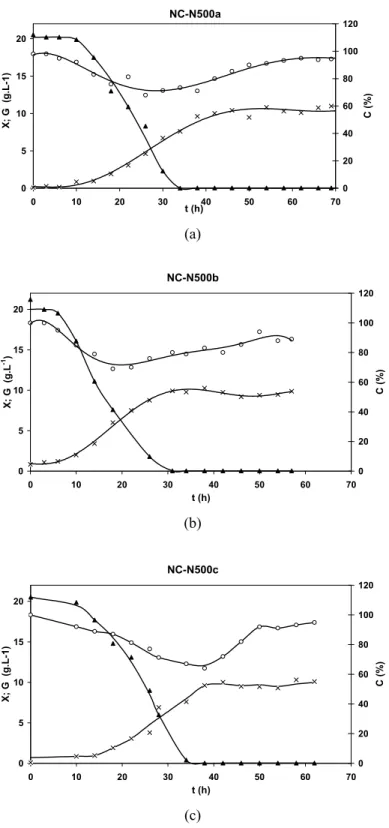
The reproducibility of the cultures was analyzed for three standard batch runs (NC-N500 a, b and c, Figures 2 and 3) conducted simultaneously with some of the seven runs.
It is possible to conclude that there was
reproducibility because the highest cell concentration of
10g . L-1 was reached at around 40h, glucose depletion
at around 35h, the lowest dissolved oxygen concentration of 70% at around 25 h of cultivation and the hoghest absorbance for red pigments of 2.8U at around 50 h in all of the three runs. In addition, red pigment production began in the middle of the cell growth phase and continue after cell growth had ceased, in a pattern typical of secondary metabolite synthesis, which was verified in all runs, as depicted in Figure 3.
Table 1: Identification, characteristics and results of the runs.
Identification N (rpm) C (%) Xmax
(g.L-1)
P (U)
NC - N200 200 5 < C < 10 9.8 1.8
C70 - N200 200 70 10.0 2.2
NC - N500 500 70 < C < 100 10.1 2.8
C120 - N500 500 120 10.0 1.6
C60 - N600 600 60 10.0 3.3
C10 - N700 700 10 10.0 2.3
NC - N700 700 70 < C < 100 9.8 3.1
Brazilian Journal of Chemical Engineering 0
5 10 15 20
0 10 20 30 40 50 60 70
t (h)
X;
G
(g
.L
-1
)
0 20 40 60 80 100 120
C
(
%
)
NC-N500a
(a)
NC-N500b
0 5 10 15 20
0 10 20 30 40 50 60 70
t (h)
X;
G
(g
.L
-1)
0 20 40 60 80 100 120
C
(
%
)
B
(b)
NC-N500c
0 5 10 15 20
0 10 20 30 40 50 60 70
t (h)
X
;
G
(g
.L
-1
)
0 20 40 60 80 100 120
C
(
%
)
C
(c)
Figure 2: Dissolved oxygen concentration (C, ż), cell concentration (X, x) and glucose
concentration (G, Ÿ) in standard batch runs [NC-N500a (A), NC-N500b (B)
Brazilian Journal of Chemical Engineering Vol. 25, No. 02, pp. 247 - 253, April - June, 2008
NC-N500 a, b, c
0.00 0.50 1.00 1.50 2.00 2.50 3.00 3.50
0 10 20 30 40 50 60 70
t (h)
Pv
(U
)
Figure 3: Absorbance of red pigments (P) in standard batch runs [NC-N500a (A),
NC-N500b (B) and NC-N500c (C)] of Monascus purpureus ATCC 36928.
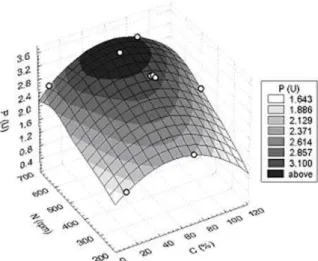
In order to analyze the effect of N (agitation speed) and C (dissolved oxygen concentration) on red pigment
(P) and citrinin (Cc) production, results of the seven
batch runs performed were arranged in response surface plots (Figure 4). For runs without C control, C corresponds to the average value of dissolved oxygen concentration throughout the production phase with the standard deviation being less than 12%.
As can be observed in Figure 4, the effect of dissolved oxygen concentration, C, was greater than that of agitation speed on red pigment production. The highest values of absorbance were achieved for high C values of around 60%, which is in accordance with oxygen dependence of the metabolic pathway for polyketides. However, for oxygen concentrations
higher than 60%, red pigment production was reduced up to 51% for C as high as 120%. This is possibly due to the oxidation of the orange colored pigment yielding the yellow colored pigments instead of the red ones (Lin and Demain, 1991). Morphological measurements as hyphal length and degree of branching, were made, but no reliable correlation with red pigment production was found (data not shown). In Figure 5 it can be observed that an increase in C (10 to 60% and 80%) results in a five fold in citrinin
production, from 17.5 up to 93.4 mg.L-1,
whileproduction of red pigments almostdoubled. As
well, CC values almost did not change for C values
higher than 80%, including 120%. Agitation speed had
no effect on CC production.
Figure 4: Response surface plots for the effect of dissolved oxygen concentration (C) and agitation speed (N)
on red pigment production (P) by Monascus purpureus ATCC 36928 in batch cultures (cultivation time=60 h).
Brazilian Journal of Chemical Engineering
Figure 5: Citrinin concentration (Cc), red pigment absorbance (P) and the ratio of red pigments to citrinin (P/Cc)
as a function of dissolved oxygen concentration (C) for Monascus purpureus ATCC 36928 batch cultures.
Citrinin production was also strain and culture medium-dependent. Twenty-nine strains of Monascus sp., belonging to four species (M. ruber, M. purpureus, M. anka and M. rubiginosus), were cultivated in our laboratory in the same semisynthetic liquid medium employed in the runs presented in this paper, with the production of
citrinin by Monascus purpureus ATCC 36928 being
the highest (47.7mg/L) and the lowest, for nine
strains was bellow 0.1mg . L-1. Considering that the
lowest citrinin concentration in the present runs was
about 20mg . L-1, certainly the strain used for
production must be carefully identified from the strains with a lower citrinin production than that of Monascus purpureus ATCC 36928. Choosing the strain which had the highest citrinin production for the present runs enable analysis of the effect of C on citrinin production.
Although an ideal situation, high P and low Cc
values simultaneously, is not possible, the best conditions for red pigment production, C=60% and N=600 rpm, correspond to those for half of the highest citrinin concentration. The relationship between red pigment, citrinin production and oxygen
concentration must be examined for other Monascus
strains.
CONCLUSIONS
The effect of dissolved oxygen, C, on red pigment and citrinin production was greater than that
of agitation speed, N. Red pigment absorbance
increased 106%, from 1.6 U at C10% and
N=200rpm up to 3.3 U at C=60% and N=600 rpm. Under the same conditions of aeration and agitation, citrinin production increased 257%, from 14.2 to
50.7 mg.L-1, showing that C had a greater effect on
citrinin than on red pigment production.
Despite this behavior, the highest red pigment absorbance, 3.3U, corresponds to a citrinin concentration that is 50% lower than the maximum production, which is achieved at C=60% and N=600rpm, indicating the relevance of an appropriate concentration of oxygen.
Furher studies on the effects of dissolved oxygen concentration and shear stress on red pigment and citrinin production for low citrinin and high red
pigment Monascus strains must be done.
ACKNOWLEDGEMENTS
This work was supported by FAPESP (Fundação de Amparo à Pesquisa do Estado de São Paulo).
NOMENCLATURE
C dissolved oxygen
concentration
%
Cc citrinin concentration mg . L-1
G glucose concentration g . L-1
Brazilian Journal of Chemical Engineering Vol. 25, No. 02, pp. 247 - 253, April - June, 2008
Q2 oxygen or nitrogen flow rate NLPM
QT air plus oxygen or nitrogen
flow rate
NLPM
N agitation speed rpm
NC runs without dissolved
oxygen concentration control
(-)
NLPM normal liter per minute (-)
P absorbance of red pigments U
X cell concentration g . L-1
Xmax maximum cell concentration g . L-1
REFERENCES
Amanullah, A., Blair, R., Nienow, AW., Thomas, C.R., Effects of agitation intensity on mycelial morphology and protein production in chemostat
cultures of recombinant Aspergillus oryzae,
Biotechnology and Bioengineering, 62, pp. 434-446 (1999).
Bakošová, A., Máté, D., Laciaková, A, Pipová, M.,
Utilization of Monascus purpureus in the
production of foods of animal origin, Bull. Vet. Inst. Pulawy, 45, pp. 111-116 (2001).
Cui, Y. Q., Lans, R. G. J. M., Luyben, K. A. M., Effects of dissolved oxygen tension and mechanical forces on fungal morphology in submerged fermentation, Biotechnology and Bioengineering, 57, pp. 409-419 (1998).
Hajjaj, H., Blanc, P. J., Groussac, E., Goma, G., Uribelarrea, J. L., Loubiere, P., Improvement of red pigment/citrinin production ratio as a function
of environmental conditions by Monascus ruber.
Biotechnology and Bioengineering, 64 (4), pp. 497-501 (2000a).
Hajjaj, H., Klaebe A., Loret, M. O., Goma, G., Blanc, P. J., François, J., Biosynthetic pathway of
citrinin in the filamentous fungus Monascus
ruber as revealed by 13C nuclear magnetic resonance, Applied Environmental Microbiology, 65, pp. 311-314 (1999).
Hajjaj, H., Klaébé, A., Goma, G., Blanc, P.J., Barbier, E., François, J., Medium-chain fatty acids affect citrinin production in the filamentous
fungus Monascus rubber, Applied Environmental
Microbiology, 66 (3), pp. 1120-1125 (2000b). Juslová, P., Matínková, L., Kren, V., Secondary
metabolites of the fungus Monascus: A review,
Journal of Industrial Microbiology, 16, pp. 163-170 (1996).
Lakrod, K., Chaisrisook, C., Yongsmith, B., Skinner, D.Z., RAPD analysis of genetic variation within a
collection of Monascus spp. isolated from red
rice (ang-kak) and tofu, Mycology Research 104 (4), pp. 403-408 (2000).
Lin, T.F., Demain, A.L., Effect of nutrition of Monascus sp. on formation of red pigments, Applied Microbiology and Biotechnology, 36, pp. 70-75 (1991).
Pamboukian, C. R. D., Facciotti, M. C. R., Schmidell, W., Relationship between morphology and
glucoamylase production by Aspergillus awamori
in submerged cultures, Brazilian Journal of Chemical Engineering, 15 (3), pp. 265-272 (1998).
Pereira, D. G., Kilikian, B.V., Effect of yeast extract on Monascus purpureus growth kinetics, Applied Biochemistry and Biotechnology, 91-93, pp. 311-316 (2001).
Pisareva, E., Savov, V., Kujumdzieva, A., Pigments and citrinin biosynthesis by fungi belonging to
genus Monascus, Z Naturforsch, 60c, pp. 116-120
(2005).
Wang, J. J., Le, C. L., Pan, T. M., Improvement of
monacolin K, Ȗ-aminobutyric acid and citrinin
production ratio as a function of environmental
conditions of Monascus purpureus NTU 601,
Journal of Industrial Microbiology and Biotechnology, 30 (11), pp. 669-676 (2003).
Wong, H.C., Koehler, P.E., Production of red
water-soluble Monascus pigments, Journal of the Food
Science., 48, pp. 1200-1203 (1983).
Yegneswaran, P. K., Gray, M. R., Thompson, B. G., Effect of dissolved oxygen control on growth and
antibiotic prodution in Streptomyces clavuligerus
fermentations, Biotechnology Progress, 7, pp. 246-250 (1991).