33
Stephanie Assef Mendes Professora substituta
Universidade Federal do Pará - UFPA Faculdade de Arquitetura e Urbanismo - FAU Pesquisadora do Laboratório de Restauração, Conservação e Reabilitação (LACORE – UFPA) Mestre em arquitetura e urbanismo pela UFPA Belém – Pará - Brasil
Thais Alessandra Bastos Caminha Sanjad Professora Adjunta IV
Universidade Federal do Pará - UFPA Faculdade de Arquitetura e Urbanismo e do Programa de Pós-Graduação em Arquitetura e Urbanismo (PPGAU); Coordenadora de Pesquisa do Laboratório de Conservação, Restauração e Reabilitação (LACORE)
Doutora em Geologia e Geoquímica pela Universidade Federal do Pará
Belém – Pará - Brasil [email protected]
Barbara Sobrinho Dias Aluna de graduação
Bolsista PIBIC/UFPA/LACORE 2014-2015 Faculdade de Arquitetura e Urbanismo Universidade Federal do Pará - UFPA Belém – Pará - Brasil
Hot restoration technologies
for external coating tiles:
Nossa Senhora da Soledade
Cemetery (Belém, Brazil)
Abstract
In Belém, Brazil, during the 19th century, Portuguese tiles were used for the external facing of sepultures at the Soledade Cemetery. These pieces are fragile be-cause of exposure to the tropical climate and of their location close to the ground. This research aims to obtain subsidies for the restoration of the glazed layer, through hot restoration, to serve as theoretical and technological references for future restora-tion projects. The samples consisted of fragments of Portuguese historical tiles from the Soledade Cemetery. Restoration was performed by cleaning (both mechanical and chemical ways) and re-iring (1000oC). Before and after the re-iring, samples were
submitted to the analytical technique of X-ray diffraction. The results indicate that the re-iring eliminated defects and pathologies existent in the glaze and caused changes in the mineralogical composition of the ceramics. Used carefully, the hot technique is one of the alternatives to improve durability and protect the Soledade historical tiles.
Keywords: glazed ceramic tiles; restoration; iring.
Geosciences
Geociências
http://dx.doi.org/10.1590/0370-44672016700067
1. Introduction
Tiles are glazed ceramic pieces, with cultural value, frequently used in architec-ture. Depending on where they are ixed, tiles may need speciic interventions of res-toration, which could be performed through either hot or cold restoration. Each one presents positive and negative consequences, depending on the quality of the manufactur-ing process and environmental conditions to which the restored pieces will be exposed.
A conservation or restoration project must be based on the documentation (regis-ter and diagnose of conservation status) and scientiic analysis of the material and its
al-terations (characterization). It should aim to reduce environmental effects, in order to: 1) rescue the aesthetic characteristics and func-tionality of the object (Fabbri, 2003); and 2) promote durability, because the repetition of interventions with short longevity may result in the loss of its original coniguration or its essence (Oliveira, 2001).
In restorative interventions, materials to be used should have characteristics that are similar to the layers they will replace, so, in areas with glaze loss, the material used must be resistant to climatic actions, be impermeable, and adhere well to the
ce-ramic layer (Sanjad, 2009). Hot restoration was studied in various researches (Oliveira, 2001; Sanjad, 2002; Burgos, 2003; Schwarz
et al., 2003; Leite, 2011): 1) to remove dark
impermeability to tiles, the process ensures greater durability of the interventions car-ried out on outdoor pieces (exposed to actions of weathering) (Oliveira, 2001). It also guarantees the aesthetic compatibility of the intervention and the ancient material (Sanjad, 2009).
In Belém, tiles were frequently used to coat the façades of historic buildings, espe-cially during the 19th century. In this period, the use of tiles in the mortuary architecture of Nossa Senhora da Soledade Cemetery stands out as the external coating of sepul-tures. Despite the city’s vast heritage of tiles, only a few tiled façades have been restored. Moreover, inappropriate procedures for tiles
used for external facing were applied in the interventions, due to low durability when exposed to weathering (Sanjad, 2007).
At this monumental romantic cem-etery, built in 1850, it is possible to ind Portuguese tiles decorated by the stamp technique. They are important components in the heritage of Brazilian tiles, due to their decorative patterns (artistic value) (Riegl, 2006) and they are inserted into a context in which the laying of tiles on cemetery struc-tures was rare, even in Europe (Queiroz, 2012) (historical value) (Riegl, 2006). The tiles from the Soledade are fragile because of exposure to the tropical climate, human actions and their location close to ground.
They are favorable to the development of pathologies, such as glaze loss and prolif-eration of microorganisms between the glazed and ceramic layers, which accelerates deterioration.
Due to the historical and artistic importance of this material, a restorative in-tervention is required. The restoration must aim to extend the lifetime of the original material and to prevent them from being replaced by replicas.
The aim of this research is to obtain subsidies for the restoration of glazed lay-ers, through hot restoration, to serve as a theoretical and technological reference for future restoration projects.
2. Materials and methods
2.1 Sampling
The samples consisted in frag-ments of Portuguese historical tiles, dec-orated by the stamp technique, collected from eight different graves of Soledade Cemetery (Figure 1). The collection was
authorized by the National Historic and Artistic Heritage Institute - IPHAN (Instituto de Patrimônio Histórico e Artístico Nacional). The samples were
taken from areas where extraction was
easy, in which the pieces were already fractured and had weak adhesion to the support, in order not to compromise the artistic unity of the graves and avoid promoting new damages.
Figure 1
Samples of deteriorated tiles fragments.
2.2 Restoratives procedures
The tiles were cleaned mechanical-ly, using a surgical scalpel, and chemi-cally, with a wash of distilled water and acetone application on decorative layers. The fragments were dried for 24 hours at 100°C in a Quimis, model Q317M-32 kiln, to remove moisture.
The re-iring was performed at 1000oC, during thirty minutes, in a
Quimis, model G318M24 Quimis mufle oven. The use of elevated tem-perature, near the temperature of tile manufacturing, was chosen in order to: remove dark stains (bio-colonization)
that existed between the glaze and ceramic layers; restore adhesion of the glaze to the ceramic; and recast the vitriied layer in order to correct defects like vacuoles, microcracks and issures. In samples with problems originating from this re-iring, a second re-iring was performed under the same condi-tions as the irst.
Before and after the hot restora-tion, the mineralogical composition of the tiles was determined by Powder X-ray Diffraction Analysis, using a PA Nalytical X'Pert PRO M PD
(PW3040/60, θ/θ) diffractometer with a ceramic X-ray tube (Cu anode, Kα1= 1.540598 Å), Kb Ni ilter, and an X'celerator PSD (Position-Sensitive Detector), belonging to the Laboratory of Mineral Characterization (LCM), at the Institute of Geosciences, UFPA. Instrumental conditions used are as fol-lows: scan range from 5 to 100°, y, tube power of 40 kV and 30 mA, step size of 0.02°, time/step of 60 s, divergence slit of 1/8°, anti-scattering slit of 1/4°, mask of 10 mm, and sample spinning with a rotation time of 1.0 s.
3. Results
3.1 Hot restoration of tiles
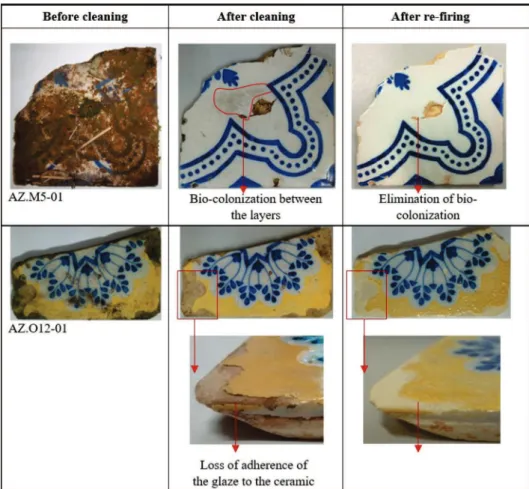
The cleaning of the tile samples removed the dirt deposits and super-ficial bio-colonization. The first
re-iring eliminated or softened the defects and pathologies that exist in the glaze (Figure 2). The pieces presented brighter
35 (microorganisms) in the interface zone
between the layers (Oliveira, 2001), was restored and this bio-colonization was also removed during the heat treatment.
Figure 2 Samples before and after the cleaning and firing treatment.
It was observed that some fragments developed new problems. In the vitriied layer, the formation of air bubbles was veriied in the AZ.H7-01, AZ.I14-02 and
AZ.O12-01 samples. Regarding the ce-ramics, there was the appearance of deep issures and a change in color and texture in the AZ.N33-01 fragment. In contrast, in
the second re-iring, performed in samples with defects in the vitriied layer, the glazes were made uniform with softening and/or disappearance of bubbles (Figure 3).
Figure 3 Samples AZ.I14 and AZ.N33 before and after the heat treatments.
The X-ray diffraction analyses show that before the iring, the samples basically contained: quartz, gehlenite, calcite, and Ca-bearing minerals such as wollastonite
(AZ.C11, AZ.H7, AZ.M5, and AZ.N33 AZ.O12) and anorthite (AZ.I14) and Ca,Mg-minerals as diopside (AZ.I14, AZ.M18, AZ.P3). After the firing, the
Figure 4
XRD patterns of the
samples before and after the re-firing.
4. Discussions
Based on the results, it was possible to improve the visual aspects and fix manufacturing defects and alterations due to re-vitriication of the decorative layer, since the temperature reached was suficient for a new fusion of the materials. The dark stains of bio-colonization in the interface area between the layers (Oliveira
et al., 2001) were also removed during
heat treatment due to the carbonization of the organic material (Sanjad, 2002).
The air bubbles in the glaze of some samples were possibly caused by the release of carbon dioxide after the breaking down of the calcium carbonate structure and/or of organic matter in the ceramic (Costa et al., 2013). In the second
new iring, these defects in the vitriied layers were minimized, probably due to: 1) re-accommodation of the glaze, which with the high temperature passed to liquid state, causing a re-vitriication; 2) the low release of CO2, since most of the organic particles were eliminated from the ceramic during the irst new iring and due to inexistence (or low quantity) of carbon dioxide.
As for the change in the ceramic of the AZ.33-01 sample, this result shows
certain fragility due to the alterations suffered by the tile, which are probably related to the area of the grave in which the tile was inserted. Since this tile was part of a panel ixed on the lateral of the N33 grave, in direct contact with the ground, the piece may have absorbed too much humidity, as well as organic and inorganic components.
Despite giving durability to the ele-ments exposed to weathering and the use of materials and techniques similar to the original, it is observed that the iring treat-ments can also present risks to the material according to its chemical and mineralogi-cal composition or level of alteration. Tests should be conducted on small fragments prior to a mass intervention.
From the point of view of the materi-al safeguarding, the hot restoration results are contributive. However, this procedure has some conceptual limitations, based on classic restoration theories. Brandi (2008), deines that “restoration must aim to rees-tablish the potential unity of a work of art , as long as is possible without producing an artistic or historical forgery, and with-out erasing every trace of the passage of time on the artwork”, and “restoration
must be reversible”. Hot restoration goes against some of these principles because it is irreversible; can compromise the marks of time in the original piece, due to the new fusion of the glaze; and may change the composition of the original material. Despite this, contemporaneous restora-tion theories are more lexible about these concepts, and seen as subjective, since they depend on a point of view.
According to Viñas (2004), restora-tion is not a neutral activity, since it in-volves a series of technical and ideological elections. In some cases, the conditions of the artifact may require the sacriice of part of the material’s consistency in order to safeguard it. Due to the fact that the work of art, in tiles, is present in the painting, the preservation of the glazed surface is a priority (Oliveira, 2001), which was secured through the hot restoration.
Changes in the mineralogical com-position of the ceramics occurred due to the mineral transformations that may happen because of re-iring temperature. re-iring time, and rate of temperature increase (Riccardi et al., 1999; Cultrone et al., 2004; Vaz et al., 2008; Cultorne and
37 calcite, a mineral with fusion temperature
of about 900 °C, present in most samples before re-iring, was derived from the mortar (Sanjad et al., 2004; Costa et al.,
2013), since the tiles had minerals in their composition such as gehlenite, formed
at about 1000oC (Sanjad et al., 2004).
Thus, the calcite disappeared after the re-firing at 1000oC. According to the
re-iring temperatures, it is possible that silica reacts with: 1) calcium compounds that originate wollastonite; 2) calcium and
magnesium compounds which originate diopside; and 3) gehlenite and aluminum phases, resulting in anorthite (Riccardi et al., 1999; López-Acre et al., 2003; Tratoré
and Kabré, 2003; Sanjad et al., 2004;
Koch, 2008).
5. Conclusions
Due to differences between the various types of tiles, such as their country of origin, fabrication tech-niques, where they were placed, and deterioration level, it is important that the tiles be scientiically analyzed before performing hot restorative intervention.
Otherwise, the restoration may compro-mise the integrity of the piece, causing irreversible damages.
Used carefully, the hot technique is one of the alternatives to improve durability and protect the heritage of the Soledade tiles and other external coating
tiles in the same deterioration situation, mainly concerning the re-vitriication of the decorative layer. However, it is necessary to evaluate the kind of altera-tion before submitting the historic tiles to this restorative intervention, because of its risks.
Acknowledgements
We are grateful to CAPES for the scholarships to the irst author, CNPq for the inancial support of research projects to the second author (Process
552690/2011-2 and 484400/2011-8), and PIBIC/UFPA for the scholar-ships to the third author. We also thank IPHAN/PA, FUMBEL and
SEURB, for permission to work at the Soledade Cemetery; LCM, Geo-sciences Institute at UFPA, for the X-ray analysis.
References
BRANDI, C. Teoria da restauração. (3.ed.). Cotia, SP: Ateliê Editorial, 2008. 149 p. (Tradução Beatriz Mugayar Kühl).
BURGOS, J. A. S. La restauracion de la ceramica vidriad de la Plaza de España, Sevi-lha. In: ____. El estúdio y la conservacíon de la cerâmica decorada em arquitec-tura. Roma: ICCROM, 2003. Cap. I, p. 42-47. 164 p.
COSTA, M. L., SANJAD, T. A. B. C., PAIVA, R. S. The mineralogy and chemistry of the German and Portuguese tiles used to face a historic building in the Ama-zon region and their natural susceptibility to tropical weathering. Acta AmaAma-zonica (Impresso), v. 43, n. 3, p. 323-330, 2013.
CULTRONE, G., SEBASTIN, E., ELERT, K., TORRE, M.J., CAZALLA, O., RO-DRIGUEZ–NAVARRO, C. Inluence of mineralogy and iring temperature on the porosity of bricks. Journal of the European Ceramic Society, v. 24, p. 547–564, 2004.
CULTRONE, G., MADKOUR, F. Evaluation of the effectiveness of treatment pro-ducts in improving the quality of ceramics used in new and historical buildings. Journal of Cultural Heritage, v. 14, p. 304-310, 2013.
FABBRI, Bruno. La caratterizzazion dei materiali nel restauro di ceramic invetriata in contest archittetonico. In: ____. El estúdio y la conservacíon de la cerâmica deco-rada em arquitectura. Roma: ICCROM, 2003. Cap. I, p. 15-21. 164 p.
KOCH, L.D ., WALL, D. de. Raman analysis of ancient pigments on a tile from the Citadel of Algiers. Spectrochimica Acta Part A, v. 71, n. 4, p. 1348–1354, 2008. LEITE, V. Desenvolvimento de técnica de restauração a quente em azulejos dos
sé-culos XVII, XVIII e XIX. Salvador: UFBA, 2011. 149 p. (Dissertação de Mestrado em Arquitetura e Urbanismo).
LÓPEZ-ARCE, P, GARCIA-GUINEA, J., GRACIA, M., OBIS, J. Bricks in historical buildings of Toledo City: characterisation and restoration. Materials Characteri-zation, v. 50, n. 1, p. 59– 68, 2003.
OLIVEIRA, M. M. de. Materiais de revestimento aplicados na conservação de azu-lejos. In: ____. Patrimônio azulejar brasileiro: aspectos históricos e de conserva-ção. Brasil: Monumenta – BID – Ministério da Cultura, 2001. Cap. 11, p. 140-163. 195p.
CONGRESSO INTERNACIONAL AZULEJAR, 2012. Aveiro e Ovar. Anais... Portugal, 2012. v.1, p.1-10
RICCARDI, M. P., MESSIGA, B., DUMINUCO, P. An approach to the dynamics of clay iring. Applied Clay Science, v. 15, p. 393–409, 1999.
RIEGL, A. O culto aos monumentos modernos: sua essência e sua gênese. Goiânia: UCG, 2006. 120 p. (Tradução Elaine Ribeiro Peixoto e Albertina Vicentine). SANJAD, T. A. B. C. Azulejaria histórica em Belém do Pará: contribuição
tecnoló-gica para réplicas e restauro. Belém: UFPA/SEDECT, 2009. 109 p.
SANJAD, T. A. B. C. Patologias e conservação de azulejos: estudo tecnológico de conservação e restauração com azulejos dos séculos XVI, XVII e XIX pertencen-tes às cidades de Belém e Salvador. Salvador, UFBA, 2002. 207 p. (Dissertação Mestrado em Arquitetura e Urbanismo).
SANJAD, T. A. B. C., ANGÉLICA, R. S., OLIVEIRA, M. M. de, COSTA, M. L. da. Caracterização mineralógica de azulejos de Salvador e Belém dos séculos XVI, XVII e XIX. REM – Revista Escola de Minas, v.57, n.4, p. 255-260, 2004. SANJAD, T. A. B. C. Intemperismo tropical em fachadas azulejadas de ediicações
históricas de Belém do Pará. Belém: UFPA, 2007. 289 p. (Tese de Doutorado em Ciências – Geologia e Geoquímica).
SCHWARZ, H-J., FREYBURG, S., MOTTNER, P., STADLBAUER, E. Conser-vation and restoration of glazed architectural ceramics in northern Germany. In: ____. El estúdio y la conservacíon de la cerâmica decorada em arquitectura. Roma: ICCROM, 2003. Cap. I, p. 38-41. 164 p.
TRAORÉ, K., KABRÉ, T.S., BLANCHARTB, P. Gehlenite and anorthite crystalli-sation from kaolinite and calcite mix. Ceramics International, v. 29, p. 377–383, 2003.
VAZ, M. F., PIRES, J., CARVALHO, A. P. Effect of the impregnation treatment with Paraloid B-72 on the properties of old Portuguese ceramic tiles. Journal of Cultural Heritage, v. 9, p. 269-276, 2008.