Platinum-Based Alloys: Investigation of the Efect of Impurities Content on Creep Rate,
Rupture Time and Relative Elongation at High Temperatures
Biserka Trumića, Lidija Gomidželovića*, Saša Marjanovićb, Aleksandra Ivanovića, Vesna Krstića
Received: March 22, 2016; Revised: October 7, 2016; Accepted: November 21, 2016
This paper presents the results of research of the efect of impurities content on high-temperature resistance of selected platinum alloys. Alloys of following systems were investigated: Pt-Rh, Pt-Rh-Pd, Pt-Rh-Pd-Ru and Pt-Rh-Pd-Ir-Au. Universal device for tensile testing of materials at high temperatures was used for examination. Investigations were carried out in a temperature range of 1300-1400 °C, with a stress of 5 MPa. It was observed that an increase in content of impurities in tested alloys at high temperatures, and at stated conditions of stress, caused a noticeable increase in creep rate while reducing rupture time and relative elongation. Experimental results conirmed that probability of brittle fracture decreases with decreasing impurity content in the alloys. Binary and multicomponent alloys of Pt-Rh, Pt-Pd-Rh, Pt-Rh-Pd-Ru and Pt-Rh-Pd-Ir-Au systems are primarily used in conditions of high temperature, and accordingly, presented results contribute to a better understanding of their behavior in such working conditions.
Keywords: Platinum-based alloys, impurities, creep rate, rupture time, relative elongation
* e-mail: [email protected]
1. Introduction
Platinum (Pt) is dense, stable, malleable, ductile, biologically compatible, gray-white, precious, rare transition metal with good electrical conductivity, belonging to platinum group metals (PMGs) which also include iridium (Ir), Osmium (Os), Palladium (Pd), Rhodium (Rh) and Ruthenium (Ru).
All this metals are extremely rare, very durable and due to
their high price, often recycled.
Annual production of platinum is around few hundred
tones making it very scarce and valuable. The largest amount of platinum is used in jewelry industry (about 40% of annual production), but this metal is also crucial for many catalytic
processes, and holds important role for electronic industry and medicine.
Platinum is often alloyed with other PGMs in order to improve durability at high temperatures. Interest of researches in platinum based alloys is constantly growing1. These types
of alloys are used in: glass industry2, 3, fertilizer plants4-6,
temperature measurement7, environment protection8, jewelry
production9, 10, shape memory applications11, 12 and medicine13.
Diferent Pt-based alloys are primarily used in various high temperature applications, so knowledge of their properties under such conditions is crucial for successful utilization.
Alloys of platinum with rhodium content up to 20% are most commonly used in high temperature aplications, but compositions with rhodium up to 30% are also utilized. Platinum-iridium allys are not used often like platinum-rhodium alloys, but iridium in small amout (up to 1%) can improve
platinum microstructure stability at high temperatures, without signiicantly afecting mechnical strenght. Higher contents of iridium in platinum-based alloys can lead to poor oxidation resistance and ebrittlement. Using gold as alloying element leads to signiicant increase of molten glass contact angle on surface of platinum-based alloy.
Some of platinum-based alloys published research
results include:
• thermodynamics and phase equilibrium of binary
Pt-Rh system14.
• thermal and mechanical properties of Pt-Rh alloys15.
• microstructural analysis of selected platinum alloys
used in industry and jewelry making (including PtRh10, PtRh30, 5Ru, 5Ir, 5Au and Pt-25Ir-15Rh)16.
• Pt-Rh, Pt-Pd, Pd-Rh and Pt-Pd-Rh phase diagrams
examined using Monte Carlo simulation method in combination with MEAM method and optimized
parameters17.
• creep rate and rupture time of Pt-Rh alloys at high temperatures18.
The aim of this paper is to examine the impact of harmful
impurities on high temperature resistance of Pt-Rh, Pt-Rh-Pd, Pt-Rh-Pd and Pt-Ru-Rh-Pd-Ir-Au alloys.
The presence of chemical elements - impurities in the
platinum metals and alloys is associated with the composition
of the starting ore deposits as well as the technological processes for their obtaining, processing and exploitation
in industrial conditions19-21.
The presence of impurities in platinum metals and
alloys has a large impact on their physical and mechanical
a Mining and Metallurgy Institute Bor, Zeleni bulevar, 35, 19210, Bor, Serbia
properties. For this reason, the purity of platinum metals and
alloys is one of their main characteristics. It is determined by calculation, from the diference between 100% weight of the metal and the sum of percentages of 10-15 control impurities. In addition, in the total number of control impurities, as a rule, there are the platinum group metals and gold. Impurities such as Rh, Ru, Pd, Ir and Au lead to
the improvement of mechanical properties of platinum, ie
to increase of its high temperature resistance. In addition to these “good” impurities there are harmful impurities, 50-70 so-called non control impurities, in a total concentration of
10-2 - 10-3% (wt.%). This work aimed to show how various
contents of impurities afect the high-temperature characteristics
of platinum materials, at a constant temperature and stress. The results are only part of the multi year researches of platinum
materials at high temperatures, which ind application in the glass industry for molding optical iber.
2. Experimental
Platinum, rhodium and palladium for alloys production
have been obtained as a side product in the production of
electrolytic copper RTB, Serbia. By additional reinement
the necessary purity for samples production has been
achieved (99.98% for Pt, 99.95% for Rh and Pd 99.98%). The composition of the samples is given in Table 1.
Impurities in the samples were characteristic for raw material of Bor deposits - Si, Sb, Fe, Al, Mg, Ag, Bi, Sb, As, Cu.
Melting of the samples was carried out in a medium-frequency induction furnace. Annealing of the samples was carried out in an electro resistant furnace type LP08, for 20 minutes at 900°C.
For testing the mechanical properties of samples at high temperatures a universal device for tensile testing of materials at high temperatures, by manufacturer Karl Frank,
type 81221, was used.
Chemical analysis of materials for samples was
performed on atomic absorption spectrophotometer.
Examination of the microstructure was performed on samples measuring 1,7x1,7 mm, which were prepared according to standard procedure - grinding, polishing (polishing machine ROWA E KG) with 0,05μm Al2O3
powder, and etched a few seconds with aqua regia (100cm3
HCl and 30cm3 HNO
3). Changes in the structure were
observed using optical and scanning electron microscope. Optical microscopy was performed on metallographic microscope EPYTIP 2, at different magnifications. Scanning-electron microscopy (SEM) was performed
on electronic microscope JEOL JSM-6610LV with
resolution of 10 nm on 20keV, accelerating voltage of 3-30 kV and magnification up to 300000x.
3. Results and Discussion
In order to supplement the existing database of platinum and platinum metals, originating from the Bor deposites in Serbia, as well as having the information about the practical implementation of the above mentioned at high temperatures, investigations were carried out on the inluence of impurities on the mechanical properties of the alloys of Pt-Rh, Pt-Rh-Pd, Pt-Rh-Pd-Ru and Pt-Rh-Pd-Ir-Au systems, with platinum as base metal, and alloying elements Rh (15-20 wt%), Pd (10-25 wt%), Ru (1.5% wt.), Ir (0.1% wt.) and Au (0.1% wt.). Since platinum metals alloys can contain a range of impurities, it is very diicult to determine the individual efect of each one to high-temperature resistance of alloys.
For the practical application of platinum alloys, it is important
to have knowledge of individual as well as the group efect of impurities on the creep resistance (creep life) and the
destruction of the alloys.
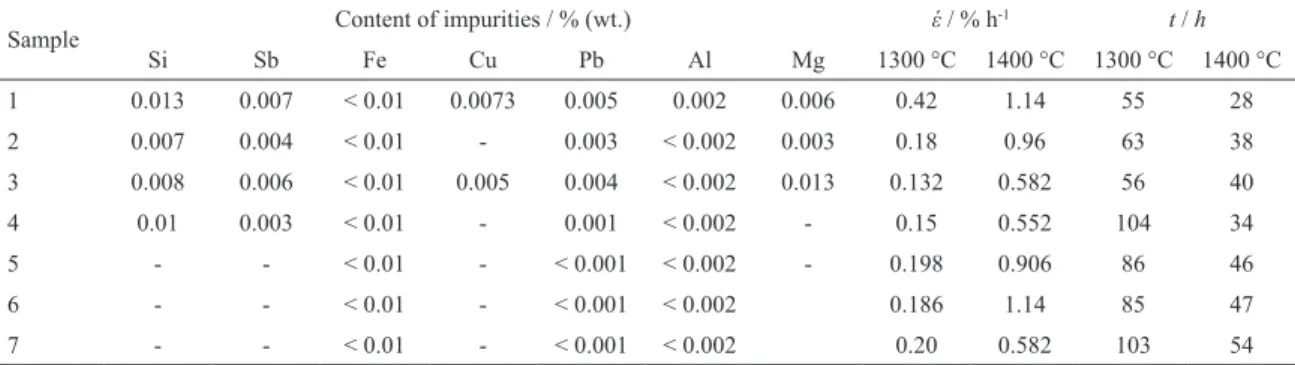
The values of the minimum creep rate (in the rest of paper creep rate) and rupture time of the alloy PtRh7 at 1300 and 1400 °C, at a stress of 5 MPa, are given in Table 2.
For PtRh7 alloy, in the temperature interval of 1300-1400 °C, at a stress of 5 MPa, based on the results shown in Table 2, at the total content of the impurities 0.05% (sample No. 1) creep resistance is twice as big, and the rupture time twice
shorter, as compared with the sample number 7, wherein
the total impurity content is 0.013%.
Based on the results in Table 2, it can be seen that in the total content of impurities, the largest share belongs to: Si, Fe, Al and Mg.
The efect of impurities on creep rate, rupture time and relative elongation, at the temperature of 1400 °C, at a stress of 5 MPa, for the alloys PtRh10, PtRh5Pd15 and PtRh10Pd25Ru1.5 is shown in Tables 3, 4 and 5.
Based on the results presented in Table 3, for the alloy PtRh10, at a temperature of 1400 °C and a stress of 5 MPa, the same rule applies as to the alloy PtRh7 under the same
Table 1: The content of alloying elements in the investigated alloys (mass%)
Alloy Rh / % (wt.) Pd / % (wt.) Ru / % (wt.) Ir / % (wt.) Au / % (wt.)
PtRh7 7 - - -
-PtRh10 10 - - -
-PtRh5Pd15 5 15 - -
-PtRh10Pd25Ru1.5 10 25 1.5 -
Sample Content of impurities / % (wt.) έ / % h
-1 t / h
Si Sb Fe Cu Pb Al Mg 1300 °C 1400 °C 1300 °C 1400 °C
1 0.013 0.007 < 0.01 0.0073 0.005 0.002 0.006 0.42 1.14 55 28
2 0.007 0.004 < 0.01 - 0.003 < 0.002 0.003 0.18 0.96 63 38
3 0.008 0.006 < 0.01 0.005 0.004 < 0.002 0.013 0.132 0.582 56 40
4 0.01 0.003 < 0.01 - 0.001 < 0.002 - 0.15 0.552 104 34
5 - - < 0.01 - < 0.001 < 0.002 - 0.198 0.906 86 46
6 - - < 0.01 - < 0.001 < 0.002 0.186 1.14 85 47
7 - - < 0.01 - < 0.001 < 0.002 0.20 0.582 103 54
Table 2: Characteristics of high-temperature resistance of alloy PtRh7 depending on impurity content at 1300 and 1400 °C and stress of 5 MPa
* all elements with symbol < are below the detection limit of AAS (method used to determine the content)
Table 3: The values of the creep rate, rupture time and relative elongation depending on the content of impurities at a temperature of 1400
°C, at a stress of 5 MPa, for the alloy PtRh10
Sample
Content of impurities / % (wt.)
έ / % h-1 t / h A / %
Fe Al Si Mg ∑ Fe,Al, Si,Mg Ca
1 0.004 < 0.002 0.001 0.01 0.0152 - 0.122 217 44
2 0.005 0.039 0.004 0.033 0.076 - 0.44 83 44.5
3 0.07 0.025 < 0.001 < 0.01 0.095 - 0.35 79 34
4 0.06 0.012 0.001 0.024 0.097 - 0.35 88 34
5 0.04 0.028 < 0.001 < 0.01 0.032 0.03 0.35 85 36
6 0.04 0.035 < 0.001 0.030 0.105 0.04 0.47 71 42
7 0.06 0.031 0.001 < 0.01 0.092 0.033 0.29 70 27
8 0.07 0.04 < 0.001 0.022 0.132 0.024 0.182 69 30
9 0.038 0.022 < 0.001 0.016 0.076 0.02 0.222 97 43
* all elements with symbol < are below the detection limit of AAS (method used to determine the content) ** alloys in each sample contained 0.001% Ag, and cumulative 0.005% of Cu, Ni, Pb, Sb and Zn
Table 4: The values of the creep rate, rupture time and relative elongation depending on the content of impurities at a temperature of 1400
°C, at a stress of 5 MPa, for the alloy PtRh5Pd15
Sample
Content of impurities / % (wt.)
έ / % h-1 t / h A / %
Fe Al Si Mg ∑ Fe,Al, Si,Mg Ca
1 < 0.004 0.009 0.018 < 0.01 0.026 0.011 1.3 20 32
2 < 0.004 0.014 0.001 0.022 0.036 0.011 1.3 17 29
3 0.004 0.009 0.002 < 0.01 0.051 < 0.01 2.4 13 39
* all elements with symbol < are below the detection limit of AAS (method used to determine the content)
** All samples contain < 0.005% Σ : Cu, Ni and Zn; Samples No. 1 and No. 2 contain 0.001% Ag; Sample No. 3 contains 0.01% Ag
Table 5: The values of the creep rate, rupture time and relative elongation depending on the content of impurities at a temperature of 1400
°C, at a stress of 5 MPa, for the alloy PtRh10Pd25Ru1.5
Sample Content of impurities / % (wt.) έ / % h-1 t / h A / %
Fe Cu Al Si
1 0.01 0.004 < 0.002 < 0.001 0.39 53 31
2 0.065 0.003 < 0.002 0.019 0.43 28.5 11.5
3 0.013 0.006 0.018 0.019 0.35 24 10
4 0.053 0.004 < 0.002 < 0.001 0.48 29 16
5 0.04 0.003 0.018 0.01 0.46 29 12.5
conditions. At the minimum content of non-precious impurities (Fe, Al, Si and Mg) of 0.015% (sample No. 1), properties that characterize the resistance at high temperatures are 1.5-3.0 times higher than in sample No. 8 with the maximum content of the afore mentioned impurities of 0.132 %. Also, from Table 3, it can be seen that the rupture time signiicantly decreases with increasing content of impurities, while the relative elongation slightly decreases with the increase of the
total content of impurities. Similar rules were also observed
for alloys PtRh5Pd15 and PtRh10Pd25Ru1.5.
The characteristics of high temperature resistance of PtRh20Pd10Ir0.1Au0.1 alloy, at a temperature of 1400 ° C and a stress of 5 MPa, are presented in Table 6.
Based on the results in Table 6 it can be concluded that
for the tested alloy with the increase in the total content of
ten most abundant impurities (Al, Fe, Si, Mg, Pb, Sb, Zn, Sn, Cu, Ni) from 0.01% to 0.083% wt., at a temperature of 1400 °C and a stress of 5 MPa, rupture time decreases ive times, relative elongation four times and creep rate increases twice, which shows excellent agreement of the results with
literature data19, 21, 22.
Based on the results presented above it can be concluded that increasing the sum of speciied impurities results in a negative impact on the lifetime and plasticity of alloy PtRh20Pd10Ir0.1Au0.1, at high temperatures. Increasing
the total content of impurities in the examined alloy from
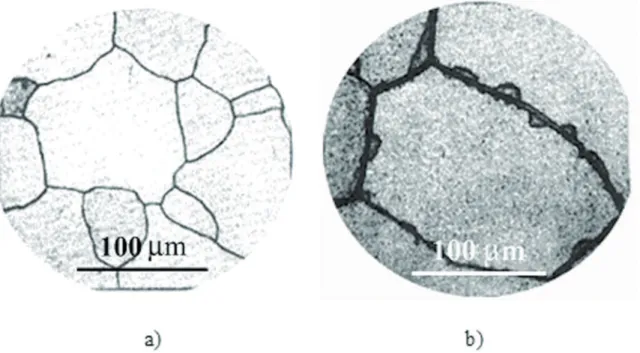
0.015 to 0.083% (wt.) was followed by the accumulation of impurity atoms in the grain and subgrain boundaries, as shown in Figure 1.
It is obvious that the accumulation of impurity atoms at the grain boundaries leads to an increase in the total volume
of the borders, which results in the creation of a very brittle
structure that cracks relatively quickly in the processing as well as in the exploatation process at high temperatures. Namely, at the concentration of impurities of 0.01% and lower, the changes in structure are not observed and alloy possesses high plasticity and temperature resistance. Increasing
the concentration of any impurity, to the hundredths or thousandths of percent, in platinum alloys, does not cause
changes in composition of grain boundaries which would
be observed under an optical microscope, but could be substantially responsible for the decrease of the relative
elongation and the destruction time at 1400 °C.
The structure of alloy PtRh20Pd10Ir0.1Au0.1 without the presence of impurities is presented in Figure 2. The grain size before testing was 0.057 mm, and after the high
temperature creep test it was 0.0267 mm.
Microstructure of PtRh20Pd10Ir0.1Au0.1 alloy sample, containing impurities above 0.0286% (wt.), is shown in Figure 3. It is characterized by high porosity and diference in grain size before (average grain diameter is 0.034 mm) and after the high temperature creep (grain size is 0.174 mm). Based on these results, it can be concluded that after plastic deformation by creep testing, average grain diameter of alloy, with impurities in an amount of 0.0286%, is signiicantly bigger compared to the average grain diameter of the alloy without impurities. Impurities accumulated in the grain boundaries have resulted in a large porosity and
accelerated intercrystalline destruction.
Intercrystalline fracture (Figure 4) occurs at grain
boundaries and is characteristic when the material is exposed
to low stress, low deformation speed and high temperatures. Increased sensitivity of platinum alloys at high temperatures, containing a large number of impurities
indicates to particular importance of the purity of the initial metals used for production of alloy.
Table 7 shows the inluence of the control impurities present in reined platinum, rhodium and palladium on a high-temperature resistance of alloy PtRh20Pd10Ir0.1Au0.1 at 1400 °C, at a stress of 5 MPa.
It is obvious that, when comparing the same or similar concentrations of Pb, Ag, and Mg, rupture time of the obtained samples is higher at lower Si content. The content of Fe, Cu, Ni and Ti within the speciied concentration does not show a signiicant efect on the characteristics of high
temperature resistance and plasticity of samples made from
diferent charges.
Constant and controlled composition of impurities in the starting charges is the main condition for obtaining platinum
alloys with stable structures and characteristics. For that purpose, for the synthesis of alloys one should always strive
to use platinum metals with high purity, which is achieved by multistage reining of them, so the inal products would be of satisfying composition and quality.
On the mutual efect of impurities with platinum group metals, as well as their interaction, it is best to judge on the basis of the phase diagrams19-21. When considering the
binary and multicomponent phase diagrams only interaction of 2-6 primary and alloying elements with a maximum of
ten impurities should be taken into account.
Impurities such as Fe, Cu, Ni, form solid solutions with platinum group metals, having a melting point lower than the melting point of the main and alloying elements. From such solid solutions, with a decrease in temperature, diferent
Table 6: The characteristics of high temperature resistance of alloy PtRh20Pd10Ir0.1Au0.1 depending on the total content of impurities
Sample Content of impurities / 10
-3 % (wt.)
έ /% h-1 t / h A / %
Ag Fe Mg Al Si Pb Sb Sn Zn Cu Ni Σ
1 0.5 2.6 0.03 5 0.02 5 0.03 0.07 0.8 0.8 0.7 15.55 0.07 340 48
Figure 1: The microstructure of the sample PtRh20Pd10Ir0.1Au0.1 with total content of the impurities a) 0.015 % (wt.), 70x ; b) 0.083% (wt.), (magniication 200x)
Figure 2: Microstructure of sample composition PtRh20Pd10Ir0.1Au0.1 without impurities: a) before and b) after creep, at 1400 °C and
a stress of 5MPa, close to the rupture point (magniication 200x)
transformations occur with formation of chemical compounds,
damaging in the further exploitation of such materials22.
Impurities such as Si, Ag, Pb, Sn, Sb, Bi, P, S, Se, Te, As, Mg, Zn, Ba, Al, with platinum group metals form sparingly
soluble and brittle compounds22. The resulting compounds
(such as Pt and Pd silicides), lead to relatively rapid fracture and destruction of materials at high temperature operation.
The probability of interaction of impurities with the
platinum group metals is even greater and more signiicant if the concentration of the impurities is higher in those metals.
Figure 3: Microstructure of sample composition PtRh20Pd10Ir0.1Au0.1 with impurities content of 0.0286%: a) before and b) after creep, at 1400 °C and a stress of 5MPa, close to the rupture point (magniication 200x)
contents of impurities in the volume of metals or alloys,
their concentration in certain zones (intercrystalline zone or zone within the crystal-grain itself) can be very high.
The equilibrium segregation of impurities takes, by rule, an area of one to ten nanometers, although in most cases an enrichment in impurities is limited by monolayer segregation of atoms equal to or slightly greater than the intercrystal zone with width of the 2-3 atomic layers.
The equilibrium segregation occurs as a result of difusion of impurities to the grain boundaries while creating a concentration gradient. It is most common for phase diagrams with low solubility of impurities in the crystal lattice metal-base, as well as for the large diferences in atomic diameters
of impurities and the base metal.
For the studied phase diagrams of platinum with Fe, Ni, and Cu grain boundaries are even more enriched with impurities if their solubility limit is lower. With the reduction
of impurities solubility limit up to the 1x10⁻³ % (at.), their
concentration in the intercrystal zone of the metal-base may reach 10% (at.), ie. may be 10.000 times larger than
in alloy volume.
Based on the afore mentioned, we reach the conclusion that practically insoluble or slightly soluble impurities such as Ba, P, As, Si, Bi and Pb show a high tendency towards forming equilibrium segregations, compared to the Fe, Ni, Cu, Ag, Mg, Zn, Al and Sb which with platinum form a continuous series or wide area (on platinum side) of solid
solutions.
The equilibrium segregation of impurities leads to a reduction in deformation energy of the crystal lattice in the
area of their existence, while reducing the Gibbs energy of intergrain borders.
Impurities accumulated at the grain boundaries may react with each other and lead to strengthening or weakening of segregations of that element or some other element.
In the irst case, at the same sign of the atomic range of deviation between two impurities compared to metal-base, the intercrystalline zone will be more enriched with atoms of impurity which has a greater range of deviation in absolute values. In the second case, at the diferent sign of the
atomic deviation and equal atomic concentrations of the two impurities, it comes to the formation of complex of atoms of
those impurities and the equilibrium segregation weakens. Segregation gets stronger in the case when the impurities absorbed on the surface of the crystal have the same sign and close values of deviation range, at the same time.
In this way, it can be expected that in cases when the removal of hamful impurities from the alloy is very diicult, their impact can be also minimized with the introduction of less harmful impurity or impurity with opposite sign of deviation range.
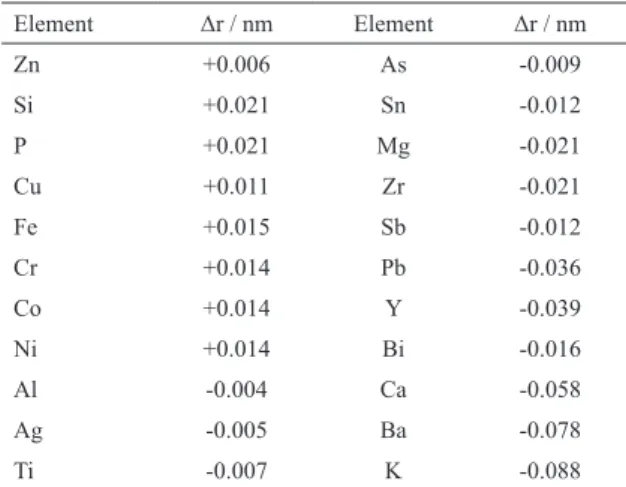
Based on the atomic diameter of platinum which is 0.139 nm, it is possible to form a series of ranges of deviation of
impurities atomic diameters.
Size of the range of deviation (Δr) of atomic diameters
of platinum and impurities, in the case when the diameter
of platinum is larger (Δr +) or smaller (-Δr) than diameters of impurities is given in Table 8.
Figure 4: Examples of intercrystalline fracture at a) 800, b) 900 and c) 1000 °C for PtRh20Pd10Ir0.1Au0.1 alloy
impact of impurities, such as Si and P in the investigated platinum alloys. Bismuth can somewhat neutralize the negative impact and accumulation of impurities such as Fe, Cu, Cr, Co, As and Ni.
The most severe form is the presence of impurities
with approximate values of the divergency range, and of the same sign, such as Al and Ag as a pair, and Zn and Si as a second pair. In these cases probability of equilibrium segregation of each pair of impurities increases, as well as their negative impact on the technological and exploitation
properties of platinum alloys.
However, in practical terms it is diicult to predict and even harder to manage the equilibrium segregation process
of impurities in platinum alloys.
In real conditions in the formation of equilibrium segregation dozen of impurities can participate and that process can be very dependent on their mutual efect, interactions with the metal-base and alloying elements with simultaneous dependence of the temperature-time factor.
4. Conclusion
In this paper are presented results of the inluence of individual impurities, as well as groups of impurities on
resistance to plastic deformation and fracture at elevated
temperatures, for the following alloys: PRh7, PtRh10, PtRh5Pd15, PtRh10Pd25Ru1.5 and PtRh20Pd10Ir0.1Au0.1.
Generally, in all investigated alloys, at elevated temperatures,with increasing of total content of impurities (Fe, Si, Al and Mg) from 0.013 to 0.068% (wt.) it was observed an increase in creep rate, alongside reduction of relative elongation and time to fracture.
The increase in total impurity content (from 0.015-0.083% (wt.)) in investigated alloys is accompanied by accumulation of their atoms at grain boundaries, resulting in occurrence of brittle and fragile structure.
At the same or similar contents of Pb, Ag and Mg, time to fracture is longer, at lower Si contents. The content of Fe, Cu, Ni and Ti within the limits of observed contents does not show signiicant negative impact on the high temperature
properties of the alloy.
For the alloys PtRh10, PtRh5Pd15 and PtRh10Pd25Ru1.5 the rupture time signiicantly decreases with increasing content of impurities, while the relative elongation slightly
decreases with the increase of the total content of impurities.
For PtRh20Pd10Ir0.1Au0.1 alloy resuts of investigation are showing that with increase in total content of ten most abundant impurities (Al, Fe, Si, Mg, Pb, Sb, Zn, Sn, Cu, Ni) from 0.01% to 0.083% wt., rupture time decreases ive times, relative elongation four times and creep rate increases twice, which is in agreement with literature data.
Based on these results, it can be concluded that after plastic deformation by creep testing, average grain diameter of alloy, with impurities in an amount of 0.0286%, is signiicantly bigger compared to the average grain diameter of the alloy without impurities. Impurities accumulated in the grain boundaries have resulted in a large porosity and
accelerated intercrystalline destruction.
The probability of interaction of impurities with the
platinum group metals is even greater and more signiicant if the concentration of the impurities is higher in those
metals.
Table 7: The inluence of control impurities content in the alloy PtRh20Pd10Ir0.1Au0.1 on high temperature properties
Sample Content of the impurities / 10
-3 % (wt.)
έ /% h-1 t / h A / %
Si Fe Pb Ag Ti Cu Ni Mg Σ
1 1.8 0.3 0.6 0.7 - 0.2 - 0.8 4.4 0.09 175 23
2 1.6 0.1 0.8 0.9 0.2 - 0.6 0.8 5. 0.24 216 65
3 0.4 1.7 0.6 0.7 - 0.2 - 0.8 4.4 0.12 276 50
4 0.2 1.5 0.8 0.9 0.2 - 0.6 0.8 5 0.05 430 70
Table 8: Values of the range of deviation (Δr) for impurities
Element Δr / nm Element Δr / nm
Zn +0.006 As -0.009
Si +0.021 Sn -0.012
P +0.021 Mg -0.021
Cu +0.011 Zr -0.021
Fe +0.015 Sb -0.012
Cr +0.014 Pb -0.036
Co +0.014 Y -0.039
Ni +0.014 Bi -0.016
Al -0.004 Ca -0.058
Ag -0.005 Ba -0.078
Ti -0.007 K -0.088
presence of very small amounts of impurities because
their concentration in certain zones (intercrystalline zone or zone within the crystal-grain itself) can be very high. Based on the afore mentioned, we reach the conclusion that practically insoluble or slightly soluble impurities such as Ba, P, As, Si, Bi and Pb show a high tendency towards forming equilibrium segregations, compared to the Fe, Ni, Cu, Ag, Mg, Zn, Al and Sb which with platinum form a continuous series or wide area (on platinum side)
of solid solutions.
Impurities accumulated at the grain boundaries may react with each other and lead to strengthening or weakening of segregations of that element or some other element.
Alloys of Pt-Rh, Pt-Pd-Rh, Pd-Ru and Pt-Rh-Pd-Ir-Au systems are primarily used in high temperature conditions, and accordingly, presented results contribute to a better understanding of their behavior in such working
conditions.
5. Acknowledgement
The research results presented in this paper are the
result of technological development project TR 34029 “Development of production technology of Pd catalyst-catchers to reduce losses of platinum in high temperature catalysis processes”, funded by the Ministry of Education, Science and Technological Development.
6. References
1. Gavin H. Platinum group metals research from a global perspective. Platinum Metals Review. 2010;54(3):166-171.
2. Preston E. Platinum in the glass industry. Platinum Metals Review. 1960;4(2):48-55.
3. Couderc C. Platinum Group Metals in Glass Making. Platinum Metals Review. 2010;54(3):186-191.
4. Ning Y, Yang Z, Zhao H. Platinum Recovery by Palladium Alloy Catchment Gauzes in nitric Acid Plants. Platinum Metals Review. 1996;40(2):80-87.
5. Yuantao N, Zhengfen Y. Platinum Loss from Alloy Catalyst Gauzes in Nitric Acid Plants. Platinum Metals Review. 1999;43(2):62-69. 6. Trumić B, Stanković D, Trujić V. Examining the surfaces in
used platinum catalysts. Journal of Mining and Metallurgy B. 2009;45(1):79-87.
7. Wu B, Liu G. Platinum: Platinum-Rhodium Thermocouple Wire. Platinum Metals Review. 1997;41(2):81-85.
8. Funabiki M, Yamada T, Kayano K. Auto exhaust catalysts. Catalysis Today. 1991;10(1):33-43.
9. Biggs T, Taylor SS, van der Lingen E. The Hardening of Platinum Alloys for Potential Jewellery Application. Platinum Metals Review. 2005;49(1):2-15.
10. Wright JC. Jewellery-Related Properties of Platinum Low Thermal Difusivity Permits Use of Laser Welding for Jewellery Manufacture. Platinum Metals Review. 2002;46(2):66-72.
11. Biggs T, Cortie MB, Witcomb MJ, Cornish LA. Platinum Alloys for Shape Memory Applications. Platinum Metals Review. 2003;47(4):142-156.
12. Biggs T, Witcomb MJ, Cornish LA. Martensite-type transformations in platinum alloys. Materials Science and Engineering: A. 1999;273-275:204-207.
13. Xiao F, Zhao F, Mei D, Mo Z, Zeng B. Nonenzymatic glucose sensor based on ultrasonic-electrodeposition of bimetallic PtM (M = Ru, Pd and Au) nanoparticles on carbon nanotubes– ionic liquid composite ilm. Biosensors and Bioelectronics. 2009;24(12):3481-3486.
14. Jacob KT, Priya S, Waseda Y. Thermodynamic properties and phase equilibria for Pt-Rh alloys. Metallurgical and Materials Transactions A.1998;29(6):1545-1550.
16. Battaini P. Microstructure Analysis of Selected Platinum Alloys. Platinum Metals Review. 2011;55(2):74-83.
17. Luyten J, de Keyzer J, Wollants P, Creemers C. Construction of modiied embedded atom method potentials for the study of the bulk phase behaviour in binary Pt-Rh, Pt-Pd, Pd-Rh and ternary Pt-Pd-Rh alloys. Calphad. 2009;33(2):370-376.
18. Trumić B, Gomidželović L, Marjanović S, Krstić V, Ivanović A, Dimitrijević S. Pt-Rh Alloys: Investigation of Creep Rate and Rupture Time at High Temperatures. Materials Testing. 2013;55(1):38-42.
19. Ritvin ЕI, Medovoi LА. Vlianie iziko-himicheskoj sledi na zharoprochnost merallicheskih materialov. Moskva: Nauka; 1974. 20. Savickij EM, Poljakova VP, Gorina NB, Roshan NR. Metalovedenie
platinovih metalov. Moskva: Metalurgija; 1975.
21. Zaharov MV, Zaharov AM. Zharoprochnie splavi. Moskva: Metalurgija; 1983.