INTRODUCTION
Address to: Prof. Wagner Luiz Tafuri. Deptº de Patologia Geral/IC/UFMG. Av. Antônio Carlos 6627, Pampulha 31270-901 Belo Horizonte, MG, Brasil.
Phone: 55 31 3409-2889 e-mail: [email protected] Received in 31/01/2012
Accepted in 31/08/2012
Schistosoma mansoni
granuloma in late evoluive
phase, in a case of tumoral form in man
Pedro Raso
[1], Leonardo Arruda Moraes Raso
[1], Ferdinan de Almeida Melo
[2]and Wagner Luiz Tafuri
[2][1]. Departamento de Anatomia Patológica e Medicina Legal, Faculdade de Medicina, Universidade Federal de Minas Gerais, Belo Horizonte, MG. [2]. Departamento de Patologia Geral, Insituto de Ciências Biológicas, Universidade Federal de Minas Gerais, Belo Horizonte, MG.
Granulomas are nodular formaions in which exudate cells are displayed in paricular arrangements to the inlammatory focus, forming structures with peculiar aspects and architecture which frequently allow to diagnose the disease even without finding its causal agent. Macrophages and their derivaives (remarkably epithelioid and giants cells) and lymphoid cells and their derivaives (paricularly plasma cells) comprise the required cells. Accessory cells are composed of eosinophil granulocytes which may, in certain cases, prevail over the other cells, so that granulomas arise almost exclusively eosinophilic as it is seen during the early acute phase of schistosomiasis toxemic form. In other cases, neutrophil granulocytes may prevail, developing an abscess (more common in paracoccidioidomycosis; rare in schistosomiasis); excepionally mast cells and basophils may also contribute as accessory cells. Fibroblasts embedded are constantly found in an extracellular matrix composed of ibronecin, laminin, glycosaminoglycans and collagens1,2.
Granulomatous reacion in schistosomiasis is a late T-dependent hypersensiivity response to soluble egg anigens (SEA) released by a mature miracidium (this becomes mature in six to eight days ater egg deposiion), which induce a marked Th2 protecive immune response, which guides the granulomatous reacion. Recent studies have indicated that IL-13 receptor α2 (IL-13 R α2) secreted by TCD4+ cells type 2 is the main mediator for granulomatous response and for hepaic ibrosis, which are two fundamental lesions in schistosomiasis3.
ABSTRACT
Introducion: Authors describe human schistosomal granuloma in late chronic phase, from the morphological and evoluionary viewpoints.
Methods: The study was based on a histological analysis of two fragments obtained from a surgical biopsy of peritoneum and large intesine of a 42-year-old paient, with a pseudotumoral form mimicking a peritoneal carcinomatosis associated to the schistosomiasis hepatointesinal form. Results: Two hundred and three granulomas were ideniied in the pseudotumor and 27 in the intesinal biopsy, with similar morphological features, most in the late chronic phase, in ibroic healing. A new structural classiicaion was suggested for granulomas: zone 1 (internal), 2 (intermediate) and 3 (external). Conclusions: Regarding granuloma as a whole, we may conclude that ibrosis is likely to be controlled by diferent and independent mechanisms in the three zones of the granuloma. Lamellar ibrosis in zone 3 seems to be controlled by matrix mesenchymal cells (ibroblasts and myoepithelial cells) and by inlammatory exudate cells (lymphocytes, plasmocytes, neutrophils, eosinophils). Annular ibrosis in zone 2, comprising a dense ibrous connecive issue, with few cells in the advanced phase, would be controlled by epithelioid cells involving zone 1 in recent granulomas. In zone 1, replacing periovular necrosis, an iniialy loose and tracery connecive neoformaion, housing stellate cells or with fusiform nuclei, a dense paucicellular nodular conncive issue emerges, probably induced by ibroblasts. In several granulomas, one of the zones is missing and granuloma is represented by two of them: Z3 and Z2, Z3 and Z1 or Z2 and Z1 and, ulimately, by a scar.
Keywords: Schistosomiasis mansoni. Granuloma. Morphology. Evoluion and pseudotumor form. Modulaion of granuloma.
Major Article
It has long been observed in humans4-7 and in laboratory animals,
specially in mice8-10, that as the schistosomiasis infecion evolves and
two changes become evident in granulomas formed around an egg: a) their volume decreases gradually to a point where they are replaced by a scar and b)as the granulomas evolve they change as for their appearance and the amount of cells around the egg. This phenomenon is termed immunomodulaion or simply modulaion and depends on the paricipaion of T-cell subpopulaions and on immunosuppressive serum factors acing among themselves8.
Cases reported in the literature have clearly shown the modulaion of granulomatous response, staring with around 70-78 days, and concluded, in some cases, within 150-day infecion, when this is indisinguishable from other chronic forms4,5. Thus, the purpose of this
work was to study morphological and evoluive aspects of granulomas in the late evoluive phase, in a paient with the tumor or pseudotumor form of abdominal schistosomiasis mansoni.
METHODS
This study was conducted in two fragments obtained from a surgical biopsy of lesions from the large intesines and from the peritoneum (B-12.369/03), of a 42-year-old male paient (E.F.S), admited at Hospital da Criança São José, Contagem/MG with a tumor form of schistosomiasis mansoni, with clinical signs and symptoms of intesinal obstrucion, mimicking neoplasms. Fragments were whiish, irregular, with a irm consistency and measured 4.0 x 2.5 x 1.5cm (peritoneum) and 1.0 x 0.8 x 0.4cm (large intesines), respecively. Ater ixed in formaldehyde (10%), they were processed and included in parain blocks. Blocks were cut at 4 micrometers which were stained by hematoxylin and eosin (HE), Gomori trichrome and by picrosirius red, according to the technique recommended by Junqueira et al.11. A yellowish
RESULTS
At the late evoluive phase, a large number of granulomas has three disinct and morphologically diferent zones: I) zone 1, central; II) zone 2, intermediate; III) zone 3, peripheral, which modiies, due to the ime of evoluion.
Central zone (zone 1)
In early phases, it is generally the longest and the less stained both by HE and by special staining such as Gomori trichrome and picrosirius. It frequently houses the embryonated egg or its shell, whether or not surrounded by an eosinophilic amorphous area of necrosis, and by a thin ibrillar substance, mixed with few starry cells resembling fibroblasts or by cells with fusiform nuclei and macrophages
(Figures 1A and 1B). This amorphous eosinophilic material, also seen in the early evoluive phase of the acute phase of schistosomiasis
(necroic-exudaive granulomas) around the egg, known as Hoeppli
phenomenon, contains egg anigens, host immunoglobulins12 and
ibronecin (non-collagen glycoprotein) with a high molecular weight produced by ibroblasts and by other mesenchymal cells13,14. In this
phase, zones 2 and 3 are already disinct, as it will be discussed later. In granulomas with no eggs, the necrosis zone, responsible for the
Hoeppli phenomenon is not ideniied. The same occurs when they
are centered by the empty shell or egg debris.
In older granulomas (posterior phase to that previously described), they enter the producive phase. In this phase, the necrosis zone tends to disappear and the egg or its shell is parially or completely involved by one or more Langhans giant cells or foreign body giant cells (Figures 1C and 1D). This aspect also became evident during the acute phase in granulomas with 70 to 90 days of evoluion4. When
stained with picrosirius, thin conjuncive ibers, stained in green, start to appear intermingling ibroblasts and hisiocytes, indicaing a type-III collagen. In the third phase, zone 1, the central one, is replaced by a homogeneous litle cell mass, stained in dark green by
Gomori, semicompact with empty spaces or completely compact.
Therefore, centrifugal ibrosis occurred from inside to outside. Few or no ibroblasts and hisiocytes are seen replaced by a dense ibrous nodule (Figure 1E). These results seem to conirm indings described by Al Adnani13of decreased ibronecin, due to decrease or absence
of cells which are able to produce it (macrophages and ibroblasts)15.
Intermediate zone (zone 2)
Its thickness is variable and it is present and is part of acute-phase granulomas in the acute acute-phase of schistosomiasis. In the same iniial period, between 45 and 78 days ater infecion, it appears as a crown completely involving zone 1. In this phase it is mainly composed of epithelioid hisiocytes. As ime passes, cellularity is reduced and gives rise to an acidophilus zone to HE and greenish stain by Gomori. It tends to be a layer composed of collagen ibers, with a variable thickness, someimes homogeneous or composed of round and parallel ibers type-3 prevailing over those of type-1 collagen (Figures 1A, 1B, 1F and 1G). Based on the early constitution of epithelioid hisiocytes, the resuling collagen is thought to be produced mainly by these cells. These morphological data are in accordance with the indings of Linder et al.15, i.e., the absence of ibronecin from
the reducion or the absence of cells (macrophages and ibroblasts)
FIGURE 1 - Pseudotumoral form of Schistosoma mansoni, showing the morphological aspect of granulomas in various stages of healing by ibrosis. A:On the let, granuloma in healing evoluive phase with central necrosis surrounding the egg (zone 1). On the right, ibrosis of zone 1 and 3 surrounding calciied eggs (HE, 10x). B:Granuloma with central necrosis. Fibrosis of zone 2 and 3 (HE, 10x). C:Various granulomas in producive phase, with Langhans giant cells or a foreign body and in ibrosis healing (HE, 10x). D: Granuloma in ibroic healing phase, subsituing central, intermediate and external zones for collagen ibers. Giant cells and fusiform cells morphologically similar to ibroblasts. In the external zone, thicker ibers like druses in onion scales (HE, 40x). E:Granuloma is totally ibrosed. The three zones, mainly 1 and 2, form a compact mass around the remnant of an egg. In the peripheral zone, zone 3, conjuncive ibers form dense structures, joined together as links in a chain, but separated by an amorphous substance (Picrosirius, 40x). F:Granuloma with three disinct zones. Zone 1 has thin conjuncive ibrils, with a lacy appearance, involving remnant of an egg. Zone 2 was subsituted by a dense conjuncive issue, with few cells, stained in Green by Gomori trichrome. In zone 3, the conjuncive issue is lamellar (Gomori, 20x). G:Fibrosis of zone 2 and 3 on the bigger granuloma. Fibrosis of zone 1 and 3 on the smaller granuloma (HE, 20x). H:Granuloma with two disinct zones. Zone 1 has thin conjuncive ibrils, with a lacy appearance, involving remnant of an egg. In zone 3, the conjuncive issue is lamellar (Gomori, 20x).
producing this glycoprotein. We believe this range, which is iniially cellular and eventually pracically ibrous and acellular, might play an important role as a barrier to the SEA difusion through egg pores to limit the lesion.
External zone (zone 3)
According to our experience with acute toxemic form in humans4,
this zone is well delineated mainly in granulomas with over 120-150
A B
C D
E F
days of evoluion (granulomas in ibroic healing phase). It is mainly formed by type-I collagen ibers and a smaller amount of type-III collagen, well evideniated by picrosirius and by Gomori trichrome stainings, forming thicker fibers, parallel and round with a few overlapped cells interwoven with twines, resembling druses in onion scales, externally involving zone 2 (Figures 1A, 1B, 1F and 1G). In older and smaller granulomas when zone 2 tends to vanish or disappear, it may directly involve zone 1 (Figures 1E and 1H). Someimes, when there is a conluence of granulomas, it starts to form a single mantle involving or limiing two or more granulomatous formaions. This external zone (zone 3) is thought to be produced by mesenchymal cells (ibroblasts, myoibroblasts, hisiocytes, plasmocytes and eosinophils) present and abundant in recent granulomas (necrotic-exudative granulomas and exudaive granulomas). Therefore, it has a centripetal formaion (from outside to inside).
Fibroic granulomas
Since the disease evolves to the chronic form, as a result of the modulaion, granulomas tend to slowly reduce its size, unil they become a small fibrotic nodule, consisting almost exclusively of collagen ibers, paucicellular or pracically acellular, similar to a scar
(Figure 1C). This aspect is seen in lesions with years of evoluion. The transformaion occurs by replacing zone 1 with an amorphous acidophilic mass, compact and more stained, which lies in the center of the lesion (Figures 1E and 1G), followed by the disappearance of zone 2, previously well-delineated and by the withdrawal of zone 3. It eventually ends up as a lesion either regular or not, consising exclusively of collagen fibers, predominantly of type 1, when ibronecin is no longer detected15.
Granulomas of the large intesine have the same characterisics described in pseudotumoral form.
Histological analysis of hepaic biopsy has shown a granuloma in ibroic healing phase, with the external zone delineated by parallel and circular connecive ibers like druses in onion scales, as a result of modulaion, and a discreet inlammatory iniltrate of mononuclear cells in portal tracts, regardless the granulomatous lesion. Portal ibrosis caused by Schistosoma mansoni eggs was also discreet. The Symmers-Bogliolo form of disease was discarded. Hepatocytes have shown a marked and difuse non-alcoholic steatosis.
DISCUSSION
Examining a large number of granulomas in the peritoneum (around 203) and in the serosa and external muscular tissue of the large intesine (27), in the same individual, E.F.C., 42 years old, from Belo Horizonte (MG), with a tumor or pseudotumoral form of schistosomiasis mansoni, provided a favorable view of the morphology of granulomas in their several evoluive phases in humans.
Both in the peritoneum and in the large intesines (LI), granulomas were in several evoluive phases (recent, old and scarred), which indicates an acive long-lasing disease, probably lasing for years and modulated, with egg deposiion at diferent stages. Although worms or their remains were not ideniied in the secions examined, eggs are believed to have been deposited in situ, both in the peritoneum and in the LI. In this case, we would have to assume that single and mated females would have gone from their natural habitat to the
peritoneum, through aberrant venous branches or connections between mesenteric and peritoneal branches. Massive and ongoing embolizaion of several eggs is unlikely.
Morphological studies conducted4, following the evolution
of hepatic granulomas since their formation until long-lasting chronic forms, in paients who developed the chronic benign form, asymptomaic or oligosymptomaic, authors recommended classifying them in four phases: 1) granulomas in the necroic-exudaive phase; 2) in the exudaive phase; 3) in the producive phase; and 4) in the ibroic healing phase. Raso et al.6, concluded that, in humans, as well as in
mice, acute forms of granulomas are signiicantly larger than those chronic forms. According to Andrade & Warren8, and corroborated
by other authors, it is correct to say that a decreased volume of granulomas is seen during the chronic phase of schistosomiasis.
Volume reduction and changes in histological aspects of granulomas start to show up during the acute phase of the disease. Between 43 and 70-78 days ater infecion, granulomas were shown to be in the necroic-exudaive phase, being large, coetaneous, with a generally extensive necrosis zone around an egg, and more externally a cellular exudaion zone composed of macrophages, ibroblasts and lymphocytes. Granulomas with no necrosis zone are termed exudaive granulomas and someimes they are termed eosinophilic granulomas when polyomorphonuclear eosinophils prevail. In addiion, according to these authors, in this phase, granulomas may be found with three disinct zones: 1) central with necrosis around the egg; 2) intermediate predominantly composed of epithelioid hisiocytes forming a crown around the necrosis zone; and 3) a more external zone comprising a mixture of cells, with the predominance of eosinophilic granulocytes. The following phase, which starts around the 70th -78th day ater
infecion, is when the granuloma undergoes changes in its size and consituion, and assumes the type of granulomas from the producive or ibroic phase. This aspect between the producive phase and the ibroic healing phase is thought to correspond to an intermediate or transiional phase between the chronic and the acute toxemic forms. Ater 9 to 18 months pracically all granulomas were in the ibroic healing phase, some of them were represented only by a scar.
In this work, recent granulomas (probably 30 to 40 days ater egg deposiion in the issue) in the necroic-exudaive phase, similar to what was seen on the 78th day of evoluion of the acute toxemic
form4, were in the necrosis zone (zone 1), someimes vast, involving
the embryonated egg, characterized by an amorphous eosinophilic material, known as Hoeppli phenomenon7, interspersed by thin
ibers and a few ibroblast-like cells. Necrosis zone was generally less extensive than that commonly seen in the acute toxemic phase up to the 78th day ater infecion. Some interpret it as the result of an Ag-Ac
reacion, as it depends on egg speciic anigens (soluble egg anigens) which are highly immunogenic due to the presence of carbohydrate epitopes, LDN, LDN-F and LDN-DF16.
dense ibrous nodule. These results seem to conirm what Al Adnani13
reported about the decrease in ibronecin due to the reducion or absence of cells able to produce it (macrophages and ibroblasts)15.
Around zone I of necrosis, a round wall is formed eminently cellular at first, composed mainly of epithelioid macrophages (zone II) which acts as a barrier trying to prevent the expansion of anigens secreted by the egg. These macrophages, at least in the beginning of the granuloma evoluion (by around 70-78 days of acute form of infecion), are epithelioid and tend to lie in palisade arrangement around zone I, forming a round mantle, which acts as a wall, prevening the egg anigen difusion. About the 78th day of
infecion (in the acute phase), as it also occurs in the chronic phase, some fuse to form giant Langhans or foreign body cells formaion which try to involve and/or comprise the egg, someimes reduced to a wizened shell, with no miracidium and no power of secreion.
In ime, the wall, which was prominently cellular, is replaced by a pracically acellular compact formaion, comprising predominantly type 1 collagen ibers, with a variable thickness, composed of round and parallel ibers. This collagen is thought to be produced in this intermediate zone 2, by epithelioid macrophages. These morphological data explain indings of Linder et al.15 i.e., the absence of ibronecin
from the decrease or absence of cells (macrophages and ibroblasts) producing this protein glycoprotein. We may consider that this range, iniially cellular and then pracically ibrous and acellular, coninues to act as a barrier to the difusion of SEA anigens, with the purpose of limiing the lesion, mainly in granulomas with more ime of evoluion.
According to our experience, the external zone (zone 3) is well delineated ater 120-150 days of infecion4. It is mainly formed by
type I collagen ibers and a smaller amount of collagen type 3, forming thicker ibers, which are parallel and round, with a few interposed and interwoven cells (connected by links similar to those of a chain) or resembling druses in onion scales, externally involving zone 2. In smaller and older granulomas when zone 2 tends to disappear, it may directly involve zone 1. According to our indings, zone 3 is produced by ibroblasts, with a possible paricipaion of other cells characterisic from the conjuncive issue or which migrate to the focus and which are present in recent granulomas.
In this case, the pseudotumoral form is associated with the hepatointesinal form of schistosomiasis. Furthermore, our results clearly demonstrate the modulaion of immunopathological response and that the signs and symptoms of the pseudotumoral form of the disease disappeared with the chemotherapy (prazinquantel).
Modulation of granulomatous response was extensively invesigated in mice. In 1964, Andrade & Warren8 demonstrated
a decrease in the size of granulomas formed around Schistosoma
mansoni eggs that occurs at the chronic phase of disease, as well as alteraions in the cellular and non-cellular consituents which take part in this inlammatory process. This phenomenon in the decreased granuloma size observed in late infecion has been called
modulaion or immunological modulaion. The phenomenon seems to
be dependent of cell-mediated immunity and has been corroborated by several other authors, as it can be seen in Boros’ review17.
Appearance and size of granulomas are very clearly described during transiion from acute to chronic phases of human schistosomiasis in two papers: in the irst, Raso & Neves4 reported a histopathological
study on 36 hepaic biopsy specimens from paients with acute toxemic
form of schistosomiasis mansoni, describing in detail the evoluion of the schistosomal granuloma from 21 to 250 days. In the second
paper, Raso et al.5 described and measured 286 granulomas from
paients with acute schistosomiasis and 165 granulomas from paients in chronic phase. In their papers Raso et al.5 clearly described the
phenomenon of granuloma immunomodulaion in humans infected with Schistosoma mansoni. Authors were able to deine, in humans, the time of appearance, development and transformation from one to another of the four basic morphological types of granuloma (granuloma in necroic-exudaive phase, in the exudaive phase, in the producive phase and in the cure by ibrosis). In 1976 Raso et al.5
were able to conclude that: a) granulomas show diverse development phases due to structural changes that occur during the evoluion of the disease; b) granuloma size varies depending on the issue or the organ where it is formed. It is larger in the liver, for example, than in the pancreas, intesines or tesicles, etc.; c) there is a clear variaion in size according to the stage of disease. They are much larger in the acute phase than in the chronic phase. As the disease progresses, there is an increasing tendency towards reduced volume; e) granuloma in humans, is much more developed than in experimental animals; f) granuloma falls under the inluence of immunosupressants.
There is, without doubt, replacement by connecive issue as ime passes, unil the transformaion of granulomatous lesion to a dense, compact nodule in the liver and in other organs is complete. This replacement may go on for months or years.
Modulaion of granulomatous response starts around 70-78 days ater infecion, and concludes, in some cases, within 150-day infecion, when it is indisinguishable from other chronic forms4,5.
An extremely important observaion was provided by anatomo-pathological study of 12 cases of acute toxemic schistosomiasis, necropsied at the Department of Pathology of Faculty of Medicine, Universidade Federal de Minas Gerais, in the 1950s-1970s by Bogliolo (4 cases) and Raso (8 cases). Granulomas of the liver, intesines, lungs, lymph nodes, etc. were maintained for a long ime in the iniial phase of development, in the necroic-exudaive phase. They were large granulomas with an extensive necrosis area around of the eggs, indicaing an absence or a retardaion of immunomodulaion. This led one of us (Raso) to conclude that the cases with no modulaion of granulomas evolved toward a fatal outcome. The same seems to have happened in the case recently described by Ferreira et al., 2012 of an acute form (Katayama syndrome) associated with Symmers form17. Rather, the majority of patients who had serial biopsies
immunomodulation of granulomas evolved as wells to healing, regardless of treatment administered.
In the acute form, an immunological imbalance is proved by changes in the cytokine proile19.
On the other hand, a serial study on liver puncture-biopsies led us to conclude that in cases of modulaion of granulomatous response, unil the phase of cure by ibrosis, developed well: for one of the chronic forms or for a possible spontaneous cure, as it was observed in three cases, 13 years ater the manifestaions of acute toxemic form20.
ACKNOWLEDGMENTS
The authors declare that there is no conlict of interest.
CONFLICT OF INTEREST
REFERENCES
As ime goes ime, both the human and in the experimental schistosomiasis have a decreased in the size of the granulomas and its replacement by ibrosis. In humans, ibrosis is predominantly consisted of type 1 collagen ibers; in mice, type 3 collagen ibers predominate. A total of 1,170 granulomas were measured on the 60th day ater infecion and were shown to have a larger size than
those measured on the 90th day. Modulaion of the immunological
response was signiicantly more eicient for LE strain-infected mice than for those infected with SJ strain. The granulomas related to SJ were signiicantly larger (on the 60th and 90th days ater infecion)22.
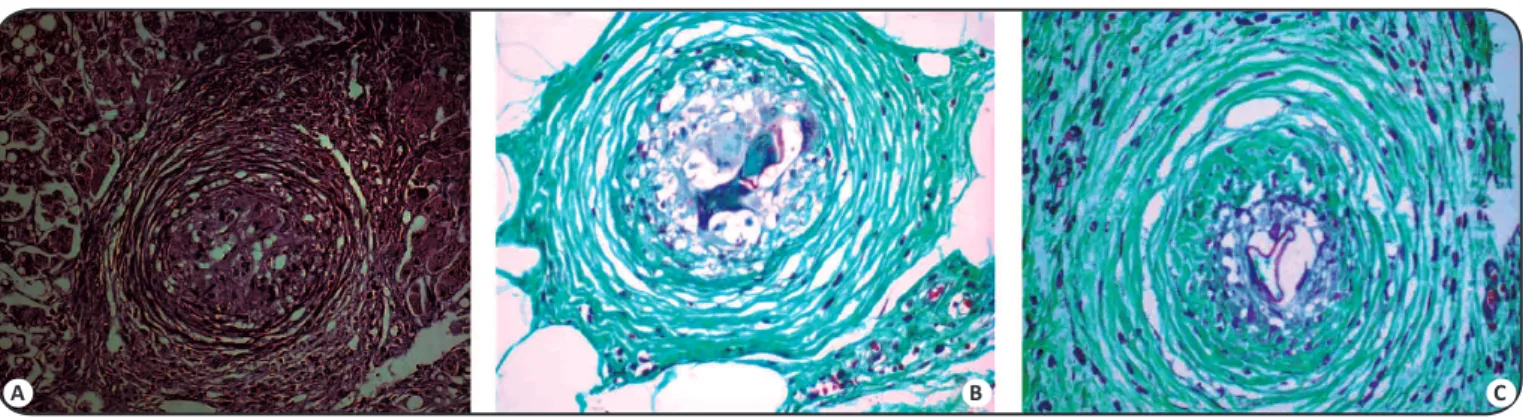
Finally, in humans, unlike the claim Silva et al. in mice21, the
immunomodulaion occurs also outside of the liver (Figure 2).
FIGURE 2 - Granuloma in ibroic healing phase, with external zone (Z3) delineated by parallel and circular connecive ibers, stained by HE in liver (A), and stained by trichromic in large intesine (B) and from peritoneum (C) as a result of modulaion, in the same individual, with pseudotumoral form of schistosomiasis mansoni.
To Carolina Dias for the English version. 1. Zhu Y, Lukacs NW, Boros DL. Cloning of THO - and TH2 - type helper lymphocytes
from liver granuloma of Schistosoma mansoni-infected mice. Infect Immunol 1944; 62:994-999.
2. Boros DL. Immunopathology of Schistosoma mansoni Infecion. Clin Microbiol Reviews 1989; 2:250-269.
3. Menik-Kane M, Cheever AW, Thompson RW, Hari DM, et al. IL-13 receptor alfa-2 down-modulates granulomatous inlamaion and prolongs host survival in schistosomiasis. Proc Acad Sci USA 2004; 102:586-590.
4. Raso P, Neves J. Contribuição ao conhecimento do quadro anatômico do ígado na forma toxêmica da esquistossomose mansoni através de punções-biópsias. An Fac Med Univ Fed Minas Gerais 1965; 22:147-195.
5. Raso P, Bernardes RC, Tafuri WL, Bogliolo L, Neves J. As dimensões do granuloma causado pelos ovos do S. mansoni no ígado humano. Rev Soc Bras Med Trop 1976; 12:45-49.
6. Raso P, Bogliolo L. Patologia. In: Cunha AS, editor. São Paulo: Savier - Editora da Universidade de São Paulo 1970; p. 70-130.
7. Raso P. Esquistossomose mansônica. In: Bogliolo Patologia. Brasileiro Filho G, editor. 7ª ed. Editora Guanabara Koogan, 2006; p. 1337-1359.
8. Andrade ZA, Warren KS. Mild prolonged schistosomiasis in mice: alteraions in host response with ime and the development of portal ibrosis. Trans R Soc Trop Med Hyg 1964; 58:53-57.
9. Coelho PMZ, Raso P, Mello RT, Toppa NH. Schistosoma mansoni in mice: modulaion of granulomatous response ater reinfecion and chemotherapeuic treatment. Rev Soc Bras Med Trop 1994; 27:119-125.
10. Lenzi HL, Romanha WS, Machado MP, Mota EM, Lenzi JA. Patologia experimental com enfoque no granuloma esquistossomóico: uma visão mulidisciplinar. Carvalho OS et al., Organizadores. Rio de Janeiro: Editora Fundação Oswaldo Cruz 2008; p. 569-654. 11. Junqueira LCV, Bignolas G, Brentani R. Picrosirino staining plus polarization
microscopy, a speciic method for collagen detecion in issues secions. Histochem J 1979; 11:47-54.
12. Smith JH, Lichtemberg FV. The Hoepply phenomenon in schistosomiasis. II. Histochemistry. Am J Pathol 1967; 50:993-1007.
13. Al Adnani MS. Concomitant immunohistochemical localizaion of ibronecin and collagen in schistosome granulomata. J Pathol 1985; 147:77-85.
14. Yamada KM, Olden K. Fibronecins-adhesive glycoproteins os cell surface and blood. Nature 1978; 275:179-184.
15. Linder E, Steman S, Lehto VP, Vaheri A. Distribuiion of ibronecin in human issues and relaionship to other connecive issue components. Ann NY Acad Sci 1978; 312:151-159.
A B C
ABSTRACT IN pORTUGUESE
Granuloma equistossomóico em fase evoluiva tardia, em um caso de forma tumoral no homem
Introdução: Os autores descrevem o granuloma esquistossomóico no homem, na fase crônica tardia, do ponto de vista morfológico e evolutivo. Métodos: O estudo baseou-se na análise histológica de dois fragmentos obidos de biópsia cirúrgica do peritônio e do intesino grosso de um paciente de 42 anos de idade, com a forma pseudotumoral mimetizando carcinomatose peritoneal associada à forma hepatointesinal da esquistossomose. Resultados: Foram identificados 203 granulomas no pseudotumor e 27 na biópsia intesinal, com aspectos morfológicos semelhantes, a maioria na fase crônica tardia, em cura por ibrose. Foi sugerida nova classiicação estrutural para os granulomas: zona 1 (interna), zona 2 (intermediária) e zona 3 (externa). Conclusões: Considerando o granuloma como um todo, concluímos que, provavelmente, a ibrose é comandada por mecanismos diferentes e independentes nas três zonas do granuloma. A fibrose lamelar na zona 3 parece ser comandada pelas células mesenquimais da matriz (ibroblastos e células mioepiteliais) e pelas células do exsudato inlamatório (linfócitos, plasmócitos, neutróilos, eosinóilos). A ibrose anular na zona 2, composta por conjunivo ibroso denso, pouco celular na fase avançada, seria comandada pelas células epitelioides que envolvem a zona 1 nos granulomas recentes. Na zona 1, subsituindo a necrose periovular, a neoformação conjuniva inicialmente frouxa, rendilhada, albergando células estreladas ou com núcleos fusiformes, surge um conjunivo denso, paucicelular, nodular, provavelmente induzido pelos ibroblastos. Em muitos granulomas falta uma das zonas descritas e o granuloma é representado apenas por duas delas: Z3 e Z2, Z3 e Z1 ou Z2 e Z1 e, no inal, por uma cicatriz.
16. van Die I, Cummings RD. Glycans modulate immune responses in helminic infeccions helmintic infeccious and allergy. Chem Immunol Allergy 2006; 90:91-112.
17. Ferreira CR, Campos FPF, Marines JAS, Kim EIM, Smeili LAA. Schistosomiasis: a case of severe infecion with fatal outcome. Autopsy Case Rep 2012; 2:1-17. 18. Bogliolo L. Subsidio para o estudo da Anatomia Patológica da forma aguda toxêmica.
Gen 1964; 19:157-236.
19. Jesus AR, Silva A, Santana LB. Clinical and immunologic evaluaion of 31 paients with acute schistosomiasis mansoni. J Infect Dis 2002; 185:98-105.
20. Raso P, Neves J, Bogliolo L, Tafuri WL, Pedroso ERP. A possível cura espontânea da esquistossomose mansoni humana: follow-up de três pacientes 13 anos após as manifestações da forma aguda toxêmica - nota prévia. Rev Soc Bras Med Trop 1978; 12:59-65.