O
riginal
a
r
ticle
RESUMO
Estudo descriivo, transversal, cujo objeivo
foianalisar a associação entre as dimensões
de apoio social e o peril de cuidadores familiares de pacientes com dependência. Entrevistaram-se 110 cuidadores, uilizando os seguintes instrumentos: quesionário de caracterização sociodemográica, So-cial Network Index, Medical Outcomes Study e Índice de Barthel. Os testes U de
Mann-Whitney e Kruskal-Wallis foram usados para comparar as dimensões de apoio social e as variáveis qualitaivas, e a correlação de Spearman para as variáveis quanitaivas. Cuidadores que não sabiam ler nunca haviam estudado apresentaram melhor percepção de apoio social em todas as dimensões, exceto na afeiva. Na dimensão interação posiiva, aqueles que possuíam companheiro e negaram sobre-carga apresentaram média superior a dos demais grupos. O número de familiares e amigos apresentou correlação com todas as dimensões de apoio social. Os resultados indicam que a rede social é importante para a percepção de apoio.
DESCRITORES Família
Cuidadores Apoio social Assistência domiciliar AbSTRACT
This is a descripive cross-secional study that analyzes the associaion between di-mensions of social support and the proiles of family caregivers. The following instru-ments were used to interview 110 caregi-vers: a socio-demographic quesionnaire, the Social Network Index, the Medical Outcomes Study, and the Barthel Index. The Mann-Whitney and Kruskal-Wallis tests were used to compare dimensions of social support and the qualitaive variables as well as to determine the Spearman correlaion for the quanitaive variables. Caregivers who could not read or had never studied showed beter percepion of social support in all dimensions except the afecive. In the posiive interacion dimension, groups who had a partner and denied being overloaded showed a higher average than others. In addiion, the number of family members and friends correlated with all dimensions of social support. Thus, the results indicate that one’s social network is important for the percepion of support.
DESCRIPTORS Family
Caregivers Social support Home nursing
RESUMEn
Estudio descripivo, transversal, cuyo ob-jeivo fue analizar la asociación entre las dimensiones de apoyo social y el peril de los cuidadores familiares de pacientes con dependencia. Se entrevistaron a 110 cuida-dores uilizando los siguientes instrumentos: cuesionario de caracterización sociodemo-gráica, Social Network Index, Medical Outco-mes Study y el Índice de Barthel. Se uilizaron los test de Mann-Whitney y Kruskal-Wallis para comparar las dimensiones del apoyo social con las variables cualitativas y la correlación de Spearman, para las variables cuanitaivas. Los cuidadores que no sabían leer y nunca habían estudiado mostraron una mejor percepción del apoyo social en todas las dimensiones, excepto la afeciva. En la dimensión de interacción positiva, aquellos que tenían pareja y negaron tener sobrecarga mostraron un promedio más alto que los otros grupos y el número de familia-res y amigos se correlacionó con todas las dimensiones de apoyo social. Los resultados mostraron que la red social es importante para la percepción de apoyo.
DESCRIPTORES Familia
Cuidadores Apoyo social
Atención domiciliaria de salud
Association between social support
and the profiles of family caregivers of
patients with disability and dependence
*AssocIAção entRe o APoIo socIAl e o PeRfIl de cuIdAdoRes fAmIlIARes de PAcIentes com IncAPAcIdAdes e dePendêncIA
AsocIAcIÓn entRe el APoYo socIAl Y el PeRfIl de los cuIdAdoRes fAmIlIARes de PAcIentes con dIscAPAcIdAd Y dePendencIA
Cintia Hitomi Yamashita1, Fernanda Amendola2, Jaqueline Correia Gaspar3, Márcia Regina Martins Alvarenga4, Maria Amélia de Campos Oliveira5
InTRODUCTIOn
As a result of demographic and epidemiological transi-ions of the populaion, there has been a tangible increase in the number of people with disabiliies and dependency in Brazil. External causes, among which traic accidents are at the forefront, are the major cause of disability among young adults, whereas falling is the most signiicant cause among the elderly(1). In many cases, the individual becomes incapable of
performing regular aciviies of daily living (ADLs) without as-sistance, needing a caregiver to provide assistance at home(2).
Law no. 10.424, issued on April 15, 2002, established home care as a form of care within the Naional Health System (SUS – Sistema Único de Saúde)(3). In November
2011, the program Beter at Home (Melhor em Casa) was launched to increase the range of home care, improve the quality of assistance, and enhance the management of the public health system(3).
Home care has become an alternaive to hospitalizaion, as it enables a reducion of both the inpaient
ime and the demand for hospital assistance, thus reducing the cost of care. Furthermore, it enables the healthcare team to become acquainted with the actual social situaion of the paients and their families, taking into account all aspects which can inluence pa-ients’ recovery in order to implement inter-venions based on families’ health needs(3).
In this form of care, the caregiver is central, serving as the person of reference for the healthcare team and as the person in charge of following the treatment plan(4). Tending to an
individual in a household can lead to changes in the family’s rouine and have signiicant impacts on a caregiver’s life, such as social
iso-laion, overload, and health problems. Full-ime care, in many cases without the possibility of replacement or assistance, results in caregivers distancing themselves from afecive and professional relaionships as well as in diminishing their social network and opportuniies for socializaion and leisure(5).
Studies have indicated the inluence of social networks in people’s lives: mortality rates are higher in groups with minimal social networks, whereas in groups with medium and large social networks, there are no staisically signii-cant inluences(6–7). In addiion, social relaionships
contrib-ute to atribuing a meaning to life and increasing the sense of security for the caregiver and the paient. Social support generates posiive efects not only for those who receive it but also for those who provide it(8–9).
Despite being synonymous in many cases, the terms
social network and social support have disinct albeit in-terrelated meanings. Social network is deined as a group of people with whom an individual maintains contact or a social connecion(10). Social support, however, refers to the
qualitaive aspect of the social network and relates to an individual’s level of saisfacion with his/her relaionships. It involves ive dimensions: material support (inancial as-sistance, provision of resources), emoional support (in the form of love, afecion, respect, and empathy), afecive support (physical demonstraions of love and afecion), posiive interacion support (availability of people with whom to have fun and relax), and informaion support (guidance, advice, and informaion)(11).
This study ideniied the social network and social support of caregivers who provide public home care. Moreover, it ob-served the exising associaions among dimensions of social support and between family members’ social and demographic characterisics as well as examined the caregiver’s health.
METHOD
This was a cross-secional study conducted using a quanitaive approach at a Home Care Service (SAD – Serviço de Assistência Domiciliária) in the subprefecture of Cidade
Ademar in São Paulo.
At the SAD in Cidade Ademar, paients are referred by the Basic Health Units (UBS – Unidades Básicas de Saúde) and included
in the service program following an assess-ment by the healthcare team. To be eligible for treatment, paients must reside within the area covered by the SAD. In addiion, they must be totally dependent on others for ADLs and/or require specialized care such as treatment of pressure ulcers, oxygen therapy, and use of probes.
The group comprised male and female caregivers of patients being treated by the service. Non-probability sampling was adopted for convenience. The criteria for inclusion in the sampling consisted of having performed the role of caregiver for more than three months without inancial compensaion for the rendered services. Families in which care was equally shared among family members such that the primary caregiver could not be ideniied were excluded.
Data were collected from March to November 2011, a prolonged ime frame due to a condiion sipulated by the SAD, which required visiing the paient with a heath professional before data collecion to introduce the study to the caregiver. Following this presentaion, scheduled interviews during which the public service professionals were not present were held with caregivers at their homes.
In June 2011, there were 229 paients and 218 care-givers registered with the SAD. From the total registered caregivers, 132 were visited, and 22 (16.7%) of these were excluded: ten who were professionals hired by the family; three who were no longer caregivers due to the paient having passed away; one who was a friend of the family;
...social relationships contribute to attributing
a meaning to life and increasing the sense
of security for the caregiver and the patient. social support
generates positive effects not only for those who receive it but also for those who
and one who, following three atempts, was not found. In addiion, an assessment of paients by means of the Barthel Index indicated that four were completely independent with regard to ADLs, leading to the exclusion of their caregiv-ers, thus resuling in a total sampling group of 110 family caregivers. From this sample, seven caregivers rendered services to more than one family member: six cared for two family members and one cared for three family members. This presented a total of 118 paients.
A quesionnaire was used to determine socio-demo-graphic characterisics; it included variables related to the paient (gender, age, diagnosed health problems, and level of dependency) and to the caregiver (gender; age; marital status; relaionship with the paient; average amount of ime
spent caring; academic background; total family income and per capita income; health problems; physical pain; overload in terms of care, social network, and social support).
To assess the paient’s level of dependency, the Bar-thel Index was used, an instrument which was validated in Brazil in 2010 and indicated excellent reliability and good results for converging and discriminaing criteria validaion(12). It is composed of ten items and scores in
ac-cordance with the paient’s performance of ADLs. Scores from 0 to 20 indicate total dependency, 21 to 60 severe dependency, 61 to 90 moderate dependency, 91 to 99 low dependency, and 100 independency(13).
To assess the social network, the Social Network Index [Remark 1] was used, which was validated in Brazil in 2003 and comprises ive issues for which caregivers must report the number of family members and friends they trust and with whom they can discuss almost anything. Furthermore, they must report their paricipaion in aciviies outside the household (leisure aciviies, aciviies in associaions, and voluntary work)(14).
The perception of social support was assessed by means of the Medical Outcomes Study, validated in Brazil in 2005. Comprising 19 items, the study encompasses the ive dimensions of social support (material, emoional, afecive, posiive interacion, and informaion). The scale for answers ranges from one (never) to ive (always), and the score is obtained using the following calculaion: [(total amount of points obtained in the dimension / maximum points for the dimension) × 100](15). The total score varies
between 20 and 100 and is divided into terciles for a social support analysis(16). The irst tercile comprises the lowest
scores, with values ranging from 20 to 46; the second tercile encompasses scores between 47 and 73, which indicate intermediate scores of social support; and the third tercile relects the high scores, which range from 74 to 100.
Upon performing the Kolmogorov-Smirnov test, it was observed that the dimensions did not present a normal distribuion; therefore, non-parametric tests were used. To compare the average scores of each dimension as well as the qualitaive variables, the Mann-Whitney U-Test was
used for variables with two categories. For variables with three or more categories, theKruskal-Wallis test was used, and if a signiicant staisical diference emerged, muliple comparisons were calculated by means of the Tukeytest. The Spearman correlaion coeicient was calculated for quanitaive variables. Results were considered staisically signiicant when p≤0.05.
The study was approved by the Ethics Commitee in Research of the School of Nursing of the Universidade de São Paulo (Case 934/2010) and by the Municipal Health Secretary of São Paulo (Instrucion 454/10). Caregivers were informed about the objecives of the study and the conideniality of data. The interviews were conducted only following the reading and signing of a consent form.
RESULTS
The majority of paients were female (56.8%), between 3 and 100 years of age and with an average age of 67.2 (SD=23.3). In addiion, diseases of the circulatory system were predominant (55.1%). The level of dependency, assessed by the Barthel Index, showed that the majority (66.1%) were totally dependent on others for ADLs, fol-lowed by those classiied within the severe dependency (20.3%), moderate dependency (11.0%), and low depen-dency (2.6%) ranges.
The majority of caregivers were female (90.0%), with an average age of 52.3 (SD=14.0), married (60.0%), and daugh-ters of the dependent family member (42.7%). Most of them were capable of reading (90.0%) and wriing (85.4%); however, 36.6% of them had not completed middle school. These results are displayed in Table 1.
The reliability of the Medical Outcomes Study was analyzed through Cronbach’s alpha, indicating an α of 0.90. The average score of the total social support was 77.5 (SD=19.9), with a predominance of high social support (59.1%). Caregivers indicated a greater percepion of sup-port in the afecive dimension, with an average of 84.9. A good internal consistency was observed in all dimensions, with an α superior to 0.80 (Table 2).
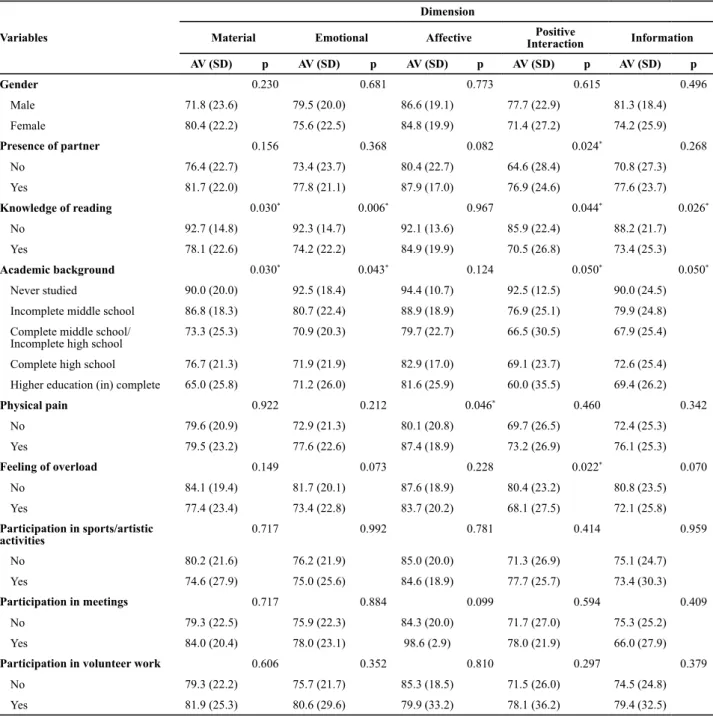
Upon analyzing the associaion between the averages of dimensions of social support and the qualitaive varia-bles related to the caregiver (gender; presence of partner;
knowledge of reading; academic background; physical pain; feeling of overload; paricipaion in aciviies such as sports/arisic aciviies, meeings, and volunteer work), it was noiced that gender and paricipaion in aciviies outside the household did not present a signiicant sta-isical diference between the averages of each category (p>0.05).
The variables knows how to read and academic ba-ckground presented significant statistical differences between the averages of all dimensions except the affective. The positive interaction dimension presented the greatest number of variations, with significant statis-tical differences between the averages of the following variables: presence of partner, knowledge of reading,
academic background, and feeling of overload. In the affective dimension, only the variable physical pain
presented a statically significant difference between the groups (Table 3).
An analysis of the correlaion between the scores of each dimension of social support and the quanitaive variables suggested that the age of caregivers showed a staisically signiicant correlaion only to the material di-mension (r=0.26).The variables number of family members
and number of friends with whom they feel comfortable discussing almost anything,which indicate caregivers’ social network, presented a staisically signiicant correlaion with all dimensions of social support, with posiive coeicients varying from r=0.20 to r=0.35 (Table 4).
Table 2 – Descriptive analysis of the scores of dimensions of social support for family caregivers of patients with disabilities and
dependency treated by the Home Care Service – São Paulo, SP, 2011.
Dimension α Average SD* Median Minimum Maximum
Material 0.90 79.5 22.3 80.0 20.0 100.0
Emotional 0.84 76.0 22.2 77.5 20.0 100.0
Information 0.86 74.9 25.3 96.7 20.0 100.0
Affective 0.88 84.9 19.7 80.0 26.6 100.0
Positive interaction 0.88 72.0 26.7 85.0 20.0 100.0
Total Score 0.90 77.5 19.8 80.8 27.3 100.0
*sd=standard deviation
Table 1 – Socio-demographic distribution of family caregivers of
patients treated by the Home Care Service – São Paulo, SP, 2011.
Variable N %
Gender
Female 99 90.0
Male 11 10.0
Marital status
Married/Consensual union 66 60.0
Single 25 22.7
Widower 10 9.1
Separated/Divorced 9 8.2
Relationship with patient*
Daughter/Son 47 42.7
Wife/Husband 27 24.5
Mother/Father 14 12.7
Sister/Brother 7 6.4
Granddaughter/Grandson 5 4.5
Other 17 15.4
Knows how to read
Yes 99 90.0
No 11 10.0
Knows how to write
Yes 94 85.5
No 13 11.8
Only their name 3 2.7
Educational background
Incomplete lower/middle school 41 37.3
Complete middle school 18 16.3
Incomplete high school 8 7.3
Complete high school 29 26.4
Other 8 7.3
Never studied 6 5.4
Table 4 – Analysis of the correlation between the average scores of dimensions of social support and the variables of age, amount of time spent caring, and social network of family caregivers of patients treated by Home Care Service – São Paulo, SP, 2011.
Variable
Dimension
Material Emotional Affective Positive Interaction Information
r(p) r(p) r(p) r(p) r(p)
Age 0.26 (0.005)* 0.07 (0.416) 0.06 (0.503) -0.01 (0.886) 0.09 (0.343)
Amount of time spent caring -0.15 (0.113) -0.03 (0.701) -0.12 (0.193) -0.00 (0.988) - 0.07 (0.431)
Number of family members 0.25 (0.007)* 0.33 (<0.001)* 0.33 (<0.001)* 0.37 (<0.001)* 0.35 (<0.001)*
Number of friends 0.20 (0.029)* 0.27 (0.004)* 0.24 (0.009)* 0.26 (0.005)* 0.23 (0.015)*
Table 3 –Comparison between the average scores of dimensions of social support and the variables related to the caregivers of
dependent patients treated by the Home Care Service – São Paulo, SP, 2011.
Variables
Dimension
Material Emotional Affective InteractionPositive Information
AV (SD) p AV (SD) p AV (SD) p AV (SD) p AV (SD) p
Gender 0.230 0.681 0.773 0.615 0.496
Male 71.8 (23.6) 79.5 (20.0) 86.6 (19.1) 77.7 (22.9) 81.3 (18.4)
Female 80.4 (22.2) 75.6 (22.5) 84.8 (19.9) 71.4 (27.2) 74.2 (25.9)
Presence of partner 0.156 0.368 0.082 0.024* 0.268
No 76.4 (22.7) 73.4 (23.7) 80.4 (22.7) 64.6 (28.4) 70.8 (27.3)
Yes 81.7 (22.0) 77.8 (21.1) 87.9 (17.0) 76.9 (24.6) 77.6 (23.7)
Knowledge of reading 0.030* 0.006* 0.967 0.044* 0.026*
No 92.7 (14.8) 92.3 (14.7) 92.1 (13.6) 85.9 (22.4) 88.2 (21.7)
Yes 78.1 (22.6) 74.2 (22.2) 84.9 (19.9) 70.5 (26.8) 73.4 (25.3)
Academic background 0.030* 0.043* 0.124 0.050* 0.050*
Never studied 90.0 (20.0) 92.5 (18.4) 94.4 (10.7) 92.5 (12.5) 90.0 (24.5)
Incomplete middle school 86.8 (18.3) 80.7 (22.4) 88.9 (18.9) 76.9 (25.1) 79.9 (24.8)
Complete middle school/ Incomplete high school
73.3 (25.3) 70.9 (20.3) 79.7 (22.7) 66.5 (30.5) 67.9 (25.4)
Complete high school 76.7 (21.3) 71.9 (21.9) 82.9 (17.0) 69.1 (23.7) 72.6 (25.4)
Higher education (in) complete 65.0 (25.8) 71.2 (26.0) 81.6 (25.9) 60.0 (35.5) 69.4 (26.2)
Physical pain 0.922 0.212 0.046* 0.460 0.342
No 79.6 (20.9) 72.9 (21.3) 80.1 (20.8) 69.7 (26.5) 72.4 (25.3)
Yes 79.5 (23.2) 77.6 (22.6) 87.4 (18.9) 73.2 (26.9) 76.1 (25.3)
Feeling of overload 0.149 0.073 0.228 0.022* 0.070
No 84.1 (19.4) 81.7 (20.1) 87.6 (18.9) 80.4 (23.2) 80.8 (23.5)
Yes 77.4 (23.4) 73.4 (22.8) 83.7 (20.2) 68.1 (27.5) 72.1 (25.8)
Participation in sports/artistic activities
0.717 0.992 0.781 0.414 0.959
No 80.2 (21.6) 76.2 (21.9) 85.0 (20.0) 71.3 (26.9) 75.1 (24.7)
Yes 74.6 (27.9) 75.0 (25.6) 84.6 (18.9) 77.7 (25.7) 73.4 (30.3)
Participation in meetings 0.717 0.884 0.099 0.594 0.409
No 79.3 (22.5) 75.9 (22.3) 84.3 (20.0) 71.7 (27.0) 75.3 (25.2)
Yes 84.0 (20.4) 78.0 (23.1) 98.6 (2.9) 78.0 (21.9) 66.0 (27.9)
Participation in volunteer work 0.606 0.352 0.810 0.297 0.379
No 79.3 (22.2) 75.7 (21.7) 85.3 (18.5) 71.5 (26.0) 74.5 (24.8)
Yes 81.9 (25.3) 80.6 (29.6) 79.9 (33.2) 78.1 (36.2) 79.4 (32.5)
DISCUSSIOn
In this study, the proile of the paients resembled that found in other studies in which the majority of paients were female with an average age between 60 and 67 years and who had diseases of the circulatory system(5, 17). Most were totally
dependent on others for ADLs, resuling in greater physical efort and atenion required from the caregiver. As the level of dependency of paients increases, so do the diiculies en-countered by the caregivers, because of their lack of technical knowledge and skills as well as their physical limitaions(18).
The interviewed caregivers were mostly wives and dau-ghters of the dependent family member and had performed the task for an average of six years, with the average age being 52 years. Similar data were found in other studies(2, 19).
The predominance of female caregivers relects a social condiion associated with gender, according to which caring is a task tradiionally assigned to women(20).
Caregivers’ social networks primarily comprised family members, and the majority did not paricipate in any acivity outside the household. The maximum number of family members and friends was 50 and 100, respecively. Upon being interviewed, caregivers referred to having a large family or having many friends, indicaing an extensive social
network. On the other hand, many caregivers report a lack of social network as a result of not having someone with whom they could discuss almost anything.
In a study on caregivers’ social networks and saisfacion with life, conducted with family caregivers of elderly peo-ple with and without demenia, the researchers observed that in both groups, the social network comprised family members, followed by friends and neighbors. In addiion, they noiced that within the group of caregivers of elderly people with demenia, interviewees with a smaller social network were less saisied with life(21).
In the present study, caregivers presented an average score of social support that was above 77.0, relecing high social support, with the score for the afecive dimension being paricularly high, averaging above 80.0. This indicates a greater percepion of being able to depend on someone when the need for physical demonstraions of love and afecion arises. Yet, the dimensions of posiive interacions and informaion showed a lower average score, 72.0 and 74.9, respecively, indicaing a lower percepion on the part of caregivers in terms of having someone to depend on, to have fun or relax with, or from whom to obtain guidance, advice, or informaion.
Both social network and social support are important for the physical and mental health of individuals, because they serve as protectors and promoters of health and contribute to how individuals deal with illness, stress, and social vulnerability(22). Support may originate not only from
family and friends but also from health and social services. When this support is precarious, caregivers experience greater exhausion, which can increase as the paient’s health deteriorates(23).
With regard to the associaion between the average scores of each dimension and the proile of the caregiver, it was noted that caregivers who were unable to read and had never studied presented staisically signiicant diferences in all dimensions except the afecive.
Caregivers with a beter academic background have a greater percepion of the restricions on their social life due to the care they provide that clearly interfere with their quality of life(24). A study on the subjecive impact of
Alzheimer’s disease in the lives of caregivers of the elderly noted that those with a greater academic background had a greater percepion of feeling overloaded(25).
However, academic background can also inluence the way in which caregivers acknowledge their role. A low edu-caional level, greater social resources, social paricipaion, and adequate health condiions can all posiively contribute to the rendering of care for a dependent paient(26). In many
situaions, the lack of a job outside the household, due to a low academic background, leads caregivers to taking care of the paient and, despite diiculies, leads to saisfacion for being able to contribute to the treatment of a sick family member.
Caregivers who reported some physical pain presented a greater percepion of social support in the afecive dimen-sion, and those who denied feeling overloaded as a result of the care they provided presented a superior average score in the posiive interacion dimension than those who reported feeling overloaded, indicaing a lower percepion of being able to depend on someone to have fun and relax with.
It was also observed that caregivers who had partners had a greater percepion of support in the posiive interac-ion dimensinterac-ion, even though many of them were unable to perform aciviies outside the household. The presence of a partner frequently provides caregivers with a percepion that they will have someone to depend on when the need to relax, be distracted, or engage in fun aciviies emerges.
In a study on the quality of life and social support of caregivers of dependent paients, the researchers noiced an inversely proporional correlaion between the feeling of overload and the domain of social relaionships – a corre-laion which indicates an individual’s saisfacion regarding his/her interpersonal relaionships and the support received from friends and family members. It was observed that the greater the feeling of overload for caregivers, the lower the average score in this domain. The study also indicated that the presence of a partner contributes to caregivers having a greater percepion of quality of life, indicaing that a hus-band or wife enables caregivers to deal with their situaion, represening potenial to strengthen caregivers(5).
Furthermore, a staisically signiicant (p≤0.05) correlaion between caregivers’ ages and percepions of social support was noiced. In other words, the older the caregiver, the greater his/her percepion of social support(27). In the
pre-sent study, the variable age only presented a correlaion to the material dimension of the social support quesionnaire.
The number of family members and friends that are part of a caregiver’s social network showed a staisically signiicant correlaion with all dimensions of social support. In other words, the more family members and friends with whom caregivers feels comfortable and can discuss almost anything, the greater their percepion of social support.
Social networks are important for minimizing stress, dealing with diseases, and strengthening a caregiver’s self--esteem. Moreover, it supports families in dealing with the situaion they are faced with(28). The distancing of caregivers
from society and friends can lead to a greater feeling of overload in addiion to causing several health problems and an increase in the number of comorbidiies(25).
A systemaic revision of the support programs for fami-lies and caregivers of paients with schizophrenia revealed that paricipaion in such programs gives caregivers the opportunity to share experiences, thus improving their percepion of social support and decreasing the feeling of overload owing to the support being received both at a so-cial as well as an emoional level. Therefore, it is important to encourage the creaion of such groups as well as families’ paricipaion in them, which might increase an individual’s capacity of dealing with his/her situaion and preserve the caregiver’s mental health(29).
Despite the health problems and the considerable changes to caregivers’ rouines, it is important to highlight that in many cases, the care provided is regarded even by the paient as a task that digniies him/her and brings saisfacion through a feeling of mission accomplished. These posiive aspects must be simulated, enabling them to lead to a beter quality of life and health for caregivers, thus increasing caregivers’ self-esteem(30).
COnCLUSIOn
In this study, it was noted that the interviewed caregivers’ social networks comprised primarily family members and that the majority of caregivers did not paricipate in any acivity outside the household. The dimensions of social support relected good rates of internal consistency and the average score of total social support was adequate, with an average above 77.0. All dimensions presented an average score above 74.0, relecing high social support; the excepion to this was the posiive interacion dimension, which presented an average score of 72.0. Furthermore, it was noted that the greater the social network of caregivers, the greater their percepion of social support in all dimensions. Caregivers who could not read or who had never studied presented a greater percepion of social support, except for when they required physical demonstraions of love and afecion.
Paying atenion to the health of the family caregiver is very important to guarantee the proper care of the paient. The assistance planning provided by healthcare teams should consider the needs of caregivers to ensure that they do not fall ill themselves with numerous morbidiies that might lead to them becoming disabled or dependent and in need of care.
In spite of many caregivers having presented a high percepion of social support, they do not always require addiional atenion and assistance. The percepion of the support they receive might be inluenced by individual characterisics; each caregiver’s level of resilience; and the objecive condiions he/she is dealing with, such as the level of dependency of the paient and the amount of ime spent caring for the paient. It is also important to consider the culture, values, and caregiver-paient relaionship when interpreing the results and planning proper care for the paient and proper assistance for the caregiver.
Notwithstanding the limitaions of the study, such as that it was conducted with a convenience sample and limited to the period of data collecion because of the pro-longed ime spent on this stage, the proposed objecives were considered to have been achieved.
1. Brasil. Ministério da Saúde; Secretaria de Atenção à Saúde. Envelhecimento e saúde da pessoa idosa [Internet]. Brasília; 2007 [citado 2013 jul. 23]. Disponível em: htp://bvsms.saude. gov.br/bvs/publicacoes/abcad19.pdf
2. Perlini NMOG, Faro ACM. Cuidar de pessoa incapacitada por acidente vascular cerebral no domicílio: o fazer do cuidador familiar. Rev Esc Enferm. 2005;39(2):154-63.
3. Brasil. Ministério da Saúde; Secretaria de Atenção à Saúde. Caderno de Atenção Domiciliar [Internet]. Brasília; 2012 [citado 2013 jul. 23]. Disponível em: htp://189.28.128.100/ dab/docs/publicacoes/geral/cad_vol1.pdf
4. São Paulo. Secretaria Municipal de Saúde. Portaria n. 1.170, de 13 de junho de 2008. Dispõe sobre a criação do Programa Hospitalar de Atendimento e Internação Domiciliar (PROHDOM) [Internet]. São Paulo; 2008 [citado 2013 set. 9]. Disponível em: htp://www.prefeitura.sp.gov. br/cidade/secretarias/upload/saude/arquivos/nupes/ PortariaMunicipal_1170_2008_SMS.pdf
5. Amendola F, Oliveira MAC, Alvarenga MRM. Inluence of social support on the quality of lifeof family caregivers while caring for people with dependence. Rev Esc Enferm [Internet]. 2011 [cited 2013 Aug 19];45(4):884-9. Available from: htp://www. scielo.br/pdf/reeusp/v45n4/en_v45n4a13.pdf
6. Schoenbach VJ, Kaplan BH, Fredman L, Kleinbaum DG. Social ies and mortality in Evans County, Georgia. Am J Epidemiol. 1986;123(4):577-91.
7. House J, Robbins C, Metzner H. The associaion of social relations with morality: prospective evidence from the Tecumseh Community Health Study. Am J Epidemiol. 1982;116(1):123-40.
8. Norbeck JS, Lindsey AM, Carrieri VL. The development of an instrument to measure social support. Nurs Res. 1981;30(5):264-9.
9. Valla VV. Educação popular, saúde comunitária e apoio social numa conjuntura de globalização. Cad Saúde Pública. 1999;15(2 Supl):7-14.
10. Bowling A. Measuring health: a review of quality of life measurement scales. Maidenhead: Open University Press; 1997. Measuring social networks and social support; p. 91-109.
11. Chor D, Griep RH, Lopes CS, Faerstein E. Medidas de rede e apoio social no Estudo Pró-Saúde: pré-testes e estudo piloto. Cad Saúde Pública. 2001;17(4):887-96.
12. Minosso JSM, Amendola F, Alvarenga MRM, Oliveira MAC. Validação, no Brasil, do Índice de Barthel em idosos atendidos em ambulatórios. Acta Paul Enferm. 2010;23(2):218-23.
13. Shah S, Vanclay F, Cooper B, Improving the sensiivity of the Barthel Index for stroke rehabilitaion. J Clin Epidemiol. 1989;42(8):703-9.
14. Griep RH, Chor D, Faerstein E, Lopes CS. Coniabilidade teste-reteste de aspectos da rede social no Estudo Pró-Saúde. Rev Saúde Pública. 2003;37(3):379-85.
15. Griep RH, Chor D, Faerstein E, Werneck GL, Lopes CS. Validade de constructo de escala de apoio social do Medical Outcomes
Study adaptada para o português no Estudo Pró-Saúde. Cad
Saúde Pública. 2005;21(3):703-14.
16. Andrade CR, Chor D, Faerstein E, Griep RH, Lopes CS, Fonseca MJM. Apoio social e auto-exame das mamas no Estudo Pró-Saúde. Cad Saúde Pública. 2005;21(2):379-86.
17. Gaspar JC, Oliveira MAC, Duayer MFF. Perfil dos pacientes com perdas funcionais e dependência atendidos pelo PSF no município de São Paulo. Rev Esc Enferm USP. 2007;41(4):619-28.
18. Thober E, Creutzberg M, Viegas K. Nível de dependência de idosos e cuidados no âmbito familiar. Rev Bras Enferm. 2005;58(8):438-43.
19. Yamashita CH, Amendola F, Alvarenga MRM, Oliveira MAC. Peril sociodemográico de cuidadores familiares de pacientes dependentes atendidos por uma Unidade de Saúde da Família no município de São Paulo. Mundo Saúde. 2010;34(1):20-4.
20. Bicalho CS, Lacerda MR, Catafesta F. Releindo sobre quem é o cuidador familiar. Cogitare Enferm. 2008;13(1):118-23.
21. Figueiredo D, Lima MP, Sousa L. Cuidadores familiares de idosos dependentes com e sem demência: rede social, pessoal e satisfação com a vida. Psic Saúde Doenças. 2012;13(1):117-29.
22. Gonçalves TR, Pawlowski J, Bandeira DR, Piccinini CA. Avaliação de apoio social em estudos brasileiros: aspectos conceituais e instrumentos. Ciênc Saúde Coleiva. 2011;16(3):1755-69.
23. Sanchez KOL, Ferreira NMLA, Dupas G, Costa DB. Apoio social à família do paciente com câncer. Rev Bras Enferm. 2010;63(2):290-9.
24. Ferreira CG, Alexandre TS, Lemos ND. Fatores associados à qualidade de vida de cuidadores de idosos em Assistência Domiciliária. Saúde Soc. 2011;20(2):398-409.
25. Lemos NP, Gazzola JM, Ramos LR. Cuidando do paciente com Alzheimer: o impacto da doença no cuidador. Saúde Soc. 2006;15(3):170-9.
26. Brodaty H, Donkin M. Family caregivers of people with demenia. Dialogues Clin Neurosci. 2009;11(2):217-28.
27. Choi-Kwon S, Mitchell PH, Veith R, Teri L, Buzaiis A, Cain KC, et al. Comparing perceived burden for Korean and American informal caregivers of stroke survivors. Rehabil Nurs. 2009;34(4):141-50.
28. Brito ES, Rabinovich EP. Desarrumou tudo! O impacto do acidente vascular encefálico na família. Saúde Soc. 2008;17(2):153-69.
29. Bademli K, Duman ZC. Family to family support programs for the caregivers of schizophrenia paients: a systemaic review. Turk Psikiyatri Derg. 2011;22(4):255-65.