titrimetriC aSSay of liSinopril in aqueouS and
non-aqueouS media
K.Basavaiah1*, K. Tharpa1, K.B. Vinay2
1Department of chemistry, University of Mysore, Manasagangotri, Mysore-57006, India
2Advinus Therapeutics Pvt. Ltd., Peenya II Phase, Bangalore-560058, India. *Corresponding Author E-mail: [email protected]
abstract: Four simple titrimetric procedures are described for the determination of lisinopril (LNP) in bulk and in pharmaceuticals based on the neutralization of basic-amino and acidic carboxylic acid groups present in LNP. Method A is based on the neutralization of basic amino groups using perchloric acid as titrant in anhydrous acetic acid medium. Method B, method C and method D are based on neutralization of carboxylic acid group using NaOH, sodium metho-xide and methanolic KOH, as titrants, respectively. Method A is applicable over 2.0-20.0 mg range and the calculations are based in the molar ratio of 1:2 (LNP:HClO4). Method B, method C and method D are applicable over 2.0-20.0 mg, 1.0-10.0 mg and 5.0-15.0 mg range, res-pectively, and their respective molar ratios are 1:1 (LNP:NaOH), 1:2 (LNP:CH3ONa) and 1:1 (LNP:KOH). Intraday and inter day accuracy and precision of the methods were evaluated and the results showed intra- and inter-day precision less than 2.7% (RSD), and accuracy of < 2.5 % (RE). The developed methods were applied to determine LNP in tablets and the results were validated statistically by comparing the results with those of the reference method by applying the Student’s t-test and F-test. The accuracy was further ascertained by recovery studies via
standard addition technique. No interferences from common tablet exipients was observed.
Key words: Lisinopril, titrimetry, potentiometry, pharmaceuticals
introduction
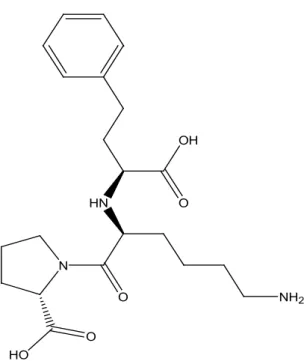
Lisinopril, 1-[6-Amino-2-(1-carboxy-3- phenyl-propylamino)-hexanoyl]-pyrrolidine-2-carboxylic acid, is a lysine derivative of enala-prilat, the active metabolit of enalapril. It is an angiotensin converting enzyme (ACE) inhibitor used in the treatment of hypertension, heart fai-lure, acute myocardial infarction and preventing renal and retinal complications of diabetics [1] and was introduced into therapy in 1990s [2]. The oficial methods for the determination of LNP are potentiometric acid-base titration [2] and HPLC [3] using actylsilane column at 50 0C and
phos-phate solution-acetronitrile (96:4 v/v) as mobile phase.
hydro-chlorothiazide [23]. These methods are mostly applicable in relatively high concentrations. Po-larographic [12, 24, 25] determination of LNP are rather complicated and they are not so sensitive. Other techniques include- gas chromatography [26], HPTLC-densitometry [16], capillary elec-trophoresis [27] and HPLC [28-31]. Though the existing methods are sensitive yet they are expen-sive. Cost effective analytical technique such as titrimetry is still needed in various quality control laboratories in the developing countries.
There is only one report, an oficial method [2], on the use of titrimetry method for the de-termination of LNP. The method consisted of the titration of the aqueous solution of the tablet con-taining LNP with 0.1M NaOH potentiometrically and requires fairly large quauntities of LNP for each titration. The present manuscript describes four sensitive titrimetric methods for the deter-mination of LNP in both pure form and in tablet form. The methods make use of the two amino groups and one carboxylic acid functional groups present in the molecule. The developed methods are more simple than many existing methods besi-des being applicable to smaller amounts compared to the lone titrimetric method available [2].
experimental
Apparatus
Potentiometric titration was performed with an Elico 120 digital pH meter provided with a combined glass-SCE electrode system. The KCl of the salt bridge was replaced with saturated so-lution of KCl in methanol.
Materials and reagents
LNP was kindly provided by Cipla Ltd., India, and was used as received. Pharmaceutical preparations of LNP, such as Hipril (Micro Car-syon Ltd.), Lipril (Lupin laboratories Ltd.), and Listril (Torrent Pharmaceutical Ltd.) were pur-chased from the local market. All other reagents and solvent used were of analytical grade and they
were purchased from either Merck, Loba Chemie and S.d. Fine Chem of Mumbai, India.
A 0.01 M perchloric acid (standardized against 0.01 M potassium dihydrogen phthalate) and 0.5% crystal violet indicator was prepared in glacial acetic acid for method A. A 0.01 M NaOH (standardized against 0.01 M potassium hydrogen phthalate) and 0.2% (w/v) phenolphthalein indi-cator were prepared in ethanol for method B. A 0.005M sodium methoxide (standardized against benzoic acid) was prepared in 3:1 benzene: me-thanol and 0.2% (w/v) phenolphthalein in same solvent for method C. A 0.005M KOH (standardi-zed against benzoic acid) was prepared in metha-nol for method D.
A stock standard solution of LNP contai-ning 2 mg/ml was prepared in glacial acetic acid (method A), 2 mg/ml in water (method B), 1 mg/ ml in 3:1 benzene:methanol (method C) and 1 mg/ ml in methanol (method D).
procedures
Method A
Different volumes (1-10 ml) of standard solution containing 2mg/ml LNP were taken in a 100 ml titration lask and the volume was madeup to 10 ml with glacial acetic acid. Two drops of crystal violet indicator were added and the so-lution titrated against standardized soso-lution of 0.01M perchloric acid to a blue end point.
Method B
Method C
Varying aliquots (1-10 ml) of 1 mg/ml stan-dard LNP solution were accurately measured into a titration lask and volume adjusted to 10 ml with 3:1 benzene: methanol. Two drops of 0.2% phe-nolphthalein were added and titrated against stan-dardized solution of 0.005M sodium methoxide to a irst appearance of pink color end point.
Method D
Different volumes (1-10 ml) of standard solution containing 1mg/ml LNP were taken in a 50 ml beaker and volume madeup to 20 ml with methanol. The titration was carried potentiome-trically against standardized solution of 0.005 M KOH.
All titrations were carried in a well closed container in order to avoid atmospheric carbon dioxide from dissolving into the solutions.
The amount of LNP in the aliquot was com-puted from the following formula:
Amount (mg) = V x Mw x S n where V = ml of titrant reacted Mw = relative molecular mass of drug S = strength of titrant, moles/L
n = number of moles of titrant reacting with per mole of LNP.
Procedure for the determination of lisinipril
in tablets
Twenty tablets were weighed accurately and ground into a ine powder. Four portions of the powder equivalent to 200 mg or 100 mg of LNP was accurately weighed into a 100 mL volu-metric lask and extraction was done by shaking for half an hour with 40 ml of solvent speciied under each methods; then, the volume was diluted to the mark with the respective solvents, mixed well and iltered using a Whatman No. 42 ilter paper. First 10 mL portion was discarded and sub-sequent amount of the tablet extract was subjected to titration by following the procedures mention under each methods.
results and discussion
O HO
N
NH2 HN
OH
O
O
fig. 1. Structure of lisinopril
Therefore, the reaction stiochiometry of 1:1 was used for the calculation purpose. Further, a potentiometric titrations was performed by va-rying the ratios of benzene-methanol as solvent and sodium methoxide as titrant and found that the peaks are rather broad and distorted. Similarly, 5:1 benzene-methanol shows lot of luctuations in the potential reading.
Method validation
Method validations are done according to the present ICH guidelines [36].
Selectivity
The proposed methods were tested for se-lectivity by placebo blank and synthetic mixture analyses. A placebo blank containing talc (20 mg), starch (15 mg), lactose (5 mg), calcium carbonate (10 mg), calcium dihydrogenorthophosphate (10 mg), methyl cellulose (5 mg), sodium alginate (15 mg) and magnesium stearate (10 mg) was prepa-red, extracted with respective solvents mentioned under four different methods and solution made as
described under “procedure for tablets”. A conve-nient aliquot of solution was subjected to analysis by titrimetry according to the recommended pro-cedures. In all the cases, there was no measurable consumption of titrant suggesting the non-interfe-rence by the inactive ingredients.
A separate experiment was performed with synthetic mixture. To the placebo blank of similar composition, 100 or 200 mg of LNP was added, homogenized and the solution of the synthetic mixture was prepared as done under “procedure for tablets”. Ten ml of the resulting solution was assayed (n=5) which yielded a % recovery of 101.3±0.62 - 104±0.23. These results complement the indings of the placebo blank analysis with respect to selectivity.
Accuracy
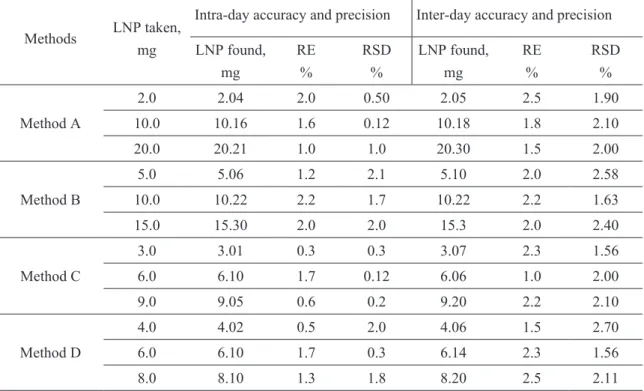
The accuracy of the proposed methods was determined by performing replicate determina-tions. The intra-day and inter-day variation in the analysis of LNP was measured at three different levels. The accuracy of an analytical method ex-presses the closeness between the reference value and the found value. Accuracy was evaluated as percentage relative error between the measured and taken amounts/concentrations. The results of this study are compiled in Table 1 and speak of the excellent accuracy of the results.
Precision
table 1. Evaluation of intra-day and inter-day accuracy and precision
Methods LNP taken, mg
Intra-day accuracy and precision Inter-day accuracy and precision
LNP found, mg
RE %
RSD %
LNP found, mg
RE %
RSD %
Method A
2.0 2.04 2.0 0.50 2.05 2.5 1.90
10.0 10.16 1.6 0.12 10.18 1.8 2.10
20.0 20.21 1.0 1.0 20.30 1.5 2.00
Method B
5.0 5.06 1.2 2.1 5.10 2.0 2.58
10.0 10.22 2.2 1.7 10.22 2.2 1.63
15.0 15.30 2.0 2.0 15.3 2.0 2.40
Method C
3.0 3.01 0.3 0.3 3.07 2.3 1.56
6.0 6.10 1.7 0.12 6.06 1.0 2.00
9.0 9.05 0.6 0.2 9.20 2.2 2.10
Method D
4.0 4.02 0.5 2.0 4.06 1.5 2.70
6.0 6.10 1.7 0.3 6.14 2.3 1.56
8.0 8.10 1.3 1.8 8.20 2.5 2.11
Ruggedness
Method ruggedness was expressed as the RSD of the same procedure applied by four di-fferent analysts as well as using three didi-fferent burettes. The inter-analyst RSD were within 1.1% whereas the inter-burettes RSD for the same LNP concentrations ranged from 2.54-3.14% sugges-ting that the developed method was rugged.
Application to tablet analysis
Commercial LNP tablets were analysed using the developed methods and also a literature method (8) (reference method). The method con-sisted of the measurement of the aborbance of the charge transfer complex formed between LNP and para-chloranilic acid in methanol medium at 525 nm. The results obtained were compared statisti-cally by the Student’s t-test and the variance-ratio F-test. The calculated t- and F- values did not ex-ceed the tabulated values at the 95 % conidence level and for four degrees of freedom, indicating close similarity between the proposed methods
table. 2. Results of analysis of tablets by the proposed methods. Tablets analysed** Label claim, mg/tablet
Found* (Percent label claim ±SD)
Reference
method Method A Method B Method C Method D
Normoprila 2.5 98.64 ± 1.58
99.12 ± 1.22 t = 0.59 F= 2.77
98.44 ± 1.22 t = 0.23 F= 1.68
97.72 ± 1.92 t = 0.83 F= 1.48
99.06 ± 2.14 t = 0.36 F= 1.83
Liprilb 5.0 100.5 ± 9.26
101.2 ± 1.74 t = 0.74 F= 1.91
100.1 ± 0.85 t = 0.59 F= 2.19
100.8 ± 0.64 t = 0.49 F= 3.88
99.42 ± 1.56 t = 1.21 F= 1.53
Hiprilc 10.0 97.46 ± 1.76
98.58 ± 1.14 t = 1.22 F= 2.72
96.72 ± 1.36 t = 0.75 F= 1.67
97.72 ± 1.04 t = 0.52 F= 2.86
98.72 ± 1.42 t = 1.25 F= 1.54
*Mean value of ive determinations.
**Marketed by: a. Micro Carsyon, Bangalore (India) b. Torrent pharmaceuticals Ltd. Nalagarh (India) c. Aristo Pharmceuticals Ltd. Mumbai (India)
Tabulated t-value at 95% conidence level for four degree of freedom is 2.77. Tabulated F-value at 95% conidence level for four degree of freedom is 6.39.
Recovery study
To further ascertain the accuracy and reliability of the methods, recovery experiments were per-formed via standard-addition procedure. Pre-analysed tablet powder was spiked with pure LNP at three different levels and the total was found by the proposed methods. Each determination was repeated three times. The percent recovery of pure LNP added was within the permissible limits indicating the absence of inactive ingredients in the assay.
table. 3. Accuracy assessment by recovery experiments.
Tablets studied
Method A Method B
LNP in tablet, mg LNP in tablet, mg* Pure LNP added, mg Total found, mg Pure LNP recovered*, Percent± SD LNP in tablet, mg Pure LNP added, mg Total found, mg Pure LNP recovered*, Percent ± SD
Lipril 5.0 5.06 5.06 5.06 2.5 5.0 10.0 7.59 10.09 15.02
101.2 ± 1.64 100.6 ± 1.20 99.6 ± 1.56
5.01 5.01 5.01 2.5 5.0 10.0 7.55 10.00 15.04
101.6 ± 0.62 99.8 ± 1.06 100.3 ± 1.12
Hipril 10.0 4.93 4.93 4.93 2.5 5.0 10.0 7.39 9.92 15.06
98.4 ± 1.76 99.8 ± 0.95 101.3 ± 1.26
4.84 4.84 4.84 2.5 5.0 10.0 7.27 9.77 14.37
Tablets studied
Method C Method D
LNP in tablet, mg Pure LNP added, mg Total found, mg Pure LNP recovered*, Percent ± SD
LNP in tablet, mg Pure LNP added, mg Total found, mg Pure LNP recovered*, Percent ± SD
Lipril 4.00 4.00 4.00 2.0 4.0 6.0 6.03 8.14 10.13
101.5 ± 0.97 103.5 ± 1.26 102.2 ± 0.85
4.97 4.97 4.97 2.50 5.0 10.0 7.55 10.0 15.1
103.2 ± 1.75 100.6 ± 1.26 101.3 ± 1.6
Hipril 3.92 3.92 3.92 2.0 4.0 6.0 5.84 7.85 9.78
96.0 ± 1.24 98.3 ± 1.52 97.2 ± 1.36
4.94 4.94 4.94 2.50 5.0 10.0 7.35 9.80 14.89
96.4 ± 0.96 97.2 ± 1.18 99.5 ± 1.46
*Mean value of three determinations
Conclusion
The proposed methods are selective as the drug contains amino and carboxylic acid groups, which preferentially get neutralized by acid and alkali, respectively. All the methods show no in-terference from the common excipients and addi-tives. The statistical parameters and the recovery data reveal good accuracy and precision of the proposed methods. Therefore, it is concluded that the proposed methods are simple and selective for the determination of LNP in pure form and com-mercial dosage forms. Hence, the present approach encourages their successful use in routine analysis of the drug in quality control laboratories.
acknowledgement
The Authors are grateful to Cipla India Ltd, Mumbia, India, for providing the pure sample of lisinopril as gift. One of the authors (KT) thanks the authorities of the University of Mysore, Myso-re, for permission and facilities. Kalsang Tharpa also gratefully acknowledges the inancial help from the Department of Education, Central Ti-betan Administration of His Holiness, The Dalai Lama.
references
Parfitt, K. “The Complete Drug Reference”.
[1] (1999)32nd
ed. 898. The Pharamaceutical Press, Martindalle, MA.
The British Pharmacopoeia, Her Majesty’s Stationary [2]
Office, London, (1998) pp. 799. The US Pharmacopoeia, 24
[3] th revision, Asian Edition,
United States Pharmacopoeial Convention, INC, Twinbrook Parkway, Rockville, MD, (2000), pp. 979 and pp. 2149.
G. Parashevas, J. Atta-Politou, M. Koupparis, J. Pharm. [4]
Biomed. Anal 8 (2002) 865.
A. Rajasekaran, S. Udayavani, J Indian Chem Soc., 78 [5]
(2001) 485.
F.A El-yazbi, H.H. Abdine, R.A. Shaalan, J. Pharm. [6]
Biomed. Anal, 19 (1999) 819.
A. El-Gindy, A. Ashour, L. Abdel-Fattah, M.M. Shabana, [7]
J. Pharm. Biomed. Anal25 (2001) 923.
N. Rahman, N. Anwar, M. Kashif, Farmaco 60 (2005) [8]
605.
R. Asad, M.A. Tariq, U.R. Atta, J. Chin. Chem. Soc 52 [9]
(2005) 1055.
R. Nafisur, S. Manisha, H. Md. Nasrul, J. Braz. Chem. [10]
Soc 16 (2005) 1001.
N. Rahman, M.R. Siddiqui, S.N.H. Azmi, Chem. Anal. [11]
(Warsaw) 52 (2007) 465.
O. Abdel Razak, S.F. Belal, M.M. Bedair, N.S. Barakat, [12]
R.S. Haggag, J. Pharm. Biomed. Anal 31 (2003) 701-711. S.A. Esra, E. Lale, S. Olcay, II Farmaco 58 (2003)165. [13]
C. Zacharis, P. Tzanavaras, , D. Themelis, , G. [14]
Theodoridis, , A. Economou, P. Rigas, Anal. Bioanal. Chem 379 (2004) 759.
O. Durisehvar, S. Hulya, J. Pharm. Biomed. Anal. [15]
21(1999) 691.
A. El-Gindy, A. Ashour, L. Abdel-Fattah, M.M. Shabana, [16]
J. Pharm. Biomed. Anal25 (2001) 923.
S. Beata, Acta. Pol. Pharm 61 (2005) 327. [17]
D. Bonazzi, R. Gotti, V. Andrisano, V. Cavrini, J. Pharm. [18]
Biomed. Anal 16 (1997) 431.
C.V.N. Prasad, R.N. Saha, P. Parimoo, Pharm. Pharmacol. [19]
Commun 5 (1999) 383.
D. Ozer, H. Senel, J. Pharm. Biomed. Anal
[20] 21 (1999)
691.
R.C. Mashru, P.P. Parikh, East. Pharm 43 (2000)111. [21]
N. Erk, Spectrosc-Lett., 31 (1998) 633. [23]
N. El-Enany, F. Belal, S. Al-Ghannam, Mikrochim. Acta [24]
141 (2003) 55.
A. Rajasekaran, S. Murugesan, Asian J. Chem
[25] 13 (2001)
1245.
A.B. Avadhanulu, A.R.R. Pantulu, Indian Drugs 30 [26]
(1993) 646.
S. Hillaert, K. De Grauwe, and B.W. Van den, J. [27]
Chromatogr. A924 (2001) 439.
D. Ivanoic, M. Medenica, B. Jancic, N. Knezevic, Acta [28]
Chromatogr 18 (2007) 143.
E.R.K. Nevin, K. Murat, Ana. Lett 32 (1999) 1131. [29]
R.T. Sane, G.R. Valiyare, U.M. Deshmukh, S.R. Singh, [30]
R. Sodhi, Indian Drugs29 (1992) 558.
A.B. Christopher, S. Jessica, Z. Zack, A.R. Robert, J. [31]
Pharm. Biomed. Anal37 (2004) 559.
S.S.M. Hassan, M.B. Elsayes, Mikrochimica Acta
[32] (1973)
801-807.
J.S. Fritz and R.T. Keen, Anal. Chem 25 (1953)179-181. [33]
J.S. Firtz and N.M. Lisicki, Anal. Chem 23 (1951) 589. [34]
J. Firtz. Anal. Chem
[35] 24 (1952) 306.
International Conference on Hormonisation of Technical [36]