Proceedings of the
I
nternational
Fire
S
afety
S
ymposium 2015
Coimbra, 20-22 April, 2015
Portugal
Hot Disk
®Organizers:
cib - International Council for Research and Innovation in Building Construction
UC - University of Coimbra
albrasci - Luso-Brazilian Association for Fire Safety
Editors:
João Paulo C. Rodrigues George V. Hadjisophocleous Luís M. Laím
Proceedings of the
International Fire Safety Symposium 2015
Organizers:
CIB - International Council for Research and Innovation in Building Construction UC - University of Coimbra ALBRASCI - Luso-Brazilian Association for Fire Safety
Authors:
II
Proceedings of the International Fire Safety Symposium 2015
held at the Department of Civil Engineering of the University of Coimbra, Portugal 20th-22nd April 2015
ISBN 978-989-98435-5-4 ISSN 2412-2629
A Simposium organised by
International Council
for Research and Innovation in Building and Construction (www.cibworld.nl)
University of Coimbra (www.uc.pt)
ALBRASCI
Luso-Brazilian Association for Fire Safety
(http://www.albrasci.com)
All rights reserved. No part of the publication may be reproduced, stored in a retrieval system, or transmitted in any form or by any means, electronic, mechanical, photocopied, recording or otherwise, without prior permission of the Publisher.
III
Organizing Committee
João Paulo Correia Rodrigues, UC - University of Coimbra, Portugal (Chairman)
Greg Baker, BRANZ, New Zealand (Co-chairman)
Cristina Calmeiro dos Santos, UC - University of Coimbra, Portugal C.J. Walsh, Sustainable Design International ltd., Ireland
Ehab Zalok, Carleton University, Canada
Hélder David da Silva Craveiro, UC - University of Coimbra, Portugal Hugo Caetano, UC - University of Coimbra, Portugal
V
Scientific Committee
George V. Hadjisophocleous, University of Carleton, Canada (Chairman)
Ahmed Kashef, National Research Council, Canada Ali Nadjai, University of Ulster, UK
Brian Meacham, WPI, USA
Charlie Fleishman, University of Canterbury, New Zealand Dhionis Dhima, CSTB, France
Ehab Zalok, Carleton University, Canada Euripidis Mistakidis, University of Volos, Greece
Frantisek Wald, Technical University of Prague, Czech Republic George Boustras, European University of Cyprus, Cyprus Geraldine Charreau, INTI, Argentina
Gintaris Kaklauskas, Technical University of Vilnius, Lithuania Gordon Andrews, University of Leeds, UK
Guillermo Rein, Imperial College of London, UK Guo-Qiang Li, Tonngji University, China Jean Marc Franssen, Liège University, Belgium
João Paulo Correia Rodrigues, University of Coimbra, Portugal Jose Torero, The University of Queensland, Australia
Juan de Dios Rivera , Pontificia Universidad Católica de Chile Karen Boyce, University of Ulster, UK
Kathrin Grewolls, Ingenieurbüro Für Brandschutz Grewolls, Germany Manfred Korzen, BAM, Germany
Manuel Romero, Universidad Politecnica de Valencia, Spain Maria Cruz Alonso – Instituto Eduardo Torroja, Spain Paulo Vila Real, University of Aveiro, Portugal Pierre Pimienta, CSTB, France
Pietro Gambarova, Politecnico de Milano, Italy Raffaele Landolfo, University of Naples, Italy
Ricardo Cruz Hernandez, Universidad de Santander, Colombia Rita Fahy, National Fire Protection Association, USA
Rosária Ono, University of São Paulo (School of Architecture), Brazil Simo Hostikka, VTT, Finland
Sunil K. Sharma, Fire Research, Central Building Research Institute, India Takashi Horiguchi, University of Hokkaido, Japan
Tan Kang Hai, Nanyang Technological University, Singapore Ulf Wickstrom, Lulea University of Technology, Sweden Ulrich Krause, University of Magdeburg, Germany
Valdir Pignatta e Silva, University of São Paulo (School of Engineering), Brazil Venkatesh Kodur, Michigan State University, USA
VII
PREFACE
On behalf of the Organising and Scientific committees, as well as the CIB W-14 Commission on Fire Safety it is our pleasure to welcome you to the International Fire Safety Symposium - IFireSS 2015, which is organised by the CIB’s Commission W14-Fire Safety, ALBRASCI and University of Coimbra. The Symposium aims to contribute to the exchange of ideas and knowledge in the area of Fire Safety and assist in planning future research activities in this area. CIB W14-Fire Safety is a Working Commission of CIB (International Council for Research and Innovation in Building & Construction) and its main objectives are:
• To create an ongoing research and innovation focus for the development of a comprehensive, coherent, rational and empirical basis for a safe and sustainable built environment, which includes fire science and engineering practices and design methodologies; • To promote the acceptance of Fire Science and Engineering Practices, Procedures and Design Methodologies worldwide, and to encourage their use in Building and Fire Safety Legislation, Codes, Regulations and Standards;
• To provide technical input, from a Fire Science and Engineering Perspective, to other relevant CIB Working Commissions and Task Groups;
• To facilitate the transfer of state-of-the-art Fire Science and Engineering Technology at international level;
• To encourage capacity building for Fire Science and Engineering worldwide.
The Luso-Brazilian Association for Fire Safety (ALBRASCI) was established recently by Portuguese and Brazilian specialists in the area of Fire Safety to create a platform for the development of Fire Safety in Portugal and Brazil.
The University of Coimbra (UC) is a reference in higher education and research in Portugal, due to the quality of the courses taught and to the advances achieved in pure and applied research in various areas of knowledge. UC is also well-known around the World due to the research and training in Fire Safety with an MSc and PhD in the area.
The Symposium has participants from researchers around the world and covers a wide variety of research areas including: Structural Fire Safety; Mechanical and Thermal Properties of Materials; Fire Chemistry, Physics and Combustion; Fire Reaction; Fire Safety in Vehicles and Tunnels; Fire Risk Assessment; Smoke Control Systems; Firefighting and Evacuation; and Fire Regulations, Standardization and Construction Trends.
Joao Paulo C Rodrigues George Hadjisophocleous
IX
CONTENTS
FIRE SAFETY OF STRUCTURES
LOCALIZED FIRE TESTS ON THE STEEL COLUMNS FOR DIFFERENT CROSS SECTION AND CEILING CONDITIONS
Ali Nadjai, Sanghoon Han, Vassart Olivier and Obiala Renata
………...3
NUMERICAL MODELS OF COLD FORMED STEEL COLUMNS MADE OF SQUARE TUBULAR SECTIONS SUBJECT TO FIRE
Waghner C. Rocha, Tiago A. Pires and José J.R. Silva
………...9
SHEAR BUCKLING EVALUATION IN STEEL PLATE GIRDERS WITH NON-RIGID END POSTS SUBJECTED TO ELEVATED TEMPERATURES
André Reis, Nuno Lopes and Paulo Vila Real
……….19
PARTIALLY ENCASED SECTION: STRENGTH AND STIFFNESS UNDER FIRE CONDITIONS Paulo Piloto, David Almeida, A.B Ramos-Gavilán and Luís M.R. Mesquita
……….29
RECENT APPLICATION OF EN1993-1-2 IN GERMANY
Martin Mensinger, Florian M. Block, Christian Maiershofer, Rudolf O. Reisch and Walter Borgogno
……….39
TEMPERATURES IN BLIND-BOLTS CONNECTIONS TO HOLLOW AND CONCRETE FILLED TUBULAR COLUMNS
Ana M. Pascual and Manuel L. Romero
……….51
EXPERIMENTAL INVESTIGATIONS ON THE THERMAL AND MECHANICAL BEHAVIOUR OF COMPOSITE COLUMNS WITH MASSIVE STEEL CORE IN FIRE
Peter Schaumann and Inka Kleiboemer
X
FIRE BEHAVIOR OF COLD FORMED COLUMNS – EXPERIMENTAL TESTS Waghner C. Rocha, José J.R. Silva, Tiago A. Pires and Leonardo M. Costa
……….71
FIRE REACTION OF CONCRETE WITH AND WITHOUT PP FIBRES: EXPERIMENTAL ANALYSIS AND NUMERICAL SIMULATION
Paulo Piloto, Luís M.R. Mesquita and Carlos Balsa
……….79
EXPERIMENTAL INVESTIGATION ON THE BEHAVIOUR OF COLD-FORMED STEEL COLUMNS SUBJECTED TO FIRE
Hélder D. Craveiro, João P. Rodrigues and Luís Laím
……….89
INCLINED COAL HANDLING BRIDGE AFTER FIRE
Kamila Horová, Petr Hejtmánek, Slavomír Entler and František Wald
……….99
IN-PLANE LOADED CONCRETE SLABS SUBJECTED TO FIRE: A NOVEL TEST SET-UP TO INVESTIGATE SPALLING
Francesco Lo Monte, Roberto Felicetti, Chiara Rossino, Alessandra Piovan and Gabriele Scaciga
………...107
BEHAVIOR OF A STEEL-CONCRETE JOINT UNDER A ROBUSTNESS SCENARIO - INFLUENCE OF THE BEAM SPAN LENGTH AND THE BEAM AXIAL RESTRAINT
Cécile Haremza, Aldina Santiago and Luís Simões da Silva
………...117
BEHAVIOUR OF UNPROTECTED AND PROTECTED CELLULAR BEAMS HAVING DIFFERENT OPENING SHAPES IN FIRE CONDITIONS
Ali Nadjai, Sanghoon Han, Faris Ali, Klelia Petrou, El Hadi and Ali Naili
………...125
INFLUENCE OF HEAT AND MASS TRANSPORT ON MECHANICAL BEHAVIOUR OF TIMBER ELEMENTS IN FIRE
Robert Pečenko, Staffan Svensson and Tomaž Hozjan
XI
BOLTED TIMBER CONNECTIONS UNDER HIGH TEMPERATURES Eduardo Schneid, Carolina da Rosa and Poliana Dias de Moraes
………...145
PARAMETRIC STUDY ON COLD-FORMED STEEL COLUMNS MADE WITH OPEN CROSS-SECTIONS SUBJECTED TO FIRE
Hélder D. Craveiro, João P. Rodrigues and Luís Laím
………...155
ACCURACY OF AVAILABLE ANALYTICAL MODELS FOR FIRE DESIGN OF COLD-FORMED STEEL OPEN FLEXURAL MEMBERS
Luís Laím, João P. Rodrigues and Hélder D. Craveiro
………...165
INFLUENCE OF INDUSTRIAL FAÇADES AND TRAPEZOIDAL SHEETING ON STEEL MEMBERS WITH INTUMESCENT COATING
Martin Mensinger and Peter Kraus
………...175
VERIFICATION OF WEB TAPERED BEAM-COLUMNS IN CASE OF FIRE USING THE GENERAL METHOD OF EUROCODE 3
Carlos Couto, Pedro Duarte, Paulo Vila Real and Nuno Lopes
………...185
A PARAMETRIC STUDY ON THE APPLICABILITY OF THE 500°C ISOTHERM METHOD FOR INVESTIGATING INTERACTION CURVES OF COLUMNS EXPOSED TO FIRE
Lijie Wang, Robby Caspeele and Luc Taerwe
………...195
FIRE RESISTANCE OF WOODEN CELLULAR SLABS WITH RECTANGULAR PERFORATIONS
Jorge Meireles, Elza Fonseca, Paulo Piloto and Débora Ferreira
………...203
NUMERICAL EVALUATION OF THE BEHAVIOR OF PARTIALLY ENCASED COMPOSITE BEAMS IN FIRE
Fabio M. Rocha and Jorge M. Neto
XII
ASSESSMENT OF THE SHEAR BEHAVIOUR OF T-SHAPED CONNECTORS AT ELEVATED TEMPERATURES
Luís Laím and João P.C. Rodrigues
………...223
FIRE TESTS ON SLENDER CONCRETE FILLED TUBULAR COLUMNS SUBJECTED TO LARGE ECCENTRICITIES
Ana Espinós, Manuel L. Romero, Enrique Serra and Vicente Albero
………...233
THERMO-STRUCTURAL ANALYSES OF RC BEAMS IN FIRE
Gabriela B.M.L. Albuquerque, Valdir Pignatta Silva and João Paulo C. Rodrigues
………...243
PARAMETERS WITH INFLUENCE ON THE BEHAVIOR OF COMPOSITE TUBULAR COLUMNS SUBJECTED TO FIRE
Tiago A.C. Pires, João P.C. Rodrigues and José J.R. Silva
………...253
FIRE BEHAVIOUR OF TABIQUE WALLS
Alexandre Araújo, Elza Fonseca, Débora Ferreira, Paulo Piloto and Jorge Pinto
………...263
MECHANICAL RESPONSE OF TWO-LAYERED CURVED REINFORCED CONCRETE BEAM EXPOSED TO NATURAL FIRE CONDITIONS
Dušan Ružić, Miran Saje, Igor Planinc, Robert Pečenko and Tomaž Hozjan
………...271
ASSESSMENT OF THE INFLUENCE OF THE VENTILATION IN ADVANCED FIRE MODELS Iolanda Del Prete, Nicola Bianco, Emidio Nigro and Giuseppe Rotondo
………...281
MECHANICAL AND THERMAL PROPERTIES OF MATERIALS
STRESS REDISTRIBUTION ALONG POST-INSTALLED REBARS UNDER NON-UNIFORM TEMPERATURE LOADING
Nicolas Pinoteau, Sébastien Rémond, Pierre Pimienta and Thierry Guillet
XIII
COMPRESSIVE STRENGTH OF FIBRE CONCRETES WITH ENHANCED FIRE BEHAVIOR Hugo Caetano, João P.C. Rodrigues and Armando M. Junior
………...303
DETERMINATION OF WOOD THERMAL CONDUCTIVITY Eduardo Schneid, Carolina da Rosa and Poliana D. Moraes
………...313
ULTRASONOGRAPHY APPLIED TO DETERMINE THE CONCRETE RESISTANCE UNDER A FIRE CONDITION
Armando L.M. Junior, Nádia S. Veiga, Carolina A.N. Alvim, André A. Garcia, Maria C.D. Relvas and Rafaela Montefusco
………...321
FIRE BEHAVIOUR OF LIGHTWEIGHT CONCRETE UNITS BASED ON CORN COB AGGREGATE
Nuno Alves, Paulo Piloto, Elza Fonseca, Luísa Barreira, Débora Ferreira and Jorge Pinto ………...331
THE RELATIONS BETWEEN THE ASSESSED DIAGNOSTIC PARAMETERS AND MECHANICAL PROPERTIES OF HEATED CONCRETES
Izabela Hager and Tomasz Tracz
………...341
COMPRESSIVE BEHAVIOUR OF A TIRE RECYCLED STEEL AND TEXTILE FIBER CONCRETE SUBJECTED TO FIRE
Cristina C. Santos and João P. Rodrigues
………...349
EXPERIMENTAL RESEARCH ON THE RESIDUAL MECHANICAL PROPERTIES OF AN ORDINARY CONCRETES AFTER FIRE
Cristina C. Santos and João P. Rodrigues
………...359
COMPRESSIVE STRENGTH AT ELEVATED TEMPERATURES OF A CONCRETE WITH CHIPS OF POLYETHYLENE TEREPHTHALATE
Hugo Caetano, João P. Rodrigues and Pierre Pimienta
XIV
FIRE CHEMISTRY, PHYSICS AND COMBUSTION
A DESIGN FIRE MODEL FOR THE FULL PROCESS OF FIRE Xia Zhang, Xiao Li and George Hadjisophocleous
………...381
TOXIC GAS ANALYSIS FROM COMPARTMENT FIRES USING HEATED RAW GAS SAMPLING WITH HEATED FTIR 50+ SPECIES GAS ANALYSIS
Abdulaziz A. Alarifi, Herodotos N. Phylaktou and Gordon E. Andrews
………...391
NUMERICAL SIMULATION OF VAPOUR CLOUD FIRES USING FLACS-FIRE Deiveegan Muthusamy and Kees van Wingerden
………...401
IMPACT OF WOOD FIRE LOAD ON TOXIC EMISSIONS IN VENTILATION CONTROLLED COMPARTMENT FIRES
Bintu G. Mustafa, Gordon E. Andrews, Herodotos N. Phylaktou, Ayesh AlShammri, Vishal Shah and Omar A.O. Aljumaiah
………...411
THE EFFECT OF USING LIDS IN DIFFERENTIAL SCANNING CALORIMETER EXPERIMENTS FOR DETERMINING THE HEAT OF REACTION OF WOOD
Xiaoyun Wang, Charles Fleishmann and Michael Spearpoint
………...421
INVERSE MODEL FOR DETERMINING HEAT RELEASE RATES Qianru Guo, Alvaro Salinas and Ann E. Jeffers
………...431
TOXIC GASES FROM COMPARTMENT FIRES WITH HANGING COTTON TOWELS AND LOW VENTILATION
Gordon E. Andrews, Paul Yeomans, Herodotos N. Phylaktou and Omar A. Aljumaiah
………...441
ANALYSIS OF A NEW PLATE THERMOMETER - THE COPPER DISC PLATE THERMOMETER
Alexandra Byström, Oskar Lind, Erika Palmklint, Petter Jönsson and Ulf Wickström
XV
FIRE REACTION
NUMERICAL INVESTIGATION ON WINDOW EJECTED FACADE FLAMES M. Duny, D. Dhima, J.P. Garo, H.Y. Wang and B. Martinez-Ramirez
………...463
BURNING OF POLYURETHANE FOAM CLOSE TO A WALL AND A CORNER DEPENDING ON SEPARATION DISTANCE
Junghoon Ji, Kazunori Harada, Yoshifumi Ohmiya, Masaki Noaki and Yichul Shin
………...473
THE APPLICATION OF DIFFERENT COMPONENT SCHEMES TO PREDICT WOOD PYROLYSIS AND FIRE BEHAVIOUR
Xiaoyun Wang, Charles Fleishmann, Michael Spearpoint and Xinyan Huang
………...483
BURNING OF POLYURETHANE FOAM BLOCK IN ISO ROOM COMPARTMENT
Kazunori Harada, Ken Matsuyama, Kazuhiko Ido, Masaaki Noaki, Sungchan Lee and Jaeyoung Lee
………...493
NUMERICAL MODELING OF A VERTICAL WALL FIRE M. Duny, D. Dhima, J.P. Garo and H.Y. Wang
………...503
FIRE SPREAD RESULTED FROM BURNING A DOUBLE-SKIN FAÇADE DEMONSTRATION RIG
Nadia C.L. Chow
………...513
TESTS ON INTUMESCENT PAINTS FOR FIRE PROTECTION OF EXISTING STEEL STRUCTURES
Antonio Bilotta, Donatella de Silva, Emidio Nigro and Luca Ponticelli
XVI
SMOKE CONTROL
ROAD TUNNEL - FIRE AND EVACUATION SCENARIO CASE STUDY Dirceu Santos, João P. Rodrigues and Jorge Saraiva
………...533
SCALE MODEL EXPERIMENTS ON SMOKE MOVEMENT IN A TILTED TUNNEL S.I. Tsang, W.K. Chow and Gigi C.H. Lui
………...543
FULL-SCALE TESTS AND CFD MODELLING TO INVESTIGATE THE EFFECT OF DIFFERENT MAKE-UP AIR VELOCITIES ON SMOKE LAYER HEIGHT IN ATRIUM FIRES Amir Rafinazari and George Hadjisophocleous
………...553
FULL-SIZE EXPERIMENTS OF AIR CURTAINS FOR SMOKE CONTROL IN CASE OF FIRE João Carlos Viegas and Hildebrando Cruz
………...561
FIRE RISK ASSESSMENT
THE EFFECTS OF CONSTRUCTION TYPE AND ACTIVE FIRE PROTECTION SYSTEMS ON THE OVERALL BUILDING FIRE RISK
Xiao Li, Xia Zhang and George Hadjisophocleous
………...575
SENSITIVITY ANALYSIS OF SIMULATION PARAMETERS FOR FIRE RISK ASSESSMENT Damien Lamalle, Pierre Carlotti, Richard Perkins and Pietro Salizzoni
………...585
FIRE RISK OF HORIZONTAL WOODEN STRUCTURES FULL SCALE VERIFICATION Petr Hejtmánek, Luciano M. Bezerra and George C. B. Braga
………...595
FIRE RISK ASSESSMENT OF INDUSTRIAL BUILDINGS – PARAMETERS THAT MAY HAVE INFLUENCE
Cecília Barra, João P. Rodrigues and Robert Fitzgerald
XVII
EVACUATION AND FIREFIGHTING
THE EFFECTIVENESS OF FIRE EXITS IN COMPLEX BUILDINGS – A WAYFINDING EXPERIMENT
Rosaria Ono, Katia B.R. Moreira, Tomaz P. Leivas and Gilberto L. Camanho
………...615
METHODOLOGY TO VALIDATE THE ‘FASTER IS SLOWER’ CONCEPT
César Martín-Gómez, Iker Zuriguel, Natalia Mambrilla, Ángel Garcimartín and Martín Pastor ………...623
PARAMETERS FOR BREATHING PROTECTION EQUIPMENT CONSUMPTION: CONTRIBUTION FROM AN EXPERIMENTAL PROTOCOL.
Cristiano Corrêa, Anderson S. Castro, Aline Falcão, George C. Braga, José J.R. Silva and Tiago A.C. Pires
………...631
MULTICRITERIA EVALUATION OF EFFICIENCY IN THE URBAN FIREFIGHTING José P. Lopes, Carlos H. Antunes and João P. Rodrigues
………...641
FIRE REGULATIONS, STANDARDIZATION AND CONSTRUCTION TRENDS
A FRAMEWORK FOR SYSTEMATIC DEVELOPMENT OF FIRE SCENARIOS AND QUANTIFIED DESIGN BASIS FIRES
Ian Jutras, Brian Meacham and Beth Tubbs
………...653
EXPERIMENTAL PLAN FOR ASSESSING FIRE PERFORMANCE OF SELECT ‘GREEN’ BUILDING FEATURES AND TECHNOLOGIES
Drew Martin, Brian Meacham and Nicholas Dembsey
………...663
RELIABILITY¬ BASED METHODOLOGY FOR DETERMINING AN EQUIVALENT STANDARD FIRE DURATION
Ruben Van Coile, Robby Caspeele and Luc Taerwe
XVIII
IMPORTANCE OF ACCOUNTABILITY IN BUILDING CONTROL: A CASE STUDY Amaya Osácar and Juan Echeverria
………...683
RELIABILITY CENTERED MAINTENANCE APPROACH TO INSPECTION, TESTING, AND MAINTENANCE OF FIRE PROTECTION SYSTEMS AND EQUIPMENT
Lonny Simonian
………...693
AN OVERVIEW OF CONCRETE MODULUS OF ELASTICITY EVOLUTION WITH TEMPERATURE AND COMMENTS TO EUROPEAN CODE PROVISIONS
Izabela Hager and Katarzyna Krzemień
IFireSS – International Fire Safety Symposium
Coimbra, Portugal, 20
th-22
ndApril 2015
203
FIRE RESISTANCE OF WOODEN CELLULAR SLABS WITH
RECTANGULAR PERFORATIONS
Jorge Meireles
Lab tech. IPB - Bragança
Elza Fonseca
Professor IPB - Bragança
Paulo Piloto
Professor IPB - Bragança
Débora Ferreira
Professor IPB - Bragança
ABSTRACT
This paper presents a numerical approach with finite element method in order to predict both the behaviour and the performance of the wooden slabs with rectangular perforations under fire exposure. These typical constructions have good sound absorption, thermal insulation and relevant architectonic features, they are used in many civil engineering applications. These slabs are normally installed at lower level in building constructions essentially due to an easy maintenance requisite. Depending on the installation requirement, the perforated wooden slabs could have an additional insulation material inside the cavities. The proposed numerical model could be applied to different design constructive slab solutions. For this purpose a 3D numerical simulation was conducted with particular attention to the wood thermal properties variation with temperature. The numerical results were compared with those obtained experimentally in laboratory, for two wooden slabs. The fire resistance (performance criteria related to the insulation (I) and integrity (E)) was evaluated, as well as the effect of rectangular perforations into the residual cross section of the slab. This study was conducted in accordance with European Standard EN 1365-2 and using a fire resistance furnace which complies the requirements of EN 1363-1 in the experimental test.
Keywords: Wooden slab, perforations, charring layer.
Corresponding author – Departamento de Mecânica Aplicada da Escola Superior de Tecnologia e Gestão do Instituto Politecnico de
Jorge Meireles, Elza Fonseca, Paulo Piloto and Débora Ferreira
204
1. INTRODUCTION
Wood is a natural material and presents advantages due its high strength and stiffness when compared with other materials. The main advantages of wood, relatively to the use of other materials, are: ease of construction and maintenance, pleasant appearance, renewable material and lightweight. The main disadvantage is the high level of combustion when exposed to fire conditions. The fire safety of this type of structures involves prevention, inhibition and detection. This involves appropriate design rules, installation, construction and maintenance of the wood in different applications [1]. If wood is submitted to a sufficient heat flux, a degradation thermal process (pyrolysis) occurs, producing gases accompanied by loss in serviceable cross-section and its mass. The factors which affect the burning behaviour of wood determine the charring rate. These types of factors include: level of radiant heat exposure, char layer formation, moisture content, species and dimensions, as reported by Poon et al [2]. The authors of this work have published different articles in conferences and journals related to this theme [3-7]. They studied different wood species and their behaviour, the evolution of charring rate, using experimental and numerical techniques. In their research activity they usually consider standard fire conditions to improve new design solutions or develop new safety design rules [8-9].
In this work, the main objectives are: present a numerical model validated with experimental tests to predict the evolution of the charring layer during a fire scenario using a finite element method with appropriate material properties and boundary conditions; determine the charring layer of two different constructive solutions using wooden slabs with different rectangular perforations; determine the fire resistance in such way that contributes for a safety design in typical perforated wooden slab.
2. METHODOLOGY
2.1 Wooden slab design
The model considers a wooden slab with three different cellular zones and with different rectangular perforations (250x20) mm and (20x20) mm in the bottom layer for slab 1 and slab 2, considered for tests, as represented in figure 1.
Jorge Meireles, Elza Fonseca, Paulo Piloto and Débora Ferreira
205
The top wooden surface is solid with homogenous thickness. Figure 2 shows the geometric model considered in this work.
Figure 2: Geometry of wooden slabs.
2.2 Experimental tests
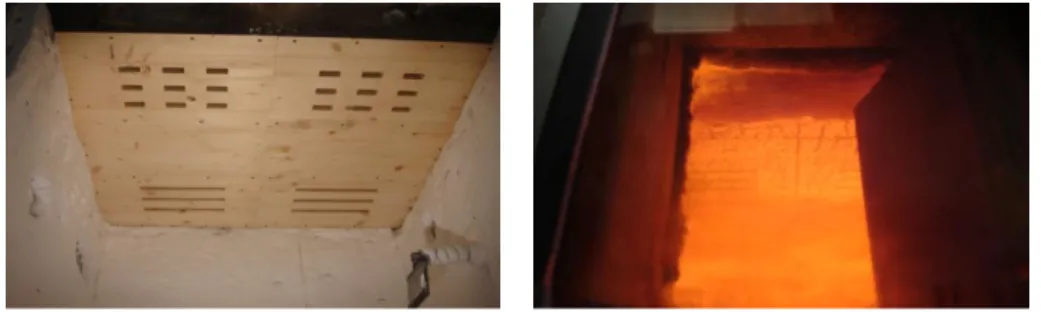
The slabs were tested on fire resistance furnace, see Figure 3. This oven is equipped with 4 burners with natural gas, with a total output of 360 kW, a working volume of 1 m3, prepared to work with any standard fire curve.
Figure 3: Test slab in the oven, before and during the test.
Jorge Meireles, Elza Fonseca, Paulo Piloto and Débora Ferreira
206
Three types of thermocouples were used: single wire for spot measurements Tij, copper discs with plasterboard walls for measuring the temperature in the unexposed side, thermocouple wire welded to the connectors TCi and plate thermocouples TPi for measuring the temperature within the cellular zones, see Figure 4.
The acquisition signal of the thermocouples was made with a data acquisition systems HBM (MGC Plus and Spider 8).
Figure 4: Thermocouples installation in wooden slabs.
2.2 Numerical simulation
A 3D finite element (Solid70) with 8 nodes was used for thermal and nonlinear transient analysis, using Ansys software. Figure 5 shows the mesh used in numerical simulation.
Jorge Meireles, Elza Fonseca, Paulo Piloto and Débora Ferreira
207
Each wooden slab was exposed to fire, at the bottom surface, during 1500 s and 950 s, respectively. At the exposed face and internal cavities the environment temperature follows typical heating real curves obtained previously, based on data obtained during test slab by mean of plate thermocouples (TPi). The convection coefficient is taken equal to 25 W/m2K [11] inside cavities and in the exposed face. At the unexposed face the ambient temperature is constant (20 ºC) and the value of convection is equal to 4W/m2K [12]. The surface emissivity is taken constant and equal to 1,0 for exposed side and internal cavities [11].
The non-linearity due to the thermal properties dependence will be taken into account in the numerical simulation.
Wood material when exposed to fire presents a thermal physical degradation. The interface between charred and noncharred wood is the transition phase between black and brown material [12] and is characterized by a threshold value of 300 ºC, according Eurocode 5 [13]. Also the thermal properties of wood vary considerably with temperature and should be defined according Annex B of Eurocode 5 [13]. This standard code provides the design values for density, thermal conductivity and specific heat of wood.
The wood referred to these slabs has a density approaches to 450 kg/m3, in the material for ceiling boards, and a density of 480 kg/m3 for the beams and floor.
3. RESULTS AND DISCUSSION
During the fire test exposure, the insulation (I) criteria were verified, in both wooden slabs, since the temperature on the unexposed surface do not exceed the initial temperature by more than 180 ºC [10]. The integrity (E) criteria was also verified during experimental tests using the cotton ignition test where no flame appearance occurred during the wooden slabs testing [10].
The time temperature evolution was compared with experimental (T_exp) results, in particular different nodal positions (T_num) during 1500 s (slab 1) and 950 s (slab 2). Figure 6 represents the temperature evolution in different locations for each slab.
Jorge Meireles, Elza Fonseca, Paulo Piloto and Débora Ferreira 208 a) b) c) d)
Figure 6: Time-temperature history in: a) beams, b) rectangular perforations (20x20)mm, e) cellular zone without perforations, d) rectangular perforations (250x20)mm. 0
50 100 150 200
0 200 400 600 800 1000 1200 1400 1600 T [ºC]
t [seg]
T26-num T27-num T26-exp T27-exp
0 50 100 150 200
0 200 400 600 800 1000
T [ºC]
t [seg]
T26-num T27-num T26-exp T27-exp
0 100 200 300 400 500
0 200 400 600 800 1000 1200 1400 1600 T [ºC]
t [seg]
T35-num T36-num T25-num T35-exp T36-exp T25-exp
0 100 200 300 400 500
0 200 400 600 800 1000
T [ºC]
t [seg]
T35-num T36-num T25-num T35-exp T36-exp T25-exp
0 50 100 150 200
0 200 400 600 800 1000 1200 1400 1600 T [ºC]
t [seg]
T17-num T37-num T17-exp T37-num
0 50 100 150 200
0 200 400 600 800 1000
T [ºC]
t [seg]
T17-num T37-num T17-exp T37-exp
0 100 200 300 400 500
0 200 400 600 800 1000 1200 1400 1600 T [ºC]
t [seg]
T33-num T34-num T24-num T33-exp T34-exp T24-exp
0 100 200 300 400 500
0 200 400 600 800 1000
T [ºC]
t [seg]
Jorge Meireles, Elza Fonseca, Paulo Piloto and Débora Ferreira
209
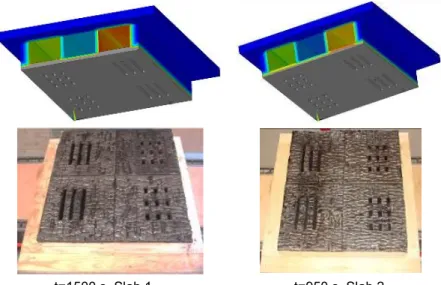
Figure 7 shows the temperature evolution at the end of fire exposure for each slab. Both results represent the charring layer on the wood material, in grey colour. For the last time step a criterion for determine the carbonized layer is applied, that will be compared with the experimental record obtained in each slab, allowing to evaluate the residual cross section and the influence of different perforations on the fire resistance.
t=1500 s, Slab 1 t=950 s, Slab 2 Figure 7: Temperature and charring rate results.
Figure 8: Cross-sections locations for charring rate measure.
Jorge Meireles, Elza Fonseca, Paulo Piloto and Débora Ferreira
210
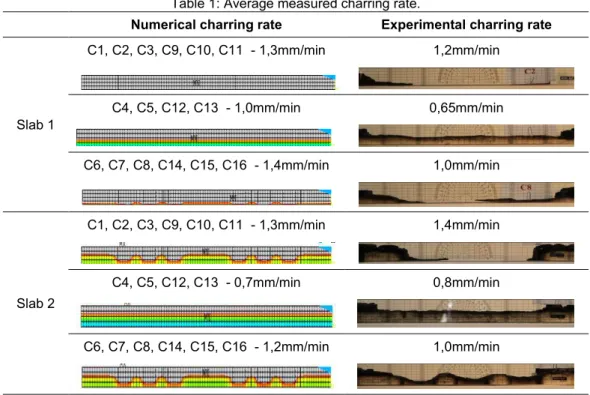
At the end of fire exposure, cells without perforations do not exceeded 100ºC, while cells with perforations presented triple temperature values. Also, the charring rate value relationship between the perforated and non-perforated layers is almost double, which is supported by the temperatures recorded within the cellular cavities of each slab.
The assessment of the charred layer allowed to verify that the cavity without perforations presents the lowest values of charring rate, being the perforated rectangular layer that reaches higher temperatures values.
The obtained results demonstrate the importance of the study of these structures and the determination of the fire resistance duration.
Table 1: Average measured charring rate.
Numerical charring rate Experimental charring rate
Slab 1
C1, C2, C3, C9, C10, C11 - 1,3mm/min 1,2mm/min
C4, C5, C12, C13 - 1,0mm/min 0,65mm/min
C6, C7, C8, C14, C15, C16 - 1,4mm/min 1,0mm/min
Slab 2
C1, C2, C3, C9, C10, C11 - 1,3mm/min 1,4mm/min
C4, C5, C12, C13 - 0,7mm/min 0,8mm/min
Jorge Meireles, Elza Fonseca, Paulo Piloto and Débora Ferreira
211
4. CONCLUSIONS
In wooden slab with perforations, the type and the size of perforation can limit the use of these constructive elements in terms of fire resistance. The wooden slab with perforations are typical and very common engineering solutions, used to improve the acoustic absorption of the ceiling plates. The constructive elements should be chosen before, to prevent and delay the fire damage effect, allowing that the slab could remain in service during more time. Perforations increase the wood surface exposed to the fire action, facilitating the penetration of flames and heat flow.
This study allows verifying the evolution of the temperature and the char-layer throughout a wooden slab. It was possible to characterize the thermal behaviour of the various components and the evolution of the temperature inside the cellular zones. The perforated wooden slabs reach a speed charring almost twice the unperforated. This is justified by the temperatures recorded within the cavities. To test the same time, the temperature of the unperforated cellular zone did not exceed 100 ° C, while in the cavities with openings this value is the triple.
5. AKNOWLEDGMENTS
The authors gratefully acknowledge to Jular enterprise, who provided technical support for the wood slabs construction.
6. REFERENCES
[1] Fonseca E.M.M., Couto D., Piloto P.A.G. - Fire safety in perforated wooden slabs: a numerical approach, 5 Int. Conf. Safety and Security Eng., Vol.134, 2013, p.577-584. [2] Poon L., England J.P. - Literature Review on the Contribution of Fire Resistant Timber
Construction to Heat Release Rate – Timber Development Association, Warrington Fire Research Ltd., Project20633, 2b:1-78, 2003.
[3] Fonseca, E.M.M., Barreira, L., Experimental and Numerical Method for Determining Wood Char-Layer at High Temperatures due an Anaerobic Heating, International Journal of Safety and Security Engineering, 1(1), pp. 65-76, 2011.
Jorge Meireles, Elza Fonseca, Paulo Piloto and Débora Ferreira
212
[5] Coelho, D., Fonseca, E., Vila Real, P., Faria, J.A., Arede, A., Modelo Numérico para Avaliação do Efeito do Isolamento em Lajes de Madeira Submetidas ao Fogo, Atas do 2º Congresso Ibero-Latino-Americano em Segurança contra Incêndios, ISBN:978-972-96524-9-3, pp. 229-238, Coimbra, Portugal, June, 2013.
[6] Fonseca, Elza M.M., Barreira, Luisa M.S., Meireles, Jorge M.M., Piloto, Paulo A.G., Avaliação Numérica da Ação do Fogo em Coberturas de Madeira com Cavidades e Perfurações, Actas das 3.as Jornadas de Segurança aos Incêndios Urbanos, ISBN: 978-989-98435-0-9, pp. 229-236, Coimbra, Portugal, June, 2013.
[7] Fonseca, E.M.M., Barreira, L.M.S., Meireles, J.M., Piloto, P.A.G., Numerical Model to Assess the Fire Behaviour of Cellular Wood Slabs with Drillings, 4th International Conference on Integrity, Reliability & Failure, S.Gomes et al (Eds.), Edições INEGI, Proceedings IRF’2013, CD-ROM; Funchal, July, 2013.
[8] Barbosa, L.F.M., Almeida, P.M.L., Fonseca, E.M.M., Barreira, L.M.S., Coelho, D.C.S., Hybrid wood/steel elements under fire, International Congress Fire Computer Modeling, Universidad de Cantabria, ISBN: 978-84-86116-69-9, pp. 407-420, Santander, October, 2012.
[9] Fonseca, E.M.M., Thermal Analysis of Hollow Tubular Sections under High Temperatures, Frontiers of Engineering Mechanics Research, 2(1), pp. 9-14, 2013.
[10] CEN, EN1365-2 - Fire resistance tests for loadbearing elements. Part 2: Floors and roofs, Brussels, 1999.
[11] CEN, EN1991-1-2 - Eurocode 1: Actions on Structures, Part 1-2: General actions - Actions on Structures Exposed to Fire, Brussels, 2002.
[12] Schaffer, E.L., Structural Fire Design: Wood, Forest Products Laboratory, FPL 450:16p, 1984.